REVIEW 3 major objections 3 minor 12 references
Improvised Nuclear Weapons with 60%-Enriched Uranium
T0 review · 3 major / 3 minor · reviewed 2026-08-15 · deepseek-v4-flash
Pith's one-line read As little as 40 kilograms of 60%-enriched uranium can be used to build a crude nuclear weapon with a kiloton yield.
desk verdict Plausible and well-benchmarked feasibility claim that 40 kg of 60%-enriched uranium in a multi-tonne tungsten-carbide tamper can reach kiloton yield, but the central threshold depends on an unmodeled tamper absorption effect that the paper itself defers. read the letter →
The pith
A machine-rendered reading of the paper's core claim, the machinery that carries it, and where it could break.
The reading
What carries the argument
The central mechanism is a gun-type assembly in the style of the Hiroshima 'Little Boy' bomb, rescaled with an oversized neutron-reflecting tamper of tungsten carbide weighing 10–20 tonnes. The tamper does two things: it reflects escaping neutrons back into the core, cutting the critical mass at 60% enrichment from about 113 kg to roughly 25–30 kg, and it inertially delays disassembly so the chain reaction burns longer. The calculation runs on a published fission-burn code called FissionBomb, extended to 60%-enriched uranium by isotope-averaged effective cross sections, with the fast-fission cross section of 238U bracketed between 0.10 and 0.15 barns. Because yields grow exponentially with the initial neutron multiplication rate $\alpha$, the oversized tamper is what turns a marginal core into a kiloton explosion. Predetonation risk is estimated from the 238U spontaneous-fission rate with a Poisson calculation plus a bare-core transport code, treating the tamper's extra neutron reflection as a small correction.
What would settle it
Run an independent time-dependent Monte Carlo neutron-transport calculation of a 40 kg 60%-enriched uranium core inside a 50 cm tungsten-carbide tamper during a 200–500 µs gun-type assembly, including spontaneous-fission neutrons; if the computed predetonation probability exceeds a few percent or the yield falls below roughly 1 kt, the central claim fails.
Extended reading notes
Core claim
The paper's central claim is that the conventional 'weapons-grade' threshold of 90% enrichment does not mark the practical lower bound for a usable device. Using isotope-averaged cross sections in a published fission-burn model, the author finds that a bare sphere of 60%-enriched uranium would need about 113 kg to go critical, but a tungsten-carbide tamper 50–70 cm thick brings the tamped critical mass down to roughly 25–30 kg. For a 40 kg core inside a 50 cm tamper the computed yield is about 1.4 kt, and for the paper's fiducial 60 kg core with a 60 cm tamper (13.35 t) the yield is 15.27 kt. Predetonation from 238U spontaneous fission is kept at a few percent or less provided assembly takes under about 500 µs, which the author argues is achievable. The conclusion is that a group with 40 kg of stolen 60%-enriched uranium, some tungsten carbide, and a gun-type tube could expect a kiloton-scale explosion without first testing the device.
Load-bearing premise
The load-bearing assumption is that a large neutron-reflecting tamper raises predetonation risk only slightly, so the bare-core predetonation calculation still bounds the tamped device; if that assumption is wrong, a 40 kg weapon could fizzle well below kiloton yield.
Editorial extensions
If this is right
- A group that obtains 40–50 kg of 60%-enriched uranium and 10–20 tonnes of tungsten carbide could assemble a gun-type device with a kiloton-scale yield, without a test.
- The 408 kg stockpile would permit either several 40 kg devices or a single 70–80 kg core, which the paper estimates can approach 100 kt at the limit of a 70 cm tamper and the shipping-container weight limit.
- The device is too massive for a ballistic missile, so the practical delivery threat is a standard shipping container on a truck or cargo ship.
- The design is uranium-inefficient, with fission efficiencies around 1–5%, so the main engineering constraint is tamper mass rather than enrichment level.
Reading between the lines
- Beyond the paper, the same tamper logic suggests the 'usable enrichment' threshold may be lower than 60%, since a sufficiently small core with a very thick tamper keeps predetonation low; the paper does not compute yields for, say, 20%-enriched material.
- A direct independent Monte Carlo run on the paper's fiducial 60 kg, 60 cm geometry would be the sharpest check of the ten-percent yield uncertainty the paper assigns to its own predictions.
- The paper asserts, rather than computes, that the tamper adds only slightly to predetonation risk; verifying that assertion is the difference between 40 kg being a hard threshold and a rough extrapolation.
Signed reviews
Editorial analysis
A structured set of objections, weighed in public.
Referee Report
Summary. The manuscript adapts Reed's FissionBomb code to compute critical masses and yields for gun-type devices using 60%-enriched uranium, introducing concentration-averaged effective cross sections and a fitted value for the 238U fission cross section. It validates the model against MCNP bare critical masses from Glaser (2006) and Chadwick (2021), reproducing them to within roughly 10%, and against the Little Boy yield, obtaining 12.1–12.8 kt. The paper then computes tamped critical masses with tungsten-carbide reflectors and yield curves for core masses of 30–80 kg and tamper radii of 30–70 cm. Table II and Fig. 6 are the basis for the central claim that 40 kg with a 60–70 cm tamper yields 0.81–1.36 kt, hence 'as little as 40 kg' can produce a kiloton. The paper also discusses predetonation through spontaneous-fission rates and argues that assembly times below 500 µs make 40–60 kg devices viable.
Significance. If the calculations are correct, the result is significant for nuclear security: it would mean that a sub-state actor could divert 40 kg of 60%-enriched uranium and, with a 10–20 tonne tungsten-carbide tamper, construct a container-deliverable gun-type weapon with roughly a kiloton yield. The paper has genuine strengths: the effective cross-section model is calibrated against independent MCNP critical masses rather than against the paper's own yield claims; the Little Boy benchmark is reproduced within about 1 kt; the authors explicitly bracket results using two values of σ_f(238U); and the predetonation discussion is largely transparent. However, the central 40 kg threshold rests on a thin margin in Table II and on neglected tamper physics, so the quantitative conclusion needs additional support before the claim can be regarded as established.
major comments (3)
- [Sec. III, Table II] The 1 kt claim for 40 kg cores rests on yields of 0.81 kt with a 60 cm tamper and 1.36 kt with a 70 cm tamper, so the margin is thin. FissionBomb treats the WC tamper only through an elastic cross section (Sec. II.C, σ_el = 6.587 b), and the paper itself says 'Neutron absorption in the tamper is worth investigating given the large size.' A 60 cm WC shell is roughly 18 neutron mean free paths thick; resonance capture and inelastic scattering in tungsten reduce the albedo and hence the multiplication. Because the central claim requires 40 kg to exceed 1 kt, this omitted effect is load-bearing. Please provide a quantitative estimate, such as a simple albedo reduction or a transport calculation, of the effect of tamper absorption on the yields in Table II.
- [Sec. II.C, Fig. 4, Table II] The effective σ_f(238U) = 0.10 b is chosen to match bare critical masses, but the tamped configuration has a softer neutron spectrum in the core because of downscattering in the thick reflector. The fast-fission contribution from 238U should therefore be smaller than the bare-spectrum fitted value, so the 0.10–0.15 b bracket in Fig. 6 may overestimate, rather than bracket, the tamped yields. The paper should either compute spectrum-averaged cross sections for the tamped geometry or demonstrate that the 40 kg, 1 kt conclusion survives a further reduction of σ_f(238U).
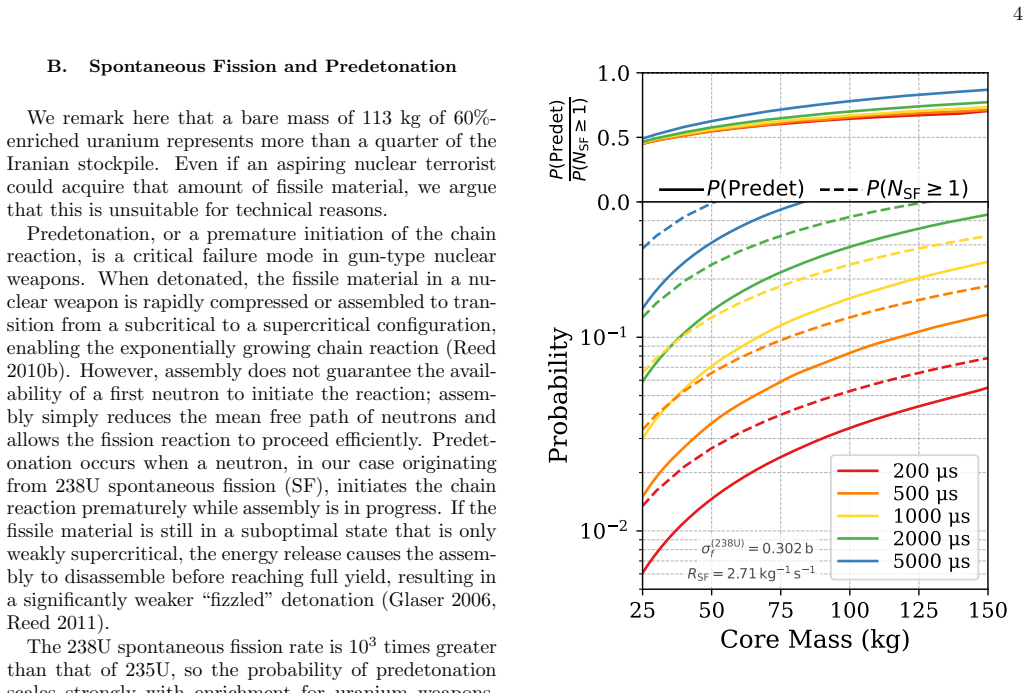
- [Sec. II.B] The statement that a tamper will increase the predetonation likelihood 'slightly but certainly not to a value as great as the SF rate' is asserted without computation. The Reed (2010b) code assumes a bare core, whereas a reflector both increases multiplication during assembly and confines source neutrons, so the probability that a spontaneous-fission neutron initiates a chain can rise. While the Poisson estimate for 40 kg in 500 µs is only about 5%, the paper's broader claims of reliable detonation without testing and of a 96% success criterion need a quantitative predetonation calculation for the tamped geometry rather than an appeal to the bare-core result.
minor comments (3)
- [Introduction, first paragraph] The phrase 'a improvised nuclear weapon' should read 'an improvised nuclear weapon.'
- [Table II and Fig. 6] The tamper radii are stated to be exact only for a 50 kg core; the presentation would be clearer if the table and figure noted explicitly that each radius corresponds to a fixed tamper mass and listed those masses.
- [Sec. II.C] The numerical artifact in which 10 and 12 cm tampers give critical masses exceeding the bare value is acknowledged; please state explicitly that the later yield calculations are restricted to tamper thicknesses where the root-finding is stable.
Circularity Check
No circularity: the 40 kg yield claim is calibrated against independent MCNP critical masses and validated against Little Boy, not fitted to the claim itself.
full rationale
The paper's central claim—that 40 kg of 60%-enriched uranium can produce a kiloton yield with a large tungsten-carbide tamper—is obtained by adapting the externally validated FissionBomb code of Reed (2009, 2010a) to lower enrichments. The only fitted quantity, the effective 238U fission cross section, is calibrated against independent MCNP bare critical masses from Glaser (2006) and Chadwick (2021), and the paper explicitly brackets the value between 0.10 b and 0.15 b. The yield calculation is not used to determine this parameter; instead the calibrated code is validated against the known Little Boy yield of 12–15 kt, reproducing 12.1–12.8 kt. No step defines a prediction in terms of the target claim, no load-bearing self-citation appears (Reed and Lamoreaux are not the authors), and no ansatz is imported solely from the authors' prior work. The acknowledged limitations—neglect of neutron absorption in the thick WC tamper and the bare-core predetonation approximation—are physical approximations and explicit uncertainties, not circular reductions. The derivation chain is self-contained against external benchmarks, so the appropriate circularity score is 0.
Assumptions & free parameters
free parameters (3)
- Effective 238U fission cross section =
0.10 b preferred; 0.15 b upper bracket; 0.302 b uncorrected
- Neutron-reduction prefactor eta for absorption sink =
1 adopted; eta less than 1 tested
- Assembly time delta-t =
200 to 500 microseconds assumed
assumptions (6)
- domain assumption Reed's FissionBomb one-group diffusion model is applicable to 60%-enriched cores with large tampers.
- domain assumption Concentration-weighted effective cross sections in Eqs. (1)-(3) capture the neutron economy of the U-235 and U-238 mixture.
- domain assumption A homogeneous spherical tungsten-carbide tamper represents the proposed steel-and-WC device.
- domain assumption Predetonation probability in a tamped device is not much larger than the bare-core Reed (2010b) estimate.
- domain assumption Sub-500 microsecond assembly is achievable for the shipping-container-scale device.
- domain assumption Iran's 60%-enriched stockpile was relocated to secret locations.
Cite this review
Pith. "Pith review of Improvised Nuclear Weapons with 60%-Enriched Uranium." pith.science (2026). https://pith.science/paper/EIB6U2F7
@misc{pith2026250720390,
  author       = {Pith},
  title        = {Pith review of: Improvised Nuclear Weapons with 60%-Enriched Uranium},
  year         = {2026},
  howpublished = {\url{https://pith.science/paper/EIB6U2F7}},
  note         = {Machine review of arXiv:2507.20390}
}
read the original abstract
In this work we show that as little as 40 kg of 60%-enriched uranium can be used to build a crude nuclear weapon with a kiloton yield. While too large to fit on a missile, such a weapon could be delivered by shipping container. This analysis is motivated by the June 2025 Israeli and US attacks on Iran, especially the bombings of the nuclear facilities at Natanz, Fordow, and Isfahan. The Iranian stockpile of approximately 408 kg of 60%-enriched uranium is, at the time of writing, inaccessible to IAEA inspectors and stored in secret. The rapid clandestine relocation of this material in June 2025 creates an opportunity for aspiring nuclear terrorists to divert an amount that could be used in the construction of an improvised gun-type nuclear weapon in the style of Little Boy.
Figures


Figures from the paper (3 more)


Reference graph
Works this paper leans on
-
[1]
We will show a high yield is achievable with enormous tampers around a gun- type assembly. A gun-type bomb was famously not tested by the Manhattan Project before being detonated over Hiroshima, as their fissile material was limited and the designers were so confident it would work that there was no need to test, an apt analog for a nuclear terrorist. Our...
work page Pith review arXiv 2010
-
[2]
(Left) Bare critical mass dependence onσ 238U f with MCNP values from Glaser (2006) and Chadwick (2021) and (right) residuals between our model calculations and the MCNP. σtr =σ el + 1 2σin. Fig. 1 of Lamoreaux (2025) predicts a bare mass for pure 235U of 46 kg, in line with the modern value. For all other values of enrichment, we take a concen- tration w...
work page 2006
-
[3]
Schematic diagram of a gun-type nuclear weapon using 60%-enriched uranium (green) deliverable by cargo container, with a mass of 10 to 20 tonnes. The bulk of the weight is given over to the neutron reflecting tamper of tungsten carbide and steel (blue). Detonation is initiated when the two subcritical uranium masses are rapidly combined into a supercritic...
work page 2009
-
[4]
The dashed grey line at the bottom is the infinite tamper limit
Critical mass dependence on WC tamper outer radius forσ 238U f = 0.10 b andσ 238U f = 0.302 b. The dashed grey line at the bottom is the infinite tamper limit. pressures required to accelerate the core pieces together are comparable to those found in artillery, and do not exceed the yield strength of the kind of materials that would be used (e.g.Reed 2014...
work page 2010
-
[5]
Any constant value will notably neglect the energy dependence of the 238U fission cross section, which drops off sharply below about 1 MeV. As 1 MeV is a typical fission neutron energy, this means that after a few scatters neutrons become significantly less effective at causing 238U fission. In the absence of a true neutron spectrum, Lamoreaux (2025) argu...
work page 2025
-
[6]
spontaneous-fission-free-millisecond
This hack imagines that a neutron that is absorbed might as well have never been emitted for the purposes of the fis- sion burn. However, as decreasingν eff increases the crit- ical mass, we commit toη= 1 as our best parameter set withσ 238U f = 0.10 b already weakly overpredicts the critical mass. 4 B. Spontaneous Fission and Predetonation We remark here...
work page 2010
-
[7]
25 50 75 100 125 150 Core Mass (kg) 10 2 10 1 Probability RSF = 2.71 kg 1 s 1 (238U) f = 0.302 b 200 s 500 s 1000 s 2000 s 5000 s P(Predet) P(NSF
work page 2000
-
[9]
Fission burn simulation for a gun-type device with a 60 kg core surrounded by a 60 cm WC tamper (bottom). The majority of the yield is released within 0.15µs, after which the coreα(top) drops to zero due to the expansion of the core. Every explosion follows these qualitative curves. We begin with a model of the Little Boy bomb to validate our effective nu...
work page 2009
Show all 12 references
-
[10]
Solid lower bounds (dashed upper bounds) useσ 238U f = 0.10 b (σ238U f = 0.15 b)
Yields for a range of core masses and tamper outer radii. Solid lower bounds (dashed upper bounds) useσ 238U f = 0.10 b (σ238U f = 0.15 b). Legend corresponds to outer tamper radii. Each radius actually corresponds to a fixed tamper mass assuming a 50 kg core (Rcore = 8.557 cm...
2025
-
[1986]
paper pre- pared for the International Task Force on the Prevention of Nuclear Terrorism. B. C. Reed, Natural Science2, 139 (2010a), accessed: 2025- 07-25. M. B. Chadwick, Nuclear Technology207, S24 (2021). B. C. Reed, American Journal of Physics77, 730 (2009). S. K. Lamoreaux...
2010 arXiv
-
[2014]
accessed: 2025-07-25. E. A. Friedman and R. K. Lewis, Public Interest Report67 (2014). J. C. Mark, T. Taylor, E. Eyster, W. Maraman, and J. Wech- sler,Can Terrorists Build Nuclear Weapons?, Tech. Rep. (Nu- clear Control Institute, Washington, DC,
2014
-
[2025]
While too large to fit on a missile, such a weapon could be delivered by shipping container
In this work we show that as little as 40 kg of 60%-enriched uranium can be used to build a crude nuclear weapon with a kiloton yield. While too large to fit on a missile, such a weapon could be delivered by shipping container. This analysis is motivated by the June 2025 Israe...
2025
Reviewed August 15, 2026 · model on record in the stance chip above.
Discussion (0). Continue with ORCID to comment.