REVIEW 3 major objections 4 minor 2 references
Beta-Binomial stick-breaking non-parametric prior
T0 review · 3 major / 4 minor · reviewed 2026-08-14 · deepseek-v4-flash
Pith's one-line read A single dependence parameter in a Beta-Binomial stick-breaking prior interpolates between the Dirichlet process and the Geometric process prior.
desk verdict Novel BBSB prior with solid theory, but the Gibbs sampler as written is not implementable and the empirical claims need a rerun. read the letter →
The pith
A machine-rendered reading of the paper's core claim, the machinery that carries it, and where it could break.
The reading
What carries the argument
The central object is the Beta-Binomial Markov chain: a stationary first-order Markov chain $V=(v_i)_{i\ge1}$ with Beta($\alpha,\theta$) marginals, built from the Beta-Binomial conjugate pair by setting $x_i\mid v_i\sim\mathrm{Bin}(\kappa,v_i)$ and $v_{i+1}\mid x_i\sim\mathrm{Be}(\alpha+x_i,\theta+\kappa-x_i)$. The integer $\kappa$ is the dependence parameter; Proposition 2.1 gives the correlation $\rho_{v_i,v_{i+1}}=\kappa/(\alpha+\theta+\kappa)$, so $\kappa=0$ yields independent lengths and large $\kappa$ yields nearly identical lengths. Inserting these dependent lengths into the stick-breaking formula produces the BBSB weights, and the chain is what carries the argument: its dependence structure is exactly the mechanism that interpolates between the Dirichlet and Geometric process priors and controls whether the weights appear in size-biased or decreasing order.
What would settle it
Compute whether a BBSB prior with, say, $\kappa=1$, $\alpha=\theta=1$ assigns positive probability to every weak neighbourhood of a fixed target measure such as $0.5\delta_0+0.5\delta_1$; if any target measure has zero prior neighbourhood probability, the full-support claim fails as stated.
Extended reading notes
Core claim
The paper's central claim is that a new class of random probability measures, the Beta-Binomial stick-breaking priors, arises when the stick-breaking weights $w_j=v_j\prod_{i=1}^{j-1}(1-v_i)$ are built from length variables $v_i$ that follow a strictly stationary Beta($\alpha,\theta$) Markov chain rather than being independent. The chain is generated through a latent Binomial chain, and its integer parameter $\kappa$ is the dependence knob: consecutive lengths have correlation $\kappa/(\alpha+\theta+\kappa)$, so $\kappa=0$ makes them independent. With $\alpha=1$, that extreme reproduces the Dirichlet process, while as $\kappa\to\infty$ the lengths converge to a single Beta($\alpha,\theta$) value and the prior converges in distribution to the Geometric process prior. For every $\kappa$, the weights sum to one almost surely, and the prior is claimed to have full support via a known result for species sampling priors. The dependence parameter also controls weight ordering: the Dirichlet extreme gives size-biased weights, the Geometric extreme gives decreasingly ordered weights, and intermediate values offer a practical trade-off.
Load-bearing premise
The load-bearing premise is that the positivity condition verified on finitely many windows of the Beta chain is all the cited full-support theorem requires, even though the chain's length variables are dependent rather than independent.
Editorial extensions
If this is right
- With $\kappa=0$ and $\alpha=1$, the BBSB prior is the Dirichlet process with parameters $(\theta,P_0)$, and its weights are size-biased ordered; as $\kappa\to\infty$ it converges in distribution to the Geometric process prior with decreasingly ordered weights.
- For fixed $\kappa,\alpha,\theta$, the stick-breaking weights sum to one almost surely and the prior has full support, which makes it a legitimate nonparametric prior.
- Larger $\kappa$ makes the prior on the number of clusters $K_n$ less informative, with a heavier right tail and larger mean and variance, so the model's skepticism about many clusters can be tuned.
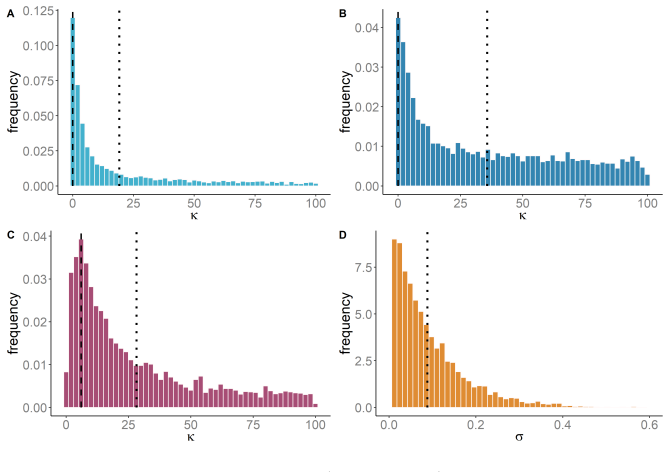
- The slice Gibbs sampler, extended to treat $\kappa$ as random, provides a posterior estimate of the best dependence level; in the paper's simulations, multi-modal data set the posterior mode of $\kappa$ at intermediate values such as 12 or 30 rather than at the Dirichlet extreme.
Reading between the lines
- Because the Beta marginals are fixed while only the dependence changes, the same construction could generate dependent families of stick-breaking priors for time-series or non-exchangeable data, where the ordering of clusters itself is informative.
- The paper proves $P[w_{j+1}<w_j]\to1$ as $\kappa\to\infty$ but not the rate; quantifying that rate would give a practical rule for choosing $\kappa$ before fitting.
- The full-support claim is imported from a cited theorem; checking directly that the Beta chain's finite-window positivity condition satisfies the theorem's hypotheses for dependent, non-exchangeable length sequences would make the support result self-contained.
- The sampler puts a prior on a finite grid for $\kappa$; extending to a continuous or unbounded prior would remove the grid choice from the analysis.
Signed reviews
Editorial analysis
A structured set of objections, weighed in public.
Referee Report
Summary. The paper introduces a new class of discrete random probability measures, the Beta-Binomial stick-breaking (BBSB) priors, obtained by inserting a stationary Beta Markov chain into the stick-breaking construction. The Markov chain is built through a Beta-Binomial latent data augmentation following Pitt et al. (2002), with dependence parameter kappa. The authors prove conditional moments and correlation for the chain, show that kappa=0 yields independent Beta length variables (and with alpha=1 recovers the Dirichlet process), and that kappa goes to infinity yields the Geometric process as a weak limit. They prove that the stick-breaking weights sum to one almost surely, assert full support via Bissiri and Ongaro (2014), and develop a slice-sampling Gibbs algorithm for density estimation, including posterior inference for kappa. The algorithm is illustrated on simulated data. The theoretical proofs for the moments, limits, and weights summing to one are self-contained and appear correct.
Significance. If the construction is validated, BBSB priors provide a natural one-parameter family interpolating between Dirichlet and Geometric stick-breaking priors, with the dependence parameter controlling weight ordering and label-switching. This is a useful addition to the Bayesian nonparametrics toolbox, and the paper includes careful proofs of the main distributional properties and of the limiting cases. The key weakness is that the proposed MCMC algorithm is not correctly derived, so the empirical claims in Section 5 are not yet reproducible; this is a correctable issue rather than a flaw in the prior construction itself.
major comments (3)
- [Section 4.1, Step 2] The conditional density stated for V is not a product of Beta mixtures. The displayed density for pi(V|...) is proportional to Be(v1|alpha+alpha_1,theta+theta_1) times product over i>=1 of sum_{x=0}^kappa Bin(x|kappa,v_i) Be(v_{i+1}|alpha_{i+1}+alpha+x,theta_{i+1}+theta+kappa-x) times constants. Because Bin(x|kappa,v_i) depends on v_i, the factor for index i couples v_i and v_{i+1}; the joint law is a first-order Markov chain, not a product over i. For example, with kappa=1, alpha=theta=1 and no data, the joint density of (v_1,...,v_m) is proportional to prod_{i=1}^{m-1} [(1-v_i)Be(v_{i+1}|1,2)+v_i Be(v_{i+1}|2,1)], which cannot be factorized as prod h_i(v_i). Consequently the block step 'sample V from this density, then U from U(0,w_dk)' is not implementable as written, and the density-estimation algorithm in Section 5 is not reproducible from the paper. A valid sampler would need to augment with the latent Binomial variables x_i (making V conditionally independent Betas given X and D) or use forward-filtering/backward-sampling; neither is supplied.
- [Section 3, after Proposition 3.1] The full-support claim is delegated to Bissiri and Ongaro (2014) with the sentence 'the above observation shows that any Beta-Binomial prior has full support.' The paper displays only a finite-window positive-probability condition, P(cap_{i=1}^n (delta<v_i<epsilon))>0 for every n and 0<delta<epsilon<1, and does not state the theorem from Bissiri and Ongaro or verify that its hypotheses cover the dependent, non-exchangeable sequence V generated by the Beta-Binomial Markov chain. Since full support is advertised in the abstract and introduction as a key property, please state the cited theorem and check its conditions, or provide a direct proof.
- [Section 4.3, Eq. (16)] The full conditional for kappa in Eq. (16) involves an infinite product over i>=1, but the sampler only stores V up to the truncation phi from Remark 4.1. The paper does not explain how to compute or approximate this infinite product, nor how to account for the unsampled tail variables v_i for i>phi. This is needed for the posterior inference for kappa reported in Section 5.2, whose results depend on the update in Eq. (16). Please specify a truncation scheme or an exact marginalization of the tail.
minor comments (4)
- [Abstract and Introduction] The Geometric process is described as a particular case of the BBSB prior, but Theorem 3.2(ii) only establishes a weak limit as kappa goes to infinity; for no finite kappa is the Geometric process obtained. Please adjust the wording to say 'limiting case'.
- [Section 2, first paragraph] The phrase 'two of reversible Markov chains' appears to be a typo; it should read 'two reversible Markov chains'.
- [Section 4.1, Step 2] The phrase 'which can be normalized to a product of Beta densities mixtures' is the incorrect claim addressed in Major Comment 1; in addition, 'latter sample U' should read 'later sample U'.
- [Appendix A.4, proof of Lemma A.4] Lemma A.4 proves L2 convergence of x_n/n, but Proposition 2.2(ii) uses an almost-sure convergent construction. Please clarify that this follows by taking a subsequence or by a Skorokhod representation argument, since the proof as written only gives L2 convergence.
Circularity Check
No significant circularity: the Dirichlet and Geometric limiting cases and the sum-one property are derived from the construction, not built into the definitions.
full rationale
The paper's central claims are derived from the Beta-Binomial Markov-chain construction rather than assumed as inputs. Proposition 3.1 proves that the stick-breaking weights sum to one a.s. by bounding E[prod (1-v_i)] conditionally on the latent Binomial chain and taking limits. Theorem 3.2(i) follows from Proposition 2.2(i), which proves that at kappa=0 the length variables are i.i.d. Be(alpha,theta); with alpha=1 this is exactly Sethuraman's stick-breaking representation of the Dirichlet process. Theorem 3.2(ii) follows from Proposition 2.2(ii), proved through Lemmas A.1-A.4, which show convergence of the Beta chain to an identical sequence (lambda,lambda,...), and then by continuity of the stick-breaking map to the Geometric-process weights; the Geometric limit is not imposed as a definition. The full-support discussion relies on Bissiri and Ongaro (2014), an external, non-self-cited theorem, and the paper supplies a positive finite-window probability calculation intended to satisfy its hypotheses; any incompleteness in verifying those hypotheses would be a support gap, not a circular reduction. No data-dependent parameter is fitted and then renamed a prediction: the posterior inference for kappa in Section 4.3 is a standard Bayesian update from a prior, and the limiting cases are established before any data analysis. The Section 4.1 assertion that pi(V|...) can be normalized to a product of Beta mixtures may be incorrect because the Binomial factors Bin(x|kappa,v_i) couple adjacent v_i, but that is a correctness or implementability issue rather than a case of the derivation reducing to its own inputs. Hence no circular step is present.
Assumptions & free parameters
free parameters (3)
- alpha
- theta
- kappa
assumptions (4)
- standard math Standard measure-theoretic probability: weak convergence, Levy-Prokhorov metric, regular conditional distributions, dominated convergence (Appendix A.1).
- domain assumption Species sampling process representation: atoms iid from a diffuse P0 and independent of the weights (Equation 1).
- domain assumption The Pitt et al. (2002) construction produces a stationary reversible Beta chain with transition density (4) when the latent Binomial chain is used.
- domain assumption Bissiri and Ongaro (2014) theorem: a positive probability for every finite window of length variables implies full support of the species sampling prior.
Cite this review
Pith. "Pith review of Beta-Binomial stick-breaking non-parametric prior." pith.science (2026). https://pith.science/paper/EIE3R4QY
@misc{pith2026190806602,
  author       = {Pith},
  title        = {Pith review of: Beta-Binomial stick-breaking non-parametric prior},
  year         = {2026},
  howpublished = {\url{https://pith.science/paper/EIE3R4QY}},
  note         = {Machine review of arXiv:1908.06602}
}
read the original abstract
A new class of nonparametric prior distributions, termed Beta-Binomial stick-breaking process, is proposed. By allowing the underlying length random variables to be dependent through a Beta marginals Markov chain, an appealing discrete random probability measure arises. The chain's dependence parameter controls the ordering of the stick-breaking weights, and thus tunes the model's label-switching ability. Also, by tuning this parameter, the resulting class contains the Dirichlet process and the Geometric process priors as particular cases, which is of interest for fast convergence of MCMC implementations. Some properties of the model are discussed and a density estimation algorithm is proposed and tested with simulated datasets.
Figures


Figures from the paper (7 more)




Reference graph
Works this paper leans on
-
[1]
Billingsley, P. (1968). Convergence of Probability Measures, Wiley series in proba- bility and statistics, John Wiley and Sons Inc. Bissiri, P. and Ongaro, A. (2014). On the topological support of species sampling priors, Electronic Journal of Statistics 8(1): 861–882. Blackwell, D. and MacQueen, J. (1973). Ferguson distributions via P´ olya urn schemes, ...
work page 1968
-
[1119]
Fuentes-Garc´ ıa, R., Mena, R. H. and Walker, S. G. (2010). A new Bayesian non- parametric mixture model, Communications in Statistics - Simulation and Com- putation 39(4): 669–682. Ghosal, S. and van der Vaart, A. (2017). Fundamentals of Nonparametric Bayesian Inference, Cambridge Series in Statistical and Probabilistic Mathematics, Cam- bridge Universit...
work page 2010
Reviewed August 14, 2026 · model on record in the stance chip above.
Discussion (0). Continue with ORCID to comment.