REVIEW 3 major objections 5 minor 57 references
FRAME: Pre-Training Video Feature Representations via Anticipation and Memory
T0 review · 3 major / 5 minor · reviewed 2026-08-07 · deepseek-v4-flash
Pith's one-line read FRAME is a self-supervised video encoder that distills spatial features from DINO and semantic features from CLIP into a compact vision transformer, then adds memory and anticipation; the paper claims that to its knowledge it is the first…
desk verdict A solid and well-ablated video SSL recipe whose main soft spot is disclosed-but-real tuning on downstream subsets and an under-tested priority claim; worth peer review with revisions. read the letter →
The pith
A machine-rendered reading of the paper's core claim, the machinery that carries it, and where it could break.
The reading
What carries the argument
The load-bearing machinery is a two-stage student-teacher pipeline. Stage 1 trains a ViT encoder so that a linear head reproduces CLIP's [CLS] token and a one-block Transformer head reproduces DINO's patch tokens, transferring dense spatial and semantic knowledge into a compact encoder. Stage 2 freezes that encoder, stores projections of the past five frames' patch tokens (reduced to dimension 64) in a FIFO memory bank, and runs cross-attention in which current-frame features serve as queries and memory-plus-current features as keys and values, followed by a self-attention block. Four lightweight decoders supervise this temporal module by predicting current CLIP features, current DINO patches, CLIP features four frames ahead, and DINO patches two frames ahead; the cosine and MSE losses are combined with weights (0.2, 0.1, 2.0, 0.4) that the authors chose empirically on a DAVIS subset. At inference the decoders are removed and only the memory-augmented encoder's patch and [CLS] outputs are used.
What would settle it
Train FRAME with every Stage 2 hyperparameter fixed before any downstream benchmark is inspected, then run the same frozen-feature evaluations on DAVIS, VIP, JHMDB, CamVid, and VSPW; if FRAME no longer beats both DINO and SiamMAE on those tasks, the central claim fails.
Extended reading notes
Core claim
The paper's central claim is that a compact vision transformer, trained in two stages, becomes a general-purpose video frame encoder for dense prediction. In Stage 1, the student encoder is trained to output CLIP's [CLS] semantic features and DINO's patch-level spatial features for single frames. In Stage 2, the frozen encoder is augmented with a FIFO memory bank of the past five frames plus a cross-attention module, and four lightweight decoders are trained to predict current CLIP and DINO features, CLIP semantics four frames ahead, and DINO patch features two frames ahead. The authors claim that this is the first student video encoder distilled from image teachers that outperforms both the image-only teachers (DINO, DINOv2) and prior self-supervised video encoders (VideoMAE, SiamMAE, CropMAE) on dense frame-level tasks. They show gains on DAVIS, VIP, JHMDB, CamVid, and VSPW while keeping the model compact, and they show that the [CLS] token, projected through the semantic decoder, performs comparably to CLIP on zero-shot and linear video action classification.
Load-bearing premise
The reported margins assume that the Stage 2 loss weights, anticipation deltas, and other settings chosen on subsets of the evaluation benchmarks did not give FRAME an unfair advantage over the baselines.
Editorial extensions
If this is right
- Because the reported gains come from frozen features under a simple k-NN propagation protocol, the improvements reside in the video representation itself rather than in task-specific decoders.
- Removing either memory or anticipation lowers performance on DAVIS, VIP, JHMDB, and CamVid, so the temporal modules are what convert image-level spatial fidelity into video-level consistency.
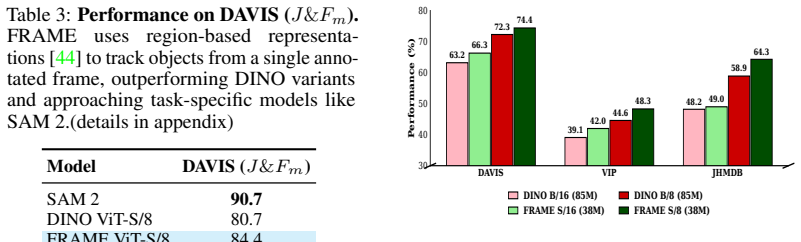
- The compact ViT-S/8 FRAME (38M parameters) beats larger DINO ViT-B/8 (85M) on the correspondence benchmarks, implying a favorable accuracy-to-compute trade-off for the distillation-plus-temporal route.
- The [CLS] token, projected through the semantic decoder, reaches CLIP-level zero-shot and linear action classification, so a single backbone can cover dense prediction and language-driven video tasks.
Reading between the lines
- A natural next step, which the paper lists as future work, is to use FRAME as a drop-in backbone in video-language models; the CLIP-aligned [CLS] token gives such models a ready-made text-vision interface.
- The paper evaluates only frozen features and explicitly notes that fine-tuning is untested; whether fine-tuning preserves or erodes the temporal-consistency gains remains an open question.
- The memory bank holds only five past frames and the anticipation targets are two to four frames ahead, so the demonstrated advantage is short-term temporal coherence; longer-range motion understanding would likely need a hierarchical or recurrent memory design.
- Because the approach inherits its spatial and semantic knowledge from DINO and CLIP, its ceiling is partly set by those teachers; a teacher with degraded spatial correspondence would presumably shrink the gains.
Editorial analysis
A structured set of objections, weighed in public.
Referee Report
Summary. The paper introduces FRAME, a two-stage self-supervised video frame encoder. Stage 1 distills dense patch features from DINO and class-token features from CLIP into a compact ViT encoder with two lightweight decoders. Stage 2 freezes this encoder and adds a FIFO memory bank plus cross-attention, trained to predict current and future DINO/CLIP features (Eq. 2). The authors evaluate the frozen encoder on video object segmentation (DAVIS), part propagation (VIP), pose propagation (JHMDB), video semantic segmentation (CamVid, VSPW), and action classification (HMDB-51, UCF-101). They report consistent improvements over DINO, SiamMAE, VideoMAE, and other self-supervised baselines, and claim to be the first student video encoder distilled from image teachers that outperforms both the original image-only models and prior self-supervised video encoders on dense prediction tasks.
Significance. If the claims hold, FRAME is a practically valuable result: it is compact (e.g., 38M parameters for ViT-S/8 while outperforming DINO ViT-B/8 on several tasks), it shows consistent gains across seven datasets and three dense-prediction families, and its two-stage distillation recipe is clearly described. The paper also provides unusually transparent ablations of encoder depth, decoder depth, memory length, resolution, epochs, and data fraction, and promises code and checkpoints. The central caveat is that the reported configuration appears to have been selected using the same downstream benchmarks that are then used as evidence of superiority. This does not make the method circular in an algorithmic sense, since the same evaluation protocol is applied to baselines, but it does make the reported margins, which are often small (e.g., +3.7 J&F over SiamMAE on DAVIS S/16), difficult to separate from selection-induced inflation. The 'first' claim is also not directly tested against the most relevant image-to-video adaptation baselines, DINO-Tracker and Time Does Tell.
major comments (3)
- [§3.2, Eq. (2); Supplementary Tables 6–10, 15] The final model configuration was selected using downstream benchmark performance on DAVIS, VIP, JHMDB, and CamVid, and those same datasets are then reported as the evidence that FRAME outperforms prior methods. Specifically, the Stage 2 loss weights (α1=0.2, α2=0.1, α3=2.0, α4=0.4) are stated in §3.2 to be 'empirically determined based on results from a subset of DAVIS'; Supplementary Table C.1 selects the anticipation deltas (+4 semantic, +2 spatial) using feature variability on Kinetics and DAVIS subsets; and Supplementary Tables 6–10 and 15 select encoder depth (12), epochs (70), data fraction (40%), resolution (400×400), memory length (5), and decoder depth (1) from DAVIS/VIP/JHMDB/CamVid scores. No held-out validation split or pre-registered configuration protocol is described. Because the reported margins are modest relative to the amount of configuration search, the paper needs either an independent validation-based selection procedure or an explicit statement of how much of the reported advantage survives under a random/held-out configuration choice.
- [Abstract and §2; Table 1] The paper's central priority claim—that FRAME is the first student video encoder distilled from image teachers to outperform image-only models and prior self-supervised video encoders on dense prediction—is not directly tested against the two most relevant image-to-video adaptation baselines discussed in §2: DINO-Tracker [47] and Time Does Tell [41]. Neither method appears in Table 1 or any other comparison table. Since those methods also adapt pre-trained DINO features for video correspondence, the 'first' claim cannot be evaluated without including them (or explicitly restricting the claim to the specific training paradigm of full-encoder distillation rather than fine-tuning or time-tuning). Please add these baselines to the comparisons, or soften the claim to match the evaluated scope.
- [Tables 1, 4, 5 and Supplementary Table 20] No error bars or statistical significance measures are reported for the main results, even though the authors themselves report variability across training-data subsets in Supplementary Table 20: four Ego4D subsets give DAVIS J&F values of 66.1, 66.4, 66.0, and 65.8, spanning a range comparable to some of the reported margins over baselines. Since several headline improvements are small (e.g., +1.8 J&F for FRAME S/8 over SiamMAE on DAVIS; +1.5 mIoU for FRAME ViT-L/14 over DINOv2 on CamVid current-frame), the paper should report the variance across training runs or at least state that the numbers are single runs and indicate which differences are stable across the Ego4D-subset repeat in Table 20.
minor comments (5)
- [§3.1] There is a typo in the first sentence of the ViT Encoder paragraph: 'We the input image' should be 'We tokenize the input image' or similar.
- [§3.1] The phrase 'yielding a strong strong frame encoder' contains a duplicated word.
- [§3.3 and §3.2] The inference protocol is internally inconsistent: §3.3 says 'we discard all decoders' and then immediately says that zero-shot classification projects the [CLS] token into CLIP space 'using the semantic decoder.' Please clarify which decoders are retained at inference time and whether the semantic decoder is used only for the zero-shot classification mode.
- [Table 1 and Related Work] The spacing and formatting of 'DAVIS' is inconsistent ('DAVIS' vs. 'DA VIS'), and the caption of Figure 1 has a misplaced '(left)' / '(Right)' annotation.
- [References] References [20] and [21] are duplicates of the same paper (Space-Time Correspondence as a Contrastive Random Walk); please merge them.
Circularity Check
DAVIS-subset hyperparameter tuning creates a partial benchmark-selection loop; the core distillation-plus-memory derivation is not circular.
-
fitted input called prediction
[Sec. 3.2 (Eq. 2), Sec. 4 Table 1, and Sec. C.1]
"These weights (α1, α2, α3, α4) were empirically determined based on results from a subset of DA VIS [33] dataset."
The same benchmark (DAVIS) used to select the Stage-2 loss weights (Eq. 2) and, in Sec. C.1, the anticipation frame deltas is then reported in Table 1 as the headline evidence that FRAME 'outperforms SiamMAE' (e.g., 65.7 vs 62.0 J&F). Since the configuration was chosen on a DAVIS subset before evaluation on DAVIS, the reported margin is the result of a selection loop on the evaluation benchmark rather than an independent test. This is not an equation-level identity, but it is a fitted-input-then-prediction loop that directly bears on the 'first to outperform' priority claim.
full rationale
FRAME's core derivation is not circular: Stage 1 distills frozen DINO/CLIP features into a compact ViT, and Stage 2 adds memory and anticipation; the central comparisons (FRAME vs DINO/SiamMAE on DAVIS/VIP/JHMDB/CamVid) are empirical evaluations of features from the same encoder, not identities forced by the loss. In fact, the student is trained to match DINO and still beats DINO, which is a meaningful external result. The self-citations (refs [10, 25, 44]) appear only in related work and the optional region-tracking appendix; they are not load-bearing and do not by themselves raise the circularity score. The substantial caveat is that several hyperparameters were selected using DAVIS/VIP/JHMDB/CamVid subsets (Sec. 3.2, Sec. B, Sec. C.1) and the same datasets are then reported as results. This introduces a selection-on-test-set loop that can inflate the headline margins, but it does not make the method's predictions equivalent to its training inputs by construction. The score of 4 reflects this partial benchmark-selection circularity while acknowledging that the central distillation-memory derivation has independent content.
Assumptions & free parameters
free parameters (4)
- Stage 2 loss weights alpha1..alpha4 =
0.2, 0.1, 2.0, 0.4
- Anticipation frame deltas =
t+4 for CLIP/CLS, t+2 for DINO/patch
- Memory length m =
5 frames
- Training schedule and data fraction =
70 epochs, 400x400, 40% Kinetics, 700 Ego4D videos
assumptions (4)
- domain assumption DINO patch features and CLIP class tokens are suitable and sufficient targets for learning video dense representations.
- domain assumption Predicting future teacher features from current and past frames improves temporal consistency and correspondence.
- domain assumption The student encoder can surpass its frozen teachers on downstream tasks when augmented with temporal modules.
- domain assumption Simple kNN patch propagation and linear probes are faithful measures of feature quality.
Cite this review
Pith. "Pith review of FRAME: Pre-Training Video Feature Representations via Anticipation and Memory." pith.science (2026). https://pith.science/paper/EIPAM3NB
@misc{pith2026250605543,
  author       = {Pith},
  title        = {Pith review of: FRAME: Pre-Training Video Feature Representations via Anticipation and Memory},
  year         = {2026},
  howpublished = {\url{https://pith.science/paper/EIPAM3NB}},
  note         = {Machine review of arXiv:2506.05543}
}
read the original abstract
Dense video prediction tasks, such as object tracking and semantic segmentation, require video encoders that generate temporally consistent, spatially dense features for every frame. However, existing approaches fall short: image encoders like DINO or CLIP lack temporal awareness, while video models such as VideoMAE underperform compared to image encoders on dense prediction tasks. We address this gap with FRAME, a self-supervised video frame encoder tailored for dense video understanding. FRAME learns to predict current and future DINO patch features from past and present RGB frames, leading to spatially precise and temporally coherent representations. To our knowledge, FRAME is the first video encoder to leverage image-based models for dense prediction while outperforming them on tasks requiring fine-grained visual correspondence. As an auxiliary capability, FRAME aligns its class token with CLIP's semantic space, supporting language-driven tasks such as video classification. We evaluate FRAME across six dense prediction tasks on seven datasets, where it consistently outperforms image encoders and existing self-supervised video models. Despite its versatility, FRAME maintains a compact architecture suitable for a range of downstream applications.
Figures


Figures from the paper (4 more)



Reference graph
Works this paper leans on
-
[47]
DINO-Tracker: Taming DINO for Self-Supervised Point Tracking in a Single Video
N. Tumanyan, A. Singer, S. Bagon, and T. Dekel. Dino-tracker: Taming dino for self-supervised point tracking in a single video, 2024. URLhttps://arxiv.org/abs/2403.14548
work page Pith review arXiv 2024
-
[41]
M. Salehi, E. Gavves, C. G. M. Snoek, and Y . M. Asano. Time does tell: Self-supervised time-tuning of dense image representations.2023 IEEE/CVF International Conference on Computer Vision (ICCV), pages 16490–16501, 2023. URLhttps://api.semanticscholar.org/CorpusID:261076544
work page 2023
-
[1]
Self-supervised Object-Centric Learning for Videos
G. Aydemir, W. Xie, and F. Güney. Self-supervised object-centric learning for videos.ArXiv, abs/2310.06907, 2023. URLhttps://api.semanticscholar.org/CorpusID:263835208
work page Pith review arXiv 2023
-
[2]
Fully-Convolutional Siamese Networks for Object Tracking
L. Bertinetto, J. Valmadre, J. F. Henriques, A. Vedaldi, and P. H. S. Torr. Fully-convolutional siamese networks for object tracking, 2021. URLhttps://arxiv.org/abs/1606.09549
work page Pith review arXiv 2021
-
[3]
G. J. Brostow, J. Shotton, J. Fauqueur, and R. Cipolla. Segmentation and recognition using structure from motion point clouds. InECCV (1), pages 44–57, 2008
work page 2008
- [4]
-
[5]
T. Chen, S. Kornblith, M. Norouzi, and G. Hinton. A simple framework for contrastive learning of visual representations, 2020. URLhttps://arxiv.org/abs/2002.05709
arXiv 2020
-
[7]
X. Chen and K. He. Exploring simple siamese representation learning.arXiv preprint arXiv:2011.10566, 2020
arXiv 2011
Show all 57 references
-
[8]
H. K. Cheng, S. W. Oh, B. Price, A. Schwing, and J.-Y . Lee. Tracking anything with decoupled video segmentation, 2023. URLhttps://arxiv.org/abs/2309.03903
2023 arXiv
-
[9]
H. K. Cheng, S. W. Oh, B. Price, J.-Y . Lee, and A. Schwing. Putting the object back into video object segmentation, 2024. URLhttps://arxiv.org/abs/2310.12982
2024 arXiv
-
[10]
I. R. Dave, S. Jenni, and M. Shah. No more shortcuts: Realizing the potential of temporal self-supervision. InProceedings of the AAAI Conference on Artificial Intelligence, volume 38, pages 1481–1491, 2024
2024
-
[11]
Doersch, A
C. Doersch, A. Gupta, and A. A. Efros. Unsupervised visual representation learning by context prediction. InProceedings of the IEEE international conference on computer vision, pages 1422–1430, 2015
2015
-
[12]
Eymaël, R
A. Eymaël, R. Vandeghen, A. Cioppa, S. Giancola, B. Ghanem, and M. V . Droogenbroeck. Efficient image pre-training with siamese cropped masked autoencoders, 2024. URL https://arxiv.org/abs/2403. 17823
2024
-
[13]
Feichtenhofer, H
C. Feichtenhofer, H. Fan, B. Xiong, R. Girshick, and K. He. A large-scale study on unsupervised spatiotemporal representation learning, 2021. URLhttps://arxiv.org/abs/2104.14558
2021 arXiv
-
[14]
Grauman, A
K. Grauman, A. Westbury, E. Byrne, Z. Chavis, A. Furnari, R. Girdhar, J. Hamburger, H. Jiang, M. Liu, X. Liu, M. Martin, T. Nagarajan, I. Radosavovic, S. K. Ramakrishnan, F. Ryan, J. Sharma, M. Wray, M. Xu, E. Z. Xu, C. Zhao, S. Bansal, D. Batra, V . Cartillier, S. Crane, T. D...
2021
-
[15]
Gupta, J
A. Gupta, J. Wu, J. Deng, and L. Fei-Fei. Siamese masked autoencoders. InNeurIPS, 2023
2023
-
[17]
K. He, H. Fan, Y . Wu, S. Xie, and R. Girshick. Momentum contrast for unsupervised visual representation learning, 2020. URLhttps://arxiv.org/abs/1911.05722. 10
2020 arXiv
-
[18]
K. He, H. Fan, Y . Wu, S. Xie, and R. Girshick. Momentum contrast for unsupervised visual representation learning. InProceedings of the IEEE/CVF conference on computer vision and pattern recognition, pages 9729–9738, 2020
2020
-
[19]
K. He, X. Chen, S. Xie, Y . Li, P. Dollár, and R. Girshick. Masked autoencoders are scalable vision learners,
-
[21]
Jabri, A
A. Jabri, A. Owens, and A. A. Efros. Space-time correspondence as a contrastive random walk, 2020. URLhttps://arxiv.org/abs/2006.14613
2020 arXiv
-
[22]
Jhuang, J
H. Jhuang, J. Gall, S. Zuffi, C. Schmid, and M. J. Black. Towards understanding action recognition. In2013 IEEE International Conference on Computer Vision, pages 3192–3199, 2013. doi: 10.1109/ICCV .2013.396
2013 doi
-
[23]
Karaev, I
N. Karaev, I. Rocco, B. Graham, N. Neverova, A. Vedaldi, and C. Rupprecht. Cotracker: It is better to track together, 2024. URLhttps://arxiv.org/abs/2307.07635
2024 arXiv
-
[24]
W. Kay, J. Carreira, K. Simonyan, B. Zhang, C. Hillier, S. Vijayanarasimhan, F. Viola, T. Green, T. Back, P. Natsev, M. Suleyman, and A. Zisserman. The kinetics human action video dataset, 2017. URL https://arxiv.org/abs/1705.06950
2017 arXiv
-
[25]
Khosla, S
S. Khosla, S. T. V , A. Schwing, and D. Hoiem. Relocate: A simple training-free baseline for visual query localization using region-based representations, 2024. URLhttps://arxiv.org/abs/2412.01826
2024
-
[26]
Kirillov, E
A. Kirillov, E. Mintun, N. Ravi, H. Mao, C. Rolland, L. Gustafson, T. Xiao, S. Whitehead, A. C. Berg, W.-Y . Lo, P. Dollár, and R. Girshick. Segment anything, 2023. URLhttps://arxiv.org/abs/2304.02643
2023 arXiv
-
[27]
Kuehne, H
H. Kuehne, H. Jhuang, E. Garrote, T. Poggio, and T. Serre. Hmdb: A large video database for human motion recognition. In2011 International Conference on Computer Vision, pages 2556–2563, 2011. doi: 10.1109/ICCV .2011.6126543
2011
-
[28]
X. Li, S. Liu, S. D. Mello, X. Wang, J. Kautz, and M.-H. Yang. Joint-task self-supervised learning for temporal correspondence, 2019. URLhttps://arxiv.org/abs/1909.11895
2019 arXiv
-
[29]
X. Li, S. Liu, S. D. Mello, X. Wang, J. Kautz, and M.-H. Yang. Joint-task self-supervised learning for temporal correspondence. InNeurIPS, 2019
2019
-
[30]
J. Miao, Y . Wei, Y . Wu, C. Liang, G. Li, and Y . Yang. Vspw: A large-scale dataset for video scene parsing in the wild. In2021 IEEE/CVF Conference on Computer Vision and Pattern Recognition (CVPR), pages 4131–4141, 2021. doi: 10.1109/CVPR46437.2021.00412
2021
-
[31]
Misra, C
I. Misra, C. L. Zitnick, and M. Hebert. Shuffle and learn: unsupervised learning using temporal order verification. InComputer Vision–ECCV 2016: 14th European Conference, Amsterdam, The Netherlands, October 11–14, 2016, Proceedings, Part I 14, pages 527–544. Springer, 2016
2016
-
[32]
Oquab, T
M. Oquab, T. Darcet, T. Moutakanni, H. V o, M. Szafraniec, V . Khalidov, P. Fernandez, D. Haziza, F. Massa, A. El-Nouby, M. Assran, N. Ballas, W. Galuba, R. Howes, P.-Y . Huang, S.-W. Li, I. Misra, M. Rabbat, V . Sharma, G. Synnaeve, H. Xu, H. Jegou, J. Mairal, P. Labatut, A. ...
2024 arXiv
-
[33]
Pont-Tuset, F
J. Pont-Tuset, F. Perazzi, S. Caelles, P. Arbeláez, A. Sorkine-Hornung, and L. V . Gool. The 2017 davis challenge on video object segmentation, 2018. URLhttps://arxiv.org/abs/1704.00675
2017 arXiv
-
[34]
R. Qian, S. Ding, X. Liu, and D. Lin. Semantics meets temporal correspondence: Self-supervised object- centric learning in videos.2023 IEEE/CVF International Conference on Computer Vision (ICCV), pages 16629–16641, 2023. URLhttps://api.semanticscholar.org/CorpusID:261049053
2023
-
[35]
Radford, J
A. Radford, J. W. Kim, C. Hallacy, A. Ramesh, G. Goh, S. Agarwal, G. Sastry, A. Askell, P. Mishkin, J. Clark, G. Krueger, and I. Sutskever. Learning transferable visual models from natural language supervision, 2021. URLhttps://arxiv.org/abs/2103.00020
2021 arXiv
-
[36]
Ranasinghe, M
K. Ranasinghe, M. Naseer, S. Khan, F. S. Khan, and M. S. Ryoo. Self-supervised video transformer. In Proceedings of the IEEE/CVF Conference on Computer Vision and Pattern Recognition, pages 2874–2884, 2022
2022
-
[37]
Ranzinger, G
M. Ranzinger, G. Heinrich, J. Kautz, and P. Molchanov. Am-radio: Agglomerative vision foundation model reduce all domains into one. InProceedings of the IEEE/CVF Conference on Computer Vision and Pattern Recognition, pages 12490–12500, 2024
2024
-
[38]
Rasheed, M
H. Rasheed, M. U. Khattak, M. Maaz, S. Khan, and F. S. Khan. Fine-tuned clip models are efficient video learners, 2023. URLhttps://arxiv.org/abs/2212.03640
2023 arXiv
-
[39]
H. A. Rasheed, M. U. Khattak, M. Maaz, S. H. Khan, and F. S. Khan. Fine-tuned clip models are efficient video learners.2023 IEEE/CVF Conference on Computer Vision and Pattern Recognition (CVPR), pages 6545–6554, 2022. URLhttps://api.semanticscholar.org/CorpusID:254366626. 11
2023
-
[40]
N. Ravi, V . Gabeur, Y .-T. Hu, R. Hu, C. Ryali, T. Ma, H. Khedr, R. Rädle, C. Rolland, L. Gustafson, E. Mintun, J. Pan, K. V . Alwala, N. Carion, C.-Y . Wu, R. Girshick, P. Dollár, and C. Feichtenhofer. Sam 2: Segment anything in images and videos, 2024. URLhttps://arxiv.org/...
2024 arXiv
-
[42]
Sameni, K
S. Sameni, K. Kafle, H. Tan, and S. Jenni. Building vision-language models on solid foundations with masked distillation. InProceedings of the IEEE/CVF Conference on Computer Vision and Pattern Recognition, pages 14216–14226, 2024
2024
-
[43]
Sermanet, C
P. Sermanet, C. Lynch, Y . Chebotar, J. Hsu, E. Jang, S. Schaal, and S. Levine. Time-contrastive networks: Self-supervised learning from video, 2018. URLhttps://arxiv.org/abs/1704.06888
2018 arXiv
-
[44]
Shlapentokh-Rothman, A
M. Shlapentokh-Rothman, A. Blume, Y . Xiao, Y . Wu, S. T. V , H. Tao, J. Y . Lee, W. Torres, Y .-X. Wang, and D. Hoiem. Region-based representations revisited, 2024. URL https://arxiv.org/abs/2402.02352
2024 arXiv
-
[45]
Soomro, A
K. Soomro, A. R. Zamir, and M. Shah. Ucf101: A dataset of 101 human actions classes from videos in the wild, 2012. URLhttps://arxiv.org/abs/1212.0402
2012 arXiv
-
[46]
Z. Tong, Y . Song, J. Wang, and L. Wang. Videomae: Masked autoencoders are data-efficient learners for self-supervised video pre-training, 2022. URLhttps://arxiv.org/abs/2203.12602
2022 arXiv
-
[48]
Valmadre, L
J. Valmadre, L. Bertinetto, J. Henriques, A. Vedaldi, and P. H. S. Torr. End-to-end representation learning for correlation filter based tracking. In2017 IEEE Conference on Computer Vision and Pattern Recognition (CVPR), pages 5000–5008, 2017. doi: 10.1109/CVPR.2017.531
2017 doi
-
[49]
M. Wang, J. Xing, and Y . Liu. Actionclip: A new paradigm for video action recognition.ArXiv, abs/2109.08472, 2021. URLhttps://api.semanticscholar.org/CorpusID:237563206
2021 arXiv
-
[50]
Q. Wang, J. Du, K. Yan, and S. Ding. Seeing in flowing: Adapting clip for action recognition with motion prompts learning.Proceedings of the 31st ACM International Conference on Multimedia, 2023. URL https://api.semanticscholar.org/CorpusID:260735882
2023
-
[51]
X. Wang, A. Jabri, and A. A. Efros. Learning correspondence from the cycle-consistency of time. In CVPR, 2019
2019
-
[52]
Y . Wang, X. Shen, Y . Yuan, Y . Du, M. Li, S. X. Hu, J. L. Crowley, and D. Vaufreydaz. Tokencut: Segmenting objects in images and videos with self-supervised transformer and normalized cut.IEEE Transactions on Pattern Analysis and Machine Intelligence, 45:15790–15801, 2022. U...
2022
-
[53]
Y . Weng, M. Han, H. He, M. Li, L. Yao, X. Chang, and B. Zhuang. Mask propagation for efficient video semantic segmentation, 2023. URLhttps://arxiv.org/abs/2310.18954
2023 arXiv
-
[54]
T. Xiao, X. Wang, A. A. Efros, and T. Darrell. What should not be contrastive in contrastive learning, 2021. URLhttps://arxiv.org/abs/2008.05659
2021 arXiv
-
[55]
Xu and X
J. Xu and X. Wang. Rethinking self-supervised correspondence learning: A video frame-level similarity perspective, 2021. URLhttps://arxiv.org/abs/2103.17263
2021 arXiv
-
[56]
J. Xu, Z. Xiong, and S. P. Bhattacharyya. Pidnet: A real-time semantic segmentation network inspired by pid controllers, 2023. URLhttps://arxiv.org/abs/2206.02066
2023 arXiv
-
[57]
N. Xu, L. Yang, Y . Fan, D. Yue, Y . Liang, J. Yang, and T. Huang. Youtube-vos: A large-scale video object segmentation benchmark, 2018. URLhttps://arxiv.org/abs/1809.03327
2018 arXiv
-
[58]
Zhang, X
T. Zhang, X. Tian, Y . Zhou, S. Ji, X. Wang, X. Tao, Y . Zhang, P. Wan, Z. Wang, and Y . Wu. Dvis++: Improved decoupled framework for universal video segmentation, 2023. URL https://arxiv.org/ abs/2312.13305
2023 arXiv
-
[59]
Q. Zhou, X. Liang, K. Gong, and L. Lin. Adaptive temporal encoding network for video instance-level human parsing, 2018. URLhttps://arxiv.org/abs/1808.00661. 12 A Supplementary This section is structured as follows. In section B, we analyze the sensitivity of FRAME to various ...
2018 arXiv
-
[2021]
URLhttps://arxiv.org/abs/2111.06377
Reviewed August 7, 2026 · model on record in the stance chip above.
Discussion (0). Sign in to comment.