Non-asymptotic Tail Bounds for the Kostlan--Shub--Smale Field: Tensor PCA and Spherical k-Spin Complexity
Pith reviewed 2026-06-26 22:15 UTC · model grok-4.3
The pith
Explicit non-asymptotic tail bounds for the Kostlan-Shub-Smale field recover the asymptotically optimal rate for rank-R tensor PCA.
A machine-rendered reading of the paper's core claim, the machinery that carries it, and where it could break.
Core claim
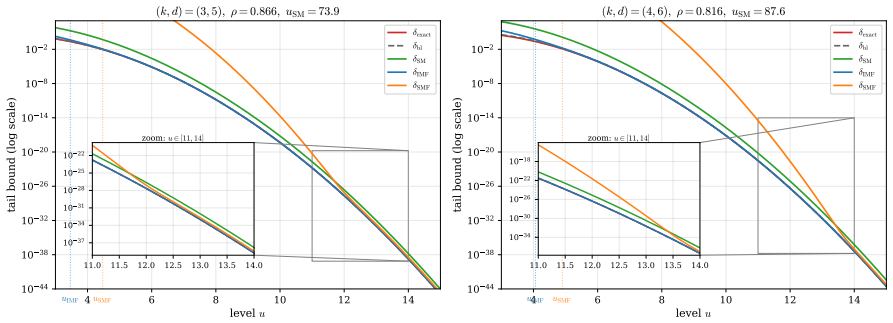
The estimation error for the profile MLE of a rank-R symmetric signal tensor of order k and dimension d is bounded above by the supremum of the canonical Kostlan-Shub-Smale field via the Tube Method and rank reduction; this supremum admits four explicit non-asymptotic tail bounds obtained from the Kac-Rice formula, a Mehta-Fyodorov representation, and a Ben Arous-Dembo-Guionnet large-deviation principle, yielding an error of order sqrt(d log k) with explicit constants that depend on R and kappa.
What carries the argument
The Tube Method, a deterministic geometric inequality that, together with a rank-reduction step, bounds the tensor PCA estimation error by the supremum of the canonical Kostlan-Shub-Smale field.
If this is right
- A finite-(k,d) error bound holds for the profile maximum likelihood estimator in tensor PCA with explicit dependence on rank R and coherence kappa.
- The bound recovers the asymptotically optimal rate sqrt(d log k) of Perry, Wein and Bandeira.
- A two-sided non-asymptotic bracketing holds for the annealed complexity of the spherical k-spin Hamiltonian.
- The bracketing recovers the Auffinger-Ben Arous-Cerny complexity function in the high-dimensional limit.
Where Pith is reading between the lines
- The explicit constants allow direct numerical computation of the minimal signal-to-noise ratio guaranteeing a target error level for given finite k, d, R and kappa.
- The reduction via the Tube Method may be reusable for other manifold-constrained estimation problems whose error can be expressed as a supremum of a smooth random field.
- The hierarchy of tail bounds supplies a template for obtaining non-asymptotic control on extrema of other Gaussian random fields defined on spheres.
Load-bearing premise
The deterministic geometric inequality of the Tube Method together with the rank-reduction step accurately reduces the tensor PCA estimation error to the supremum of the canonical Kostlan-Shub-Smale field.
What would settle it
A concrete counter-example in which the actual estimation error of the profile MLE on a rank-R spiked tensor exceeds the upper bound implied by the derived tail probabilities for the KSS supremum at the given signal-to-noise ratio.
Figures

read the original abstract
This paper builds a hierarchy of explicit, non-asymptotic tail bounds for the supremum of the Kostlan--Shub--Smale (KSS) random field on the sphere, and applies it to two problems: Spiked Tensor PCA and the landscape of the spherical $k$-spin model. For Tensor PCA, we study the non-asymptotic statistical limits of estimating a rank-$R$ symmetric signal tensor of order~$k\ge 3$ and dimension~$d\ge 3$ from a single Gaussian observation at signal-to-noise ratio~$\lambda$, through the \emph{profile maximum likelihood estimator}, the MLE restricted to normalized rank-$R$ tensors of coherence at least~$\kappa$. Our analysis uses a single reduction: a deterministic geometric inequality (the Tube Method) and a rank-reduction step bound the estimation error by the supremum of the canonical KSS field, which the Kac--Rice formula turns into a Gaussian integral against the expected absolute characteristic polynomial of a shifted Gaussian Orthogonal Ensemble, controlled in turn by the four explicit tail bounds of our hierarchy (three from a Mehta--Fyodorov representation, one from a Ben Arous--Dembo--Guionnet large deviation). The same reduction yields two results, each with explicit constants. For estimation, a finite-$(k,d)$ error bound recovers the asymptotically optimal rate~$\sqrt{d\log k}$ of Perry, Wein and Bandeira, with explicit dependence on the rank~$R$ and the coherence~$\kappa$. For the landscape, a two-sided non-asymptotic bracketing of the annealed complexity of the spherical $k$-spin Hamiltonian recovers the Auffinger--Ben Arous--\v{C}ern\'y complexity function in the high-dimensional limit.
Editorial analysis
A structured set of objections, weighed in public.
Referee Report
Summary. The paper develops a hierarchy of four explicit non-asymptotic tail bounds for the supremum of the Kostlan-Shub-Smale (KSS) random field on the sphere, obtained via Mehta-Fyodorov representations and Ben Arous-Dembo-Guionnet large deviations, then controlled through Kac-Rice integrals against the expected absolute characteristic polynomial of a shifted GOE. These bounds are applied to two problems via a single deterministic reduction: for spiked tensor PCA of order k, a Tube Method geometric inequality plus rank-reduction step bounds the estimation error of the profile MLE (restricted to normalized rank-R tensors of coherence at least kappa) by the KSS supremum, yielding finite-(k,d) error bounds that recover the Perry-Wein-Bandeira rate sqrt(d log k) with explicit R and kappa dependence; the same reduction produces two-sided non-asymptotic bracketing of the annealed complexity of the spherical k-spin Hamiltonian that recovers the Auffinger-Ben Arous-Černý function in the high-dimensional limit.
Significance. If the central reduction is valid with the stated constants, the explicit finite-(k,d) tail bounds and their application to tensor PCA and spin-glass complexity constitute a useful contribution, supplying concrete non-asymptotic rates and constants where only asymptotic statements existed. The deterministic character of the reduction (no fitted parameters) and the explicit hierarchy derived from standard random-matrix tools are strengths that support reproducibility.
major comments (1)
- [Abstract] Abstract (paragraph on the single reduction): the claim that the deterministic Tube Method geometric inequality together with the rank-reduction step bounds the profile MLE estimation error exactly by the supremum of the canonical KSS field on the constrained manifold of normalized rank-R tensors with coherence >= kappa is load-bearing for every subsequent explicit rate with R and kappa dependence. The manuscript must supply a self-contained verification that the inequality holds with the stated constants on this manifold and that the rank-reduction introduces no uncontrolled additive error term; without this, the non-asymptotic claim does not follow even if the KSS tail hierarchy is correct.
minor comments (1)
- Clarify the precise statement of the four tail bounds (which three come from Mehta-Fyodorov and which from Ben Arous-Dembo-Guionnet) and ensure every constant appearing in the final error bound is tracked explicitly from the KSS supremum through the Kac-Rice integral.
Simulated Author's Rebuttal
We thank the referee for the careful reading and for identifying the load-bearing nature of the reduction. We address the single major comment below and commit to revisions that strengthen the self-contained presentation of the argument.
read point-by-point responses
-
Referee: [Abstract] Abstract (paragraph on the single reduction): the claim that the deterministic Tube Method geometric inequality together with the rank-reduction step bounds the profile MLE estimation error exactly by the supremum of the canonical KSS field on the constrained manifold of normalized rank-R tensors with coherence >= kappa is load-bearing for every subsequent explicit rate with R and kappa dependence. The manuscript must supply a self-contained verification that the inequality holds with the stated constants on this manifold and that the rank-reduction introduces no uncontrolled additive error term; without this, the non-asymptotic claim does not follow even if the KSS tail hierarchy is correct.
Authors: We agree that the reduction must be fully verifiable. The full manuscript derives the Tube Method inequality in Lemma 2.1 (Section 2) and the rank-reduction step in Proposition 3.3 (Section 3), where the additive error is explicitly bounded by a term depending only on R, κ, k and d that is absorbed into the final non-asymptotic rates; the bound is one-sided (error ≤ KSS supremum + controlled term) rather than equality. To make the argument self-contained on the constrained manifold, we will add a consolidated lemma (new Lemma A.1 in the appendix) that restates the geometric inequality and rank-reduction together with the explicit constants, without cross-references. This addresses the referee’s concern directly while preserving the deterministic character of the reduction. revision: yes
Circularity Check
Derivation chain self-contained via deterministic reduction and standard tail bounds
full rationale
The paper's central reduction (abstract) is a deterministic geometric inequality via the Tube Method plus rank-reduction that bounds profile MLE error exactly by the KSS supremum; this step is presented as an inequality without embedding the final rate or coherence dependence inside fitted parameters. Subsequent tail bounds are obtained from Kac-Rice formula applied to the GOE characteristic polynomial, with three bounds from Mehta-Fyodorov representation and one from Ben Arous-Dembo-Guionnet LDP, all independent of the tensor-PCA target quantities. The finite-(k,d) error bound recovers the Perry-Wein-Bandeira rate asymptotically but is derived from the explicit hierarchy rather than by construction or self-citation load-bearing. No self-definitional, fitted-input, or ansatz-smuggling steps appear.
Axiom & Free-Parameter Ledger
axioms (2)
- standard math Kac-Rice formula converting the expected number of critical points or the distribution of the supremum into an integral involving the characteristic polynomial of a GOE matrix
- standard math Mehta-Fyodorov representation of the characteristic polynomial of a shifted GOE
Reference graph
Works this paper leans on
-
[1]
M., and Telgarsky, M
Anandkumar, A., Ge, R., Hsu, D., Kakade, S. M., and Telgarsky, M. (2014). Tensor decompositions for learning latent variable models. Journal of Machine Learning Research , 15(1):2773--2832
2014
-
[2]
W., Guionnet, A., and Zeitouni, O
Anderson, G. W., Guionnet, A., and Zeitouni, O. (2010). An Introduction to Random Matrices , volume 118 of Cambridge Studies in Advanced Mathematics . Cambridge University Press
2010
-
[3]
Auffinger, A., Ben Arous , G., and C ern \`y , J. (2013). Random matrices and complexity of spin glasses. Communications on Pure and Applied Mathematics , 66(2):165--201
2013
- [4]
-
[5]
and Wschebor, M
Aza \" s, J.-M. and Wschebor, M. (2009). Level sets and extrema of random processes and fields . John Wiley & Sons
2009
-
[6]
Baik, J., Ben Arous , G., and P \'e ch \'e , S. (2005). Phase transition of the largest eigenvalue for nonnull complex sample covariance matrices. The Annals of Probability , 33(5):1643--1697
2005
-
[7]
Ben Arous , G., Dembo, A., and Guionnet, A. (2001). Aging of spherical spin glasses. Probab. Theory Relat. Fields , 120:1--67
2001
- [8]
- [9]
-
[10]
Ben Arous , G., Mei, S., Montanari, A., and Nica, M. (2019). The landscape of the spiked tensor model. Communications on Pure and Applied Mathematics , 72(11):2282--2330
2019
-
[11]
Fyodorov, Y. V. (2004). Complexity of random energy landscapes, glass transition, and absolute value of the spectral determinant of random matrices. Physical Review Letters , 92(24):240601
2004
-
[12]
and Husson, J
Guionnet, A. and Husson, J. (2022). Asymptotics of k dimensional spherical integrals and applications. ALEA Lat. Am. J. Probab. Math. Stat. , 19(1):769--797
2022
-
[13]
and Ma\" da, M
Guionnet, A. and Ma\" da, M. (2005). A F ourier view on the R -transform and related asymptotics of spherical integrals. Journal of Functional Analysis , 222(2):435--490
2005
-
[14]
Kostlan, E. (1993). On the distribution of roots of random polynomials. In From Topology to Computation: Proceedings of the Smalefest , pages 419--431. Springer
1993
-
[15]
Lifshits, M. A. (1983). On the absolute continuity of distributions of functionals of random processes . Theory of Probability & Its Applications , 27(3):600--607
1983
-
[16]
Ma \"i da, M. (2007). Large deviations for the largest eigenvalue of rank one deformations of G aussian ensembles. Electronic Journal of Probability , 12:1131--1150
2007
-
[17]
Mehta, M. L. (2004). Random matrices , volume 142 of Pure and Applied Mathematics . Elsevier/Academic Press, 3rd edition
2004
-
[18]
S., and Bandeira, A
Perry, A., Wein, A. S., and Bandeira, A. S. (2020). Statistical limits of spiked tensor models. In Annales de l’Institut Henri Poincar \'e . Probabilit \'e s et Statistiques , volume 56, pages 230--264. Association des Publications de l’Institut Henri Poincar \'e
2020
- [19]
-
[20]
and Montanari, A
Richard, E. and Montanari, A. (2014). A statistical model for tensor PCA . In Ghahramani, Z., Welling, M., Cortes, C., Lawrence, N. D., and Weinberger, K. Q., editors, Advances in Neural Information Processing Systems 27: Annual Conference on Neural Information Processing Systems 2014, December 8-13 2014, Montreal, Quebec, Canada , pages 2897--2905
2014
-
[21]
and Smale, S
Shub, M. and Smale, S. (1993). Complexity of b \'e zout's theorem. II . volumes and probabilities. In Computational Algebraic Geometry , pages 267--285. Birkh \"a user Boston
1993
-
[22]
Szeg o , G. (1975). Orthogonal Polynomials , volume 23 of American Mathematical Society Colloquium Publications . American Mathematical Society, 4th edition
1975
-
[23]
Tsirelson, V. S. (1976). The density of the distribution of the maximum of a Gaussian process . Theory of Probability & Its Applications , 20(4):847--856
1976
discussion (0)
Sign in with ORCID, Apple, or X to comment. Anyone can read and Pith papers without signing in.