Machine learning unveils the quark mass dependence of the pseudoscalar meson decay constants in three-flavour N²LO ChPT
Pith reviewed 2026-06-27 18:10 UTC · model grok-4.3
The pith
Three-flavor N²LO chiral perturbation theory combined with LASSO regression on lattice data determines the quark-mass dependence of the pseudoscalar decay constants up to pion masses near 780 MeV.
A machine-rendered reading of the paper's core claim, the machinery that carries it, and where it could break.
Core claim
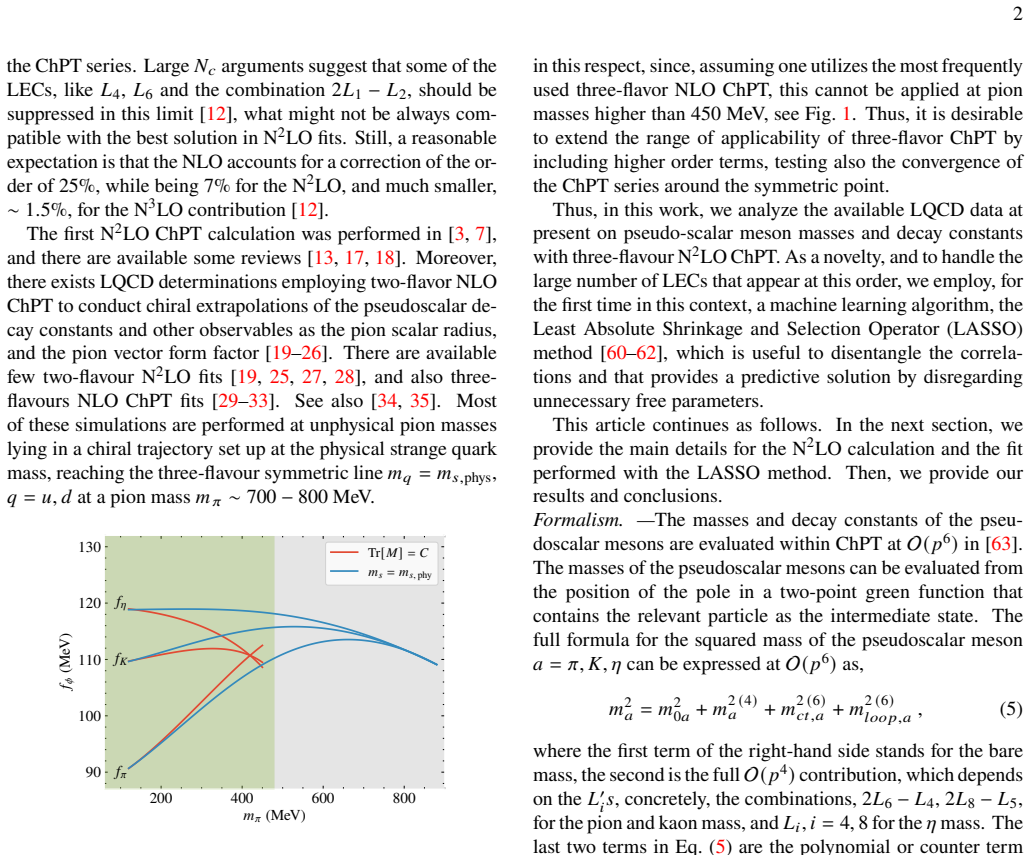
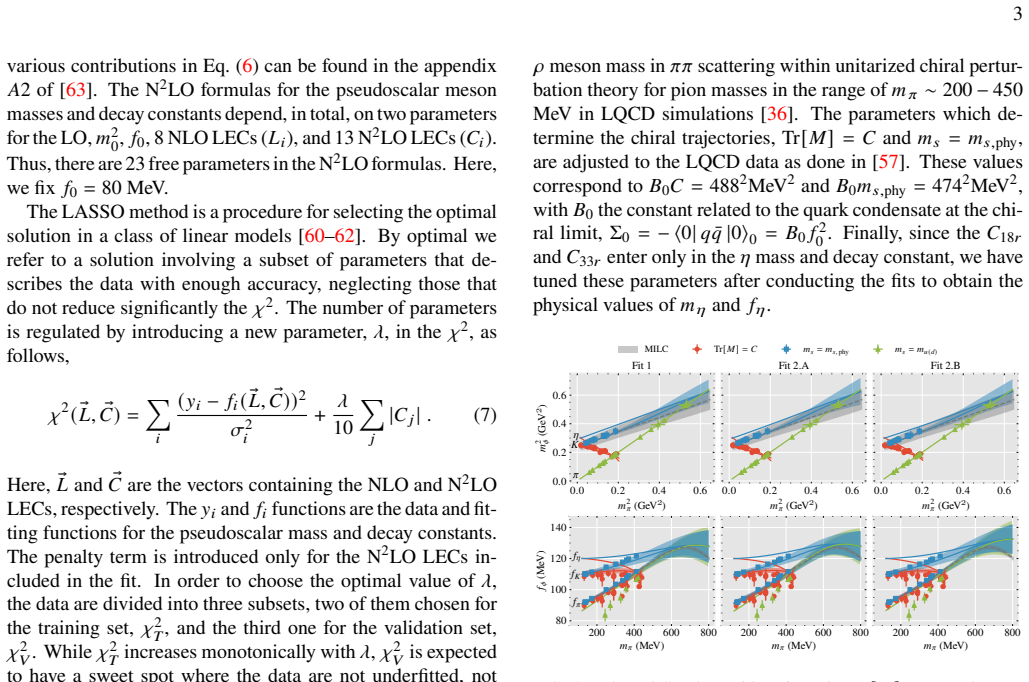
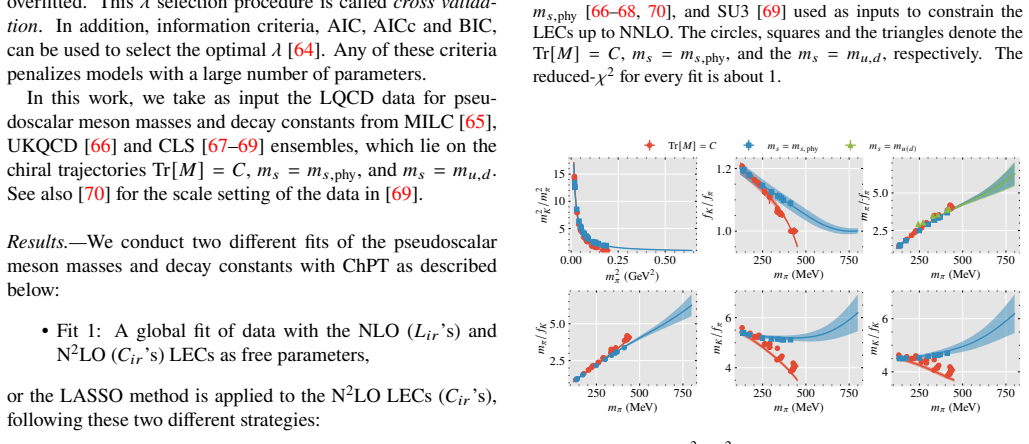
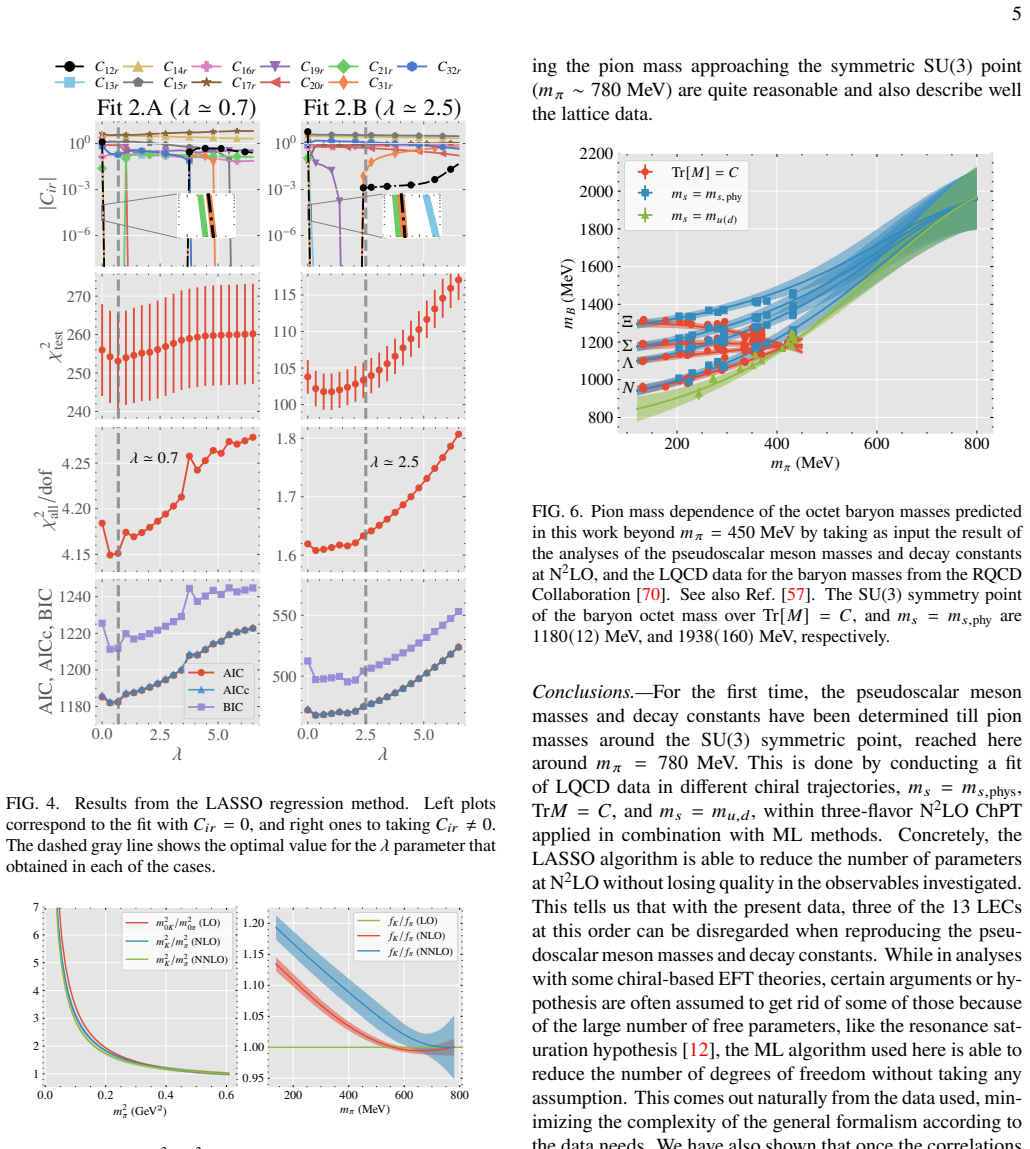
The quark mass dependence of f_π, f_K and f_η is extracted from three-flavor N²LO ChPT by applying the LASSO method to recent LQCD data, reaching pion masses around 780 MeV close to the SU(3) symmetric point; the same functions are then used inside covariant baryon ChPT to predict the octet-baryon masses in the SU(3) limit.
What carries the argument
LASSO regularisation applied to the N²LO three-flavor ChPT expressions for the decay constants, which selects and determines the relevant low-energy constants from lattice data.
If this is right
- The extracted functions supply quark-mass-dependent inputs for other effective field theories that involve pseudoscalar mesons.
- The same LASSO-fitted low-energy constants can be reused in calculations of other observables that depend on f_π, f_K and f_η.
- Predictions for octet baryon masses become available throughout the region between the physical point and the SU(3) limit.
- The analysis demonstrates that N²LO three-flavor ChPT remains applicable up to pion masses of roughly 780 MeV when the strange quark mass is not taken to infinity.
Where Pith is reading between the lines
- The same workflow could be applied to other low-energy constants or to different lattice ensembles to test consistency across observables.
- If the extracted mass dependence proves robust, it offers a practical way to vary the strange quark mass continuously in phenomenological models without re-fitting from scratch.
- The approach highlights that machine-learning regularisation can reduce the number of free parameters that must be determined from lattice data in chiral expansions.
Load-bearing premise
The LASSO procedure with its chosen penalty strength and feature set correctly isolates the physically relevant low-energy constants without systematic bias or omission.
What would settle it
A new lattice QCD calculation of the octet baryon masses performed directly at the SU(3) symmetric point that lies outside the uncertainty band obtained from the decay-constant functions derived here.
Figures
read the original abstract
The quark mass dependence of the pseudoscalar meson decay consntants, $f_\pi, f_K$ and $f_\eta$, are determined from three-flavor N$^2$LO ChPT till pion masses around $780$ MeV, near the SU(3) limit. This is done by conducting an analysis of recent LQCD data using the LASSO method, a machine-learning technique which allows to pin down the relevant low-energy-constants with high precision. Since the pion decay constant is a fundamental quantity which usually appears in relevant phenomenological lagrangians or Effective Field Theories based on QCD at low energies, this analysis can be used as input to evaluate the quark mass dependence of hadronic states. As an example, we predict the masses of the octect baryons in the SU(3) limit within covariant Baryon Chiral Perturbation Theory.
Editorial analysis
A structured set of objections, weighed in public.
Referee Report
Summary. The manuscript claims that the quark mass dependence of the pseudoscalar meson decay constants f_π, f_K and f_η can be determined from three-flavor N²LO ChPT up to m_π ≈ 780 MeV near the SU(3) limit by applying the LASSO method to recent LQCD data; the resulting parametrizations are then used as input to predict octet baryon masses in the SU(3) limit within covariant baryon ChPT.
Significance. If the LASSO procedure is shown to be robust, the work supplies a concrete parametrization of decay constants that can serve as input for other low-energy EFTs; the baryon-mass example illustrates one such application. The use of LASSO for LEC selection in ChPT is a methodological novelty that, once validated, could be of interest to the community.
major comments (2)
- [LASSO implementation (methods/results section)] The description of the LASSO analysis supplies no information on hyper-parameter tuning, cross-validation, comparison to ordinary least-squares fits, or stability under data cuts. This information is required to establish that the selected LECs are free from regularization-induced bias or omission and is therefore load-bearing for the central claim.
- [ChPT applicability discussion] No convergence tests, order-by-order comparisons, or explicit discussion are provided to justify the use of the N²LO three-flavor expansion at m_π ≈ 780 MeV near the SU(3) point. Without such checks the extracted mass dependence of f_π, f_K and f_η cannot be trusted as a reliable input for the subsequent baryon-mass predictions.
minor comments (1)
- [Abstract] Abstract contains the typo 'consntants'.
Simulated Author's Rebuttal
We thank the referee for the careful reading of our manuscript and the constructive comments. We address each major comment below and will revise the manuscript to strengthen the presentation of the LASSO analysis and the justification for the ChPT range.
read point-by-point responses
-
Referee: [LASSO implementation (methods/results section)] The description of the LASSO analysis supplies no information on hyper-parameter tuning, cross-validation, comparison to ordinary least-squares fits, or stability under data cuts. This information is required to establish that the selected LECs are free from regularization-induced bias or omission and is therefore load-bearing for the central claim.
Authors: We agree that the current description of the LASSO procedure is insufficient for full validation. In the revised manuscript we will expand the methods and results sections to document the hyper-parameter selection (including the cross-validation strategy used to determine the regularization strength), direct comparisons of the LASSO-selected LECs with those obtained from ordinary least-squares fits on the same data sets, and explicit stability tests under successive data cuts. These additions will demonstrate that the retained LECs are robust and not artifacts of the regularization. revision: yes
-
Referee: [ChPT applicability discussion] No convergence tests, order-by-order comparisons, or explicit discussion are provided to justify the use of the N²LO three-flavor expansion at m_π ≈ 780 MeV near the SU(3) point. Without such checks the extracted mass dependence of f_π, f_K and f_η cannot be trusted as a reliable input for the subsequent baryon-mass predictions.
Authors: We acknowledge that an explicit discussion of convergence is required. The revised manuscript will include a new subsection that presents order-by-order comparisons of the decay constants, quantifies the size of the N²LO corrections relative to lower orders across the simulated mass range, and references existing literature on the convergence radius of three-flavor ChPT near the SU(3) limit. This material will support the reliability of the extracted parametrizations as input for the baryon-mass calculation. revision: yes
Circularity Check
No circularity: LECs fitted to external LQCD data; baryon-mass example uses separate framework.
full rationale
The paper determines N²LO three-flavor ChPT low-energy constants by applying LASSO regularization to independent lattice QCD data on f_π, f_K and f_η. The resulting quark-mass parametrizations are then inserted into a distinct covariant baryon ChPT calculation to illustrate octet-baryon masses in the SU(3) limit. No equation, prediction or uniqueness claim reduces by construction to a quantity already defined inside the paper, nor does any load-bearing step rely on a self-citation chain. The derivation is therefore self-contained against external benchmarks.
Axiom & Free-Parameter Ledger
free parameters (1)
- Low-energy constants (LECs) at N²LO
axioms (2)
- domain assumption Validity of three-flavor N²LO ChPT expansion up to m_π ≈ 780 MeV near SU(3) limit
- ad hoc to paper LASSO penalty selects the physically relevant LECs without significant bias
Reference graph
Works this paper leans on
-
[1]
Navas et al
S. Navas et al. (Particle Data Group), Phys. Rev. D110, 030001 (2024)
2024
-
[2]
M. L. Goldberger and S. B. Treiman, Phys. Rev.110, 1178 (1958)
1958
-
[3]
Gasser and H
J. Gasser and H. Leutwyler, Annals Phys.158, 142 (1984)
1984
-
[4]
J. Bijnens and I. Jemos, Eur. Phys. J. C64, 273 (2009), arXiv:0906.3118 [hep-ph]
Pith/arXiv arXiv 2009
-
[5]
Weinberg, Nucl
S. Weinberg, Nucl. Phys. B363, 3 (1991). 7
1991
-
[6]
Weinberg, Physica A96, 327 (1979)
S. Weinberg, Physica A96, 327 (1979)
1979
-
[7]
Gasser and H
J. Gasser and H. Leutwyler, Nucl. Phys. B250, 465 (1985)
1985
-
[8]
Nambu, Phys
Y. Nambu, Phys. Rev. Lett.4, 380 (1960)
1960
-
[9]
Nambu and G
Y. Nambu and G. Jona-Lasinio, Phys. Rev.122, 345 (1961)
1961
-
[10]
Nambu and G
Y. Nambu and G. Jona-Lasinio, Phys. Rev.124, 246 (1961)
1961
-
[11]
Goldstone, Nuovo Cim.19, 154 (1961)
J. Goldstone, Nuovo Cim.19, 154 (1961)
1961
-
[12]
J. Bijnens and G. Ecker, Ann. Rev. Nucl. Part. Sci.64, 149 (2014), arXiv:1405.6488 [hep-ph]
Pith/arXiv arXiv 2014
-
[13]
Bijnens, PoSEFT09, 022 (2009), arXiv:0904.3713 [hep-ph]
J. Bijnens, PoSEFT09, 022 (2009), arXiv:0904.3713 [hep-ph]
Pith/arXiv arXiv 2009
-
[14]
H. W. Fearing and S. Scherer, Phys. Rev. D53, 315 (1996), arXiv:hep-ph/9408346
Pith/arXiv arXiv 1996
-
[15]
J. Bijnens, G. Colangelo, and G. Ecker, JHEP02, 020, arXiv:hep-ph/9902437
-
[16]
J. Bijnens, G. Colangelo, and G. Ecker, Annals Phys.280, 100 (2000), arXiv:hep-ph/9907333
Pith/arXiv arXiv 2000
- [17]
-
[18]
V. Bernard and U.-G. Meissner, Ann. Rev. Nucl. Part. Sci.57, 33 (2007), arXiv:hep-ph/0611231
Pith/arXiv arXiv 2007
-
[19]
J. Noaki et al. (JLQCD, TWQCD), Phys. Rev. Lett.101, 202004 (2008), arXiv:0806.0894 [hep-lat]
arXiv 2008
- [20]
-
[21]
A. Bazavov et al. (MILC), PoSLATTICE2010, 074 (2010), arXiv:1012.0868 [hep-lat]
Pith/arXiv arXiv 2010
-
[22]
S. Borsanyi, S. Durr, Z. Fodor, S. Krieg, A. Schafer, E. E. Scholz, and K. K. Szabo, Phys. Rev. D88, 014513 (2013), arXiv:1205.0788 [hep-lat]
Pith/arXiv arXiv 2013
-
[23]
S. D¨ urr et al. (BMW), Phys. Rev. D90, 114504 (2014), arXiv:1310.3626 [hep-lat]
Pith/arXiv arXiv 2014
-
[24]
P. A. Boyle et al., Phys. Rev. D93, 054502 (2016), arXiv:1511.01950 [hep-lat]
Pith/arXiv arXiv 2016
-
[25]
B. B. Brandt, A. J¨ uttner, and H. Wittig, JHEP11, 034, arXiv:1306.2916 [hep-lat]
-
[26]
V. G¨ ulpers, G. von Hippel, and H. Wittig, Eur. Phys. J. A51, 158 (2015), arXiv:1507.01749 [hep-lat]
Pith/arXiv arXiv 2015
-
[27]
Mawhinney (RBC, UKQCD), PoSLAT2009, 081 (2009), arXiv:0910.3194 [hep-lat]
R. Mawhinney (RBC, UKQCD), PoSLAT2009, 081 (2009), arXiv:0910.3194 [hep-lat]
arXiv 2009
-
[28]
E. E. Scholz, S. Borsanyi, S. Durr, Z. Fodor, S. D. Katz, S. Krieg, A. Schafer, and K. K. Szabo, PoSLATTICE2011, 142 (2011), arXiv:1111.3729 [hep-lat]
Pith/arXiv arXiv 2011
-
[29]
S. R. Beane, P. F. Bedaque, K. Orginos, and M. J. Savage, Phys. Rev. D75, 094501 (2007), arXiv:hep-lat/0606023
Pith/arXiv arXiv 2007
-
[30]
A. Bazavov et al. (MILC), PoSCD09, 007 (2009), arXiv:0910.2966 [hep-ph]
Pith/arXiv arXiv 2009
-
[31]
S. Aoki et al. (PACS-CS), Phys. Rev. D79, 034503 (2009), arXiv:0807.1661 [hep-lat]
Pith/arXiv arXiv 2009
-
[32]
C. Allton et al. (RBC-UKQCD), Phys. Rev. D78, 114509 (2008), arXiv:0804.0473 [hep-lat]
arXiv 2008
-
[33]
J. Bijnens and I. Jemos, Nucl. Phys. B854, 631 (2012), arXiv:1103.5945 [hep-ph]
Pith/arXiv arXiv 2012
-
[34]
Y. Aoki et al. (Flavour Lattice Averaging Group (FLAG)), Eur. Phys. J. C82, 869 (2022), arXiv:2111.09849 [hep-lat]
arXiv 2022
-
[35]
Y. Aoki et al. (Flavour Lattice Averaging Group (FLAG)), Phys. Rev. D113, 014508 (2026), arXiv:2411.04268 [hep-lat]
Pith/arXiv arXiv 2026
- [36]
-
[37]
T. N. Truong, Phys. Rev. Lett.61, 2526 (1988)
1988
-
[38]
Dobado, M
A. Dobado, M. J. Herrero, and T. N. Truong, Phys. Lett. B235, 134 (1990)
1990
-
[39]
J. A. Oller, E. Oset, and J. R. Pelaez, Phys. Rev. D59, 074001 (1999), [Erratum: Phys.Rev.D 60, 099906 (1999), Erratum: Phys.Rev.D 75, 099903 (2007)], arXiv:hep-ph/9804209
Pith/arXiv arXiv 1999
-
[40]
J. Nieves and E. Ruiz Arriola, Phys. Lett. B455, 30 (1999), arXiv:nucl-th/9807035
Pith/arXiv arXiv 1999
-
[41]
A. Gomez Nicola and J. R. Pelaez, Phys. Rev. D65, 054009 (2002), arXiv:hep-ph/0109056
Pith/arXiv arXiv 2002
-
[42]
N. Kaiser, P. B. Siegel, and W. Weise, Nucl. Phys. A594, 325 (1995), arXiv:nucl-th/9505043
Pith/arXiv arXiv 1995
-
[43]
N. Kaiser, T. Waas, and W. Weise, Nucl. Phys. A612, 297 (1997), arXiv:hep-ph/9607459
Pith/arXiv arXiv 1997
- [44]
-
[45]
J. Nieves and E. Ruiz Arriola, Phys. Rev. D64, 116008 (2001), arXiv:hep-ph/0104307
Pith/arXiv arXiv 2001
-
[46]
D. Jido, J. A. Oller, E. Oset, A. Ramos, and U. G. Meissner, Nucl. Phys. A725, 181 (2003), arXiv:nucl-th/0303062
Pith/arXiv arXiv 2003
-
[47]
C. Hanhart, J. R. Pelaez, and G. Rios, Phys. Rev. Lett.100, 152001 (2008), arXiv:0801.2871 [hep-ph]
Pith/arXiv arXiv 2008
-
[48]
R. Molina and M. D¨oring, Phys. Rev. D94, 056010 (2016), [Ad- dendum: Phys.Rev.D 94, 079901 (2016)], arXiv:1512.05831 [hep-lat]
Pith/arXiv arXiv 2016
-
[49]
D. Guo, A. Alexandru, R. Molina, and M. D¨oring, Phys. Rev. D 94, 034501 (2016), arXiv:1605.03993 [hep-lat]
Pith/arXiv arXiv 2016
-
[50]
B. Hu, R. Molina, M. D ¨oring, and A. Alexandru, Phys. Rev. Lett.117, 122001 (2016), arXiv:1605.04823 [hep-lat]
Pith/arXiv arXiv 2016
-
[51]
D. Guo, A. Alexandru, R. Molina, M. Mai, and M. D¨oring, Phys. Rev. D98, 014507 (2018), arXiv:1803.02897 [hep-lat]
Pith/arXiv arXiv 2018
-
[52]
J. Nebreda and J. R. Pelaez., Phys. Rev. D81, 054035 (2010), arXiv:1001.5237 [hep-ph]
Pith/arXiv arXiv 2010
-
[53]
M. Mai, C. Culver, A. Alexandru, M. D ¨oring, and F. X. Lee, Phys. Rev. D100, 114514 (2019), arXiv:1908.01847 [hep-lat]
arXiv 2019
-
[54]
M. Fischer, B. Kostrzewa, M. Mai, M. Petschlies, F. Pittler, M. Ueding, C. Urbach, and M. Werner (Extended Twisted Mass, ETM), Phys. Lett. B819, 136449 (2021), arXiv:2006.13805 [hep-lat]
arXiv 2021
- [55]
-
[56]
J. R. Pel ´aez, A. Rodas, and J. R. de Elvira, Eur. Phys. J. ST230, 1539 (2021), arXiv:2101.06506 [hep-ph]
arXiv 2021
- [57]
-
[58]
Meißner, Symmetry12, 981 (2020), arXiv:2005.06909 [hep-ph]
U.-G. Meißner, Symmetry12, 981 (2020), arXiv:2005.06909 [hep-ph]
arXiv 2020
-
[59]
Z. Zhuang, F. G. Dom ´ınguez, and R. Molina, (2026), arXiv:2606.03826 [hep-ph]
Pith/arXiv arXiv 2026
-
[60]
Tibshirani, J
R. Tibshirani, J. R. Stat. Soc. B58, 267 (1996)
1996
-
[61]
Hasti, R
T. Hasti, R. Tibshirani, and J. Friedman, The elements of statis- tical learning: Data mining, inference, and prediction (2009)
2009
-
[62]
James, D
G. James, D. Witten, T. Hastie, and R. Tibshirani, An introduc- tion to statistical learning (2013)
2013
-
[63]
G. Amoros, J. Bijnens, and P. Talavera, Nucl. Phys. B568, 319 (2000), arXiv:hep-ph/9907264
Pith/arXiv arXiv 2000
-
[64]
F. Gil-Dom ´ınguez and R. Molina, Phys. Lett. B843, 137997 (2023), [Erratum: Phys.Lett.B 868, 139619 (2025)], arXiv:2302.12861 [hep-lat]
arXiv 2023
-
[65]
A. Bazavov et al. (MILC), Rev. Mod. Phys.82, 1349 (2010), arXiv:0903.3598 [hep-lat]
Pith/arXiv arXiv 2010
-
[66]
T. Blum et al. (RBC, UKQCD), Phys. Rev. D93, 074505 (2016), arXiv:1411.7017 [hep-lat]
Pith/arXiv arXiv 2016
-
[67]
M. Bruno, T. Korzec, and S. Schaefer, Phys. Rev. D95, 074504 (2017), arXiv:1608.08900 [hep-lat]
Pith/arXiv arXiv 2017
-
[68]
M. C `e et al., Phys. Rev. D106, 114502 (2022), arXiv:2206.06582 [hep-lat]
arXiv 2022
-
[69]
G. S. Bali, S. Collins, W. S ¨oldner, and S. Weish¨aupl (RQCD), Phys. Rev. D105, 054516 (2022), arXiv:2201.05591 [hep-lat]
arXiv 2022
-
[70]
G. S. Bali, S. Collins, P. Georg, D. Jenkins, P. Korcyl, A. Sch¨afer, E. E. Scholz, J. Simeth, W. S¨oldner, and S. Weish¨aupl (RQCD), 8 JHEP05, 035, arXiv:2211.03744 [hep-lat]
-
[71]
See Supplemental Material atURL_will_be_inserted_ by_publisher
-
[72]
J. Martin Camalich, L. S. Geng, and M. J. Vicente Vacas, Phys. Rev. D82, 074504 (2010), arXiv:1003.1929 [hep-lat]
Pith/arXiv arXiv 2010
-
[73]
J. D. Hunter, Computing in Science & Engineering9, 90 (2007)
2007
-
[74]
Bezanson, A
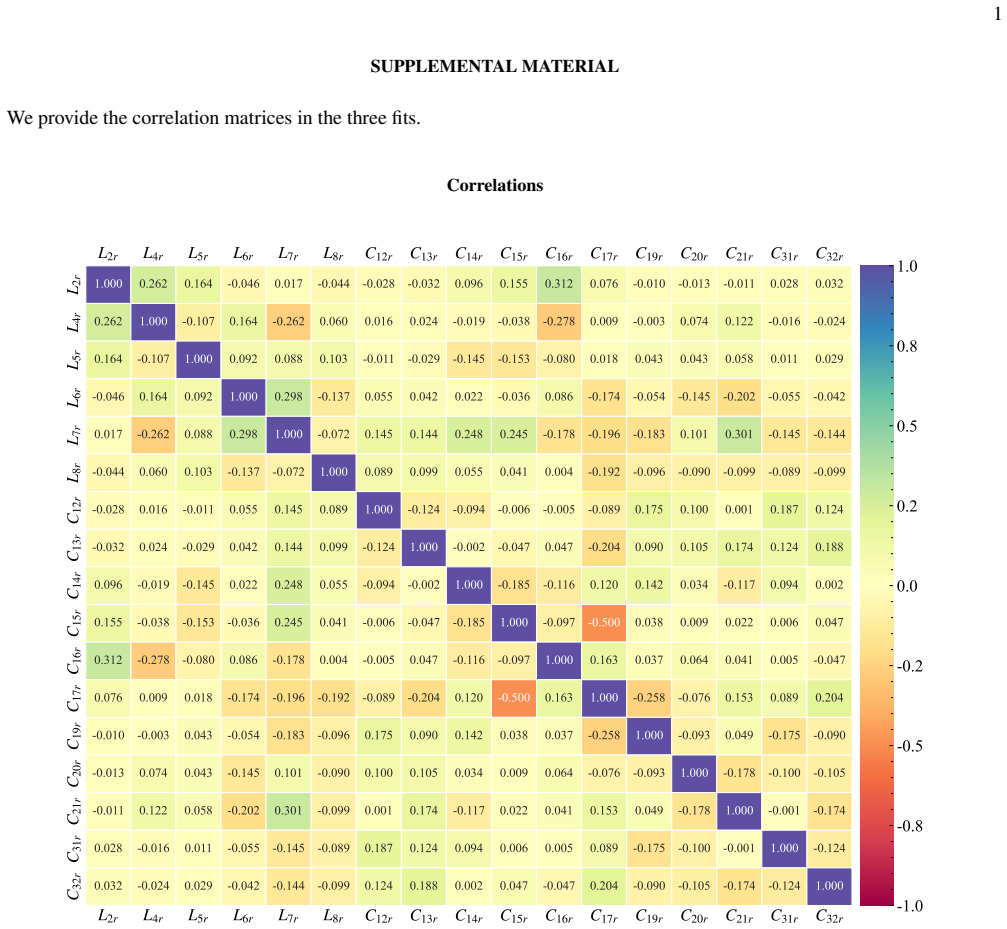
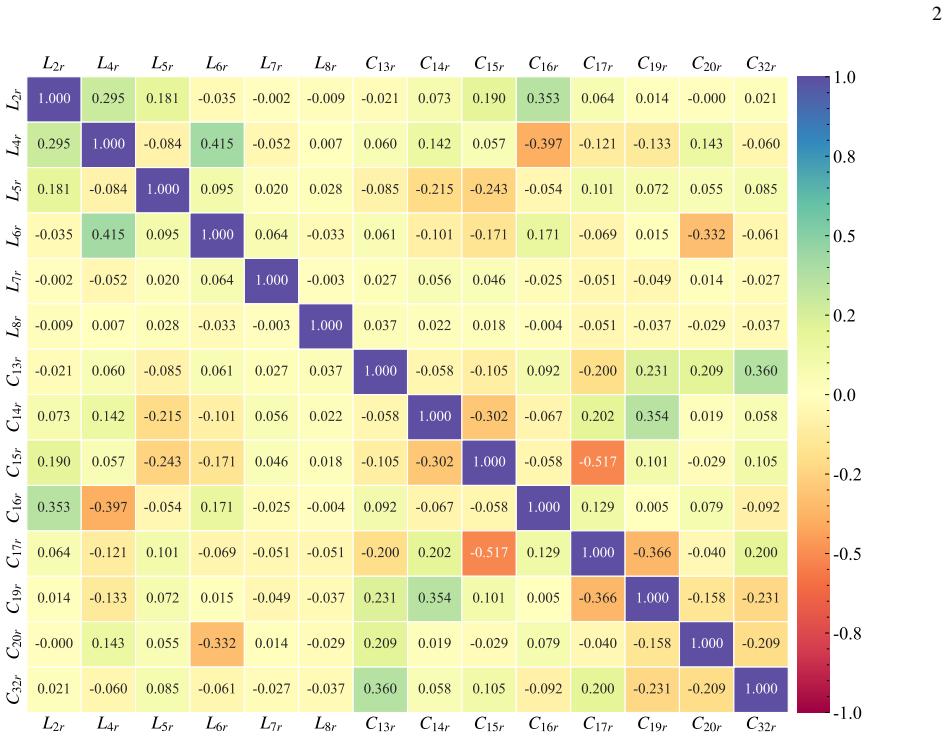
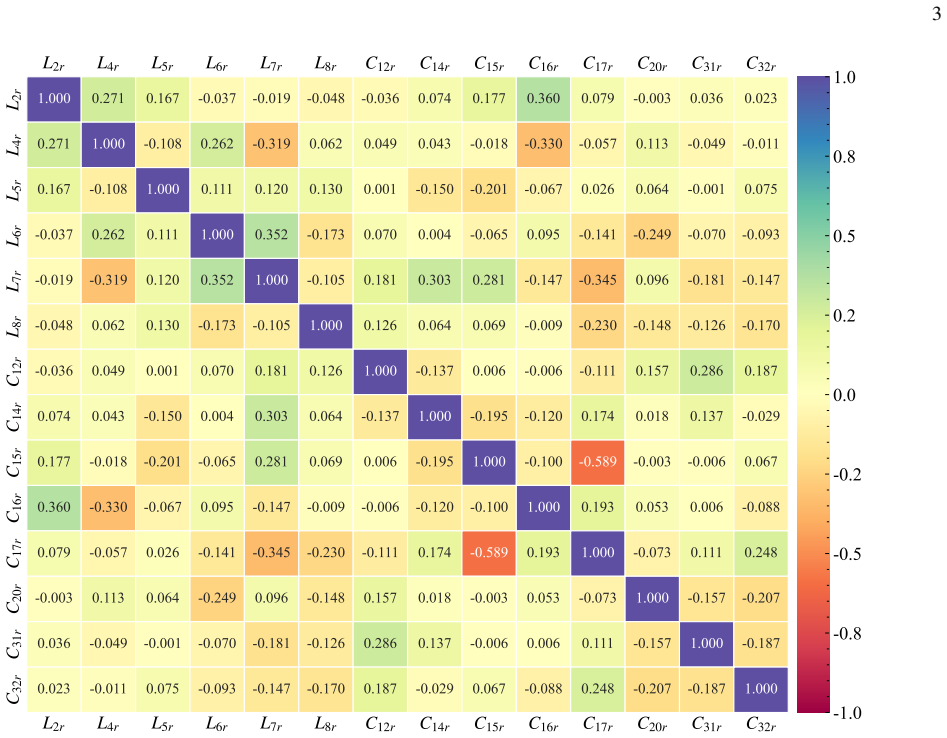
J. Bezanson, A. Edelman, S. Karpinski, and V. B. Shah, SIAM Review59, 65 (2017). 1 SUPPLEMENTAL MATERIAL We provide the correlation matrices in the three fits. Correlations L2r L2r L4r L4r L5r L5r L6r L6r L7r L7r L8r L8r C12r C12r C13r C13r C14r C14r C15r C15r C16r C16r C17r C17r C19r C19r C20r C20r C21r C21r C31r C31r C32r C32r L2rL4rL5rL6rL7rL8rC12rC13r...
2017
discussion (0)
Sign in with ORCID, Apple, or X to comment. Anyone can read and Pith papers without signing in.