REVIEW 3 major objections 5 minor 55 references
Universal prethermal dynamics in Heisenberg ferromagnets
T0 review · 3 major / 5 minor · reviewed 2026-08-14 · deepseek-v4-flash
Pith's one-line read This paper claims that a two-dimensional Heisenberg ferromagnet, after a high-density incoherent magnon pump, enters a universal prethermal regime in which the magnon distribution is self-similar with exponents distinct from Bose-Einstein…
desk verdict A plausible new SU(2)-driven magnon universality class, but the reported exponents violate the paper's own scaling relation and the quantitative claim is not yet supported. read the letter →
The pith
A machine-rendered reading of the paper's core claim, the machinery that carries it, and where it could break.
The reading
What carries the argument
The load-bearing object is the magnon-magnon scattering vertex inherited from SU(2) symmetry, $G^{\mathbf q}_{\mathbf k,\mathbf p}\approx -(Ja^2/N)(\mathbf k\cdot\mathbf p)$, which vanishes linearly with the incoming momenta. This vertex enters the Boltzmann kinetic equation for $n_k(t)$ and makes collisions soft: low-momentum magnons barely scatter, so the $k=0$ mode remains frozen and no condensate forms. The paper combines this kinetic equation with a self-similar ansatz $n_k(t)=t^{\alpha}f(t^{\beta}k)$ and a wave-turbulence dimensional analysis that yields the exponent constraint $2(d+1)\beta-2\alpha=1$; the numerical exponents are close to a particle cascade but without a sharp separation between particle and energy cascades.
What would settle it
Run the kinetic equation to times well beyond $t/\tau_*=0.3$ over a wider momentum window and check whether the collapse persists and whether the fitted exponents satisfy $2(d+1)\beta-2\alpha=1$; alternatively, a pump-probe measurement of $n_k(t)$ in yttrium iron garnet that fails to show data collapse onto $t^{-\alpha}f(t^\beta k)$ would count against the claim.
Extended reading notes
Core claim
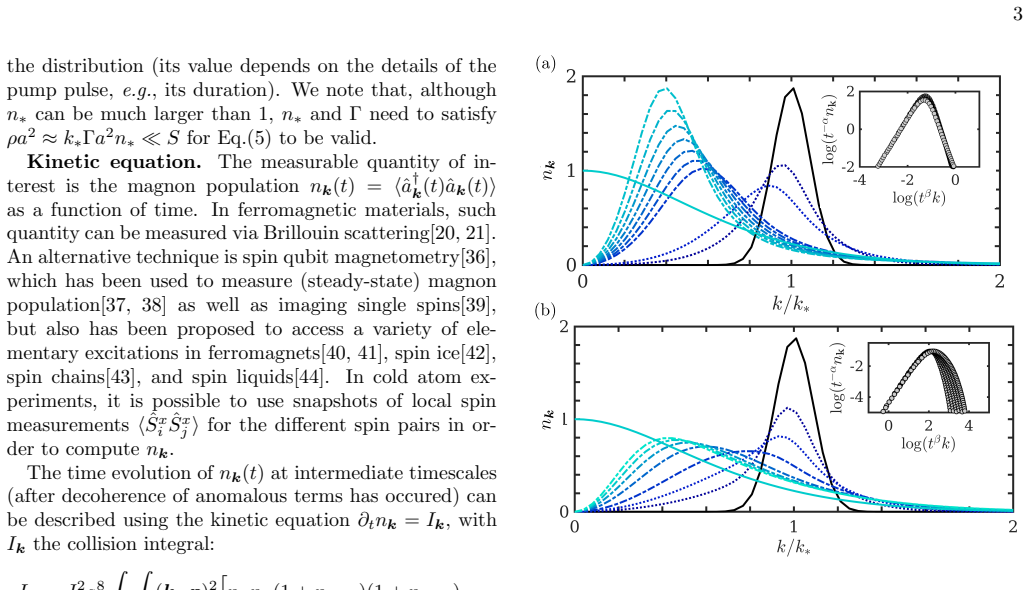
The central claim is that the SU(2)-symmetric Heisenberg ferromagnet hosts a non-thermal fixed point reachable by an incoherent, high-occupancy magnon pump. Starting from a narrow-band distribution with $n_\ast\gg1$, the population loses memory of the initial conditions on a timescale $\tau_\ast$ and enters self-similar evolution $n_k(t)=t^{\alpha}f(t^{\beta}k)$, with fitted exponents $\alpha=0.65\pm0.05$, $\beta=0.30\pm0.05$, and $f(x)\sim1/x^{2.3}$. The mechanism is the SU(2)-enforced scattering amplitude $G^{\mathbf q}_{\mathbf k,\mathbf p}\approx -(Ja^2/N)(\mathbf k\cdot\mathbf p)$, which vanishes at small momentum, suppresses collisions with the $k=0$ mode, and prevents condensate formation. These exponents differ from those observed in Bose-Einstein condensates, and the paper shows numerically that the scaling is insensitive to the initial pump shape and survives weak exchange anisotropy.
Load-bearing premise
The load-bearing premise is that the data collapse seen in the simulations over roughly one to two decades of momentum and out to $t/\tau_* \simeq 0.3$ is the true long-time universal behavior, not a finite-time crossover that would disappear at later times.
Editorial extensions
If this is right
- A microwave-pumped ferromagnet with $n_\ast\gg1$ should display data collapse onto $t^{\alpha}f(t^{\beta}k)$ with the stated exponents, independent of pulse shape.
- The $k\approx0$ magnon population remains uncondensed and grows as $t|k|^2$, a direct signature of the SU(2) soft-scattering mechanism.
- Weak exchange anisotropy populates the $k\approx0$ modes but does not shift the intermediate-momentum exponents, so the universality survives small symmetry-breaking perturbations.
- The prethermal window should be observable in yttrium iron garnet before SU(2)-breaking dipolar interactions thermalize the gas on a $10$-$100$ ns scale.
- Below the density threshold ($n_\ast\sim1$) no self-similar regime appears; the gas relaxes directly to the thermal Bose-Einstein form.
Reading between the lines
- The paper's own scaling constraint $2(d+1)\beta-2\alpha=1$ is not satisfied by the fitted exponents ($6\cdot0.30-2\cdot0.65=0.5$ rather than 1), so I read the reported self-similarity as an intermediate asymptotic; verifying exact fixed-point scaling would require longer-time data.
- If the self-similarity is exact, the same exponent pair should appear in any $d=2$ kinetic theory with a $(k\cdot p)^2$ collision kernel, regardless of the spin value, placing spin-$1/2$ and large-$S$ ferromagnets in one universality class.
- The paper leaves open whether pumping at still higher density or with a different dispersion restores a cascade separation; a direct test would be to drive the system closer to criticality and watch whether the low-momentum scaling changes.
Signed reviews
Editorial analysis
A structured set of objections, weighed in public.
Referee Report
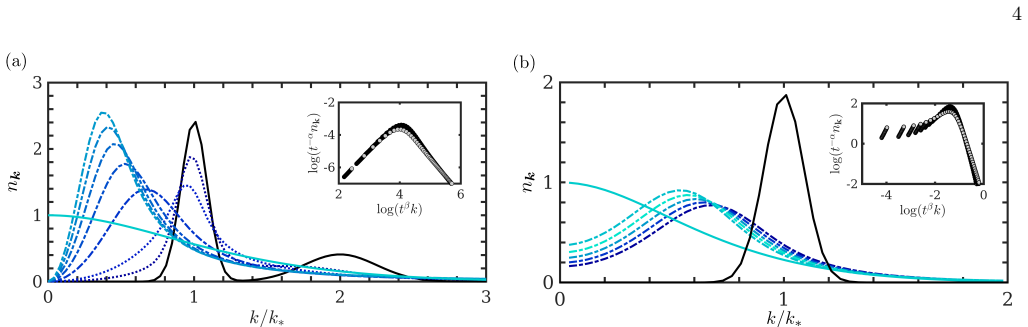
Summary. The manuscript studies far-from-equilibrium magnon dynamics in a two-dimensional Heisenberg ferromagnet. After deriving a kinetic equation with a momentum-dependent (k·p)^2 collision integral inherited from SU(2) symmetry, the authors solve it numerically for incoherent, high-occupation initial conditions and claim that the distribution becomes self-similar, n_k(t)=t^alpha f(t^beta k), with alpha=0.65±0.05, beta=0.30±0.05 and f(x)~1/x^{2.3} (Eqs. (1), (8), Fig. 2(a)). They contrast these exponents with cold-atom BEC results, present robustness checks using two-peak initial conditions and a weakly SU(2)-broken Hamiltonian, and discuss experimental relevance for YIG and cold atoms. A dimensional-analysis section derives the consistency relation 2(d+1)beta−2alpha=1 for the same kinetic equation.
Significance. If established, a new universality class for prethermal magnon dynamics would be significant, with concrete experimental signatures in Brillouin scattering, spin-qubit magnetometry, and cold-atom quenches. The paper has notable strengths: the kinetic equation is derived from a microscopic SU(2)-symmetric model; the power-counting relation follows from that same equation; the exponents are extracted from direct numerical solution of the kinetic equation rather than fitted to a pre-chosen scaling form; and robustness checks against two-peak initial conditions and a weak SU(2)-breaking perturbation are included. However, the central quantitative claim is currently undermined by the inconsistency between the fitted exponents and the paper's own scaling relation, and by the limited time window over which the collapse is demonstrated.
major comments (3)
- [Universal exponents from dimensional analysis] The fitted exponents in Eq. (8) do not satisfy the scaling relation 2(d+1)beta−2alpha=1 derived in this section from the same kinetic equation: for d=2, 6beta−2alpha=1, while the central values give 6×0.30−2×0.65=0.5, a factor-of-two discrepancy. Even at the extreme edges of the quoted errors (beta=0.35, alpha=0.60) the combination is 0.9, not 1. Since this relation is a necessary condition for n_k(t)=t^alpha f(t^beta k) to be an asymptotic self-similar solution of Eq. (7) in the n_k>>1 regime, the reported numbers cannot describe such a solution; they must be transient effective exponents. The statement in the text that the exponents are "modestly close" to the particle cascade does not address this discrepancy. To support the universality claim, the authors need to demonstrate that effective exponents extracted from the simulation converge toward the relation at later times, or provide a controlled estimate of finite-time corrections and explain why the asymptotic regime is not accessible.
- [Fig. 2(a) and Eq. (8)] The evidence for the self-similar regime is limited to t/tau* ≤ 0.3 and one to two decades in k, and the error bars in Eq. (8) are computed only from variations among initial conditions, not from uncertainty in the fitting procedure or sensitivity to the time window. No longer-time convergence test is shown, so it remains possible that the collapse is a transient crossover rather than the asymptotic universal regime. A quantitative statement of the claimed universality requires either extension of the simulation to later times with a demonstration of exponent stability, or a systematic analysis of finite-time corrections; otherwise Eq. (8) cannot be distinguished from a fit to a transient.
- [Numerical methods / reproducibility] The paper does not provide code, data, or a complete numerical specification such as the discretization scheme, time-stepping algorithm, integration tolerances, and convergence checks. Since the central claim rests on the numerical solution of Eq. (7), releasing the code or providing a detailed numerical methods appendix would allow independent verification of the data collapse and of the exponent extraction. This is a practical necessity for assessing the reliability of the reported values.
minor comments (5)
- [Introduction, paragraph 2] The phrase "lattice shacking" should be "lattice shaking".
- [Fig. 2 caption] The time sequence for panel (b) contains "0.5, 0.1" and is nonmonotonic; it likely should be "0.05, 0.1".
- [Eq. (7) and surrounding text] The symbol J is used both for the exchange coupling and as the integration measure subscript in ∫_p; consider renaming the measure to avoid ambiguity.
- [SU(2) symmetry breaking terms] The exchange anisotropy is denoted H_z in this section, which conflicts with the Zeeman field h_z introduced in Eq. (2); a distinct symbol such as H_aniso would be clearer.
- [Dimensional analysis section] The rescaled collision integral I_k = t^{3alpha-4beta-2dbeta+2beta} I_kappa is stated without defining the rescaled momenta or the argument of I_kappa; specifying these would make the power-counting derivation easier to verify.
Circularity Check
No circularity: exponents are extracted from direct numerical solution of the kinetic equation, and the analytic scaling relation is only a consistency check.
full rationale
The paper's central claim is that numerical solutions of the Boltzmann kinetic equation (7) exhibit self-similar scaling n_k(t)=t^alpha f(t^beta k) with the fitted exponents in Eq. (8). These exponents are obtained by collapsing simulation data, not by fitting constants to a pre-chosen result. The analytic dimensional-analysis relation 2(d+1)beta-2alpha=1 is derived from the same kinetic equation and used only as a consistency check; the paper explicitly acknowledges that the numerical values are only 'modestly close' to the particle-cascade branch and does not use the relation to determine alpha or beta. The robustness check with a two-peak initial condition and the n_*=1 control are independent numerical tests against the same equation. Self-citations appear only in background statements about experimental techniques and future methods (e.g., Refs. 25, 41, 43, 44, 52), and no load-bearing claim depends on an author-imported uniqueness theorem or an ansatz smuggled in via citation. The mismatch between the fitted exponents and the paper's own scaling relation is a potential internal-consistency or finite-time-effect concern, but it is not circularity: the fit is not an input renamed as a prediction. Therefore the derivation chain is self-contained with respect to circularity.
Assumptions & free parameters
free parameters (3)
- alpha =
0.65 +/- 0.05
- beta =
0.30 +/- 0.05
- f_exponent =
2.3
assumptions (6)
- standard math The Holstein-Primakoff transformation maps the Heisenberg spin Hamiltonian (2) to the bosonic Hamiltonian (5) with the (k dot p) interaction term.
- domain assumption The system is in a single magnon band with parabolic dispersion epsilon_k=JS a^2 k^2 + h_z, and only a small density of magnons rho a^2 << S, so that multi-magnon processes can be neglected.
- domain assumption The Boltzmann kinetic equation (7) with the cubic collision integral is valid over the entire prethermal window, including n*=100.
- domain assumption SU(2)-breaking interactions (dipolar, exchange anisotropy) are weak enough in the energy window of interest that they do not alter the universal exponents.
- ad hoc to paper The observed self-similar collapse over the simulated time and momentum window is asymptotic, not transient.
- domain assumption Magnon-phonon interactions are negligible on prethermal timescales t < about 1 microsecond.
Cite this review
Pith. "Pith review of Universal prethermal dynamics in Heisenberg ferromagnets." pith.science (2026). https://pith.science/paper/EJEGAZWV
@misc{pith2026190800554,
  author       = {Pith},
  title        = {Pith review of: Universal prethermal dynamics in Heisenberg ferromagnets},
  year         = {2026},
  howpublished = {\url{https://pith.science/paper/EJEGAZWV}},
  note         = {Machine review of arXiv:1908.00554}
}
read the original abstract
We study the universal far from equilibrium dynamics of magnons in Heisenberg ferromagnets. We show that such systems exhibit universal scaling in momentum and time of the quasiparticle distribution function, with the universal exponents distinct from those recently observed in Bose-Einstein condensates. This new universality class originates from the SU(2) symmetry of the Hamiltonian, which leads to a strong momentum-dependent magnon-magnon scattering amplitude. We compute the universal exponents using the Boltzmann kinetic equation and incoherent initial conditions that can be realized with microwave pumping of magnons. We compare our numerical results with analytic estimates of the scaling exponents and demonstrate the robustness of the scaling to variations in the initial conditions. Our predictions can be tested in quench experiments of spin systems in optical lattices and pump-probe experiments in ferromagnetic insulators such as yttrium iron garnet.
Figures

Reference graph
Works this paper leans on
- [1]
- [2]
- [3]
- [4]
-
[5]
Berges, A
J. Berges, A. Rothkopf, and J. Schmidt, Phys. Rev. Lett. 101, 041603 (2008)
2008
- [6]
- [7]
- [8]
Show all 55 references
-
[9]
M. C. Abraao York, A. Kurkela, E. Lu, and G. D. Moore, Phys. Rev. D 89, 074036 (2014)
2014
-
[10]
Schlichting, Phys
S. Schlichting, Phys. Rev. D 86, 065008 (2012)
2012
-
[11]
Berges, K
J. Berges, K. Boguslavski, S. Schlichting, and R. Venu- gopalan, Phys. Rev. D 89, 114007 (2014)
2014
-
[12]
Kurkela and E
A. Kurkela and E. Lu, Phys. Rev. Lett. 113, 182301 (2014)
2014
-
[13]
Pi˜ neiro Orioli, K
A. Pi˜ neiro Orioli, K. Boguslavski, and J. Berges, Phys. Rev. D 92, 025041 (2015)
2015
- [14]
-
[15]
Pr¨ ufer,et al
M. Pr¨ ufer,et al. , Nature 563, 217 (2018)
2018
-
[16]
Eigen, et al
C. Eigen, et al. , Nature 563, 221 (2018)
2018
-
[17]
S. Erne, R. B¨ ucker, T. Gasenzer, J. Berges, and J. Schmiedmayer, Nature 563, 225 (2018)
2018
-
[18]
D. C. Mattis, The Theory of Magnetism Made Simple (World Scientific, 2006)
2006
-
[19]
S. O. Demokritov, et al. , Nature 443, 430 (2006)
2006
-
[20]
V. E. Demidov, et al., Phys. Rev. Lett.99, 037205 (2007)
2007
-
[21]
A. V. Chumak, et al. , Phys. Rev. Lett. 102, 187205 (2009)
2009
-
[22]
A. A. Serga, et al. , Nature Communications 5, 3452 (2014)
2014
-
[23]
A. J. E. Kreil, et al., Phys. Rev. Lett. 121, 077203 (2018)
2018
-
[24]
A. J. Princep, R. A. Ewings, S. Ward, S. T´ oth, C. Dubs, D. Prabhakaran, and A. T. Boothroyd, npj Quantum Materials 2, 63 (2017)
2017
-
[25]
L.-M. Duan, E. Demler, and M. D. Lukin, Phys. Rev. Lett. 91, 090402 (2003)
2003
-
[26]
Trotzky, et al
S. Trotzky, et al. , Science 319, 295 (2008)
2008
-
[27]
Yan, et al
B. Yan, et al. , Nature 501, 521 (2013)
2013
-
[28]
C. V. Parker, L.-C. Ha, and C. Chin, Nature Physics 9, 769 (2013)
2013
-
[29]
Hild, et al
S. Hild, et al. , Phys. Rev. Lett. 113, 147205 (2014)
2014
-
[30]
C.-L. Hung, A. Gonz´ alez-Tudela, J. I. Cirac, and H. J. Kimble, Proc. Natl. Acad. Sci. 113, E4946 (2016)
2016
-
[31]
E. J. Davis, G. Bentsen, L. Homeier, T. Li, and M. H. Schleier-Smith, Phys. Rev. Lett. 122, 010405 (2019)
2019
-
[32]
J. Xiao, G. E. W. Bauer, K.-c. Uchida, E. Saitoh, and S. Maekawa, Phys. Rev. B 81, 214418 (2010)
2010
-
[33]
Agrawal, V
M. Agrawal, V. I. Vasyuchka, A. A. Serga, A. D. Karenowska, G. A. Melkov, B. Hillebrands, Phys. Rev. Lett. 111, 107204 (2013)
2013
-
[34]
F. J. Dyson, Phys. Rev. 102, 1217 (1956)
1956
-
[35]
A. G. Gurevich and G. A. Melkov, Magnetization oscil- lations and waves (CRC Press, 1996)
1996
-
[36]
C. L. Degen, F. Reinhard, and P. Cappellaro, Rev. Mod. Phys. 89, 035002 (2017)
2017
-
[37]
van der Sar, F
T. van der Sar, F. Casola, R. Walsworth, and A. Yacoby, Nat Commun 6, 7886 (2015)
2015
-
[38]
C. Du, T. van der Sar, T. X. Zhou, P. Upadhyaya, F. Casola, H. Zhang, M. C. Onbasli, C. A. Ross, R. L. Walsworth, Y. Tserkovnyak, and A. Yacoby, Science357, 195 (2017)
2017
-
[39]
M. S. Grinolds, S. Hong, P. Maletinsky, L. Luan, M. D. Lukin, R. L. Walsworth, and A. Yacoby, Nat Phys9, 215 (2013)
2013
-
[40]
Flebus and Y
B. Flebus and Y. Tserkovnyak, Phys. Rev. Lett. 121, 187204 (2018)
2018
-
[41]
J. F. Rodriguez-Nieva, D. Podolsky, and E. Demler, arXiv:1810.12333
-
[42]
F. K. K. Kirschner, F. Flicker, A. Yacoby, N. Y. Yao, and S. J. Blundell, Phys. Rev. B 97, 140402 (2018)
2018
-
[43]
J. F. Rodriguez-Nieva, K. Agarwal, T. Giamarchi, B. I. Halperin, M. D. Lukin, and E. Demler, Phys. Rev. B 98, 195433 (2018)
2018
-
[44]
Chatterjee, J
S. Chatterjee, J. F. Rodriguez-Nieva, and E. Demler, Phys. Rev. B 99, 104425 (2019)
2019
-
[45]
Nazarenko, Wave Turbulence , Lecture Notes in Physics (Springer Berlin Heidelberg, 2011)
S. Nazarenko, Wave Turbulence , Lecture Notes in Physics (Springer Berlin Heidelberg, 2011)
2011
-
[46]
Zakharov, V
V. Zakharov, V. Lvov, and G. Falkovich, Kolmogorov Spectra of Turbulence I: Wave Turbulence , (Springer Berlin Heidelberg, 1992)
1992
-
[47]
D. D. Sheka, I. A. Yastremsky, B. A. Ivanov, G. M. Wysin, and F. G. Mertens, Phys. Rev. B 69, 054429 (2004)
2004
-
[48]
Li, Y.-H
Y.-Q. Li, Y.-H. Liu, and Y. Zhou, Phys. Rev. B 84, 205123 (2011)
2011
-
[49]
Fujimoto and M
K. Fujimoto and M. Tsubota, Phys. Rev. A 93, 033620 (2016)
2016
-
[50]
A. J. Bray, Adv. Phys. 43, 357 (1994)
1994
-
[51]
Calabrese and Gambassi, J. Phys. A 38, R133 (2005)
2005
-
[52]
Babadi, E
M. Babadi, E. Demler, and M. Knap, Phys. Rev. X 5, 041005 (2015)
2015
-
[53]
S. M. Davidson and A. Polkovnikov, Phys. Rev. Lett. 114, 045701 (2015)
2015
-
[54]
Schachenmayer, A
J. Schachenmayer, A. Pikovski, and A. M. Rey, Phys. Rev. X 5, 011022 (2015)
2015
-
[55]
B. Zhu, A. M. Rey, and J. Schachenmayer, arXiv:1905.08782
1905 arXiv
Reviewed August 14, 2026 · model on record in the stance chip above.
Discussion (0). Continue with ORCID to comment.