REVIEW 4 major objections 6 minor 37 references
4D-CS: Exploiting Cluster Prior for 4D Spatio-Temporal LiDAR Semantic Segmentation
T0 review · 4 major / 6 minor · reviewed 2026-08-10 · deepseek-v4-flash
Pith's one-line read 4D-CS claims that explicit whole-object cluster priors, generated from a model's own past predictions and fused adaptively with point features, are what make multi-scan LiDAR semantic and moving-object segmentation consistent and state of…
desk verdict Solid empirical 4D LiDAR segmentation paper with believable SOTA gains, but the cluster-prior explanation is under-tested; the benchmark results stand regardless. read the letter →
The pith
A machine-rendered reading of the paper's core claim, the machinery that carries it, and where it could break.
The reading
What carries the argument
The central mechanism is the cluster prior: a set of foreground object clusters produced from multi-scan points and used as an explicit second view of the scene. Cluster labels are generated by voxel-based max-voting that carries the network's past semantic predictions into the current frame, followed by DBSCAN over the stacked foreground and unlabeled points, with clusters filtered to those touching a foreground point. Cluster features are the average of point features inside each cluster, and the Temporal Cluster Enhancement module refines them by attending over neighboring clusters from previous frames with Grouped Vector Attention, restoring features lost to occlusion. Finally, Adaptive Prediction Fusion computes per-point confidence scores from the concatenated branch features and uses them to weight the semantic and motion logits of the two branches, so a poor cluster cannot overwrite a good point prediction.
What would settle it
Take a validation sequence, replace the historical predictions used for cluster label generation first with ground-truth labels and then with deliberately corrupted labels. If the cluster prior is the source of the reported gains, the ground-truth version should improve accuracy substantially and the corrupted version should degrade it; if neither moves, the gains come from elsewhere. A second check is to measure intra-cluster consistency of the final semantic and motion labels: within each DBSCAN cluster, 4D-CS should show measurably higher label agreement than its point-only baseline.
Extended reading notes
Core claim
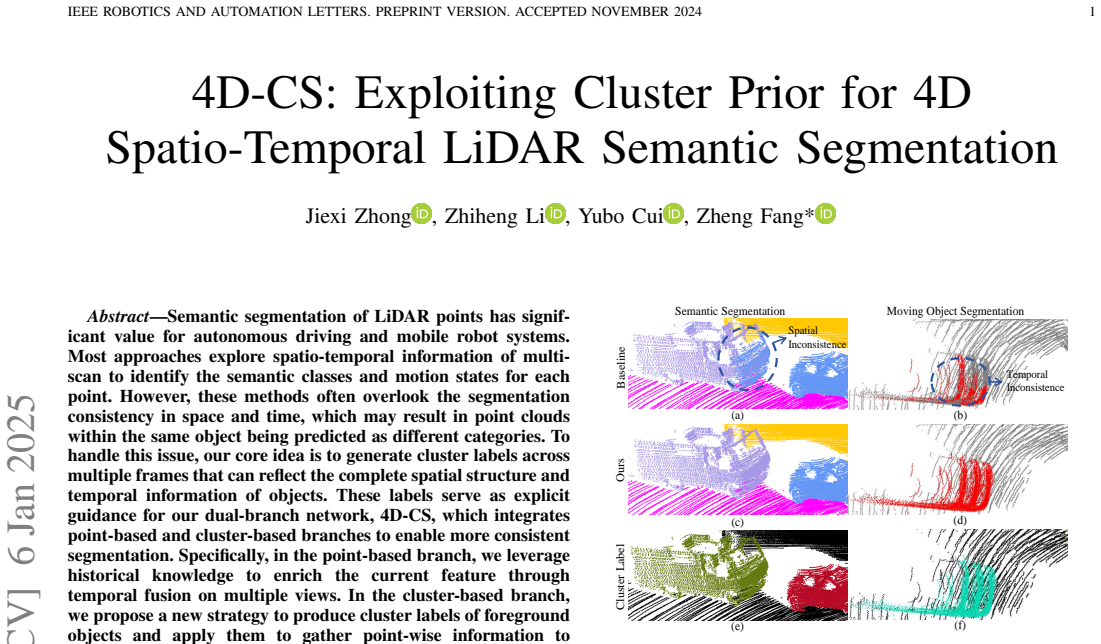
4D-CS claims that the reason multi-scan segmentation is often spatially and temporally inconsistent is that networks classify point by point without instance-level understanding. To fix this, it derives cluster labels in the current frame by transferring historical semantic predictions through voxel voting, stacking multiple aligned scans, applying DBSCAN to foreground and unlabeled points, and keeping only clusters that contain foreground points. These clusters are used to pool point features into cluster features, which are enriched by merging neighboring clusters across scans with a temporal enhancement module. The two branches' predictions are then combined by learned confidence weights. On the paper's evidence, this cluster prior is what lifts performance: compared with its WaffleIron baseline, the full model gains 5.3 points of mIoU on SemanticKITTI, large-object categories improve by 14 to 26 points, and moving-object IoU on SemanticKITTI-MOS reaches 83.5%.
Load-bearing premise
The load-bearing assumption is that clustering the stacked foreground and unlabeled points with labels taken from the model's own past predictions produces clusters that match real objects well enough to guide the segmentation.
Editorial extensions
If this is right
- Large foreground objects benefit most: trucks, other vehicles, and their moving counterparts gain 14 to 26 IoU points over the WaffleIron baseline on SemanticKITTI.
- Moving-object segmentation improves along with static semantics, so instance-level clusters help distinguish the motion states of a single object.
- Fusing historical features on three 2D views (x-y, x-z, y-z) outperforms using only a bird's-eye view, so multi-view temporal fusion retains more 3D structure.
- Adaptive confidence-weighted fusion beats hard overwrite and unweighted sum, meaning the network learns to discount unreliable cluster features.
- The added cost is modest: about 39 ms more inference time and 1.7 GB more memory than the point-only backbone on the reported setup.
Reading between the lines
- A direct metric of spatio-temporal consistency, such as the fraction of points in the same DBSCAN cluster receiving the same final label, is not reported; measuring it would test the paper's core motivation more directly than mIoU alone.
- Because cluster labels come from the model's own historical predictions, errors can feed back into the cluster branch; corrupting or ablating those historical labels would reveal how sensitive the gains are to label quality.
- The cluster branch is presented with the WaffleIron backbone and DBSCAN; the same cluster-prior idea could be tested with other point-based backbones and with agglomerative or learning-based clustering, which would show whether the mechanism generalizes.
- The method does not use ground-truth instance supervision, so integrating instance or panoptic labels during training is a natural extension that could strengthen cluster quality further.
Editorial analysis
A structured set of objections, weighed in public.
Referee Report
Summary. The paper proposes 4D-CS, a dual-branch network for multi-scan LiDAR semantic segmentation and moving object segmentation. The point-based branch uses a WaffleIron backbone and a Multi-View Temporal Fusion (MTF) module to combine historical point features. The cluster-based branch generates cluster labels by transferring the model's own historical semantic predictions into the current frame through voxel voting, applying DBSCAN to stacked foreground/unlabeled points, and then pools point features per cluster. A Temporal Cluster Enhancement (TCE) module merges neighboring cluster features across frames, and an Adaptive Prediction Fusion (APF) module adaptively weights the semantic and motion logits from both branches. Experiments on SemanticKITTI and nuScenes report state-of-the-art multi-scan mIoU (63.7 on SemanticKITTI, 67.3 on nuScenes) and moving-object IoU (83.5 on SemanticKITTI-MOS), with ablations showing the contribution of each module.
Significance. If the results hold, 4D-CS demonstrates that explicit cluster-level guidance can substantially improve segmentation of large foreground objects and motion-state consistency, with clear gains over the WaffleIron baseline and prior multi-scan methods. The paper is strengthened by comprehensive comparisons on two public benchmarks, modular ablations on the validation set, and a promised code release. However, the central mechanism—the cluster prior—is derived from the model's own historical predictions and is never directly validated: no cluster purity/completeness statistics, no oracle experiment, and no direct spatio-temporal consistency metric are reported. The claimed SOTA numbers are externally meaningful, but the paper's explanation of why the method works remains partially unsubstantiated, making the contribution interesting yet in need of additional evidence.
major comments (4)
- [III-C and Table V] The cluster labels are generated from the model's own historical semantic predictions via voxel voting and DBSCAN, but the paper never quantifies the reliability of these pseudo-labels. There is no report of cluster purity, object completeness, or agreement with ground-truth instances, and no oracle experiment is run. Table V shows that 'Direct Overwrite' degrades mIoU from 57.3 to 55.6 and IoU_M from 79.6 to 77.4, which indicates that erroneous cluster features can actively hurt performance; this makes the absence of an error-propagation analysis load-bearing. I ask for an oracle experiment (e.g., using ground-truth instance labels to form clusters) and a basic cluster-quality measurement (e.g., adjusted Rand index or purity against instance labels) to substantiate the claim that the cluster prior approximates whole objects.
- [Section IV-B and Section IV-D] The paper's core motivation is to improve 'segmentation consistency in space and time,' yet the only reported metrics are mIoU and IoU_M. These aggregate metrics do not directly measure whether points belonging to the same object receive consistent labels across frames. A direct consistency metric (e.g., temporal label consistency within tracked instances, or the proportion of points in a predicted cluster sharing the same semantic class) should be reported to validate the central claim. The qualitative figures are suggestive but not quantitative.
- [Section IV-C (Implementation Details)] The training procedure is described as: 'we train the network without historical features for 45 epochs... Afterward, the backbone is frozen, and the residual modules are trained for an additional 45 epochs.' This is unusual and underspecified: it is unclear how the cluster label generation is performed during the first phase if historical features are not used, and whether the historical predictions used as pseudo-labels come from the same network being trained or from a previously trained model. The resulting train/inference distribution mismatch for the cluster branch is not discussed.
- [Equation (6) and Section III-E] The loss function contains no explicit supervision for the cluster-based branch. Cluster features are trained only through the final segmentation and motion losses, meaning the network could learn to down-weight or ignore the cluster pathway during training. In that case the observed gains in Tables IV and V might arise primarily from the MTF and TCE modules rather than from a valid object-completeness prior. An auxiliary loss on cluster-level predictions or a direct analysis of cluster feature importance would clarify the mechanism.
minor comments (6)
- [Equation (2)] The notation in Eq. (2), specifically 'Softmax(Wi)jlvlD/h+m j', is difficult to parse; please define the tensor indexing and the softmax axis explicitly.
- [Figure 2 caption] The caption contains garbled symbols (e.g., 'tc tH tH' and misplaced subscripts) that should be corrected for readability.
- [Table V] The strategies 'Feature Fusion' and 'Unweighted Sum' are listed in Table V but not described in the text; please add one sentence defining these baselines.
- [Abstract and Section I] The abstract states the code 'will be available' at a URL, while the contributions section says 'our code will be released soon.' Please reconcile these statements and provide the release status in the final version.
- [Section IV-D (Quantitative Results)] In Table I, the improvement for 'motorcyclist' (+6.3) and several moving classes is computed from a baseline IoU of 0.0; the large relative gains should be interpreted with care since the absolute values remain low. A brief discussion of this would improve the presentation.
- [Section II-B] TASeg [21] is cited in related work but does not appear in the experimental comparisons; please state whether it was omitted for practical reasons (e.g., no public test predictions) or include it in the tables.
Circularity Check
No significant circularity: the central benchmark claims are externally validated, and the self-referential cluster-label loop does not reduce the predictions to their inputs by construction.
full rationale
The paper's derivation chain is not circular. The central claim is state-of-the-art performance on public SemanticKITTI and nuScenes benchmarks, evaluated against external methods on test servers. The cluster-based branch does use cluster labels generated from the model's own historical semantic predictions (Section III-C, 'Cluster Label Generation'), which is a self-referential pseudo-labeling design. However, no equation or construction makes the final prediction equivalent to those labels. The final outputs are an adaptive weighted sum of point-branch and cluster-branch logits with learned confidence scores (Eqs. 4 and 5), and the cluster features are average-pooled point features within DBSCAN clusters. There is no fitted parameter that is renamed as a prediction, no self-citation chain carrying the argument, and no imported uniqueness theorem. The ablation in Table V even shows that directly overwriting point features with cluster features degrades performance, indicating the cluster signal is not trivially identical to the output. The absence of cluster-purity or oracle validation is a robustness/analysis limitation, not a circular derivation. Score 0.
Assumptions & free parameters
free parameters (5)
- Non-ground voxel size for historical label transfer =
0.2m x 0.2m x 0.2m
- Ground label assignment voxel size =
10.0m x 10.0m x 0.2m
- Temporal window =
3 frames (stride 2 on nuScenes)
- KNN neighbor count in TCE =
not reported
- Number of attention groups h in TCE =
not reported (h between 1 and D)
assumptions (3)
- domain assumption Ego-motion pose transformations between frames are accurate.
- ad hoc to paper Historical semantic predictions of the model are reliable enough to serve as pseudo-labels for cluster generation.
- domain assumption DBSCAN on stacked foreground and unlabeled 3D points yields object-level clusters.
Cite this review
Pith. "Pith review of 4D-CS: Exploiting Cluster Prior for 4D Spatio-Temporal LiDAR Semantic Segmentation." pith.science (2026). https://pith.science/paper/EJI2P4LL
@misc{pith2026250102937,
  author       = {Pith},
  title        = {Pith review of: 4D-CS: Exploiting Cluster Prior for 4D Spatio-Temporal LiDAR Semantic Segmentation},
  year         = {2026},
  howpublished = {\url{https://pith.science/paper/EJI2P4LL}},
  note         = {Machine review of arXiv:2501.02937}
}
read the original abstract
Semantic segmentation of LiDAR points has significant value for autonomous driving and mobile robot systems. Most approaches explore spatio-temporal information of multi-scan to identify the semantic classes and motion states for each point. However, these methods often overlook the segmentation consistency in space and time, which may result in point clouds within the same object being predicted as different categories. To handle this issue, our core idea is to generate cluster labels across multiple frames that can reflect the complete spatial structure and temporal information of objects. These labels serve as explicit guidance for our dual-branch network, 4D-CS, which integrates point-based and cluster-based branches to enable more consistent segmentation. Specifically, in the point-based branch, we leverage historical knowledge to enrich the current feature through temporal fusion on multiple views. In the cluster-based branch, we propose a new strategy to produce cluster labels of foreground objects and apply them to gather point-wise information to derive cluster features. We then merge neighboring clusters across multiple scans to restore missing features due to occlusion. Finally, in the point-cluster fusion stage, we adaptively fuse the information from the two branches to optimize segmentation results. Extensive experiments confirm the effectiveness of the proposed method, and we achieve state-of-the-art results on the multi-scan semantic and moving object segmentation on SemanticKITTI and nuScenes datasets. The code will be available at https://github.com/NEU-REAL/4D-CS.git.
Figures


Figures from the paper (4 more)


Reference graph
Works this paper leans on
-
[1]
Suma++: Efficient lidar-based semantic slam,
X. Chen, A. Milioto, E. Palazzolo, P. Giguere, J. Behley, and C. Stach- niss, “Suma++: Efficient lidar-based semantic slam,” in 2019 IEEE/RSJ International Conference on Intelligent Robots and Systems (IROS) , pp. 4530–4537, IEEE, 2019
work page 2019
-
[2]
Robohop: Segment-based topological map representa- tion for open-world visual navigation,
S. Garg, K. Rana, M. Hosseinzadeh, L. Mares, N. S ¨underhauf, F. Day- oub, and I. Reid, “Robohop: Segment-based topological map representa- tion for open-world visual navigation,”arXiv preprint arXiv:2405.05792, 2024
arXiv 2024
-
[3]
Kpconv: Flexible and deformable convolution for point clouds,
H. Thomas, C. R. Qi, J.-E. Deschaud, B. Marcotegui, F. Goulette, and L. J. Guibas, “Kpconv: Flexible and deformable convolution for point clouds,” in Proceedings of the IEEE/CVF international conference on computer vision , pp. 6411–6420, 2019
work page 2019
-
[4]
Pointnet++: Deep hierarchical feature learning on point sets in a metric space,
C. R. Qi, L. Yi, H. Su, and L. J. Guibas, “Pointnet++: Deep hierarchical feature learning on point sets in a metric space,” Advances in neural information processing systems , vol. 30, 2017
2017
-
[5]
Pointnet: Deep learning on point sets for 3d classification and segmentation,
C. R. Qi, H. Su, K. Mo, and L. J. Guibas, “Pointnet: Deep learning on point sets for 3d classification and segmentation,” in Proceedings of the IEEE Conference on Computer Vision and Pattern Recognition , 2017
work page 2017
-
[6]
Cylinder3d: An effective 3d framework for driving-scene lidar semantic segmentation,
H. Zhou, X. Zhu, X. Song, Y . Ma, Z. Wang, H. Li, and D. Lin, “Cylinder3d: An effective 3d framework for driving-scene lidar semantic segmentation,” arXiv preprint arXiv:2008.01550 , 2020
arXiv 2008
-
[7]
Spherical transformer for lidar- based 3d recognition,
X. Lai, Y . Chen, F. Lu, J. Liu, and J. Jia, “Spherical transformer for lidar- based 3d recognition,” in Proceedings of the IEEE/CVF Conference on Computer Vision and Pattern Recognition , pp. 17545–17555, 2023
work page 2023
-
[8]
Cenet: Toward concise and efficient lidar semantic segmentation for autonomous driving,
H.-X. Cheng, X.-F. Han, and G.-Q. Xiao, “Cenet: Toward concise and efficient lidar semantic segmentation for autonomous driving,” in 2022 IEEE International Conference on Multimedia and Expo (ICME) , pp. 01–06, IEEE, 2022
work page 2022
Show all 37 references
-
[9]
Rethinking range view representation for lidar segmentation,
L. Kong, Y . Liu, R. Chen, Y . Ma, X. Zhu, Y . Li, Y . Hou, Y . Qiao, and Z. Liu, “Rethinking range view representation for lidar segmentation,” in Proceedings of the IEEE/CVF International Conference on Computer Vision, pp. 228–240, 2023
2023
-
[10]
Svqnet: Sparse voxel-adjacent query network for 4d spatio-temporal lidar se- mantic segmentation,
X. Chen, S. Xu, X. Zou, T. Cao, D.-Y . Yeung, and L. Fang, “Svqnet: Sparse voxel-adjacent query network for 4d spatio-temporal lidar se- mantic segmentation,” in Proceedings of the IEEE/CVF International Conference on Computer Vision , pp. 8569–8578, 2023
2023
-
[11]
Lidar-based recurrent 3d semantic segmentation with temporal memory alignment,
F. Duerr, M. Pfaller, H. Weigel, and J. Beyerer, “Lidar-based recurrent 3d semantic segmentation with temporal memory alignment,” in 2020 International Conference on 3D Vision (3DV), pp. 781–790, IEEE, 2020
2020
-
[12]
Meta-rangeseg: Lidar sequence seman- tic segmentation using multiple feature aggregation,
S. Wang, J. Zhu, and R. Zhang, “Meta-rangeseg: Lidar sequence seman- tic segmentation using multiple feature aggregation,” IEEE Robotics and Automation Letters, vol. 7, no. 4, pp. 9739–9746, 2022
2022
-
[13]
Memoryseg: Online lidar semantic segmentation with a latent memory,
E. Li, S. Casas, and R. Urtasun, “Memoryseg: Online lidar semantic segmentation with a latent memory,” in Proceedings of the IEEE/CVF International Conference on Computer Vision , pp. 745–754, 2023
2023
-
[14]
Using a waffle iron for automotive point cloud semantic segmentation,
G. Puy, A. Boulch, and R. Marlet, “Using a waffle iron for automotive point cloud semantic segmentation,” in Proceedings of the IEEE/CVF International Conference on Computer Vision , pp. 3379–3389, 2023
2023
-
[15]
A density-based algorithm for discovering clusters in large spatial databases with noise,
M. Ester, H.-P. Kriegel, J. Sander, X. Xu, et al. , “A density-based algorithm for discovering clusters in large spatial databases with noise,” in kdd, vol. 96, pp. 226–231, 1996
1996
-
[16]
Point transformer v2: Grouped vector attention and partition-based pooling,
X. Wu, Y . Lao, L. Jiang, X. Liu, and H. Zhao, “Point transformer v2: Grouped vector attention and partition-based pooling,” Advances in Neural Information Processing Systems , vol. 35, pp. 33330–33342, 2022
2022
-
[17]
Polarnet: An improved grid representation for online lidar point clouds semantic segmentation,
Y . Zhang, Z. Zhou, P. David, X. Yue, Z. Xi, B. Gong, and H. Foroosh, “Polarnet: An improved grid representation for online lidar point clouds semantic segmentation,” in Proceedings of the IEEE/CVF conference on computer vision and pattern recognition , pp. 9601–9610, 2020
2020
-
[18]
Search- ing efficient 3d architectures with sparse point-voxel convolution,
H. Tang, Z. Liu, S. Zhao, Y . Lin, J. Lin, H. Wang, and S. Han, “Search- ing efficient 3d architectures with sparse point-voxel convolution,” in European conference on computer vision , pp. 685–702, Springer, 2020
2020
-
[19]
Rpvnet: A deep and efficient range-point-voxel fusion network for lidar point cloud segmentation,
J. Xu, R. Zhang, J. Dou, Y . Zhu, J. Sun, and S. Pu, “Rpvnet: A deep and efficient range-point-voxel fusion network for lidar point cloud segmentation,” in Proceedings of the IEEE/CVF International Conference on Computer Vision , pp. 16024–16033, 2021
2021
-
[20]
2dpass: 2d priors assisted semantic segmentation on lidar point clouds,
X. Yan, J. Gao, C. Zheng, C. Zheng, R. Zhang, S. Cui, and Z. Li, “2dpass: 2d priors assisted semantic segmentation on lidar point clouds,” in European Conference on Computer Vision , pp. 677–695, Springer, 2022
2022
-
[21]
Taseg: Temporal aggregation network for lidar semantic segmentation,
X. Wu, Y . Hou, X. Huang, B. Lin, T. He, X. Zhu, Y . Ma, B. Wu, H. Liu, D. Cai, et al. , “Taseg: Temporal aggregation network for lidar semantic segmentation,” in Proceedings of the IEEE/CVF Conference on Computer Vision and Pattern Recognition , pp. 15311–15320, 2024
2024
-
[22]
Receding moving object segmentation in 3d lidar data using sparse 4d convolutions,
B. Mersch, X. Chen, I. Vizzo, L. Nunes, J. Behley, and C. Stachniss, “Receding moving object segmentation in 3d lidar data using sparse 4d convolutions,” IEEE Robotics and Automation Letters , vol. 7, no. 3, pp. 7503–7510, 2022
2022
-
[23]
Rvmos: Range-view moving object seg- mentation leveraged by semantic and motion features,
J. Kim, J. Woo, and S. Im, “Rvmos: Range-view moving object seg- mentation leveraged by semantic and motion features,” IEEE Robotics and Automation Letters , vol. 7, no. 3, pp. 8044–8051, 2022
2022
-
[24]
Mf-mos: A motion-focused model for moving object segmentation,
J. Cheng, K. Zeng, Z. Huang, X. Tang, J. Wu, C. Zhang, X. Chen, and R. Fan, “Mf-mos: A motion-focused model for moving object segmentation,” arXiv preprint arXiv:2401.17023 , 2024
2024 arXiv
-
[25]
Dynamic clus- tering transformer network for point cloud segmentation,
D. Lu, J. Zhou, K. Y . Gao, J. Du, L. Xu, and J. Li, “Dynamic clus- tering transformer network for point cloud segmentation,” International Journal of Applied Earth Observation and Geoinformation , vol. 128, p. 103791, 2024
2024
-
[26]
Clustering based point cloud representation learning for 3d analysis,
T. Feng, W. Wang, X. Wang, Y . Yang, and Q. Zheng, “Clustering based point cloud representation learning for 3d analysis,” in Proceedings of the IEEE/CVF International Conference on Computer Vision , pp. 8283– 8294, 2023
2023
-
[27]
The lov ´asz-softmax loss: A tractable surrogate for the optimization of the intersection-over-union measure in neural networks,
M. Berman, A. R. Triki, and M. B. Blaschko, “The lov ´asz-softmax loss: A tractable surrogate for the optimization of the intersection-over-union measure in neural networks,” in Proceedings of the IEEE conference on computer vision and pattern recognition , pp. 4413–4421, 2018
2018
-
[28]
Abstract flow for temporal se- mantic segmentation on the permutohedral lattice,
P. Schutt, R. A. Rosu, and S. Behnke, “Abstract flow for temporal se- mantic segmentation on the permutohedral lattice,” in 2022 International Conference on Robotics and Automation (ICRA) , pp. 5139–5145, IEEE, 2022
2022
-
[29]
Mars3d: A plug-and- play motion-aware model for semantic segmentation on multi-scan 3d point clouds,
J. Liu, C. Chang, J. Liu, X. Wu, L. Ma, and X. Qi, “Mars3d: A plug-and- play motion-aware model for semantic segmentation on multi-scan 3d point clouds,” in Proceedings of the IEEE/CVF Conference on Computer Vision and Pattern Recognition , pp. 9372–9381, 2023
2023
-
[30]
Segnet4d: Effective and efficient 4d lidar semantic segmentation in autonomous driving environments,
N. Wang, R. Guo, C. Shi, H. Zhang, H. Lu, Z. Zheng, and X. Chen, “Segnet4d: Effective and efficient 4d lidar semantic segmentation in autonomous driving environments,” arXiv preprint arXiv:2406.16279 , 2024
2024 arXiv
-
[31]
Semantickitti: A dataset for semantic scene understanding of lidar sequences,
J. Behley, M. Garbade, A. Milioto, J. Quenzel, S. Behnke, C. Stachniss, and J. Gall, “Semantickitti: A dataset for semantic scene understanding of lidar sequences,” in Proceedings of the IEEE/CVF international conference on computer vision , pp. 9297–9307, 2019
2019
-
[32]
nuscenes: A multi- modal dataset for autonomous driving,
H. Caesar, V . Bankiti, A. H. Lang, S. V ora, V . E. Liong, Q. Xu, A. Krishnan, Y . Pan, G. Baldan, and O. Beijbom, “nuscenes: A multi- modal dataset for autonomous driving,” in Proceedings of the IEEE/CVF conference on computer vision and pattern recognition , pp. 11621– 11631, 2020
2020
-
[33]
Decoupled weight decay regularization,
I. Loshchilov and F. Hutter, “Decoupled weight decay regularization,” arXiv preprint arXiv:1711.05101 , 2017
2017 arXiv
-
[34]
Efficient spatial-temporal information fusion for lidar-based 3d moving object segmentation,
J. Sun, Y . Dai, X. Zhang, J. Xu, R. Ai, W. Gu, and X. Chen, “Efficient spatial-temporal information fusion for lidar-based 3d moving object segmentation,” in 2022 IEEE/RSJ International Conference on Intelligent Robots and Systems (IROS) , pp. 11456–11463, IEEE, 2022
2022
-
[35]
Moving object segmentation in 3d lidar data: A learning-based approach exploiting sequential data,
X. Chen, S. Li, B. Mersch, L. Wiesmann, J. Gall, J. Behley, and C. Stach- niss, “Moving object segmentation in 3d lidar data: A learning-based approach exploiting sequential data,” IEEE Robotics and Automation Letters, vol. 6, no. 4, pp. 6529–6536, 2021
2021
-
[36]
Insmos: Instance-aware moving object segmentation in lidar data,
N. Wang, C. Shi, R. Guo, H. Lu, Z. Zheng, and X. Chen, “Insmos: Instance-aware moving object segmentation in lidar data,” arXiv preprint arXiv:2303.03909, 2023
2023 arXiv
-
[37]
Motionbev: Attention-aware online lidar moving object segmentation with bird’s eye view based appearance and motion features,
B. Zhou, J. Xie, Y . Pan, J. Wu, and C. Lu, “Motionbev: Attention-aware online lidar moving object segmentation with bird’s eye view based appearance and motion features,” arXiv preprint arXiv:2305.07336 , 2023
2023 arXiv
Reviewed August 10, 2026 · model on record in the stance chip above.
Discussion (0). Continue with ORCID to comment.