Subsystem relaxation and a calibrated sampling diagnostic for programmable quantum annealers
Pith reviewed 2026-05-20 06:19 UTC · model grok-4.3
The pith
Six-qubit subsystems on quantum annealers lose memory of their initial state when the environment is large or strongly coupled.
A machine-rendered reading of the paper's core claim, the machinery that carries it, and where it could break.
Core claim
A six-qubit subsystem becomes initial-state independent when the environment is large or strongly coupled, while quenched disorder and atypical environment states arrest relaxation. Pairing the memory order parameter with the distance to a calibrated conditional-Boltzmann reference yields a diagnostic that flags rare wrong-basin trapping that memory loss alone misses; memory-retaining conditions stay far from the reference with median distance 0.35. Relaxed ferromagnetic readouts are near-deterministic so small distances there serve as consistency checks. In a mixed-frustration benchmark the local-update model mispredicts QPU relaxation roughly sevenfold while non-local classical sampling is
What carries the argument
Subsystem-environment protocol that varies environment size, coupling, disorder, preparation, geometry and QPU generation, combined with a memory order parameter and distance to an independently calibrated conditional-Boltzmann reference distribution.
If this is right
- Relaxed ferromagnetic readouts become near-deterministic and serve as a consistency check rather than a thermometric test.
- The local-update model used by practitioners mispredicts observed relaxation dynamics by a factor of roughly seven.
- Non-local classical sampling reproduces the QPU relaxation behavior in the mixed-frustration benchmark.
- The protocol supplies a subsystem-level validation method for assessing sampling quality on quantum annealers.
Where Pith is reading between the lines
- The diagnostic could be applied to other open-system quantum devices to separate genuine thermal sampling from preparation memory.
- Extending the protocol to larger subsystems might reveal scaling limits on when environment size guarantees relaxation.
- The mismatch with local-update models suggests that sampling algorithms for annealers should incorporate non-local moves to match hardware behavior.
Load-bearing premise
The conditional-Boltzmann reference distribution can be calibrated independently of the QPU data in a way that supplies an unbiased benchmark without circular dependence on the same measurements.
What would settle it
Direct measurement showing that the six-qubit subsystem remains dependent on its initial state even in large or strongly coupled environments, or that the diagnostic distance stays large for clearly relaxed ferromagnetic cases.
Figures


read the original abstract
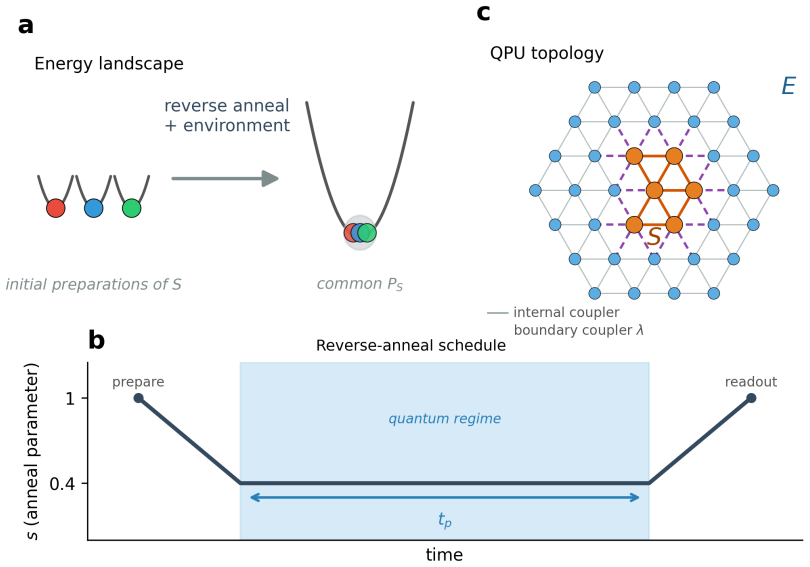
Programmable quantum annealers are used as open-system samplers, but it is unclear when reverse annealing erases preparation memory and what the readout represents. Here we implement a subsystem-environment protocol on two D-Wave quantum annealers, varying environment size, coupling, disorder, preparation, geometry and QPU generation. A six-qubit subsystem becomes initial-state independent when the environment is large or strongly coupled, while quenched disorder and atypical environment states arrest relaxation. Pairing the memory order parameter with the distance to a calibrated conditional-Boltzmann reference yields a diagnostic that flags rare wrong-basin trapping memory loss alone misses; memory-retaining conditions stay far from the reference (median 0.35). Relaxed ferromagnetic readouts are near-deterministic, so small distances there are a consistency check, not a thermometric test. In a mixed-frustration benchmark, the local-update model practitioners assume mispredicts QPU relaxation roughly sevenfold, whereas non-local classical sampling recovers it. We provide a subsystem-level validation protocol for quantum-annealer sampling.
Editorial analysis
A structured set of objections, weighed in public.
Referee Report
Summary. The manuscript implements a subsystem-environment protocol on two D-Wave quantum annealers, varying environment size, coupling strength, disorder, preparation, geometry, and QPU generation. It reports that a six-qubit subsystem becomes independent of its initial state when the environment is large or strongly coupled, while quenched disorder and atypical environment states arrest relaxation. The central contribution is a diagnostic that pairs a memory order parameter with the distance to a calibrated conditional-Boltzmann reference; this diagnostic is claimed to flag rare wrong-basin trapping events that memory loss alone misses, with memory-retaining conditions staying far from the reference (median distance 0.35). In a mixed-frustration benchmark the local-update model is reported to mispredict QPU relaxation roughly sevenfold, whereas non-local classical sampling recovers the observed behavior. The work concludes by offering a subsystem-level validation protocol for quantum-annealer sampling.
Significance. If the central claims hold, the paper supplies a practical, experimentally grounded diagnostic for assessing when programmable quantum annealers function as unbiased samplers versus when they remain trapped in wrong basins. The quantitative mismatch between the local-update model and hardware data, together with the recovery by non-local sampling, directly challenges a modeling assumption widely used by practitioners. The multi-parameter experimental sweep on real QPUs and the concrete numerical observations (six-qubit independence, median distance 0.35, sevenfold discrepancy) constitute useful benchmarks for the community. The provision of an explicit validation protocol is a constructive contribution to the field of quantum annealing as open-system sampling.
major comments (3)
- [Calibration procedure and diagnostic definition] Calibration of conditional-Boltzmann reference: the manuscript states that the reference is 'calibrated' but does not demonstrate that the calibration parameters are obtained from an independent classical procedure or from data disjoint from the QPU subsystem readouts used to compute the distance metric. Because the diagnostic's validity rests on the reference serving as an unbiased benchmark, any dependence on the same measurements renders the distance partially self-referential and weakens the claim that the diagnostic reliably distinguishes proper relaxation from trapping.
- [Mixed-frustration benchmark results] Model-mismatch quantification: the abstract and results section report that the local-update model 'mispredicts QPU relaxation roughly sevenfold.' No error bars, raw counts, or full statistical controls are supplied for this factor, nor is the precise definition of 'misprediction' (e.g., which observable, which subset of conditions) given in sufficient detail to allow independent verification. This quantitative claim is load-bearing for the paper's critique of common modeling assumptions.
- [Subsystem relaxation results] Statistical controls for relaxation claims: the central observation that 'a six-qubit subsystem becomes initial-state independent when the environment is large or strongly coupled' is presented without reported uncertainties, sample sizes per condition, or explicit tests for post-hoc selection of the 'large/strong' regimes. Because this independence underpins both the memory-order-parameter analysis and the diagnostic, the absence of these controls affects the robustness of the reported phenomenology.
minor comments (3)
- [Methods] The definition of the memory order parameter and the precise distance metric to the conditional-Boltzmann reference should be stated as explicit equations in the methods section for reproducibility.
- [Figures] Figure panels displaying distance distributions would benefit from inclusion of raw histograms or additional panels stratified by environment size and coupling to allow readers to assess the median value of 0.35 directly.
- [Experimental methods] A short table summarizing the number of experimental runs, qubit counts, and annealing schedules for each QPU generation would improve clarity of the experimental design.
Simulated Author's Rebuttal
We thank the referee for their thorough review and valuable feedback on our manuscript. We have carefully considered each comment and made revisions to improve the clarity and rigor of the presentation. Our point-by-point responses are provided below.
read point-by-point responses
-
Referee: [Calibration procedure and diagnostic definition] Calibration of conditional-Boltzmann reference: the manuscript states that the reference is 'calibrated' but does not demonstrate that the calibration parameters are obtained from an independent classical procedure or from data disjoint from the QPU subsystem readouts used to compute the distance metric. Because the diagnostic's validity rests on the reference serving as an unbiased benchmark, any dependence on the same measurements renders the distance partially self-referential and weakens the claim that the diagnostic reliably distinguishes proper relaxation from trapping.
Authors: We appreciate this observation. The calibration of the conditional-Boltzmann reference was performed using an independent classical Monte Carlo sampling procedure on the effective subsystem Hamiltonian, drawing on data sources separate from the QPU subsystem readouts. To eliminate any ambiguity regarding self-referentiality, we have added a dedicated subsection in the Methods that explicitly describes the classical calibration protocol, confirms the disjoint nature of the data, and includes a supplementary figure illustrating the calibration workflow. This revision strengthens the claim that the diagnostic serves as an unbiased benchmark. revision: yes
-
Referee: [Mixed-frustration benchmark results] Model-mismatch quantification: the abstract and results section report that the local-update model 'mispredicts QPU relaxation roughly sevenfold.' No error bars, raw counts, or full statistical controls are supplied for this factor, nor is the precise definition of 'misprediction' (e.g., which observable, which subset of conditions) given in sufficient detail to allow independent verification. This quantitative claim is load-bearing for the paper's critique of common modeling assumptions.
Authors: We agree that additional statistical detail is warranted for this quantitative claim. In the revised manuscript we have added error bars (standard error of the mean) to the relevant plots, supplied the raw event counts underlying the sevenfold factor, and provided an explicit definition of misprediction as the ratio of the local-update model's predicted relaxation probability to the observed QPU relaxation probability for the initial-state independence observable, restricted to the mixed-frustration benchmark conditions. We have also included bootstrap-derived uncertainty estimates and clarified the exact subset of parameter points used. revision: yes
-
Referee: [Subsystem relaxation results] Statistical controls for relaxation claims: the central observation that 'a six-qubit subsystem becomes initial-state independent when the environment is large or strongly coupled' is presented without reported uncertainties, sample sizes per condition, or explicit tests for post-hoc selection of the 'large/strong' regimes. Because this independence underpins both the memory-order-parameter analysis and the diagnostic, the absence of these controls affects the robustness of the reported phenomenology.
Authors: We acknowledge the value of these controls. The revised results section now reports the number of anneals per condition (typically 1000–2000), includes standard-error bars on the memory order parameter, and states that the 'large' and 'strongly coupled' regimes were defined a priori from theoretical scaling arguments rather than post-hoc inspection. We have added a statistical comparison (two-sample t-test) confirming significant loss of initial-state dependence in those regimes, together with a brief discussion of how the regime boundaries were chosen. revision: yes
Circularity Check
No significant circularity detected in derivation chain
full rationale
The provided abstract and excerpts describe an empirical protocol on D-Wave QPUs, subsystem relaxation under varying environment size/coupling/disorder, and a diagnostic pairing a memory order parameter with distance to a calibrated conditional-Boltzmann reference. No equations, sections, or derivation steps are quoted that reduce a claimed prediction or result to its own inputs by construction (e.g., no fitted parameter renamed as independent prediction, no self-citation load-bearing a uniqueness claim, no ansatz smuggled via prior work). The calibration procedure is mentioned but not detailed in a manner allowing exhibition of circular dependence on the same QPU readouts. Per hard rules, without a specific quote exhibiting Eq. X = Eq. Y or equivalent reduction, circularity cannot be claimed. The central claims rest on experimental variation and comparison to classical sampling, appearing self-contained against external benchmarks.
Axiom & Free-Parameter Ledger
free parameters (1)
- calibration parameters for conditional-Boltzmann reference
axioms (1)
- domain assumption The conditional-Boltzmann distribution provides a valid external benchmark for the relaxed subsystem state on the QPU.
Lean theorems connected to this paper
-
IndisputableMonolith/Cost/FunctionalEquation.leanwashburn_uniqueness_aczel unclear?
unclearRelation between the paper passage and the cited Recognition theorem.
Pairing the memory order parameter with the distance to a calibrated conditional-Boltzmann reference yields a diagnostic that flags rare wrong-basin trapping
-
IndisputableMonolith/Foundation/AlphaCoordinateFixation.leanJ_uniquely_calibrated_via_higher_derivative unclear?
unclearRelation between the paper passage and the cited Recognition theorem.
β_eff = 1/2h ln(n↓/n↑) ... conditional marginal P_th_S(σ_S|σ_E=1)
What do these tags mean?
- matches
- The paper's claim is directly supported by a theorem in the formal canon.
- supports
- The theorem supports part of the paper's argument, but the paper may add assumptions or extra steps.
- extends
- The paper goes beyond the formal theorem; the theorem is a base layer rather than the whole result.
- uses
- The paper appears to rely on the theorem as machinery.
- contradicts
- The paper's claim conflicts with a theorem or certificate in the canon.
- unclear
- Pith found a possible connection, but the passage is too broad, indirect, or ambiguous to say the theorem truly supports the claim.
Reference graph
Works this paper leans on
-
[1]
Application of quantum annealing to training of deep neural networks
Steven H. Adachi and Maxwell P. Henderson. “Application of quantum annealing to training of deep neural networks”. Preprint athttps://arxiv.org/abs/1510. 06356(2015)
work page 2015
-
[2]
Mohammad H. Amin, Evgeny Andriyash, Jason Rolfe, Bohdan Kulchytskyy, and Roger Melko. “Quantum Boltzmann machine”. Physical Review X8, 021050 (2018)
work page 2018
-
[3]
Marcello Benedetti, John Realpe-G´ omez, Rupak Biswas, and Alejandro Perdomo- Ortiz. “Estimation of effective temperatures in quantum annealers for sampling ap- plications: A case study with possible applications in deep learning”. Physical Review A94, 022308 (2016)
work page 2016
-
[4]
High-quality thermal Gibbs sampling with quantum annealing hardware
Jon Nelson, Marc Vuffray, Andrey Y. Lokhov, Tameem Albash, and Carleton Coffrin. “High-quality thermal Gibbs sampling with quantum annealing hardware”. Physical Review Applied17, 044046 (2022)
work page 2022
-
[5]
Programmable quantum annealers as noisy Gibbs samplers
Marc Vuffray, Carleton Coffrin, Yaroslav A. Kharkov, and Andrey Y. Lokhov. “Programmable quantum annealers as noisy Gibbs samplers”. PRX Quantum3, 020317 (2022)
work page 2022
-
[6]
Quantum annealing and condensed matter physics
Viv Kendon and Nicholas Chancellor. “Quantum annealing and condensed matter physics”. Journal of Physics: Condensed Matter38, 143005 (2026)
work page 2026
-
[7]
Global warming: Tempera- ture estimation in annealers
Jack Raymond, Sheir Yarkoni, and Evgeny Andriyash. “Global warming: Tempera- ture estimation in annealers”. Frontiers in ICT3, 23 (2016). 16
work page 2016
-
[8]
Thermalization, freeze-out, and noise: Deciphering experimental quantum annealers
Jeffrey Marshall, Eleanor G. Rieffel, and Itay Hen. “Thermalization, freeze-out, and noise: Deciphering experimental quantum annealers”. Physical Review Applied8, 064025 (2017)
work page 2017
-
[9]
Power of paus- ing: Advancing understanding of thermalization in experimental quantum annealers
Jeffrey Marshall, Davide Venturelli, Itay Hen, and Eleanor G. Rieffel. “Power of paus- ing: Advancing understanding of thermalization in experimental quantum annealers”. Physical Review Applied11, 044083 (2019)
work page 2019
-
[10]
Classical thermometry of quantum an- nealers.arXiv preprint arXiv:2512.03162, 2025
George Grattan, Pratik Sathe, and Cristiano Nisoli. “Classical thermometry of quan- tum annealers” (2025). arXiv:2512.03162
-
[11]
Elijah Pelofske and Cristiano Nisoli. “Erasing classical memory with quantum fluc- tuations: Shannon information entropy of reverse quantum annealing”. Preprint at https://arxiv.org/abs/2509.10927(2025)
-
[12]
Finite-temperature criticality through quantum annealing.arXiv preprint arXiv:2507.07167, 2025
Gianluca Teza et al. “Finite-temperature criticality through quantum anneal- ing” (2025). arXiv:2507.07167
-
[13]
Localization transition induced by programmable disorder
Jaime L. C. da C. Filho, Zoe Gonzalez Izquierdo, Andreia Saguia, Tameem Albash, Itay Hen, and Marcelo S. Sarandy. “Localization transition induced by programmable disorder”. Physical Review B105, 134201 (2022)
work page 2022
-
[14]
Entanglement and the foundations of statistical mechanics
Sandu Popescu, Anthony J. Short, and Andreas Winter. “Entanglement and the foundations of statistical mechanics”. Nature Physics2, 754–758 (2006)
work page 2006
-
[15]
Sheldon Goldstein, Joel L. Lebowitz, Roderich Tumulka, and Nino Zangh` ı. “Canon- ical typicality”. Physical Review Letters96, 050403 (2006)
work page 2006
-
[16]
From quantum chaos and eigenstate thermalization to statistical mechanics and thermodynamics
Luca D’Alessio, Yariv Kafri, Anatoli Polkovnikov, and Marcos Rigol. “From quantum chaos and eigenstate thermalization to statistical mechanics and thermodynamics”. Advances in Physics65, 239–362 (2016)
work page 2016
-
[17]
Coherent quantum annealing in a programmable 2,000 qubit Ising chain
Andrew D. King, Sei Suzuki, Jack Raymond, Alex Zucca, Trevor Lanting, Fabio Altomare, Andrew J. Berkley, et al. “Coherent quantum annealing in a programmable 2,000 qubit Ising chain”. Nature Physics18, 1324–1328 (2022)
work page 2022
-
[18]
Quantum critical dynamics in a 5,000-qubit programmable spin glass
Andrew D. King, Jack Raymond, Trevor Lanting, Richard Harris, Alex Zucca, Fabio Altomare, Andrew J. Berkley, et al. “Quantum critical dynamics in a 5,000-qubit programmable spin glass”. Nature617, 61–66 (2023)
work page 2023
-
[19]
Unraveling reverse annealing: A study of D-Wave quantum annealers
Vrinda Mehta, Hans De Raedt, Kristel Michielsen, and Fengping Jin. “Unraveling reverse annealing: A study of D-Wave quantum annealers”. Physical Review A112, 012414 (2025)
work page 2025
-
[20]
Understanding the physics of D-Wave annealers: From Schr¨ odinger to Lindblad to Markovian dynamics
Vrinda Mehta et al. “Understanding the physics of D-Wave annealers: From Schr¨ odinger to Lindblad to Markovian dynamics”. Physical Review A112, 032616 (2025)
work page 2025
-
[21]
Tameem Albash and Daniel A. Lidar. “Adiabatic quantum computation”. Reviews of Modern Physics90, 015002 (2018)
work page 2018
-
[22]
Thermalization and its mecha- nism for generic isolated quantum systems
Marcos Rigol, Vanja Dunjko, and Maxim Olshanii. “Thermalization and its mecha- nism for generic isolated quantum systems”. Nature452, 854–858 (2008)
work page 2008
-
[23]
Many-body localization and thermalization in quantum statistical mechanics
Rahul Nandkishore and David A. Huse. “Many-body localization and thermalization in quantum statistical mechanics”. Annual Review of Condensed Matter Physics6, 15–38 (2015)
work page 2015
-
[24]
Col- loquium: Many-body localization, thermalization, and entanglement
Dmitry A. Abanin, Ehud Altman, Immanuel Bloch, and Maksym Serbyn. “Col- loquium: Many-body localization, thermalization, and entanglement”. Reviews of Modern Physics91, 021001 (2019). 17
work page 2019
-
[25]
D-Wave ocean software documentation: Reverse annealing
D-Wave Quantum Inc. “D-Wave ocean software documentation: Reverse annealing”. https://docs.dwavequantum.com(2024). Accessed 2026
work page 2024
-
[26]
Quan- tum mechanical evolution towards thermal equilibrium
Noah Linden, Sandu Popescu, Anthony J. Short, and Andreas Winter. “Quan- tum mechanical evolution towards thermal equilibrium”. Physical Review E79, 061103 (2009)
work page 2009
-
[27]
Seung Woo Shin, Graeme Smith, John A. Smolin, and Umesh Vazirani. “How “quantum” is the D-Wave machine?”. Preprint athttps://arxiv.org/abs/1401. 7087(2014)
work page 2014
-
[28]
Identifying quantum coherence in quantum annealers.arXiv preprint arXiv:2602.21355, 2026
Connor Aronoff, Travis Howard, David Nicholaeff, Alejandro Lopez-Bezanilla, and Wade DeGottardi. “Identifying quantum coherence in quantum annealers” (2026). arXiv:2602.21355
-
[29]
Why and when pausing is beneficial in quantum annealing
Huo Chen and Daniel A. Lidar. “Why and when pausing is beneficial in quantum annealing”. Physical Review Applied14, 014100 (2020)
work page 2020
-
[30]
Quantum thermalization through entangle- ment in an isolated many-body system
Adam M. Kaufman, M. Eric Tai, Alexander Lukin, Matthew Rispoli, Robert Schittko, Philipp M. Preiss, and Markus Greiner. “Quantum thermalization through entangle- ment in an isolated many-body system”. Science353, 794–800 (2016)
work page 2016
-
[31]
Many-body localization in a quantum simulator with pro- grammable random disorder
J. Smith, A. Lee, P. Richerme, B. Neyenhuis, P. W. Hess, P. Hauke, M. Heyl, D. A. Huse, and C. Monroe. “Many-body localization in a quantum simulator with pro- grammable random disorder”. Nature Physics12, 907–911 (2016)
work page 2016
-
[32]
Adam L. Shaw, Daniel K. Mark, Joonhee Choi, Ran Finkelstein, Pascal Scholl, Soon- won Choi, and Manuel Endres. “Experimental signatures of hilbert-space ergodicity: Universal bitstring distributions and applications in noise learning”. Physical Review X15, 031001 (2025)
work page 2025
-
[33]
D-Wave system documentation: Solver properties, anneal schedules and qpu-specific parameters
D-Wave Quantum Inc. “D-Wave system documentation: Solver properties, anneal schedules and qpu-specific parameters”.https://docs.dwavequantum.com/docs/ latest/doc_physical_properties.html(2024). Accessed 2026
work page 2024
-
[34]
A practical heuristic for finding graph minors
Jun Cai, William G. Macready, and Aidan Roy. “A practical heuristic for finding graph minors”. Preprint athttps://arxiv.org/abs/1406.2741(2014)
work page internal anchor Pith review Pith/arXiv arXiv 2014
-
[35]
Perils of embedding for sampling problems
Jeffrey Marshall, Andrea Di Gioacchino, and Eleanor G. Rieffel. “Perils of embedding for sampling problems”. Physical Review Research2, 023020 (2020). 18
work page 2020
discussion (0)
Sign in with ORCID, Apple, or X to comment. Anyone can read and Pith papers without signing in.