REVIEW 4 major objections 4 minor 49 references
RH-RAG: Trustworthy Long-Form Generation for Privacy-Constrained Settings
T0 review · 4 major / 4 minor · reviewed 2026-08-06 · deepseek-v4-flash
Pith's one-line read A plan-write-verify loop lets local 7B models rival cloud LLM factuality.
desk verdict A sensible local-RAG architecture with a genuinely new integration, but the evaluation is too weak and circular to support the 'trustworthy' claim; worth a serious referee only if the authors redo the evidence. read the letter →
The pith
A machine-rendered reading of the paper's core claim, the machinery that carries it, and where it could break.
The reading
What carries the argument
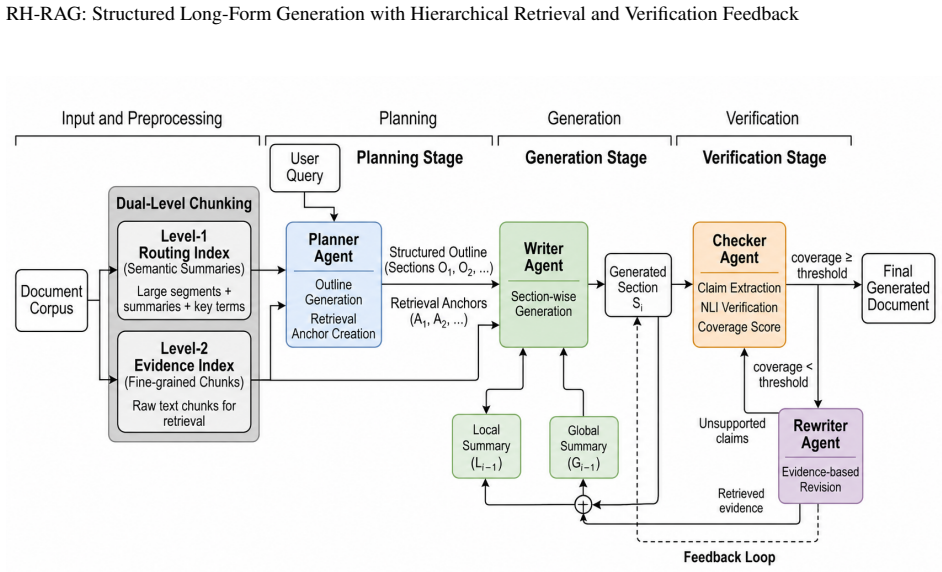
The load-bearing mechanism is the attestation-driven revision loop: a claim-level natural-language-inference (NLI) gate, expressed by Eq. (2), that blocks a generated section until a measured fraction of its atomic claims are entailed by retrieved evidence. It is supported by two complementary structures: a dual-level retrieval index (coarse routing summaries for planning, fine-grained evidence chunks for writing and checking) and a bounded coherence memory (a one-to-two-sentence local summary plus a running global summary of the document so far). The planner's retrieval anchors decouple global document structure from local evidence retrieval, so narrative coherence is fixed before generatio
What would settle it
Run RH-RAG on a corpus of never-before-published documents, have independent human annotators mark each atomic claim as supported or unsupported against the source, and compare their judgments with the NLI coverage score in Eq. (2) at $\tau = 0.8$. The central claim is falsified if accepted sections (coverage $\geq 0.8$) systematically contain human-judged unsupported claims, or if rejected sections are mostly human-supported—that is, if the coverage score does not track human factuality on novel text.
Extended reading notes
Core claim
The paper's central claim is that the missing ingredient for trustworthy local long-form generation is not a larger model or a longer context window, but a closed verification loop between generation and retrieval. Each generated section is decomposed into atomic claims; for each claim the top-$k$ evidence chunks are retrieved, and an NLI classifier marks the claim supported, unsupported, or contradicted. The section's factual coverage is computed as $$\operatorname{coverage}(S_i) = \frac{|C_{\mathrm{supported}}|}{|C_{\mathrm{total}}|},$$ and only sections reaching a coverage threshold of $\tau = 0.8$ are accepted; otherwise a Revision Agent rewrites just the failed claims using newly retrie
Load-bearing premise
The framework assumes that an NLI model's entailment judgment against the top-5 retrieved chunks is a trustworthy proxy for whether a claim is actually supported; if the checker cannot distinguish 'not retrieved' from 'false', the revision loop may polish text while missing real hallucinations—and the paper itself notes that at $\tau = 0.9$ valid legal claims get rejected because domain phrasing is absent from retrieved passages.
Editorial extensions
If this is right
- If the results hold, organizations with confidential reports can obtain cloud-comparable faithfulness from locally hosted 7–8B models, removing data-transfer risk.
- The Checker Agent is the main driver of factual grounding: removing it drops AlignScore by 3.4–4.6 points across the three test domains.
- The framework's gains transfer across literary, financial, and legal domains, suggesting the plan–write–verify mechanism is not domain-specific.
- Accepting sections only at coverage $\tau = 0.8$, with up to three revision iterations, is the paper's chosen faithfulness–compute trade-off; stricter thresholds give diminishing returns and can hurt fluency.
- Planning before writing, via retrieval anchors, establishes global narrative coherence before any text exists, decoupling structure from local evidence use.
Reading between the lines
- Because the same NLI family drives both the revision gate and the SUMMAC faithfulness metric, part of the reported gain may reflect the generator conforming to the scorer; an independent human factuality audit would estimate how much of the gain is real.
- The paper's own limitation note concedes that the literary test documents are public-domain texts likely present in pretraining corpora, so real-world confidential reports may show smaller coherence gains than these evaluations suggest.
- Domain-adaptive thresholds are a natural next step: the paper observes that at $\tau = 0.9$ the NLI checker rejects valid legal claims whose phrasing is absent from retrieved passages, implying technical domains may need specialized or evidence-augmented NLI rather than simply a higher threshold.
- The plan–write–verify decomposition is orthogonal to retrieval architecture, so combining it with graph-based retrieval or citation-anchored generation could push faithfulness further, though such combinations are untested here.
Editorial analysis
A structured set of objections, weighed in public.
Referee Report
Summary. The paper proposes RH-RAG, a multi-agent RAG framework for privacy-constrained long-form generation with local 7B–8B language models. The system has three stages: a Planner constructs a global outline and per-section retrieval anchors from a coarse Level-1 summary index; a Writer generates sections incrementally using bounded coherence memory (local + global summaries); and a Checker extracts atomic claims, judges them with DeBERTa-v3-large NLI against the top-5 Level-2 evidence chunks, and iteratively revises sections up to T=3 until a coverage threshold τ is reached. The evaluation spans literary, financial, and legal domains (20 documents per domain) and reports win-rate (GPT-4o judge), SUMMAC, and AlignScore, claiming consistent improvements over standard and hierarchical RAG baselines and near parity with proprietary cloud systems.
Significance. If the claimed results hold, the framework would be practically important: it would allow privacy-sensitive organizations to generate long, source-grounded documents with local open-weight models at reliability approaching GPT-4o-class systems. The architectural decomposition is sensible, the paper provides full prompt templates, ablates the individual stages, and tests three backbone models across three domains. These are real strengths. However, the evidence as presented does not yet support the central trustworthiness/factuality claim. The control loop and the headline faithfulness metric are the same NLI-based instrument family, the sample size is small with no significance testing, the threshold ablation table is missing, and the representative output in Appendix D shows the very repetition and prompt-leakage artifacts the framework claims to eliminate. With an independent faithfulness metric, calibration/error analysis, and statistical rigor, the contribution could be valuable; in its current form the empirical claims are not established.
major comments (4)
- [§3.4, Eq. (2); §4.3] The acceptance rule in Eq. (2) is DeBERTa-v3-large NLI coverage of generated claims against the top-5 Level-2 chunks, while the main faithfulness metric SUMMAC (§4.3) is itself an NLI-based entailment aggregation; AlignScore is another learned alignment model. The revision loop is therefore tuned to the same instrument family used for evaluation. No independent factuality evaluation (e.g., FActScore or human annotation) or calibration/error analysis is reported. Appendix C.2 even concedes that at τ=0.9 the NLI checker rejects valid legal claims, indicating that Eq. (2) is not a calibrated proxy for factual adequacy. The paper needs at least one independent faithfulness/grounding measure and a per-domain error analysis before the reported gains can be attributed to source-grounded factuality rather than better satisfaction of the evaluation instrument.
- [§3.4, top-k=5 retrieval] Judging each claim against only the top-5 retrieved Level-2 chunks cannot certify document-level grounding. A claim entailed by one retrieved passage can pass even if contradicted elsewhere in the same source document; conversely, a true claim can fail when its evidence is not in the top-5. The authors acknowledge the second failure mode in Appendix C.2. Without document-level contradiction checking or an analysis of how often accepted claims are contradicted by non-retrieved source passages, the claims of ‘document-level alignment’ and ‘trustworthy’ generation in §5 are stronger than the verification loop supports. Please quantify this risk in the revised manuscript.
- [Table 1; §5] All headline numbers come from only 20 documents per domain and are reported without error bars, per-document variance, or significance tests. The threshold ablation that motivates the default τ=0.8 is referenced as ‘Table??’ in §3.4 and §4.2, discussed in §5 and Appendix C.2, but the table is missing from the manuscript; Appendix C.2 gives only qualitative statements. For a paper whose central claim is ‘consistently improves,’ the absence of variance/statistics and the primary ablation table is a load-bearing gap. Add confidence intervals or significance tests, and complete the missing ablation.
- [Appendix D] The representative output contains extensive verbatim repetition (e.g., ‘Cash flow, people, and personal time are essential topics...’ recurs across multiple sections) and leaks the internal coherence-memory formulation: ‘it is important to have a long memory of the document's comprehensive guide... In contrast, a short memory...’. This is direct evidence of context-saturation/drift artifacts that the framework claims to solve, and it calls into question the win-rate and coherence claims in Table 1. If this output is representative, please report quantitative repetition and prompt-leakage metrics and show that such artifacts are rare across the evaluation set.
minor comments (4)
- [References] Reference [9] has a malformed author list (‘Kaiwen, Rui Wei, Dongsheng Shan...’); it needs correction and full author names.
- [§1, §2] The paper describes the verification as ‘deterministic claim-level verification,’ but the checker relies on an LLM for claim extraction, dense retrieval, and a thresholded NLI classifier. Please qualify what ‘deterministic’ means in this pipeline.
- [§3.1] Level-1 summaries are produced by a Mistral-7B-Instruct model fine-tuned on XSum, but no details are given on the fine-tuning procedure, and XSum (news) is far from the legal/financial/literary evaluation domains. The domain mismatch may affect planning quality; please provide details or a short analysis.
- [§4.3] The evaluation uses GPT-4o as an external judge, which may appear to conflict with the privacy-constrained setting. Please clarify explicitly that the judge is used only for offline evaluation and not during deployment.
Circularity Check
The Checker's NLI-coverage gate (Eq. 2) and the headline SUMMAC faithfulness metric are the same NLI judgment family, so the reported factuality gains partly reduce to optimizing the evaluator.
-
self definitional
[Section 3.4 (Eq. 2) and Section 4.3 (SUMMAC); Table 1]
"a DeBERTa-v3-large NLI model classifies the claim as supported, unsupported, or contradicted given the retrieved evidence. The section’s factual coverage is then quantified as: coverage(Si) = |Csupported|/|Ctotal| (2). If coverage(Si)≥τ, the section is accepted. ... SUMMAC [13] measures entailment-based semantic consistency between generated text and source documents using sentence-level NLI aggregation."
The revision loop's acceptance criterion is Eq. (2), an NLI entailment-coverage score against retrieved chunks, and the loop rewrites sections until coverage reaches τ. The paper's headline faithfulness evidence for 'trustworthy' is SUMMAC, which is explicitly 'sentence-level NLI aggregation.' Therefore the system is optimized to satisfy NLI entailment judgments and then evaluated with an NLI entailment metric; the reported SUMMAC gains over baselines are partly a consequence of this shared instrument, not independent evidence of source-grounded factuality. The paper reports no human factuality annotation or non-NLI metric (e.g., FActScore) to break the loop. Appendix C.2's admission that at τ=0.9 the NLI model rejects valid legal claims confirms that Eq. (2) is an uncalibrated proxy, so o
full rationale
The paper is an empirical pipeline rather than a formal derivation, so there is no hidden mathematical circularity and no load-bearing self-citation. The main circularity is the identity of the Checker's optimization target with the headline faithfulness metric: Section 3.4 defines acceptance by an NLI-coverage score, and Section 4.3 measures faithfulness with SUMMAC, which is itself NLI-based. Thus the central claim that RH-RAG improves factual grounding is at least partially by construction: the system is engineered to raise NLI entailment coverage and then scored with an NLI entailment aggregator. Win-rate is a style/coherence judge and cannot break this loop; AlignScore is a learned alignment metric, but the paper's 'trustworthy' claim relies heavily on SUMMAC. The paper's own Appendix C.2 concedes that the NLI model rejects valid claims at high thresholds, and Section 7 flags possible data contamination in the literary domain, further weakening the independence of the empirical evidence. Because the framework also contains substantive non-circular components—dual-level retrieval, planning, bounded coherence memory, and revision—the circularity is partial rather than total, supporting a score of 6.
Assumptions & free parameters
free parameters (4)
- coverage threshold tau =
0.8
- top-k retrieved passages per claim =
5
- max revision iterations T =
3
- Level-1 segment size =
20,000-30,000 tokens
assumptions (5)
- domain assumption DeBERTa-v3-large NLI entailment labels are a valid proxy for whether a claim is factually grounded in the retrieved evidence.
- domain assumption The top-k retrieved evidence chunks contain all facts needed to verify each claim; absence of support implies unsupported.
- domain assumption Mistral-7B-Instruct summaries of 20k-30k token segments preserve the information needed for routing and coherence memory.
- domain assumption GPT-4o as judge produces unbiased relative quality judgments for long-form documents.
- ad hoc to paper The attestation loop converges to factual adequacy within T=3 iterations.
Cite this review
Pith. "Pith review of RH-RAG: Trustworthy Long-Form Generation for Privacy-Constrained Settings." pith.science (2026). https://pith.science/paper/EKGRWIEK
@misc{pith2026260801311,
  author       = {Pith},
  title        = {Pith review of: RH-RAG: Trustworthy Long-Form Generation for Privacy-Constrained Settings},
  year         = {2026},
  howpublished = {\url{https://pith.science/paper/EKGRWIEK}},
  note         = {Machine review of arXiv:2608.01311}
}
read the original abstract
Generating long-form content from extensive internal reports remains challenging for organizations operating under strict privacy and security constraints, where proprietary cloud-based LLM APIs are often not viable. While locally deployed open-weight models offer a privacy-preserving alternative, existing retrieval-augmented generation (RAG) approaches on smaller models frequently lack effective global planning and accumulate factual inconsistencies over long outputs. To address these limitations, we present RH-RAG, a multi-agent framework for secure and trustworthy long form generation using local language models. RH-RAG decomposes generation into three coordinated stages: a Planner Agent that constructs a global document outline from high-level semantic summaries, a Writer Agent that incrementally generates coherent section-wise content using bounded coherence memory, and a Checker Agent that mitigates hallucinations through natural language inference-based factual verification and an attestation-driven revision loop. The framework further employs a dual-level retrieval index that supports efficient planning and fine-grained contextual generation on consumer-grade hardware. Evaluations across literary, financial, and legal domains demonstrate that RH-RAG consistently improves factual grounding, semantic coherence, and document-level alignment compared to standard and hierarchical RAG baselines, while achieving reliability competitive with proprietary cloud-based systems without compromising data privacy.
Figures
Reference graph
Works this paper leans on
-
[1]
Retrieval-augmented generation for knowledge-intensive nlp tasks
Patrick Lewis, Ethan Perez, Aleksandra Piktus, Fabio Petroni, Vladimir Karpukhin, Naman Goyal, Heinrich Küttler, Mike Lewis, Wen-tau Yih, Tim Rocktäschel, Sebastian Riedel, and Douwe Kiela. Retrieval-augmented generation for knowledge-intensive nlp tasks. InAdvances in Neural Information Processing Systems, 2020
2020
-
[2]
Leveraging passage retrieval with generative models for open domain question answering
Gautier Izacard and Edouard Grave. Leveraging passage retrieval with generative models for open domain question answering. InEACL, 2021
work page 2021
-
[3]
Darren Edge, Ha Trinh, Newman Cheng, Joshua Bradley, Alex Chao, Apurva Mody, Steven Truitt, and Jonathan Larson. From local to global: A graph rag approach to query-focused summarization.arXiv preprint arXiv:2404.16130, 2024
arXiv 2024
-
[4]
Learning to plan and generate text with citations.arXiv preprint arXiv:2404.03381, 2024
Constanza Fierro, Reinald Kim Amplayo, Fantine Huot, Nicola De Cao, Joshua Maynez, Shashi Narayan, and Mirella Lapata. Learning to plan and generate text with citations.arXiv preprint arXiv:2404.03381, 2024
arXiv 2024
-
[5]
Kanell, Peter Xu, Omar Khattab, and Monica S
Yijia Shao, Yucheng Jiang, Theodore A. Kanell, Peter Xu, Omar Khattab, and Monica S. Lam. Assisting in writing wikipedia-like articles from scratch with large language models. InProceedings of the 2024 Conference of the North American Chapter of the Association for Computational Linguistics (NAACL), pages 6252–6278, Mexico City, Mexico, 2024. Association ...
work page 2024
-
[6]
Replug: Retrieval-augmented black-box language models
Weijia Shi, Sewon Min, Michihiro Yasunaga, et al. Replug: Retrieval-augmented black-box language models. arXiv preprint arXiv:2301.12652, 2023
arXiv 2023
-
[7]
Hierarchical Context Merging: Better Long Context Understanding for Pre-trained LLMs
Woomin Song, Seunghyuk Oh, Sangwoo Mo, et al. Hierarchical context merging: Better long context understand- ing for pre-trained llms.arXiv preprint arXiv:2404.10308, 2024
work page Pith review arXiv 2024
-
[8]
Mindmap: Knowledge graph prompting sparks graph of thoughts in large language models
Yilin Wen, Zifeng Wang, and Jimeng Sun. Mindmap: Knowledge graph prompting sparks graph of thoughts in large language models. InProceedings of the 62nd Annual Meeting of the Association for Computational Linguistics (Volume 1: Long Papers), pages 10370–10388. Association for Computational Linguistics, 2024
work page 2024
Show all 49 references
-
[9]
Mirage: Scaling test-time inference with parallel graph-retrieval-augmented reasoning chains.arXiv preprint arXiv:2508.18260, 2025
Kaiwen, Rui Wei, Dongsheng Shan, Jianzhong Zou, Bi Yang, Junnan Zhao, Jiang Zhu, and Zhong. Mirage: Scaling test-time inference with parallel graph-retrieval-augmented reasoning chains.arXiv preprint arXiv:2508.18260, 2025
2025
-
[10]
Self-rag: Learning to retrieve, generate, and critique through self-reflection.arXiv preprint arXiv:2310.11511, 2023
Akari Asai, Zeqiu Wu, Yizhong Wang, Avirup Sil, and Hannaneh Hajishirzi. Self-rag: Learning to retrieve, generate, and critique through self-reflection.arXiv preprint arXiv:2310.11511, 2023
2023 arXiv
-
[11]
Factscore: Fine-grained atomic evaluation of factual precision in long form text generation
Sewon Min, Kalpesh Krishna, et al. Factscore: Fine-grained atomic evaluation of factual precision in long form text generation. InEMNLP, 2023
2023
-
[12]
Alignscore: Evaluating factual consistency with a unified alignment function
Yuheng Zha, Yichi Yang, Ruichen Li, and Zhiting Hu. Alignscore: Evaluating factual consistency with a unified alignment function. InProceedings of the 61st Annual Meeting of the Association for Computational Linguistics (ACL), 2023
2023
-
[13]
Bennett, and Marti A
Philippe Laban, Tobias Schnabel, Paul N. Bennett, and Marti A. Hearst. Summac: Re-visiting nli-based models for inconsistency detection in summarization.arXiv preprint arXiv:2111.09525, 2021
2021 arXiv
-
[14]
Wayback machine.https://archive.org/web/, 2024
Internet Archive. Wayback machine.https://archive.org/web/, 2024. Accessed: 2026-03-16
2024
-
[15]
Multi-lexsum: Real-world summaries of civil rights lawsuits at multiple granularities.arXiv preprint arXiv:2206.10883, 2022
Zejiang Shen, Kyle Lo, Lauren Yu, Nathan Dahlberg, Margo Schlanger, and Doug Downey. Multi-lexsum: Real-world summaries of civil rights lawsuits at multiple granularities.arXiv preprint arXiv:2206.10883, 2022
2022 arXiv
-
[16]
Jiang, Alexandre Sablayrolles, Antoine Roux, Arthur Mensch, et al
Albert Q. Jiang, Alexandre Sablayrolles, Antoine Roux, Arthur Mensch, et al. Mistral 7b.arXiv preprint arXiv:2310.06825, 2023
2023 arXiv
-
[17]
The llama 3 herd of models.arXiv preprint arXiv:2407.21783, 2024
Meta AI. The llama 3 herd of models.arXiv preprint arXiv:2407.21783, 2024
2024 arXiv
-
[18]
Qwen2.5 technical report.arXiv preprint arXiv:2412.15115, 2025
Qwen Team. Qwen2.5 technical report.arXiv preprint arXiv:2412.15115, 2025
2025 arXiv
-
[19]
Xing, Ion Stoica, and Joseph E
Lianmin Zheng, Wei-Lin Chiang, Ying Sheng, Siyuan Zhuang, Zhanghao Wu, Yonghao Zhuang, Zi Lin, Zhuohan Li, Dacheng Li, Eric P. Xing, Ion Stoica, and Joseph E. Gonzalez. Judging llm-as-a-judge with mt-bench and chatbot arena. InAdvances in Neural Information Processing Systems, 2023
2023
-
[20]
The probabilistic relevance framework: Bm25 and beyond.Foundations and Trends in Information Retrieval, 2009
Stephen Robertson and Hugo Zaragoza. The probabilistic relevance framework: Bm25 and beyond.Foundations and Trends in Information Retrieval, 2009. 6 RH-RAG: Structured Long-Form Generation with Hierarchical Retrieval and Verification Feedback
2009
-
[21]
Leveraging large language models in code question answering: Baselines and issues.arXiv preprint arXiv:2411.03012, 2024
Georgy Andryushchenko, Vladimir Ivanov, Vladimir Makharev, Elizaveta Tukhtina, and Aidar Valeev. Leveraging large language models in code question answering: Baselines and issues.arXiv preprint arXiv:2411.03012, 2024
2024 arXiv
-
[22]
Reliable, adaptable, and attributable language models with retrieval.arXiv preprint arXiv:2403.03187, 2024
Akari Asai, Zexuan Zhong, Danqi Chen, Pang Wei Koh, Luke Zettlemoyer, Hannaneh Hajishirzi, and Wen-tau Yih. Reliable, adaptable, and attributable language models with retrieval.arXiv preprint arXiv:2403.03187, 2024
2024 arXiv
-
[23]
Peters, and Arman Cohan
Iz Beltagy, Matthew E. Peters, and Arman Cohan. Longformer: The long-document transformer.arXiv preprint arXiv:2004.05150, 2020
2004 arXiv
-
[24]
Amanda Bertsch, Uri Alon, Graham Neubig, and Matthew R. Gormley. Unlimiformer: Long-range transformers with unlimited length input.arXiv preprint arXiv:2305.01625, 2023
2023 arXiv
-
[25]
Gosum: Extractive summarization of long documents by reinforcement learning and graph organized discourse state.arXiv preprint arXiv:2211.10247, 2023
Junyi Bian, Xiaodi Huang, Hong Zhou, and Shanfeng Zhu. Gosum: Extractive summarization of long documents by reinforcement learning and graph organized discourse state.arXiv preprint arXiv:2211.10247, 2023
2023 arXiv
-
[26]
Attributed question answering: Evaluation and modeling for attributed large language models
Bernd Bohnet, Vinh Tran, Pat Verga, Roee Aharoni, et al. Attributed question answering: Evaluation and modeling for attributed large language models. InProceedings of EMNLP, 2022
2022
-
[27]
Booookscore: A systematic exploration of book-length summarization in the era of llms
Yapei Chang, Kyle Lo, Tanya Goyal, and Mohit Iyyer. Booookscore: A systematic exploration of book-length summarization in the era of llms. InInternational Conference on Learning Representations, 2024
2024
-
[28]
Extending context window of large language models via positional interpolation.arXiv preprint arXiv:2306.15595, 2023
Shouyuan Chen, Sherman Wong, Liangjian Chen, and Yuandong Tian. Extending context window of large language models via positional interpolation.arXiv preprint arXiv:2306.15595, 2023
2023 arXiv
-
[29]
Longlora: Efficient fine-tuning of long-context large language models.arXiv preprint arXiv:2309.12307, 2024
Yukang Chen, Shengju Qian, Haotian Tang, Xin Lai, Zhijian Liu, Song Han, and Jiaya Jia. Longlora: Efficient fine-tuning of long-context large language models.arXiv preprint arXiv:2309.12307, 2024
2024 arXiv
-
[30]
Generating long sequences with sparse transformers
Rewon Child, Scott Gray, Alec Radford, and Ilya Sutskever. Generating long sequences with sparse transformers. arXiv preprint arXiv:1904.10509, 2019
1904 arXiv
-
[31]
A discourse-aware attention model for abstractive summarization of long documents
Arman Cohan, Franck Dernoncourt, Doo Soon Kim, et al. A discourse-aware attention model for abstractive summarization of long documents. InNAACL-HLT, 2018
2018
-
[32]
Gptq: Accurate post-training quantization for generative pre-trained transformers.arXiv preprint arXiv:2210.17323, 2023
Elias Frantar, Saleh Ashkboos, Torsten Hoefler, and Dan Alistarh. Gptq: Accurate post-training quantization for generative pre-trained transformers.arXiv preprint arXiv:2210.17323, 2023
2023 arXiv
-
[33]
Enabling large language models to generate text with citations
Tianyu Gao, Howard Yen, Jiatong Yu, and Danqi Chen. Enabling large language models to generate text with citations. InEMNLP, 2023
2023
-
[34]
Memsum: Extractive summarization of long documents using multi-step episodic markov decision processes
Nianlong Gu, Elliott Ash, and Richard Hahnloser. Memsum: Extractive summarization of long documents using multi-step episodic markov decision processes. InACL, 2022
2022
-
[35]
Deberta: Decoding-enhanced bert with disentan- gled attention.arXiv preprint arXiv:2006.03654, 2021
Pengcheng He, Xiaodong Liu, Jianfeng Gao, and Weizhu Chen. Deberta: Decoding-enhanced bert with disentan- gled attention.arXiv preprint arXiv:2006.03654, 2021
2006 arXiv
-
[36]
Transformers are rnns: Fast autoregressive transformers with linear attention.ICML, 2020
Angelos Katharopoulos, Apoorv Vyas, Nikolaos Pappas, and François Fleuret. Transformers are rnns: Fast autoregressive transformers with linear attention.ICML, 2020
2020
-
[37]
Booksum: A collection of datasets for long-form narrative summarization
Wojciech Kryscinski, Nazneen Rajani, Divyansh Agarwal, Caiming Xiong, and Dragomir Radev. Booksum: A collection of datasets for long-form narrative summarization. InFindings of EMNLP, 2022
2022
-
[38]
Long-context llms struggle with long in-context learning.arXiv preprint arXiv:2404.02060, 2024
Tianle Li, Ge Zhang, Quy Duc Do, Xiang Yue, and Wenhu Chen. Long-context llms struggle with long in-context learning.arXiv preprint arXiv:2404.02060, 2024
2024 arXiv
-
[39]
Rouge: A package for automatic evaluation of summaries
Chin-Yew Lin. Rouge: A package for automatic evaluation of summaries. InACL Workshop on Text Summarization, 2004
2004
-
[40]
Text summarization with pretrained encoders
Yang Liu and Mirella Lapata. Text summarization with pretrained encoders. InEMNLP, 2019
2019
-
[41]
Zeroscrolls: A zero-shot benchmark for long text understanding
Uri Shaham, Maor Ivgi, Avia Efrat, Jonathan Berant, and Omer Levy. Zeroscrolls: A zero-shot benchmark for long text understanding. InEMNLP Findings, 2023
2023
-
[42]
Extractive is not faithful: An investigation of broad unfaithfulness problems in extractive summarization
Shiyue Zhang, David Wan, and Mohit Bansal. Extractive is not faithful: An investigation of broad unfaithfulness problems in extractive summarization. InACL, 2023
2023
-
[43]
Benchmarking foundation models with language- model-as-an-examiner.Advances in Neural Information Processing Systems, 2023
Yushi Bai, Jiahao Ying, Yixin Cao, Xin Lv, Yuze He, et al. Benchmarking foundation models with language- model-as-an-examiner.Advances in Neural Information Processing Systems, 2023
2023
-
[44]
Lmsys-chat-1m: A large-scale real-world llm conversation dataset.arXiv preprint arXiv:2309.11998, 2023
Lianmin Zheng, Wei-Lin Chiang, Ying Sheng, et al. Lmsys-chat-1m: A large-scale real-world llm conversation dataset.arXiv preprint arXiv:2309.11998, 2023. 7 RH-RAG: Structured Long-Form Generation with Hierarchical Retrieval and Verification Feedback A Prompt Templates for RH-R...
2023 arXiv
-
[45]
Understand the query and determine: * objective * document type * required scope
-
[46]
Analyze routing summaries and identify: * major themes * important concepts * required evidence areas
-
[47]
section_title
Divide the document into logically ordered sections. Section Rules: * Each section should focus on one major idea * Avoid redundancy and overlapping sections * Ensure sections collectively cover the topic * Order sections logically For each section generate: * section_title: c...
2024
-
[48]
It explains how traditional education ne- glects these topics and how they can be learned through experiential learning and CASHFLOW games
Section Title:Income Differences and Invest- ment Skills Section Description:This section discusses the importance of understanding income differences and investment skills in achieving financial free- dom. It explains how traditional education ne- glects these topics and how ...
-
[49]
It explains how giving first fosters reciprocity and how creating income involves making money work for you, not working for money
Section Title:Generosity and Financial Intelli- gence Section Description:This section emphasizes the importance of generosity and financial intelli- gence in achieving financial freedom and success. It explains how giving first fosters reciprocity and how creating income invo...
Reviewed August 6, 2026 · model on record in the stance chip above.
Discussion (0). Sign in to comment.