REVIEW 3 major objections 4 minor 1 cited by
Surpassing the rate-transmittance linear bound of quantum key distribution
T0 review · 3 major / 4 minor · reviewed 2026-08-14 · deepseek-v4-flash
Pith's one-line read Quantum key distribution beats the linear loss bound in a fibre experiment.
desk verdict Solid experiment, but the PLOB-beating claim depends on an unpublished finite-size proof and a wrongly-directed bound in Appendix E. read the letter →
The pith
A machine-rendered reading of the paper's core claim, the machinery that carries it, and where it could break.
The reading
What carries the argument
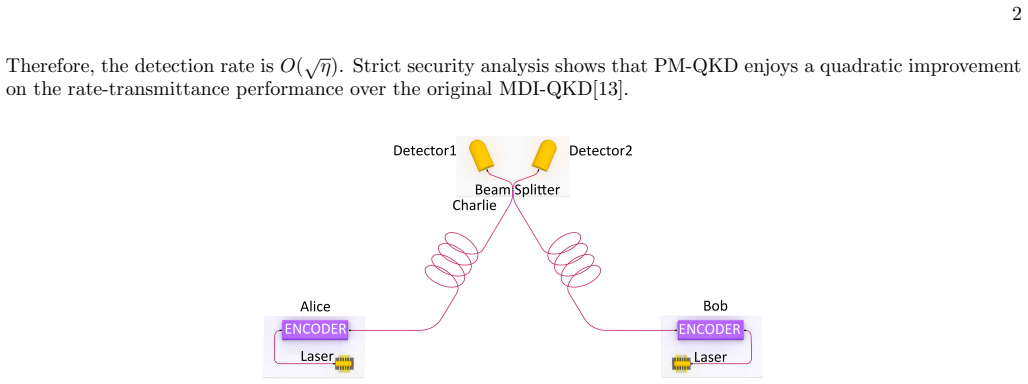
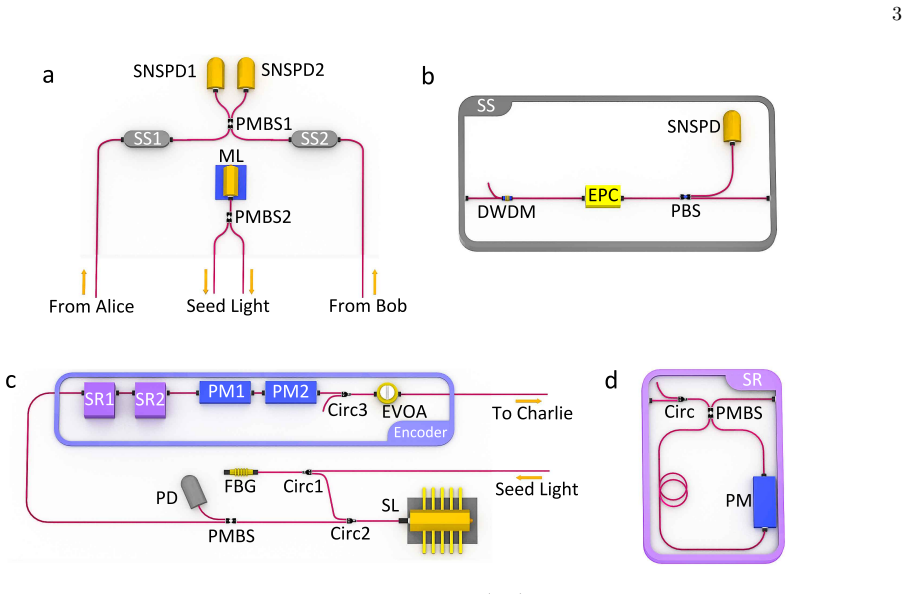
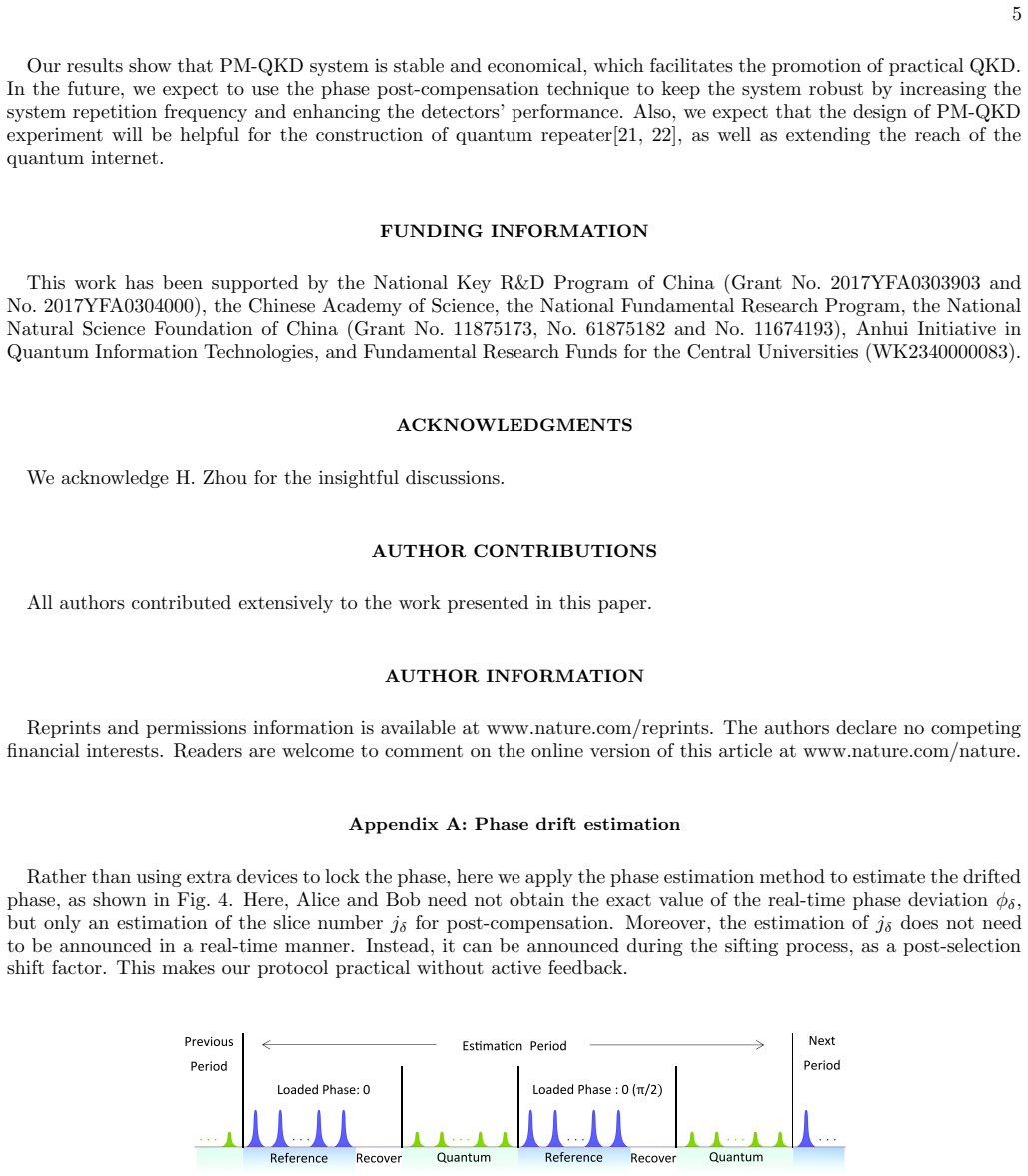
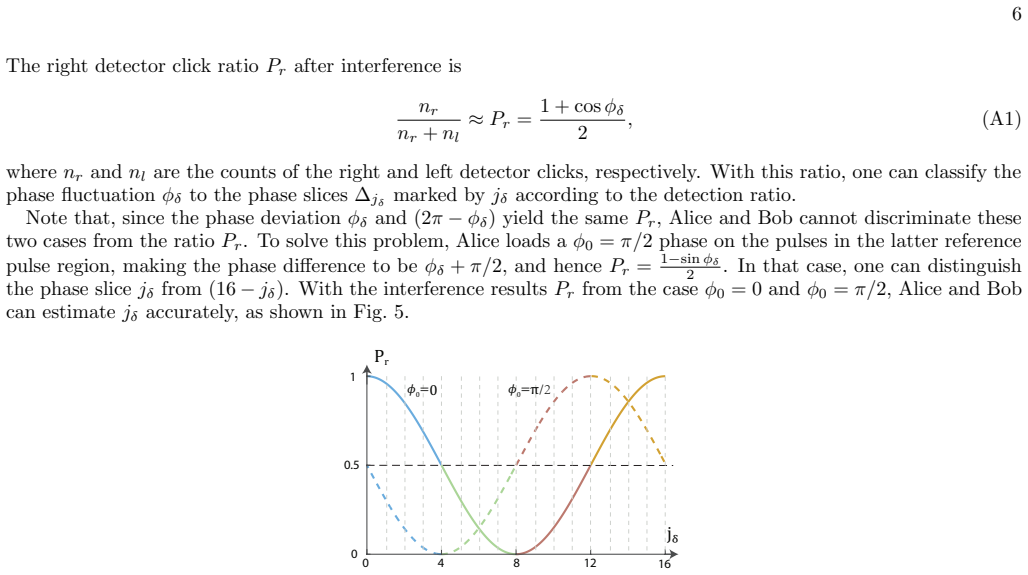
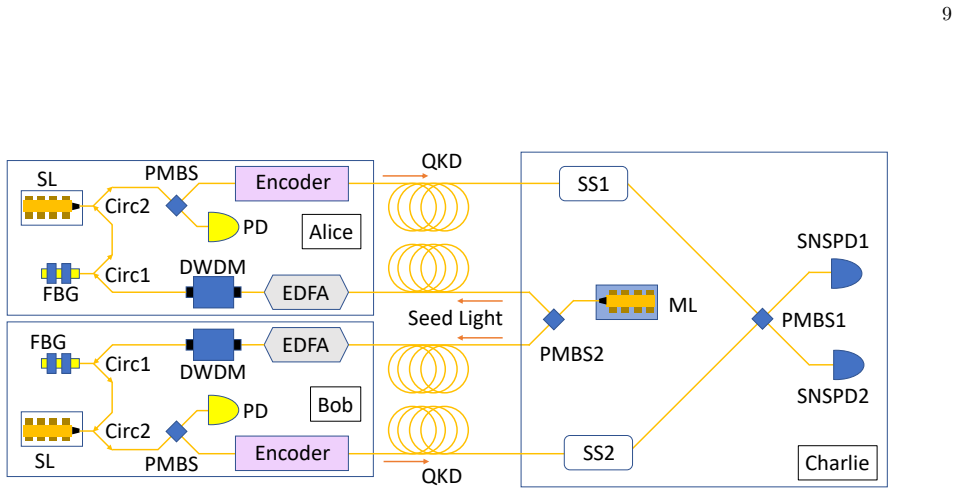
The carrying mechanism is the phase-encoding of key bits into coherent states from two independent lasers, followed by interference at a central beam splitter; the security proof decomposes the joint state into odd and even total photon-number components and shows that only the even component leaks, giving $K = M_\mu[1-H(q^{\mathrm{even}}_\mu)] - l_{\mathrm{cor}}$. Two experimental techniques make this real: laser injection, where a shared narrow-linewidth master laser seeds both slave lasers to suppress phase and frequency fluctuations, and phase post-compensation, where strong reference pulses sent through the channel estimate the slice $j_\delta$ of the phase deviation, and sifting uses $j_s = j_a - j_b + j_\delta$ to correct the drift in software rather than with active feedback. The decoy-state method bounds the even-photon fraction $q^{\mathrm{even}}_\mu$. Together, these turn the channel phase drift from a fatal error into a post-selected correction.
What would settle it
Recompute the 302 km key rate using the full finite-size security proof of Ref. [24], including an explicit treatment of the reference-pulse-based estimate $j_\delta$ as adversarial information; if the resulting key length falls below the linear bound $R_{\mathrm{PLOB}}=5.44\times10^{-7}$, or if the failure probability exceeds $1.68\times10^{-10}$, the central claim is falsified. A simpler observable check: run the same setup with active phase locking replacing post-compensation and compare key rates; a large gap would indicate the reference-pulse method leaks or biases sifting.
Extended reading notes
Core claim
The central claim is that PM-QKD can be made to work over long fibre and that its measured key rate follows the predicted quadratic improvement rather than the linear bound. The key rate formula used is $K = M_\mu[1-H(q^{\mathrm{even}}_\mu)] - l_{\mathrm{cor}}$, where the privacy term depends only on the even-photon component $q^{\mathrm{even}}_\mu$, not on the bit error rate. The experiment achieves $R = 6.74\times 10^{-7}$ at 302 km against a linear bound $R_{\mathrm{PLOB}}=5.44\times 10^{-7}$, a 24.0% margin with failure probability $1.68\times 10^{-10}$, and it also reports surpassing the bound at 402 km. At 502 km the system yields a secret key rate of 0.118 bps over an 81.7 dB channel loss, a new loss-tolerance record for fibre QKD.
Load-bearing premise
The load-bearing premise is that the unpublished finite-size security analysis in Ref. [24] is correct and covers the post-compensation sifting based on reference pulses sent through the untrusted channel, including the assumption that the phase drift stays nearly constant between reference and quantum pulses; if that proof fails, the reported key rates may not be secure.
Editorial extensions
If this is right
- The 302 km and 402 km results show that the linear rate–transmittance bound is not a practical ceiling for phase-encoding MDI QKD; secure keys can be extracted beyond it with commercial fibre.
- The 502 km result extends the fibre distance record for QKD and demonstrates operation at a channel loss comparable to satellite links, suggesting terrestrial fibre networks can reach distances previously reserved for free-space links.
- Using phase-mismatched data, the groups with $j_s \neq 0, D/2$, increases the key rate by 72.6% at 302 km, so discarding mismatched-phase rounds is wasteful; grouping them by phase difference and correcting errors group-wise is a direct rate multiplier.
- The observed rate–distance relation follows $R=O(\sqrt{\eta})$, so future QKD system design can budget for square-root scaling in loss rather than linear scaling when using PM-QKD.
Reading between the lines
- The preprint does not contain the finite-size security proof; an independent check of whether the 24% margin at 302 km survives a fully composable treatment would settle the result's standing.
- The same laser-injection and post-compensation machinery could be adapted to twin-field QKD variants and to the phase-stabilization stages of quantum repeater links, a connection the paper only gestures at in its outlook.
- A testable extension would vary the reference-pulse intensity and the time between reference and quantum pulses to map the trade-off between phase-estimation accuracy and detector noise; the paper states the protocol tolerates faster fluctuation than active locking but does not quantify this frontier.
- If the security proof covers composable finite-size key rates, QKD deployments could use cheaper, faster local lasers with software phase correction instead of active phase-locking hardware.
Signed reviews
Editorial analysis
A structured set of objections, weighed in public.
Referee Report
Summary. The paper reports an experimental implementation of phase-matching quantum key distribution (PM-QKD) over 101, 201, 302, 402 km standard fibre and 502 km ultralow-loss fibre, using laser injection for phase stabilization and a phase post-compensation sifting method. The headline claims are that the finite-size secret key rate exceeds the PLOB linear rate-transmittance bound at 302 km and 402 km, reaching 6.74e-7 bps at 302 km (24.0% above the bound) and 0.118 bps at 502 km. The key-rate formula is taken from the asymptotic PM-QKD security analysis of Ref. [13], while the finite-size parameter estimation is given as a collection of formulas in Appendix E, with the full finite-size security proof deferred to an unpublished companion paper, Ref. [24].
Significance. If the finite-size security proof and the security of the phase post-compensation sifting are valid, this is an important experimental result: it would be the first demonstration of a QKD key rate surpassing the linear rate-transmittance bound, and the 502 km result would extend the fibre QKD distance record. The manuscript has genuine strengths: the protocol is specified in Box 1, the experimental setup is described in unusual detail in Appendices A-D, extensive raw-data tables are provided, and the comparison with the PLOB bound is explicit. The asymptotic security basis in the published PRX paper (Ref. [13]) is legitimate support. However, the central quantitative claim is not self-contained: the finite-size proof is missing, and one of the few printed finite-size bounds has the wrong inequality direction. As a result, the current version does not yet establish the headline rate-transmittance claim.
major comments (3)
- [Appendix E, Eq. (E6)] Equation (E6) states \(M_{\rm even}=1-\sum_{k\ {\rm odd}}M_k \ge 1-M_1\). Since \(M_1\) is itself one of the odd contributions, \(\sum_{k\ {\rm odd}}M_k \ge M_1\), so the correct implication is \(M_{\rm even}\le 1-M_1\). As printed, a lower bound on the single-photon clicked number is converted into a lower bound on the even-photon (tagged) fraction. When used in Eqs. (E1)-(E2), this would underestimate the privacy leakage and overestimate the secure key length. This is load-bearing because the 24% margin over the PLOB bound at 302 km is computed from the finite-size key estimate. The inequality direction must be corrected and the numerical key rates in Table II re-checked.
- [Appendix E, first paragraph] The finite-size security analysis is not contained in the manuscript. The first paragraph of Appendix E states that 'the detailed finite-size security analysis of PM-QKD is in Ref. [24]', and Ref. [24] is listed as 'Under preparation'. The central claim of the paper is that the measured finite-size key rates are secure and exceed the PLOB bound; this claim rests entirely on the missing analysis. The formulas in Appendix E (Chernoff bounds, decoy-state estimates, and the quoted failure probability \(\epsilon\)) are stated without proof and do not by themselves constitute a composable finite-size security statement. A publishable version must include the complete finite-size security proof, with explicit failure probabilities for parameter estimation, error correction, and privacy amplification, or must replace the citation to the unpublished companion paper with a publicly available and refereed proof.
- [Main text after Eq. (1), Box 1, and Appendix C] The phase post-compensation sifting uses the shift \(j_\delta\), estimated from strong reference pulses transmitted through the untrusted channel and announced by Eve. The manuscript asserts, without proof, that 'the sifting strategy does not affect the security of PM-QKD' (Appendix C). This is load-bearing: at 302 km, Table II reports an aligned key length of 7,809,030 and a total key length of 13,479,300. With \(N=2.000\times10^{13}\) sending rounds, the aligned-only key rate is \(7.809\times10^6/2.000\times10^{13}=3.90\times10^{-7}\), which is below the PLOB value \(5.44\times10^{-7}\). Thus the claimed surpassing of the linear bound depends on including the phase-mismatched groups and on the unproven compatibility of the \(j_\delta\)-based sifting with the PM-QKD security proof. The security analysis must cover the public announcement of \(j_\delta\), the grouping of \(j_s\) and \(j_s+D/2\), and the joint privacy amplification over the retained groups, or the central claim is unsupported.
minor comments (4)
- [Abstract] The abstract contains a typo: 'Quantum key distribution (QKD offers' is missing the closing parenthesis after 'QKD'.
- [Appendix E, Sec. 3] The Chernoff bound formulas in Eqs. (E11)-(E15) are presented as a recipe, but the relation between the Gaussian-approximation parameter \(n_\alpha\) and the quoted failure probabilities is not stated. Please define how \(n_\alpha=7\) (Table I) leads to the reported \(\epsilon\approx1.7\times10^{-10}\).
- [Table II] The column headers 'Channel loss' and 'Total loss(double side)' appear to list transmittances rather than losses; for example, the values decrease with distance. Please clarify the definitions and units so that the PLOB bound comparison is unambiguous.
- [Reference [24]] A reference listed as 'Under preparation' cannot serve as the basis for the central finite-size security claim; it should be replaced by a published or otherwise publicly verifiable source, or the proof should be included in the manuscript.
Circularity Check
Central claim that the finite-size secure key rate beats PLOB is deferred to an unpublished companion paper by the same authors; Eq. (E6) has the inequality reversed.
-
self citation load bearing
[Appendix E, Eq. (E6) and text after Eq. (E5); Appendix C, Box 1 sifting step; Ref. [24]; Table II (302 km).]
"The detailed finite-size security analysis of PM-QKD is in Ref. [24]. ... Note that, the sifting strategy does not affect the security of PM-QKD. It only affects the error correction efficiency."
The finite-size key length formulas (E1)-(E5) and the estimator behind the reported key rates and failure probabilities are not derived here; the proof is assigned to Ref. [24], an unpublished companion paper by co-authors Zeng, Wu, and Ma. The headline 302-km margin over the PLOB bound depends on the mismatched-phase groups: Table II gives aligned key length 7,809,030 versus total 13,479,300, so aligned-only rate 3.90e-7 is below R_PLOB = 5.44e-7. The claim that the phase-post-compensation sifting with j_delta estimated from reference pulses through the untrusted channel 'does not affect the security' is asserted without proof and is load-bearing for that margin. Moreover, Eq. (E6) as printed is invalid: M_even = 1 - sum_{k odd} M_k implies M_even <= 1 - M_1, not >=.
full rationale
The paper's asymptotic PM-QKD key-rate framework comes from Ref. [13], a published peer-reviewed theory paper by two of the present authors; because that result is parameter-free and does not depend on the experimental data, it counts as independent support and does not by itself raise the circularity score. The same cannot be said for Ref. [24], which is listed as 'Under preparation' and whose authors (Zeng, Wu, Ma) are co-authors of this manuscript. Appendix E explicitly defers the detailed finite-size security analysis to Ref. [24], and the formulas supplied there are not self-contained: Eq. (E6) states M_even = 1 - sum_{k odd} M_k >= 1 - M_1, but the correct direction is M_even <= 1 - M_1. The 302-km claim of exceeding R_PLOB = 5.44e-7 by 24% uses the mismatched-phase groups (total key length 13,479,300 vs aligned-only 7,809,030, corresponding to 3.90e-7, below the bound), and the security of this mismatched-phase sifting is asserted without proof ('the sifting strategy does not affect the security of PM-QKD'). These load-bearing elements are grounded in an inaccessible self-citation, which is a genuine circularity/self-support problem. However, the experimental apparatus, raw counting data, PLOB comparison, and the published asymptotic theory are all independent content, so the score is moderate rather than extreme.
Assumptions & free parameters
free parameters (5)
- Fluctuation factor n_alpha =
7
- Error correction efficiency f =
1.1
- Signal state intensity (single side) =
0.0358, 0.0364, 0.0384, 0.0353, 0.0253 for 101, 201, 302, 402, 502 km
- Dark count rate p_d =
Listed per distance in Table II
- Number of phase slices D =
16
assumptions (4)
- domain assumption The security proof of PM-QKD (Ref [13], Ma, Zeng, Zhou, PRX 2018) is correct, including the claim that information leakage depends only on q_even and not on bit error rate.
- ad hoc to paper The finite-size security analysis in Ref [24] (Zeng, Wu, Ma, 'Under preparation') correctly bounds the key rate for finite data sizes, including the Chernoff bound estimates and the failure probabilities quoted in the paper.
- ad hoc to paper The phase post-compensation sifting, where the correction shift j_delta is estimated from strong reference pulses sent through the untrusted channel, does not compromise security.
- standard math The decoy-state method yields tight bounds on the even-photon component q_even and the single-photon yield, as used in Appendix E.
Cite this review
Pith. "Pith review of Surpassing the rate-transmittance linear bound of quantum key distribution." pith.science (2026). https://pith.science/paper/EKLGFXXW
@misc{pith2026190801271,
  author       = {Pith},
  title        = {Pith review of: Surpassing the rate-transmittance linear bound of quantum key distribution},
  year         = {2026},
  howpublished = {\url{https://pith.science/paper/EKLGFXXW}},
  note         = {Machine review of arXiv:1908.01271}
}
abstract
Quantum key distribution (QKD offers a long-term solution to establish information-theoretically secure keys between two distant users. In practice, with a careful characterization of quantum sources and the decoy-state method, measure-device-independent quantum key distribution (MDI-QKD) provides secure key distribution. While short-distance fibre-based QKD has already been available for real-life implementation, the bottleneck of practical QKD lies on the limited transmission distance. Due to photon losses in transmission, it was believed that the key generation rate is bounded by a linear function of the channel transmittance, $O(\eta)$, without a quantum repeater, which puts an upper bound on the maximal secure transmission distance. Interestingly, a new phase-encoding MDI-QKD scheme, named twin-field QKD, has been suggested to beat the linear bound, while another variant, named phase-matching quantum key distribution (PM-QKD), has been proven to have a quadratic key-rate improvement, $O(\sqrt{\eta})$. In reality, however, the intrinsic optical mode mismatch of independent lasers, accompanied by phase fluctuation and drift, impedes the successful experimental implementation of the new schemes. Here, we solve this problem with the assistance of the laser injection technique and the phase post-compensation method. In the experiment, the key rate surpasses the linear key-rate bound via 302 km and 402 km commercial-fibre channels, achieving a key rate over 4 orders of magnitude higher than the existing results in literature. Furthermore, with a 502 km ultralow-loss fibre, our system yields a secret key rate of 0.118 bps. We expect this new type of QKD schemes to become a new standard for future QKD.
Figures

Figures from the paper (4 more)

Forward citations
Cited by 1 Pith paper
-
Zigzag approach to higher key rate of sending-or-not-sending twin field quantum key distribution with finite key effects
The paper introduces a zigzag de Finetti-based bound on the phase-flip error of odd-parity post-selected bits, giving the best reported finite-key rates for SNS-TF QKD.
Reference graph
Works this paper leans on
-
[24]
Boaron, G
A. Boaron, G. Boso, D. Rusca, C. Vulliez, C. Autebert, M. Caloz, M. Perrenoud, G. Gras, F. Bussi` eres, M.-J. Li, D. Nolan, A. Martin, and H. Zbinden, Phys. Rev. Lett. 121, 190502 (2018)
2018
-
[13]
Simulation formulas for MDI-QKD protocols The key rate of MDI-QKD is [6] RMDI = 1 2{Q11[1−H(e11)]−fQrectH(Erect)}, (F6) whereQ11 =µaµbe−µa−µbY11 and 1/2 is the basis sifting factor. We take this formula from Eq. (B27) in Ref. [20]. In simulation, the gain and error rates are given by Y11 = (1−pd)2[ηaηb 2 + (2ηa + 2ηb− 3ηaηb)pd + 4(1−ηa)(1−ηb)p2 d], e11 =e...
work page 2014
-
[1]
Laser injection details As is shown in Fig. 7, the continuous wave emitted from the master laser (Realphoton Technology Ltd.) are split by a PMBS and transmitted through long fibres and finally injected into Alice and Bobs slave laser (Agilecom Ltd.). To achieve a good laser injection result, we apply the Erbium doped fiber amplifier (EDFA) to amplify the lig...
-
[2]
The circulator followed are utilized to prevent Trojan horse attack
Encoding and measurement devices In accordance with random bit values generated beforehand, two Sagnac rings [23] (SR1-2) are employed to modulate the intensities of reference state and three decoy states while two phase modulators (PM1-2) are employed to modulate encoding phases and random phases. The circulator followed are utilized to prevent Trojan ho...
-
[3]
Synchronization systems The entire system are synchronized by two arbitrary-function generators (Tektronix, AFG3253) which is not shown in Fig. 1. Three 100 KHz electric signals in phase are modulated by two arbitrary-function generators. The delay between any two of them is adjustable. Alice, Bob and Charlie use one of them to regenerate their own 312.5 ...
-
[4]
Key length formula In the experimental PM-QKD protocol introduced in Appendix C, Alice and Bob group the signals by the phase difference js. For the signals in group js, the key length is K(js) =M(js) µ [1−H(qeven(js) µ )]−l(js) cor, (E1) whereMµ(js) is the clicked rounds when Alice and Bob both send out signal lights with µia =µib =µ/2 in the group js. qe...
-
[5]
According to the security analysis in Ref
Decoy-state estimation The core of parameter estimation step is to estimate the phase error number Meven(J) µ in the signal state group set J with µa =µb =µ/2. According to the security analysis in Ref. [24], Meven(J) µ is bounded by Meven(J) µ = 1− ∑ k:odd Ms(J) k ≥ 1−Ms(J) 1 , (E6) where Ms(js) k is the k-photon clicked number in the group set J of sign...
-
[6]
To record the sending round number when Alice and Bob both send out signal, weak decoy or vacuum pulses, denoted as{Ns,N w,N vac}; and the number of according single-clicked rounds (including the rounds with error), denoted as{Ms,M w,M vac}
Show all 38 references
-
[7]
Calculate the{EU( ¯Qa), EL( ¯Qa)}a by ¯Qa∗ = ¯Ma Na
Based on an inversed usage of Chernoff bound introduced in Appendix E 3, to calculate {EU( ¯Ma), EL( ¯Ma)}a, where a =s,w,vac as signal, weak decoy and vacuum pulse, and estimate the failure probability ϵ1. Calculate the{EU( ¯Qa), EL( ¯Qa)}a by ¯Qa∗ = ¯Ma Na. (E7)
-
[8]
Pa(k) is the Poisson distribution when the intensity setting is a
Calculate the minimal Y∗L 1 based on{EU( ¯Qa∗), EL( ¯Qa∗)}a and the following formula, ¯Y∗ 1 ≥ ¯Y∗L 1 = µ µν−ν2 ( EL[ ¯Qw∗]eν− EU[ ¯Qs∗]eµν2 µ2− µ2−ν2 µ2 EU[ ¯Qvac∗] ) , (E8) calculate ¯ML k by ¯Mk =N∞ k ¯Y∗ k, (E9) 11 where N∞ k =N ∑ a Pa(k)(ra)2, (E10) are the asymptotic rou...
-
[9]
As a result, Alice and Bob can obtain an lower bound estimation of Ms(J) 1 with failure probability ϵ1 +ϵ2
Based on a direct usage of Chernoff bound introduced in Appendix E 3, to calculate ( Ms(J) 1 )L and estimate the failure probability ϵ2. As a result, Alice and Bob can obtain an lower bound estimation of Ms(J) 1 with failure probability ϵ1 +ϵ2. From Eq. (E6), we can bound the p...
-
[10]
To evaluate E( ¯Ma) from Ma, we inversely use the Chernoff bounds based on Bernoulli variables
Chernoff-Hoeffding bound Here we present the methods to evaluate E( ¯Ma) from Ma and evaluate Ms 1 from M1 using Chernoff bounds. To evaluate E( ¯Ma) from Ma, we inversely use the Chernoff bounds based on Bernoulli variables. We briefly summarize the results in Ref. [25]. For the o...
-
[11]
For the expected value E(χ), we set the lower and upper bound of the estimated χ as{χL,χU}
=ps 1M1. For the expected value E(χ), we set the lower and upper bound of the estimated χ as{χL,χU}. Denote χL = (1− ¯δL)E(χ), χU = (1 + ¯δU)E(χ). (E13) The failure probability of the estimation χ∈ [χL,χU], given by the Chernoff bound, is ϵ =e−(¯δL)2E(χ)/(2+¯δL) +e−(¯δU)2E(χ)/(...
-
[12]
(B13) in Ref
Gain, yield and error rate of PM-QKD In PM-QKD, the k-photon the yield Yk is ( Eq. (B13) in Ref. [13]) Yk≈ 1− (1− 2pd)(1−η)k, (F1) and the gain Qµ when µa =µb =µ/2, is ( Eq. (B14) in Ref. [13]) Qµ≈ 1− (1− 2pd)e−ηµ. (F2) The even signal fraction qeven µ is bounded by qeven µ ≤ ...
-
[14]
C. H. Bennett and G. Brassard, inProceedings of the IEEE International Conference on Computers, Systems and Signal Processing (IEEE Press, New York, 1984) pp. 175–179
1984
-
[15]
A. K. Ekert, Phys. Rev. Lett. 67, 661 (1991)
1991
-
[16]
Hwang, Phys
W.-Y. Hwang, Phys. Rev. Lett. 91, 057901 (2003)
2003
-
[17]
H.-K. Lo, X. Ma, and K. Chen, Phys. Rev. Lett. 94, 230504 (2005)
2005
-
[18]
Wang, Phys
X.-B. Wang, Phys. Rev. Lett. 94, 230503 (2005)
2005
-
[19]
H.-K. Lo, M. Curty, and B. Qi, Phys. Rev. Lett. 108, 130503 (2012). 14 TABLE III. Experimental data of all signals Distance (km) 101 201 302 402 502 Sending rounds Vacuum state 48107173 453046887 25000166415 147832268203 414356078125 Decoy state 6975540085 23129235810 28071615...
2012
-
[20]
Tang, H.-L
Y.-L. Tang, H.-L. Yin, S.-J. Chen, Y. Liu, W.-J. Zhang, X. Jiang, L. Zhang, J. Wang, L.-X. You, J.-Y. Guan, et al., IEEE Journal of Selected Topics in Quantum Electronics 21, 116 (2014)
2014
-
[21]
Takeoka, S
M. Takeoka, S. Guha, and M. M. Wilde, Nat. Commun. 5, 5235 (2014)
2014
-
[22]
Pirandola, R
S. Pirandola, R. Laurenza, C. Ottaviani, and L. Banchi, Nat. Commun. 8, 15043 (2017)
2017
-
[23]
Yin, T.-Y
H.-L. Yin, T.-Y. Chen, Z.-W. Yu, H. Liu, L.-X. You, Y.-H. Zhou, S.-J. Chen, Y. Mao, M.-Q. Huang, W.-J. Zhang, H. Chen, M. J. Li, D. Nolan, F. Zhou, X. Jiang, Z. Wang, Q. Zhang, X.-B. Wang, and J.-W. Pan, Phys. Rev. Lett. 117, 190501 (2016)
2016
-
[25]
Lucamarini, Z
M. Lucamarini, Z. Yuan, J. Dynes, and A. Shields, Nature 557, 400 (2018)
2018
-
[26]
X. Ma, P. Zeng, and H. Zhou, Phys. Rev. X 8, 031043 (2018)
2018
-
[27]
Lin and N
J. Lin and N. L¨ utkenhaus, Phys. Rev. A98, 042332 (2018)
2018
-
[28]
Minder, M
M. Minder, M. Pittaluga, G. Roberts, M. Lucamarini, J. Dynes, Z. Yuan, and A. Shields, Nature Photonics , 1 (2019)
2019
-
[29]
Liu, Z.-W
Y. Liu, Z.-W. Yu, W. Zhang, J.-Y. Guan, J.-P. Chen, C. Zhang, X.-L. Hu, H. Li, T.-Y. Chen, L. You, et al., arXiv preprint arXiv:1902.06268 (2019)
2019 arXiv
-
[30]
Wang, D.-Y
S. Wang, D.-Y. He, Z.-Q. Yin, F.-Y. Lu, C.-H. Cui, W. Chen, Z. Zhou, G.-C. Guo, and Z.-F. Han, Phys. Rev. X 9, 021046 (2019)
2019
-
[31]
Zhong, J
X. Zhong, J. Hu, M. Curty, L. Qian, and H.-K. Lo, arXiv preprint arXiv:1902.10209 (2019)
2019
-
[32]
Lipka, M
M. Lipka, M. Parniak, and W. Wasilewski, Applied Physics B 123, 238 (2017)
2017
-
[33]
Ma and M
X. Ma and M. Razavi, Phys. Rev. A 86, 062319 (2012)
2012
-
[34]
Zukowski, A
M. Zukowski, A. Zeilinger, M. A. Horne, and A. K. Ekert, Phys. Rev. Lett. 71, 4287 (1993)
1993
-
[35]
Briegel, W
H.-J. Briegel, W. D¨ ur, J. I. Cirac, and P. Zoller, Phys. Rev. Lett. 81, 5932 (1998)
1998
-
[36]
R. A. Bergh, in Fiber optic and laser sensors X, Vol. 1795 (International Society for Optics and Photonics, 1993) pp. 126–135
1993
-
[37]
P. Zeng, W. Wu, and X. Ma, Under preparation
-
[38]
Zhang, Q
Z. Zhang, Q. Zhao, M. Razavi, and X. Ma, Phys. Rev. A 95, 012333 (2017). 15 TABLE IV. Detailed data I of 101 km Phase Slice OPD 0 OPD 1 OPD 2 OPD 3 OPD 4 OPD 5 OPD 6 OPD 7 DETL DETR DETL DETR DETL DETR DETL DETR DETL DETR DETL DETR DETL DETR DETL DETR 0 375744 3969399 185800 4...
2017
Reviewed August 14, 2026 · model on record in the stance chip above.
Discussion (0). Continue with ORCID to comment.