REVIEW 7 major objections 7 minor 71 references
Efficient Star Distillation Attention Network for Lightweight Image Super-Resolution
T0 review · 7 major / 7 minor · reviewed 2026-08-07 · deepseek-v4-flash
Pith's one-line read A 410K-parameter lightweight super-resolution network claims the best PSNR and SSIM scores on five standard benchmarks.
desk verdict Competent incremental lightweight SR paper whose headline claim is plausible but rests on an uncontrolled comparison; worth peer review with a request for retrained baselines and code. read the letter →
The pith
A machine-rendered reading of the paper's core claim, the machinery that carries it, and where it could break.
The reading
What carries the argument
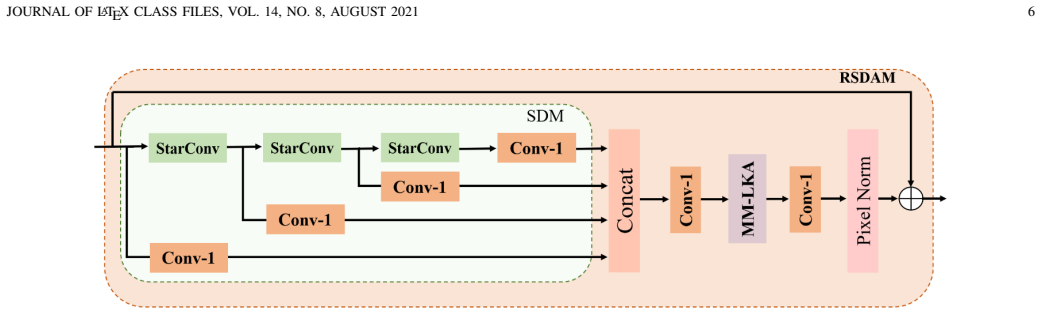
The key machinery is the Residual Star Distillation Attention Module (RSDAM), which stacks a Star Distillation Module (SDM) and a Multi-shape Multi-scale Large Kernel Attention (MM-LKA) module inside a residual connection. SDM uses the star operation (element-wise multiplication of two branches after depth-wise and 1×1 convolutions, as in StarNet) to map features into high-dimensional non-linear spaces, interleaved with channel splitting and 1×1 convolutions to distill features hierarchically. MM-LKA divides input features into groups: some receive 1D (strip) depth-wise convolutions and 1D dilated depth-wise convolutions, others receive 2D square depth-wise convolutions and 2D dilated depth-wise convolutions; the groups are concatenated and fused by a 1×1 convolution to produce attention weights that reweight the input. This design is intended to learn multi-shape multi-scale long-range dependencies while keeping computational and memory footprints far below standard LKA.
What would settle it
Train each competing lightweight method (e.g., IMDN, RFDN, OSFFNet, FIWHN) with the exact SDAN training protocol and compare on a held-out set of images not used for any hyperparameter selection; alternatively, replace SDM and MM-LKA in SDAN with a matched-parameter plain residual block and check whether the 0.33 dB gap on Set5 ×4 disappears.
Extended reading notes
Core claim
The central discovery claimed is that a lightweight SR architecture can obtain state-of-the-art reconstruction quality by performing information distillation in high-dimensional non-linear feature spaces (using the star operation) instead of in low-dimensional spaces, and by capturing multi-shape multi-scale long-range dependencies with a group-wise 1D/2D depth-wise large-kernel attention module that avoids the quadratic complexity of standard large kernel attention. The paper reports that SDAN with 410K parameters attains the best PSNR/SSIM among compared lightweight methods on all five benchmarks for ×4 SR, e.g., 32.54 dB on Set5 and 31.13 dB on Manga109, and also matches or exceeds heavyweight networks such as EDSR, RDN, and RCAN while using at least 10 times fewer parameters. The authors attribute this to the discriminative representation learning enabled by SDM and the representative long-range dependencies captured by MM-LKA.
Load-bearing premise
The load-bearing premise is that the reported PSNR/SSIM improvements are caused by the proposed SDM and MM-LKA modules rather than by the particular training recipe or by kernel-size choices tuned on the test benchmarks.
Editorial extensions
If this is right
- If the reported results reproduce, lightweight super-resolution can reach the quality of models with 10 to 100 times more parameters, lowering the barrier for on-device SR.
- The star operation may serve as a cheap nonlinearity for channel distillation in other low-level vision tasks such as denoising and deblurring.
- MM-LKA's group-wise combination of strip and square depth-wise kernels offers a template for reducing large-kernel attention cost in other CNN architectures.
- The ablations suggest MM-LKA contributes more than SDM to the gain (0.22 dB vs 0.12 dB on Set5 ×4), pointing future work toward attention design rather than distillation alone.
Reading between the lines
- The paper's ablations tune kernel sizes on Manga109 and Set5, the same benchmarks used for final reporting; a fairer estimate of generalizable gain would come from a held-out validation set.
- Because the training protocol (Adan, constant learning rate 5e-3, 1e6 iterations, EMA 0.999) differs from that of prior baselines, part of the reported margin may be training-recipe rather than architecture; re-running baselines under the same protocol would isolate the module contribution.
- The same grouped multi-shape large-kernel attention idea could transfer to high-level vision tasks, where LKA has been used for classification and detection, and the parameter savings might be analogous.
- A testable extension is to increase the number of RSDAM blocks at fixed parameter budget to see whether the star-distillation design continues to gain, or saturates sooner than standard residual blocks.
Signed reviews
Editorial analysis
A structured set of objections, weighed in public.
Referee Report
Summary. The manuscript proposes SDAN, a lightweight single-image super-resolution network built from a Star Distillation Module (SDM) and a Multi-shape Multi-scale Large Kernel Attention (MM-LKA) module, integrated into a Residual Star Distillation Attention Module (RSDAM). SDM applies the 'star operation' inside a multi-branch channel-splitting distillation structure, and MM-LKA computes attention from groups of 1D and 2D depth-wise convolutions of different kernel shapes and sizes. The network is trained from scratch with the ADAN optimizer on DF2K and evaluated on Set5, Set14, BSD100, Urban100, and Manga109 at scales ×2, ×3, and ×4. The paper reports best or second-best PSNR/SSIM among the compared lightweight methods on all five datasets with roughly 405–410K parameters, and results comparable to heavy networks such as EDSR and RDN with far fewer parameters.
Significance. If the reported gains are attributable to the proposed architecture, this is a meaningful contribution: it combines two currently active ideas (star operation and decomposed large-kernel attention) in a low-parameter regime and reports consistent gains over recent lightweight SR methods. The paper includes extensive benchmarking, and the reported numbers are direct measurements rather than predictions from fitted constants, so there is no circularity in the empirical claims. However, the central attribution claim is currently under-supported because the ablations lack a specified baseline, hyperparameters are chosen on test benchmarks, and prior methods are not retrained under the same protocol; these are fixable experimental issues rather than logical inconsistencies. No code or trained models are provided, which further limits independent verification.
major comments (7)
- [Section IV.A / Table V] The comparison with prior lightweight methods is uncontrolled. SDAN is trained with the ADAN optimizer (β1=0.98, β2=0.92, β3=0.99), EMA 0.999, constant learning rate 5×10^-3, and 1×10^6 iterations, whereas the baseline numbers are taken from their original papers with their own optimizers, schedules, and iteration counts. Given that the PSNR margins over the strongest baselines are only 0.02–0.20 dB (e.g., 32.54 vs. 32.39 dB on Set5 ×4 and 27.74 vs. 27.72 dB on BSD100 ×4), the reported superiority may be a training-recipe effect rather than an architectural one. Please retrain all baselines under the SDAN training protocol, or provide an ablation that fixes the training protocol and varies only the architecture.
- [Section IV.B / Tables II and III] The ablations select architectural hyperparameters on the same test benchmarks used for final comparison: the SDM kernel size is chosen on Manga109 ×3 and the MM-LKA kernel sizes on Set5 ×4, and these benchmarks reappear in Table V. This induces selection bias in the final reported numbers. Please move hyperparameter selection to a held-out validation set, or use a nested evaluation that does not reuse the test split.
- [Section IV.B / Table I] The baseline for the break-down ablation is not architecturally specified. The text says 'the model without the SDM and MM-LKA' but does not describe the remaining layers, channel widths, number of RSDAM-like blocks, or parameter count. Without this specification, the 0.12, 0.22, and 0.33 dB increments cannot be attributed to SDM and MM-LKA rather than to changes in capacity. Please give a precise baseline configuration and, ideally, parameter-matched variants.
- [Section IV.B / Tables II and V] The parameter counts are inconsistent. The SDM kernel-size ablation reports 451K parameters for kz=7 on ×3 (Table II), and the text indicates that larger kernels perform better, yet the final ×3 SDAN in Table V has only 408K parameters. The paper does not explain how the selected kernel is reconciled with the final model's parameter count. Please clarify which kernel size is used in the final model and why the counts differ.
- [Section IV.B / Table III] The presentation of the MM-LKA ablation conflicts with the text. The text states that the configuration with 7×7 square convolution and strip size 11 gives the best 32.54 dB, but as typeset, Table III does not unambiguously associate 32.54 dB with that configuration; the column markers appear to place the value elsewhere. The table should be re-typeset so that each column is a named configuration, and the text and table must agree.
- [Section III.C / Table VI] The claim that MM-LKA has lower computational and memory footprints than LKA is asserted but not demonstrated. No FLOPs or parameter comparison between LKA and MM-LKA is given, and Table VI reports only absolute FLOPs for whole networks. Please provide a formal derivation of the complexity reduction, or an ablation that measures the complexity of LKA versus MM-LKA under matched settings.
- [Table V / Related Work] The comparison table omits several recent LKA-based lightweight SR methods discussed in the Related Work, including LKASR, LKDN, MSID, and LCAN. Since the paper's contribution is specifically an improvement over LKA, these omissions weaken the state-of-the-art claim. Please include these methods or justify their exclusion.
minor comments (7)
- [Section IV.C / Tables IV and V] The text refers to Table IV for lightweight SR results and Table V for heavy-model comparison, but the captions indicate the reverse; the cross-references should be corrected.
- [Section IV.C / Visual results] LBRN is mentioned in the visual comparison but is not listed among the compared methods in Table V and is not described anywhere in the paper.
- [Section III.A] BSConv is used without definition or citation; please specify what this convolution is and why it is chosen.
- [Section II.A / References] Luo et al.'s LatticeNet is cited as reference [39], but reference [39] is the LKDN paper; LatticeNet appears to be reference [36].
- [Section IV.D] The phrase 'FLOPs [43]' cites ECA-Net; a standard reference for FLOPs should be used, or the bracket removed.
- [Equation (5) / Section III.A] There are garbled symbols in the loss-function paragraph: 'Where' is capitalized mid-sentence and the parameters symbol appears as '9'; the formatting should be fixed.
- [Table III / Table V] The parameter counts across the MM-LKA ablation and the final model should be made consistent; currently the best configuration selected in Table III is not clearly tied to the 410K parameter count reported for ×4 in Table V.
Circularity Check
No significant circularity: SDAN's results are direct empirical measurements, with only non-load-bearing self-citations.
full rationale
The paper contains no derivation that takes a fitted constant or a self-cited theorem as input and outputs the claimed result. SDAN's reported PSNR/SSIM values (e.g., 32.54 dB on Set5 x4 in Table V) are direct measurements of a trained network against external benchmarks (Set5, Set14, BSD100, Urban100, Manga109), not predictions from a model with parameters fitted to those benchmarks. The proposed SDM and MM-LKA are specified by explicit equations (Eq. 7-11), and their contributions are assessed by ablations in Table I that train and test under the stated DF2K protocol; the ablation increments are empirical, not derived from the modules' definitions. Self-citations to LCAN [41] and ERAN [47] appear only in related-work and comparison tables and do not bear on the central claim. The kernel-size choices in Tables II and III are selected on Manga109 and Set5 and then reported on the same benchmarks, which is a correctness and selection-bias concern, not a circular reduction: no quantity is defined in terms of another or forced by construction. Thus no circular step can be exhibited with the required reduction, and the honest finding is no significant circularity; the score of 2 reflects the presence of minor, non-load-bearing self-citations rather than any identified circular step.
Assumptions & free parameters
free parameters (4)
- StarConv depth-wise kernel size =
7x7 (best)
- MM-LKA square kernel size =
7x7 (best)
- MM-LKA strip kernel size =
7 (best per Table III; text claims 11)
- Number of RSDAM blocks M =
not stated
assumptions (3)
- domain assumption The star operation maps inputs into high-dimensional non-linear feature spaces, as claimed by StarNet.
- domain assumption Bicubic downsampled training pairs and PSNR/SSIM in YCbCr space are the appropriate evaluation protocol.
- domain assumption L1 loss with ADAN optimizer, EMA 0.999, and 1e6 iterations is a fair training setup.
invented entities (3)
-
Star Distillation Module (SDM)
-
Multi-shape Multi-scale Large Kernel Attention (MM-LKA)
-
Residual Star Distillation Attention Module (RSDAM)
Cite this review
Pith. "Pith review of Efficient Star Distillation Attention Network for Lightweight Image Super-Resolution." pith.science (2026). https://pith.science/paper/EKVBUORM
@misc{pith2026250612475,
  author       = {Pith},
  title        = {Pith review of: Efficient Star Distillation Attention Network for Lightweight Image Super-Resolution},
  year         = {2026},
  howpublished = {\url{https://pith.science/paper/EKVBUORM}},
  note         = {Machine review of arXiv:2506.12475}
}
read the original abstract
In recent years, the performance of lightweight Single-Image Super-Resolution (SISR) has been improved significantly with the application of Convolutional Neural Networks (CNNs) and Large Kernel Attention (LKA). However, existing information distillation modules for lightweight SISR struggle to map inputs into High-Dimensional Non-Linear (HDNL) feature spaces, limiting their representation learning. And their LKA modules possess restricted ability to capture the multi-shape multi-scale information for long-range dependencies while encountering a quadratic increase in the computational burden with increasing convolutional kernel size of its depth-wise convolutional layer. To address these issues, we firstly propose a Star Distillation Module (SDM) to enhance the discriminative representation learning via information distillation in the HDNL feature spaces. Besides, we present a Multi-shape Multi-scale Large Kernel Attention (MM-LKA) module to learn representative long-range dependencies while incurring low computational and memory footprints, leading to improving the performance of CNN-based self-attention significantly. Integrating SDM and MM-LKA, we develop a Residual Star Distillation Attention Module (RSDAM) and take it as the building block of the proposed efficient Star Distillation Attention Network (SDAN) which possesses high reconstruction efficiency to recover a higher-quality image from the corresponding low-resolution (LR) counterpart. When compared with other lightweight state-of-the-art SISR methods, extensive experiments show that our SDAN with low model complexity yields superior performance quantitatively and visually.
Figures


Figures from the paper (4 more)


Reference graph
Works this paper leans on
-
[1]
Image super- resolution using deep convolutional networks,
C. Dong, C. C. Loy, K. He, and X. Tang, “Image super- resolution using deep convolutional networks,”IEEE transactions on pattern analysis and machine intelli- gence, vol. 38, no. 2, pp. 295–307, 2015
work page 2015
-
[2]
An edge-guided image interpola- tion algorithm via directional filtering and data fusion,
L. Zhang and X. Wu, “An edge-guided image interpola- tion algorithm via directional filtering and data fusion,” IEEE transactions on Image Processing, vol. 15, no. 8, pp. 2226–2238, 2006
work page 2006
-
[3]
Accurate image super- resolution using very deep convolutional networks,
J. Kim, J. K. Lee, and K. M. Lee, “Accurate image super- resolution using very deep convolutional networks,” in Proceedings of the IEEE conference on computer vision and pattern recognition, 2016, pp. 1646–1654
work page 2016
-
[4]
Deep residual learning for image recognition,
K. He, X. Zhang, S. Ren, and J. Sun, “Deep residual learning for image recognition,” inProceedings of the IEEE conference on computer vision and pattern recog- nition, 2016, pp. 770–778
2016
-
[5]
Enhanced deep residual networks for single image super-resolution,
B. Lim, S. Son, H. Kim, S. Nah, and K. Mu Lee, “Enhanced deep residual networks for single image super-resolution,” inProceedings of the IEEE conference on computer vision and pattern recognition workshops, 2017, pp. 136–144
2017
-
[6]
Densely connected convolutional networks,
G. Huang, Z. Liu, L. Van Der Maaten, and K. Q. Wein- berger, “Densely connected convolutional networks,” in Proceedings of the IEEE conference on computer vision and pattern recognition, 2017, pp. 4700–4708
work page 2017
-
[7]
Residual dense network for image super-resolution,
Y . Zhang, Y . Tian, Y . Kong, B. Zhong, and Y . Fu, “Residual dense network for image super-resolution,” in Proceedings of the IEEE conference on computer vision and pattern recognition, 2018, pp. 2472–2481
work page 2018
-
[8]
Image super-resolution using very deep residual channel attention networks,
Y . Zhang, K. Li, K. Li, L. Wang, B. Zhong, and Y . Fu, “Image super-resolution using very deep residual channel attention networks,” inProceedings of the European conference on computer vision (ECCV), 2018, pp. 286– 301
work page 2018
Show all 71 references
-
[9]
Image super-resolution via deep recursive residual network,
Y . Tai, J. Yang, and X. Liu, “Image super-resolution via deep recursive residual network,” inProceedings of the IEEE conference on computer vision and pattern recognition, 2017, pp. 3147–3155
2017
-
[10]
Deeply-recursive convolutional network for image super-resolution,
J. Kim, J. K. Lee, and K. M. Lee, “Deeply-recursive convolutional network for image super-resolution,” in JOURNAL OF LATEX CLASS FILES, VOL. 14, NO. 8, AUGUST 2021 11 Proceedings of the IEEE conference on computer vision and pattern recognition, 2016, pp. 1637–1645
2021
-
[11]
Fast and accurate single image super-resolution via information distillation network,
Z. Hui, X. Wang, and X. Gao, “Fast and accurate single image super-resolution via information distillation network,” inProceedings of the IEEE conference on computer vision and pattern recognition, 2018, pp. 723– 731
2018
-
[12]
Lightweight im- age super-resolution with information multi-distillation network,
Z. Hui, X. Gao, Y . Yang, and X. Wang, “Lightweight im- age super-resolution with information multi-distillation network,” inProceedings of the 27th acm international conference on multimedia, 2019, pp. 2024–2032
2019
-
[13]
Residual feature distilla- tion network for lightweight image super-resolution,
J. Liu, J. Tang, and G. Wu, “Residual feature distilla- tion network for lightweight image super-resolution,” in Computer vision–ECCV 2020 workshops: Glasgow, UK, August 23–28, 2020, proceedings, part III 16. Springer, 2020, pp. 41–55
2020
-
[14]
A lightweight pyramid feature fusion network for single image super- resolution reconstruction,
B. Liu, X. Ning, S. Ma, and X. Lian, “A lightweight pyramid feature fusion network for single image super- resolution reconstruction,”IEEE Signal Processing Let- ters, 2024
2024
-
[15]
Convolutional modulation feature distillation network for image super- resolution,
X. Wu, L. Chen, M. Tan, and Y . Wu, “Convolutional modulation feature distillation network for image super- resolution,” in2024 IEEE International Conference on Multimedia and Expo (ICME). IEEE, 2024, pp. 1–6
2024
-
[16]
Efficient image super-resolution with feature interaction weighted hybrid network,
W. Li, J. Li, G. Gao, W. Deng, J. Yang, G.-J. Qi, and C.-W. Lin, “Efficient image super-resolution with feature interaction weighted hybrid network,”IEEE Transactions on Multimedia, 2024
2024
-
[17]
Hybrid convolution-transformer for lightweight single image super-resolution,
J. Li and Y . Ke, “Hybrid convolution-transformer for lightweight single image super-resolution,” inICASSP 2024-2024 IEEE International Conference on Acoustics, Speech and Signal Processing (ICASSP). IEEE, 2024, pp. 2395–2399
2024
-
[18]
Osffnet: Omni-stage feature fusion network for lightweight image super-resolution,
Y . Wang and T. Zhang, “Osffnet: Omni-stage feature fusion network for lightweight image super-resolution,” inProceedings of the AAAI conference on artificial intelligence, vol. 38, no. 6, 2024, pp. 5660–5668
2024
-
[19]
Attention is all you need,
A. Vaswani, N. Shazeer, N. Parmar, J. Uszkoreit, L. Jones, A. N. Gomez, Ł. Kaiser, and I. Polosukhin, “Attention is all you need,”Advances in neural informa- tion processing systems, vol. 30, 2017
2017
-
[20]
Squeeze-and-excitation networks,
J. Hu, L. Shen, and G. Sun, “Squeeze-and-excitation networks,” inProceedings of the IEEE conference on computer vision and pattern recognition, 2018, pp. 7132– 7141
2018
-
[21]
Second-order non-local attention networks for person re-identification,
B. N. Xia, Y . Gong, Y . Zhang, and C. Poellabauer, “Second-order non-local attention networks for person re-identification,” inProceedings of the IEEE/CVF inter- national conference on computer vision, 2019, pp. 3760– 3769
2019
-
[22]
An image is worth 16x16 words: Transformers for image recognition at scale,
A. Dosovitskiy, L. Beyer, A. Kolesnikov, D. Weis- senborn, X. Zhai, T. Unterthiner, M. Dehghani, M. Min- derer, G. Heigold, S. Gellyet al., “An image is worth 16x16 words: Transformers for image recognition at scale,”arXiv preprint arXiv:2010.11929, 2020
2010 arXiv
-
[23]
Swin transformer: Hierarchical vi- sion transformer using shifted windows,
Z. Liu, Y . Lin, Y . Cao, H. Hu, Y . Wei, Z. Zhang, S. Lin, and B. Guo, “Swin transformer: Hierarchical vi- sion transformer using shifted windows,” inProceedings of the IEEE/CVF international conference on computer vision, 2021, pp. 10 012–10 022
2021
-
[24]
Patch- based separable transformer for visual recognition,
S. Sun, X. Yue, H. Zhao, P. H. Torr, and S. Bai, “Patch- based separable transformer for visual recognition,”IEEE transactions on pattern analysis and machine intelli- gence, vol. 45, no. 7, pp. 9241–9247, 2022
2022
-
[25]
Large separable kernel attention: Rethinking the large kernel attention design in cnn,
K. W. Lau, L.-M. Po, and Y . A. U. Rehman, “Large separable kernel attention: Rethinking the large kernel attention design in cnn,”Expert Systems with Applica- tions, vol. 236, p. 121352, 2024
2024
-
[26]
Towards universal object detection by domain attention,
X. Wang, Z. Cai, D. Gao, and N. Vasconcelos, “Towards universal object detection by domain attention,” inPro- ceedings of the IEEE/CVF conference on computer vision and pattern recognition, 2019, pp. 7289–7298
2019
-
[27]
Few-shot object detection with attention-rpn and multi-relation detector,
Q. Fan, W. Zhuo, C.-K. Tang, and Y .-W. Tai, “Few-shot object detection with attention-rpn and multi-relation detector,” inProceedings of the IEEE/CVF conference on computer vision and pattern recognition, 2020, pp. 4013–4022
2020
-
[28]
Neural attention-driven non-maximum suppression for person detection,
C. Symeonidis, I. Mademlis, I. Pitas, and N. Nikolaidis, “Neural attention-driven non-maximum suppression for person detection,”IEEE transactions on image process- ing, vol. 32, pp. 2454–2467, 2023
2023
-
[29]
Structured knowledge distillation for accurate and efficient object detection,
L. Zhang and K. Ma, “Structured knowledge distillation for accurate and efficient object detection,”IEEE Trans- actions on Pattern Analysis and Machine Intelligence, vol. 45, no. 12, pp. 15 706–15 724, 2023
2023
-
[30]
Online attention accumulation for weakly super- vised semantic segmentation,
P.-T. Jiang, L.-H. Han, Q. Hou, M.-M. Cheng, and Y . Wei, “Online attention accumulation for weakly super- vised semantic segmentation,”IEEE Transactions on Pat- tern Analysis and Machine Intelligence, vol. 44, no. 10, pp. 7062–7077, 2021
2021
-
[31]
An efficient sampling-based attention network for semantic segmen- tation,
X. He, J. Liu, W. Wang, and H. Lu, “An efficient sampling-based attention network for semantic segmen- tation,”IEEE Transactions on Image Processing, vol. 31, pp. 2850–2863, 2022
2022
-
[32]
Transformer scale gate for semantic segmentation,
H. Shi, M. Hayat, and J. Cai, “Transformer scale gate for semantic segmentation,” inProceedings of the IEEE/CVF conference on computer vision and pattern recognition, 2023, pp. 3051–3060
2023
-
[33]
Prediction calibration for generalized few-shot semantic segmenta- tion,
Z. Lu, S. He, D. Li, Y .-Z. Song, and T. Xiang, “Prediction calibration for generalized few-shot semantic segmenta- tion,”IEEE transactions on image processing, vol. 32, pp. 3311–3323, 2023
2023
-
[34]
Fsanet: Frequency self-attention for semantic segmentation,
F. Zhang, A. Panahi, and G. Gao, “Fsanet: Frequency self-attention for semantic segmentation,”IEEE Trans- actions on Image Processing, vol. 32, pp. 4757–4772, 2023
2023
-
[35]
Towards context-aware convolutional network for image restora- tion,
F. Hao, J. Du, W. Liang, J. Xu, and X. Xu, “Towards context-aware convolutional network for image restora- tion,”Knowledge-Based Systems, p. 113579, 2025
2025
-
[36]
Lat- tice network for lightweight image restoration,
X. Luo, Y . Qu, Y . Xie, Y . Zhang, C. Li, and Y . Fu, “Lat- tice network for lightweight image restoration,”IEEE Transactions on Pattern Analysis and Machine Intelli- gence, vol. 45, no. 4, pp. 4826–4842, 2022
2022
-
[37]
Lkasr: Large kernel attention for lightweight image super-resolution,
H. Feng, L. Wang, Y . Li, and A. Du, “Lkasr: Large kernel attention for lightweight image super-resolution,” Knowledge-Based Systems, vol. 252, p. 109376, 2022. JOURNAL OF LATEX CLASS FILES, VOL. 14, NO. 8, AUGUST 2021 12
2022
-
[38]
Multi-scale information distillation network for efficient image super-resolution,
Y . Hu, Y . Huang, and K. Zhang, “Multi-scale information distillation network for efficient image super-resolution,” Knowledge-Based Systems, vol. 275, p. 110718, 2023
2023
-
[39]
Large kernel distillation network for efficient single image super-resolution,
C. Xie, X. Zhang, L. Li, H. Meng, T. Zhang, T. Li, and X. Zhao, “Large kernel distillation network for efficient single image super-resolution,” inProceedings of the IEEE/CVF conference on computer vision and pattern recognition, 2023, pp. 1283–1292
2023
-
[40]
Visual attention network,
M.-H. Guo, C.-Z. Lu, Z.-N. Liu, M.-M. Cheng, and S.- M. Hu, “Visual attention network,”Computational visual media, vol. 9, no. 4, pp. 733–752, 2023
2023
-
[41]
Large coordinate kernel attention network for lightweight im- age super-resolution,
F. Hao, J. Wu, H. Lu, J. Du, J. Xu, and X. Xu, “Large coordinate kernel attention network for lightweight im- age super-resolution,”arXiv preprint arXiv:2405.09353, 2024
2024 arXiv
-
[42]
Aim 2019 challenge on constrained super-resolution: Methods and results,
K. Zhang, S. Gu, R. Timofte, Z. Hui, X. Wang, X. Gao, D. Xiong, S. Liu, R. Gang, N. Nanet al., “Aim 2019 challenge on constrained super-resolution: Methods and results,” in2019 IEEE/CVF International Conference on Computer Vision Workshop (ICCVW). IEEE, 2019, pp. 3565–3574
2019
-
[43]
Eca-net: Efficient channel attention for deep convolu- tional neural networks,
Q. Wang, B. Wu, P. Zhu, P. Li, W. Zuo, and Q. Hu, “Eca-net: Efficient channel attention for deep convolu- tional neural networks,” inProceedings of the IEEE/CVF conference on computer vision and pattern recognition, 2020, pp. 11 534–11 542
2020
-
[44]
Sa-net: Shuffle attention for deep convolutional neural networks,
Q.-L. Zhang and Y .-B. Yang, “Sa-net: Shuffle attention for deep convolutional neural networks,” inICASSP 2021-2021 IEEE International Conference on Acoustics, Speech and Signal Processing (ICASSP). IEEE, 2021, pp. 2235–2239
2021
-
[45]
Feature distillation interaction weighting network for lightweight image super-resolution,
G. Gao, W. Li, J. Li, F. Wu, H. Lu, and Y . Yu, “Feature distillation interaction weighting network for lightweight image super-resolution,” inProceedings of the AAAI conference on artificial intelligence, vol. 36, no. 1, 2022, pp. 661–669
2022
-
[46]
Fast, accurate, and lightweight super-resolution with cascading residual network,
N. Ahn, B. Kang, and K.-A. Sohn, “Fast, accurate, and lightweight super-resolution with cascading residual network,” inProceedings of the European conference on computer vision (ECCV), 2018, pp. 252–268
2018
-
[47]
Efficient resid- ual attention network for single image super-resolution,
F. Hao, T. Zhang, L. Zhao, and Y . Tang, “Efficient resid- ual attention network for single image super-resolution,” Applied Intelligence, vol. 52, no. 1, pp. 652–661, 2022
2022
-
[48]
Gaussian error linear units (gelus),
D. Hendrycks and K. Gimpel, “Gaussian error linear units (gelus),”arXiv preprint arXiv:1606.08415, 2016
2016 arXiv
-
[49]
Real-time single image and video super-resolution using an efficient sub- pixel convolutional neural network,
W. Shi, J. Caballero, F. Husz ´ar, J. Totz, A. P. Aitken, R. Bishop, D. Rueckert, and Z. Wang, “Real-time single image and video super-resolution using an efficient sub- pixel convolutional neural network,” inProceedings of the IEEE conference on computer vision and pattern re...
2016
-
[50]
Closed-loop matters: Dual re- gression networks for single image super-resolution,
Y . Guo, J. Chen, J. Wang, Q. Chen, J. Cao, Z. Deng, Y . Xu, and M. Tan, “Closed-loop matters: Dual re- gression networks for single image super-resolution,” in Proceedings of the IEEE/CVF conference on computer vision and pattern recognition, 2020, pp. 5407–5416
2020
-
[51]
Fast, accurate and lightweight super-resolution with neural ar- chitecture search,
X. Chu, B. Zhang, H. Ma, R. Xu, and Q. Li, “Fast, accurate and lightweight super-resolution with neural ar- chitecture search,” in2020 25th International conference on pattern recognition (ICPR). IEEE, 2021, pp. 59–64
2021
-
[52]
Exploring more diverse network architectures for single image super-resolution,
G. Cheng, A. Matsune, H. Du, X. Liu, and S. Zhan, “Exploring more diverse network architectures for single image super-resolution,”Knowledge-Based Systems, vol. 235, p. 107648, 2022
2022
-
[53]
Adan: Adap- tive nesterov momentum algorithm for faster optimizing deep models,
X. Xie, P. Zhou, H. Li, Z. Lin, and S. Yan, “Adan: Adap- tive nesterov momentum algorithm for faster optimizing deep models,”IEEE Transactions on Pattern Analysis and Machine Intelligence, 2024
2024
-
[54]
Hornet: Efficient high-order spatial interactions with recursive gated convolutions,
Y . Rao, W. Zhao, Y . Tang, J. Zhou, S. N. Lim, and J. Lu, “Hornet: Efficient high-order spatial interactions with recursive gated convolutions,”Advances in Neural Information Processing Systems, vol. 35, pp. 10 353– 10 366, 2022
2022
-
[55]
Focal modulation networks,
J. Yang, C. Li, X. Dai, and J. Gao, “Focal modulation networks,”Advances in Neural Information Processing Systems, vol. 35, pp. 4203–4217, 2022
2022
-
[56]
Monarch mixer: A simple sub-quadratic gemm-based architecture,
D. Fu, S. Arora, J. Grogan, I. Johnson, E. S. Eyuboglu, A. Thomas, B. Spector, M. Poli, A. Rudra, and C. R ´e, “Monarch mixer: A simple sub-quadratic gemm-based architecture,”Advances in Neural Information Process- ing Systems, vol. 36, pp. 77 546–77 603, 2023
2023
-
[57]
Hyena hier- archy: Towards larger convolutional language models,
M. Poli, S. Massaroli, E. Nguyen, D. Y . Fu, T. Dao, S. Baccus, Y . Bengio, S. Ermon, and C. R´e, “Hyena hier- archy: Towards larger convolutional language models,” in International Conference on Machine Learning. PMLR, 2023, pp. 28 043–28 078
2023
-
[58]
Mamba: Linear-time sequence modeling with selective state spaces,
A. Gu and T. Dao, “Mamba: Linear-time sequence modeling with selective state spaces,”arXiv preprint arXiv:2312.00752, 2023
2023 arXiv
-
[59]
Rewrite the stars,
X. Ma, X. Dai, Y . Bai, Y . Wang, and Y . Fu, “Rewrite the stars,” inProceedings of the IEEE/CVF Conference on Computer Vision and Pattern Recognition, 2024, pp. 5694–5703
2024
-
[60]
Efficient image super-resolution using vast-receptive-field attention,
L. Zhou, H. Cai, J. Gu, Z. Li, Y . Liu, X. Chen, Y . Qiao, and C. Dong, “Efficient image super-resolution using vast-receptive-field attention,” inEuropean conference on computer vision. Springer, 2022, pp. 256–272
2022
-
[61]
Ntire 2017 challenge on single image super-resolution: Methods and results,
R. Timofte, E. Agustsson, L. Van Gool, M.-H. Yang, and L. Zhang, “Ntire 2017 challenge on single image super-resolution: Methods and results,” inProceedings of the IEEE conference on computer vision and pattern recognition workshops, 2017, pp. 114–125
2017
-
[62]
Low-complexity single-image super- resolution based on nonnegative neighbor embedding,
M. Bevilacqua, A. Roumy, C. Guillemot, and M. L. Alberi-Morel, “Low-complexity single-image super- resolution based on nonnegative neighbor embedding,” 2012
2012
-
[63]
On single image scale-up using sparse-representations,
R. Zeyde, M. Elad, and M. Protter, “On single image scale-up using sparse-representations,” inInternational conference on curves and surfaces. Springer, 2010, pp. 711–730
2010
-
[64]
Con- tour detection and hierarchical image segmentation,
P. Arbelaez, M. Maire, C. Fowlkes, and J. Malik, “Con- tour detection and hierarchical image segmentation,” IEEE transactions on pattern analysis and machine in- telligence, vol. 33, no. 5, pp. 898–916, 2010
2010
-
[65]
Single image super-resolution from transformed self-exemplars,
J.-B. Huang, A. Singh, and N. Ahuja, “Single image super-resolution from transformed self-exemplars,” in JOURNAL OF LATEX CLASS FILES, VOL. 14, NO. 8, AUGUST 2021 13 Proceedings of the IEEE conference on computer vision and pattern recognition, 2015, pp. 5197–5206
2021
-
[66]
Sketch-based manga re- trieval using manga109 dataset,
Y . Matsui, K. Ito, Y . Aramaki, A. Fujimoto, T. Ogawa, T. Yamasaki, and K. Aizawa, “Sketch-based manga re- trieval using manga109 dataset,”Multimedia tools and applications, vol. 76, pp. 21 811–21 838, 2017
2017
-
[67]
Image quality assessment: from error visibility to struc- tural similarity,
Z. Wang, A. C. Bovik, H. R. Sheikh, and E. P. Simoncelli, “Image quality assessment: from error visibility to struc- tural similarity,”IEEE transactions on image processing, vol. 13, no. 4, pp. 600–612, 2004
2004
-
[68]
Automatic differentiation in pytorch,
A. Paszke, S. Gross, S. Chintala, G. Chanan, E. Yang, Z. DeVito, Z. Lin, A. Desmaison, L. Antiga, and A. Lerer, “Automatic differentiation in pytorch,” 2017
2017
-
[69]
Efficient dual- branch information interaction network for lightweight image super-resolution,
H. Jin, G. Gao, J. Li, Z. Guo, and Y . Yu, “Efficient dual- branch information interaction network for lightweight image super-resolution,”IEEE Transactions on Instru- mentation and Measurement, 2024
2024
-
[70]
Lightweight image super-resolution network based on extended convolution mixer,
G. Gendy, N. Sabor, and G. He, “Lightweight image super-resolution network based on extended convolution mixer,”Engineering Applications of Artificial Intelli- gence, vol. 133, p. 108069, 2024
2024
-
[71]
Cross-receptive focused inference network for lightweight image super-resolution,
W. Li, J. Li, G. Gao, W. Deng, J. Zhou, J. Yang, and G.-J. Qi, “Cross-receptive focused inference network for lightweight image super-resolution,”IEEE Transactions on Multimedia, vol. 26, pp. 864–877, 2023
2023
Reviewed August 7, 2026 · model on record in the stance chip above.
Discussion (0). Continue with ORCID to comment.