REVIEW 4 major objections 5 minor 32 references
Specific Heat Signature of the Berezinskii-Kosterlitz-Thouless Transition in Ultrathin Superconducting Films
T0 review · 4 major / 5 minor · reviewed 2026-08-14 · deepseek-v4-flash
Pith's one-line read The specific heat of ultrathin Pb films shows a broad BKT-type peak, not a BCS jump.
desk verdict A genuinely new calorimetric data set on ultrathin Pb films whose BKT claim rests on an unvalidated baseline subtraction and an internal contradiction. read the letter →
The pith
A machine-rendered reading of the paper's core claim, the machinery that carries it, and where it could break.
The reading
What carries the argument
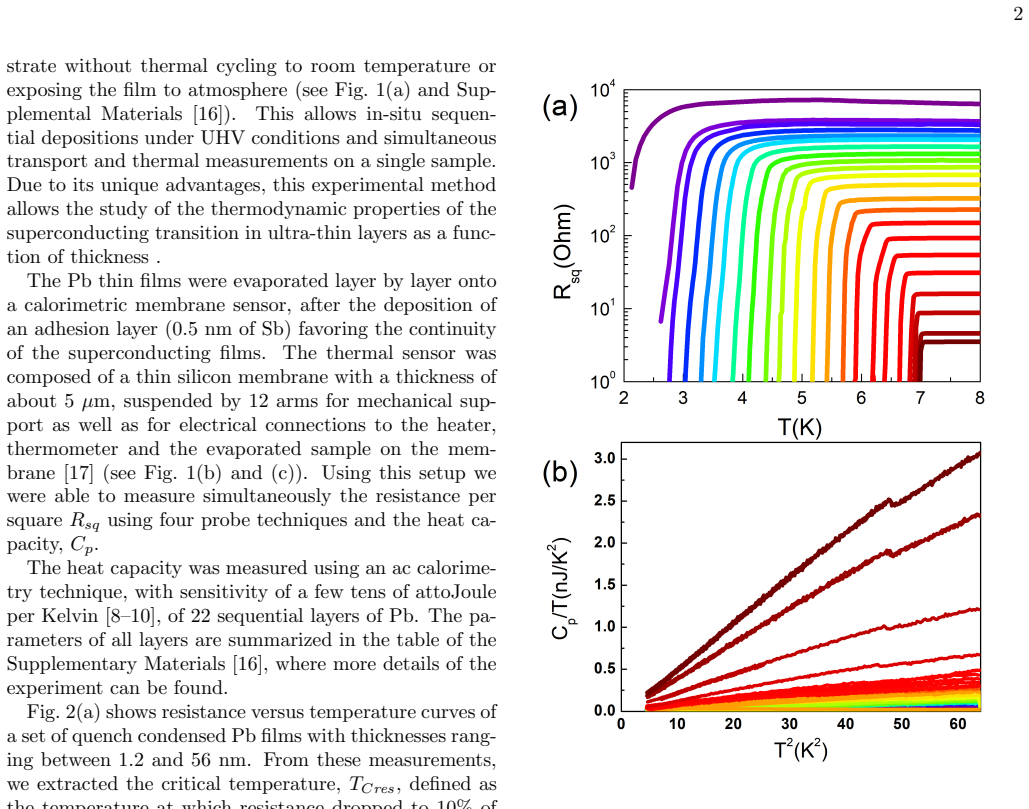
The central objects are the BKT-specific-heat expectations and the dirty-limit coherence length xi' = sqrt(xi0*l) ≈ 4.9 nm, which sets the thickness below which the film is effectively two dimensional. The measurement uses ac-calorimetry on a suspended silicon membrane with sensitivity of a few tens of attojoules per kelvin. Subtracting the extrapolated normal-state specific heat of the thickest film from each layer yields the electronic superconducting contribution ces in which the BCS jump and the broad BKT peak are compared as a function of thickness.
What would settle it
Measure the normal-state specific heat of each ultrathin film directly by destroying superconductivity with a magnetic field larger than the critical field at every temperature from 2 K to 8 K, then recompute ces; if the broad peak survives this measured subtraction, the BKT interpretation stands, while if it vanishes the peak is an artifact of the extrapolated background.
Extended reading notes
Core claim
The paper claims that, in ultrathin superconducting Pb films, the specific heat carries the BKT signature: for films thinner than the dirty-limit coherence length, the BCS jump at the resistive transition disappears and is replaced by a broad, non-universal peak above TBKT, with excess entropy extending up to the bulk Tc. Thick films, by contrast, show a BCS-like jump whose amplitude approaches the bulk Pb value. The authors present these observations as evidence for a continuous BCS-BKT crossover tuned by film thickness.
Load-bearing premise
All electronic superconducting specific-heat curves are obtained by subtracting a single normal-state curve, the thickest film's, extrapolated from above 7.2 K to low temperature, which assumes the per-mass phonon and normal-electron specific heat are identical for every film thickness.
Editorial extensions
If this is right
- Films thinner than about 5 nm show no measurable specific-heat jump at the resistive Tc and instead display a broad peak that extends up to the bulk Pb transition temperature.
- The peak amplitude grows as thickness decreases and saturates for thicknesses below 5 nm, consistent with the crossover to two-dimensional behavior.
- Thick films, above about 9 nm, show a specific-heat jump whose amplitude matches the bulk Pb value, supporting the BCS description in three dimensions.
- The observations support a continuous BCS-to-BKT crossover tuned by film thickness, rather than a single abrupt transition at a fixed thickness.
Reading between the lines
- A natural extension is that specific-heat measurements could serve as a thickness-resolved thermodynamic probe of vortex unbinding in other two-dimensional superconductors, not just quench-condensed lead.
- The measured peak amplitude, roughly two orders of magnitude above a naive estimate of 2kB per vortex per coherence area, suggests the entropy release involves more than isolated vortices, possibly dense vortex fluctuations or contributions from emergent superconducting puddles; this goes beyond the paper's claims.
- If the BCS-BKT crossover is continuous, intermediate-thickness films should show both a reduced jump and a growing peak; the paper reports a progression of this kind, but a quantitative crossover curve would require a model of the peak shape, which the authors state is non-universal.
Signed reviews
Editorial analysis
A structured set of objections, weighed in public.
Referee Report
Summary. This paper reports specific heat measurements of quench-condensed Pb films with thicknesses from 1.2 to 55.9 nm. Thick films exhibit a specific heat jump at the superconducting transition, which the authors fit with an α-extended BCS model. After subtracting a common normal-state baseline extrapolated from the thickest film, the thinner films show a broad peak in the derived electronic specific heat with no apparent jump at the resistive Tc. The authors interpret this as a thermodynamic signature of a continuous BCS-to-BKT crossover as a function of film thickness.
Significance. If the interpretation is correct, this would be the first thermodynamic signature of the BKT transition in a 2D superconductor, a result of considerable interest. The experimental technique, with attojoule-per-kelvin sensitivity and the ability to measure films with masses of tens of nanograms, is a substantial achievement. The paper also includes a tabulated dataset (Table I) and a transparent description of the α-model fitting procedure in the Supplemental Materials.
major comments (4)
- [Supplemental S3, Eq. (3)] The extraction of the superconducting electronic specific heat for every film relies on subtracting the normal-state specific heat of stage 22, c_n^22(T), measured above 7.2 K and extrapolated to 2 K. The paper states that the normal-state curves of all stages "nearly overlap" above 7.2 K, but no quantitative comparison is given, and there is no demonstration that the normal-state specific heat per unit mass is thickness-independent below Tc. Since the broad peak and the absence of a jump are defined relative to this single baseline, a thickness-dependent phonon coefficient, a thickness-dependent Sommerfeld coefficient, or partial substrate coverage would each produce a spurious broad peak in c_es^i. This is the central load-bearing assumption of the paper and needs to be validated, for example by showing that the normal-state c_p/T versus T^2 curves for all stages (including the region between each film's Tc_res and 7.2 K, where thin films are already in the normal state) collapse onto a single curve within experimental uncertainty.
- [Table I and main text] The main text states that for t ≤ 9 nm the specific heat jump "becomes immeasurable, smaller than the noise," but Table I reports nonzero jump amplitudes for stages 12–17 with thicknesses t = 3.75–7.24 nm, for instance Δc_p = 0.27055 mJ g^{-1} K^{-1} for stage 12 at t = 3.75 nm. This is a direct contradiction on the central observation that thin films lack a jump at Tc. The authors must resolve this inconsistency, either by correcting the table or by explaining why the tabulated jump values are not considered significant.
- [Discussion, peak amplitude paragraph] The paper acknowledges that the amplitude of the broad peak is "close to two orders of magnitude larger" than a naive vortex estimate and that BKT-specific heat curves are non-universal and system-dependent, so no quantitative model comparison is possible. It also raises emergent granularity and incomplete coverage as possible causes of the absence of a jump. These statements weaken the claim of quantitative consistency with BKT, because the same observations could plausibly arise from inhomogeneity or from a thickness-dependent normal-state background. To support the BKT interpretation, the authors should at least demonstrate that the broad peak and the missing jump cannot be explained by thickness-dependent normal-state properties or by a distribution of local critical temperatures.
- [Supplemental S4] The BCS fit of the 55.9-nm film uses a free parameter α and a temperature-dependent γ(T) with two additional coefficients. This fit shows that the data are compatible with an extended BCS model, but it is not a parameter-free prediction; the agreement therefore does not uniquely establish the BCS interpretation. This is a secondary point relative to the BKT claim, but it should be stated more cautiously.
minor comments (5)
- [Main text, Section 2] There are unresolved reference placeholders in the main text: "for bulk Pb for instance [ ? ]" and "Like for Nb [ ? ]" should be replaced with actual citations.
- [Supplemental S1 and main text] The Supplemental Materials S1 describes the Sb adhesion layer as "about 2.5 nm thick," while the main text says "0.5 nm of Sb"; these values should be reconciled.
- [Abstract] The abstract contains a typo: "the systems enters" should be "the system enters."
- [Figure 4] The caption of Fig. 4 labels panel (a) as the electronic specific heat ces, while the text introduces Fig. 4 as showing the specific heat cp; please clarify which quantity is plotted in each panel.
- [Figure 4(b,c)] The paper does not provide error bars for the jump amplitudes or the peak amplitudes in Fig. 4(b,c); adding them would help assess the significance of the thickness trends.
Circularity Check
No circular derivation: the BKT-specific-heat claim is an interpretation of subtracted calorimetry data, not a quantity built from BKT theory or from the paper's own fitted parameters.
full rationale
Walking the derivation chain, the central quantity is the electronic superconducting specific heat c_es^i = c_p^i - c_n^22 (Supplemental S3, Eq. (3)). This is a standard normal-state background subtraction, with c_n^22 obtained by fitting only the thickest film's normal-state specific heat and extrapolating it to all layers. Nothing in Eq. (3) is defined in terms of BKT theory, and no BKT parameter is fitted to the thin-film data. The broad peak that is later attributed to BKT physics appears after subtraction, but that subtraction is not equivalent to imposing the BKT prediction; the BKT claim is an interpretation of the resulting curves, not a construction that builds the answer into the input. The thick-film BCS consistency is also not circular: the paper fits the α-model with free parameters α = 2.7 and a temperature-dependent γ(T) to the same thick-film data, and presents this as a fit ('the fit is in good agreement') rather than as a parameter-free prediction. This weakens the force of the BCS statement but does not reduce a predicted quantity to a fitted input. Self-citations are present, e.g. [19] for the mean free path used to estimate the dirty-limit coherence length, but they supply material parameters and prior empirical comparisons; they are not invoked as an external uniqueness theorem or as the sole justification of the BKT attribution. The paper explicitly disclaims quantitative model comparison: 'Since the details of the specific heat versus temperature curves are predicted to be non-universal and are system dependent, we are not able to compare our results to a quantitative model.' The main non-circularity risk is the assumption that all films share the normal-state specific heat of layer 22 below 7.2 K; the paper states the normal-state curves 'nearly overlap' but does not quantify this. That is an uncontrolled assumption and a correctness risk, not a circularity, because a failure of that assumption would produce a spurious peak rather than force the BKT conclusion by definition. Overall, the derivation is self-contained data reduction followed by theoretical interpretation, so the circularity score is 0.
Assumptions & free parameters
free parameters (3)
- alpha (gap ratio in alpha-model fit) =
2.7
- gamma(T) coefficients in the normal-state fit =
gamma(T) = 8e-7 T^2 + 1e-5 J/g/K^2
- beta and zeta coefficients of c22_n = gamma T + beta T^3 + zeta T^5 =
Not stated explicitly
assumptions (4)
- domain assumption BKT theory predicts an immeasurable essential singularity at T_BKT and a broad non-universal specific heat peak above T_BKT.
- domain assumption The Padamsee alpha-model, with adjustable gap ratio alpha and temperature-dependent gamma, describes strong-coupling superconducting Pb.
- ad hoc to paper The normal-state specific heat per unit mass is identical for all film thicknesses, so the thickest film's extrapolated normal-state curve can be subtracted from every film.
- domain assumption Quench-condensed Pb films with an Sb adhesion layer are continuous and uniform down to 1.2 nm, so the BKT 2D interpretation applies.
Cite this review
Pith. "Pith review of Specific Heat Signature of the Berezinskii-Kosterlitz-Thouless Transition in Ultrathin Superconducting Films." pith.science (2026). https://pith.science/paper/ELBEEAUH
@misc{pith2026190800729,
  author       = {Pith},
  title        = {Pith review of: Specific Heat Signature of the Berezinskii-Kosterlitz-Thouless Transition in Ultrathin Superconducting Films},
  year         = {2026},
  howpublished = {\url{https://pith.science/paper/ELBEEAUH}},
  note         = {Machine review of arXiv:1908.00729}
}
abstract
The Berezinskii-Kosterlitz-Thouless (BKT) transition is expected to have a clear signature on the specific heat. The singularity at the transition temperature $T_{BKT}$ is predicted to be immeasurable, and a broad non-universal peak is expected at $T>T_{BKT}$. Up to date this has not been observed in two-dimensional superconductors. We use a unique highly sensitive technique to measure the specific heat of ultrathin Pb films. We find that thick films exhibit a specific heat jump at $T_C$ that is consistent with BCS theory. As the film thickness is reduced below the superconducting coherence length and the systems enters the 2D limit the specific heat reveals BKT-like behavior. We discuss these observations in the framework of the continuous BCS-BKT crossover as a function of film thickness.
Figures


Figures from the paper (2 more)


Reference graph
Works this paper leans on
- [1]
- [2]
-
[3]
P.M. Chaikin, and T.C. Lubensky. Principles of con- densed matter physics, 550, Cambridge University Press (1995)
work page 1995
- [4]
-
[5]
K. Epstein, A.M. Goldman, and A. M. Kadin, Phys. Rev. Lett. 47 534 (1981)
work page 1981
-
[6]
S. A. Wolf, D. U. Gubser, W. W. Fuller, J. C. Garland, and R. S. Newrock, Phys. Rev. Lett. 47, 1071 (1981)
1981
-
[7]
A. F. Hebard and A. T. Fiory, Phys. Rev. Lett. 50, 1603 (1983)
work page 1983
-
[8]
O. Bourgeois, S.E. Skipetrov, F. Ong, and J. Chaussy, Phys. Rev. Lett. 94, 057007 (2005)
work page 2005
Show all 32 references
-
[9]
Poran, M
S. Poran, M. Molina-Ruiz, A. G´ erardin, A. Frydman, O. Bourgeois, Rev. Sci. Instrum. 85, 053903 (2014)
2014
-
[10]
As the film is thinned, ∆cp becomes immeasurable and an excess specific heat peak emerges with a temperature region that extends up to TCbulk = 7.2 K
for which ∆cp was found to be larger than the bulk value by up to a factor of eight. As the film is thinned, ∆cp becomes immeasurable and an excess specific heat peak emerges with a temperature region that extends up to TCbulk = 7.2 K. These results are consistent with a crossov...
-
[11]
Poran, T
S. Poran, T. Nguyen-Duc, A. Auerbach, N. Dupuis, A. Frydman, & O. Bourgeois, Nat. Commun. 8, 14464 (2017)
2017
-
[12]
Strongin, R.S
M. Strongin, R.S. Thompson, O.F. Kammerer, and J.E. Crow, Phys. Rev. B 1, 1078 (1970)
1970
-
[13]
Dynes, J.P
R.C. Dynes, J.P. Garno, and J.M. Rowell, Phys. Rev. Lett. 40, 479 (1978)
1978
-
[14]
Dynes, A.E
R.C. Dynes, A.E. White, J.M. Graybeal, and J.P. Garno, Phys. Rev. Lett. 57, 2195 (1986)
1986
-
[15]
Haviland, Y
D.B. Haviland, Y. Liu, and A.M. Goldman, Phys. Rev. Lett. 62, 2180 (1989)
1989
-
[16]
Bourgeois, A
O. Bourgeois, A. Frydman, and R.C. Dynes, Phys. Rev. Lett. 88, 186403 (2002)
2002
-
[17]
See Supplemental Material at http://link.aps.org/ for de- tails on the fabrication process, on the ac-calorimetry method used for the measurement of the heat capacity and on the Alpha-model used to do the BCS fit on the electronic specific heat in the superconductate
-
[18]
Nguyen, A
T. Nguyen, A. Tavakoli, S. Triqueneaux, R. Swami, A. Ruhtinas, J. Gradel, P. Garcia-Campos, K. Hasselbach, A. Frydman, B. Piot, M. Gibert , E. Collin and O. Bour- geois, Journal of Low Temperature Physics, accepted (arXiv:1907.08443). A. Brown, M.W. Zemansky, and H.A. Boorse, ...
1953 arXiv
-
[19]
Martin, Proceedings of the Physical Society 78, 5 1489 (1961)
D.L. Martin, Proceedings of the Physical Society 78, 5 1489 (1961)
1961
-
[20]
Bourgeois, A
O. Bourgeois, A. Frydman, and R.C. Dynes, Phys. Rev. B 68, 092509 (2003)
2003
-
[21]
Kowal and Z
D. Kowal and Z. Ovadyahu, Solid State Comm. 90, 783 (1994); ibid Physica C 468 322 (2008)
1994
-
[22]
Ghosal, M
A. Ghosal, M. Randeria, and N. Trivedi, Phys. Rev. Lett. 81, 3940 (1998)
1998
-
[23]
Ghosal, M
A. Ghosal, M. Randeria, and N. Trivedi, Phys. Rev. B. 65, 014501 (2001)
2001
-
[24]
Feigel’man, L.B
M.V. Feigel’man, L.B. Ioffe, V.E. Kravtsov, and E.A. Yuzbashyan, Phys. Rev. Lett. 98, 027001 (2007)
2007
-
[25]
Bouadim, Y
K. Bouadim, Y. Loh, M. Randeria, and N. Trivedi, Na- ture Physics 7, 884 (2011)
2011
-
[26]
Biscaras, N
J. Biscaras, N. Bergeal, S. Hurand, C. Feuillet-Palma, A. Rastogi, R.C. Budhani, M. Grilli, S. Caprara, and J. Lesueur, Nat. Mat. 12, 542 (2013). Supplemental Materials for Specific Heat Signature of the Berizinskii-Kosterlitz-Thouless Transition in Ultrathin Superconducting Fi...
2013 arXiv
-
[27]
Haviland, Y
D.B. Haviland, Y. Liu, and A.M. Goldman. Onset of Superconductivity in the Two-Dimensional Limit. Phys. Rev. Lett. 62, 2180 (1989)
1989
-
[28]
Schiller, and H
C.K. Schiller, and H. Bulow, J. Appl. Phys. 40, 4179 (1969)
1969
-
[29]
Padamsee, J.E
H. Padamsee, J.E. Neighbor, and C.A. Shiffman. Quasiparticle Phenomenology for Thermo- dynamics of Strong-Coupling Superconductors. Journal of Low Temperature Physics, 12, 387 (1973)
1973
-
[30]
Shiffman, J.F
C.A. Shiffman, J.F. Cochran, and M. Garber. The specific heat jump in superconducting lead. J. Phys. Chem. Solids, 24, 1369 (1963)
1963
-
[31]
Grimvall
G. Grimvall. Temperature effect in cyclotron resonance and specific heat of electron masses. Solid State Commun. 7, 213 (1969)
1969
-
[32]
Grimvall
G. Grimvall. Temperature dependent effective masses of conduction electrons. J. Phys. Chem. Solids, 29, 1221 (1968). 6
1968
Reviewed August 14, 2026 · model on record in the stance chip above.
Discussion (0). Continue with ORCID to comment.