REVIEW 4 major objections 5 minor 29 references
Self-Organizing Maps with Variable Input Length for Motif Discovery and Word Segmentation
T0 review · 4 major / 5 minor · reviewed 2026-08-14 · deepseek-v4-flash
Pith's one-line read VILMAP extends self-organizing maps to variable input lengths, enabling motif discovery and word segmentation while avoiding catastrophic forgetting.
desk verdict A real extension to variable-length SOMs undermined by an evaluation that measures word recognition, not segmentation. read the letter →
The pith
A machine-rendered reading of the paper's core claim, the machinery that carries it, and where it could break.
The reading
What carries the argument
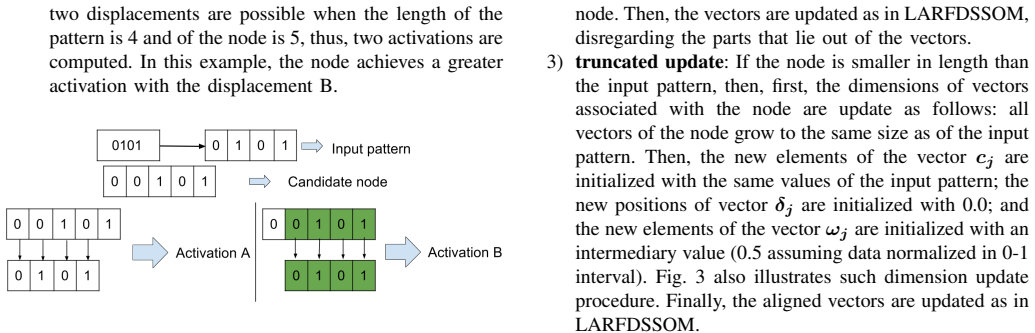
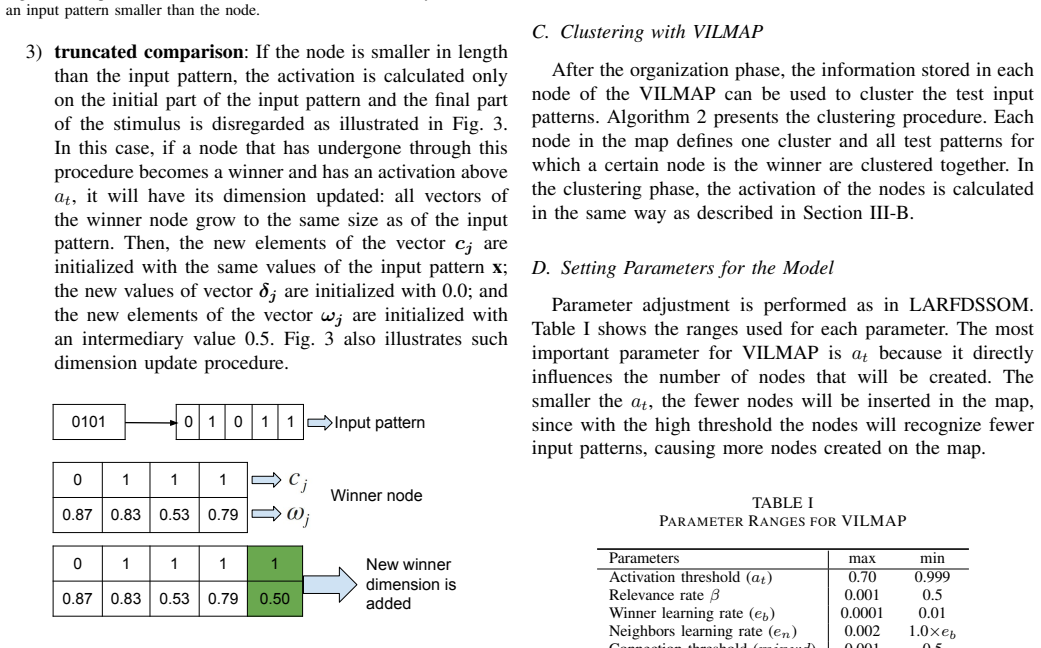
The central mechanism is the weighted activation function of LARFDSSOM adapted to variable lengths. Each node stores a center, a relevance vector, and a distance vector; activation is $\sum_i \omega_{ji} / (\sum_i \omega_{ji} + D_\omega(x, c_j) + \epsilon)$, where $D_\omega$ is the weighted Euclidean distance. Three comparison modes (regular, sliding window, and truncated) decide how a node of one length matches an input of another, and the truncated update grows all three vectors when a smaller winning node meets a longer input. This growth rule is what lets the map handle increasing input sizes and what the authors say prevents catastrophic forgetting.
What would settle it
Train VILMAP on a set of short patterns, then on the same patterns extended by a constant tail, and then present the unextended short patterns again. If the map no longer clusters them as before (for example, if they activate a different node or the F-measure on the short set drops), the truncated update has changed the stored geometry and catastrophic forgetting is not avoided. Similarly, on a labeled time series with motifs of two different lengths, one could compare VILMAP's clusters against a brute-force sliding-window motif search to see whether motifs of both lengths are recovered.
Extended reading notes
Core claim
On its own terms, the central discovery is that the dimension-selective update rules of LARFDSSOM can be extended to variable-size inputs by adding three length-matching modes. When node and input match, the original distance and update apply. When the input is shorter than the node, a sliding-window comparison takes the best shift and updates only the overlapping part. When the input is longer, the node's center, relevance, and distance vectors grow to the input size, with the new center entries copied from the input, new relevance entries set to $0.5$, and new distance entries set to zero, and only then is the standard update applied. The paper argues these rules let the map discover motifs of different lengths and, because growing a node's dimensions does not disturb its old dimensions, let it keep performing on short inputs after training on long ones.
Load-bearing premise
The claim rests on the assumption that when a node is stretched to a longer input, initializing the newly added dimensions with neutral relevance and zero distance leaves everything the node already learned intact, so longer inputs do not corrupt shorter-pattern clusters.
Editorial extensions
If this is right
- A single VILMAP can be trained on a corpus of utterances of varying phonetic length and then used to cluster new utterances without knowing the motif length in advance.
- Because the map is online and passes through the data once, it offers a candidate neural account of how infants could track recurring phoneme sequences without batch statistics.
- The lack of catastrophic forgetting when dimensions grow suggests the model can be a building block for a recurrent growing map that learns longer expressions over time, as the authors propose.
- The competitive word-segmentation scores come without detecting exact word boundaries, implying that recognizing words as whole inputs is enough for much of the segmentation task.
Reading between the lines
- A natural test the paper does not run is whether VILMAP finds a motif that appears at several different lengths within the same time series, since the sliding-window mode only handles an input shorter than a node.
- The neutrality of the $0.5$ initialization for new relevance dimensions is an assumption that could be tested by ablation: starting new dimensions at relevance $1$ might let long patterns distort old clusters, while starting at $0$ might prevent learning them.
- If the word-segmentation result transfers, it suggests that boundary-free whole-word recognition could be a viable developmental pathway, complementing statistical segmentation models rather than competing with them.
- A concrete next step would be feeding VILMAP progressively longer sequences of subword units and checking whether the map's stored prototypes grow compositionally, which would test whether the dimension-growth tolerance reaches beyond 72 features.
Signed reviews
Editorial analysis
A structured set of objections, weighed in public.
Referee Report
Summary. The manuscript proposes VILMAP, an extension of the LARFDSSOM self-organizing map in which each node's center, relevance, and distance vectors can grow to match the length of the input pattern. Activation is computed by regular, sliding-window, or truncated comparisons, and node vectors are extended with hand-initialized entries when a smaller node wins over a larger input. The authors claim that VILMAP can discover time-series motifs of different lengths, avoids catastrophic forgetting when trained with inputs of increasing dimension, and achieves word-segmentation results similar to or better than published methods. Three experiments are reported: a fixed-length GunPoint motif-identification task, a TIMIT-derived phoneme experiment with input dimensions increasing from 24 to 72, and a Brent-Siskind word/non-word recognition experiment compared against DiBS, TPs, PUDDLE, and AGu.
Significance. If the variable-length extension worked as claimed, VILMAP would be a useful and apparently novel SOM variant, particularly for online, biologically motivated learning. Positive features of the submission include a sufficiently detailed algorithmic description, a public code repository, and an Experiment 2 design that targets the real and interesting failure mode of catastrophic forgetting under growing input dimensionality. However, the evidence as presented does not support the two headline claims: no experiment actually varies motif length during discovery, and the word-segmentation evaluation is a binary word/non-word recognition task, not a boundary-prediction task. The comparison against boundary-based segmentation systems is therefore not commensurable. The reported numbers are also optimistic upper bounds because they are selected as the best of 100 parameter samples on the test data without a validation split or error bars. The contribution is better framed as a preliminary proof-of-concept for a variable-length SOM extension, with the central claims substantially narrowed.
major comments (4)
- [Section IV-A] The only motif-discovery experiment uses the GunPoint dataset, whose inputs all have fixed length 150. This cannot support the abstract's claim that VILMAP can 'identify Motifs with different lengths in time series,' because no variable-length motif is presented and no quantitative error measure or baseline comparison is reported; the result is a visual match of prototypes to class averages. An experiment with known motifs of several lengths, or a subsequence-level evaluation, is needed for the central claim.
- [Section IV-C] The word-segmentation experiment explicitly concedes that VILMAP 'does not identify precisely the word boundaries'; instead, words and non-words are separated beforehand and the network is asked to recognize word-length inputs. This measures word/non-word classification, not segmentation. Consequently, Table II's comparison with DiBS, TPs, PUDDLE, and AGu, whose scores from [19] are boundary-based segmentation results, compares different tasks, and the reported F-measure of 0.750 cannot be read as a competitive segmentation result.
- [Sections IV-B and IV-C] The reported F-measures are selected as the best of 100 Latin Hypercube parameter sets evaluated on the test data, with no validation split, no error bars, and no significance tests. This makes the numbers optimistic upper bounds and prevents any claim of similarity or superiority to the cited methods. The authors should report the full distribution of results or select parameters on a separate validation set and then evaluate on held-out test data.
- [Section III-A and III-B] The activation threshold a_t directly controls node creation, and the truncated comparison and truncated update rules for unequal node/input lengths are heuristic: when a node grows, new center entries are set to the input values and new relevance entries are set to 0.5. The manuscript gives no analysis or sensitivity study of how this initialization changes the existing distance geometry or how a_t interacts with the sliding-window and truncated activations. Because these rules determine node counts and downstream clustering, a threshold sweep or ablation would be needed before the model's behavior can be considered robust.
minor comments (5)
- [Eq. (3)] The winner rule in Eq. (3) does not specify tie-breaking; with the shifting used for unequal lengths, an explicit tie rule would improve reproducibility.
- [Figure 4] The captions of Figures 4(a) and 4(b) do not define Procedure A and Procedure B; the text describes them partially, but the captions should be self-contained.
- [Section IV-B] The construction of the False dataset is underspecified: the text does not state how many random sequences are generated, how labels are assigned, or how accidental matches to true words are handled, all of which are needed for replication.
- [Section IV-C] The paper refers to [19] for the comparison scores but does not state whether the same corpus split, tokenization, or scoring implementation is used; the evaluation protocol should be clarified.
- [Section IV-A] The authors state that parameters for Experiment 1 were adjusted by trial and error while Experiment 3 uses Latin Hypercube Sampling; the difference in tuning methodology should be explained and justified.
Circularity Check
No circularity found; the paper's extension of LARFDSSOM is empirical and its evaluation issues are correctness concerns, not self-referential derivations.
full rationale
The paper's central claims are empirical: VILMAP can identify motifs of different lengths, avoids catastrophic forgetting when input dimensionality grows, and reaches word-segmentation-like F-measures comparable to literature baselines. No derivation chain is presented that would reduce a predicted quantity to an input by construction. The model inherits update rules and relevance-weighting from the authors' earlier LARFDSSOM work [5], and that self-citation is appropriate prior work rather than circular support: VILMAP's contribution is the variable-length extension (sliding-window and truncated comparisons, dimension-growing updates), and the contributions are evaluated on external data (GunPoint, TIMIT-derived phoneme features, Brent-Siskind corpus) against independently published baselines. The activation threshold a_t is a free parameter that controls node insertion, but it is not fitted to the reported outcome as a renamed prediction; the reported F-measures are actual run results. The concern that Experiment 3 changes the task from boundary segmentation to isolated word/non-word recognition is a correctness and commensurability critique, not a circularity one: the metrics are unsupported or potentially inflated, but they are not equivalent to the model's inputs by definition. Similarly, selecting the best of 100 Latin Hypercube parameter samples without a separate validation split is a statistical optimism issue, not a self-definitional reduction. Therefore no circular step meeting the quoted-evidence standard is present.
Assumptions & free parameters
free parameters (7)
- Activation threshold a_t =
0.702 (Exp1); sampled 0.70-0.999 in Exp2/3
- Relevance rate beta =
0.092 (Exp1); sampled 0.001-0.5 in Exp2/3
- Winner learning rate e_b =
0.060 (Exp1); sampled 0.0001-0.01 in Exp2/3
- Neighbor learning rate e_n =
0.247 (Exp1); sampled 0.002-1.0*e_b in Exp2/3
- Connection threshold minwd =
0.223 (Exp1); sampled 0.001-0.5 in Exp2/3
- Relevance smoothness eps_ds =
0.070 (Exp1); sampled 0.01-0.1 in Exp2/3
- Maximum nodes Nmax =
10000 (Exp1); unspecified elsewhere
assumptions (4)
- domain assumption Weighted Euclidean distance is a sufficient similarity measure for phoneme feature vectors after simple alignment, truncation, or dimension extension.
- domain assumption LARFDSSOM's relevance and receptive-field update rules remain valid when node dimensions are dynamically expanded.
- domain assumption The phoneme sequence can be represented as fixed 12-dimensional feature vectors with no loss of segmentation-relevant information.
- domain assumption Sliding-window alignment with a single best shift is sufficient to match patterns of different lengths.
Cite this review
Pith. "Pith review of Self-Organizing Maps with Variable Input Length for Motif Discovery and Word Segmentation." pith.science (2026). https://pith.science/paper/ELXQWNLL
@misc{pith2026190802830,
  author       = {Pith},
  title        = {Pith review of: Self-Organizing Maps with Variable Input Length for Motif Discovery and Word Segmentation},
  year         = {2026},
  howpublished = {\url{https://pith.science/paper/ELXQWNLL}},
  note         = {Machine review of arXiv:1908.02830}
}
read the original abstract
Time Series Motif Discovery (TSMD) is defined as searching for patterns that are previously unknown and appear with a given frequency in time series. Another problem strongly related with TSMD is Word Segmentation. This problem has received much attention from the community that studies early language acquisition in babies and toddlers. The development of biologically plausible models for word segmentation could greatly advance this field. Therefore, in this article, we propose the Variable Input Length Map (VILMAP) for Motif Discovery and Word Segmentation. The model is based on the Self-Organizing Maps and can identify Motifs with different lengths in time series. In our experiments, we show that VILMAP presents good results in finding Motifs in a standard Motif discovery dataset and can avoid catastrophic forgetting when trained with datasets with increasing values of input size. We also show that VILMAP achieves results similar or superior to other methods in the literature developed for the task of word segmentation.
Figures

Figures from the paper (3 more)


Reference graph
Works this paper leans on
-
[19]
Relating unsupervised word segmentation to reported vocabulary acquisition,
E. Larsen, A. Cristia, and E. Dupoux, “Relating unsupervised word segmentation to reported vocabulary acquisition,” Jun 2017. [Online]. Available: osf.io/wa6tq
work page 2017
-
[1]
Survey on time series motif discovery,
S. Torkamani and V . Lohweg, “Survey on time series motif discovery,” Wiley Interdisciplinary Reviews: Data Mining and Knowledge Discov- ery, vol. 7, no. 2, 2017
work page 2017
-
[2]
Finding motifs in time series,
J. Lin, E. Keogh, S. Lonardi, and P. Patel, “Finding motifs in time series,” pp. 53–68, 10 2002
work page 2002
-
[3]
T. Kohonen, “The self-organizing map,” Neurocomputing, vol. 21, no. 1-3, pp. 1–6, nov 1998. [Online]. Available: http://linkinghub.elsevier. com/retrieve/pii/S0925231298000307
work page 1998
-
[4]
Growing self-organizing maps for surface reconstruction from unstructured point clouds,
R. L. M. E. do Rego, A. F. R. Araujo, and F. B. de Lima Neto, “Growing self-organizing maps for surface reconstruction from unstructured point clouds,” in 2007 International Joint Conference on Neural Networks , Aug 2007, pp. 1900–1905
work page 2007
-
[5]
H. F. Bassani and A. F. R. Araujo, “Dimension Selective Self- Organizing Maps With Time-Varying Structure for Subspace and Projected Clustering,” IEEE Transactions on Neural Networks and Learning Systems , vol. 26, no. 3, pp. 458–471, mar 2015. [Online]. Available: http://ieeexplore.ieee.org/document/6803941/
-
[6]
R. Miikkulainen, J. A. Bednar, Y . Choe, and J. Sirosh, Computational Maps in the Visual Cortex . Springer, Janeiro 2005, vol. 1
work page 2005
-
[7]
Phoneme recognition using time-dependent versions of self- organizing maps,
J. Kangas, “Phoneme recognition using time-dependent versions of self- organizing maps,” in [Proceedings] ICASSP 91: 1991 International Conference on Acoustics, Speech, and Signal Processing , Apr 1991, pp. 101–104 vol.1
work page 1991
Show all 29 references
-
[8]
Self-organized formation of topologically correct feature maps,
T. Kohonen, “Self-organized formation of topologically correct feature maps,” Biological cybernetics, vol. 43, no. 1, pp. 59–69, 1982
1982
-
[9]
Curse of dimensionality,
E. Keogh and A. Mueen, “Curse of dimensionality,” in Encyclopedia of machine learning. Springer, 2011, pp. 257–258
2011
-
[10]
Subspace clustering for high dimensional data: A review,
L. Parsons, E. Haque, and H. Liu, “Subspace clustering for high dimensional data: A review,” SIGKDD Explor. Newsl. , vol. 6, no. 1, pp. 90–105, Jun. 2004. [Online]. Available: http://doi.acm.org/10.1145/ 1007730.1007731
2004
-
[11]
Clustering high-dimensional data: A survey on subspace clustering, pattern-based clustering, and correlation clustering,
H.-P. Kriegel, P. Kr ¨oger, and A. Zimek, “Clustering high-dimensional data: A survey on subspace clustering, pattern-based clustering, and correlation clustering,” ACM Trans. Knowl. Discov. Data , vol. 3, no. 1, pp. 1:1–1:58, Mar. 2009. [Online]. Available: http://doi.acm.org...
2009
-
[12]
Dimension selective self-organizing maps for clustering high dimensional data,
H. F. Bassani and A. F. Ara ´ujo, “Dimension selective self-organizing maps for clustering high dimensional data,” in Neural Networks (IJCNN), The 2012 International Joint Conference on . IEEE, 2012, pp. 1–8
2012
-
[13]
Dis- covery of variable length time series motif,
P. Nunthanid, V . Niennattrakul, and C. A. Ratanamahatana, “Dis- covery of variable length time series motif,” in Electrical Engineer- ing/Electronics, Computer, Telecommunications and Information Tech- nology (ECTI-CON), 2011 8th International Conference on . IEEE, 2011, pp. 472–475
2011
-
[14]
The ucr time series classification archive,
Y . Chen, E. Keogh, B. Hu, N. Begum, A. Bagnall, A. Mueen, and G. Batista, “The ucr time series classification archive,” July 2015
2015
-
[15]
Time series motif discovery: dimensions and applications,
A. Mueen, “Time series motif discovery: dimensions and applications,” Wiley Interdisciplinary Reviews: Data Mining and Knowledge Discovery, vol. 4, no. 2, pp. 152–159, 2014. [Online]. Available: http://dx.doi.org/10.1002/widm.1119
2014 doi
-
[16]
The self-organizing map,
T. Kohonen, “The self-organizing map,” Proceedings of the IEEE , vol. 78, no. 9, pp. 1464–1480, 1990
1990
-
[17]
Word segmentation: The role of distributional cues,
J. R. Saffran, E. L. Newport, and R. N. Aslin, “Word segmentation: The role of distributional cues,” Journal of memory and language , vol. 35, no. 4, pp. 606–621, 1996
1996
-
[18]
Unconventional word segmentation in brazilian children’s early text production,
J. Correa and J. E. Dockrell, “Unconventional word segmentation in brazilian children’s early text production,”Reading and Writing, vol. 20, no. 8, pp. 815–831, Nov 2007
2007
-
[20]
Learning diphone-based segmen- tation,
R. Daland and J. B. Pierrehumbert, “Learning diphone-based segmen- tation,” Cognitive science, vol. 35, no. 1, pp. 119–155, 2011
2011
-
[21]
Statistical learning by 8-month-old infants,
J. R. Saffran, R. N. Aslin, and E. L. Newport, “Statistical learning by 8-month-old infants,” Science, vol. 274, no. 5294, pp. 1926–1928, 1996
1926
-
[22]
Words in puddles of sound: Modelling psycholinguistic effects in speech segmentation,
P. Monaghan and M. H. Christiansen, “Words in puddles of sound: Modelling psycholinguistic effects in speech segmentation,” Journal of child language, vol. 37, no. 3, pp. 545–564, 2010
2010
-
[23]
Adaptor grammars: A framework for specifying compositional nonparametric bayesian mod- els,
M. Johnson, T. L. Griffiths, and S. Goldwater, “Adaptor grammars: A framework for specifying compositional nonparametric bayesian mod- els,” in Advances in neural information processing systems , 2007, pp. 641–648
2007
-
[24]
Timit acoustic-phonetic continuous speech corpus, 1993,
J. S. Garofolo, L. F. Lamel, W. M. Fisher, J. G. Fiscus, D. S. Pallett, N. L. Dahlgren, and V . Zue, “Timit acoustic-phonetic continuous speech corpus, 1993,” Linguistic Data Consortium, Philadelphia
1993
-
[25]
Nltk: the natural language toolkit,
S. Bird and E. Loper, “Nltk: the natural language toolkit,” in Proceedings of the ACL 2004 on Interactive poster and demonstration sessions. Association for Computational Linguistics, 2004, p. 31. [Online]. Available: http://www.nltk.org
2004
-
[26]
The carnegie mellon university pronouncing dictionary - a machine-readable pronunciation dictionary for north american english. on-line
CMU, “The carnegie mellon university pronouncing dictionary - a machine-readable pronunciation dictionary for north american english. on-line.” 2011
2011
-
[27]
A comparison of uncertainty and sensitivity analysis results obtained with random and latin hypercube sampling,
J. C. Helton, F. Davis, and J. D. Johnson, “A comparison of uncertainty and sensitivity analysis results obtained with random and latin hypercube sampling,” Reliability Engineering & System Safety , vol. 89, no. 3, pp. 305–330, 2005
2005
-
[28]
The role of exposure to isolated words in early vocabulary development,
M. R. Brent and J. M. Siskind, “The role of exposure to isolated words in early vocabulary development,” in Cognition, vol. 81, 2001, pp. 31–44. [Online]. Available: https://childes.talkbank.org/access/Eng-NA/ Brent.html
2001
-
[29]
MacWhinney, The childes project: Tools for analyzing talk
B. MacWhinney, The childes project: Tools for analyzing talk. Psy- chology Press, 2000, vol. 2
2000
Reviewed August 14, 2026 · model on record in the stance chip above.
Discussion (0). Continue with ORCID to comment.