REVIEW 3 major objections 6 minor 76 references
MATCHA:Towards Matching Anything
T0 review · 3 major / 6 minor · reviewed 2026-08-10 · deepseek-v4-flash
Pith's one-line read MATCHA claims that a single dense feature descriptor, built by fusing diffusion-model and DINOv2 features under correspondence supervision, reaches state-of-the-art accuracy on geometric, semantic, and temporal matching at once.
desk verdict Temporal protocol under-specification makes the 'single feature SOTA across all three' claim premature, but the fusion idea and held-out gains are solid enough to warrant serious review. read the letter →
The pith
A machine-rendered reading of the paper's core claim, the machinery that carries it, and where it could break.
The reading
What carries the argument
The load-bearing mechanism is a transformer fusion module of $k$ self- and cross-attention blocks acting on the DIFT semantic feature $F_h$ and geometric feature $F_l$, supervised separately by a dual-softmax geometric loss and a contrastive-plus-flow semantic loss. The fused outputs $F_s$ and $F_g$ are then concatenated with the frozen DINOv2 descriptor $F_d$ (with channel strides) to form $F_m$, so the fusion stage is the only place where correspondence supervision enters. The design works by having semantic and geometric branches borrow information from each other during training, which the ablations claim makes the two descriptors more cooperative at the later concatenation step.
What would settle it
A concrete falsifier would be a benchmark suite with three tasks where task-specific features (e.g., DISK for geometric, SD4Match for semantic, DINOv2 for temporal) each beat MATCHA on their respective task and MATCHA does not beat them on any; the claim of a single feature reaching state of the art would then be false.
Extended reading notes
Core claim
The paper's central claim is that a single feature descriptor $F_m$, produced by supervised attention-based fusion of DIFT geometric and semantic features followed by channel-wise concatenation with DINOv2 features, achieves state-of-the-art results across geometric, semantic, and temporal matching—claimed as the first single feature to do so. The authors supervise only the intermediate semantic and geometric descriptors $F_s$ and $F_g$ with geometric and semantic losses, and leave $F_m$ itself unsupervised; the final descriptor is the concatenation of $F_g$, $F_s$, and $F_d$ (with channel strides). In their comparisons, MATCHA outperforms task-specific geometric features (DISK, XFeat, MASt3R.E) and unsupervised foundation features (DIFT, DINOv2) on the three tasks, with the largest margins on semantic and temporal matching.
Load-bearing premise
MATCHA's unified feature is never directly supervised; instead only the intermediate fused semantic and geometric descriptors receive supervision, and the final concatenation is expected to behave well on all tasks.
Editorial extensions
If this is right
- A single $F_m$ descriptor can replace task-specific feature extractors in pipelines that use nearest-neighbor matching, covering geometric verification, semantic matching, and point tracking.
- Diffusion-model features that already show emergent correspondences can be pushed past fully unsupervised methods by adding correspondence supervision only to intermediate fused branches.
- DINOv2's object-level representation carries complementary knowledge for temporal matching, and combining it with supervised diffusion features yields the largest gains on TAP-Vid.
- The re-purposed TAP-Vid protocol provides a common temporal benchmark for feature models, making it possible to compare geometric, semantic, and unified descriptors under identical conditions.
Reading between the lines
- If MATCHA's claim generalizes, a practical consequence the paper does not spell out is that multi-task systems could cache one descriptor per image and serve geometric, semantic, and temporal matching needs from the same representation, simplifying memory and latency budgets.
- The ablation's attribution of the joint-supervision failure to data imbalance suggests that a future version trained on a larger, better-balanced semantic-geometric corpus could make direct supervision of the unified feature viable; this is a testable extension the authors leave open.
- Because the paper only evaluates with nearest-neighbor search, reusing $F_m$ inside dense matchers with cost aggregation or iterative refinement is a natural next test; the descriptor's role might grow where its 8x-downsampled geometry is too coarse.
- The re-purposed TAP-Vid protocol could become a standard probe for generalization of feature models, but its single-object bias means good scores there may overstate performance on scenes with repetitive structure; future benchmarks should include such scenes.
Signed reviews
Editorial analysis
A structured set of objections, weighed in public.
Referee Report
Summary. The paper proposes MATCHA, a single feature descriptor intended for geometric, semantic, and temporal correspondence matching. It builds on stable diffusion DIFT features (semantic Fh and geometric Fl) and DINOv2 features Fd. A transformer-based fusion module with self- and cross-attention augments Fh and Fl using correspondence supervision (dual-softmax for geometric, contrastive plus flow loss for semantic), yielding enhanced features Fs and Fg. These are concatenated with a strided subsample of DINOv2 features to form the final unified descriptor Fm. The paper evaluates MATCHA on semantic matching (SPair-71k, PF-Pascal, PF-Willow), geometric matching (HPatches, MegaDepth, ScanNet, Aachen for pose estimation), and zero-shot temporal matching on a re-purposed TAP-Vid protocol, and claims state-of-the-art performance across all three tasks with a single descriptor.
Significance. If the results hold, MATCHA provides a single dense descriptor that performs well across geometric, semantic, and temporal matching, potentially replacing task-specific feature extractors in several pipelines. The strength of the paper is its extensive empirical evaluation: ablations (Tab. 3, Tab. 6) show the contribution of each component, and the main evaluations on PF-Willow, Aachen, and TAP-Vid are held-out, reducing circularity concerns. The paper is also transparent about its limitations (e.g., resolution precision and runtime). The central value is the demonstration that limited correspondence supervision can be injected into foundation-model features without destroying their generalization, and that a carefully designed fusion makes otherwise incompatible features complementary.
major comments (3)
- [Sec. 4.3, Tab. 4] The temporal matching protocol is underspecified, and the temporal results are load-bearing for the central claim. The paper does not state how query points that are occluded or out-of-frame in the target frame are handled, how the PCK thresholds are normalized (e.g., relative to image dimensions vs. object scale), or whether mutual nearest-neighbor search is used. TAP-Vid's standard evaluation metrics (e.g., average position error, occlusion accuracy, average Jaccard) are not reported, and no comparison with the official TAP-Vid evaluation is provided. Because MATCHA's margin over DIFT.Uni+DINOv2 is only 1.8 points on average PCK (92.3 vs 90.5), small protocol choices could alter the ranking, and with it the claim of being the first single feature to achieve state-of-the-art across all three tasks. Please specify the complete protocol and report the standard TAP-Vid metrics, or restrict the temporal claim accordingly.
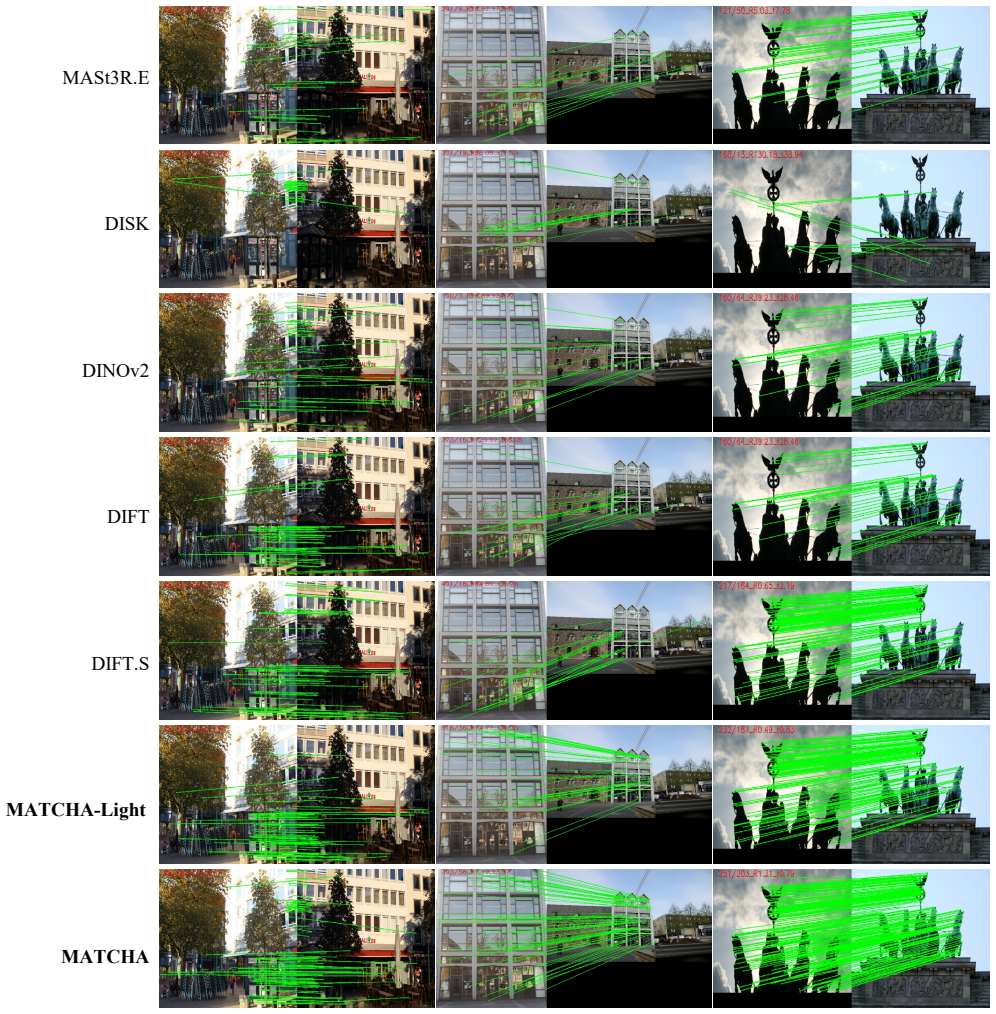
- [Abstract, Sec. 4.5, Tabs. 1 and 4] The claim that MATCHA 'consistently surpasses state-of-the-art methods across geometric, semantic, and temporal matching tasks' and 'outperforms all other methods across all tasks' is not supported by the reported numbers. In Table 1, supervised GeoASM outperforms MATCHA on both SPair-71k (PCK@0.1: 85.6 vs 79.6) and PF-Pascal (98.0 vs 96.8); MATCHA is best only on PF-Willow, where GeoASM is not reported. In Figure 4, DISK and R2D2 are more accurate than MATCHA on HPatches at error thresholds below about 7px. The claims should be qualified to the setting of feature-based methods using nearest-neighbor matching with downsampled features, or to the average score over the three tasks, and the abstract should be revised to avoid the universal 'consistently surpasses' wording.
- [Sec. 3.3, Eqs. (5)-(6), Tab. 6] The final descriptor Fm is never directly supervised; only the intermediate descriptors Fs and Fg receive correspondence supervision, and Fm is obtained by channel-wise concatenation with a frozen DINOv2 feature. The paper's own supplementary ablation (Table 6) shows that adding joint supervision to the unified feature (MATCHA-Light.Uni.S) sharply degrades semantic matching (PF-Willow average PCK drops from 78.0 to 50.7), which the authors attribute to data imbalance. The central claim of a 'single unified feature' therefore rests on the assumption that indirect supervision of Fs and Fg transfers to Fm through concatenation. While the final evaluations provide some evidence for this, the paper does not analyze the scale compatibility of the concatenated features or test alternative lightweight alignment mechanisms. I request a more thorough discussion of why concatenation is an appropriate unification operation, and ideally an experiment that normalizes or jointly calibrates the concatenated features without full joint training.
minor comments (6)
- [Fig. 2 caption] The caption contains a typo: 'MACHA' should be 'MATCHA'.
- [Sec. 4.3] The text says 'TAPVid dataset consists of 30 highly varying real-world video sequences'; this refers only to TAPVid-Davis. Please clarify which TAPVid subset is used and why other subsets are omitted.
- [Eq. (6)] The notation ':: ds' is not defined; please state explicitly that it denotes taking every ds-th channel of the feature tensor.
- [Tab. 4] The 'Average Score' column is not defined. Please explain how the score is computed and justify averaging the three task averages, which may have different difficulty scales.
- [Sec. 4.1, Tab. 1] The legend says 'Red indicates methods using image pairs as inputs', but color is not visible in the printed table; please use explicit symbols instead.
- [Sec. 3.2] The formula for N is typeset ambiguously; please rewrite it as N = (H/(8p)) * (W/(8p)) to avoid confusion.
Circularity Check
No significant circularity: MATCHA's SOTA claims rest on external benchmarks and held-out evaluations; the self-defined TAP-Vid protocol is a validity concern, not circular reasoning.
full rationale
MATCHA is an empirical feature-learning paper rather than a formal derivation. The final unified feature Fm is constructed by (i) supervised training of Fs and Fg via Eq. (5) on standard geometric (ScanNet, MegaDepth) and semantic (PF-PASCAL, SPair-71k, AP-10k) training data and (ii) channel-wise concatenation with frozen DINOv2 features in Eq. (6). The geometric and semantic evaluations are against external benchmarks (HPatches, Aachen, PF-Willow, and held-out splits of ScanNet/MegaDepth/SPair-71k), so those numbers are not fitted to the evaluation targets. The temporal evaluation on TAP-Vid is zero-shot: MATCHA was not trained on TAP-Vid, and the reported gain over DIFT.Uni+DINOv2 is an empirical outcome rather than an input to the method. The re-purposed PCK protocol is a benchmark-validity concern (occlusion handling and normalization are not specified), but this is not a circularity: the protocol does not define the feature or the training objective. Self-citations (e.g., Dynomo, Patch2pix, SFD2) appear only in related work and are not load-bearing. No equation reduces to its own input, and no fitted parameter is renamed as a prediction. Hence no significant circularity is present.
Assumptions & free parameters
free parameters (4)
- Fusion attention blocks k / hidden size / heads =
k=8, hidden=512, heads=8
- Loss temperatures and weights =
tau=0.02, beta=14.3, w_cl=1.0, w_flow=1.0, w_sem=0.1
- Output descriptor dimensions and patch size =
D_g=256, D_s=768, p=2
- Training schedule (iterations, batch size, learning rates) =
220k iterations, batch 24/48, lr 1e-4 to 2e-5
assumptions (4)
- domain assumption Stable diffusion features (DIFT) encode both geometric and semantic correspondence information in distinct layers and timesteps.
- domain assumption DINOv2 features provide object-level semantic knowledge complementary to DIFT without needing adaptation.
- domain assumption Nearest-neighbor search in the learned feature space is a valid surrogate for solving geometric, semantic, and temporal matching.
- ad hoc to paper Direct correspondence supervision on F_s and F_g transfers to the unified F_m without joint supervision.
Cite this review
Pith. "Pith review of MATCHA:Towards Matching Anything." pith.science (2026). https://pith.science/paper/ELYAVGF3
@misc{pith2026250114945,
  author       = {Pith},
  title        = {Pith review of: MATCHA:Towards Matching Anything},
  year         = {2026},
  howpublished = {\url{https://pith.science/paper/ELYAVGF3}},
  note         = {Machine review of arXiv:2501.14945}
}
read the original abstract
Establishing correspondences across images is a fundamental challenge in computer vision, underpinning tasks like Structure-from-Motion, image editing, and point tracking. Traditional methods are often specialized for specific correspondence types, geometric, semantic, or temporal, whereas humans naturally identify alignments across these domains. Inspired by this flexibility, we propose MATCHA, a unified feature model designed to ``rule them all'', establishing robust correspondences across diverse matching tasks. Building on insights that diffusion model features can encode multiple correspondence types, MATCHA augments this capacity by dynamically fusing high-level semantic and low-level geometric features through an attention-based module, creating expressive, versatile, and robust features. Additionally, MATCHA integrates object-level features from DINOv2 to further boost generalization, enabling a single feature capable of matching anything. Extensive experiments validate that MATCHA consistently surpasses state-of-the-art methods across geometric, semantic, and temporal matching tasks, setting a new foundation for a unified approach for the fundamental correspondence problem in computer vision. To the best of our knowledge, MATCHA is the first approach that is able to effectively tackle diverse matching tasks with a single unified feature.
Figures


Figures from the paper (14 more)




Reference graph
Works this paper leans on
-
[1]
Hpatches: A benchmark and evaluation of handcrafted and learned local descriptors
Vassileios Balntas, Karel Lenc, Andrea Vedaldi, and Krys- tian Mikolajczyk. Hpatches: A benchmark and evaluation of handcrafted and learned local descriptors. In Proceedings of the IEEE conference on computer vision and pattern recog- nition, pages 5173–5182, 2017. 5
work page 2017
-
[2]
Speeded-up robust features (surf)
Herbert Bay, Andreas Ess, Tinne Tuytelaars, and Luc Van Gool. Speeded-up robust features (surf). Computer vi- sion and image understanding, 110(3):346–359, 2008. 2
2008
-
[3]
Emerg- ing properties in self-supervised vision transformers
Mathilde Caron, Hugo Touvron, Ishan Misra, Herv ´e J´egou, Julien Mairal, Piotr Bojanowski, and Armand Joulin. Emerg- ing properties in self-supervised vision transformers. In Pro- ceedings of the IEEE/CVF international conference on com- puter vision, pages 9650–9660, 2021. 3
2021
-
[4]
Aspanformer: Detector-free image matching with adaptive span transformer
Hongkai Chen, Zixin Luo, Lei Zhou, Yurun Tian, Ming- min Zhen, Tian Fang, David Mckinnon, Yanghai Tsin, and Long Quan. Aspanformer: Detector-free image matching with adaptive span transformer. In European Conference on Computer Vision, pages 20–36. Springer Nature Switzerland Cham, 2022. 2
work page 2022
-
[5]
Cats++: Boosting cost aggregation with convolutions and transformers
Seokju Cho, Sunghwan Hong, and Seungryong Kim. Cats++: Boosting cost aggregation with convolutions and transformers. IEEE Transactions on Pattern Analysis and Machine Intelligence, 45(6):7174–7194, 2022. 3, 5
work page 2022
-
[6]
Local All-Pair Correspondence for Point Tracking
Seokju Cho, Jiahui Huang, Jisu Nam, Honggyu An, Seun- gryong Kim, and Joon-Young Lee. Local all-pair correspon- dence for point tracking. arXiv preprint arXiv:2407.15420,
-
[7]
Universal correspondence network
Christopher B Choy, JunYoung Gwak, Silvio Savarese, and Manmohan Chandraker. Universal correspondence network. Advances in neural information processing systems , 29,
-
[8]
Ond ˇrej Chum, Ji ˇr´ı Matas, and Josef Kittler. Locally opti- mized ransac. In Pattern Recognition: 25th DAGM Sympo- sium, Magdeburg, Germany, September 10-12, 2003. Pro- ceedings 25, pages 236–243. Springer, 2003. 6
work page 2003
Show all 76 references
-
[9]
Scannet: Richly-annotated 3d reconstructions of indoor scenes
Angela Dai, Angel X Chang, Manolis Savva, Maciej Hal- ber, Thomas Funkhouser, and Matthias Nießner. Scannet: Richly-annotated 3d reconstructions of indoor scenes. In Proceedings of the IEEE conference on computer vision and pattern recognition, pages 5828–5839, 2017. 5, 6, 9
2017
-
[10]
Superpoint: Self-supervised interest point detection and description
Daniel DeTone, Tomasz Malisiewicz, and Andrew Rabi- novich. Superpoint: Self-supervised interest point detection and description. In Proceedings of the IEEE conference on computer vision and pattern recognition workshops , pages 224–236, 2018. 1, 2, 6, 9
2018
-
[11]
Diffusion models beat gans on image synthesis
Prafulla Dhariwal and Alexander Nichol. Diffusion models beat gans on image synthesis. Advances in neural informa- tion processing systems, 34:8780–8794, 2021. 1, 3
2021
-
[12]
Tap-vid: A benchmark for track- ing any point in a video
Carl Doersch, Ankush Gupta, Larisa Markeeva, Adria Re- casens, Lucas Smaira, Yusuf Aytar, Joao Carreira, Andrew Zisserman, and Yi Yang. Tap-vid: A benchmark for track- ing any point in a video. Advances in Neural Information Processing Systems, 35:13610–13626, 2022. 1, 2, 3, 6, 7, 10
2022
-
[13]
D2- net: A trainable cnn for joint description and detection of local features
Mihai Dusmanu, Ignacio Rocco, Tomas Pajdla, Marc Polle- feys, Josef Sivic, Akihiko Torii, and Torsten Sattler. D2- net: A trainable cnn for joint description and detection of local features. In Proceedings of the ieee/cvf conference on computer vision and pattern recognition, ...
-
[14]
Dkm: Dense kernelized feature matching for geometry estimation
Johan Edstedt, Ioannis Athanasiadis, M ˚arten Wadenb ¨ack, and Michael Felsberg. Dkm: Dense kernelized feature matching for geometry estimation. In Proceedings of the IEEE/CVF Conference on Computer Vision and Pattern Recognition, pages 17765–17775, 2023. 2
2023
-
[15]
Roma: Robust dense fea- ture matching
Johan Edstedt, Qiyu Sun, Georg B ¨okman, M ˚arten Wadenb¨ack, and Michael Felsberg. Roma: Robust dense fea- ture matching. In Proceedings of the IEEE/CVF Conference on Computer Vision and Pattern Recognition, pages 19790– 19800, 2024. 3
2024
-
[16]
S2dnet: Learning accurate correspondences for sparse-to- dense feature matching
Hugo Germain, Guillaume Bourmaud, and Vincent Lepetit. S2dnet: Learning accurate correspondences for sparse-to- dense feature matching. arXiv preprint arXiv:2004.01673 ,
2004 arXiv
-
[17]
Proposal flow
Bumsub Ham, Minsu Cho, Cordelia Schmid, and Jean Ponce. Proposal flow. In Proceedings of the IEEE Con- ference on Computer Vision and Pattern Recognition, pages 3475–3484, 2016. 5, 7
2016
-
[18]
Proposal flow: Semantic correspondences from ob- ject proposals
Bumsub Ham, Minsu Cho, Cordelia Schmid, and Jean Ponce. Proposal flow: Semantic correspondences from ob- ject proposals. IEEE transactions on pattern analysis and machine intelligence, 40(7):1711–1725, 2017. 5, 9
2017
-
[19]
Harley, Zhaoyuan Fang, and Katerina Fragkiadaki
Adam W. Harley, Zhaoyuan Fang, and Katerina Fragkiadaki. Particle video revisited: Tracking through occlusions using point trajectories. In ECCV, 2022. 1, 3
2022
-
[20]
Unsupervised semantic correspondence using stable diffu- sion
Eric Hedlin, Gopal Sharma, Shweta Mahajan, Hossam Isack, Abhishek Kar, Andrea Tagliasacchi, and Kwang Moo Yi. Unsupervised semantic correspondence using stable diffu- sion. Advances in Neural Information Processing Systems , 36, 2024. 3, 5
2024
-
[21]
Learning semantic corre- spondence with sparse annotations
Shuaiyi Huang, Luyu Yang, Bo He, Songyang Zhang, Xum- ing He, and Abhinav Shrivastava. Learning semantic corre- spondence with sparse annotations. In European Conference on Computer Vision, pages 267–284. Springer, 2022. 3, 5
2022
-
[22]
Openclip, 2021
Gabriel Ilharco, Mitchell Wortsman, Ross Wightman, Cade Gordon, Nicholas Carlini, Rohan Taori, Achal Dave, Vaishaal Shankar, Hongseok Namkoong, John Miller, et al. Openclip, 2021. 3
2021
-
[23]
Omniglue: Generalizable feature match- ing with foundation model guidance
Hanwen Jiang, Arjun Karpur, Bingyi Cao, Qixing Huang, and Andr´e Araujo. Omniglue: Generalizable feature match- ing with foundation model guidance. In Proceedings of the IEEE/CVF Conference on Computer Vision and Pattern Recognition, pages 19865–19875, 2024. 2, 3
2024
-
[24]
Co- tracker: It is better to track together
Nikita Karaev, Ignacio Rocco, Benjamin Graham, Natalia Neverova, Andrea Vedaldi, and Christian Rupprecht. Co- tracker: It is better to track together. arXiv preprint arXiv:2307.07635, 2023. 1, 3
2023 arXiv
-
[25]
De- formable spatial pyramid matching for fast dense correspon- dences
Jaechul Kim, Ce Liu, Fei Sha, and Kristen Grauman. De- formable spatial pyramid matching for fast dense correspon- dences. In Proceedings of the IEEE Conference on Computer Vision and Pattern Recognition, pages 2307–2314, 2013. 3
2013
-
[26]
Fcss: Fully con- volutional self-similarity for dense semantic correspondence
Seungryong Kim, Dongbo Min, Bumsub Ham, Sangryul Jeon, Stephen Lin, and Kwanghoon Sohn. Fcss: Fully con- volutional self-similarity for dense semantic correspondence. In Proceedings of the IEEE conference on computer vision and pattern recognition, pages 6560–6569, 2017. 1, 3
2017
-
[27]
Semantic attribute matching networks
Seungryong Kim, Dongbo Min, Somi Jeong, Sunok Kim, Sangryul Jeon, and Kwanghoon Sohn. Semantic attribute matching networks. In Proceedings of the IEEE/CVF Con- ference on Computer Vision and Pattern Recognition, pages 12339–12348, 2019. 3
2019
-
[28]
Poselib-minimal solvers for camera pose es- timation, 2020
Viktor Larsson. Poselib-minimal solvers for camera pose es- timation, 2020. 6
2020
-
[29]
Sfnet: Learning object-aware semantic correspon- dence
Junghyup Lee, Dohyung Kim, Jean Ponce, and Bumsub Ham. Sfnet: Learning object-aware semantic correspon- dence. In Proceedings of the IEEE/CVF Conference on Com- puter Vision and Pattern Recognition , pages 2278–2287,
-
[30]
Ground- ing image matching in 3d with mast3r.European Conference on Computer Vision, 2024
Vincent Leroy, Yohann Cabon, and J´erˆome Revaud. Ground- ing image matching in 3d with mast3r.European Conference on Computer Vision, 2024. 6, 8, 10, 11, 13, 14, 15, 16, 17, 18, 19, 20, 21, 22, 23, 24
2024
-
[31]
Sd4match: Learning to prompt stable diffu- sion model for semantic matching
Xinghui Li, Jingyi Lu, Kai Han, and Victor Adrian Prisacariu. Sd4match: Learning to prompt stable diffu- sion model for semantic matching. In Proceedings of the IEEE/CVF Conference on Computer Vision and Pattern Recognition, pages 27558–27568, 2024. 1, 3, 5
2024
-
[32]
Megadepth: Learning single- view depth prediction from internet photos
Zhengqi Li and Noah Snavely. Megadepth: Learning single- view depth prediction from internet photos. In Proceed- ings of the IEEE conference on computer vision and pattern recognition, pages 2041–2050, 2018. 6, 9
2018
-
[33]
Lightglue: Local feature matching at light speed
Philipp Lindenberger, Paul-Edouard Sarlin, and Marc Polle- feys. Lightglue: Local feature matching at light speed. In Proceedings of the IEEE/CVF International Conference on Computer Vision, pages 17627–17638, 2023. 2
2023
-
[34]
Sift flow: Dense correspondence across scenes and its applications
Ce Liu, Jenny Yuen, and Antonio Torralba. Sift flow: Dense correspondence across scenes and its applications. IEEE transactions on pattern analysis and machine intelligence , 33(5):978–994, 2010. 3
2010
-
[35]
Decoupled weight decay regularization
I Loshchilov. Decoupled weight decay regularization. arXiv preprint arXiv:1711.05101, 2017. 10
2017 arXiv
-
[36]
Distinctive image features from scale- invariant keypoints
David G Lowe. Distinctive image features from scale- invariant keypoints. International journal of computer vi- sion, 60:91–110, 2004. 1, 2
2004
-
[37]
Dynamic 3d gaussians: Tracking by per- sistent dynamic view synthesis
Jonathon Luiten, Georgios Kopanas, Bastian Leibe, and Deva Ramanan. Dynamic 3d gaussians: Tracking by per- sistent dynamic view synthesis. In 3DV, 2024. 3
2024
-
[38]
Diffusion hyperfeatures: Searching through time and space for semantic correspondence
Grace Luo, Lisa Dunlap, Dong Huk Park, Aleksander Holyn- ski, and Trevor Darrell. Diffusion hyperfeatures: Searching through time and space for semantic correspondence. Ad- vances in Neural Information Processing Systems, 36, 2024. 1, 3, 5
2024
-
[39]
Contextdesc: Lo- cal descriptor augmentation with cross-modality context
Zixin Luo, Tianwei Shen, Lei Zhou, Jiahui Zhang, Yao Yao, Shiwei Li, Tian Fang, and Long Quan. Contextdesc: Lo- cal descriptor augmentation with cross-modality context. In Proceedings of the IEEE/CVF conference on computer vi- sion and pattern recognition, pages 2527–2536, 2019. 2
2019
-
[40]
Spair-71k: A large-scale benchmark for semantic correspon- dence
Juhong Min, Jongmin Lee, Jean Ponce, and Minsu Cho. Spair-71k: A large-scale benchmark for semantic correspon- dence. arXiv preprint arXiv:1908.10543, 2019. 5, 9
1908 arXiv
-
[41]
Scalable nearest neigh- bor algorithms for high dimensional data
Marius Muja and David G Lowe. Scalable nearest neigh- bor algorithms for high dimensional data. IEEE transactions on pattern analysis and machine intelligence , 36(11):2227– 2240, 2014. 2
2014
-
[42]
Orb-slam: a versatile and accurate monocular slam system
Raul Mur-Artal, Jose Maria Martinez Montiel, and Juan D Tardos. Orb-slam: a versatile and accurate monocular slam system. IEEE transactions on robotics , 31(5):1147–1163,
-
[43]
Neural congealing: Aligning images to a joint se- mantic atlas
Dolev Ofri-Amar, Michal Geyer, Yoni Kasten, and Tali Dekel. Neural congealing: Aligning images to a joint se- mantic atlas. In Proceedings of the IEEE/CVF Conference on Computer Vision and Pattern Recognition, pages 19403– 19412, 2023. 1
2023
-
[44]
Dinov2: Learning robust visual features without supervision
Maxime Oquab, Timoth ´ee Darcet, Th ´eo Moutakanni, Huy V o, Marc Szafraniec, Vasil Khalidov, Pierre Fernandez, Daniel Haziza, Francisco Massa, Alaaeldin El-Nouby, et al. Dinov2: Learning robust visual features without supervision. arXiv preprint arXiv:2304.07193, 2023. 3, 4, ...
2023 arXiv
-
[45]
Pytorch: An im- perative style, high-performance deep learning library
Adam Paszke, Sam Gross, Francisco Massa, Adam Lerer, James Bradbury, Gregory Chanan, Trevor Killeen, Zeming Lin, Natalia Gimelshein, Luca Antiga, et al. Pytorch: An im- perative style, high-performance deep learning library. Ad- vances in neural information processing systems ...
2019
-
[46]
Xfeat: Accelerated fea- tures for lightweight image matching
Guilherme Potje, Felipe Cadar, Andr ´e Araujo, Renato Mar- tins, and Erickson R Nascimento. Xfeat: Accelerated fea- tures for lightweight image matching. In Proceedings of the IEEE/CVF Conference on Computer Vision and Pattern Recognition, pages 2682–2691, 2024. 1, 5, 6, 8, 9
2024
-
[47]
Learning transferable visual models from natural language supervi- sion
Alec Radford, Jong Wook Kim, Chris Hallacy, Aditya Ramesh, Gabriel Goh, Sandhini Agarwal, Girish Sastry, Amanda Askell, Pamela Mishkin, Jack Clark, et al. Learning transferable visual models from natural language supervi- sion. In International conference on machine learning, ...
2021
-
[48]
R2d2: Reliable and repeatable detec- tor and descriptor
Jerome Revaud, Cesar De Souza, Martin Humenberger, and Philippe Weinzaepfel. R2d2: Reliable and repeatable detec- tor and descriptor. Advances in neural information process- ing systems, 32, 2019. 1, 2, 5, 6, 9
2019
-
[49]
Convo- lutional neural network architecture for geometric matching
Ignacio Rocco, Relja Arandjelovic, and Josef Sivic. Convo- lutional neural network architecture for geometric matching. In Proceedings of the IEEE conference on computer vision and pattern recognition, pages 6148–6157, 2017. 3
2017
-
[50]
End- to-end weakly-supervised semantic alignment
Ignacio Rocco, Relja Arandjelovi ´c, and Josef Sivic. End- to-end weakly-supervised semantic alignment. In Proceed- ings of the IEEE Conference on Computer Vision and Pattern Recognition, pages 6917–6925, 2018. 3
2018
-
[51]
Neighbourhood con- sensus networks
Ignacio Rocco, Mircea Cimpoi, Relja Arandjelovi ´c, Akihiko Torii, Tomas Pajdla, and Josef Sivic. Neighbourhood con- sensus networks. Advances in neural information processing systems, 31, 2018. 2, 3
2018
-
[52]
High-resolution image synthesis with latent diffusion models
Robin Rombach, Andreas Blattmann, Dominik Lorenz, Patrick Esser, and Bj ¨orn Ommer. High-resolution image synthesis with latent diffusion models. In Proceedings of the IEEE/CVF conference on computer vision and pattern recognition, pages 10684–10695, 2022. 3
2022
-
[53]
High-resolution image synthesis with latent diffusion models
Robin Rombach, Andreas Blattmann, Dominik Lorenz, Patrick Esser, and Bj ¨orn Ommer. High-resolution image synthesis with latent diffusion models. In Proceedings of the IEEE/CVF conference on computer vision and pattern recognition, pages 10684–10695, 2022. 1, 3, 4
2022
-
[54]
Particle video: Long-range mo- tion estimation using point trajectories.International journal of computer vision, 80:72–91, 2008
Peter Sand and Seth Teller. Particle video: Long-range mo- tion estimation using point trajectories.International journal of computer vision, 80:72–91, 2008. 1, 3
2008
-
[55]
Superglue: Learning feature matching with graph neural networks
Paul-Edouard Sarlin, Daniel DeTone, Tomasz Malisiewicz, and Andrew Rabinovich. Superglue: Learning feature matching with graph neural networks. In Proceedings of the IEEE/CVF conference on computer vision and pattern recognition, pages 4938–4947, 2020. 1, 2
2020
-
[56]
Benchmarking 6dof outdoor visual localization in changing conditions
Torsten Sattler, Will Maddern, Carl Toft, Akihiko Torii, Lars Hammarstrand, Erik Stenborg, Daniel Safari, Masatoshi Okutomi, Marc Pollefeys, Josef Sivic, et al. Benchmarking 6dof outdoor visual localization in changing conditions. In Proceedings of the IEEE conference on compu...
2018
-
[57]
Structure- from-motion revisited
Johannes L Schonberger and Jan-Michael Frahm. Structure- from-motion revisited. In Proceedings of the IEEE con- ference on computer vision and pattern recognition , pages 4104–4113, 2016. 1
2016
-
[58]
Dynomo: Online point tracking by dynamic online monocular gaussian recon- struction
Jenny Seidenschwarz, Qunjie Zhou, Bardienus Duisterhof, Deva Ramanan, and Laura Leal-Taix ´e. Dynomo: Online point tracking by dynamic online monocular gaussian recon- struction. arXiv preprint arXiv:2409.02104, 2024. 3
2024 arXiv
-
[59]
Loftr: Detector-free local feature matching with transformers
Jiaming Sun, Zehong Shen, Yuang Wang, Hujun Bao, and Xiaowei Zhou. Loftr: Detector-free local feature matching with transformers. In Proceedings of the IEEE/CVF con- ference on computer vision and pattern recognition , pages 8922–8931, 2021. 2, 5, 9
2021
-
[60]
Emergent correspondence from image diffusion
Luming Tang, Menglin Jia, Qianqian Wang, Cheng Perng Phoo, and Bharath Hariharan. Emergent correspondence from image diffusion. Advances in Neural Information Pro- cessing Systems, 36:1363–1389, 2023. 1, 3, 5, 6, 8, 10, 13, 14, 15, 16, 17, 18, 19, 20, 21, 22, 23, 24
2023
-
[61]
Sosnet: Second order similarity reg- ularization for local descriptor learning
Yurun Tian, Xin Yu, Bin Fan, Fuchao Wu, Huub Heijnen, and Vassileios Balntas. Sosnet: Second order similarity reg- ularization for local descriptor learning. In Proceedings of the IEEE/CVF conference on computer vision and pattern recognition, pages 11016–11025, 2019. 2
2019
-
[62]
Glu- net: Global-local universal network for dense flow and corre- spondences
Prune Truong, Martin Danelljan, and Radu Timofte. Glu- net: Global-local universal network for dense flow and corre- spondences. In Proceedings of the IEEE/CVF conference on computer vision and pattern recognition, pages 6258–6268,
-
[63]
Disk: Learning local features with policy gradient
Michał Tyszkiewicz, Pascal Fua, and Eduard Trulls. Disk: Learning local features with policy gradient. Advances in Neural Information Processing Systems , 33:14254–14265,
-
[64]
Attention is all you need
A Vaswani. Attention is all you need. Advances in Neural Information Processing Systems, 2017. 4
2017
-
[65]
Tracking everything everywhere all at once
Qianqian Wang, Yen-Yu Chang, Ruojin Cai, Zhengqi Li, Bharath Hariharan, Aleksander Holynski, and Noah Snavely. Tracking everything everywhere all at once. InInternational Conference on Computer Vision, 2023. 3
2023
-
[66]
Shape of motion: 4d re- construction from a single video
Qianqian Wang, Vickie Ye, Hang Gao, Jake Austin, Zhengqi Li, and Angjoo Kanazawa. Shape of motion: 4d re- construction from a single video. In arXiv preprint arXiv:2407.13764, 2024. 3
2024
-
[67]
Croco: Self-supervised pre-training for 3d vision tasks by cross-view completion
Philippe Weinzaepfel, Vincent Leroy, Thomas Lucas, Ro- main Br´egier, Yohann Cabon, Vaibhav Arora, Leonid Ants- feld, Boris Chidlovskii, Gabriela Csurka, and J ´erˆome Re- vaud. Croco: Self-supervised pre-training for 3d vision tasks by cross-view completion. Advances in Neura...
2022
-
[68]
Spatialtracker: Tracking any 2d pixels in 3d space
Yuxi Xiao, Qianqian Wang, Shangzhan Zhang, Nan Xue, Sida Peng, Yujun Shen, and Xiaowei Zhou. Spatialtracker: Tracking any 2d pixels in 3d space. In CVPR, 2024. 3
2024
-
[69]
Rnnpose: Recurrent 6-dof object pose refinement with robust correspondence field estimation and pose optimization
Yan Xu, Kwan-Yee Lin, Guofeng Zhang, Xiaogang Wang, and Hongsheng Li. Rnnpose: Recurrent 6-dof object pose refinement with robust correspondence field estimation and pose optimization. In Proceedings of the IEEE/CVF con- ference on computer vision and pattern recognition , pag...
2022
-
[70]
Sfd2: Semantic-guided feature detection and description
Fei Xue, Ignas Budvytis, and Roberto Cipolla. Sfd2: Semantic-guided feature detection and description. In Pro- ceedings of the IEEE/CVF Conference on Computer Vision and Pattern Recognition, pages 5206–5216, 2023. 2
2023
-
[71]
Lift: Learned invariant feature transform
Kwang Moo Yi, Eduard Trulls, Vincent Lepetit, and Pascal Fua. Lift: Learned invariant feature transform. In Com- puter Vision–ECCV 2016: 14th European Conference, Am- sterdam, The Netherlands, October 11-14, 2016, Proceed- ings, Part VI 14, pages 467–483. Springer Internationa...
2016
-
[72]
Ap-10k: A benchmark for animal pose esti- mation in the wild
Hang Yu, Yufei Xu, Jing Zhang, Wei Zhao, Ziyu Guan, and Dacheng Tao. Ap-10k: A benchmark for animal pose esti- mation in the wild. arXiv preprint arXiv:2108.12617, 2021. 9
2021 arXiv
-
[73]
Telling left from right: Identifying geometry-aware semantic corre- spondence
Junyi Zhang, Charles Herrmann, Junhwa Hur, Eric Chen, Varun Jampani, Deqing Sun, and Ming-Hsuan Yang. Telling left from right: Identifying geometry-aware semantic corre- spondence. In Proceedings of the IEEE/CVF Conference on Computer Vision and Pattern Recognition , pages 307...
2024
-
[74]
A tale of two features: Stable diffusion complements dino for zero-shot semantic correspondence
Junyi Zhang, Charles Herrmann, Junhwa Hur, Luisa Pola- nia Cabrera, Varun Jampani, Deqing Sun, and Ming-Hsuan Yang. A tale of two features: Stable diffusion complements dino for zero-shot semantic correspondence. Advances in Neural Information Processing Systems, 36, 2024. 1, 3, 5
2024
-
[75]
Patch2pix: Epipolar-guided pixel-level correspondences
Qunjie Zhou, Torsten Sattler, and Laura Leal-Taixe. Patch2pix: Epipolar-guided pixel-level correspondences. In Proceedings of the IEEE/CVF conference on computer vi- sion and pattern recognition, pages 4669–4678, 2021. 2, 6
2021
-
[2020]
1, 2, 5, 6, 8, 10, 11, 13, 14, 15, 16, 17, 18, 19, 20, 21, 22, 23, 24
Reviewed August 10, 2026 · model on record in the stance chip above.
Discussion (0). Continue with ORCID to comment.