REVIEW 2 major objections 5 minor 2 cited by
Gravitational capture cross-section in Zipoy-Voorhees spacetimes
T0 review · 2 major / 5 minor · reviewed 2026-08-11 · deepseek-v4-flash
Pith's one-line read The quadrupole parameter of a compact object changes its gravitational capture cross-section for particles and photons.
desk verdict Two genuinely new q-metric formulas, but the massive capture cross-section is only valid for small velocities and the paper overreaches by calling an equatorial computation 'the' cross-section. read the letter →
The pith
A machine-rendered reading of the paper's core claim, the machinery that carries it, and where it could break.
The reading
What carries the argument
The load-bearing object is the q-metric line element $ds^2 = -f^{1+q}dt^2 + f^{-q}[g^{-q(2+q)}(dr^2/f + r^2 d\theta^2) + r^2\sin^2\theta\, d\phi^2]$, with $f=1-2M/r$ and $g=1+M^2\sin^2\theta/(r^2 f)$. Capture is governed by the effective potentials $U^2 = f^{1+q}(1+\tilde{L}^2/(r^2 f^{-q}))$ for massive particles and $U_{\mathrm{ph}}^2 = L^2 f^{1+2q}/r^2$ for photons; the critical impact parameters come from the turning-point conditions at the photon sphere $r_{\mathrm{ph}}=(3+2q)M$ and, for massive particles, at the marginally bound orbit where $\tilde{E}=1$. The escape angle is obtained from the locally measured energy and tangential velocity in an orthonormal frame.
What would settle it
Compute the critical impact parameter for photons arriving from many different directions in the q-metric and average over all directions; if the angle-averaged value differs from Eq. (39), the equatorial formula is not the full capture cross-section. For massive particles, solve the turning-point equation at finite energy to see whether the cross-section really follows $16\pi M^2(1+3q\ln 2)/v_\infty^2$.
Extended reading notes
Core claim
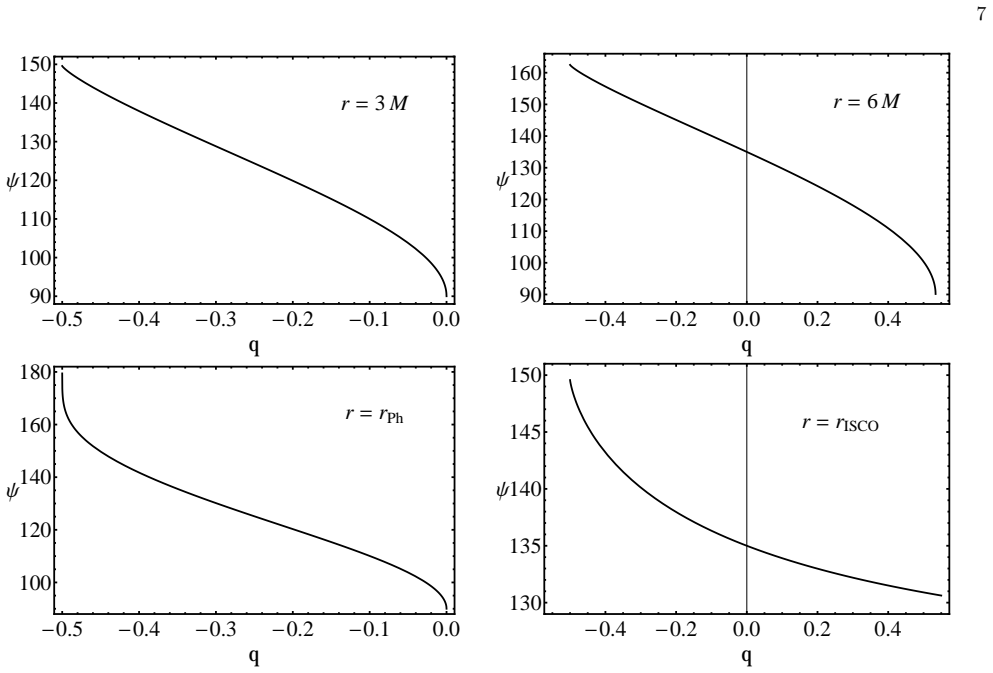
Within the q-metric, the capture cross-section of massless test particles is exactly $\sigma_{\mathrm{ph}} = \pi M^2 (3+2q)^{3+2q}/(1+2q)^{1+2q}$, valid for $q > -1/2$, with the critical impact parameter $b_c = M(3+2q)^{3/2+q}/(1+2q)^{1/2+q}$ at the photon sphere $r_{\mathrm{ph}}=(3+2q)M$. For massive particles, working in the small-$q$, marginally bound ($E=1$) limit gives $\sigma_{\mathrm{m}} = 16\pi M^2 (1+3q\ln 2)/v_\infty^2$, with the marginally bound orbit shifted to $r_{\mathrm{mb}} = 4M + 2Mq(3-2\ln 2)$. A photon emitted at radius $r$ escapes to infinity when $\sin\psi > M(3+2q)^{3/2+q}/(r(1+2q)^{1/2+q} f^{(1+q)/2})$, which at $r=6M$ reduces near $q=0$ to $\psi < 135^\circ - 51.33^\circ q$. All expressions reduce to the Schwarzschild values as $q\to 0$.
Load-bearing premise
The paper's cross-section formulas assume capture is determined by motion in one plane (the equatorial plane), and for massive particles by particles that begin at rest far away; capture from other directions or speeds is not yet included.
Editorial extensions
If this is right
- For $q>0$, the photon capture cross-section $\sigma_{\mathrm{ph}}$ grows monotonically from the Schwarzschild value $27\pi M^2$; for $-1/2<q<0$ it shrinks, so the quadrupole sign controls whether the object captures more or less light.
- The marginally bound orbit for massive particles moves from $r=4M$ to $r=4M+2Mq(3-2\ln 2)$, so a positive quadrupole enlarges, and a negative quadrupole shrinks, the capture radius for slowly moving particles.
- At fixed emission radius, the escape cone for photons narrows linearly with $q$ near $q=0$, for instance $\psi < 135^\circ - 51.33^\circ q$ at $r=6M$.
- All derived quantities recover the Schwarzschild limits: $\sigma_{\mathrm{m}}\to 16\pi M^2/v_\infty^2$, $\sigma_{\mathrm{ph}}\to 27\pi M^2$, and $\sin\psi > 1/\sqrt{2}$ at $r=6M$.
Reading between the lines
- Because the q-metric is axisymmetric, a natural extension is to compute the angle-averaged capture cross-section over all incidence directions; the equatorial value in the paper is likely only one slice of that full result.
- The massive-particle formula is strictly a small-$q$ and near-zero-$v_\infty$ result; solving the turning-point equation at finite $E$ would show how the cross-section depends on incoming speed beyond the $1/v_\infty^2$ factor.
- If applied to accreting neutron stars or white dwarfs, the ratio $\sigma_{\mathrm{m}}(q)/\sigma_{\mathrm{m}}(0)$ offers a first estimate of how oblateness shifts accretion rates, which numerical accretion simulations could test.
Signed reviews
Editorial analysis
A structured set of objections, weighed in public.
Referee Report
Summary. The paper studies the static, axisymmetric q-metric (Zipoy-Voorhees) and considers equatorial-plane geodesics for massive and massless test particles. From the effective potential it derives a capture cross-section for massive particles, an exact photon capture cross-section, and an escape-angle inequality for photons. All expressions are checked in the q=0 limit against known Schwarzschild results, and the authors suggest applications to compact objects such as white dwarfs and neutron stars.
Significance. If properly qualified, the paper provides compact analytic formulas for the equatorial-plane capture radius and escape angle in a simple axisymmetric generalization of Schwarzschild. The derivations are self-contained: they start from the metric and the geodesic Lagrangian, and the q=0 limits are genuine checks rather than inputs. The exact photon formula and the closed-form escape-angle inequality are useful additions to the q-metric geodesic literature. However, the broad claims in the title and abstract go beyond what is derived: the massive formula is only a small-q and small-v_inf approximation, and the photon formula is not the full direction-dependent capture cross-section of an axisymmetric spacetime. The significance of the paper therefore depends on whether the authors are willing to restrict their claims to the equatorial plane and to the stated asymptotic limits.
major comments (2)
- [Sec. II A, Eq. (29)]
- [Sec. III, Eq. (39) and Sec. V]
minor comments (5)
- [Sec. II (around Eq. 23 and Fig. 3)]
- [Sec. IV]
- [Sec. IV, Eq. (44)]
- [Sec. II A, Eq. (29)]
- [General]
Circularity Check
No circularity found: all results are derived from the q-metric Lagrangian and geodesic equations, with Schwarzschild limits used only as checks.
full rationale
The paper's derivation chain starts from the q-metric line element (Eq. 1) and the geodesic Lagrangian (Eq. 4), then derives the effective potential (Eq. 14), circular-orbit conditions (Eqs. 19-21), the marginally-bound radius and angular momentum (Eqs. 27-28), and the capture cross-section (Eq. 29) by Taylor expansion for small q. The massless case similarly follows from the photon effective potential (Eq. 33), the photosphere radius (Eq. 37), and the critical impact parameter (Eq. 38), giving Eqs. (39) and (44). No parameter is fitted to the target result; the q=0 limits are external Schwarzschild benchmarks used as consistency checks, not inputs. Although the paper cites its own earlier work on q-metric geodesics (Refs. [8-10]), those citations are background context and do not supply the load-bearing formulas; the relevant equations are derived in this paper. The skeptical concern that Eq. (29) is presented without stating its small-v_inf / small-q validity domain is a correctness or presentation issue, not a circularity: Eq. (21) explicitly fixes E=1 before the expansion, so the derivation does not hide that assumption. There is no step in which a prediction is equivalent by construction to an input, and no self-citation chain forces the result.
Assumptions & free parameters
assumptions (3)
- standard math The geodesic equation and the normalization condition g_alpha beta p^alpha p^beta = -m^2 correctly describe test particle motion in the q-metric.
- domain assumption Particles on the equatorial plane theta=pi/2 remain on that plane.
- domain assumption The q-metric with q > -0.553 (for massive) and q > -0.5 (for massless) represents a physically meaningful spacetime with real ISCO and photon sphere.
Cite this review
Pith. "Pith review of Gravitational capture cross-section in Zipoy-Voorhees spacetimes." pith.science (2026). https://pith.science/paper/ELYE3JZK
@misc{pith2026241206598,
  author       = {Pith},
  title        = {Pith review of: Gravitational capture cross-section in Zipoy-Voorhees spacetimes},
  year         = {2026},
  howpublished = {\url{https://pith.science/paper/ELYE3JZK}},
  note         = {Machine review of arXiv:2412.06598}
}
abstract
We consider geodesics of massive and massless test particles in the gravitational field of a static and axisymmetric compact object described by the quadrupolar metric ($q$-metric), which is the simplest generalization of the Schwarzschild metric, containing an independent quadrupole parameter $q$. We analyze the effective potential profile and calculate the orbital parameters and capture cross-sections of test particles in this spacetime. Moreover, we derive the explicit expression for the escape angle of photons as a function of the quadrupole parameter. All the results reduce in the corresponding limit of vanishing quadrupole to the well-known case of the Schwarzschild spacetime. We argue that our results could be used to investigate realistic compact objects such as white dwarfs and neutron stars.
Figures


Figures from the paper (4 more)


Forward citations
Cited by 2 Pith papers
-
Constraining quadrupole deformations with relativistic effects
In the Zipoy-Voorhees spacetime, the Shapiro time delay and the Shirokov oscillation frequencies acquire corrections from the quadrupole deformation parameter q, with the delay correction appearing at first order in q.
-
Schwarzschild-like Black Holes Submerged in an Exponential Density Dark Matter Profile
An analytic Schwarzschild-like metric with an exponential dark matter halo is constructed and its shadows, quasi-normal modes, and greybody bounds are computed, though several derived expressions have sign errors.
Reference graph
Works this paper leans on
-
[1]
R. Beig and W. Simon, Proceedings of the Royal Society of London. A. Mathematical and Physical Sciences 376, 333 (1981)
work page 1981
-
[2]
Hence, to get real values for rISCO , we choose the condition q >−0.553
≈ −0.553. Hence, to get real values for rISCO , we choose the condition q >−0.553. Another interesting quantity is the efficiency of the source to convert mass into radiation η, which is defined as η = h 1 − ˜E(rISCO ) i × 100% (23) In Fig. 3, we show the efficiency as a function ofq when M = 1. As one can see, the maximum efficiency 8.0417% is achieved f...
-
[3]
Kundu, Journal of Mathematical Physics 22, 2006 (1981)
P. Kundu, Journal of Mathematical Physics 22, 2006 (1981)
work page 1981
-
[4]
N. van de Bergh and P. Wils, Classical and Quantum Gravity 2, 229 (1985)
work page 1985
-
[5]
≈ −1.447 and q > −(1 − 1/ √
-
[6]
Quevedo, Fortschritte der Physik/Progress of Physics 38, 733 (1990)
H. Quevedo, Fortschritte der Physik/Progress of Physics 38, 733 (1990)
work page 1990
-
[7]
D. M. Zipoy, Journal of Mathematical Physics 7, 1137 (1966)
1966
-
[8]
Voorhees, Physical Review D 2, 2119 (1970)
B. Voorhees, Physical Review D 2, 2119 (1970)
1970
Show all 24 references
-
[9]
Herrera, F
L. Herrera, F. M. Paiva, N. O. Santos, and V. Ferrari, International Journal of Modern Physics D 9, 649 (2000), 8 gr-qc/9812023
2000 arXiv
-
[10]
Toktarbay and H
S. Toktarbay and H. Quevedo, Gravitation and Cosmol- ogy 20, 252 (2014), 1510.04155
2014 arXiv
-
[11]
Boshkayev, E
K. Boshkayev, E. Gasper ´ ın, A. C. Guti´ errez-Pi˜ neres, H. Quevedo, and S. Toktarbay, Phys. Rev. D 93, 024024 (2016), 1509.03827
2016 arXiv
-
[12]
Boshkayev, T
K. Boshkayev, T. Konysbayev, E. Kurmanov, O. Lu- ongo, D. Malafarina, and H. Quevedo, Phys. Rev. D 104, 084009 (2021), 2106.04932
2021 arXiv
-
[13]
L. D. Landau and E. M. Lifshitz, The classical theory of fields (Oxford: Pergamon Press, 1975)
1975
-
[14]
S. L. Shapiro, S. A. Teukolsky, Y. A. Smorodinskij, A. D. Dolgov, and S. N. Rodionov, Black holes, white dwarfs and neutron stars. The physics of compact objects. (Mir, Moskva, 1985)
1985
-
[15]
A. F. Zakharov, Soviet Astronomy 32, 456 (1988)
1988
-
[16]
Ahmedov, O
B. Ahmedov, O. Rahimov, and B. Toshmatov, Universe 7, 307 (2021)
2021
- [17]
- [18]
-
[19]
Toshmatov, O
B. Toshmatov, O. Rahimov, B. Ahmedov, and A. Ahme- dov, Galaxies 9, 65 (2021)
2021
-
[20]
A. F. Zakharov, Classical and Quantum Gravity 11, 1027 (1994)
1994
-
[21]
A. F. Zakharov, Theoretical and Mathematical Physics 90, 97 (1992)
1992
-
[22]
Abdujabbarov, B
A. Abdujabbarov, B. Ahmedov, O. Rahimov, and U. Sa- likhbaev, Physica Scripta 89, 084008 (2014)
2014
-
[23]
O. G. Rahimov, A. A. Abdujabbarov, and B. J. Ahme- dov, Astrophysics and Space Science 335, 499 (2011), 1105.4543
2011 arXiv
-
[24]
C. W. Misner, K. S. Thorne, and J. A. Wheeler, Gravi- tation (Macmillan, 1973)
1973
Reviewed August 11, 2026 · model on record in the stance chip above.
Discussion (0). Continue with ORCID to comment.