REVIEW 4 major objections 5 minor 3 cited by
Boosted fusion gates above the percolation threshold for scalable graph-state generation
T0 review · 4 major / 5 minor · reviewed 2026-08-11 · deepseek-v4-flash
Pith's one-line read An experimental boosted type-II fusion gate reaches a measured success probability of 71.0(7)%, exceeding the 58.98% percolation threshold for scalable graph-state generation from three-photon GHZ states.
desk verdict First experimental boosted fusion gate above the percolation threshold, with a real caveat about calibration transparency. read the letter →
The pith
A machine-rendered reading of the paper's core claim, the machinery that carries it, and where it could break.
The reading
What carries the argument
The load-bearing object is the boosted Bell-state measurement: three 50:50 beam splitters plus two two-photon N00N states $|\gamma\rangle = (|2H\,0V\rangle + |0H\,2V\rangle)/\sqrt{2}$, one on each side of the central interferometer. The first beam splitter distinguishes $|\Psi^{+}\rangle$ and $|\Psi^{-}\rangle$ exactly as in a conventional fusion gate; when the input photons are in $|\Phi^{\pm}\rangle$, they exit together and interact with one auxiliary N00N state, producing distinct four-photon output distributions that tag $|\Phi^+\rangle$ versus $|\Phi^-\rangle$. Reading those patterns requires photon-number resolution up to four photons, supplied by pseudo-photon-number-resolving detectors built from a 32-channel superconducting nanowire array. This mechanism converts the 50% linear-optics Bell-measurement limit into a 75% theoretical success probability while keeping all operations passive and linear.
What would settle it
Count all eight-photon coincidence events in a fixed run without applying the normalization factors, sort every event into a success or failure pattern for the four Bell states, and compare the efficiency-corrected success fraction with 58.98%; if the fraction cannot be independently reconstructed to remain above the threshold, the central claim fails.
Extended reading notes
Core claim
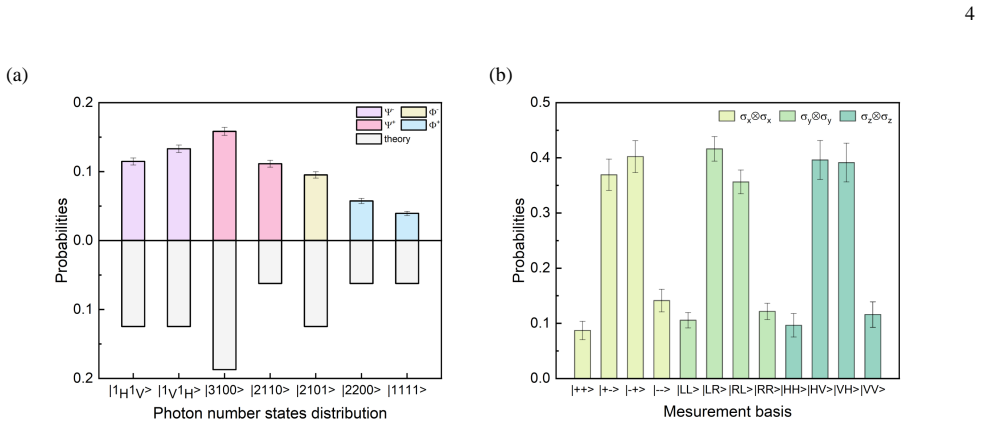
The central claim is that a boosted Bell-state measurement, implemented with eight demultiplexed photons from a solid-state single-photon source, succeeds with probability 71.0(7)% averaged over the four Bell states, compared with the 75% theoretical value of the boosting scheme and the 50% limit of standard linear-optics fusion. Success is read from eight-photon coincidence patterns: the usual single-interferometer outputs identify the $|\Psi^{\pm}\rangle$ states, while the $|\Phi^{\pm}\rangle$ states are identified by four-photon number-resolving patterns produced when two photons from a Bell state meet a two-photon N00N auxiliary state on a second beam splitter. The corrected detection probabilities for the $|\Psi^-\rangle$, $|\Psi^+\rangle$, $|\Phi^-\rangle$, and $|\Phi^+\rangle$ outcomes are 0.248(5), 0.270(6), 0.095(5), and 0.097(4), giving the total 71.0(7)%. The paper takes this to be the success probability that enters the percolation analysis, and observes that it exceeds the 58.98% threshold by 17 standard deviations and greatly surpasses the 57.9% of the previous best Bell-state measurement.
Load-bearing premise
The central claim assumes that the 71.0(7)% success probability, obtained by classifying eight-photon coincidence events and correcting the counts with normalization factors calibrated from a large dataset, is an unbiased estimate of the lossless fusion success probability that the percolation threshold analysis requires.
Editorial extensions
If this is right
- 2D cluster states of linear size 10, 100, and 1000 can be generated from three-photon GHZ resource states once the fusion success probability exceeds the lossless percolation threshold, with the connected-node fraction rising sharply near the threshold.
- Compared with the previous 57.9% Bell-state measurement, a gate at 71% success sits on the far side of the percolation boundary, so the connected scale of the generated graph state grows exponentially larger under the paper's simulations.
- The auxiliary N00N states used for the boost are generated deterministically by Hong-Ou-Mandel interference from the same demultiplexed photon stream, so the scheme needs no extra entangled ancilla source.
- The measured 67(2)% fidelity of the fused photons exceeds the classical bound by more than eight standard deviations, confirming that the successful fusion events carry genuine two-photon entanglement.
Reading between the lines
- An extension the paper does not make is to measure the gate's success probability under controlled photon loss and compare it with loss-tolerant percolation thresholds, which are higher than 58.98%.
- Reconstructing the success probability from raw unnormalized eight-photon counts, or from a detector-calibrated maximum-likelihood model, would test how much of the 71.0(7)% figure depends on the normalization factors.
- Running the same boosted gate directly on heralded three-photon GHZ resource states, rather than on two Bell states, would demonstrate the exact resource-to-cluster scaling path that the percolation simulations assume.
- Quantifying how the gate's success probability degrades as the Hong-Ou-Mandel visibility of the auxiliary photons falls below the raw values 0.9076(6) and 0.9050(6) would give a practical sensitivity curve for deploying the scheme with less ideal sources.
Signed reviews
Editorial analysis
A structured set of objections, weighed in public.
Referee Report
Summary. The paper reports an experimental implementation of a boosted type-II fusion gate, following the Ewert–van Loock scheme with four auxiliary photons in N00N states. Using a demultiplexed quantum-dot single-photon source and eight-photon coincidence detection, the authors claim a Bell-state discrimination success probability of 71.0(7)%, which exceeds the 58.98% percolation threshold for scalable graph-state generation from three-photon GHZ states. They also report a two-photon entanglement fidelity of 67(2)% for the fused output and present Newman–Ziff simulations suggesting that operation above threshold enables generation of large 2D cluster states.
Significance. If the central claim holds, this is an important experimental milestone: it would be the first fusion gate demonstrated above the percolation threshold for photonic graph-state generation, a key prerequisite for scalable fusion-based quantum computing. The experiment combines state-of-the-art components—high-efficiency quantum-dot single photons, demultiplexing, and pseudo-photon-number-resolving detectors—and the comparison with a specific theoretical threshold is a concrete, falsifiable statement. However, the support for the headline number rests on normalization details that are not fully disclosed, and the fidelity characterization covers only one branch of the gate. The result is potentially significant, but the manuscript in its current form does not fully establish the claimed milestone.
major comments (4)
- [Fig. 4(a) and the paragraph on detection probabilities] The central claim that the success probability is 71.0(7)% depends on corrected detection probabilities whose normalization factors are 'calibrated at the start of data collection using a large dataset of coincident counts', but the manuscript does not provide the raw counts, the complete set of possible output patterns, the assignment of each pattern to a success or failure outcome, or the calibration procedure and its uncertainty budget. The quoted error of ±0.7% appears to be propagated only from the four statistical errors (0.248(5), 0.270(6), 0.095(5), 0.097(4)); it does not include systematic uncertainty in the normalization factors. Because the threshold is 58.98%, an upward bias of about 12 percentage points would spuriously place the gate above threshold, so this missing information is load-bearing for the paper's main conclusion. Please provide the raw coincidence counts, a full pattern table, and a systematic error analysis for the normalization.
- [Fig. 4(b) and the fidelity measurement] The reported fidelity of 67(2)% is obtained for the |Ψ−⟩14 outcome, which the text says 'corresponds to the post-selected outcome |Ψ−⟩23 obtained through the Bell-state measurement'. This is precisely the branch that can be distinguished without any auxiliary photons, as stated earlier: 'we can distinguish |Ψ−⟩23 without an auxiliary state'. Therefore this entanglement measurement does not verify the boosted branches |Φ+⟩23 and |Φ−⟩23, which are the branches where the auxiliary N00N states provide the advantage over the 50% limit. The claim that the experiment 'provides the first direct experimental evidence of the effectiveness of a boosted fusion gate' is not supported unless fidelities for the boosted branches are also reported. Please measure and report entanglement witnesses or fidelities for the auxiliary-assisted output branches.
- [Simulation paragraph and Fig. 1(b)] The abstract and introduction state that the percolation threshold is 58.98%, but the simulation paragraph says 'there is a specific threshold of 0.672 [17] when photon loss is ignored' for building 2D-cluster states from 3-photon GHZ states. If these two numbers refer to different lattices, resource states, or graph-state families, that distinction must be stated explicitly. As written, the paper appears to quote two different thresholds (0.5898 and 0.672) for the same resource-state construction, which makes the quantitative comparison between the experimental 0.71 and the threshold ambiguous. Please clarify which threshold applies to Fig. 1(b) and reconcile the two values.
- [Abstract and 'Results' section] The abstract states that the success probability is 'experimentally measured to be 71.0(7)%', but the body makes clear that this value is a normalized, loss-corrected probability derived from post-selected coincidence events: 'The probabilities are corrected by normalization factors.' The paper should state explicitly that 71.0(7)% is the conditional success probability given that all eight photons reach the interference stage, not the end-to-end success probability per experimental attempt. This distinction is important because the percolation-threshold comparison is valid for the former, but a reader of the abstract could reasonably interpret the number as a raw device-level success probability.
minor comments (5)
- [Abstract and introduction] The phrase 'One minimal resource states are three-photon Greenberger-Horne-Zeilinger (GHZ) states' has a subject-verb agreement error; it should be 'One minimal resource state is...'.
- [Eq. (1) and (2)] The ket notation such as |4000⟩ is not fully defined: the text says each term represents a 'specific path and polarization distribution', but it does not specify the ordering of the four output modes or the convention for horizontal/vertical polarization. Please add a sentence defining the mode ordering and the polarization convention.
- [Experimental setup description] There are typographical spacing errors, e.g., 'a,bdenoting' should be 'a, b denoting', and 'the target two-photon state ( |γ⟩56)' has an awkward space before the ket. These are minor and should be corrected in revision.
- [Fig. 3(c) and sentence on phase scanning] The sentence 'the phase of one of the photons (photon 2) is changed from 0 to 2.2π, all measured Bell state visibilities are listed in Fig. 3(c)' is confusing: it would help to specify what is plotted on the horizontal axis, which Bell-state visibility is being shown, and whether the points are at specific phase values. The figure caption should also state the meaning of the error bars.
- [Summary paragraph] The statement that the fusion gate 'exponentially expands the connected scale of the graph-state compared to conventional approaches' is not quantified in the main text. A log-scale plot of connected cluster size versus number of resource states, or a precise scaling statement, would make this claim verifiable.
Circularity Check
No significant circularity: the central success-probability claim is an experimental measurement benchmarked against external theoretical results (Ewert–van Loock 75% gate, Pant et al. percolation threshold), and the stated normalization calibration is independent of the target value.
full rationale
The paper's derivation chain is not circular. The boosted fusion gate and its 75% theoretical success probability are taken from Ewert and van Loock (Ref. [26]), an external published protocol; the percolation threshold 58.98% and the 2D-cluster threshold 0.672 are taken from Pant et al. (Ref. [17]), also external. The experimental claim of 71.0(7)% is a measured quantity, formed by summing four corrected detection probabilities (0.248(5), 0.270(6), 0.095(5), 0.097(4)). The paper states that these probabilities are corrected by normalization factors 'calibrated at the start of data collection using a large dataset of coincident counts' rather than chosen to reproduce the theoretical 75% value; there is no quoted equation or procedure showing that the factors were derived from the target success probability. Self-citations (Refs. [20], [28], [30]) concern the single-photon source, demultiplexer, and GHZ-state source used as tools; none is invoked to justify the fusion success probability or the threshold. The absence of raw counts and the under-specification of the normalization procedure is a transparency/reproducibility concern, but the paper does not reduce its central claim to its own input by construction, so no circular step is established.
Assumptions & free parameters
free parameters (1)
- Normalization factors for multi-photon detection probabilities =
Not specified
assumptions (4)
- domain assumption The Ewert-van Loock boosted Bell-state measurement protocol is correct, including the output states in Eqs. (1) and (2).
- domain assumption The joint state of the two photons entering the Bell-state measurement is a maximally mixed product state, making the average over Bell states the relevant success probability for fusing 3-photon GHZ states.
- domain assumption The percolation thresholds (58.98% and 0.672) from Pant et al. are correct and apply to this fusion gate.
- domain assumption The single-photon source produces photons with the claimed purity and indistinguishability, and the PPNRDs resolve photon numbers as assumed.
Cite this review
Pith. "Pith review of Boosted fusion gates above the percolation threshold for scalable graph-state generation." pith.science (2026). https://pith.science/paper/EM6CYEMH
@misc{pith2026241218882,
  author       = {Pith},
  title        = {Pith review of: Boosted fusion gates above the percolation threshold for scalable graph-state generation},
  year         = {2026},
  howpublished = {\url{https://pith.science/paper/EM6CYEMH}},
  note         = {Machine review of arXiv:2412.18882}
}
read the original abstract
Fusing small resource states into a larger, fully connected graph-state is essential for scalable photonic quantum computing. Theoretical analysis reveals that this can only be achieved when the success probability of the fusion gate surpasses a specific percolation threshold of 58.98% by using three-photon GHZ states as resource states. However, such an implementation of a fusion gate has never been experimentally realized before. Here, we successfully demonstrate a boosted fusion gate with a theoretical success probability of 75%, using deterministically generated auxiliary states. The success probability is experimentally measured to be 71.0(7)%. We further demonstrate the effectiveness of the boosted fusion gate by fusing two Bell states with a fidelity of 67(2)%. Our work paves a crucial path toward scalable linear optical quantum computing.
Figures


Figures from the paper (1 more)
Forward citations
Cited by 3 Pith papers
-
Single-photon-boosted type-I fusion gates
A type-I fusion gate, boosted with four single-photon ancillas and passive linear optics, reaches 3/4 success probability via a distillation protocol.
-
Resource-efficient linear-optical generation of GHZ-like states
Variable-entanglement intermediate states and a tunable non-exhaustive bleeding protocol reduce the average photon cost of generating GHZ and GHZ-like photonic states, e.g., from 10240 to 5287.6 photons for the 10-qub...
-
Quantum repeaters based on stationary and flying Gottesman-Kitaev-Preskill qudits
A quantum repeater that simultaneously uses GKP-encoded flying and stationary qudits is proposed, and the combined protocol is claimed to outperform pure one-way or two-way GKP repeaters in intermediate parameter regimes.
Reference graph
Works this paper leans on
-
[17]
M. Gimeno-Segovia, P. Shadbolt, D. E. Browne, and T. Rudolph, From three-photon greenberger-horne-zeilinger states to ballistic universal quantum computation, Physical re- view letters 115, 020502 (2015)
work page 2015
-
[1]
S. Aaronson and A. Arkhipov, The computational complexity of linear optics, in Proceedings of the forty-third annual ACM symposium on Theory of computing (2011) pp. 333–342
work page 2011
-
[2]
Meanwhile, the aux- iliary photons 5 and 6 (7 and 8) are prepared in a two-photon N00N state |γ⟩56 = 1√ 2 (|2H 0V ⟩56 + |0H 2V ⟩56) (|γ⟩78 = 1√ 2 (|2H 0V ⟩78 + |0H 2V ⟩78)) based on the well-known Hong- Ou-Mandel (HOM) effect. As an example, two identical pho- tons 5 and 6 are sent through a 50:50 beam splitter (BS), re- sulting in a two-photon N00N state...
work page 2020
-
[3]
The data are plotted in Fig. 4(b). We calculate the state fidelity using F = Tr(ρexp|Ψ−⟩14⟨Ψ−|14) = 67(2)% . The measured fi- delity exceeds the classical threshold of 0.5 by more than 8 standard deviations, providing strong evidence of genuine en- tanglement between photon pairs 1 and 4 and demonstrating the effectiveness of the fusion operations. Notabl...
-
[4]
All valid eight-fold coincidence events are then recorded by a programmable multi-channel coincidence unit. An eight- fold coincidence rate of approximately 3 Hz is observed, cor- responding to an end-to-end efficiency of 16% for individual photons. Given an average detector efficiency of 72%, an overall transmission efficiency of 31% can be estimated fro...
-
[5]
Zhong, H
H.-S. Zhong, H. Wang, Y .-H. Deng, M.-C. Chen, L.-C. Peng, Y .-H. Luo, J. Qin, D. Wu, X. Ding, Y . Hu,et al., Quantum com- putational advantage using photons, Science 370, 1460 (2020)
2020
- [6]
-
[7]
D. Bluvstein, S. J. Evered, A. A. Geim, S. H. Li, H. Zhou, T. Manovitz, S. Ebadi, M. Cain, M. Kalinowski, D. Hangleiter, et al., Logical quantum processor based on reconfigurable atom arrays, Nature 626, 58–65 (2023)
work page 2023
Show all 35 references
-
[8]
Acharya, I
R. Acharya, I. Aleiner, R. Allen, T. I. Andersen, M. Ansmann, F. Arute, K. Arya, A. Asfaw, J. Atalaya, R. Babbush, et al. , Suppressing quantum errors by scaling a surface code logical qubit, Nature 614, 676–681 (2023)
2023
-
[9]
D. E. Browne and T. Rudolph, Resource-efficient linear optical quantum computation, Phys. Rev. Lett. 95, 010501 (2005)
2005
-
[10]
Duan and R
L.-M. Duan and R. Raussendorf, Efficient quantum computa- tion with probabilistic quantum gates, Physical review letters 95, 080503 (2005)
2005
-
[11]
Varnava, D
M. Varnava, D. E. Browne, and T. Rudolph, Loss tolerance in one-way quantum computation via counterfactual error correc- tion, Physical review letters 97, 120501 (2006)
2006
-
[12]
Kieling, T
K. Kieling, T. Rudolph, and J. Eisert, Percolation, renormal- ization, and quantum computing with nondeterministic gates, Physical Review Letters 99, 130501 (2007)
2007
-
[13]
Varnava, D
M. Varnava, D. E. Browne, and T. Rudolph, How good must single photon sources and detectors be for efficient linear op- tical quantum computation?, Phys. Rev. Lett. 100, 060502 (2008)
2008
-
[14]
T. M. Stace, S. D. Barrett, and A. C. Doherty, Thresholds for topological codes in the presence of loss, Physical review letters 102, 200501 (2009)
2009
-
[15]
Fujii and Y
K. Fujii and Y . Tokunaga, Fault-tolerant topological one-way quantum computation with probabilistic two-qubit gates, Phys- ical review letters 105, 250503 (2010)
2010
-
[16]
Y . Li, S. D. Barrett, T. M. Stace, and S. C. Benjamin, Fault toler- ant quantum computation with nondeterministic gates, Physical review letters 105, 250502 (2010)
2010
-
[18]
Y . Li, P. C. Humphreys, G. J. Mendoza, and S. C. Benjamin, Resource costs for fault-tolerant linear optical quantum com- puting, Physical Review X 5, 041007 (2015)
2015
-
[19]
J. M. Auger, H. Anwar, M. Gimeno-Segovia, T. M. Stace, and D. E. Browne, Fault-tolerant quantum computation with nondeterministic entangling gates, Physical Review A 97, 10.1103/physreva.97.030301 (2018)
2018 doi
-
[20]
M. Pant, D. Towsley, D. Englund, and S. Guha, Percolation thresholds for photonic quantum computing, Nature Commu- nications 10, 1070 (2019)
2019
-
[21]
Bartolucci, P
S. Bartolucci, P. Birchall, H. Bombin, H. Cable, C. Dawson, M. Gimeno-Segovia, E. Johnston, K. Kieling, N. Nickerson, M. Pant, et al. , Fusion-based quantum computation, Nature Communications 14, 912 (2023)
2023
-
[22]
M. A. Nielsen, Optical quantum computation using cluster states, Phys. Rev. Lett. 93, 040503 (2004)
2004
-
[23]
Chen, L.-C
S. Chen, L.-C. Peng, Y .-P. Guo, X.-M. Gu, X. Ding, R.-Z. Liu, J.-Y . Zhao, X. You, J. Qin, Y .-F. Wang,et al., Heralded three- photon entanglement from a single-photon source on a photonic chip, Phys. Rev. Lett. 132, 130603 (2024)
2024
-
[24]
H. Cao, L. M. Hansen, F. Giorgino, L. Carosini, P. Zah ´alka, F. Zilk, J. C. Loredo, and P. Walther, Photonic source of her- alded greenberger-horne-zeilinger states, Phys. Rev. Lett. 132, 130604 (2024)
2024
-
[25]
Maring, A
N. Maring, A. Fyrillas, M. Pont, E. Ivanov, P. Stepanov, N. Mar- garia, W. Hease, A. Pishchagin, T. H. Au, S. Boissier, et al., A versatile single-photon-based quantum computing platform, Nature Photonics 18, 603–609 (2024)
2024
-
[26]
N. C. Menicucci, P. van Loock, M. Gu, C. Weedbrook, T. C. Ralph, and M. A. Nielsen, Universal quantum computation with continuous-variable cluster states, Phys. Rev. Lett. 97, 110501 (2006)
2006
-
[27]
M. J. Bayerbach, S. E. D’Aurelio, P. van Loock, and S. Barz, Bell-state measurement exceeding 50% success probability with linear optics, Science Advances 9, eadf4080 (2023)
2023
-
[28]
W. P. Grice, Arbitrarily complete bell-state measurement us- ing only linear optical elements, Physical Review A 84, 10.1103/physreva.84.042331 (2011)
2011 doi
-
[29]
Ewert and P
F. Ewert and P. van Loock, 3/4-efficient bell measurement with passive linear optics and unentangled ancillae, Physical Review Letters 113, 10.1103/physrevlett.113.140403 (2014)
2014 doi
-
[30]
M. C. L ¨obl, S. Paesani, and A. S. Sørensen, Efficient percola- tion simulations for lossy photonic fusion networks, Phys. Rev. Res. 6, 033273 (2024)
2024
-
[31]
Ding, Y .-P
X. Ding, Y .-P. Guo, M.-C. Xu, R.-Z. Liu, G.-Y . Zou, J.-Y . Zhao, Z.-X. Ge, Q.-H. Zhang, H.-L. Liu, L.-J. Wang, et al. , High-efficiency single-photon source above the loss-tolerant threshold for efficient linear optical quantum computing (2023), arXiv:2311.08347 [quant-ph]
2023 arXiv
-
[32]
HANBURY BROWN and R
R. HANBURY BROWN and R. Q. TWISS, A test of a new type of stellar interferometer on sirius, Nature 178, 1046–1048 (1956)
1956
-
[33]
H. Wang, Y . He, Y .-H. Li, Z.-E. Su, B. Li, H.-L. Huang, X. Ding, M.-C. Chen, C. Liu, J. Qin, J.-P. Li, Y .-M. He, C. Schneider, M. Kamp, C.-Z. Peng, S. H ¨ofling, C.-Y . Lu, and J.-W. Pan, High-efficiency multiphoton boson sampling, Nature Photonics 11, 361 (2017)
2017
-
[34]
Y . Meng, M. L. Chan, R. B. Nielsen, M. H. Appel, Z. Liu, Y . Wang, N. Bart, A. D. Wieck, A. Ludwig, L. Midolo, et al., Deterministic photon source of genuine three-qubit en- tanglement, Nature Communications 15, 10.1038/s41467-024- 52086-y (2024)
2024 doi
-
[35]
Thomas, L
P. Thomas, L. Ruscio, O. Morin, and G. Rempe, Efficient gener- ation of entangled multiphoton graph states from a single atom, Nature 608, 677–681 (2022)
2022
Reviewed August 11, 2026 · model on record in the stance chip above.
Discussion (0). Continue with ORCID to comment.