REVIEW 2 major objections 8 minor 1 cited by
FIRMGrasp: A Friction-Informed Risk Margin for Robust Grasp Synthesis
T0 review · 2 major / 8 minor · reviewed 2026-07-31 · grok-4.5
Pith's one-line read A risk-adjusted grasp margin scored on the adverse friction tail certifies force closure with probability at least β and flags grasps that classical epsilon rates as safe but fail when friction drops.
desk verdict Clean CVaR specialization of Ferrari-Canny that actually separates friction-sensitive grasps; math holds, evidence is sim-only and prior-dependent. read the letter →
The pith
A machine-rendered reading of the paper's core claim, the machinery that carries it, and where it could break.
The reading
What carries the argument
The risk-adjusted margin ε(β): the inscribed-ball radius of the grasp wrench space assembled at the CVaR-discounted friction v_β = CVaR_β(μ). Positivity of this radius is the closure certificate; the same construction specializes to the classical Ferrari-Canny epsilon under a point-mass prior.
What would settle it
Run the same certified-versus-rejected split on physical hardware with measured contact friction drawn from the paper’s adverse mixture: if grasps with ε(β)>0 do not retain the object under lateral pull at low friction at a clearly higher rate than grasps with ε_nom>0 but ε(β)≤0, the predictive claim fails.
Extended reading notes
Core claim
The authors show that evaluating the Ferrari-Canny force-closure margin at the CVaR mean of the adverse friction tail yields a single scalar ε(β) that is monotone in the confidence level β, differentiable in the grasp parameters, and carries a probabilistic certificate: ε(β)>0 implies force closure with probability at least β. Under calibrated priors this margin separates friction-sensitive grasps that the nominal epsilon rates as high quality, and it orders realized dynamic retention above both the nominal epsilon and a recent min-weight baseline.
Load-bearing premise
The method assumes a calibrated scalar friction distribution really describes execution-time contact, and that quasi-static hard-finger Coulomb friction in simulation is enough for the certificate to predict physical retention.
Editorial extensions
If this is right
- Grasp synthesizers can rank or filter candidate contacts by ε(β) without resimulating every friction sample.
- A positive risk margin supplies an explicit probability lower bound on force closure under a stated friction prior.
- Differentiability of the CVaR margin opens gradient-based synthesis that optimizes the adverse tail rather than a nominal coefficient.
- Object geometry that concentrates friction sensitivity (irregular shapes) can be flagged before execution by the drop of ε(β) below zero.
Reading between the lines
- The same CVaR construction could be applied to uncertain contact normals or object pose, giving a family of risk margins beyond friction alone.
- If the friction prior were estimated online from tactile slip, the certificate could be refreshed during grasp execution rather than fixed at synthesis.
- Libraries that already expose min-weight or epsilon could add ε(β) as a cheap post-process on stored wrench generators, turning existing grasp pools into friction-robust rankings.
Signed reviews
Editorial analysis
A structured set of objections, weighed in public.
Referee Report
Summary. The manuscript introduces FIRMGrasp, a CVaR-based family of grasp-quality margins for uncertainty in a scalar Coulomb friction coefficient. It defines a risk-adjusted friction v_β=CVaR_β(μ), assembles the grasp wrench space at v_β, and scores a grasp by its signed inscribed-ball radius ε^(β); it also defines Q_β as the lower-tail CVaR of the Ferrari-Canny margin. The paper establishes wrench-space nesting, monotonicity in β, almost-everywhere differentiability, and conditional probabilistic closure certificates. Empirically, it evaluates 1,599 LEAP/Allegro grasps, cross-dataset Shadow Hand grasps, a risk-adjusted synthesis objective, and Drake shake/lift tests. The reported results show substantial nominal-versus-adverse divergence and better ranking of simulated dynamic outcomes than nominal ε and FRoGGeR's min-weight metric.
Significance. If the claims are appropriately scoped, the work provides a useful and computationally attractive robustness axis for grasp evaluation. Once β and a friction prior are chosen, the metric introduces no fitted predictive parameters, requires essentially one LP per stored grasp, and comes with a non-circular conditional closure certificate. The held-out shake and lift studies test outcomes never used to fit the metric, and the cross-hand, cross-dataset, and synthesis experiments make the value of the new axis plausible. Its practical importance nevertheless depends on obtaining realistic friction priors and contact models; the present dynamic discrimination is comparative and moderate rather than a validated physical coverage guarantee.
major comments (2)
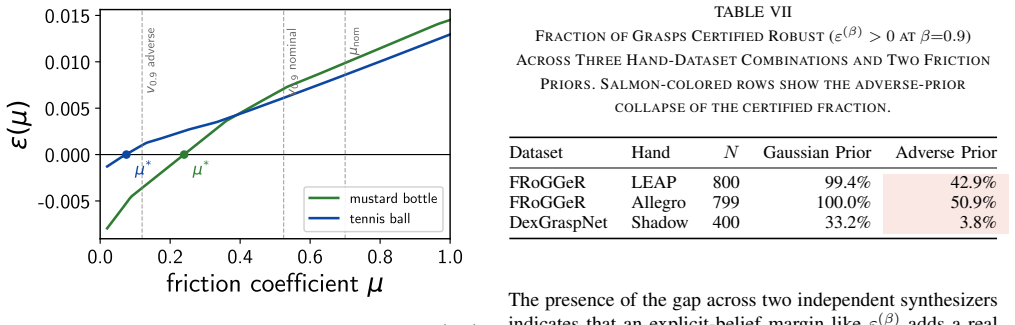
- [Abstract; §IX-D; Theorem 1 and Corollary 2; §X-E] The closure certificate is mathematically valid only conditionally on the stipulated scalar, contact-shared friction prior and the quasi-static linearized Coulomb model. Neither N(0.7,0.1²) nor 0.5U(0.7,1.0)+0.5U(0.1,0.3) is calibrated from measurements, and the adverse choice gives v_0.9≈0.12. The dynamic studies use fixed simulated μ∈{0.2,0.3,0.4}, welded pads, and the same Coulomb-style simulator family, so they test ranking—not realized ≥β execution coverage under an independently estimated friction law. The abstract's “calibrated friction distribution” and the certificate claims should be qualified accordingly, prior sensitivity or measured calibration reported, and force closure clearly distinguished from dynamic retention.
- [§X-E, Figures 12–13 and Tables VIII–IX] The empirical superiority claim rests on modest AUC differences over highly clustered data: 302 established grasps span only seven objects, with repeated friction/direction outcomes, while the reported bootstrap is grasp-level. The shake gap is 0.629 versus 0.578 (ℓ*) and 0.534 (εnom), and the pick gap over ℓ* is 0.78 versus 0.75 and acknowledged as nonsignificant. Please define the AUC observation unit, report object-cluster paired bootstrap intervals, and preferably include an intention-to-treat analysis counting contact-transfer failures. Wording such as “decisive” and the abstract's success-ordering claim should be tempered until this is done.
minor comments (8)
- [§X-B, Table V] Both objectives leave the median adverse-prior ε^(β) negative (−0.00119 versus −0.00322), so the study demonstrates reduced friction sensitivity rather than predominantly adverse-tail-certified synthesis. Please give confidence intervals for 72/125 versus 86/127 and explain “matched budget” alongside solve times of 19.3 s and 14.9 s.
- [§VII, Theorem 3] The claim of a.e. differentiability of ε(g,μ) alone is not quite enough to interchange differentiation with the tail expectation in Eq. (13). Please state the needed integrability/Lipschitz or finite-sample regularity conditions, or formulate the result through the sample-average subgradient.
- [§IX-F and Table VI] εnom is sometimes evaluated with normalized cone edges while ε^(β) uses unit normal forces. This explains why entries such as ε_N^(0.5) can exceed εnom in Table VI, but the convention should be repeated in the table/figure captions or a common scale used for direct comparison.
- [§X-D, Table VII] For DexGraspNet, fingertip forward kinematics followed by projection onto scaled meshes can change contact locations and normals. Given that only 33.2% certify even under the nominal prior, please add a reconstruction sanity check and avoid interpreting cross-dataset fractions as directly comparable across hands and contact conventions.
- [§IX-E] v_β is estimated from 2×10^5 samples even though the chosen Gaussian and mixture-uniform priors admit closed-form tail means. Supplying those formulas would strengthen the “closed-form analytic” description and improve reproducibility.
- [§IX-G, Table III, §X-E] Please explain why the per-object median split produces group sizes 109 and 44, and specify pad dimensions/materials, force limits, shake amplitude/duration, and the precise binary adverse-outcome threshold used for AUC.
- [§VI and §IX-D] The friction ranges are motivated primarily by a commercial reference chart [41]. A measured tribology reference, or explicit presentation of the priors as illustrative stress tests, would be preferable.
- [§VIII] Algorithm 1 does not use Theorem 3's gradient; the text should consistently present differentiability as enabling future gradient-based synthesis rather than as a capability exercised by the present pipeline.
Circularity Check
No load-bearing circularity: ε^(β) is a definitional CVaR-at-friction Ferrari-Canny radius, certificates follow from nesting/CVaR tail bounds, and predictive AUCs are on held-out dynamics the metric never fits.
full rationale
The central construction is Definition 7: ε^(β)(g) := ε(g, v_β) with v_β = CVaR_β(μ). That is a deliberate reparameterization of the classical Ferrari-Canny radius at a risk-adjusted friction, not a fit to shake/pick labels. Theorem 1 is the standard lower-tail CVaR implication (CVaR_β(Z)>0 ⇒ Pr[Z>0]≥β) applied to Z=ε(g,μ); Corollary 2 follows from GWS nesting in μ (Lemma 1) plus v_β ≤ VaR_β(μ). Monotonicity and differentiability are likewise standard CVaR/envelope facts. Empirical claims (53% adverse-tail loss; AUC 0.63/0.78) evaluate this fixed analytic functional on stored grasp maps and on dynamic Drake outcomes the metric does not see at construction time; priors are stipulated, not fitted to those outcomes. Baselines (nominal ε, FRoGGeR ℓ*, DexGraspNet) are external. Author self-citations ([8],[10]–[12],[32]) appear only as related-work motivation for risk-sensitive control and do not underwrite the theorems or the ranking experiments. No equation forces success ranking by construction. Score 1 only for ordinary non-load-bearing self-citation presence.
Assumptions & free parameters
free parameters (4)
- confidence level β =
0.9 (primary)
- nominal friction prior N(0.7, 0.1²) =
mean 0.7, std 0.1
- adverse friction mixture 0.5U(0.7,1.0)+0.5U(0.1,0.3) =
equal 0.5/0.5 mixture on stated intervals
- friction-cone linearization (n_s generators) and unit-normal-force GWS convention
assumptions (5)
- domain assumption Hard-finger Coulomb friction with polyhedral cone linearization; admissible contact forces lie in C^(i) with ||f_t||=μ f_n on generators.
- domain assumption Grasp wrench space nests in friction: W(μ') ⊆ W(μ) for 0 ≤ μ' ≤ μ, and primitive wrenches are affine in μ.
- standard math Lower-tail CVaR properties: CVaR_β(Z)>0 ⇒ VaR_β(Z)>0 ⇒ Pr[Z>0]≥β; CVaR is monotone in β and admits Danskin/envelope gradients under stated conditions.
- domain assumption Quasi-static force closure at the grasp instant (not finite-horizon closed-loop execution) is the right robustness property to certify.
- ad hoc to paper Stored analytical grasp maps plus Drake replay with welded fingertip pads faithfully test friction sensitivity of certified contacts.
invented entities (3)
-
Risk-adjusted friction v_β := CVaR_β(μ) and risk-adjusted wrench body W^(β):=W(v_β)
-
Risk-adjusted margin ε^(β) and CVaR margin Q_β
independent evidence
-
Risk-adjusted min-weight ℓ*(β)
independent evidence
Cite this review
Pith. "Pith review of FIRMGrasp: A Friction-Informed Risk Margin for Robust Grasp Synthesis." pith.science (2026). https://pith.science/paper/EM6JWSDB
@misc{pith2026260725049,
  author       = {Pith},
  title        = {Pith review of: FIRMGrasp: A Friction-Informed Risk Margin for Robust Grasp Synthesis},
  year         = {2026},
  howpublished = {\url{https://pith.science/paper/EM6JWSDB}},
  note         = {Machine review of arXiv:2607.25049}
}
abstract
Classical grasp quality metrics assume one deterministic friction coefficient and therefore cannot assess whether a grasp maintains force closure across plausible friction values. We present FIRMGrasp, a family of grasp quality metrics that incorporates friction uncertainty through Conditional Value-at-Risk (CVaR). At confidence level $\beta$, we evaluate the force-closure margin at the mean of the adverse friction tail. This evaluation defines the risk-adjusted margin $\varepsilon^{(\beta)}$, the inscribed-ball radius of the corresponding grasp wrench space. We prove that $\varepsilon^{(\beta)}$ varies monotonically with $\beta$, remains differentiable in the grasp parameters, and certifies that any grasp with $\varepsilon^{(\beta)} > 0$ achieves force closure with probability at least $\beta$. Across 1,599 LEAP Hand and Allegro Hand grasps, $\varepsilon^{(\beta)}$ identifies friction-sensitive grasps that receive high nominal Ferrari-Canny scores, and 53% of the nominally force-closed grasps lose closure in the adverse friction tail. The nominal margin ranks a successful grasp above a failed grasp with probabilities of only 0.53 in the shake test and 0.67 in the pick test, whereas $\varepsilon^{(\beta)}$ achieves 0.63 and 0.78. At an adverse friction coefficient of 0.2, 70% of grasps with positive $\varepsilon^{(\beta)}$ withstand a simulated lift and lateral pull, compared with 25% of grasps with positive nominal margin and nonpositive $\varepsilon^{(\beta)}$. We also synthesize grasps with positive $\varepsilon^{(\beta)}$ for the RealHand L6 and LEAP Hand, both of which retain the object during adverse-friction lifts. In MuJoCo trials with the RealHand L6, 95% of grasps that establish contact and have positive $\varepsilon^{(\beta)}$ retain the object at the same adverse friction coefficient.
Figures


Figures from the paper (10 more)




Forward citations
Cited by 1 Pith paper
-
Grasp Execution Without a Planner: Configuration-Space Grasp Distance Fields with Certified Safety & Guaranteed Quality
Grasp execution via a softmin field over grasp configurations with CBF-QP safety filtering, eliminating trajectory replanning, with a force-closure margin guarantee that fails in one reported trial.
Reviewed July 31, 2026 · model on record in the stance chip above.
Discussion (0). Continue with ORCID to comment.