REVIEW 2 major objections 4 minor 24 references
Multiple Outbursts of Halley-Type Comet 12P/Pons-Brooks
T0 review · 2 major / 4 minor · reviewed 2026-08-16 · deepseek-v4-flash
Pith's one-line read Comet 12P/Pons-Brooks erupted seven times before reaching the Sun, each time ejecting billions of kilograms of dust with a per-mass energy close to the heat released by crystallization of amorphous water ice.
desk verdict 12P's repeated large outbursts are real and well documented, but the paper's headline masses and energies are understated by roughly 2-3x because of a fixable algebra error in the mean-radius formula. read the letter →
The pith
A machine-rendered reading of the paper's core claim, the machinery that carries it, and where it could break.
The reading
What carries the argument
The central analytical tool is a photometric model that converts an outburst's fading lightcurve into a dust particle size distribution. For impulsively ejected, gas-drag-accelerated dust, the scattering cross-section inside a fixed aperture falls as $C(t) \propto \delta t^{6-2\gamma}$, so measuring the decay slope gives the differential size index $\gamma$. This is combined with a mass-to-cross-section relation, $M \sim 0.02\,C$ (in SI units), derived by assuming grain radius $a = 18\,\mu$m, albedo 0.04, and density $10^3$ kg m$^{-3}$. Using Outburst D's measured $\gamma = 4.2$ as the template for all seven events, the paper converts each outburst's excess cross-section into a dust mass, then into kinetic energy and power.
What would settle it
Measure the ejected dust size distribution during a future outburst using thermal infrared or polarimetric observations; if the mean grain radius is a few hundred micrometers or larger rather than the assumed 18 $\mu$m, the derived outburst masses rise by orders of magnitude and the specific energy drops far below the $10^5$ J kg$^{-1}$ crystallization value, ruling out that energy match.
Extended reading notes
Core claim
The paper reports that 12P/Pons-Brooks, a Halley-type comet, was continuously active from at least 8 au and exhibited a series of seven major photometric outbursts beginning near 4 au, each with a sawtooth lightcurve and a radiation-pressure-shaped 'horned' coma. From the best-characterized event, Outburst D, the dust size distribution is a power law with differential index $\gamma = 4.2 \pm 0.2$, the optically dominant grains have radii $a \gtrsim 10\,\mu$m (mean radius $\bar a = 18\,\mu$m), and the derived median outburst mass is $M \sim 2 \times 10^9$ kg. The kinetic energy of Outburst D is $E \sim 4.8 \times 10^{14}$ J, giving a specific energy near $7 \times 10^4$ J kg$^{-1}$, close to the $10^5$ J kg$^{-1}$ released by amorphous ice crystallization. The authors conclude that crystallization, with consequent release of trapped supervolatile gases, is the most consistent but not definitive explanation for the outbursts.
Load-bearing premise
The masses, energies, and the crystallization match all rest on the assumption that every outburst ejected dust with the same size distribution, minimum grain size, albedo, and density as the single well-observed Outburst D; if the grains are actually larger or fewer, the derived energy per kilogram falls away from the crystallization threshold.
Editorial extensions
If this is right
- If crystallization drives the outbursts, each event should remove a near-surface patch roughly 5 km across, implying the nucleus must be at least this size to supply the observed dust masses.
- The apparent ~14-day spacing between several outbursts could be the recharge time for heat to conduct through a porous mantle to buried amorphous ice, giving a testable timescale for future modeling.
- A single 12P outburst carries mass comparable to the entire mass lost by 67P/Churyumov-Gerasimenko over one orbit, showing that 12P's outburst mechanism operates on a far larger scale than typical cometary activity.
- Momentum conservation predicts a non-gravitational acceleration of roughly $10^{-7}/r_n^3$ m s$^{-2}$ (with nucleus radius $r_n$ in km), which could be searched for in astrometric data to constrain the nucleus size.
- The roughly constant outburst cross-section, near $10^{11}$ m$^2$, hints at a fundamental physical scale in the nucleus that a successful mechanism must reproduce.
Reading between the lines
- A direct extension of the paper's logic is that the same per-outburst dust mass would produce a larger apparent brightness amplification at larger heliocentric distances, because the base coma is fainter there; this could be checked by comparing high-cadence photometry of future outbursts at different distances.
- If the 14-day spacing reflects the rotation period or a beat period of the nucleus, the next apparition's outburst times could be predicted from a fixed source region, an inference the paper does not draw explicitly.
- The assumed grain size distribution is the main lever on the energy argument: at infrared or millimeter wavelengths one could detect the thermal emission of the ejected grains and directly measure whether the mean radius is near 18 $\mu$m or much larger, which would confirm or overturn the crystallization energy match.
- Should crystallization be correct, outbursts should become less frequent or weaker after perihelion as the subsurface amorphous ice reservoir is progressively heated and converted, a testable prediction for post-perihelion monitoring.
Signed reviews
Editorial analysis
A structured set of objections, weighed in public.
Referee Report
Summary. This paper analyzes optical photometry and imaging of comet 12P/Pons-Brooks from about 8 au inbound to about 1 au, identifying a series of seven large outbursts that begin near 4 au. The authors measure an expansion speed of the dust coma, infer a differential dust size index from the fading of Outburst D, and use these to estimate individual outburst dust masses (about 10^9 to 10^10 kg), kinetic energies (about 10^14 J), release times, and powers. They further argue that the specific kinetic energy of the ejecta is comparable to the latent heat of amorphous water ice crystallization, making crystallization a plausible but not definitive outburst driver. The paper also reports the heliocentric lightcurve, inter-outburst mass-loss rates, and constraints on the nucleus size and non-gravitational acceleration.
Significance. If the quantitative estimates are corrected, this is a valuable observational study of a rarely observed Halley-type comet in outburst. The dataset is unusually comprehensive, combining resolved imaging from the Nordic Optical Telescope with dense amateur photometry, and the paper is explicit about its modeling uncertainties such as albedo, density, and phase function. The identification of seven quasi-periodic outbursts, each with masses rivaling the entire per-orbit mass loss of 67P, is a significant contribution. The proposed crystallization mechanism is physically motivated and appropriately hedged, but as discussed below the specific-energy comparison needs recalculation before it can be used as supporting evidence.
major comments (2)
- [§3, Dust Mass, Eq. (8) and Table 2] Equation (8) is mis-evaluated. For a differential size distribution n(a) da = Γ a^{-γ} da with γ > 4 and amax >> amin, the cross-section-weighted mean radius is a = (γ-3)/(γ-4) amin. Substituting the paper's γ = 4.2 gives a = 6 amin = 60 µm, not the stated 11/6 amin = 18 µm. Evaluating the integrals with the paper's stated finite range amin = 10 µm and amax = 4 mm gives a ≈ 42 µm. Consequently, Equation (9) should be M ≈ 0.08 C (or about 0.056 C for the finite range), not M ≈ 0.02 C. All masses in Table 2, the quoted mean and median outburst masses, and the derived kinetic energies and powers are therefore understated by factors of roughly 2.3 to 3.3. For example, Outburst D becomes about 1.6 × 10^10 to 2.2 × 10^10 kg rather than 6.8 × 10^9 kg. This is an algebraic error, not merely an unmeasured-parameter uncertainty, and it affects the quantitative claims in the abstract.
- [§3, Outburst Mechanism (page 17)] The kinetic-energy estimate uses V = 375 m s^{-1} for the entire ejected mass, but the paper itself establishes that V = 375 m s^{-1} applies to the smallest dynamically coupled grains, a ≈ 10 µm, and that V(a) ∝ a^{-1/2} (Equation 2). With the fitted γ = 4.2, the mass-averaged specific kinetic energy is E/M = 0.5 V0^2 a0 [∫a^{2-γ} da] / [∫a^{3-γ} da]. For amax >> amin this equals V(amin)^2 / 12 ≈ 1.2 × 10^4 J kg^{-1}, and with the finite range 10 µm to 4 mm it is about 1.7 × 10^4 J kg^{-1}. This is an order of magnitude below the claimed 7 × 10^4 J kg^{-1} and well below the 10^5 J kg^{-1} crystallization energy. The statement that the specific outburst energy and the specific crystallization energy are comparable needs to be recomputed, or the crystallization argument must be substantially softened.
minor comments (4)
- [Abstract] The last sentence contains a typesetting error: 'both ∼ 10^5 J kg/s' should read 'both ∼ 10^5 J kg^{-1}'.
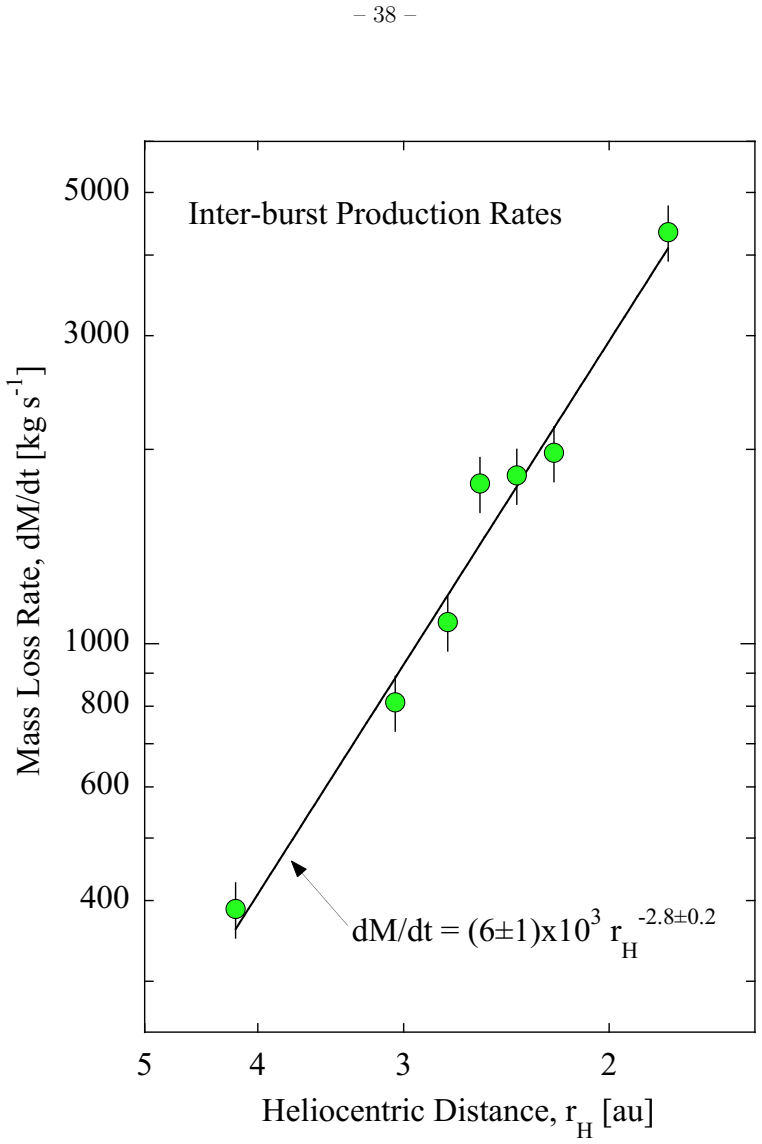
- [§3, Outburst Decay Shapes vs. §4 Summary] The differential size index is quoted as γ = 4.2 ± 0.2 in the main text and Figure 8 but as 4.2 ± 0.3 in the summary bullet. These should be unified.
- [§3, Eq. (6)] Equation (6) as written contains a0^2, whereas the derivation from Equations (3) and (5) gives a0^{3-γ}. Because the authors set a0 = 1 m, the numerical value is unchanged and the fitted slope is unaffected, but the equation is dimensionally inconsistent and should be corrected.
- [§3, Heliocentric Lightcurve] The two acceptable lightcurve models (m,n = 4.0,2.0 and 4.5,1.0) are described as comparably good, but Figure 3 does not show residuals; a brief residual diagnostic would strengthen the claim that both models are acceptable.
Circularity Check
No load-bearing circularity: outburst masses, energies, and powers are independent outputs of photometric cross-sections, a fitted size index, and measured expansion speeds.
full rationale
The derivation is self-contained rather than circular. The differential size index gamma=4.2 is fit to the decay slope of Outburst D through Equation 6 (C(t) proportional to t^{6-2gamma}, Figure 8), while the peak excess cross-sections Delta-C are independent photometric quantities from Equation A1. Masses are then obtained from M=(4/3)rho a C (Equation 7) with a from Equation 8; these masses are new outputs and are not used to regenerate the fitted lightcurve. Energy and power for Outburst D follow from the fitted mass and the measured deprojected speed V=375+/-38 m/s, and the specific energy comparison uses the external latent heat of amorphous-ice crystallization (~10^5 J/kg) from the literature. The few self-citations (Jewitt et al. 2021b for V proportional to r_H^-1; Prialnik & Jewitt 2024 for crystallization context) are auxiliary; the V scaling is corroborated by the historical Struve measurement, and the crystallization interpretation is explicitly hedged ('most consistent with, although do not definitively establish'). No fitted parameter is renamed as a prediction, and no equation reduces to its inputs by construction. The paper also flags its own missing data (e.g., 'no measurement of alpha_NGA exists'), which are limitations rather than circular dependencies. Separately, Equation 8's stated 11/6 a_min = 18 microns appears inconsistent with gamma=4.2 and a_max >> a_min, which would give 6 a_min = 60 microns if cross-section-weighted; if correct, this is a numerical/correctness issue that would rescale masses up by roughly 2-3x, but it does not make the derivation circular.
Assumptions & free parameters
free parameters (7)
- gamma (differential size index) =
4.2 +/- 0.2
- V0 (terminal velocity constant) =
1.2 m/s
- amin (minimum particle radius) =
10 µm (derived from beta <= 0.1)
- p_V (geometric albedo) =
0.04
- Phase function gradient =
0.02 mag/deg
- rho (dust bulk density) =
1000 kg/m3
- Spatial index n in photometry model =
1 or 2 (bracketing models)
assumptions (6)
- domain assumption The dust size distribution is a single power law n(a) da = Gamma a^-gamma da over a broad size range.
- domain assumption Particles are accelerated by gas drag with terminal velocity V(a) = V0 (a0/a)^(1/2), and radiation pressure efficiency is beta ~ 10^-6/a.
- domain assumption The dust albedo and phase function are p_V = 0.04 and 0.02 mag/deg, taken from other comets.
- domain assumption The size distribution measured for Outburst D applies to all seven outbursts.
- domain assumption Amorphous water ice crystallization releases roughly 10^5 J/kg, as reported in prior literature.
- domain assumption The nucleus is approximated as spherical with sun-facing hemisphere sublimation for the equilibrium temperature estimate (cos theta = 1/2).
Cite this review
Pith. "Pith review of Multiple Outbursts of Halley-Type Comet 12P/Pons-Brooks." pith.science (2026). https://pith.science/paper/EMBCWCRJ
@misc{pith2026250420316,
  author       = {Pith},
  title        = {Pith review of: Multiple Outbursts of Halley-Type Comet 12P/Pons-Brooks},
  year         = {2026},
  howpublished = {\url{https://pith.science/paper/EMBCWCRJ}},
  note         = {Machine review of arXiv:2504.20316}
}
read the original abstract
We present optical observations of Halley type comet 12P/Pons-Brooks on its approach to perihelion. The comet was active even in the first observations at about 8 au. Starting at 4 au, 12P exhibited an extraordinary series of outbursts, in which the brightness changed by a factor up to 100 and the coma morphology transformed under the action of radiation pressure into a distinctive ``horned'' appearance. Individual outburst dust masses are several x 1e9 kg, with kinetic energies 1e14 J, release times 1e4 s and effective power 1e10 W. These properties are most consistent with, although do not definitively establish, an origin by the crystallization of amorphous water ice with the related release of trapped supervolatile gases. This interpretation is supported by the observation that the specific outburst energy and the specific crystallization energy are comparable (both near 1e5 J kg/s.
Figures


Figures from the paper (7 more)



Reference graph
Works this paper leans on
-
[1]
Bailey, M. E. & Emel’Yanenko, V. V. 1996, MNRAS, 278,
work page 1996
-
[2]
Major Outbursts IDa UT Dateb DOYc Vpeak d Vbasee ∆Vf Cpeak g Cbaseh ∆Ci Massj A 2023 Jul 21 567 11.74 16.57 4.83 1.10 ×10¹¹ 1.28×10⁹ 1.08×10¹¹ 2.2×10⁹ B 2023 Oct 06 644 11.81 15.36 3.55 5.66 ×10¹⁰ 2.15×10⁹ 5.44×10¹⁰ 1.1×10⁹ C 2023 Nov 01 670 10.23 14.83 4.60 1.88 ×10¹¹ 2.71×10⁹ 1.85×10¹¹ 3.7×10⁹ D 2023 Nov 15 684 9.37 14.15 4.78 3.47 ×10¹¹ 4.25×10⁹ 3.42×1...
work page 2023
-
[6]
1.— Observing geometry as a function of Day of Year (1 = UT 2022 January 1)
bEstimated date of peak brightness cDay of Year of peak brightness dPeak magnitude eBase magnitude fOutburst range, magnitudes gCross-section at outburst peak, m 2 hCross-section at outburst base, m 2 iChange in cross-section due to outburst, m 2 jMass (kg), from Equation 7 – 30 – 0246810 -20-1001020304050 02004006008001000 Helio- and Geocentric Distance ...
work page 2022
-
[22]
Observing Geometry UT Date DOY a νb rH c ∆d αe θ−⊙f θ−V g δih Note 2022 Mar 23.2 82.2 212.2 7.939 8.030 7.1 273.2 220.6 6.6 Not detected 2022 Mar 30.2 89.2 212.3 7.890 7.903 7.2 268.2 220.0 6.5 2022 May 29.1 149.1 213.6 7.456 6.930 6.9 214.7 207.1 1.3 2022 Jun 23.1 174.1 214.1 7.271 6.671 6.8 183.6 198.6 -2.1 2022 Jul 30.0 210.0 215.0 6.991 6.496 7.5 137....
work page 2022
-
[31]
Comet 12P/Pons-Brooks: Identification with Comets C/1385 U1 and C/1457 A1
doi:10.1088/0004-637X/728/1/31 Lin, Z.-Y., Knollenberg, J., Vincent, J.-B., et al. 2017, MNRAS, 469, S731. doi:10.1093/mnras/stx2768 Meech, K. J. & Jewitt, D. C. 1987, A&A, 187, 585 Meyer, M., Kobayashi, T., Nakano, S., et al. 2020, arXiv:2012.15583. doi:10.48550/arXiv.2012.15583 M¨ uller, D. R., Altwegg, K., Berthelier, J.-J., et al. 2024, MNRAS, 529,
work page Pith review arXiv doi:10.48550/arxiv.2012.15583 2017
-
[47]
doi:10.3847/1538-4365/aabfdf Ye, Q. et al
- [77]
-
[105]
W., Riello, M., De Angeli, F., et al
doi:10.1007/s11038-012-9413-z Evans, D. W., Riello, M., De Angeli, F., et al. 2018, A&A, 616, A4. doi:10.1051/0004- 6361/201832756 Fern´ andez, J. A., Gallardo, T., & Young, J. D. 2016, MNRAS, 461,
Show all 24 references
-
[131]
doi:10.3847/PSJ/abfe11 Kronk, G. W. 2003, Cometography, by Gary W. Kronk, ISBN 0521585058. Cambridge, UK: Cambridge University Press, p.852 Landolt, A. U. 1992, AJ, 104,
2003 doi
-
[169]
doi:10.3847/0004- 6256/152/6/169 – 25 – Jewitt, D. C. & Meech, K. J. 1987, ApJ, 317,
1987 doi
-
[188]
doi:10.3847/1538-3881/abe4cf Kelley, M. S. P., Farnham, T. L., Li, J.-Y., et al. 2021, PSJ, 2, 4,
2021 doi
-
[191]
V., Asher, D
doi:10.1007/s11214- 015-0223-2 Emel’yanenko, V. V., Asher, D. J., & Bailey, M. E. 2013, Earth Moon and Planets, 110,
2013 doi
- [223]
-
[261]
2021, AJ, Cometary Activity Begins at Kuiper Belt Distances: Evidence from C/2017 K2, 161, 4,
doi:10.3847/1538-3881/abf09c Jewitt, D., Kim, Y., Mutchler, M., et al. 2021, AJ, Cometary Activity Begins at Kuiper Belt Distances: Evidence from C/2017 K2, 161, 4,
2021 doi
-
[296]
doi:10.1086/124249 Davidsson, B. J. R., Samarasinha, N. H., Farnocchia, D., et al. 2022, MNRAS, 509,
2022 doi
- [340]
-
[359]
M., Hainaut, O., et al
doi:10.1016/j.icarus.2016.11.026 Sekanina, Z., Larson, S. M., Hainaut, O., et al. 1992, A&A, 263, 367 Willmer, C. 2018, ApJS, 236,
2016 doi
-
[467]
2016, AJ, 152,
doi:10.1039/D3FD00048F Ishiguro, M., Kuroda, D., Hanayama, H., et al. 2016, AJ, 152,
2016 doi
-
[992]
2016, ApJ, 829, L8
doi:10.1086/165347 Jewitt, D., Mutchler, M., Weaver, H., et al. 2016, ApJ, 829, L8. doi:10.3847/2041- 8205/829/1/L8 Jewitt, D., Agarwal, J., Li, J., et al. 2017, AJ, 153,
2016 doi
-
[1087]
2015, A&A, 583, A38
doi:10.1093/mnras/278.4.1087 Bertaux, J.-L. 2015, A&A, 583, A38. doi:10.1051/0004-6361/201525992 Bobrovnikoff, N. T. 1932, PASP, 44, 261,
2015 doi
-
[2024]
Meech et al., University of Arizona Press, Tucson, Arizona, pp
In Comets III, editor K. Meech et al., University of Arizona Press, Tucson, Arizona, pp. 823-843 Schambeau, C. A., Fern´ andez, Y. R., Samarasinha, N. H., et al. 2017, Icarus, 284,
2017
-
[2763]
M., Marinoni, S., et al
doi:10.1093/mnras/stae622 – 26 – Pancino, E., Marrese, P. M., Marinoni, S., et al. 2022, A&A, 664, A109. doi:10.1051/0004- 6361/202243939 Prialnik, D. & Bar-Nun, A. 1992, A&A, 258, L9 Prialnik, D., and Jewitt, D
2022 doi
-
[3065]
2015, Space Sci
doi:10.1093/mnras/stab3191 67P/ Dones, L., Brasser, R., Kaib, N., et al. 2015, Space Sci. Rev., 197,
2015 doi
-
[3075]
doi:10.1093/mnras/stw1532 Gritsevich, M., Weso lowski, M., & Castro-Tirado, A. J. 2025, MNRAS. doi:10.1093/mnras/staf219 Gudipati, M. S., Fleury, B., Wagner, R., et al. 2023, Faraday Discussions, 245,
2025 doi
Reviewed August 16, 2026 · model on record in the stance chip above.
Discussion (0). Continue with ORCID to comment.