What Is a Pattern in Statistical Mechanics? Formalizing Structure and Patterns in One-Dimensional Spin Lattice Models with Computational Mechanics
Pith reviewed 2026-06-27 18:01 UTC · model grok-4.3
The pith
Recasting Boltzmann distributions of one-dimensional spin models as stochastic processes allows computational mechanics to formalize their structure and patterns.
A machine-rendered reading of the paper's core claim, the machinery that carries it, and where it could break.
Core claim
By deriving a novel expression for the Boltzmann distribution on finite one-dimensional spin configurations and recasting it as a stochastic process, the structure of each model is quantified by its excess entropy and statistical complexity, while its structure-generating mechanism is given by its epsilon-machine; these jointly determine configurations that agree with those typical under the Boltzmann distribution.
What carries the argument
The epsilon-machine of the stochastic process obtained from the Boltzmann distribution, which encodes the minimal finite-state machine that generates the spin configurations while quantifying structure via excess entropy and statistical complexity.
Load-bearing premise
That recasting the Boltzmann distribution for finite spin configurations as a stochastic process enables valid analysis of structure within computational mechanics while preserving compatibility with statistical mechanics.
What would settle it
A mismatch between the configurations determined by the epsilon-machines and information measures and the typical configurations sampled from the Boltzmann distribution would falsify the agreement claim.
Figures
read the original abstract
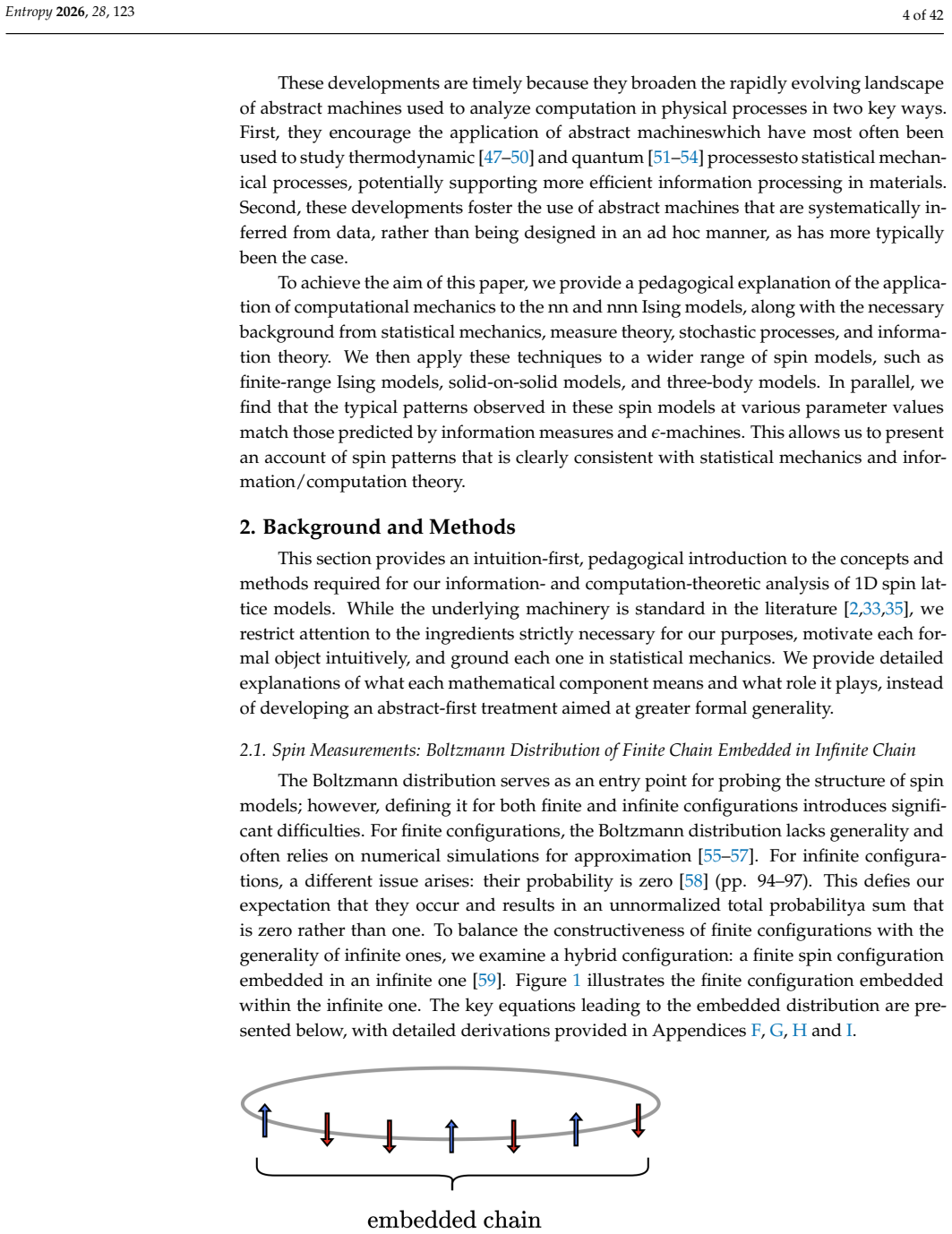
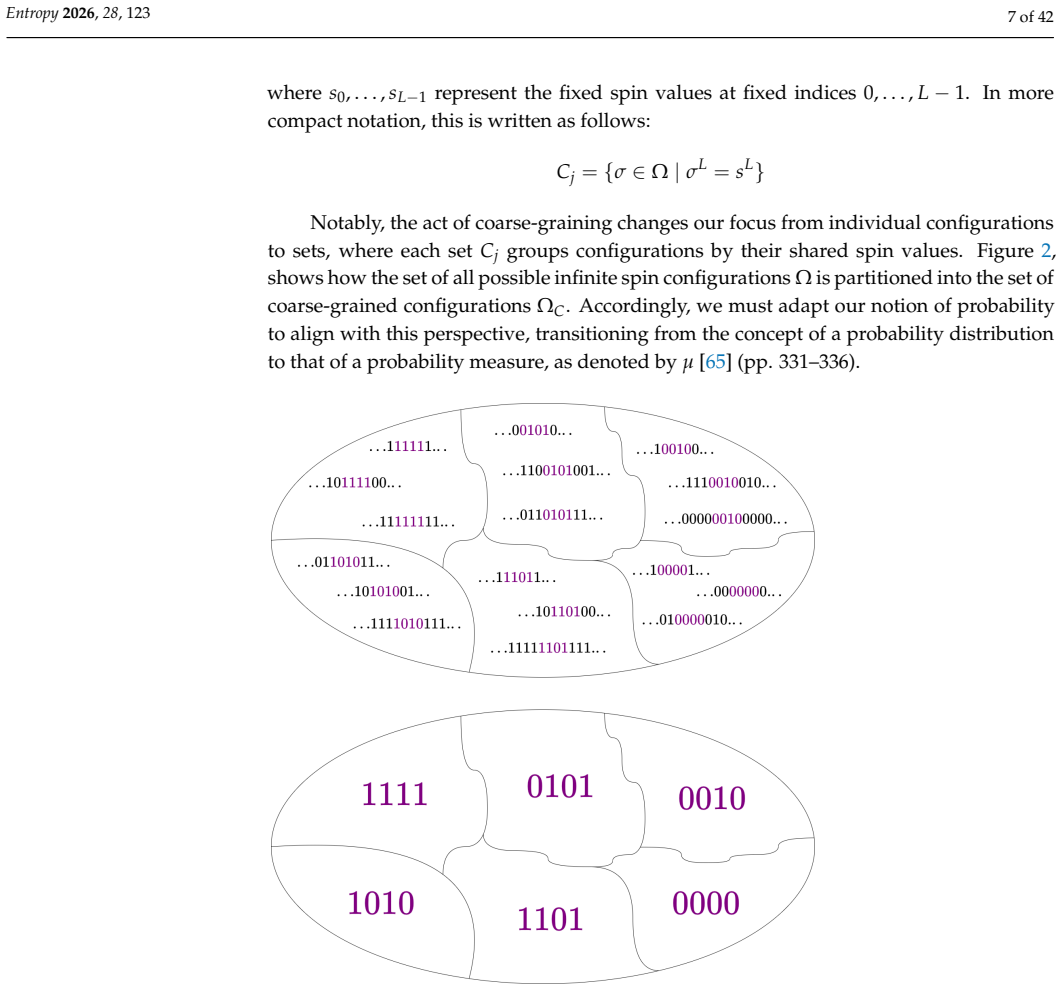
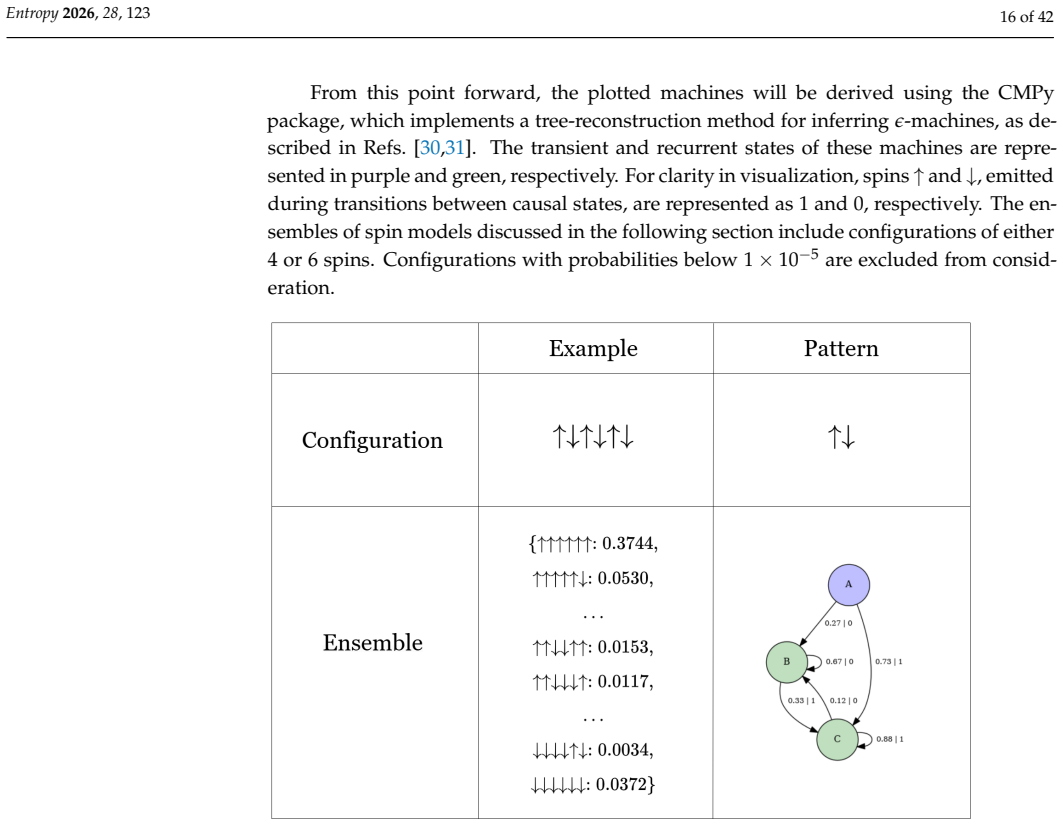
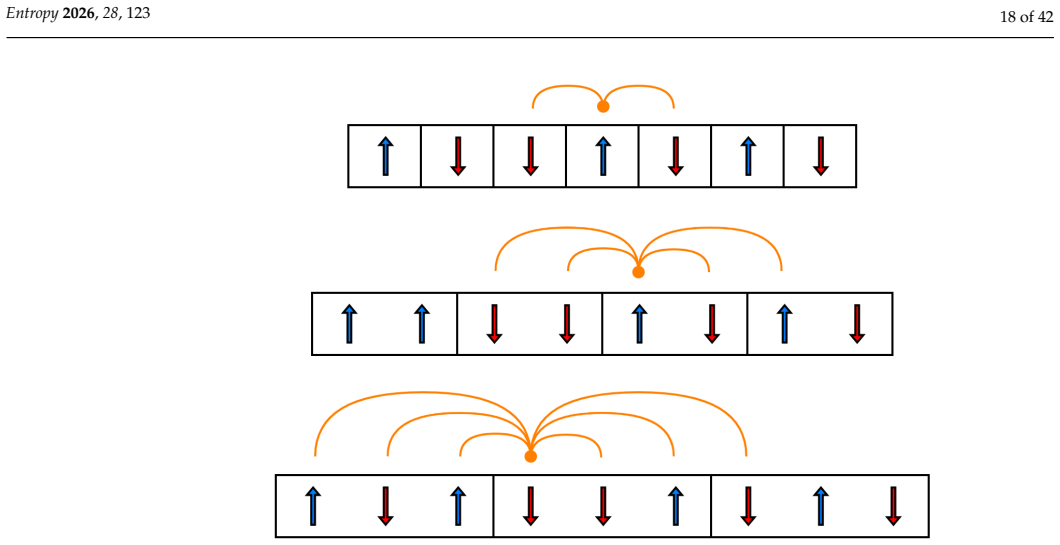
This work formalizes the notions of structure and pattern for three distinct one-dimensional spin-lattice models (finite-range Ising, solid-on-solid, and three-body), using information-theoretic and computation-theoretic methods. We begin by presenting a novel derivation of the Boltzmann distribution for finite one-dimensional spin configurations embedded in infinite ones. We next recast this distribution as a stochastic process, thereby enabling us to analyze each spin-lattice model within the theory of computational mechanics. In this framework, the process's structure is quantified by excess entropy (predictable information) and statistical complexity (stored information), and the process's structure-generating mechanism is specified by its epsilon-machine. To assess compatibility with statistical mechanics, we compare the configurations jointly determined by the information measures and epsilon-machines to typical configurations drawn from the Boltzmann distribution, and we find agreement. We also include a self-contained primer on computational mechanics and provide code implementing the information measures and spin-model distributions.
Editorial analysis
A structured set of objections, weighed in public.
Referee Report
Summary. The paper claims to formalize notions of structure and pattern in three one-dimensional spin-lattice models (finite-range Ising, solid-on-solid, three-body) via a novel derivation of the Boltzmann distribution for finite embedded configurations in infinite chains, followed by recasting the distribution as a stationary stochastic process. Computational mechanics is then applied to compute excess entropy, statistical complexity, and epsilon-machines; compatibility with statistical mechanics is assessed by comparing configurations jointly determined by these quantities against typical samples from the original Boltzmann measure, with reported agreement. A self-contained primer on computational mechanics and implementing code are included.
Significance. If the embedding derivation and recasting hold, the work supplies a concrete information-theoretic and computation-theoretic definition of 'pattern' for these models, with the reported agreement serving as an internal consistency check. The provision of code supports reproducibility, and the primer lowers the barrier for readers from statistical mechanics.
minor comments (3)
- [Abstract and results section] The abstract states agreement between the information-theoretic configurations and Boltzmann samples but does not specify the quantitative metric or tolerance used for 'agreement'; this should be stated explicitly in the results section.
- [Section introducing the stochastic process] Notation for the embedded finite configurations and the induced stochastic process should be introduced with a clear table or diagram showing the mapping from spin configurations to symbols in the epsilon-machine alphabet.
- [Primer section] The primer on computational mechanics is useful, but cross-references to the specific excess-entropy and statistical-complexity formulas used for the three models would improve readability.
Simulated Author's Rebuttal
We thank the referee for their positive assessment of the manuscript and for recommending minor revision. The referee's summary correctly captures our contributions: the embedding derivation of the Boltzmann distribution, its recasting as a stationary process, the application of computational mechanics to quantify structure via excess entropy and statistical complexity, the specification of mechanisms via epsilon-machines, and the consistency check against typical samples. We also appreciate the recognition of the primer and code for lowering barriers and supporting reproducibility.
Circularity Check
No significant circularity; derivation presented as independent.
full rationale
The abstract describes a novel derivation of the Boltzmann distribution for finite embedded spin configurations, followed by recasting as a stochastic process and application of computational mechanics quantities, with a subsequent comparison to typical Boltzmann samples offered as compatibility check. No equations, sections, or self-citations are supplied that would allow exhibition of any reduction by construction (e.g., a fitted parameter renamed as prediction or a self-citation chain bearing the central claim). The comparison step is framed as external validation rather than tautological, and the work includes a self-contained primer plus code, indicating the derivation chain is treated as self-contained against external benchmarks. Absent specific quotes demonstrating equivalence of output to input, no circular steps are identified.
Axiom & Free-Parameter Ledger
axioms (2)
- domain assumption Boltzmann distribution governs probabilities of spin configurations in the models
- standard math Excess entropy, statistical complexity, and epsilon-machines from computational mechanics quantify structure and generating mechanisms
Reference graph
Works this paper leans on
-
[1]
Quantifying the Rise and Fall of Complexity in Closed Systems: The Coffee Automaton
Aaronson, S.; Carroll, S.M.; Ouellette, L. Quantifying the Rise and Fall of Complexity in Closed Systems: The Coffee Automaton. arXiv 2014, arXiv:1405.6903
Pith/arXiv arXiv 2014
-
[2]
Feldman, D.P .; Crutchfield, J.P . Discovering Noncritical Organization: Statistical Mechanical, Information Theoretic, and Com- putational Views of Patterns in One-Dimensional Spin Systems. Entropy 2022, 24, 1282. https://doi.org/10.3390/e24091282
-
[3]
Bak, P .How Nature Works: The Science of Self-organized Criticality , ebook ed.; Springer: New York, NY , USA, 2013
2013
-
[4]
URL https://www.science.org/doi/abs/10.1126/science
Rothstein, J. Information, Measurement, and Quantum Mechanics. Science 1951, 114, 171–175. https://doi.org/10.1126/science. 114.2955.171
-
[5]
Eliazar, I. Five degrees of randomness. Phys. A Stat. Mech. Its Appl. 2021, 568, 125662. https://doi.org/10.1016/j.physa.2020.1 25662
-
[6]
Sethna, J.P .Statistical Mechanics: Entropy, Order Parameters, and Complexity ; Oxford University Press: Oxford, UK, 2006
2006
-
[7]
Goldenfeld, N. Lectures on Phase T ransitions and the Renormalization Group; Frontiers in Physics; Westview Press: Boca Raton, FL, USA, 1992; V olume 85. https://doi.org/10.1201/9780429493492
-
[8]
Chaikin, P .M.; Lubensky , T.C.Principles of Condensed Matter Physics ; Cambridge University Press: Cambridge, UK, 1995
1995
-
[9]
Scaling Laws for Ising Models Near Tc
Kadanoff, L.P . Scaling Laws for Ising Models Near Tc. Phys. Phys. Fiz. 1966, 2, 263–272. https://doi.org/10.1103/ PhysicsPhysiqueFizika.2.263
1966
-
[10]
Statistical Mechanics of Phase T ransitions; Clarendon Press: Oxford, UK, 1992
Yeomans, J.M. Statistical Mechanics of Phase T ransitions; Clarendon Press: Oxford, UK, 1992
1992
-
[11]
Krinsky , S.; Furman, D. Exact renormalization-group exhibiting tricritical fixed point for a spin-one Ising model in one dimen- sion. Phys. Rev. B 1975, 11, 2602–2613. https://doi.org/10.1103/PhysRevB.11.2602
-
[12]
Ising Model: Local Spin Correlations and Conformal Invariance
Gheissari, R.; Hongler, C.; Park, S.C. Ising Model: Local Spin Correlations and Conformal Invariance. Commun. Math. Phys. 2019, 367, 771–833. https://doi.org/10.1007/s00220-019-03312-y
-
[13]
Analytical and Numerical Studies of the One-Dimensional Spin Facilitated Kinetic Ising Model
Schulz, M.; Trimper, S. Analytical and Numerical Studies of the One-Dimensional Spin Facilitated Kinetic Ising Model. J. Stat. Phys. 1999, 94, 173–194. https://doi.org/10.1023/A:1004560416939
-
[14]
One-dimensional Ising model: Kinetic studies
Lacombe, R.H.; Simha, R. One-dimensional Ising model: Kinetic studies. J. Chem. Phys. 1974, 61, 1899–1911. https://doi.org/ 10.1063/1.1682190. https://doi.org/10.3390/e28010123 Entropy 2026, 28, 123 40 of 42
-
[15]
Some necessary background
Landau, D.P .; Binder, K. Some necessary background. In A Guide to Monte Carlo Simulations in Statistical Physics , 4th ed.; Cambridge University Press: Cambridge, UK, 2015; pp. 7–46
2015
-
[17]
Exact Distribution of Energies in the Two-Dimensional Ising Model
Beale, P .D. Exact Distribution of Energies in the Two-Dimensional Ising Model. Phys. Rev. Lett. 1996, 76, 78–81. https: //doi.org/10.1103/PhysRevLett.76.78
-
[18]
Single-file water as a one-dimensional Ising model
Köfinger, J.; Dellago, C. Single-file water as a one-dimensional Ising model. New J. Phys. 2010, 12, 093044. https://doi.org/10.1 088/1367-2630/12/9/093044
2010
-
[19]
Tsypin, M.M.; Blote, H.W.J. Probability distribution of the order parameter for the three-dimensional Ising-model universality class: A high-precision Monte Carlo study . Phys. Rev. E 2000, 62, 73–76. https://doi.org/10.1103/PhysRevE.62.73
-
[20]
Probability distributions of the work in the two-dimensional Ising model
Chatelain, C.; Karevski, D. Probability distributions of the work in the two-dimensional Ising model. J. Stat. Mech. Theory Exp. 2006, 2006, P06005. https://doi.org/10.1088/1742-5468/2006/06/P06005
-
[21]
Statistical Mechanics, 3rd ed.; Butterworth-Heinemann: Oxford, UK, 2011
Pathria, R.K.; Beale, P .D. Statistical Mechanics, 3rd ed.; Butterworth-Heinemann: Oxford, UK, 2011
2011
-
[22]
Random-Energy Model: Limit of a Family of Disordered Models
Derrida, B. Random-Energy Model: Limit of a Family of Disordered Models. Phys. Rev. Lett. 1980, 45, 79–82. https://doi.org/ 10.1103/PhysRevLett.45.79
-
[23]
Thermostatics and Thermodynamics: An Introduction to Energy, Information and States of Matter, with Engineering Applica- tions; D
Tribus, M. Thermostatics and Thermodynamics: An Introduction to Energy, Information and States of Matter, with Engineering Applica- tions; D. Van Nostrand Company , Inc.: Princeton, NJ, USA, 1961
1961
-
[24]
Steps to an Ecology of Mind: Collected Essays in Anthropology, Psychiatry, Evolution, and Epistemology ; Jason Aronson Inc.: Northvale, NJ, USA; London, UK, 1987
Bateson, G. Steps to an Ecology of Mind: Collected Essays in Anthropology, Psychiatry, Evolution, and Epistemology ; Jason Aronson Inc.: Northvale, NJ, USA; London, UK, 1987
1987
-
[25]
Elements of Information Theory , 2nd ed.; Wiley-Interscience: Hoboken, NJ, USA, 2006
Cover, T.M.; Thomas, J.A. Elements of Information Theory , 2nd ed.; Wiley-Interscience: Hoboken, NJ, USA, 2006
2006
-
[26]
The Dripping Faucet as a Model Chaotic System ; Aerial Press: Santa Cruz, CA, USA, 1984
Shaw, R. The Dripping Faucet as a Model Chaotic System ; Aerial Press: Santa Cruz, CA, USA, 1984
1984
-
[27]
Symbolic dynamics of noisy chaos
Crutchfield, J.P .; Packard, N.H. Symbolic dynamics of noisy chaos. Phys. D 1983, 7, 201–223
1983
-
[28]
Toward a quantitative theory of self-generated complexity .Int
Grassberger, P . Toward a quantitative theory of self-generated complexity .Int. J. Theor. Phys. 1986, 25, 907–938
1986
-
[29]
Complexity measures and cellular automata
Lindgren, K.; Nordhal, M.G. Complexity measures and cellular automata. Complex Syst. 1988, 2, 409–440
1988
-
[30]
Inferring statistical complexity
Crutchfield, J.P .; Young, K. Inferring statistical complexity . Phys. Rev. Lett. 1989, 63, 105–108
1989
-
[31]
The calculi of emergence: Computation, dynamics, and induction
Crutchfield, J.P . The calculi of emergence: Computation, dynamics, and induction. Phys. D 1994, 75, 11–54
1994
-
[32]
Crutchfield, J.P . Between order and chaos. Nat. Phys. 2012, 8, 17–24. https://doi.org/10.1038/nphys2190
-
[33]
Computational Mechanics: Pattern and Prediction, Structure and Simplicity
Shalizi, C.R.; Crutchfield, J.P . Computational Mechanics: Pattern and Prediction, Structure and Simplicity . J. Stat. Phys. 2001, 104, 817–879. https://doi.org/10.1023/A:1010388907793
-
[34]
Introduction to Automata Theory, Languages, and Computation , 2nd ed.; Addison-Wesley: Carrollton, TX, USA, 2001
Hopcroft, J.E.; Ullman, J.D. Introduction to Automata Theory, Languages, and Computation , 2nd ed.; Addison-Wesley: Carrollton, TX, USA, 2001
2001
-
[35]
Thermodynamic depth of causal states: Objective complexity via minimal representations
Crutchfield, J.P .; Shalizi, C.R. Thermodynamic depth of causal states: Objective complexity via minimal representations. Phys. Rev. E 1999, 59, 275–283. https://doi.org/10.1103/PhysRevE.59.275
-
[36]
Optimal causal inference: Estimating stored information and approximating causal archi- tecture
Still, S.; Crutchfield, J.P .; Ellison, C.J. Optimal causal inference: Estimating stored information and approximating causal archi- tecture. Chaos 2010, 20, 037111. https://doi.org/10.1063/1.3489885
-
[37]
Bayesian structural inference for hidden processes
Streloff, C.C.; Crutchfield, J.P . Bayesian structural inference for hidden processes. Phys. Rev. E 2014, 89, 042119. https: //doi.org/10.1103/PhysRevE.89.042119
-
[38]
Predictive Rate–Distortion for Infinite-Order Markov Processes
Marzen, S.E.; Crutchfield, J.P . Predictive Rate–Distortion for Infinite-Order Markov Processes. J. Stat. Phys. 2016, 163, 1312–1338. https://doi.org/10.1007/s10955-016-1520-1
-
[39]
Disco: Physics-based unsupervised discovery of coherent structures in spatiotemporal systems
Rupe, A.; Kumar, N.; Epifanov , V .; Kashinath, K.; Pavlyk, O.; Schimbach, F.; Patwary , M.; Maidanov , S.; Lee, V .; Prabhat.; et al. Disco: Physics-based unsupervised discovery of coherent structures in spatiotemporal systems. In Proceedings of the 2019 IEEE/ACM Workshop on Machine Learning in High Performance Computing Environments (MLHPC), Denver, CO,...
-
[40]
Rupe, A.; Crutchfield, J.P . Spacetime Autoencoders Using Local Causal States. arXiv 2020, arXiv:2010.05451. https://doi.org/ 10.48550/arXiv .2010.05451
work page internal anchor Pith review doi:10.48550/arxiv 2020
-
[41]
Discovering causal structure with reproducing-kernel Hilbert space ϵ-machines
Brodu, N.; Crutchfield, J.P . Discovering causal structure with reproducing-kernel Hilbert space ϵ-machines. Chaos: Interdiscip. J. Nonlinear Sci. 2022, 32, 023103. https://doi.org/10.1063/5.0062829
-
[42]
Inferring kernel epsilon-machines: Discovering structure in complex systems
Jurgens, A.M.; Brodu, N. Inferring kernel epsilon-machines: Discovering structure in complex systems. Chaos: Interdiscip. J. Nonlinear Sci. 2025, 35, 033162. https://doi.org/10.1063/5.0142981
-
[43]
Structural information in two-dimensional patterns: Entropy convergence and excess entropy
Feldman, D.P .; Crutchfield, J.P . Structural information in two-dimensional patterns: Entropy convergence and excess entropy . Phys. Rev. E 2003, 67, 051104. https://doi.org/10.1103/PhysRevE.67.051104
-
[44]
Anatomy of a Spin: The Information-Theoretic Structure of Classical Spin Systems
Vijayaraghavan, V .S.; James, R.G.; Crutchfield, J.P . Anatomy of a Spin: The Information-Theoretic Structure of Classical Spin Systems. Entropy 2017, 19, 214
2017
-
[45]
Extreme Quantum Advantage when Simulating Classical Systems with Long-Range Interaction
Aghamohammadi, C.; Mahoney , J.R.; Crutchfield, J.P . Extreme Quantum Advantage when Simulating Classical Systems with Long-Range Interaction. Sci. Rep. 2017, 7, 6735. https://doi.org/10.1038/s41598-017-04928-7 . https://doi.org/10.3390/e28010123 Entropy 2026, 28, 123 41 of 42
-
[46]
The ambiguity of simplicity in quantum and classical simulation
Aghamohammadi, C.; Mahoney , J.R.; Crutchfield, J.P . The ambiguity of simplicity in quantum and classical simulation. Phys. Lett. A 2017, 381, 1223–1227. https://doi.org/10.1016/j.physleta.2016.12.036
-
[47]
Revisiting thermodynamics in computation and information theory .arXiv 2024, arXiv:2102.09981
Chattopadhyay , P .; Paul, G. Revisiting thermodynamics in computation and information theory .arXiv 2024, arXiv:2102.09981
arXiv 2024
-
[48]
A thermodynamically consistent model of finite-state machines
Chu, D.; Spinney , R.E. A thermodynamically consistent model of finite-state machines. Interface Focus 2018, 8, 20180037. https://doi.org/10.1098/rsfs.2018.0037
-
[49]
Thermodynamics of stochastic Turing machines
Strasberg, P .; Cerrillo, J.; Schaller, G.; Brandes, T. Thermodynamics of stochastic Turing machines. arXiv 2015, arXiv:1506.00894
Pith/arXiv arXiv 2015
-
[50]
Stochastic Process Turing Machines
Wolpert, D.H.; Scharnhorst, J. Stochastic Process Turing Machines. arXiv 2024, arXiv:2410.07131
arXiv 2024
-
[51]
Li, L.; Chang, L.; Cleaveland, R.; Zhu, M.; Wu, X. The Quantum Abstract Machine. arXiv 2024, arXiv:2402.13469
arXiv 2024
-
[52]
Quantum finite automata: Survey , status and research directions
Bhatia, A.S.; Kumar, A. Quantum finite automata: Survey , status and research directions. arXiv 2019, arXiv:1901.07992
Pith/arXiv arXiv 2019
-
[53]
A local model of quantum Turing machines
Wang, D.S. A local model of quantum Turing machines. arXiv 2019, arXiv:1912.03767
arXiv 2019
-
[54]
Revisiting the simulation of quantum Turing machines by quantum circuits
Molina, A.; Watrous, J. Revisiting the simulation of quantum Turing machines by quantum circuits. Proc. R. Soc. A Math. Phys. Eng. Sci. 2019, 475, 20180767. https://doi.org/10.1098/rspa.2018.0767
-
[55]
Ising-model Monte Carlo simulations: Density of states and mass gap
Alves, N.A.; Berg, B.A.; Villanova, R. Ising-model Monte Carlo simulations: Density of states and mass gap. Phys. Rev. B 1990, 41, 383–386. https://doi.org/10.1103/PhysRevB.41.383
-
[56]
Monte Carlo simulation of the Ising model on FPGA
Lin, Y .; Wang, F.; Zheng, X.; Gao, H.; Zhang, L. Monte Carlo simulation of the Ising model on FPGA. J. Comput. Phys. 2013, 237, 224–234. https://doi.org/10.1016/j.jcp.2012.12.005
-
[57]
Pushing the limits of Monte Carlo simulations for the three-dimensional Ising model
Ferrenberg, A.M.; Xu, J.; Landau, D.P . Pushing the limits of Monte Carlo simulations for the three-dimensional Ising model. Phys. Rev. E 2018, 97, 043301. https://doi.org/10.1103/PhysRevE.97.043301
-
[58]
MacKay , D.J.Information Theory, Inference, and Learning Algorithms ; Cambridge University Press: Cambridge, UK, 2003
2003
-
[59]
Surface Diffusion Modelling: Transfer Matrix Approach
Myshlyavtsev , A.V . Surface Diffusion Modelling: Transfer Matrix Approach. InStudies in Surface Science and Catalysis ; Guerrero- Ruiz, A., Rodríguez-Ramos, I., Eds.; Elsevier Science B.V .: Amsterdam, The Netherlands, 2001; V olume 138, pp. 173–190. https: //doi.org/10.1016/S0167-2991(01)80375-7
-
[60]
Coarse-graining as a downward causation mechanism
Flack, J.C. Coarse-graining as a downward causation mechanism. Philos. T rans. R. Soc. A Math. Phys. Eng. Sci. 2017, 375, 20160338. https://doi.org/10.1098/rsta.2016.0338
-
[61]
What Is a Macrostate? Subjective Observations and Objective Dynamics
Shalizi, C.R.; Moore, C. What Is a Macrostate? Subjective Observations and Objective Dynamics. Found. Phys. 2025, 55. https://doi.org/10.1007/s10701-024-00814-1
-
[62]
Introduction to (generalized) Gibbs measures
Ny , A.L. Introduction to (generalized) Gibbs measures. arXiv 2007, arXiv:0712.1171
Pith/arXiv arXiv 2007
-
[63]
A new characterization of Gibbs measures on NZd
Muir, S. A new characterization of Gibbs measures on NZd . Nonlinearity 2011, 24, 2933–2952. https://doi.org/10.1088/0951-7 715/24/10/014
-
[64]
Limiting Gibbs measures of Potts model with countable set of spin values
Ganikhodjaev , N. Limiting Gibbs measures of Potts model with countable set of spin values. J. Math. Anal. Appl. 2007, 336, 693–703. https://doi.org/10.1016/j.jmaa.2007.03.013
-
[65]
An Introduction to Symbolic Dynamics and Coding , 2nd ed.; Cambridge University Press: Cambridge, UK, 2021
Lind, D.; Marcus, B. An Introduction to Symbolic Dynamics and Coding , 2nd ed.; Cambridge University Press: Cambridge, UK, 2021
2021
-
[66]
Regularities Unseen, Randomness Observed: Levels of Entropy Convergence
Crutchfield, J.P .; Feldman, D.P . Regularities Unseen, Randomness Observed: Levels of Entropy Convergence. arXiv 2001, arXiv:cond-mat/0102181
Pith/arXiv arXiv 2001
-
[67]
The Mathematical Theory of Communication ; University of Illinois Press: Champaign-Urbana, IL, USA, 1963
Shannon, C.E.; Weaver, W. The Mathematical Theory of Communication ; University of Illinois Press: Champaign-Urbana, IL, USA, 1963
1963
-
[68]
A Brief Introduction to Information Theory , Excess Entropy , and Computational Mechanics
Feldman, D. A Brief Introduction to Information Theory , Excess Entropy , and Computational Mechanics. College of the Atlantic, Bar Harbor, ME, USA, 1998
1998
-
[69]
Causal Architecture, Complexity , and Self-Organization in Time Series and Cellular Automata
Shalizi, C.R. Causal Architecture, Complexity , and Self-Organization in Time Series and Cellular Automata. Ph.D. Dissertation, University of Wisconsin-Madison, Madison, WI, USA, 2001. Available online: http://bactra.org/thesis/ (accessed on accessed on 18 January 2026 )
2001
-
[70]
Probabilistic Deterministic Finite Automata and Recurrent Networks, Revisited
Marzen, S.E.; Crutchfield, J.P . Probabilistic Deterministic Finite Automata and Recurrent Networks, Revisited. Entropy 2022, 24, 90. https://doi.org/10.3390/e24010090
-
[71]
Young, K.; Crutchfield, J.P . Fluctuation Spectroscopy . Chaos Solitons Fractals 1994, 4, 5–39. https://doi.org/10.1016/0960-077 9(94)90007-8
-
[72]
The Grammar and Statistical Mechanics of Complex Physical Systems
Young, K.A. The Grammar and Statistical Mechanics of Complex Physical Systems. Ph.D. Dissertation, University of California, Santa Cruz, CA, USA, 1991
1991
-
[73]
Real Patterns
Dennett, D.C. Real Patterns. J. Philos. 1991, 88, 27–51
1991
-
[74]
Statistical Mechanics of Liquid He 3
Kikuchi, R. Statistical Mechanics of Liquid He 3. Phys. Rev. 1955, 99, 1666–1671
1955
-
[75]
Many-Neighbored Ising Chain
Dobson, J.F. Many-Neighbored Ising Chain. J. Math. Phys. 1969, 10
1969
-
[76]
Magnetic Neutron Diffraction from Exchange-Coupled Lattices at High Temperatures
Slotnick, M. Magnetic Neutron Diffraction from Exchange-Coupled Lattices at High Temperatures. Phys. Rev. 1951, 83, 996–1000. https://doi.org/10.1103/PhysRev .83.996
-
[77]
Zener, C.; Heikes, R.R. Exchange Interactions. Rev. Mod. Phys. 1953, 25, 191–201. https://doi.org/10.1103/RevModPhys.25.191. https://doi.org/10.3390/e28010123 Entropy 2026, 28, 123 42 of 42
-
[78]
Frustration Properties of the 1D Ising Model
Zarubin, A.V .; Kassan-Ogly , F.A.; Proshkin, A.I.; Shestakov , A.E. Frustration Properties of the 1D Ising Model. J. Exp. Theor. Phys. 2019, 128, 778–807. https://doi.org/10.1134/S106377611904006X
-
[79]
Frustration in a generalized Kagome Ising antiferromagnet: Exact results
Mutallib, K.A.; Barry , J.H. Frustration in a generalized Kagome Ising antiferromagnet: Exact results. Phys. Rev. E 2022, 106, 014149. https://doi.org/10.1103/PhysRevE.106.014149
-
[80]
Ising models of quantum frustration
Moessner, R.; Sondhi, S.L. Ising models of quantum frustration. Phys. Rev. B 2001, 63, 224401. https://doi.org/10.1103/ PhysRevB.63.224401
2001
-
[81]
The Growth of Crystals and the Equilibrium Structure of Their Surfaces
Burton, W.K.; Cabrera, N.; Frank, F.C. The Growth of Crystals and the Equilibrium Structure of Their Surfaces. Philos. T rans. R. Soc. London. Ser. A Math. Phys. Sci. 1951, 243, 299–358
1951
discussion (0)
Sign in with ORCID, Apple, or X to comment. Anyone can read and Pith papers without signing in.