A decade of monitoring the HIP 41378's planetary system
Pith reviewed 2026-06-26 07:42 UTC · model grok-4.3
The pith
A decade of radial velocity monitoring confirms orbital periods and masses for all five transiting planets in the HIP 41378 system while identifying a candidate sixth planet.
A machine-rendered reading of the paper's core claim, the machinery that carries it, and where it could break.
Core claim
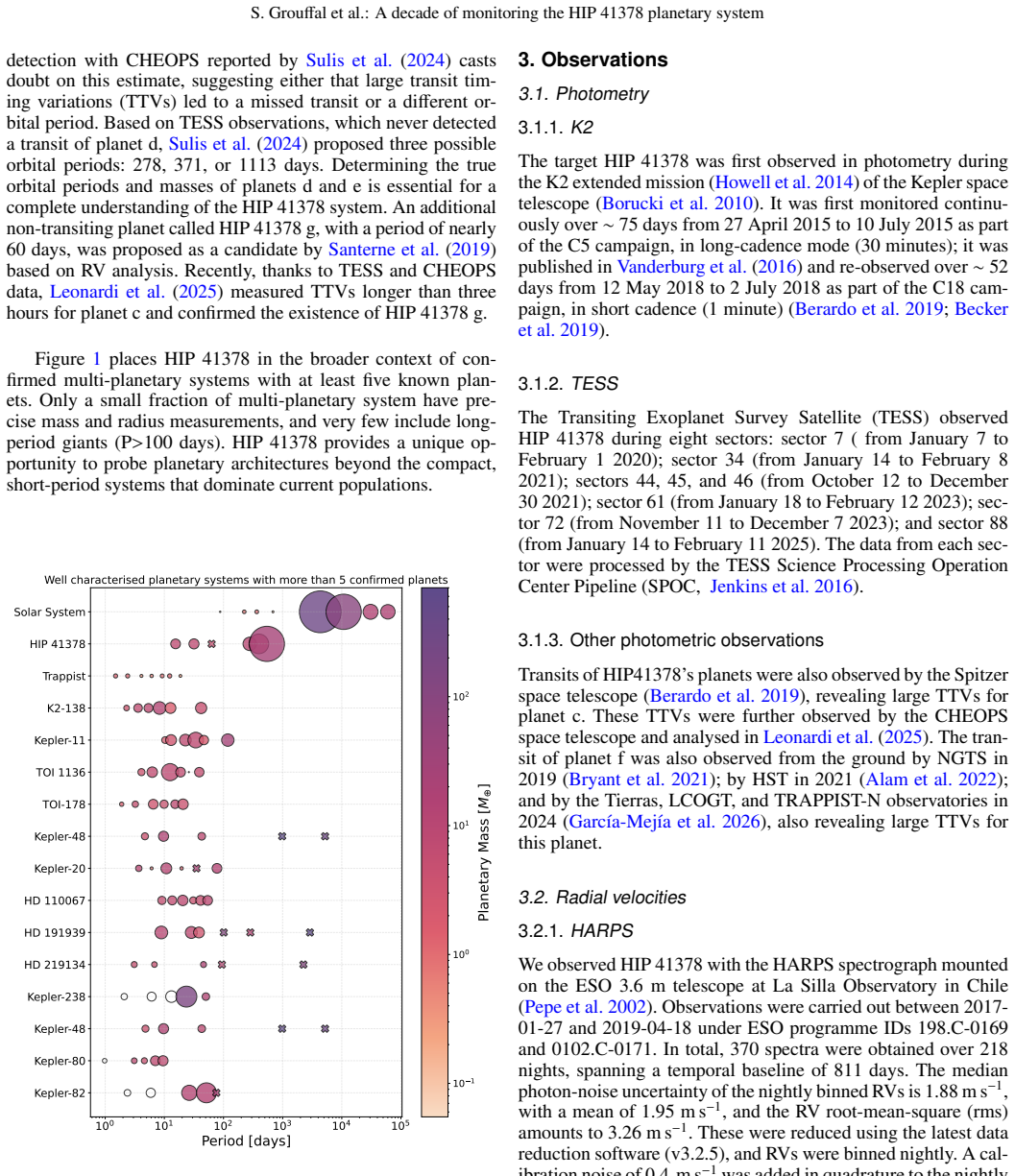
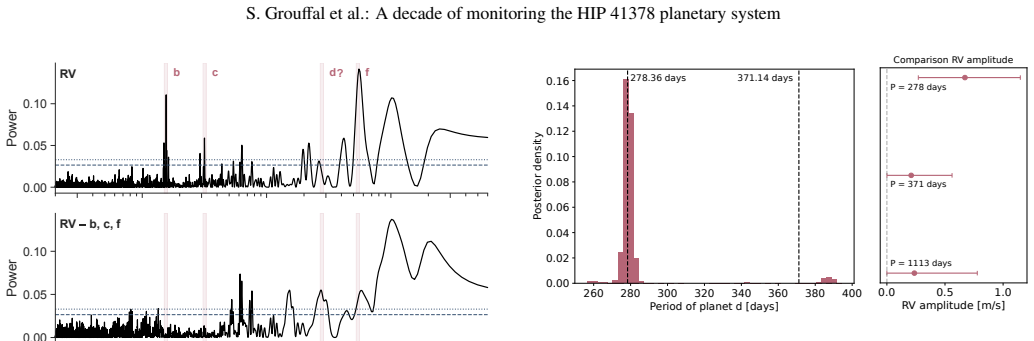
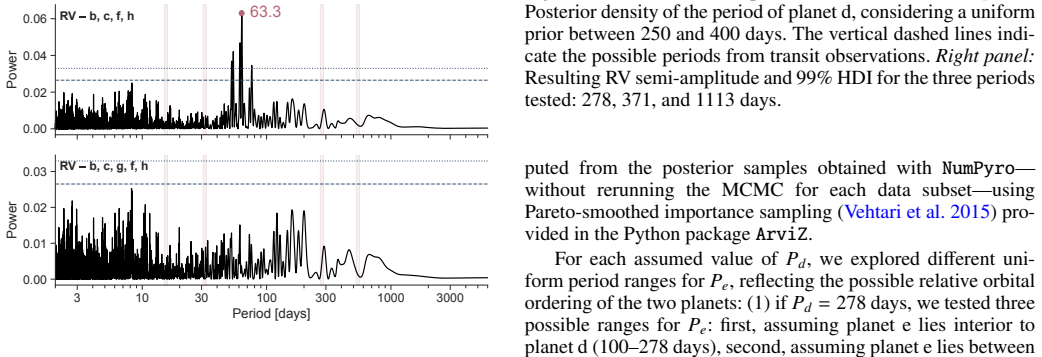
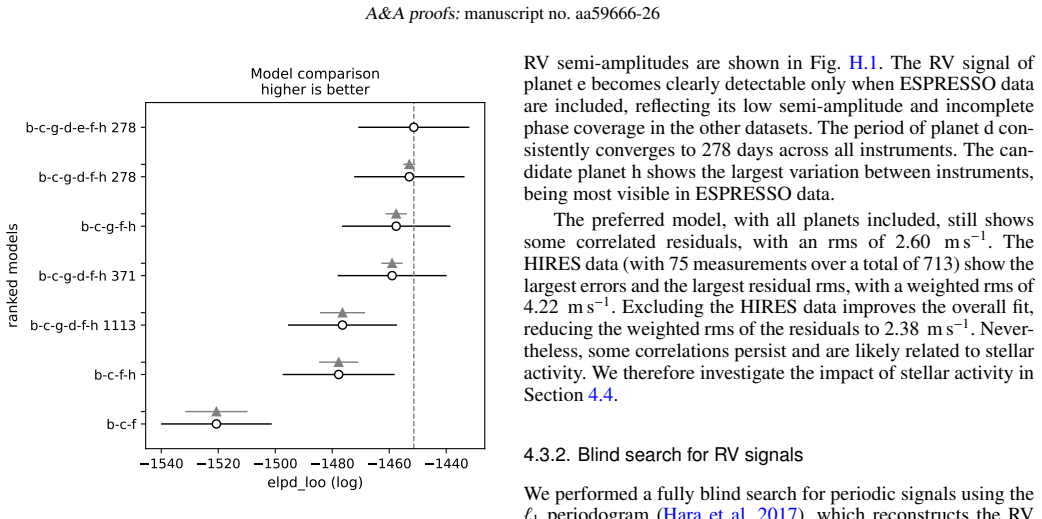
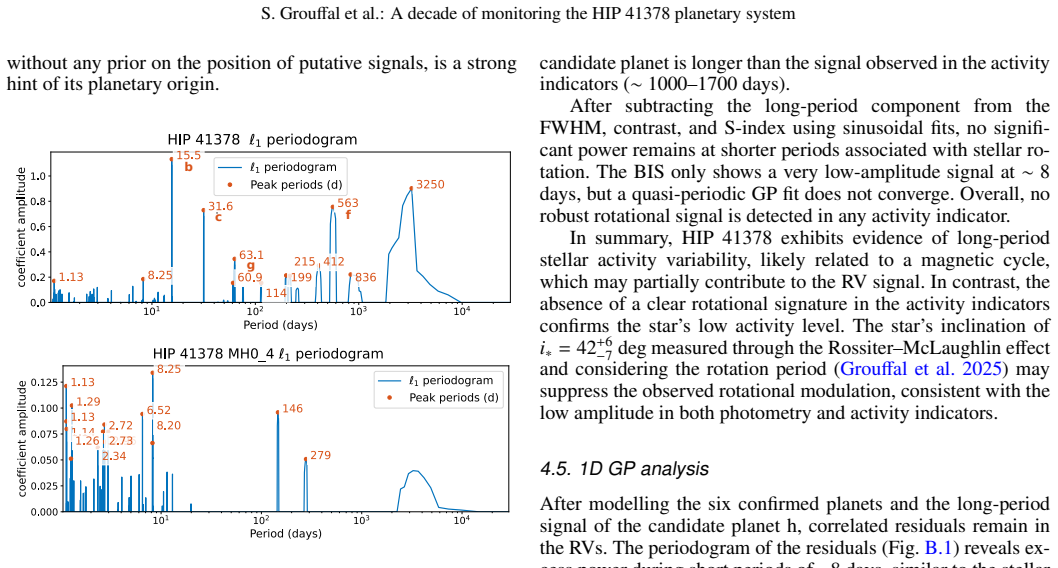
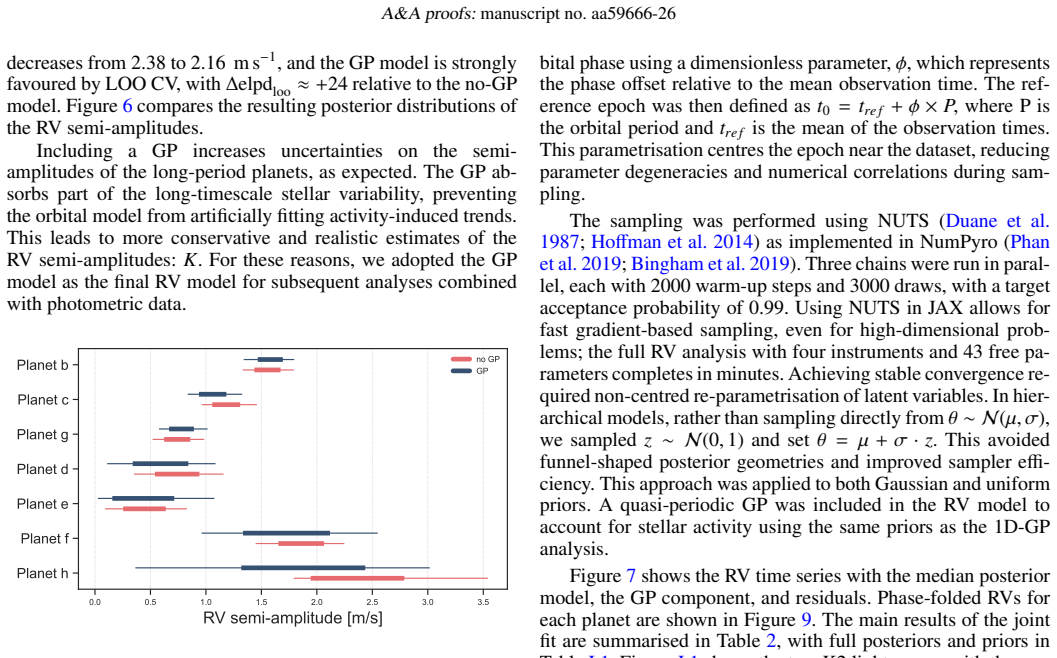
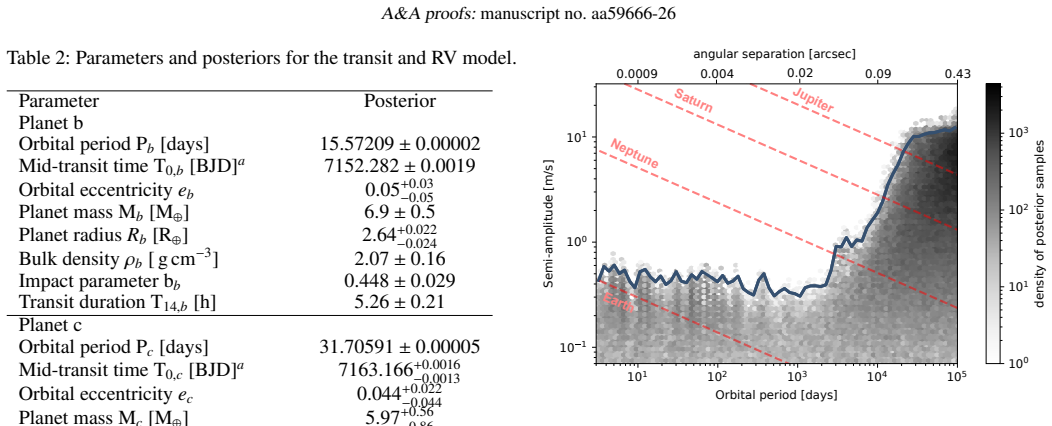
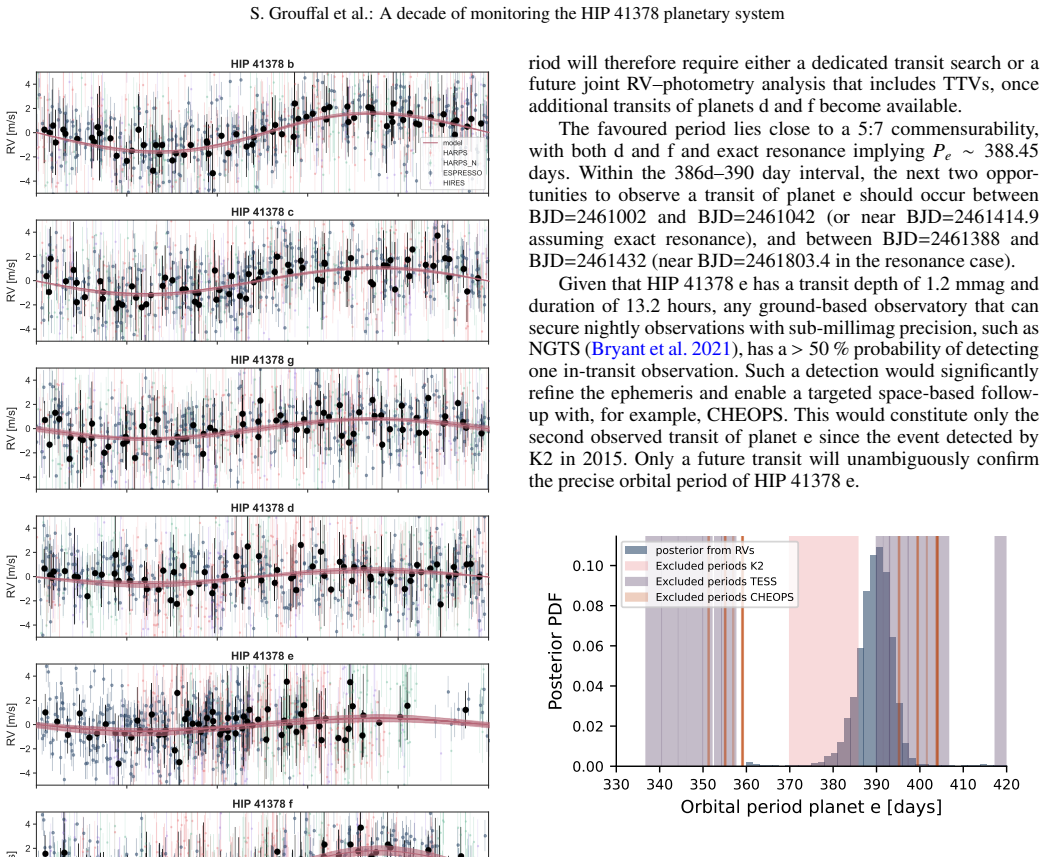
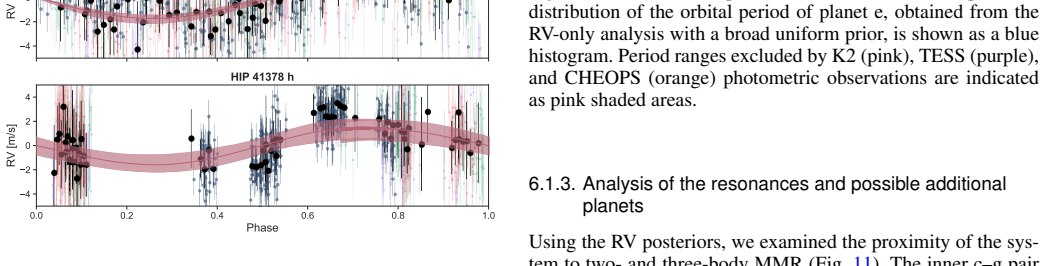
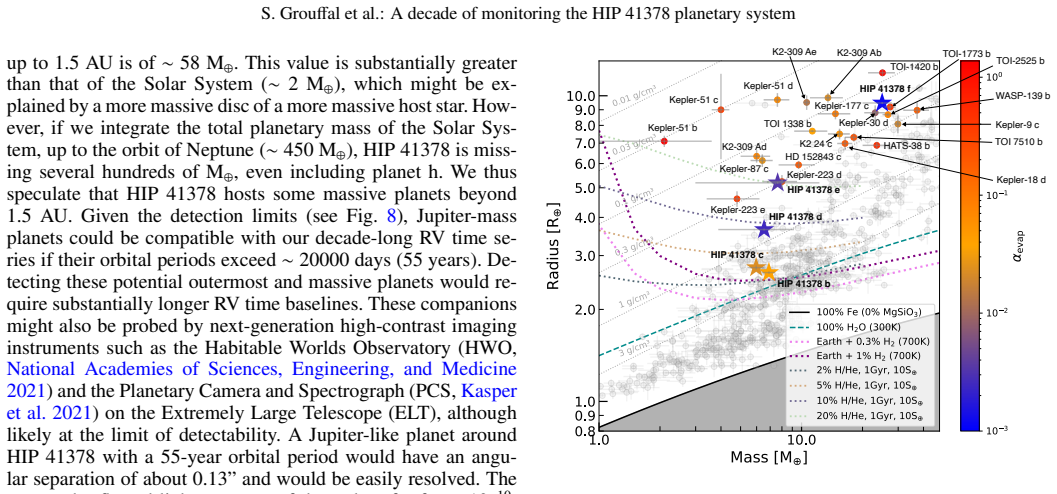
Through decade-long radial velocity monitoring the authors detect signals matching all five transiting planets, confirming an orbital period of 278 days for planet d, refining the period of planet e to 393 days, measuring a mass of 25 Earth masses for planet f that yields a density of 0.166 g cm^{-3}, verifying the 63-day non-transiting planet g, and identifying a candidate 2602-day signal attributed to planet h, while also examining the system's resonant structure and completeness for additional planets.
What carries the argument
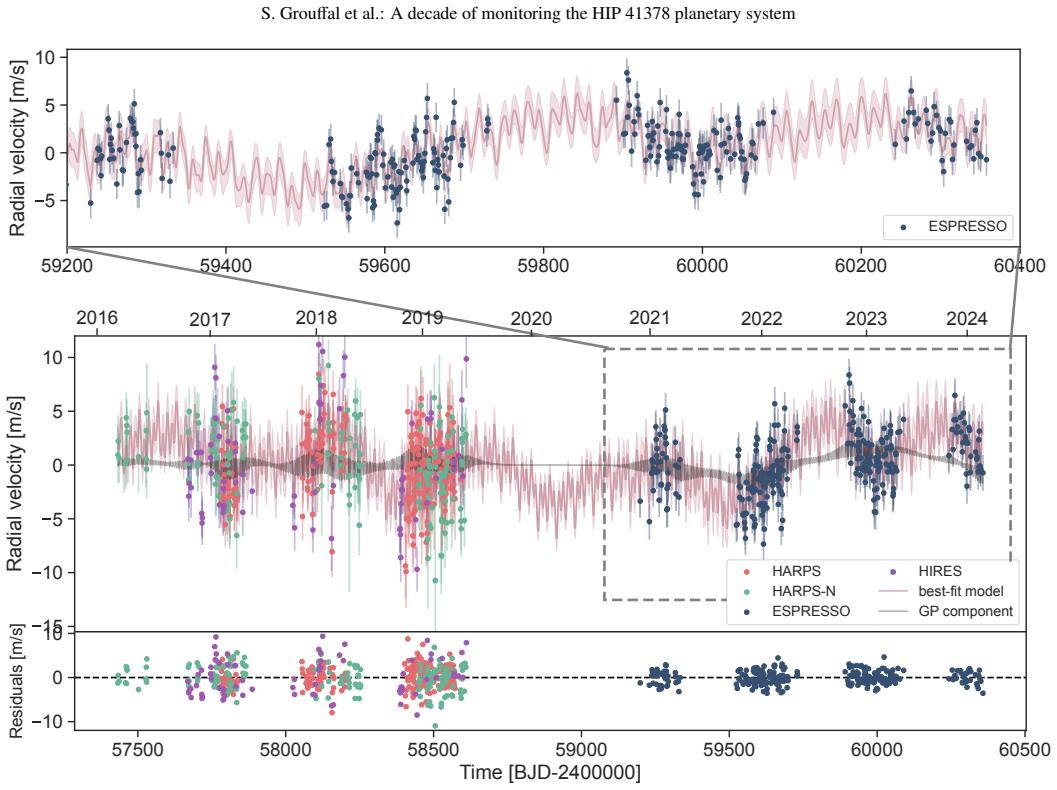
The decade-long radial velocity time series extracted from multiple spectrographs, used to isolate periodic Doppler signals for each planet and to derive masses and periods.
If this is right
- The refined periods enable a precise assessment of mean-motion resonances and long-term dynamical stability across the system.
- The mass and density of planet f provide a direct test of interior structure models for super-puff planets.
- Confirmation of planet g and the candidate h improve the census of planets in the system and limit the presence of additional undetected bodies.
- The overall architecture supplies new boundary conditions on formation pathways that produce both compact inner planets and an ultra-low-density outer planet.
Where Pith is reading between the lines
- Similar decade-scale RV campaigns on other transiting multi-planet systems could resolve whether long-period signals are planetary or activity-related.
- The measured density of planet f invites direct comparison with atmospheric escape and inflation models over gigayear timescales.
- Dynamical simulations tuned to the updated periods could predict transit timing variations observable with future photometry.
Load-bearing premise
The long-period radial velocity signals arise from orbiting planets rather than stellar magnetic activity cycles or residual instrumental effects.
What would settle it
Future observations showing that the 2602-day signal correlates with stellar activity indicators, or continued monitoring that fails to recover the reported periods for planets d and e, would falsify the planetary interpretation.
Figures
read the original abstract
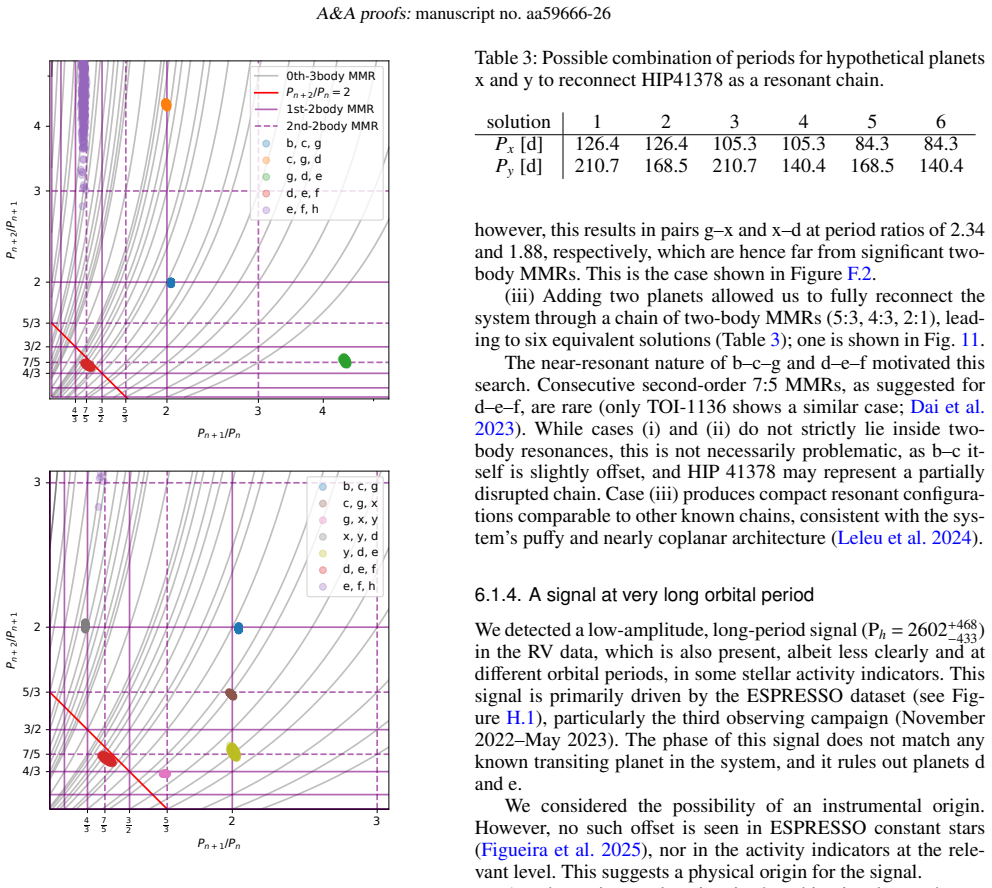
Multi-planetary systems provide key constraints on planet formation and evolution, as their architecture encodes the dynamical history of planets formed within a common protoplanetary disk. However, the current population remains strongly biased toward compact, short-period systems, and only a limited number of such systems with measured masses and radii are known. HIP 41378 is an exceptional system hosting five transiting planets with orbital periods up to 1.5 years, including an ultra-low density planet HIP 41378 f. The outer transiting planets d and e remained poorly constrained with unknown periods and masses, leaving the system architecture only partially characterised. We present long-term monitoring of this target with high-precision radial-velocity (RV) instruments (HARPS, HARPS-N, HIRES, and ESPRESSO) and space-based photometry spanning 2015-2024. We detect RV signals for all the planets, confirming their orbital periods and constraining their masses. In particular, the RV data strongly favour an orbital period of Pd = 278 days for planet d and refine the orbital period of planet e to Pe = 393+3-5 days. We measure a new mass of Mf = 25 \pm 5 earth masses for HIP 41378 f, confirming its super-puff nature with a bulk density of 0.166+0.033-0.036 g cm3. We also confirm the planetary nature of HIP 41378 g, a non-transiting planet with a 63-day period, and determine its minimum mass. In addition, the RVs reveal a long-period signal, with P = 2602+468-433 days, which we attribute to the candidate planet HIP 41378 h, although a stellar magnetic cycle cannot be excluded. Finally, we investigate the system's dynamical architecture and resonant structure, assess its completeness by constraining additional undetected planets, and discuss the implications for the origin and internal structure of the remarkable planet HIP 41378 f.
Editorial analysis
A structured set of objections, weighed in public.
Referee Report
Summary. The manuscript reports a decade (2015-2024) of high-precision RV monitoring of the HIP 41378 system with HARPS, HARPS-N, HIRES, and ESPRESSO, combined with space-based photometry. It claims detection of RV signals for all known planets, confirming Pd = 278 days for planet d, refining Pe = 393+3-5 days for planet e, measuring Mf = 25 ± 5 M⊕ for the super-puff planet f (density 0.166+0.033-0.036 g cm-3), confirming the non-transiting planet g at 63 days, and detecting a long-period signal (P = 2602+468-433 days) attributed to candidate planet h, while noting a stellar magnetic cycle cannot be excluded. The work also analyzes dynamical architecture, resonant structure, completeness, and implications for planet f.
Significance. If the RV detections and planetary interpretations hold, particularly the mass for the ultra-low-density planet f and the period constraints on the outer transiting planets, the results would provide rare mass measurements in a multi-planet system with periods up to ~1.5 years. This strengthens constraints on formation and evolution models for systems with both compact and long-period components, and the multi-instrument, decade-long baseline is a notable strength for characterizing such architectures.
major comments (1)
- [Abstract] Abstract (long-period signal paragraph): The attribution of the P = 2602+468-433 d signal to candidate planet h is load-bearing for the central claim of detecting RV signals 'for all the planets.' However, the ~9-year baseline covers only ~1.3 cycles, and the manuscript explicitly states a stellar magnetic cycle cannot be excluded. No details are provided on correlations with activity indicators (BIS, FWHM, log R'HK) or cross-instrument phase coherence to rule out quasi-periodic activity mimicking a Keplerian signal; this weakens the planetary interpretation relative to the stronger claims for d, e, f, and g.
minor comments (2)
- The abstract reports asymmetric uncertainties for some parameters (e.g., Pe, density of f) but symmetric for others (e.g., Mf); ensure consistent reporting and explicit definition of how uncertainties were derived from the posterior distributions in the methods section.
- Notation for planet labels (d, e, f, g, h) should be cross-checked against prior literature citations for HIP 41378 to avoid any ambiguity in the system architecture discussion.
Simulated Author's Rebuttal
We thank the referee for their careful and constructive review of our manuscript. We address the single major comment below and agree that additional details on the long-period signal will improve the presentation.
read point-by-point responses
-
Referee: [Abstract] Abstract (long-period signal paragraph): The attribution of the P = 2602+468-433 d signal to candidate planet h is load-bearing for the central claim of detecting RV signals 'for all the planets.' However, the ~9-year baseline covers only ~1.3 cycles, and the manuscript explicitly states a stellar magnetic cycle cannot be excluded. No details are provided on correlations with activity indicators (BIS, FWHM, log R'HK) or cross-instrument phase coherence to rule out quasi-periodic activity mimicking a Keplerian signal; this weakens the planetary interpretation relative to the stronger claims for d, e, f, and g.
Authors: We thank the referee for this observation. The manuscript already qualifies the long-period signal as a candidate planet h and explicitly states that a stellar magnetic cycle cannot be excluded, distinguishing it from the confirmed detections of d, e, f, and g. We acknowledge that the abstract paragraph does not include the requested supporting details. In the revised manuscript we will add a concise paragraph (or subsection) summarizing our checks: (i) Pearson and Spearman correlations between the ~2600 d RV signal and the activity indicators BIS, FWHM, and log R'HK from each instrument, (ii) the absence of significant power at this period in the activity time series, and (iii) the phase coherence of the signal across the four instruments. These checks show no compelling activity correlation, although the limited number of cycles prevents a definitive exclusion. We will also note that the signal amplitude is consistent across instruments. This addition directly addresses the referee's concern without altering the cautious interpretation already presented. revision: yes
Circularity Check
No significant circularity; results from new RV data fits to standard models
full rationale
The paper reports new multi-instrument RV time series (2015-2024) and applies standard Keplerian orbit fitting to extract periods and masses for the known planets plus one candidate. All quantitative claims (Pd=278 d, Pe=393 d, Mf=25 M⊕, long-period signal at ~2602 d) are direct outputs of the data-model comparison; no parameter is fitted on a subset and then re-labeled as a prediction, no self-citation supplies a uniqueness theorem, and no ansatz is imported from prior work by the same team. The analysis is therefore self-contained against external benchmarks and receives the default non-circularity score.
Axiom & Free-Parameter Ledger
free parameters (3)
- Orbital period of planet d =
278 days
- Orbital period of planet e =
393 days
- Mass of planet f =
25 Earth masses
axioms (1)
- domain assumption Detected periodic RV variations are produced by orbiting planets rather than stellar activity or systematics
Reference graph
Works this paper leans on
-
[1]
& Foreman-Mackey, D
Aigrain, S. & Foreman-Mackey, D. 2023, ARA&A, 61, 329
2023
-
[2]
C., Faria, J
Akinsanmi, B., Santos, N. C., Faria, J. P., et al. 2020, A&A, 635, L8
2020
-
[3]
K., Kirk, J., Dressing, C
Alam, M. K., Kirk, J., Dressing, C. D., et al. 2022, ApJL, 927, L5
2022
-
[4]
Albert, J. G. 2020, arXiv e-prints, arXiv:2012.15286
arXiv 2020
-
[5]
2019, A&A, 624, A45
Alibert, Y . 2019, A&A, 624, A45
2019
-
[6]
Bailer-Jones, C. A. L., Rybizki, J., Fouesneau, M., Demleitner, M., & Andrae, R. 2021, AJ, 161, 147
2021
-
[7]
M., et al
Balsalobre-Ruza, O., Lillo-Box, J., Silva, A. M., et al. 2025, A&A, 694, A15
2025
-
[8]
C., Vanderburg, A., Rodriguez, J
Becker, J. C., Vanderburg, A., Rodriguez, J. E., et al. 2019, AJ, 157, 19
2019
-
[9]
2022, AJ, 163, 277
Belkovski, M., Becker, J., Howe, A., Malsky, I., & Batygin, K. 2022, AJ, 163, 277
2022
-
[10]
Berardo, D., Crossfield, I. J. M., Werner, M., et al. 2019, AJ, 157, 185
2019
-
[11]
P., Jankowiak, M., et al
Bingham, E., Chen, J. P., Jankowiak, M., et al. 2019, J. Mach. Learn. Res., 20, 28:1
2019
-
[12]
J., Koch, D., Basri, G., et al
Borucki, W. J., Koch, D., Basri, G., et al. 2010, Science, 327, 977
2010
-
[13]
Brandt, T. D. 2021, ApJS, 254, 42
2021
-
[14]
M., Bayliss, D., Santerne, A., et al
Bryant, E. M., Bayliss, D., Santerne, A., et al. 2021, MNRAS, 504, L45
2021
-
[15]
P., Marcy, G
Butler, R. P., Marcy, G. W., Williams, E., et al. 1996, PASP, 108, 500
1996
-
[16]
Canup, R. M. & Ward, W. R. 2006, Nature, 441, 834 Castro-González, A., Demangeon, O. D. S., Lillo-Box, J., et al. 2023, A&A, 675, A52
2006
-
[17]
2022, MNRAS, 513, 541
Cerioni, M., Beaugé, C., & Gallardo, T. 2022, MNRAS, 513, 541
2022
-
[18]
R., Fabrycky, D
Ciardi, D. R., Fabrycky, D. C., Ford, E. B., et al. 2013, APJ, 763, 41
2013
-
[19]
2012, in Society of Photo-Optical Instru- mentation Engineers (SPIE) Conference Series, V ol
Cosentino, R., Lovis, C., Pepe, F., et al. 2012, in Society of Photo-Optical Instru- mentation Engineers (SPIE) Conference Series, V ol. 8446, Ground-based and Airborne Instrumentation for Astronomy IV , ed. I. S. McLean, S. K. Ramsay, & H. Takami, 84461V
2012
-
[20]
M., Skrutskie, M
Cutri, R. M., Skrutskie, M. F., van Dyk, S., et al. 2003, VizieR Online Data Cata- log: 2MASS All-Sky Catalog of Point Sources (Cutri+2003), VizieR On-line Data Catalog: II/246. Originally published in: University of Massachusetts and Infrared Processing and Analysis Center, (IPAC/California Institute of Technology) (2003)
2003
-
[21]
2023, AJ, 165, 33
Dai, F., Masuda, K., Beard, C., et al. 2023, AJ, 165, 33
2023
-
[22]
F., Richmond, M
Droege, T. F., Richmond, M. W., Sallman, M. P., & Creager, R. P. 2006, PASP, 118, 1666
2006
-
[23]
D., Pendleton, B
Duane, S., Kennedy, A. D., Pendleton, B. J., & Roweth, D. 1987, Physics Letters B, 195, 216
1987
-
[24]
2021, A&A, 656, A70
Emsenhuber, A., Mordasini, C., Burn, R., et al. 2021, A&A, 656, A70
2021
-
[25]
P., Santos, N
Faria, J. P., Santos, N. C., Figueira, P., & Brewer, B. J. 2018, Journal of Open Source Software, 3, 487
2018
-
[26]
Feinberg, L. D., Sitarski, B. N., McElwain, M. W., et al. 2026, arXiv e-prints, arXiv:2601.11803
arXiv 2026
-
[27]
P., Silva, A
Figueira, P., Faria, J. P., Silva, A. M., et al. 2025, A&A, 700, A174
2025
-
[28]
Ford, E. B. 2014, Proceedings of the National Academy of Science, 111, 12616
2014
-
[29]
2021, The Journal of Open Source Software, 6, 3285
Foreman-Mackey, D., Luger, R., Agol, E., et al. 2021, The Journal of Open Source Software, 6, 3285
2021
-
[30]
2024, dfm/tinygp: The tiniest of Gaussian Process libraries Gaia Collaboration, Vallenari, A., Brown, A
Foreman-Mackey, D., Yu, W., Yadav, S., et al. 2024, dfm/tinygp: The tiniest of Gaussian Process libraries Gaia Collaboration, Vallenari, A., Brown, A. G. A., et al. 2023, A&A, 674, A1
2024
-
[31]
& Zhang, X
Gao, P. & Zhang, X. 2020, ApJ, 890, 93 García-Mejía, J., de Beurs, Z. L., Tamburo, P., et al. 2026, AJ, 171, 245
2020
-
[32]
Gilbert, G. J. & Fabrycky, D. C. 2020, AJ, 159, 281
2020
-
[33]
Gillon, M., Triaud, A. H. M. J., Demory, B.-O., et al. 2017, Nature, 542, 456
2017
-
[34]
& Batygin, K
Goldberg, M. & Batygin, K. 2022, AJ, 163, 201
2022
-
[35]
2022, A&A, 668, A172
Grouffal, S., Santerne, A., Bourrier, V ., et al. 2022, A&A, 668, A172
2022
-
[36]
2025, A&A, 701, A173
Grouffal, S., Santerne, A., Bourrier, V ., et al. 2025, A&A, 701, A173
2025
-
[37]
Guillot, T., Ida, S., & Ormel, C. W. 2014, A&A, 572, A72
2014
-
[38]
C., Bouchy, F., Stalport, M., et al
Hara, N. C., Bouchy, F., Stalport, M., et al. 2020, A&A, 636, L6
2020
-
[39]
C., Boué, G., Laskar, J., & Correia, A
Hara, N. C., Boué, G., Laskar, J., & Correia, A. C. M. 2017, MNRAS, 464, 1220
2017
-
[40]
C., Delisle, J.-B., Unger, N., & Dumusque, X
Hara, N. C., Delisle, J.-B., Unger, N., & Dumusque, X. 2022, A&A, 658, A177
2022
-
[41]
K., Dressing, C
Harada, C. K., Dressing, C. D., Alam, M. K., et al. 2023, AJ, 166, 208
2023
-
[42]
2024, exoplanet-dev/jaxoplanet: Astro- nomical time series analysis with JAX
Hattori, S., Garcia, L., Murray, C., et al. 2024, exoplanet-dev/jaxoplanet: Astro- nomical time series analysis with JAX
2024
-
[43]
D., Gelman, A., et al
Hoffman, M. D., Gelman, A., et al. 2014, J. Mach. Learn. Res., 15, 1593
2014
-
[44]
W., Marcy, G
Howard, A. W., Marcy, G. W., Johnson, J. A., et al. 2010, Science, 330, 653
2010
-
[45]
Howe, A. R. & Burrows, A. 2015, APJ, 808, 150
2015
-
[46]
R., Burrows, A., & Verne, W
Howe, A. R., Burrows, A., & Verne, W. 2014, APJ, 787, 173
2014
-
[47]
B., Sobeck, C., Haas, M., et al
Howell, S. B., Sobeck, C., Haas, M., et al. 2014, PASP, 126, 398
2014
-
[48]
2000, ApJ, 537, 1013
Ikoma, M., Nakazawa, K., & Emori, H. 2000, ApJ, 537, 1013
2000
-
[49]
N., et al
Izidoro, A., Ogihara, M., Raymond, S. N., et al. 2017, MNRAS, 470, 1750
2017
-
[50]
M., Twicken, J
Jenkins, J. M., Twicken, J. D., McCauliff, S., et al. 2016, in Society of Photo- Optical Instrumentation Engineers (SPIE) Conference Series, V ol. 9913, Soft- ware and Cyberinfrastructure for Astronomy IV , ed. G. Chiozzi & J. C. Guz- man, 99133E
2016
-
[51]
A., Collier Cameron, A., Faria, J
John, A. A., Collier Cameron, A., Faria, J. P., et al. 2023, MNRAS, 525, 1687
2023
-
[52]
J., & Thorngren, D
Karalis, A., Lee, E. J., & Thorngren, D. P. 2025, APJ, 978, 46
2025
-
[53]
2021, The Messenger, 182, 38
Kasper, M., Cerpa Urra, N., Pathak, P., et al. 2021, The Messenger, 182, 38
2021
-
[54]
2022, A&A, 657, A7
Kervella, P., Arenou, F., & Thévenin, F. 2022, A&A, 657, A7
2022
-
[55]
Kipping, D. M. 2013, MNRAS, 435, 2152
2013
-
[56]
& Petit, A
Laskar, J. & Petit, A. C. 2017, A&A, 605, A72 Lecavelier Des Etangs, A. 2007, A&A, 461, 1185
2017
-
[57]
Lee, E. J. & Chiang, E. 2016, ApJ, 817, 90
2016
-
[58]
C., et al
Leleu, A., Alibert, Y ., Hara, N. C., et al. 2021, A&A, 649, A26
2021
-
[59]
2024, A&A, 687, L1
Leleu, A., Delisle, J.-B., Burn, R., et al. 2024, A&A, 687, L1
2024
-
[60]
2025, A&A, 702, A211
Leonardi, P., Borsato, L., Pagliaro, L., et al. 2025, A&A, 702, A211
2025
-
[61]
J., Marcy, G
Lissauer, J. J., Marcy, G. W., Bryson, S. T., et al. 2014, ApJ, 784, 44
2014
-
[62]
Lopez, E. D. & Fortney, J. J. 2014, APJ, 792, 1
2014
-
[63]
D., Fortney, J
Lopez, E. D., Fortney, J. J., & Miller, N. 2012, APJ, 761, 59
2012
-
[64]
Lu, T., Li, G., Cassese, B., & Lin, D. N. C. 2025, ApJ, 980, 39
2025
-
[65]
2019, AJ, 157, 64
Luger, R., Agol, E., Foreman-Mackey, D., et al. 2019, AJ, 157, 64
2019
-
[66]
N., Knudstrup, E., Silva Aguirre, V ., et al
Lund, M. N., Knudstrup, E., Silva Aguirre, V ., et al. 2019, AJ, 158, 248
2019
-
[67]
P., Leleu, A., et al
Luque, R., Osborn, H. P., Leleu, A., et al. 2023, Nature, 623, 932
2023
-
[68]
Mamajek, E. E. & Hillenbrand, L. A. 2008, APJ, 687, 1264
2008
-
[69]
E., Livingston, J
Masuda, K., Libby-Roberts, J. E., Livingston, J. H., et al. 2024, AJ, 168, 294
2024
-
[70]
2017, APJL, 849, L33
Millholland, S., Wang, S., & Laughlin, G. 2017, APJL, 849, L33
2017
-
[71]
C., He, M
Millholland, S. C., He, M. Y ., & Zink, J. K. 2022, AJ, 164, 72
2022
-
[72]
M., Fabrycky, D
Mills, S. M., Fabrycky, D. C., Migaszewski, C., et al. 2016, Nature, 533, 509
2016
-
[73]
2023, A&A, 670, A68
Mishra, L., Alibert, Y ., Udry, S., & Mordasini, C. 2023, A&A, 670, A68
2023
-
[74]
1980, Progress of Theoretical Physics, 64, 544
Mizuno, H. 1980, Progress of Theoretical Physics, 64, 544
1980
-
[75]
2009, A&A, 501, 1139
Mordasini, C., Alibert, Y ., & Benz, W. 2009, A&A, 501, 1139
2009
-
[76]
& Tremaine, S
Murchikova, L. & Tremaine, S. 2020, AJ, 160, 160
2020
-
[77]
M., & Fridlund, M
Muresan, A., Persson, C. M., & Fridlund, M. 2024, A&A, 692, A122 National Academies of Sciences, Engineering, and Medicine. 2021, Pathways to Discovery in Astronomy and Astrophysics for the 2020s
2024
-
[78]
W., Hartmann, L
Noyes, R. W., Hartmann, L. W., Baliunas, S. L., Duncan, D. K., & Vaughan, A. H. 1984, APJ, 279, 763
1984
-
[79]
F., Helled, R., & Bouchy, F
Otegi, J. F., Helled, R., & Bouchy, F. 2022, A&A, 658, A107
2022
-
[80]
2021, A&A, 645, A96
Pepe, F., Cristiani, S., Rebolo, R., et al. 2021, A&A, 645, A96
2021
discussion (0)
Sign in with ORCID, Apple, or X to comment. Anyone can read and Pith papers without signing in.