REVIEW 5 major objections 5 minor 33 references
Structured Coupled Generative Adversarial Networks for Unsupervised Monocular Depth Estimation
T0 review · 5 major / 5 minor · reviewed 2026-08-14 · deepseek-v4-flash
Pith's one-line read A dual GAN fused by a deep CRF reaches 0.1354 mean relative error on KITTI unsupervised depth.
desk verdict Solid empirical architecture paper whose central claim—a CRF that couples generator and discriminator—is not actually in the equations; the paper runs the same CRF twice and sums gradients, so the main novelty is unsupported as written. read the letter →
The pith
A machine-rendered reading of the paper's core claim, the machinery that carries it, and where it could break.
The reading
What carries the argument
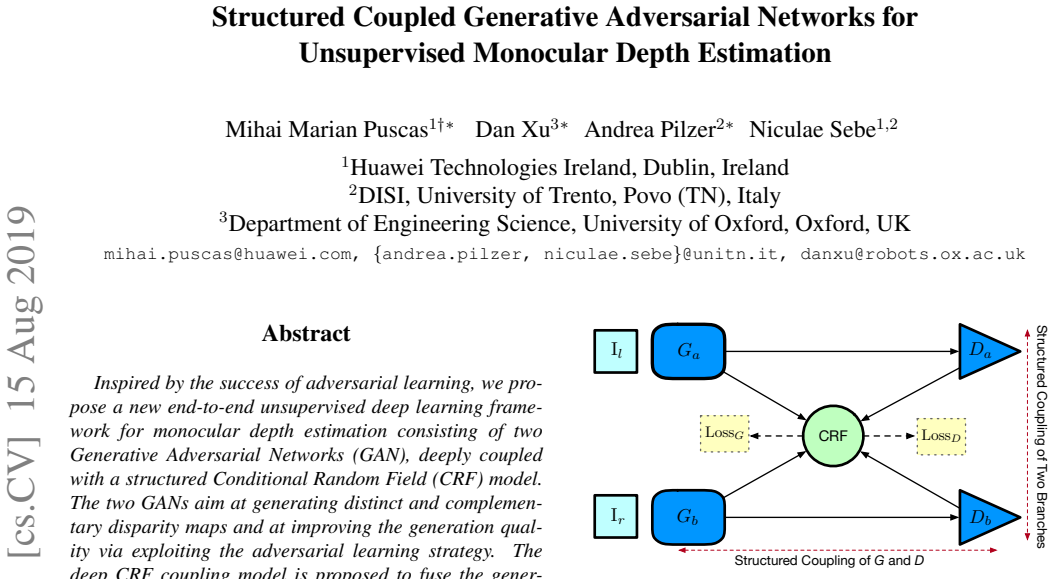
The central object is the deep CRF coupling model: a continuous conditional random field whose hidden disparity field $d_r$ is refined by mean-field inference implemented as differentiable neural-network blocks (NMF). Its energy combines two unary terms that tie the hidden field to the two generator disparity maps $d_{ra}$ and $d_{rh}$, plus Gaussian appearance and smoothness kernels over a local $15 \times 15$ receptive field that let nearby pixels exchange messages; the same CRF is applied to the two discriminators' pixel-level score maps to produce a fused adversarial score map. The mean-field update, $d_i^r = \frac{\alpha_1 d_{ra,i} + \alpha_2 d_{rh,i} + \sum_l \sum_{j\neq i} k_l(f_i,f_j) d_j^r}{\alpha_1 + \alpha_2 + \sum_l \sum_{j\neq i} k_l(f_i,f_j)}$, is what couples the branches: gradients from the fused adversarial loss flow into both generators and both discriminators, so the CRF is the mechanism that turns 'generate and discriminate' into 'generate, discriminate, and refine together'.
What would settle it
Measure, on KITTI, the per-pixel correlation between the photometric reconstruction error of each synthesized image and the corresponding discriminator fake-score map; if the correlation is near zero or the high-error regions do not overlap, the premise behind the CRF coupling is unsupported. A direct ablation would do the same job: replace the CRF coupling with a simple channel-concatenation or weighted average of the two disparity maps and two score maps; if the CRF version does not beat that fusion on the reported metrics, the structured coupling is not the source of the gain.
Extended reading notes
Core claim
The paper's core discovery is that explicit, structured coupling of a dual GAN improves unsupervised monocular depth estimation. Two generators produce two complementary disparity maps from the two stereo views, a pixel-level discriminator scores each synthesized image, and then one deep CRF, implemented as a differentiable mean-field network, refines and fuses the two disparity maps and the two adversarial score maps in the same model. The CRF's unary terms pull the hidden disparity toward both generator outputs, while Gaussian appearance and smoothness kernels propagate information between nearby pixels; gradients from the fused adversarial score map flow back into both discriminators and generators. With this joint coupling, the CRF-DGAN reaches a mean relative error of 0.1354 on KITTI at the 80-meter cap and 0.1283 at 50 meters, outperforming the compared unsupervised methods that use only image pairs during training.
Load-bearing premise
The whole method rests on the assumption that a pixel's generative error (how badly image reconstruction fails there) and its discriminative error (how fake the discriminator judges that region) line up spatially, so that fusing the two maps with a CRF has real structure to exploit; if those maps are uncorrelated or misaligned, the coupled CRF has no signal to work with.
Editorial extensions
If this is right
- On KITTI, the full model reports a mean relative error of 0.1354 at the 80-meter cap and 0.1283 at 50 meters, with 82.8 percent of pixels within the 1.25 threshold at 80 meters, beating all compared unsupervised methods that train on image pairs only.
- The system needs stereo image pairs only during training; at test time a hallucination subnetwork produces a disparity map from a single image, so the method applies where only a monocular camera is available.
- Coupling both discriminators and generators with the CRF improves over coupling discriminators alone in the paper's ablations, showing that mutual constraints between generator and discriminator contribute beyond the dual-branch structure.
- Because the same CRF machinery is applied to adversarial score maps, the scheme is a template for other GAN-based dense prediction tasks with rich spatial structure, as the paper itself notes.
Reading between the lines
- The CRF coupling is a general module, not a depth-specific one; it should transfer to other dense prediction tasks with two complementary branches and pixel-level discriminators, such as optical flow, scene flow, or surface normal estimation, though the paper does not test this.
- A quantitative test of the paper's central premise is missing: correlating per-pixel generative error with discriminator score would tell whether the CRF is exploiting real structure or simply acting as a learned smoother.
- Because the hallucination network is trained with an L1 loss between the two disparity maps, the monocular test-time path is only as good as that approximation; one could push further by adding the CRF-fused disparity as supervision for the hallucinator.
- The local 15-by-15 message-passing window means the CRF's structured prior is largely local; a fully connected or multi-scale version could change the gains, separating the benefit of the CRF model from the benefit of a larger receptive field.
Signed reviews
Editorial analysis
A structured set of objections, weighed in public.
Referee Report
Summary. The manuscript proposes CRF-DGAN, an end-to-end unsupervised framework for monocular depth estimation. Two generator/discriminator pairs operating on stereo images synthesize right-view images; a hallucination sub-network converts the left-view disparity to an approximate right-view disparity so that only a single image is needed at test time; and a deep continuous CRF, implemented as differentiable mean-field iterations, is applied to refine both the generator disparity maps and the pixel-level discriminator score maps. The total loss combines reconstruction, hallucination, adversarial, and CRF reconstruction terms. Experiments on KITTI, Cityscapes, and Make3D report state-of-the-art performance among unsupervised methods using only image pairs, and an ablation study attributes gains to each component of the model.
Significance. If the reported results are correct, the paper makes a solid contribution to unsupervised monocular depth estimation by demonstrating that CRF-based structured refinement can be combined with adversarial training in a dual-GAN architecture. Strengths include the breadth of experiments (three datasets, many baselines), the component-wise ablation, and the stated intention to release code. The central novelty—the 'structured coupling' of generators and discriminators—is appealing, but the manuscript as written does not accurately instantiate this idea in the equations, and the reported ablation gains cannot be unambiguously attributed to it. These issues are correctable in revision, but they are load-bearing for the paper's main claim.
major comments (5)
- [§3.2, Eq. (4)] Equation (4) is malformed: it contains the undefined term 'd_i^r]', and the pairwise summation over j is missing from the exponential, so the mean-field Gaussian update cannot be verified as following from Eq. (3). Because the NMF implementation and its backpropagation rely on this update, please provide a corrected derivation and state the assumed form of the variational distribution.
- [§3.2, Eq. (5)] Equation (5) drops the beta_l kernel weights introduced in Eq. (3); with the update as written, the message-passing terms are unweighted bilateral filters, and the claimed 'four parameters' (alpha_1, alpha_2, beta_1, beta_2) reduce to only two learnable weights. Please correct Eq. (5) to include beta_l in both numerator and denominator and clarify exactly which parameters are optimized during training.
- [§3.2, 'Joint Coupling of the Generator and Discriminator'] The described coupling procedure runs two separate forward computations of the same CRF—one on disparity maps and one on adversarial score maps—and then sums gradients in a single backward pass. This is shared-weight smoothing of two outputs, not a joint probabilistic model; Eq. (3) defines an energy over only the hidden disparity variable and contains no term linking it to a hidden adversarial-score variable. Consequently, the 1.2-point rel improvement in Table 1 (variant v versus iii) cannot be attributed to structured cross-modal coupling. Please either add an explicit coupling term to the CRF energy or revise the stated contribution to describe what is actually implemented.
- [Table 1] The baseline row reports an RMS log error of -0.773, which is impossible for a root-mean-square quantity, and the row contains only six entries for the seven metric columns shown in the header. Please correct the table, verify all numerical values, and ensure the ablation comparisons cited in the text (e.g., the '0.779 to 0.813' accuracy gain) correspond to the correct rows.
- [§3.1, Eq. (2)] The second term of Eq. (2) compares the synthesized left image \tilde{I}_l with the right image I_r, and the definitions of \tilde{I}_l and \tilde{I}_r appear to be swapped relative to the disparity outputs of G_a and G_b described in the text. Please clarify the notation (d_l versus d_r, G_a versus G_b) and correct the reconstruction loss so that each synthesized image is compared with its corresponding real view.
minor comments (5)
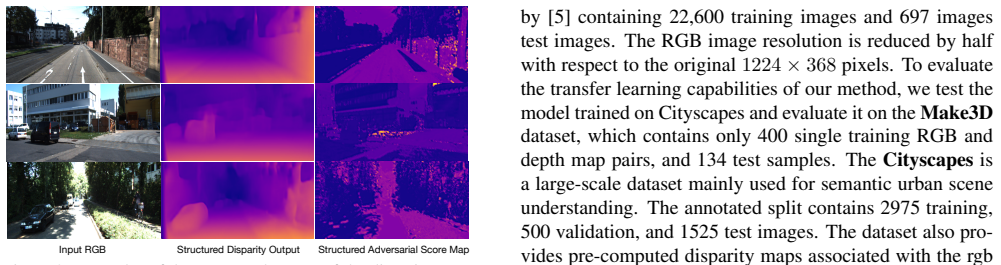
- [Section 1 and Fig. 7] The paper motivates the CRF coupling by asserting that depth prediction maps and discriminative error maps share spatially co-located structural information, but only qualitative examples are provided. A quantitative measurement of this correlation would considerably strengthen the motivation.
- [§4.2, ablation discussion] The sentence 'we improve 4 points from 0.779 to 0.813' in the ablation discussion refers to a comparison between variants (ii) and (iv) in Table 1, not to a direct comparison of (v) and (iii); please make the compared rows explicit.
- [Abstract and footnote] The code URL is given as 'https://github.com/mihaipuscas/ 3dv---coupled-crf-disparity' with a space in the middle; the correct link should be provided.
- [§3.1, Eq. (1)] In Eq. (1), the third and fourth expectations are both with respect to p(I_n^r), while the second is with respect to p(I_n^l); given the described roles of G_a and G_b, the input distributions of the two generators should be stated consistently.
- [§4.1 and §4.2] The number of mean-field iterations T and the values of the loss weights gamma_1, gamma_2, gamma_3 are not reported; these details are needed to reproduce the results.
Circularity Check
No load-bearing circularity: the depth prediction is anchored to external benchmarks and learned CRF parameters; self-citations are incremental, not definitional.
full rationale
The central depth prediction is trained with photometric, adversarial, hallucination, and CRF losses and evaluated against LiDAR ground truth on KITTI, Cityscapes, and Make3D. No parameter is fitted to the test set and then renamed as a prediction. Eq. 3 defines a standard continuous CRF energy with unary terms on the two generator disparity maps and pairwise RGB kernels; Eq. 5 is the corresponding mean-field update. The CRF weights are learned end-to-end on training data, and the final disparity map is an evaluated output, not a re-statement of the training target. The paper cites several works by the same authors (e.g., [19], [20], [28], [29], [30]), but the CRF equations are written out in the paper and the self-citations are incremental related work rather than an unverified uniqueness theorem. The manuscript does contain a genuine internal consistency problem: the claimed joint coupling of generator and discriminator is described as two separate CRF forward computations with collected gradients, and Eq. 5 contains no adversarial-score variable; Table 1 also reports an impossible negative RMS log value. These are correctness concerns, not circular reductions, so under the instruction to flag circularity only where Eq. X equals Eq. Y by construction or a fitted parameter is renamed as a prediction, no circular step is exhibited. The honest finding is therefore a low score with no circular steps.
Assumptions & free parameters
free parameters (3)
- loss weights gamma1, gamma2, gamma3 =
not reported
- CRF kernel window size =
15x15
- number of mean-field iterations T =
not specified
assumptions (4)
- domain assumption Photometric warping assumes Lambertian surfaces and known stereo calibration
- standard math Differentiable bilinear warping is a valid proxy for view synthesis
- standard math Mean-field approximation of the continuous CRF yields a tractable and effective inference
- domain assumption Pixel-level discriminator outputs carry spatial structure correlated with depth errors
Cite this review
Pith. "Pith review of Structured Coupled Generative Adversarial Networks for Unsupervised Monocular Depth Estimation." pith.science (2026). https://pith.science/paper/EMY6T4FA
@misc{pith2026190805794,
  author       = {Pith},
  title        = {Pith review of: Structured Coupled Generative Adversarial Networks for Unsupervised Monocular Depth Estimation},
  year         = {2026},
  howpublished = {\url{https://pith.science/paper/EMY6T4FA}},
  note         = {Machine review of arXiv:1908.05794}
}
read the original abstract
Inspired by the success of adversarial learning, we propose a new end-to-end unsupervised deep learning framework for monocular depth estimation consisting of two Generative Adversarial Networks (GAN), deeply coupled with a structured Conditional Random Field (CRF) model. The two GANs aim at generating distinct and complementary disparity maps and at improving the generation quality via exploiting the adversarial learning strategy. The deep CRF coupling model is proposed to fuse the generative and discriminative outputs from the dual GAN nets. As such, the model implicitly constructs mutual constraints on the two network branches and between the generator and discriminator. This facilitates the optimization of the whole network for better disparity generation. Extensive experiments on the KITTI, Cityscapes, and Make3D datasets clearly demonstrate the effectiveness of the proposed approach and show superior performance compared to state of the art methods. The code and models are available at https://github.com/mihaipuscas/ 3dv---coupled-crf-disparity.
Figures

Figures from the paper (3 more)


Reference graph
Works this paper leans on
- [1]
-
[2]
A. Behl, O. H. Jafari, S. K. Mustikovela, H. A. Alhaija, C. Rother, and A. Geiger. Bounding boxes, segmentations and object coordinates: How important is recognition for 3d scene flow estimation in autonomous driving scenarios? In CVPR, 2017
work page 2017
-
[3]
Cordts, M
M. Cordts, M. Omran, S. Ramos, T. Rehfeld, M. Enzweiler, R. Benenson, U. Franke, S. Roth, and B. Schiele. The cityscapes dataset for semantic urban scene understanding. In CVPR, 2016
2016
-
[4]
D. Eigen and R. Fergus. Predicting depth, surface normals and semantic labels with a common multi-scale convolu- tional architecture. In ICCV, 2015
work page 2015
- [5]
-
[6]
Y . Gan, X. Xu, W. Sun, and L. Lin. Monocular depth estima- tion with affinity, vertical pooling, and label enhancement. In ECCV, 2018
work page 2018
-
[7]
R. Garg, G. Carneiro, and I. Reid. Unsupervised cnn for single view depth estimation: Geometry to the rescue. In ECCV, 2016
work page 2016
- [8]
Show all 33 references
-
[9]
Godard, O
C. Godard, O. Mac Aodha, and G. J. Brostow. Unsuper- vised monocular depth estimation with left-right consistency. CVPR, 2017
2017
-
[10]
Goodfellow, J
I. Goodfellow, J. Pouget-Abadie, M. Mirza, B. Xu, D. Warde-Farley, S. Ozair, A. Courville, and Y . Bengio. Gen- erative adversarial nets. In NIPS, 2014
2014
-
[11]
X. Guo, H. Li, S. Yi, J. Ren, and X. Wang. Learning monoc- ular depth by distilling cross-domain stereo networks. In ECCV, 2018
2018
-
[12]
Kr ¨ahenb¨uhl and V
P. Kr ¨ahenb¨uhl and V . Koltun. Efficient inference in fully connected crfs with gaussian edge potentials. NIPS, 2011
2011
-
[13]
J. N. Kundu, P. K. Uppala, A. Pahuja, and R. V . Babu. Adadepth: Unsupervised content congruent adaptation for depth estimation. In CVPR, 2018
2018
-
[14]
Kuznietsov, J
Y . Kuznietsov, J. St ¨uckler, and B. Leibe. Semi-supervised deep learning for monocular depth map prediction. CVPR, 2017
2017
-
[15]
Laina, C
I. Laina, C. Rupprecht, V . Belagiannis, F. Tombari, and N. Navab. Deeper depth prediction with fully convolutional residual networks. arXiv preprint arXiv:1606.00373, 2016
2016 arXiv
-
[16]
F. Liu, C. Shen, G. Lin, and I. Reid. Learning depth from sin- gle monocular images using deep convolutional neural fields. TPAMI, 2016
2016
-
[17]
Mahjourian, M
R. Mahjourian, M. Wicke, and A. Angelova. Unsupervised learning of depth and ego-motion from monocular video us- ing 3d geometric constraints. In CVPR, 2018
2018
-
[18]
Mayer, E
N. Mayer, E. Ilg, P. Hausser, P. Fischer, D. Cremers, A. Dosovitskiy, and T. Brox. A large dataset to train convo- lutional networks for disparity, optical flow, and scene flow estimation. In CVPR, 2016
2016
-
[19]
Pilzer, S
A. Pilzer, S. Lathuiliere, N. Sebe, and E. Ricci. Refine and distill: Exploiting cycle-inconsistency and knowledge dis- tillation for unsupervised monocular depth estimation. In CVPR, 2019
2019
-
[20]
Pilzer, D
A. Pilzer, D. Xu, M. Puscas, E. Ricci, and N. Sebe. Unsuper- vised adversarial depth estimation using cycled generative networks. In 3DV, 2018
2018
-
[21]
Ristovski, V
K. Ristovski, V . Radosavljevic, S. Vucetic, and Z. Obradovic. Continuous conditional random fields for efficient regression in large fully connected graphs. In AAAI, 2013
2013
-
[22]
Saxena, S
A. Saxena, S. H. Chung, and A. Y . Ng. Learning depth from single monocular images. In NIPS, 2006
2006
-
[23]
Saxena, M
A. Saxena, M. Sun, and A. Y . Ng. Make3d: Learning 3d scene structure from a single still image. TPAMI, 2009
2009
-
[24]
Turan, Y
M. Turan, Y . Almalioglu, H. Araujo, E. Konukoglu, and M. Sitti. A non-rigid map fusion-based rgb-depth slam method for endoscopic capsule robots. arXiv preprint arXiv:1705.05444, 2017
2017 arXiv
-
[25]
C. Wang, J. M. Buenaposada, R. Zhu, and S. Lucey. Learn- ing depth from monocular videos using direct methods. In CVPR, 2018
2018
-
[26]
P. Wang, X. Shen, Z. Lin, S. Cohen, B. Price, and A. Yuille. Towards unified depth and semantic prediction from a single image. In CVPR, 2015
2015
-
[27]
Xie and Z
S. Xie and Z. Tu. Holistically-nested edge detection. In ICCV, 2015
2015
-
[28]
D. Xu, E. Ricci, W. Ouyang, X. Wang, and N. Sebe. Multi-scale continuous CRFs as sequential deep networks for monocular depth estimation. CVPR, 2017
2017
-
[29]
D. Xu, E. Ricci, W. Ouyang, X. Wang, and N. Sebe. Monoc- ular depth estimation using multi-scale continuous CRFs as sequential deep networks. TPAMI, 41(6):1426–1440, 2018
2018
-
[30]
D. Xu, W. Wang, H. Tang, H. Liu, N. Sebe, and E. Ricci. Structured attention guided convolutional neural fields for monocular depth estimation. In CVPR, 2018
2018
-
[31]
H. Zhan, R. Garg, C. S. Weerasekera, K. Li, H. Agarwal, and I. Reid. Unsupervised learning of monocular depth estima- tion and visual odometry with deep feature reconstruction. arXiv preprint arXiv:1803.03893, 2018
2018 arXiv
-
[32]
T. Zhou, M. Brown, N. Snavely, and D. G. Lowe. Unsuper- vised learning of depth and ego-motion from video. CVPR, 2017
2017
-
[33]
Y . Zou, Z. Luo, and J.-B. Huang. Df-net: Unsupervised joint learning of depth and flow using cross-task consistency. In ECCV, 2018
2018
Reviewed August 14, 2026 · model on record in the stance chip above.
Discussion (0). Continue with ORCID to comment.