REVIEW 3 major objections 4 minor 54 references
Quenching of Intervalley Exchange Coupling in the Presence of Momentum-Dark States in TMDCs
T0 review · 3 major / 4 minor · reviewed 2026-08-14 · deepseek-v4-flash
Pith's one-line read Momentum-dark exciton states below the bright K/K' valley in WSe2 quench intervalley exchange coupling, extending valley lifetimes to nanoseconds, whereas MoSe2 lifetimes stay in the hundreds of femtoseconds.
desk verdict A credible, transparent microscopic calculation showing that momentum-dark states can quench intervalley exchange coupling in W-based TMDCs, but the predicted Mo/W lifetime contrast hinges on a debated band-structure input and deserves robustness checking. read the letter →
The pith
A machine-rendered reading of the paper's core claim, the machinery that carries it, and where it could break.
The reading
What carries the argument
The central object is the intervalley exchange coupling matrix element $X^{\xi\bar\xi}_Q$, which couples the bright $(K\uparrow,K\uparrow)$ and $(K'\downarrow,K'\downarrow)$ exciton densities through an intervalley coherence $C^{\xi\bar\xi}_Q$. The coupling grows linearly with the center-of-mass momentum $|Q|$ and requires simultaneous energy and momentum conservation, so only excitons in the optically bright $K$ and $K'$ states participate. The supporting machinery is a Heisenberg equation-of-motion hierarchy truncated at second order in the optical field, producing coupled equations for the excitonic coherence, the incoherent exciton densities (including Boltzmann-like exciton-phonon scattering into momentum-dark states), and the intervalley coherence. The momentum-dark states act as a fast reservoir: exciton-phonon scattering moves population into $(K,\Lambda)$ and $(K,K')$ states where the exchange term has no matrix element, starving the intervalley coupling of population.
What would settle it
Measure the helicity-resolved valley lifetime in a single WSe$_2$ monolayer while applying biaxial strain or changing the dielectric environment to shift the $(K,\Lambda)$ dark state relative to the bright $(K,K')$ state: the theory predicts a sharp crossover from nanosecond to sub-picosecond lifetimes as the dark state crosses above the bright state, so observing no such crossover would refute the quenching mechanism.
Extended reading notes
Core claim
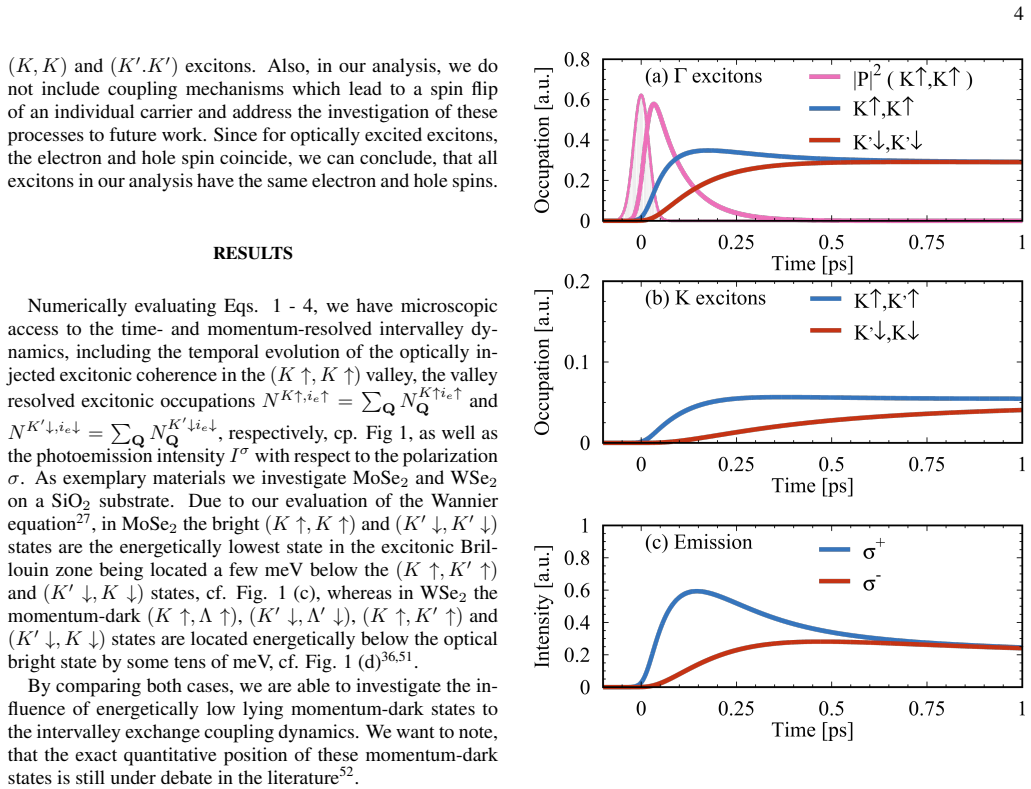
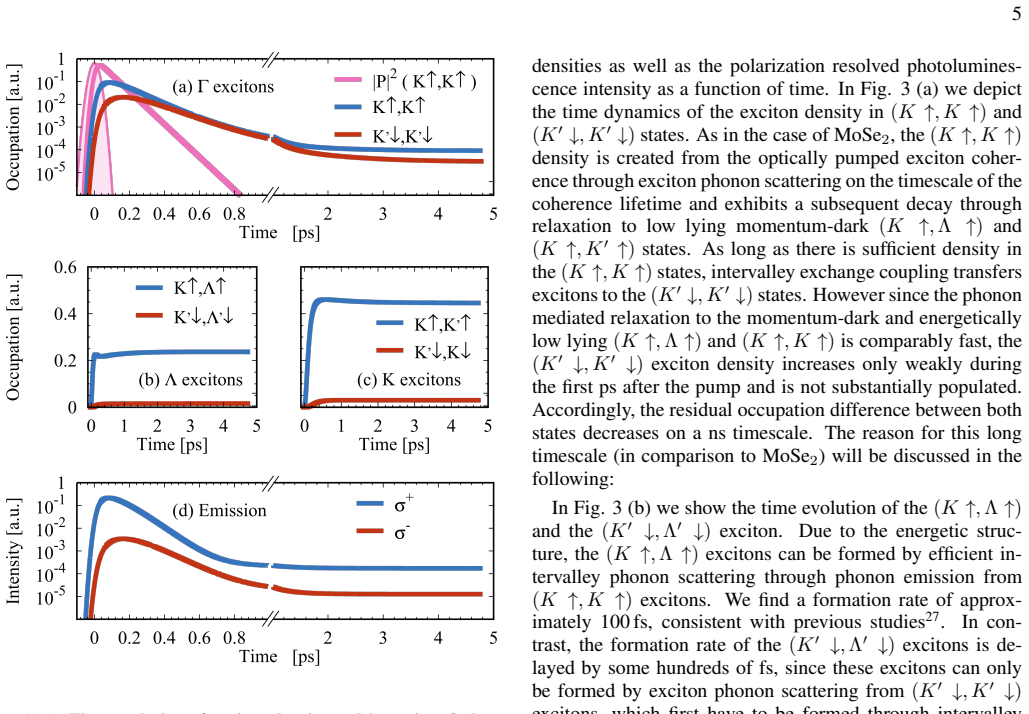
The central claim is that the intervalley exchange coupling (IEC), the dipole-dipole interaction that flips electron and hole spins simultaneously and transfers excitons between $K$ and $K'$, is strongly quenched whenever momentum-dark exciton states lie energetically below the bright state. The paper demonstrates this by computing the coupled dynamics of bright and dark exciton populations, phonon scattering, and the intervalley coherence in MoSe$_2$ and WSe$_2$. In MoSe$_2$ the bright $(K\uparrow,K\uparrow)$ and $(K'\downarrow,K'\downarrow)$ states are the lowest, so most excitons remain in coupled states and the valley polarization decays in 150--400 fs depending on temperature. In WSe$_2$ the $(K\uparrow,\Lambda\uparrow)$ and $(K\uparrow,K'\uparrow)$ states are tens of meV lower, so exciton-phonon scattering drains the bright states within roughly 100--300 fs; since IEC cannot act on these momentum-dark states, the remaining occupation difference between the two valleys persists on a nanosecond timescale at 77 K. The paper concludes that this mechanism explains the large difference in valley lifetimes and polarization degrees between Mo- and W-based TMDCs, while noting that other spin-flip mechanisms may become relevant on longer timescales.
Load-bearing premise
All conclusions depend on the energetic ordering of the momentum-dark exciton states: in WSe$_2$ the $(K,\Lambda)$ and $(K,K')$ dark states must sit tens of meV below the bright state, and in MoSe$_2$ above it; the authors note that the exact quantitative ordering is still under debate.
Editorial extensions
If this is right
- In W-based monolayers such as WSe$_2$, exciton valley polarization can survive for nanoseconds at cryogenic temperatures, making them the practical choice for valleytronic memory and polarization-encoded photonics.
- In Mo-based monolayers, the bright exciton is the ground state, so any optically created valley polarization is homogenized within a few hundred femtoseconds; these materials will not retain valley information without additional engineering.
- The temperature dependence of the valley lifetime is opposite in the two families: MoSe$_2$ lifetimes grow with temperature (150 fs at 77 K to 400 fs at 300 K) as dark states become populated, while WSe$_2$ lifetimes shrink (1.6 ns to 8 ps) as thermal population returns to the bright state.
- The degree of polarization of incoherent photoluminescence can be high (about 64% in WSe$_2$ at 77 K) even when the total valley lifetime is long, because emission samples only light-cone excitons that must first be repopulated by scattering.
- When IEC is quenched, other intervalley spin relaxation channels such as single-carrier spin flips may become the dominant decay path on longer timescales, so measured lifetimes may fall below the pure-IEC values.
Reading between the lines
- If the dark-bright splitting can be tuned continuously by strain, dielectric screening, or stacking, the theory implies a sharp crossover in valley lifetime as the $(K,\Lambda)$ dark state crosses the bright state, effectively dialling valleytronic performance.
- The same reservoir picture should extend to other W-based TMDCs and to heterobilayers whenever a momentum-dark exciton is the ground state, so the quenching mechanism is likely a general design rule rather than a WSe$_2$ special case.
- Because the model defines valley lifetime from the total exciton density while photoluminescence reports only light-cone excitons, measurements that mix the two definitions may disagree; a careful experiment should specify which observable is being reported.
- The debated quantitative ordering of the dark states could be pinned down experimentally from the phonon-assisted photoluminescence spectrum, whose bright-to-dark energy separation fixes the temperature at which the valley-lifetime crossover should occur.
Signed reviews
Editorial analysis
A structured set of objections, weighed in public.
Referee Report
Summary. The paper develops a microscopic Heisenberg-equation-of-motion theory for exciton dynamics in monolayer TMDCs, including intervalley Coulomb exchange coupling (IEC), exciton-phonon scattering, and radiative decay. The model is applied to MoSe2 and WSe2 on SiO2, where the energetic ordering of momentum-dark exciton states relative to the bright K/K' excitons differs. In MoSe2 the bright states are lowest and the calculated valley lifetime is a few hundred femtoseconds; in WSe2 the momentum-dark (K,Lambda) and (K,K') states lie tens of meV below the bright state, and the resulting thermalization into these IEC-inactive states is argued to quench the intervalley exchange coupling, producing valley lifetimes of about 1.6 ns at 77 K and 8 ps at room temperature. The degree of polarization of the incoherent emission is also computed and compared with experiments, using a 1 ns non-radiative recombination rate as an external parameter.
Significance. If the assumed dark-bright splitting in WSe2 is correct, the paper offers a simple and physically appealing explanation for the experimentally observed Mo/W dichotomy in valley dynamics and for the strong temperature dependence of the valley lifetime. The theoretical framework itself is a strength: the equations of motion are derived from a well-defined Hamiltonian, the Coulomb and phonon parameters are taken from DFT, and the authors explicitly compare their results with pump-probe, Kerr-rotation, and polarization experiments. The manuscript is also honest in flagging the uncertainty in the dark-state ordering and in acknowledging that other spin-relaxation mechanisms may dominate at long times. However, the central quantitative claim is contingent on a band-structure input that the authors themselves describe as under debate, and the polarization predictions depend on a fitted non-radiative decay rate. These issues need to be addressed before the paper can be accepted.
major comments (3)
- [Results, 'Intervalley coupling in WSe2' and Fig. 5(a)] The central prediction of a 1.6 ns valley lifetime in WSe2 at 77 K rests entirely on the assumed energetic ordering that places the momentum-dark (K,Lambda) and (K,K') excitons tens of meV below the bright state. The authors note in the same section that the exact quantitative position of these states is under debate (Ref. 52), and the quenching mechanism is threshold-like: at 77 K, a splitting of tens of meV suppresses the bright-state population by Boltzmann factors of order 10^-2 to 10^-4, but if the true splitting were only a few meV or positive, the predicted valley lifetime would collapse to the MoSe2 scale. Please provide a sensitivity analysis of the valley lifetime as a function of the dark-bright splitting (including negative splittings), and state explicitly the critical splitting at which the Mo/W dichotomy disappears. Without this, the headline lifetime contrast is not robust to the known uncertainty in the input.
- [Results, 'Degree of Polarization and Valley Lifetime' and Fig. 5(b)] The computed degree of polarization is controlled by the non-radiative recombination rate, which is set to 1 ns as an external parameter. While the text mentions that rates of 500 ps and 200 ps are shown in the supplementary material, the main-text Fig. 5(b) presents a single choice (1 ns) and the numbers (64% at 77 K, 1% at room temperature) are quantitatively compared with experiments. Because this fitted rate is not predicted by the model, the polarization result should be presented as an illustration under an assumed non-radiative lifetime, with a sensitivity curve shown in the main text or at least a clear label in the figure that the absolute values are parameter-dependent. As it stands, the comparison with experimental polarization values gives the impression of a prediction rather than a fit-dependent estimate.
- [Conclusion] The conclusion states that the intervalley exchange coupling is 'strongly quenched' in WSe2 because excitons thermalize into momentum-dark states. This is a population-redistribution effect: the microscopic coupling itself is not altered, but the occupancy of the coupled bright states is reduced. The authors should clarify in the conclusion that the quenching is a consequence of the assumed level ordering and of the exciton-phonon thermalization rates, and that the physical picture would change qualitatively if the ordering were reversed. This clarification is needed to prevent the result from being read as a parameter-free prediction.
minor comments (4)
- [Theoretical Approach] There is a typo in the sentence 'We restrixt the description' which should read 'We restrict the description'; also 'Troughout this paper' should be 'Throughout this paper'.
- [Results, 'Intervalley coupling in MoSe2'] The authors state that for MoSe2 the deviations from Ref. 52 are 'only on the order of few meV and smaller in comparison to the thermal energy of the excitons.' For consistency, the corresponding discussion for WSe2 should quantify the uncertainty in the dark-bright splitting (which is tens of meV) and explain why that uncertainty does not equally affect the qualitative conclusions.
- [Results, 'Degree of Polarization and Valley Lifetime'] In the text, the degree of polarization is written as 'nσ+−nσ− nσ++nσ−' without proper parentheses; please use (nσ+ - nσ-)/(nσ+ + nσ-) for clarity.
- [Fig. 3(c) discussion] There is a typo 'exictons' in the sentence 'The formation of the (K↑ K′ ↑) exictons occurs within 200 fs'; it should be 'excitons'.
Circularity Check
No significant circularity: the Mo/W valley-lifetime contrast follows from an explicitly stated external band-structure input, not from a fitted or self-referential reduction.
full rationale
The paper's central claim is that intervalley exchange coupling (IEC) is quenched when momentum-dark exciton states lie below the optically bright states, as in WSe2, whereas MoSe2, with dark states above the bright states, exhibits fast valley relaxation. This is a deductive consequence of the model Hamiltonian: the authors explicitly state that IEC requires energy and momentum conservation and therefore applies only to (K,K) and (K',K') excitons, while momentum-dark states are immune. The energetic ordering of the dark states is an external input taken from their prior DFT-based Wannier-equation calculations (Refs. 27, 36, 51), and the authors openly note that 'the exact quantitative position of these momentum-dark states is still under debate in the literature' (Ref. 52). This is a robustness/sensitivity limitation, not a circularity: the input does not definitionally contain the output, and the prediction would indeed change if the input ordering changed, which is precisely what makes it a genuine conditional prediction rather than a tautology. The non-radiative recombination rate of 1 ns used for the polarization calculation is chosen from an external experimental value (Ref. 26) and the authors explicitly discuss its influence on the degree of polarization; it is not fitted to the predicted valley lifetime, which is extracted independently from the density dynamics. The transient intervalley transfer and the order-of-magnitude polarization are checked against external experiments (Refs. 12, 14, 21, 53, 54), and the paper itself cautions that other spin-relaxation mechanisms become relevant on long timescales. No equation is shown to reduce to its own input, no fitted parameter is renamed as a prediction, and the self-citations point to externally falsifiable prior calculations rather than to an unverified uniqueness theorem. The derivation chain is therefore self-contained once the material-specific band-structure parameters are accepted as inputs; any concern about the uncertainty in those parameters belongs to correctness risk, not circularity.
Assumptions & free parameters
free parameters (1)
- Non-radiative recombination rate =
1 ns (with 500 ps and 200 ps tested in supplementary)
assumptions (5)
- domain assumption The 1s exciton state dominates the dynamics; higher excitonic states are ignored due to large energy separation.
- domain assumption The Wannier equation with the DFT-derived dielectric function and band parameters accurately describes exciton dispersions and wavefunctions.
- domain assumption The excitonic Hamiltonian with intervalley Coulomb exchange, exciton-phonon, and exciton-photon couplings is complete for the studied dynamics; higher-order many-body correlations are negligible under weak excitation.
- domain assumption Momentum-dark exciton states at K' and Lambda do not participate in intervalley exchange coupling due to energy and momentum conservation.
- domain assumption The energetic ordering of momentum-dark states below the bright state in WSe2 (and above in MoSe2) is as given by the authors' DFT-based calculations.
Cite this review
Pith. "Pith review of Quenching of Intervalley Exchange Coupling in the Presence of Momentum-Dark States in TMDCs." pith.science (2026). https://pith.science/paper/ENCIYK4O
@misc{pith2026190811178,
  author       = {Pith},
  title        = {Pith review of: Quenching of Intervalley Exchange Coupling in the Presence of Momentum-Dark States in TMDCs},
  year         = {2026},
  howpublished = {\url{https://pith.science/paper/ENCIYK4O}},
  note         = {Machine review of arXiv:1908.11178}
}
abstract
Monolayers of transition metal dichalcogenides are promising materials for valleytronic applications, since they possess two individually addressable excitonic transitions at the non-equivalent $K$ and $K'$ points with different spins, selectively excitable with light of opposite circular polarization. Here, it is of crucial importance to understand the elementary processes determining the lifetime of these optically injected valley excitons. In this study, we perform microscopic calculations based on a Heisenberg equation of motion formalism to investigate the efficiency of the intervalley coupling in the presence (W based TMDCs) and absence (Mo based TMDCs) of energetically low lying momentum-dark exciton states. While we predict a valley exciton lifetime on the order of some hundreds of fs in the absence of low lying momentum-dark states we demonstrate a strong quenching of the valley lifetime in the presence of such states.
Figures

Figures from the paper (1 more)

Reference graph
Works this paper leans on
-
[1]
author Wang, G. et al. title Colloquium: Excitons in atomically thin transition metal dichalcogenides . journal Rev. Mod. Phys. volume 90 , pages 021001 ( year 2018 )
work page 2018
-
[2]
author Manca M. et al. title Enabling valley selective exciton scattering in monolayer WSe2 through upconversion . journal Nature Communications volume 8 , pages 14927 ( year 2017 )
work page 2017
-
[3]
author Christiansen, D. et al. title Phonon sidebands in monolayer transition metal dichalcogenides . journal Phys. Rev. Lett. volume 119 , pages 187402 ( year 2017 )
work page 2017
-
[4]
author Steinhoff, A. et al. title Exciton fission in monolayer transition metal dichalcogenide semiconductors . journal Nature Communications volume 8 , pages 1166 ( year 2017 )
work page 2017
-
[5]
author Steinleitner, P. et al. title Dielectric engineering of electronic correlations in a van der waals heterostructure . journal Nano Letters volume 18 , pages 1402--1409 ( year 2018 )
work page 2018
-
[6]
author Kunstmann Jens et al. title Momentum-space indirect interlayer excitons in transition-metal dichalcogenide van der Waals heterostructures . journal Nature Physics volume 14 , pages 801--805 ( year 2018 )
work page 2018
-
[7]
author Cao, T. et al. title Valley-selective circular dichroism of monolayer molybdenum disulphide . journal Nat Commun volume 3 , pages 887 ( year 2012 )
work page 2012
-
[8]
title Valley polarization in MoS2 monolayers by optical pumping
author Zeng Hualing , author Dai Junfeng , author Yao Wang , author Xiao Di & author Cui Xiaodong . title Valley polarization in MoS2 monolayers by optical pumping . journal Nat Nano volume 7 , pages 490--493 ( year 2012 )
work page 2012
Show all 54 references
-
[9]
author Wang, Q. et al. title Valley carrier dynamics in monolayer molybdenum disulfide from helicity-resolved ultrafast pump-probe spectroscopy . journal ACS Nano volume 7 , pages 11087--11093 ( year 2013 )
2013
-
[10]
, author Schaibley, J
author Moody, G. , author Schaibley, J. & author Xu, X. title Exciton dynamics in monolayer transition metal dichalcogenides . journal J. Opt. Soc. Am. B volume 33 , pages C39--C49 ( year 2016 )
2016
-
[11]
author Smole n \' n ski, T. et al. title Tuning valley polarization in a wse _ 2 monolayer with a tiny magnetic field . journal Phys. Rev. X volume 6 , pages 021024 ( year 2016 )
2016
-
[12]
author Schmidt, R. et al. title Ultrafast coulomb-induced intervalley coupling in atomically thin ws2 . journal Nano Letters volume 16 , pages 2945--2950 ( year 2016 )
2016
-
[13]
author Plechinger, G. et al. title Valley dynamics of excitons in monolayer dichalcogenides . journal physica status solidi (RRL) - Rapid Research Letters volume 11 , pages 1700131 ( year 2017 ). note 1700131
2017
-
[14]
author McCormick, E. J. et al. title Imaging spin dynamics in monolayer ws 2 by time-resolved kerr rotation microscopy . journal 2D Materials volume 5 , pages 011010 ( year 2018 )
2018
-
[15]
& author Wu, M
author Yu, T. & author Wu, M. W. title Valley depolarization due to intervalley and intravalley electron-hole exchange interactions in monolayer mos _ 2 . journal Phys. Rev. B volume 89 , pages 205303 ( year 2014 )
2014
-
[16]
author Glazov, M. M. et al. title Exciton fine structure and spin decoherence in monolayers of transition metal dichalcogenides . journal Phys. Rev. B volume 89 , pages 201302 ( year 2014 )
2014
-
[17]
& author Wu, M
author Wang, L. & author Wu, M. title Intrinsic electron spin relaxation due to the d'yakonov-perel mechanism in monolayer mos2 . journal Physics Letters A volume 378 , pages 1336 -- 1340 ( year 2014 )
2014
-
[18]
& author Wu, M
author Wang, L. & author Wu, M. W. title Electron spin relaxation due to d'yakonov-perel' and elliot-yafet mechanisms in monolayer mos _ 2 : Role of intravalley and intervalley processes . journal Phys. Rev. B volume 89 , pages 115302 ( year 2014 )
2014
-
[19]
& author Song, Y
author Dery, H. & author Song, Y. title Polarization analysis of excitons in monolayer and bilayer transition-metal dichalcogenides . journal Phys. Rev. B volume 92 , pages 125431 ( year 2015 )
2015
-
[20]
author Dal Conte, S. et al. title Ultrafast valley relaxation dynamics in monolayer mos _ 2 probed by nonequilibrium optical techniques . journal Phys. Rev. B volume 92 , pages 235425 ( year 2015 )
2015
-
[21]
author Wang, Z. et al. title Intravalley spin–flip relaxation dynamics in single-layer ws2 . journal Nano Letters volume 18 , pages 6882--6891 ( year 2018 )
2018
-
[22]
author Maialle, M. Z. , author de Andrada e Silva, E. A. & author Sham, L. J. title Exciton spin dynamics in quantum wells . journal Phys. Rev. B volume 47 , pages 15776--15788 ( year 1993 )
1993
-
[23]
author Vinattieri, A. et al. title Exciton dynamics in GaAs quantum wells under resonant excitation . journal Phys. Rev. B volume 50 , pages 10868--10879 ( year 1994 )
1994
-
[24]
author Qiu, D. Y. , author Cao, T. & author Louie, S. G. title Nonanalyticity, valley quantum phases, and lightlike exciton dispersion in monolayer transition metal dichalcogenides: Theory and first-principles calculations . journal Phys. Rev. Lett. volume 115 , pages 176801 (...
2015
-
[25]
author Selig, M. et al. title Ultrafast dynamics in monolayer tmdcs: the interplay of dark excitons, phonons and intervalley coulomb exchange . journal arXiv:1908.10080 ( year 2019 )
1908 arXiv
-
[26]
, author You, Y
author Zhang, X.-X. , author You, Y. , author Zhao, S. Y. F. & author Heinz, T. F. title Experimental evidence for dark excitons in monolayer WSe_ 2 . journal Phys. Rev. Lett. volume 115 , pages 257403 ( year 2015 )
2015
-
[27]
author Selig, M. et al. title Dark and bright exciton formation, thermalization, and photoluminescence in monolayer transition metal dichalcogenides . journal 2D Materials volume 5 , pages 035017 ( year 2018 )
2018
-
[28]
author Lindlau, J. et al. title The role of momentum-dark excitons in the elementary optical response of bilayer WSe2 . journal Nature Communications volume 9 , pages 2586 ( year 2018 )
2018
-
[29]
author Brem, S. et al. title Phonon-assisted photoluminescence from dark excitons in monolayers of transition metal dichalcogenides . journal arXiv:1904.04711 ( year 2019 )
1904 arXiv
-
[30]
author Glazov, M. et al. title Intervalley polaron in atomically thin transition metal dichalcogenides . journal arXiv preprint arXiv:1904.02674 ( year 2019 )
1904 arXiv
-
[31]
& author Koch, S
author Haug, H. & author Koch, S. W. title Quantum Theory of the Optical and Electronic Properties of Semiconductors ( publisher 5th ed. (World Scientific Publishing Co. Pre. Ltd., Singapore, 2004). )
2004
-
[32]
, author Kuckenburg, S
author Thr\"anhardt, A. , author Kuckenburg, S. , author Knorr, A. , author Meier, T. & author Koch, S. W. title Quantum theory of phonon-assisted exciton formation and luminescence in semiconductor quantum wells . journal Phys. Rev. B volume 62 , pages 2706--2720 ( year 2000 )
2000
-
[33]
& author Koch, S
author Kira, M. & author Koch, S. title Many-body correlations and excitonic effects in semiconductor spectroscopy . journal Progress in Quantum Electronics volume 30 , pages 155 -- 296 ( year 2006 )
2006
-
[34]
, author Selig, M
author Katsch, F. , author Selig, M. , author Carmele, A. & author Knorr, A. title Theory of exciton-exciton interactions in monolayer transition metal dichalcogenides . journal physica status solidi (b) volume 255 , pages 1800185 ( year 2018 )
2018
-
[35]
, author Qu, F
author Wu, F. , author Qu, F. & author MacDonald, A. H. title Exciton band structure of monolayer mos _ 2 . journal Phys. Rev. B volume 91 , pages 075310 ( year 2015 )
2015
-
[36]
author Selig, M. et al. title Excitonic linewidth and coherence lifetime in monolayer transition metal dichalcogenides . journal Nature Communications volume 7 , pages 13279 ( year 2016 )
2016
-
[37]
author Niehues, I. et al. title Strain control of exciton-phonon coupling in atomically thin semiconductors . journal Nano Letters volume 18 , pages 1751--1757 ( year 2018 )
2018
-
[38]
, author Pedersen, Thomas G
author Trolle, Mads L. , author Pedersen, Thomas G. & author Veniard, Valerie . title Model dielectric function for 2D semiconductors including substrate screening . journal Scientific Reports volume 7 , pages 39844 ( year 2017 )
2017
-
[39]
, author Olsen, T
author Latini, S. , author Olsen, T. & author Thygesen, K. S. title Excitons in van der waals heterostructures: The important role of dielectric screening . journal Phys. Rev. B volume 92 , pages 245123 ( year 2015 )
2015
-
[40]
author Qiu, D. Y. , author da Jornada, F. H. & author Louie, S. G. title Screening and many-body effects in two-dimensional crystals: Monolayer mos _ 2 . journal Phys. Rev. B volume 93 , pages 235435 ( year 2016 )
2016
-
[41]
author Kormanyos, A. et al. title k p theory for two-dimensional transition metal dichalcogenide semiconductors . journal 2D Materials volume 2 , pages 022001 ( year 2015 )
2015
-
[42]
author Li, X. et al. title Intrinsic electrical transport properties of monolayer silicene and MoS_ 2 from first principles . journal Phys. Rev. B volume 87 , pages 115418 ( year 2013 )
2013
-
[43]
, author Li, X
author Jin, Z. , author Li, X. , author Mullen, J. T. & author Kim, K. W. title Intrinsic transport properties of electrons and holes in monolayer transition-metal dichalcogenides . journal Phys. Rev. B volume 90 , pages 045422 ( year 2014 )
2014
-
[44]
title The quantum theory of light ( publisher Claredon Press Oxford , year 1973 )
author Loudon, R. title The quantum theory of light ( publisher Claredon Press Oxford , year 1973 )
1973
-
[45]
author Ivanov, A. L. & author Haug, H. title Self-consistent theory of the biexciton optical nonlinearity . journal Phys. Rev. B volume 48 , pages 1490--1504 ( year 1993 )
1993
-
[46]
, author Rosati, R
author Lengers, F. , author Rosati, R. , author Kuhn, T. & author Reiter, D. E. title Spatiotemporal dynamics of coulomb-correlated carriers in semiconductors . journal Phys. Rev. B volume 99 , pages 155306 ( year 2019 )
2019
-
[47]
author Chernikov, A. et al. title Exciton binding energy and nonhydrogenic rydberg series in monolayer WS_ 2 . journal Phys. Rev. Lett. volume 113 , pages 076802 ( year 2014 )
2014
-
[48]
, author Selig, M
author Brem, S. , author Selig, M. , author Bergh\"auser, G. & author Malic, E. title Exciton Relaxation Cascade in two-dimensional Transition Metal Dichalcogenides . journal Scientific Reports volume 8 , pages 8238 ( year 2018 )
2018
-
[49]
author Brem, S. et al. title Intrinsic lifetime of higher excitonic states in tungsten diselenide monolayers . journal Nanoscale ( year 2019 )
2019
-
[50]
& author Stahl, A
author Axt, V. & author Stahl, A. Z. title A dynamics-controlled truncation scheme for the hierarchy of density matrices in semiconductor optics . journal Physik B - Condensed Matter volume 93 , pages 195 ( year 1994 )
1994
-
[51]
author Malic, E. et al. title Dark excitons in transition metal dichalcogenides . journal Phys. Rev. Materials volume 2 , pages 014002 ( year 2018 )
2018
-
[52]
& author Thygesen, K
author Deilmann, T. & author Thygesen, K. S. title Finite-momentum exciton landscape in mono- and bilayer transition metal dichalcogenides . journal 2D Materials volume 6 , pages 035003 ( year 2019 )
2019
-
[53]
author Wang, G. et al. title Polarization and time-resolved photoluminescence spectroscopy of excitons in mose2 monolayers . journal Applied Physics Letters volume 106 , pages 112101 ( year 2015 )
2015
-
[54]
title Valley depolarization in monolayer WSe2
author Yan Tengfei , author Qiao Xiaofen , author Tan Pingheng & author Zhang Xinhui . title Valley depolarization in monolayer WSe2 . journal Scientific Reports volume 5 , pages 15625 ( year 2015 )
2015
Reviewed August 14, 2026 · model on record in the stance chip above.
Discussion (0). Continue with ORCID to comment.