REVIEW 3 major objections 7 minor 48 references
Wave-particle duality ellipse and application in quantum imaging with undetected photons
T0 review · 3 major / 7 minor · reviewed 2026-08-07 · deepseek-v4-flash
Pith's one-line read The paper claims that wave-particle duality in any two-path interferometer is exactly an ellipse equation, $V^2/\gamma^2 + D^2 = 1$, and that the same law, with object transmittance in place of coherence, lets researchers image objects…
desk verdict A correct but largely derivative reformulation of complementarity, with an imaging extension that is interesting but rests on an unproven uniformity assumption. read the letter →
The pith
A machine-rendered reading of the paper's core claim, the machinery that carries it, and where it could break.
The reading
What carries the argument
The key machinery is the normalized optical degree of coherence $\gamma = |\langle M_1|M_2\rangle|$ between the marginal states of the two paths, together with the output probability $P \propto |c_1|^2 + |c_2|^2 + 2|c_1 c_2| \gamma \cos \phi$ of the interferometer. Computing visibility and predictability from $P$ and rearranging yields the ellipse equation, so $\gamma$ (or $T$, or the product $\gamma \alpha T$) acts as the semimajor axis that sets the ellipticity $\eta = 1 - \gamma$. In the QIUP scenario, the object transmittance $T$ plays exactly this role because partial absorption of the idler photon introduces which-way information that reduces the induced coherence between signal modes. The same calculation structure is reused with the replacement of $\gamma$ by the generalized coherence factor $\gamma T \alpha$.
What would settle it
Use an object with a known sharp transmittance edge in the idler arm and scan the signal-photon camera to measure $V$ and $D$ at every pixel. If a deliberately introduced, spatially varying idler misalignment changes the reconstructed transmittance in a way that tracks the misalignment rather than the object, the robustness claim fails; if the reconstruction still matches the known object, it survives. A simpler check is to directly measure $\gamma$ and $\alpha$ at several transverse positions and test whether they are constant.
Extended reading notes
Core claim
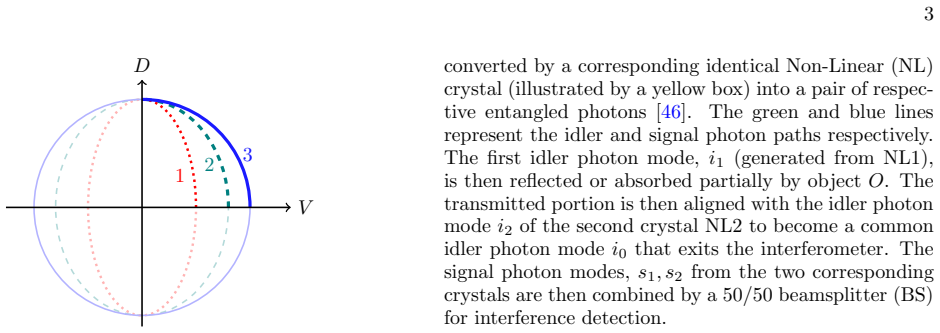
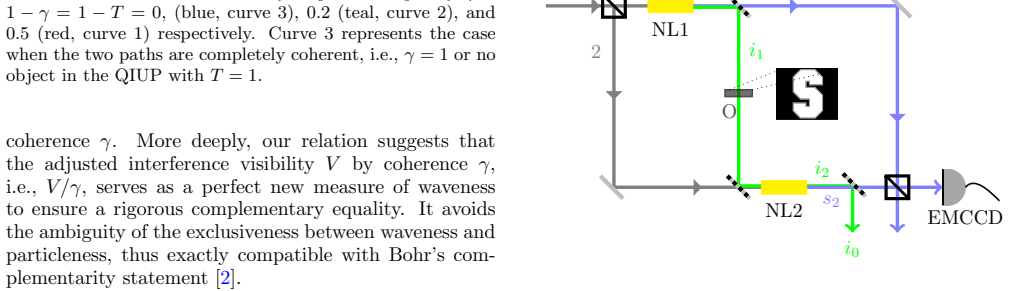
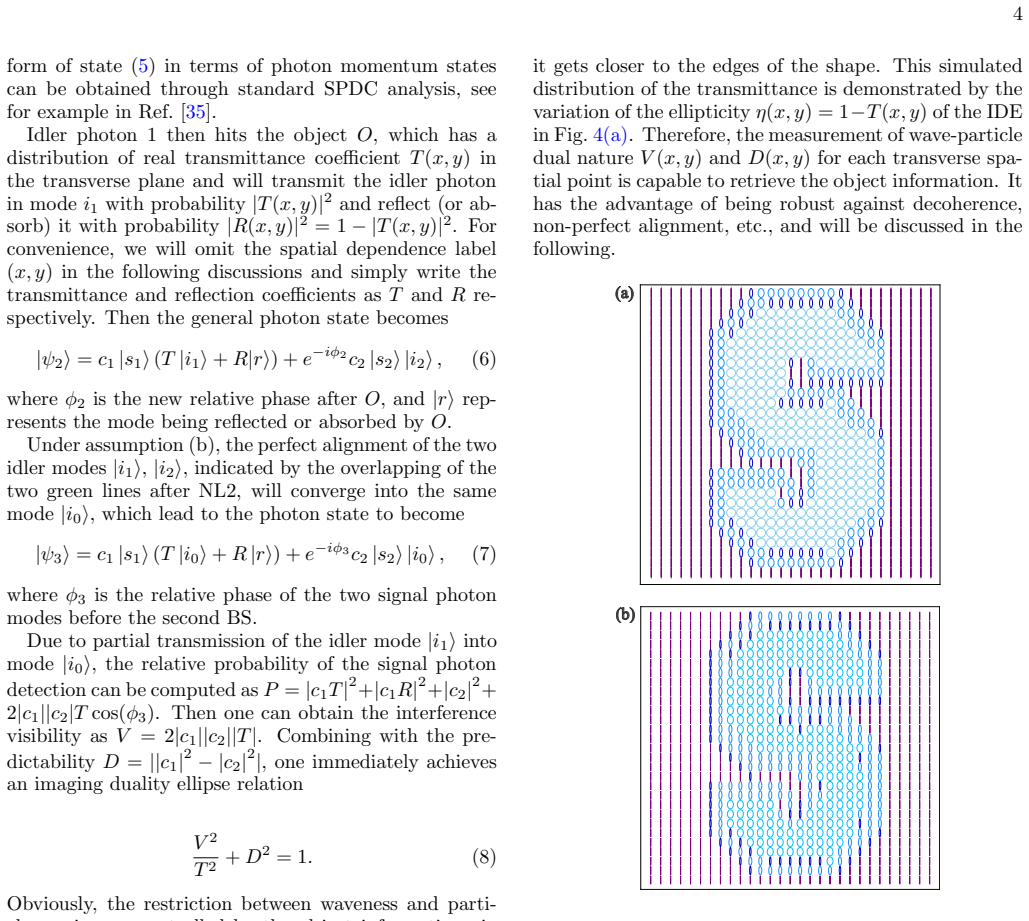
The central discovery is a closed-form duality relation that upgrades the familiar inequality $V^2 + D^2 \le 1$ to an exact equality. For a generic two-path interferometer whose two paths have coefficients $c_1$ and $c_2$ and marginal-state overlap $\gamma$, the interference visibility is $V = 2|c_1 c_2| \gamma$ and the predictability is $D = \bigl||c_1|^2 - |c_2|^2\bigr|$, and these obey $V^2/\gamma^2 + D^2 = 1$. The paper calls this the Duality Ellipse, with ellipticity $1-\gamma$. In the quantum imaging with undetected photons setting, the idler photon encounters an object of transmittance $T$, which enters exactly as $\gamma$ does, giving the imaging duality ellipse $V^2/T^2 + D^2 = 1$; with pump decoherence $\gamma$ and idler misalignment $\alpha$, the robust form is $V^2/(\gamma^2 T^2 \alpha^2) + D^2 = 1$. The claim is that the measured $(V, D)$ pair at each transverse point therefore encodes the object transmittance $T(x, y)$ through the ellipse's ellipticity.
Load-bearing premise
The load-bearing premise is that the pump partial coherence $\gamma$ and the idler alignment overlap $\alpha$ are uniform across the whole transverse plane; if either of them varies with position, the measured ellipse no longer maps one-to-one to the object's transmittance profile.
Editorial extensions
If this is right
- The wave-particle tradeoff becomes an exact equality rather than an inequality, so for any measured degree of coherence the visibility and predictability are locked together by one number.
- In quantum imaging with undetected photons, object transmittance can be recovered without ever detecting the idler photons, from visibility and predictability measurements alone.
- Pump decoherence and idler misalignment do not break the ellipse form; they multiply the semimajor axis by a constant $\alpha \gamma$ across the whole image, preserving the relative profile of the object.
- A calibration run with no object ($T = 1$) directly fixes the unknown $\alpha \gamma$ product, allowing absolute transmittance values to be extracted from a single additional measurement.
- Because the derivation only uses the structure of two-path coefficients, the duality ellipse applies to any quantum particle in a two-path interferometer, not only photons.
Reading between the lines
- If $\gamma$ or $\alpha$ varies across the transverse plane, the one-to-one image mapping breaks; a spatially resolved calibration of $\gamma$ and $\alpha$ would turn the robust scheme into a quantitative imaging tool and is a natural next step.
- The coherence-normalized visibility $V/\gamma$ could serve as a universal waveness measure in other platforms, such as multi-path interferometers, where the ellipse may generalize to a hyperellipsoid.
- Because the concurrence $C = 2|c_1 c_2|\sqrt{1-\gamma^2}$ is directly related to $\gamma$, the duality ellipse re-expresses entanglement-based complementarity relations entirely in coherence language, which may simplify future proofs.
- One could test the imaging ellipse in an actual experiment by imaging a sharp-edge object and deliberately introducing a spatially dependent misalignment; if the reconstruction follows the object rather than the misalignment pattern, the robustness claim is confirmed.
Editorial analysis
A structured set of objections, weighed in public.
Referee Report
Summary. The paper derives a complementarity relation for a two-path interferometer with partial coherence: with visibility V, predictability D, and degree of coherence gamma, it obtains the 'duality ellipse' V^2/gamma^2 + D^2 = 1 (Eq. 4). It then extends this to quantum imaging with undetected photons (QIUP), where an object of transmittance T is placed in one idler arm, obtaining V^2/T^2 + D^2 = 1 (Eq. 8), and further to a realistic case with pump decoherence gamma and idler misalignment alpha, obtaining V^2/(gamma^2 T^2 alpha^2) + D^2 = 1 (Eq. 11). The paper argues that measuring V and D pointwise reconstructs the object profile T(x,y) and that this reconstruction is robust against the imperfections parametrized by alpha and gamma. The algebraic derivations of Eqs. (4), (8), and (11) are internally consistent under the stated single-mode, pure-state assumptions.
Significance. If the robustness claim were fully established, the imaging duality ellipse would be a useful operational tool: it would connect wave-particle duality measurements to object reconstruction in QIUP and would offer a simple calibration procedure for misalignment and decoherence. The paper's derivations are explicit and the proposed calibration idea (using a T=1 region to determine alpha*gamma) is a constructive step. However, the central imaging claim currently depends on an unproven uniformity assumption for alpha and gamma across the transverse plane, and the pointwise extension of the single-mode derivation to a spatially varying object is not justified from the transverse multimode structure of SPDC. In addition, the duality ellipse itself is a rearrangement of the standard complementarity inequality, so the claimed conceptual novelty needs to be stated more carefully against prior work.
major comments (3)
- [Section IV, Eq. (11)] The robust-imaging claim rests on the assertion that alpha=|langle i0|i0'rangle| and gamma=|langle m1|m2rangle| are 'uniform across the entire transverse plane' and independent of the signal photon's transverse coordinate. No derivation or experimental support is given. In a realistic SPDC source, the idler modes i1 and i2 are multimode fields entangled with the signal modes; the overlap alpha is an integral over transverse degrees of freedom and will generally vary with the signal coordinate or with the object position, and the pump coherence gamma can likewise be mode-dependent. If alpha(x,y) or gamma(x,y) varies, then eta(x,y)=1-T(x,y)alpha(x,y)gamma(x,y) is not a one-to-one scaled map of T(x,y), and the reconstruction procedure and the calibration via a T=1 reference fail unless the spatial variation is modeled, measured, or bounded. This is load-bearing for the central claim of robust QIUP and must be addressed.
- [Section III, Eqs. (5)-(8)] The point-by-point imaging relation is introduced by writing T as a scalar coefficient and then reinstating the spatial label (x,y) in the discussion. However, the SPDC state in Eq. (5) is a multimode state; the object modifies the idler mode function, and the visibility measured at a signal pixel is in general a functional of T(x,y) integrated over the two-photon transverse mode correlations. The derivation should start from the full transverse-mode expansion, as in Ref. [35], and show under which approximations (e.g., point-like object, plane-wave pump, pixel-wise factorizability) Eq. (8) holds pointwise. As written, the transition from a scalar T to an image T(x,y) is an unproven modeling step.
- [Section II, Eq. (4)] The algebraic derivation of Eq. (4) is correct, but its interpretation as a fundamentally new duality relation should be qualified. Since V=2|c1 c2|gamma, the rescaled quantity V/gamma is simply the maximum visibility 2*sqrt(P1 P2) determined by the path probabilities; Eq. (4) is therefore the standard normalization identity 4P1 P2 + (P1-P2)^2 = 1 restated in terms of the coherence-adjusted visibility. The 'duality ellipse' is a rearrangement of the conventional duality inequality V^2 + D^2 <= 1. The authors should state this explicitly, compare with earlier coherence-based complementarity relations such as Refs. [11] and [12], and explain what new predictions or operational advantages follow from the ellipse formulation that do not already follow from the standard inequality.
minor comments (7)
- [Section V] The text contains typos: 'ellipicity' should be 'ellipticity', and 'non-perfections' is nonstandard; please use 'imperfections'.
- [Figure 4] Figure 4 is described as a simulation, but no parameters (beam size, coherence values, noise model, object profile) are given; please clarify whether it is a quantitative simulation or a schematic illustration.
- [References] Reference [40] is incomplete ('Phys. Rev. X14' with no article number), and reference [28] lacks journal volume and page details; these should be completed.
- [Section II] The sentence 'This universality ensures the DE applies equally to systems in pure and mixed states' is imprecise because Eq. (1) is a pure joint state with non-orthogonal marginals; please clarify whether and how mixed joint states are covered.
- [Section III] Calling the transmittance T a 'generalized form of coherence' is unconventional; a brief explanation of the sense in which T acts like a coherence parameter would help the reader.
- [Section IV, Eq. (11)] Equation (11) assumes T is real and nonnegative; if the object is phase-shifting or complex, the squared denominator and the calibration relation need modification, which should be stated.
- [Section III, Eq. (6)] The notation |i1> -> T|i1> + R|r> with R=sqrt(1-|T|^2) should specify whether the object acts coherently (partial reflection) or incoherently (absorption with an orthogonal loss mode); the probability calculation treats |r> as orthogonal, which is fine, but the physical model should be stated explicitly.
Circularity Check
Duality ellipse is a normalization identity; robust imaging rests on an unproved uniformity assertion.
-
self definitional
[Section II, Eqs. (2)-(4)]
"Then the interference visibility V and predictability D can be computed respectively [6, 8] as V = 2|c1 c2|γ and D = ||c1|2 − |c2|2|. ... it also leads to an exact closed relation V 2/γ2 + D 2 = 1, (4). ... our relation suggests that the adjusted interference visibility V by coherence γ, i.e., V/γ, serves as a perfect new measure of waveness."
Substituting the definitions just written into Eq. (4) gives (2|c1c2|)^2 + (|c1|^2 − |c2|^2)^2 = 1, which is exactly the normalization identity |c1|^2 + |c2|^2 = 1 after rescaling by 1/γ. The quantity V/γ is proposed as a new measure of waveness precisely so that the equality holds; γ appears only in the denominator chosen by the authors, not through any independent dynamical constraint. The central 'duality ellipse' is therefore a definitional reshuffling of the standard pure-state duality equality rather than a new prediction.
-
self definitional
[Section III, Eqs. (7)-(8)]
"Due to partial transmission of the idler mode |i1⟩ into mode |i0⟩, the relative probability of the signal photon detection can be computed as P = |c1T|2 + |c1R|2 + |c2|2 + 2|c1||c2|T cos(ϕ3). Then one can obtain the interference visibility as V = 2|c1||c2||T|. Combining with the predictability D = ||c1|2 − |c2|2|, one immediately achieves an imaging duality ellipse relation V 2/T 2 + D 2 = 1. (8)"
Here T is inserted into the state in Eq. (7) as an amplitude transmission and then extracted as a prefactor of the visibility. Dividing (2|c1c2|T)^2 by T^2 again returns the standard normalization identity, so Eq. (8) is the same algebraic identity with T playing the role of γ. The proposal to determine the object by measuring V and D is an inversion of the definitional relation V = 2|c1||c2||T|, not an independent consequence of a separate physical law.
full rationale
The algebra in Sections II and III is internally consistent, and no load-bearing self-citation chain is used: citations to prior QIUP and ZWM work are external, and the state evolution is written out explicitly. The circularity that is present is that the central 'duality ellipse' and 'imaging duality ellipse' are definitional rescalings: visibility is constructed with the very factor (γ or T) that the ellipse then claims to explain, so dividing by that factor returns the standard normalization identity. The imaging protocol is thus a model inversion rather than an independently tested prediction. Separately, the robustness claim in Section IV rests on the assertion that α and γ 'have a uniform effect across the entire transverse plane' and are 'independent of the signal photon's transverse plane distribution'; this is load-bearing for the one-to-one recovery of T(x,y), but it is asserted rather than derived or experimentally supported. That is a missing-support/correctness gap, not a circular reduction, and it should be weighed when assessing the imaging claim.
Assumptions & free parameters
assumptions (5)
- domain assumption The post-first-BS path state is a pure superposition of path-flagged states with possibly non-orthogonal marginals: |Psi1> = c1|1>|M1> + c2|2>|M2>.
- domain assumption The degree of coherence is defined as gamma = |<M1|M2>| and visibility is V = 2|c1 c2| gamma.
- domain assumption The SPDC source produces exactly one signal-idler pair per pump photon, with other photon-number terms discarded.
- domain assumption The object is modeled as a real beam-splitter coefficient T(x,y) with |T|^2 + |R|^2 = 1, and the reflected/absorbed mode is orthogonal to the transmitted mode.
- ad hoc to paper The pump partial coherence gamma and idler misalignment alpha are uniform across the transverse plane and independent of (x,y).
Cite this review
Pith. "Pith review of Wave-particle duality ellipse and application in quantum imaging with undetected photons." pith.science (2026). https://pith.science/paper/ENGUCY6Y
@misc{pith2026250521443,
  author       = {Pith},
  title        = {Pith review of: Wave-particle duality ellipse and application in quantum imaging with undetected photons},
  year         = {2026},
  howpublished = {\url{https://pith.science/paper/ENGUCY6Y}},
  note         = {Machine review of arXiv:2505.21443}
}
read the original abstract
We present a systematic framework to quantify the interplay between coherence and wave-particle duality in generic two-path interference systems. Our analysis reveals a closed-form duality ellipse (DE) equality, that rigorously unifies visibility (a traditional waveness measure) and predictability (a particleness measure) with degree of coherence, providing a complete mathematical embodiment of Bohr's complementarity principle. Extending this framework to quantum imaging with undetected photons (QIUP), where both path information and photon interference are inherently linked to spatial object reconstruction, we establish an imaging duality ellipse (IDE) that directly connects wave-particle duality to the object's transmittance profile. This relation enables object characterization through duality measurements alone and remains robust against experimental imperfections such as decoherence and misalignment. Our results advance the fundamental understanding of quantum duality while offering a practical toolkit for optimizing coherence-driven quantum technologies, from imaging to sensing.
Figures

Figures from the paper (1 more)
Reference graph
Works this paper leans on
-
[35]
Lahiri, R
M. Lahiri, R. Lapkiewicz, G. B. Lemos, and A. Zeilinger, Theory of quantum imaging with undetected photons, Physical Review A92, 013832 (2015)
2015
-
[11]
Qian and G
X.-F. Qian and G. S. Agarwal, Quantum duality: A source point of view, Phys. Rev. Research2, 012031 (2020)
2020
-
[12]
T. H. Yoon and M. Cho, Quantitative complementarity of wave-particle duality, Science Advances7, eabi9268 (2021)
work page 2021
-
[1]
De Broglie,Recherches sur la th´ eorie des quanta, Ph.D
L. De Broglie,Recherches sur la th´ eorie des quanta, Ph.D. thesis, Migration-universit´ e en cours d’affectation (1924)
work page 1924
-
[2]
Bohret al.,The quantum postulate and the recent development of atomic theory, Vol
N. Bohret al.,The quantum postulate and the recent development of atomic theory, Vol. 3 (Printed in Great Britain by R. & R. Clarke, Limited, 1928)
work page 1928
-
[3]
Bloch, Heisenberg and the early days of quantum me- chanics, Physics Today29, 23 (1976)
F. Bloch, Heisenberg and the early days of quantum me- chanics, Physics Today29, 23 (1976)
work page 1976
-
[4]
W. K. Wootters and W. H. Zurek, Complementarity in the double-slit experiment: Quantum nonseparability and a quantitative statement of bohr’s principle, Physical Review D19, 473 (1979)
work page 1979
-
[5]
R. J. Glauber, Amplifiers, attenuators, and schr¨ odinger’s cat, Ann. New York Acad. Sci.480
Show all 48 references
-
[6]
D. M. Greenberger and A. Yasin, Simultaneous wave and particle knowledge in a neutron interferometer, Physics Letters A128, 391 (1988)
1988
-
[7]
Jaeger, M
G. Jaeger, M. A. Horne, and A. Shimony, Complementar- ity of one-particle and two-particle interference, Physical Review A48, 1023 (1993)
1993
-
[8]
Jaeger, A
G. Jaeger, A. Shimony, and L. Vaidman, Two interfer- ometric complementarities, Physical Review A51, 54 (1995)
1995
-
[9]
Englert, Fringe visibility and which-way informa- tion: An inequality, Physical review letters77, 2154 (1996)
B.-G. Englert, Fringe visibility and which-way informa- tion: An inequality, Physical review letters77, 2154 (1996)
1996
-
[10]
Liu, J.-H
H.-Y. Liu, J.-H. Huang, J.-R. Gao, M. S. Zubairy, and S.-Y. Zhu, Relation between wave-particle duality and quantum uncertainty, Physical Review A85, 022106 (2012)
2012
-
[13]
Jakob and J
M. Jakob and J. A. Bergou, Quantitative complemen- tarity relations in bipartite systems: Entanglement as a physical reality, Optics Communications283, 827 (2010)
2010
-
[14]
X.-F. Qian, A. Vamivakas, and J. Eberly, Entanglement limits duality and vice versa, Optica5, 942 (2018)
2018
-
[15]
Norrman, K
A. Norrman, K. Blomstedt, T. Set¨ al¨ a, and A. T. Friberg, Complementarity and polarization modulation in photon interference, Physical Review Letters119, 040401 (2017)
2017
-
[16]
De Zela, Hidden coherences and two-state systems, Optica5, 243 (2018)
F. De Zela, Hidden coherences and two-state systems, Optica5, 243 (2018)
2018
-
[17]
M. L. Basso and J. Maziero, Complete complementarity relations for multipartite pure states, Journal of Physics A: Mathematical and Theoretical53, 465301 (2020)
2020
-
[18]
Qureshi, Predictability, distinguishability, and entan- glement, Optics Letters46, 492 (2021)
T. Qureshi, Predictability, distinguishability, and entan- glement, Optics Letters46, 492 (2021)
2021
-
[19]
M. N. Bera, T. Qureshi, M. A. Siddiqui, and A. K. Pati, Duality of quantum coherence and path distinguishabil- ity, Physical Review A92, 012118 (2015)
2015
-
[20]
M. L. Basso and J. Maziero, Entanglement monotones from complementarity relations, Journal of Physics A: Mathematical and Theoretical55, 355304 (2022)
2022
-
[21]
D¨ urr, Quantitative wave-particle duality in multibeam interferometers, Physical Review A64, 042113 (2001)
S. D¨ urr, Quantitative wave-particle duality in multibeam interferometers, Physical Review A64, 042113 (2001)
2001
-
[22]
M. L. Basso and J. Maziero, Complete complementarity relations and their lorentz invariance, Proceedings of the Royal Society A477, 20210058 (2021)
2021
-
[23]
M. L. Basso and J. Maziero, Entanglement monotones connect distinguishability and predictability, Physics Letters A425, 127875 (2022)
2022
-
[24]
Qian and M
X.-F. Qian and M. Izadi, Bridging coherence optics and classical mechanics: A generic light polarization- entanglement complementary relation, Physical Review Research5, 033110 (2023)
2023
-
[25]
Yang, X.-Z
Y.-H. Yang, X.-Z. Liu, J.-L. Jiang, H. Chen, X. Yang, X.-F. Qian, S.-M. Fei, and M.-X. Luo, Photonic energy- coherence theorem and experimental validations, to ap- pear in Laser & Photonics Reviews (2025)
2025
-
[26]
interaction-free
A. G. White, J. R. Mitchell, O. Nairz, and P. G. Kwiat, “interaction-free” imaging, Physical Review A58, 605 (1998)
1998
-
[27]
G. B. Lemos, V. Borish, G. D. Cole, S. Ramelow, R. Lap- kiewicz, and A. Zeilinger, Quantum imaging with unde- tected photons, Nature512, 409 (2014)
2014
-
[28]
X.-F. Qian, K. Konthasinghe, S. Manikandan, D. Spiecker, A. Vamivakas, and J. Eberly, Turning off quantum duality, Physical Review Research2, 012016 (2020)
2020
-
[29]
S. Das, C. Mukhopadhyay, S. S. Roy, S. Bhattacharya, A. S. De, and U. Sen, Wave-particle duality employing quantum coherence in superposition with non-orthogonal pointers, Journal of Physics A: Mathematical and Theo- retical53, 115301 (2020)
2020
-
[30]
K. Wang, D. R. Terno, ˇC. Brukner, S. Zhu, and X.-S. Ma, Controlling wave-particle duality with entanglement between single-photon and bell states, Physical Review A106, 053715 (2022)
2022
-
[31]
Janovitch, M
M. Janovitch, M. Brunelli, and P. P. Potts, Wave-particle duality in a quantum heat engine, Phys. Rev. Research 5, L042007 (2023)
2023
-
[32]
J.-K. Li, K. Sun, Y. Wang, Z.-Y. Hao, Z.-H. Liu, J. Zhou, X.-Y. Fan, J.-L. Chen, J.-S. Xu, C.-F. Li, and G.- C. Guo, Experimental demonstration of separating the wave–particle duality of a single photon with the quan- tum cheshire cat, Light: Science & Applications12, 18 (2023)
2023
-
[33]
Born and E
M. Born and E. Wolf,Principles of optics: electromag- netic theory of propagation, interference and diffraction of light(Elsevier, 2013)
2013
-
[34]
Mandel, Coherence and indistinguishability, Optics letters16, 1882 (1991)
L. Mandel, Coherence and indistinguishability, Optics letters16, 1882 (1991)
1991
-
[36]
Gilaberte Basset, A
M. Gilaberte Basset, A. Hochrainer, S. T¨ opfer, 7 F. Riexinger, P. Bickert, J. R. Le´ on-Torres, F. Steinlech- ner, and M. Gr¨ afe, Video-rate imaging with undetected photons, Laser & Photonics Reviews15, 2000327 (2021)
2021
-
[37]
T¨ opfer, M
S. T¨ opfer, M. Gilaberte Basset, J. Fuenzalida, F. Stein- lechner, J. P. Torres, and M. Gr¨ afe, Quantum hologra- phy with undetected light, Science advances8, eabl4301 (2022)
2022
-
[38]
E. A. Santos, T. Pertsch, F. Setzpfandt, and S. Saravi, Subdiffraction quantum imaging with undetected pho- tons, Physical review letters128, 173601 (2022)
2022
-
[39]
B. E. Haase, J. Hennig, M. Kutas, E. Waller, J. Her- ing, G. von Freymann, and D. Molter, Phase-quadrature quantum imaging with undetected photons, Optics Ex- press31, 143 (2023)
2023
-
[40]
Dalvit, T
D. Dalvit, T. Volkoff, Y.-S. Choi, A. Azad, H.-T. Chen, and P. Milonni, Quantum frequency combs with path identity for quantum remote sensing, Phys. Rev. X14
-
[41]
G. J. Machado, L. Sendra, A. Vall´ es, and J. P. Torres, Complementarity relationship between coherence and path distinguishability in an interferometer based on in- duced coherence, Physical Review A110, 012421 (2024)
2024
-
[42]
G. B. Lemos, M. Lahiri, S. Ramelow, R. Lapkiewicz, and W. N. Plick, Quantum imaging and metrology with un- detected photons: tutorial, JOSA B39, 2200 (2022)
2022
-
[43]
Hochrainer, M
A. Hochrainer, M. Lahiri, M. Erhard, M. Krenn, and A. Zeilinger, Quantum indistinguishability by path iden- tity and with undetected photons, Reviews of Modern Physics94, 025007 (2022)
2022
-
[44]
W. K. Wootters, Entanglement of formation of an arbi- trary state of two qubits, Physical Review Letters80, 2245 (1998)
1998
-
[45]
X. Zou, L. Wang, and L. Mandel, Induced coherence and indistinguishability in optical interference, Phys. Rev. Lett.67, 318 (1991)
1991
-
[46]
Z. J. Ou,Quantum optics for experimentalists(World Scientific Publishing Company, 2017)
2017
-
[47]
Mandel and E
L. Mandel and E. Wolf,Optical coherence and quantum optics(Cambridge university press, 1995)
1995
-
[48]
X. Zou, L. Wang, and L. Mandel, Induced coherence without induced emission resulting in nonlocal interfer- ence, inOSA Annual Meeting(Optica Publishing Group,
Reviewed August 7, 2026 · model on record in the stance chip above.
Discussion (0). Sign in to comment.