REVIEW 3 major objections 5 minor 49 references
The connected Grundy coloring problem: Formulations and a local-search enhanced biased random-key genetic algorithm
T0 review · 3 major / 5 minor · reviewed 2026-08-12 · deepseek-v4-flash
Pith's one-line read The paper introduces the first exact and heuristic optimization methods for the connected Grundy coloring problem, with a representative-based integer program that dominates the standard one and a local-search genetic algorithm that…
desk verdict A solid, honest first computational treatment of connected Grundy coloring: first IP formulations and a useful BRKGA, with a benchmark-modification caveat that is real but not disqualifying. read the letter →
The pith
A machine-rendered reading of the paper's core claim, the machinery that carries it, and where it could break.
The reading
What carries the argument
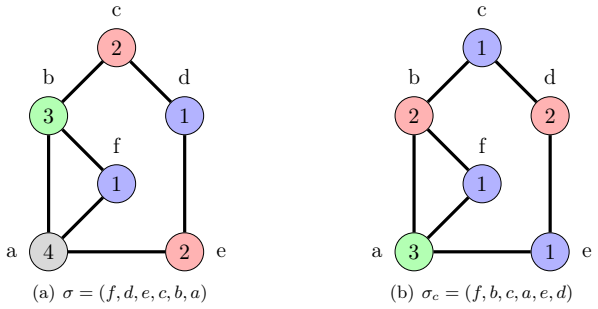
The central object is a connected Grundy coloring: a proper vertex coloring obtainable by the first-fit rule on a vertex sequence in which every new vertex is adjacent to an earlier one. The argument runs through two IP models; the standard model uses variables $z_{vkt}$ deciding that vertex $v$ receives color $k$ at time $t$, with constraints enforcing properness, the Grundy property, and connectivity, while the representatives model uses variables $Z_{vut}$ and $y_{vu}$ so each vertex is represented by an earlier vertex and representatives are ordered, breaking symmetry. The heuristic machinery is a BRKGA whose random-key vector encodes vertex priorities, a decoder that produces a connected sequence with a priority queue in $O(|V|\log|V| + |E|)$, and a local search that moves a single vertex to a position next to one of its neighbors; Propositions 7 and 8 give $O(1)$ and $O(|N(v)|)$ connectivity checks that make the neighborhood search practical.
What would settle it
Take a small disconnected graph with three components, compute the connected Grundy number of the path-connected version produced by the Section 5.1.1 procedure, and compare it with the maximum connected Grundy number of the components; the first non-trivial case where the two differ shows that the benchmark modification changes the problem being solved.
Extended reading notes
Core claim
On its own terms, the paper establishes that connected Grundy coloring can be attacked directly: the first claim is that two integer programming formulations correctly encode first-fit colorings over connected vertex sequences, with the representatives model breaking symmetries, and that the representatives model is computationally superior on the tested benchmark. The second claim is that a biased random-key genetic algorithm whose decoder builds a connected sequence by repeatedly extracting the highest-priority reachable vertex, with a local search that moves one vertex next to a neighbor and a reset mechanism, reliably produces high-quality colorings for instances up to 500 vertices. The paper further reports that the approach, with connectivity checks removed, improves the Grundy coloring problem, finding new best-known solutions on 36 of 362 benchmark instances.
Load-bearing premise
The load-bearing premise is that adding a path between the highest-degree vertices of disconnected components leaves the connected Grundy number unchanged in the typical case; the paper itself gives a graph with two isolated vertices where this fails, so the modified benchmark results may not transfer to the original disconnected graphs.
Editorial extensions
If this is right
- Exact computation of the connected Grundy number is feasible for small graphs: the two formulations together proved optimality on 132 of 240 instances with up to 30 vertices, and another 46 were certified optimal by matching known upper bounds.
- The symmetry-breaking representatives formulation is the stronger exact tool, especially on dense instances, and is the better starting point for any future exact method.
- The reset-and-local-search BRKGA recipe transfers to the ordinary Grundy coloring problem, where it produced new best-known solutions on 36 of 362 instances.
- Large graphs of up to 500 vertices can receive good connected Grundy colorings within a 300-second budget, making the heuristic usable where the IPs run out of memory.
- Because $\Gamma_c(G) \le \Gamma(G)$, any connected coloring that reaches a known Grundy upper bound is automatically optimal; this certificate was used throughout the small-instance experiments.
Reading between the lines
- The benchmark-connection procedure in Section 5.1.1 is the paper's least controlled step: if adding a path between high-degree vertices changes the connected Grundy number for graphs beyond the two-isolated-vertices example, the large-instance results describe the modified graphs rather than the original disconnected benchmarks.
- The representatives model's edge on dense graphs suggests that symmetry is the principal obstacle for exact connected Grundy coloring, so symmetry-breaking cuts or orbitopal fixing could plausibly extend exact solvability beyond 30 vertices.
- The move-one-vertex-next-to-a-neighbor neighborhood is a generic operation for first-fit-based coloring problems and could be tested on connected greedy edge colorings or other constrained first-fit settings.
- The paper does not explore incremental decoding, but the decoder's priority-queue structure suggests the BRKGA could be adapted to streaming graphs where vertices arrive over time.
Editorial analysis
A structured set of objections, weighed in public.
Referee Report
Summary. The paper studies the connected Grundy coloring problem, in which one seeks a proper vertex coloring obtainable by a first-fit heuristic on a connected vertex sequence, maximizing the number of colors. The authors propose two integer programming formulations (a standard partition-based model and a representatives-based model), and a biased random-key genetic algorithm (BRKGA) enhanced with a reset mechanism and a local search procedure using a newly defined neighborhood. They provide a theoretical analysis of the local search neighborhood, present computational experiments on instances with up to 30 vertices for the exact methods and up to 500 vertices for the heuristics, and extend the approach to the (non-connected) Grundy coloring problem.
Significance. If the results are correct, this is the first systematic optimization study of the connected Grundy coloring problem, a natural NP-hard variant of Grundy coloring. The two IP formulations are non-trivial, and the neighborhood analysis is a useful theoretical contribution. The paper also shows that the proposed BRKGA can be adapted to the Grundy coloring problem and may improve known results. The computational study is extensive, with 50 runs per instance and comparisons across several graph classes. However, the empirical support for the central claim is weakened by an unproven modification of disconnected benchmark instances, and the correctness of the formulations is asserted rather than formally proven. The local-search theory also contains a proof gap that should be addressed.
major comments (3)
- [5.1.1] The procedure that connects disconnected benchmark instances by adding a path between the highest-degree vertices of each component can change the connected Grundy number of the resulting graph; the authors themselves concede the counterexample of two isolated vertices, where the optimum increases from 1 to 2. The paper neither reports how many of the 282 tested instances were disconnected nor provides any empirical or theoretical validation that the equality Γc(G) = max_i Γc(G_i) holds for the instances actually used in Tables 7-10. Since the BRKGA objective values are computed on these modified graphs, the reported solution qualities cannot be directly attributed to the original benchmark graphs. This weakens the central claim that the proposed BRKGA finds high-quality solutions on the original instance set. The authors should restrict the benchmark to connected graphs, or prove invariance conditions for their modification, or report per-instance evidence that the modification does not alter the optimum (for example, using the combinatorial upper bounds on the original components).
- [2] The paper does not provide a formal proof that formulations (1)-(9) and (10)-(20) are exact models of the connected Grundy coloring problem. In particular, the representatives-based formulation contains subtle constraints such as (12), (14), and (15) whose interpretation is not fully formalized, and it is not shown that the integer programming optimum equals Γc(G) for every connected graph G. A correctness proof, or at least a detailed bijection between feasible IP solutions and connected Grundy colorings, is essential because the optimality claims in Section 5.3 and the use of these formulations as exact benchmarks depend on this equivalence.
- [4.2] The proof of Proposition 4 is not rigorous as written. In the case p_S'(v) < p_S(v), the interval [1, p_S'(v)] in S' contains the vertex v, whereas in S it contains the vertex that occupied that position before the move, so the statement that the two solutions have the same vertices colored the same way in that interval is false. The conclusion that all vertices keep their colors may still be true, but the proof must be corrected; as written, it does not rule out the possibility that a vertex adjacent to v changes color because v now appears earlier with the same color. Since Proposition 4 is used to justify pruning in the local search (Section 4.3), a correct proof is needed.
minor comments (5)
- [3.2] In Algorithm 1, line 10, the pseudocode enqueues the variable v (the vertex just colored) instead of u (the neighbor being examined); it should read Enqueue(Q, u).
- [4] The first paragraph of Section 4 contains a typo: 'in it's i-th position' should be 'in its i-th position'. The abstract also has 'AGrundy' missing a space.
- [6.1] The caption of Figure 11(a) refers to 'BRKGA+R+LS and BRKGA-B', but the comparison is with BRKGA-G (the Grundy coloring BRKGA from Silva et al.); the caption should be corrected.
- [5.2] The parameter tuning is performed on a subset of 28 instances; the paper should clarify whether these instances are also included in the final test set, since in-sample tuning would make the reported differences more favorable to the tuned variant.
- [5.4] Tables 7-10 report averages over 50 runs but no dispersion measure; adding standard deviations or confidence intervals would help the reader judge the variability of the reported improvements.
Circularity Check
No significant circularity: the IP formulations and decoder are derived from the problem definition, and the prior-work upper bound and BRKGA baselines are used as independent benchmarks, not as fitted targets.
full rationale
The paper's central mathematical content is self-contained. The standard and representative IP formulations directly encode the connected first-fit and connectivity conditions (constraints (5) and (7) in the standard model; (14) and (15) in the representatives model), and the decoder in Algorithm 1 constructs a connected sequence by a priority queue, so its output is a connected Grundy coloring by construction rather than by calibration. The upper bounds ζ(G), Δ2(G)+1, and Ψ(G) used to truncate the color set are cited mathematical bounds; Ψ(G) comes from the authors' earlier Silva et al. (2024) paper, but it is a parameter-free proven inequality, not a value fitted in this paper, so invoking it does not make the present claims circular. The comparisons with BRKGA-B and with Silva et al.'s BRKGA-G are external benchmark comparisons: BRKGA-G is an independently reported algorithm, and BRKGA-B is a controlled ablation, not a fitted predictor of the results being claimed. Hyperparameter selection on a disclosed 28-instance subset is standard practice and does not reduce any reported solution value to a fit. The one substantive weakness is Section 5.1.1, where disconnected benchmark instances are modified by adding paths between components; the authors explicitly concede a case in which the connected Grundy number changes (two isolated vertices). This is a benchmark-validity caveat: the modified instances are different inputs, so performance on them may not transfer to the original graphs. It does not, however, make any derivation equivalent to its inputs, and no equation or heuristic output is forced by a fitted parameter. Hence no circularity is present.
Assumptions & free parameters
free parameters (1)
- BRKGA population and genetic parameters =
p=1.7*|V| for BRKGA+R+LS, pe=30%, pm=10%, rho_e=60%, glim=2000, local search on 5 solutions
assumptions (4)
- domain assumption Validity of combinatorial upper bounds ζ(G), Δ2(G)+1, Ψ(G) for the Grundy number
- domain assumption Correctness of the time-indexed encoding of first-fit sequences
- ad hoc to paper The connected-sequence modification of disconnected benchmark graphs preserves the connected Grundy number in most cases
- standard math Standard graph theory definitions and NP-hardness of connected Grundy coloring from Benevides et al. (2014)
Cite this review
Pith. "Pith review of The connected Grundy coloring problem: Formulations and a local-search enhanced biased random-key genetic algorithm." pith.science (2026). https://pith.science/paper/ENXECJEQ
@misc{pith2026241114533,
  author       = {Pith},
  title        = {Pith review of: The connected Grundy coloring problem: Formulations and a local-search enhanced biased random-key genetic algorithm},
  year         = {2026},
  howpublished = {\url{https://pith.science/paper/ENXECJEQ}},
  note         = {Machine review of arXiv:2411.14533}
}
read the original abstract
Given a graph G=(V,E), a connected Grundy coloring is a proper vertex coloring that can be obtained by a first-fit heuristic on a connected vertex sequence. A first-fit coloring heuristic is one that attributes to each vertex in a sequence the lowest-index color not used for its preceding neighbors. A connected vertex sequence is one in which each element, except for the first one, is connected to at least one element preceding it. The connected Grundy coloring problem consists of obtaining a connected Grundy coloring maximizing the number of colors. In this paper, we propose two integer programming (IP) formulations and a local-search enhanced biased random-key genetic algorithm (BRKGA) for the connected Grundy coloring problem. The first formulation follows the standard way of partitioning the vertices into color classes while the second one relies on the idea of representatives in an attempt to break symmetries. The BRKGA encompasses a local search procedure using a newly proposed neighborhood. A theoretical neighborhood analysis is also presented. Extensive computational experiments indicate that the problem is computationally demanding for the proposed IP formulations. Nonetheless, the formulation by representatives outperforms the standard one for the considered benchmark instances. Additionally, our BRKGA can find high-quality solutions in low computational times for considerably large instances, showing improved performance when enhanced with local search and a reset mechanism. Moreover we show that our BRKGA can be easily extended to successfully tackle the Grundy coloring problem, i.e., the one without the connectivity requirements.
Figures


Figures from the paper (8 more)


Reference graph
Works this paper leans on
-
[1]
C. Avanthay, A. Hertz, and N. Zufferey. A variable neighborhood search for graph coloring. European Journal of Operational Research, 151 0 (2): 0 379--388, 2003
work page 2003
-
[2]
L. Bahiense, Y. A. M. Frota, T. F. Noronha, and C. C. Ribeiro. A branch-and-cut algorithm for the equitable coloring problem using a formulation by representatives. Discrete Applied Mathematics, 164: 0 34--46, 2014
work page 2014
-
[3]
J. C. Bean. Genetic algorithms and random keys for sequencing and optimization. ORSA Journal on Computing, 6 0 (2): 0 154--160, 1994
work page 1994
-
[4]
F. Benevides, V. Campos, M. Dourado, S. Griffiths, R. Morris, L. Sampaio, and A. Silva. Connected greedy colourings. In Latin A merican S ymposium on T heoretical I nformatics , pages 433--441. Springer, 2014
work page 2014
-
[5]
C. Berge. Graphs and hypergraphs. North-Holland Publishing Co., 1973
work page 1973
- [6]
- [7]
-
[8]
D. Br \'e laz. New methods to color the vertices of a graph. Communications of the ACM, 22 0 (4): 0 251--256, 1979
work page 1979
Show all 49 references
-
[9]
Camp\^elo, V
M. Camp\^elo, V. Campos, and R. Corr\^ea. On the asymmetric representatives formulation for the vertex coloring problem. Electronic Notes in Discrete Mathematics, 19: 0 337--343, 2005
2005
-
[10]
C. A. Christen and S. M. Selkow. Some perfect coloring properties of graphs. Journal of Combinatorial Theory, Series B, 27 0 (1): 0 49--59, 1979
1979
-
[11]
R. C. Corr\^ea, M. Camp\^elo, and Y. A. M. Frota. Cliques, holes and the vertex coloring polytope. Information Processing Letters, 89: 0 159--164, 2004
2004
-
[12]
de Freitas, B
R. de Freitas, B. Dias, N. Maculan, and J. Szwarcfiter. On distance graph coloring problems. International Transactions in Operational Research, 28 0 (3): 0 1213--1241, 2021
2021
-
[13]
Erd o s, W
P. Erd o s, W. Hare, S. T. Hedetniemi, and R. Laskar. On the equality of the G rundy and ochromatic numbers of a graph. Journal of Graph Theory, 11 0 (2): 0 157--159, 1987
1987
-
[14]
Frota, N
Y. Frota, N. Maculan, T. F. Noronha, and C. C. Ribeiro. A branch-and-cut algorithm for partition coloring. Networks: An International Journal, 55: 0 194--204, 2010
2010
-
[15]
Furini, E
F. Furini, E. Malaguti, and A. Santini. An exact algorithm for the partition coloring problem. Computers & Operations Research, 92: 0 170--181, 2018
2018
-
[16]
J. F. Gon c alves and M. G. Resende. Biased random-key genetic algorithms for combinatorial optimization. Journal of Heuristics, 17 0 (5): 0 487--525, 2011
2011
-
[17]
J. F. Gon c alves and G. W \"a scher. A MIP model and a biased random-key genetic algorithm based approach for a two-dimensional cutting problem with defects. European Journal of Operational Research, 286 0 (3): 0 867--882, 2020
2020
-
[18]
P. M. Grundy. Mathematics and games. Eureka, 2: 0 6--9, 1939
1939
-
[19]
Y. He, C. Gao, N. Sang, Z. Qu, and J. Han. Graph coloring based surveillance video synopsis. Neurocomputing, 225: 0 64--79, 2017
2017
-
[20]
S. M. Hedetniemi, S. T. Hedetniemi, and T. Beyer. A linear algorithm for the grundy (coloring) number of a tree. Congressus Numerantium, 36: 0 351--363, 1982
1982
-
[21]
S. M. Homayouni, D. B. Fontes, and J. F. Gon c alves. A multistart biased random key genetic algorithm for the flexible job shop scheduling problem with transportation. International Transactions in Operational Research, 30 0 (2): 0 688--716, 2023
2023
-
[22]
D. S. Johnson, L. Breslau, I. Diakonikolas, N. Duffield, Y. Gu, M. Hajiaghayi, H. Karloff, M. G. C. Resende, and S. Sen. Near-optimal disjoint-path facility location through set cover by pairs. Operations Research, 68: 0 896--926, 2020
2020
-
[23]
Jovanovi \'c , N
P. Jovanovi \'c , N. Pavlovi \'c , I. Belo s evi \'c , and S. Milinkovi \'c . Graph coloring-based approach for railway station design analysis and capacity determination. European Journal of Operational Research, 287 0 (1): 0 348--360, 2020
2020
-
[24]
M. A. Londe, L. S. Pessoa, C. E. Andrade, and M. G. C. Resende. Early years of biased random-key genetic algorithms: A systematic review. Journal of Global Optimization, 2024. URL https://doi.org/10.1007/s10898-024-01446-5
2024 doi
-
[25]
M. A. Londe, L. S. Pessoa, C. E. Andrade, and M. G. C. Resende. Biased random-key genetic algorithms: A review. European Journal of Operational Research, 321 0 (1): 0 1--22, 2025
2025
-
[26]
L \"u and J.-K
Z. L \"u and J.-K. Hao. A memetic algorithm for graph coloring. European Journal of Operational Research, 203 0 (1): 0 241--250, 2010
2010
-
[27]
R. G. Marzo, R. A. Melo, C. C. Ribeiro, and M. C. Santos. New formulations and branch-and-cut procedures for the longest induced path problem. Computers & Operations Research, 139: 0 105627, 2022
2022
-
[28]
R. A. Melo and C. C. Ribeiro. Improved solutions for the freight consolidation and containerization problem using aggregation and symmetry breaking. Computers & Industrial Engineering, 85: 0 402--413, 2015
2015
-
[29]
R. A. Melo and C. C. Ribeiro. MIP formulations for induced graph optimization problems: a tutorial. International Transactions in Operational Research, 30 0 (6): 0 3159--3200, 2023
2023
-
[30]
R. A. Melo, M. F. Queiroz, and M. C. Santos. A matheuristic approach for the b -coloring problem using integer programming and a multi-start multi-greedy randomized metaheuristic. European Journal of Operational Research, 295 0 (1): 0 66--81, 2021
2021
-
[31]
R. A. Melo, C. C. Ribeiro, and J. A. Riveaux. The minimum quasi-clique partitioning problem: Complexity, formulations, and a computational study. Information Sciences, 612: 0 655--674, 2022
2022
-
[32]
R. A. Melo, C. C. Ribeiro, and J. A. Riveaux. A biased random-key genetic algorithm for the minimum quasi-clique partitioning problem. Annals of Operations Research, 2023. doi:10.1007/s10479-023-05609-7
2023 doi
-
[33]
Moalic and A
L. Moalic and A. Gondran. Variations on memetic algorithms for graph coloring problems. Journal of Heuristics, 24 0 (1): 0 1--24, 2018
2018
-
[34]
Morgenstern
C. Morgenstern. Graph generator ggen, 2015. Online reference at http://iridia.ulb.ac.be/ fmascia/files/ggen.tar.bz2, last accessed on July 25, 2023
2015
-
[35]
E. Mota, L. Rocha, and A. Silva. Connected greedy coloring of H -free graphs. Discrete Applied Mathematics, 284: 0 572--584, 2020
2020
-
[36]
Nogueira, R
B. Nogueira, R. G. Pinheiro, and A. Subramanian. A hybrid iterated local search heuristic for the maximum weight independent set problem. Optimization Letters, 12 0 (3): 0 567--583, 2018
2018
-
[37]
M. G. C. Resende, R. F. Toso, J. F. Gonçalves, and R. M. A. Silva. A biased random-key genetic algorithm for the steiner triple covering problem. Optimization Letters, 6 0 (4): 0 605--619, 2012
2012
-
[38]
San Segundo, S
P. San Segundo, S. Coniglio, F. Furini, and I. Ljubi \'c . A new branch-and-bound algorithm for the maximum edge-weighted clique problem. European Journal of Operational Research, 278 0 (1): 0 76--90, 2019
2019
-
[39]
Z. Shi, W. Goddard, S. T. Hedetniemi, K. Kennedy, R. Laskar, and A. McRae. An algorithm for partial grundy number on trees. Discrete Mathematics, 304 0 (1-3): 0 108--116, 2005
2005
-
[40]
M. C. Silva, R. A. Melo, M. C. Santos, R. F. Toso, and M. G. C. Resende. Obtaining the G rundy chromatic number: How bad can my greedy heuristic coloring be? Computers & Operations Research, 168: 0 106703, 2024
2024
-
[41]
S. E. Silva, C. C. Ribeiro, and U. dos Santos Souza. A biased random-key genetic algorithm for the chordal completion problem. RAIRO-Operations Research, 57 0 (3): 0 1559--1578, 2023
2023
-
[42]
G. J. Simmons. On the ochromatic number of a graph. Congressus Numerantium, 40: 0 339--366, 1983
1983
-
[43]
Spears and K
W. Spears and K. A. De Jong . On the virtues of parameterized uniform crossover. In R. Belew and L. Booker, editors, Proceedings of the Fourth International Conference on Genetic Algorithms, pages 230--236, San Mateo, 1991. Morgan Kaufman
1991
-
[44]
J. A. Telle and A. Proskurowski. Algorithms for vertex partitioning problems on partial k-trees. SIAM Journal on Discrete Mathematics, 10 0 (4): 0 529--550, 1997
1997
-
[45]
R. F. Toso. API for biased random-key genetic algorithms, 2018. Online reference at https://github.com/rfrancotoso/brkgaAPI, last accessed on December 5, 2022
2018
-
[46]
R. F. Toso and M. G. Resende. A C++ application programming interface for biased random-key genetic algorithms. Optimization Methods and Software, 30 0 (1): 0 81--93, 2015
2015
-
[47]
Trick, V
M. Trick, V. Chvatal, B. Cook, D. Johnson, C. McGeoch, and B. Tarjan. Benchmark instances from the S econd DIMACS I mplementation C hallenge, 2015. Online reference at http://archive.dimacs.rutgers.edu/pub/challenge/graph/benchmarks/, last access on July 25, 2023
2015
-
[48]
M. Zaker. New bounds for the chromatic number of graphs. Journal of Graph Theory, 58 0 (2): 0 110--122, 2008
2008
-
[49]
X. Zhu, L. Dai, and Z. Wang. Graph coloring based pilot allocation to mitigate pilot contamination for multi-cell massive MIMO systems. IEEE Communications Letters, 19 0 (10): 0 1842--1845, 2015
2015
Reviewed August 12, 2026 · model on record in the stance chip above.
Discussion (0). Continue with ORCID to comment.