REVIEW 3 major objections 5 minor 1 cited by
Extending parton branching TMDs to small $x$
T0 review · 3 major / 5 minor · reviewed 2026-08-14 · deepseek-v4-flash
Pith's one-line read The parton-branching TMD framework can be extended to small $x$ by adding angular ordering and non-Sudakov form factors to its evolution kernels.
desk verdict A genuinely new but unproven step in PB TMD small-x extension; the key non-Sudakov factorization in Sec. 4 is asserted rather than derived, and Fig. 3 rests on it. read the letter →
The pith
A machine-rendered reading of the paper's core claim, the machinery that carries it, and where it could break.
The reading
What carries the argument
The central machinery is the set of modified CCFM splitting kernels of Eq. (4.1), built from DGLAP splitting functions multiplied by two exponentials: the Sudakov factor $\tilde{\Delta}_s$ and the non-Sudakov factor $\tilde{\Delta}_{ns}$ of Eq. (4.2). The key move is the replacement in Eq. (4.4): $\tilde{\Delta}_{ns}\to\Delta_{ns}=\exp\left(-\int_{q_i}^{k_\perp}\frac{dq'^2}{q'^2}\int^{z_M} dz\,\frac{1}{z}\right)$ for $k_\perp>q_i$, and $\Delta_{ns}=1$ for $k_\perp<q_i$. This is what converts angular-ordered phase space into a CCFM-like small-$x$ correction to the PB evolution, summing virtual corrections for fast emitted gluons while leaving the DGLAP Sudakov factor responsible for the remaining virtual contributions.
What would settle it
A decisive check would be to run an independent numerical solution of the CCFM evolution that does not set the non-Sudakov form factor to one for $k_\perp<q_i$, and compare the resulting gluon density at $Q^2=100\,\mathrm{GeV}^2$ over $10^{-5}<x<10^{-3}$; if the difference is of the same size as the non-Sudakov suppression seen in the paper's Figure 3, the $1/z$ factorization used here is not valid.
Extended reading notes
Core claim
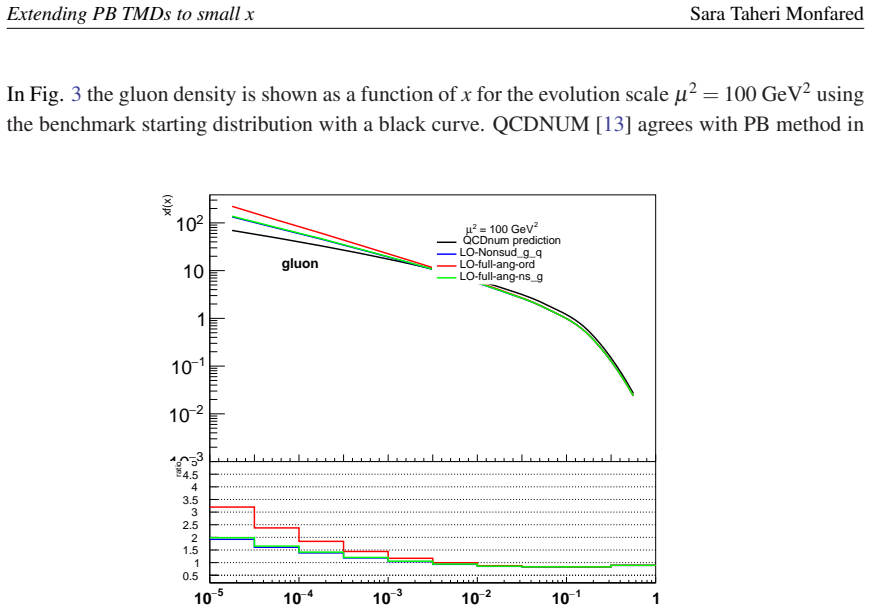
The paper reports a method to incorporate CCFM effects into the PB formulation for TMD parton distribution functions. Starting from the PB equation with Sudakov form factors and a soft-gluon resolution scale $z_M$, the authors enlarge the phase space from DGLAP ordering to full angular ordering and introduce non-Sudakov form factors for the virtual corrections associated with fast emitted gluons. In the numerical study, angular ordering increases the gluon density at small $x$ below about $10^{-3}$; adding the non-Sudakov form factor to the $gg$ and $gq$ splitting functions suppresses this growth, but the small-$x$ gluon remains above the DGLAP baseline. The paper also presents new leading-order PB TMD fits to precision inclusive deep-inelastic data, with goodness-of-fit values around 1.24 and 1.26 for the two sets.
Load-bearing premise
The load-bearing premise is the Section 4 assertion that, for $k_\perp<q_i$, the $1/z$ virtual corrections are already covered by the DGLAP Sudakov factor, so the non-Sudakov form factor can be set to one there; this identification is stated but not derived.
Editorial extensions
If this is right
- PB-evolved TMDs can now be generated with CCFM small-$x$ effects, so existing PB-based simulations of QCD cascades can be pushed into the semi-hard regime without switching to a separate formalism.
- The small-$x$ gluon density remains above the DGLAP baseline even after non-Sudakov suppression, so the extension changes the normalization and shape of low-$x$ gluon-initiated processes.
- Because the PB equation is solved iteratively, the angular-ordering and non-Sudakov contributions can be switched on one at a time, making the small-$x$ dynamics inspectable step by step.
- The new leading-order fits, with goodness-of-fit around 1.24 and 1.26, provide a LO PB TMD set that can serve as the starting point for LO CCFM evolution.
Reading between the lines
- If the factorization assumption at $k_\perp<q_i$ holds, the same PB machinery should reproduce the small-$x$ gluon from full CCFM in inclusive structure-function data; a natural test is to let $q_0$ float as a fitted parameter rather than fixing it, since the paper only studies its variation externally.
- The natural next observable is the $Z$-boson transverse-momentum spectrum or Drell-Yan $q_T$ distributions, because the paper provides the TMD input but stops at gluon densities.
- The fact that the small-$x$ gluon stays above the DGLAP baseline suggests that, in this approximation, small-$x$ resummation and DGLAP evolution are not simply additive; quantifying the region where the $1/z$ terms are double counted could give a criterion for when this non-Sudakov ansatz needs further resummation.
Signed reviews
Editorial analysis
A structured set of objections, weighed in public.
Referee Report
Summary. This proceedings paper proposes an extension of the parton-branching (PB) approach to transverse-momentum-dependent (TMD) parton densities so that it covers the small-x regime. It first presents new leading-order PB fits to inclusive HERA DIS data, reporting chi2/dof values of about 1.24 and 1.26, and studies the dependence of the fits on the soft-gluon resolution scale q0. It then modifies the PB splitting kernels by including angular ordering and non-Sudakov form factors following CCFM methods. The main numerical result is that including the non-Sudakov factor suppresses the small-x gluon density relative to the angular-ordering-only result, but the density still remains above the DGLAP-based baseline.
Significance. If the central factorization step in Sec. 4 is correct, the paper offers a practical route to incorporate CCFM small-x dynamics into the PB TMD framework, which would be useful for semi-hard QCD phenomenology at the LHC and future colliders. The paper's strengths include concrete LO fits with reasonable chi2/dof, a systematic step-by-step numerical study of the kernel modifications, and comparison with QCDNUM in the DGLAP limit. However, the load-bearing technical step, Eq. (4.4), is stated without derivation or numerical validation, and the quantitative small-x results are presented without uncertainty estimates. The contribution is therefore best viewed as an exploratory proposal whose central claim requires further support before the method can be considered established.
major comments (3)
- [Sec. 4, Eqs. (4.2)-(4.4)] The statement that '1/z ΔnsΔs is already covered by 1/z Δs for k⊥ < qi', which leads to setting Δns = 1 in that region, is load-bearing and is not derived. The integration ranges in Eq. (4.2) differ: Δns integrates over q'^2 from z_{i-1}q_{i-1} to k⊥, while Δs in Eq. (4.3) integrates over q'^2 from z_{i-1}q_{i-1} to qi. For k⊥ < qi the product 1/z Δns Δs contains an integral over the interval [k⊥, qi] with the 1/(1-z) kernel but not with the 1/z kernel, so the claimed equality with 1/z Δs is not an identity unless additional conditions on the z-integration endpoint and plus-prescription are imposed. Please provide a derivation of this replacement or a numerical cross-check comparing results obtained with the full Eq. (4.2) product against those obtained with Eq. (4.4), since Fig. 3 and the central qualitative conclusion depend on this step.
- [Sec. 4, Eq. (4.1)] The modified splitting functions in Eq. (4.1) involve singular 1/z and 1/(1-z) terms multiplied by form factors, but the paper does not specify the plus-distribution prescription or the precise z-integration limits used in the numerical implementation. Without this information the kernels are not uniquely defined and the results are not reproducible. In particular, the lower limit zM of the z integrals in Eq. (4.2) needs to be specified explicitly for both Δs and Δns, including how zM depends on q0 and on the relevant transverse momentum scale in each case.
- [Sec. 4, Fig. 3] The numerical evidence for the small-x behavior is presented without uncertainty bands, and the curves are obtained from a benchmark starting distribution rather than from the LO fitted densities. As a result, the comparison among the red, green, and blue curves in Fig. 3 does not establish whether the differences are significant relative to input-distribution and parameter uncertainties. Please quantify the theoretical uncertainty, for example by varying q0, αs, and the starting distribution, or explicitly label these curves as exploratory illustrations without quantitative claims.
minor comments (5)
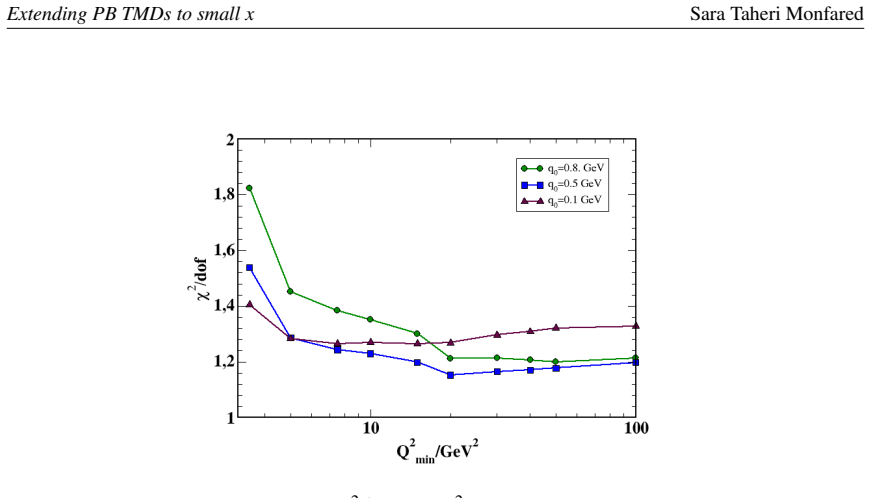
- [Sec. 2] The LO fits are characterized only by chi2/dof values; showing a comparison of the fitted distributions to the HERA data or to the NLO PB results would make the quality of the fits more transparent.
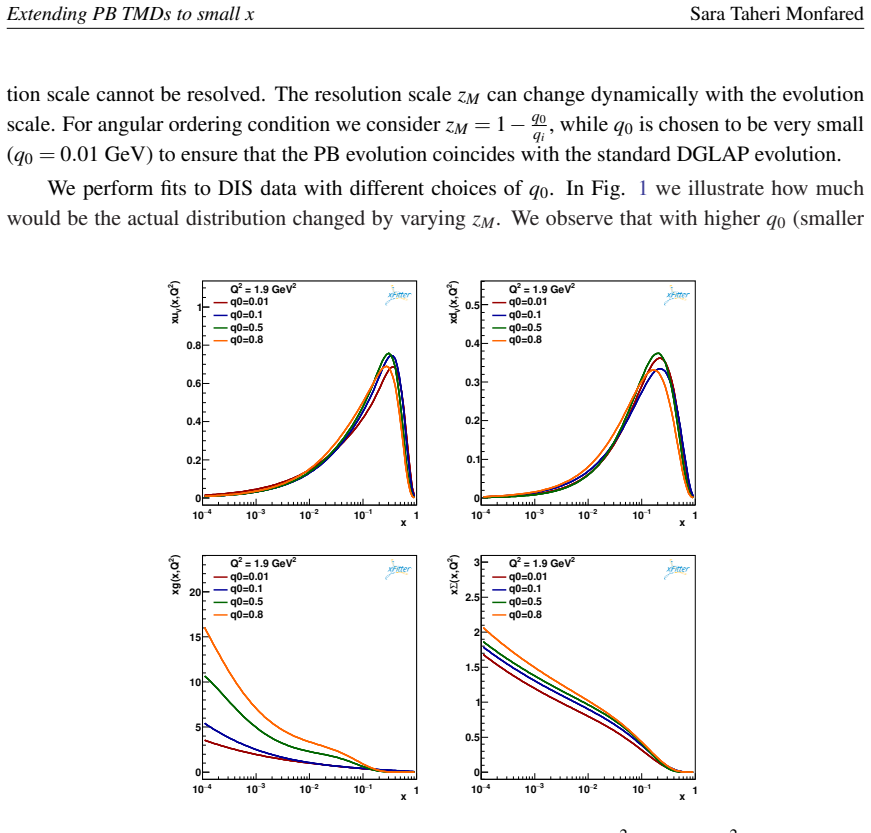
- [Sec. 3, Fig. 1] Figure 1 shows the q0 dependence of the parton densities without uncertainty bands, so it is difficult to judge whether the visible small-x enhancement is statistically significant; adding fit uncertainties would strengthen the discussion.
- [Sec. 4] The notation 'q,i−1' in the sentence 'DGLAP ordering ( qi > q,i−1)' appears to be a typo for q_{i-1}; the subscript notation should be made consistent throughout.
- [Sec. 4, Fig. 3] The axes and labels in Fig. 3 are garbled (for example, the x-axis tick labels and the ratio panel), and the figure should be reformatted so that the curves are readable and the ratio is clearly defined.
- [Sec. 4] The paper says 'We observe that 1/z ΔnsΔs is already covered by 1/z Δs for k⊥ < qi' without an explicit reference to the original CCFM literature for this replacement; citing the specific equations in Refs. [3,4,5] would help the reader check the validity of the step.
Circularity Check
Minor self-definitional step in the non-Sudakov form factor; central CCFM-into-PB extension is not circular.
-
self definitional
[Sec. 4, Eqs. (4.2)-(4.4)]
"We observe that 1/z ΔnsΔs is already covered by 1/z Δs for k⊥ < qi and the non-Sudakov form factor acts only if k⊥ > qi. We obtain the following Δns form factors: ~Δns→ Δns = exp(−∫_{k⊥}^{q_i} dq′2/q′2 ∫^{z_M} dz 1/z) for k⊥ > qi; ~Δns→ Δns = 1 for k⊥ < qi (4.4)"
The statement that the non-Sudakov form factor 'acts only if k⊥ > qi' is not derived from the earlier ~Δns and ~Δs integrals in Eq. (4.2); it is implemented by the piecewise definition Δns = 1 for k⊥ < qi. The 'observation' that 1/z ΔnsΔs is 'already covered' by 1/z Δs is the sole justification for that definition. Consequently, the numerical result that non-Sudakov corrections only suppress the small-x gluon density in the k⊥ > qi region is true by construction. This is a localized self-definitional model choice rather than a fitted parameter disguised as a prediction, and the central CCFM-into-PB extension still imports its kernels from the standard CCFM literature.
full rationale
The paper is largely self-contained against external benchmarks. The Sec. 2 LO fit is explicitly a fit to inclusive-DIS HERA1+2 data using xFitter, not a prediction of those data relabeled as a result. The Sec. 3 study of the soft-gluon resolution scale varies q0 and reports the resulting χ2 dependence; this is a parameter study, not a fitted quantity called a prediction. The small-x extension in Sec. 4 imports the standard CCFM Sudakov and non-Sudakov form factors from Refs. [3,4,5] and solves the PB equation with them, benchmarking against QCDNUM in the DGLAP limit. Self-citations [1,2,5] describe the PB formalism and the authors' earlier CCFM implementation; they are not used as an external uniqueness theorem or as the sole load-bearing justification for the numerical curves. The one identifiable circular element is the piecewise definition of Δns in Eq. (4.4): the claim that non-Sudakov effects act only for k⊥ > qi is encoded by setting Δns = 1 below qi, so the corresponding part of the Fig. 3 result is self-definitional. This does not, however, make the overall derivation circular in the sense that the plotted small-x curves are fitted to the same observables they purport to predict. Overall circularity is therefore minor.
Assumptions & free parameters
free parameters (2)
- q0 (soft-gluon resolution scale parameter) =
0.01 GeV (default); variations 0.1, 0.5, 0.8 GeV
- Initial PDF parameters (LO fits) =
not listed in paper
assumptions (4)
- domain assumption PB TMD evolution framework from Refs [1,2] is correct
- domain assumption Standard CCFM splitting functions and angular ordering are the right small-x extension
- domain assumption Non-Sudakov form factor is only needed for the 1/z terms in Pgg and Pgq
- standard math DGLAP evolution is the correct baseline for the comparison
Cite this review
Pith. "Pith review of Extending parton branching TMDs to small $x$." pith.science (2026). https://pith.science/paper/ENYLYFKG
@misc{pith2026190801621,
  author       = {Pith},
  title        = {Pith review of: Extending parton branching TMDs to small $x$},
  year         = {2026},
  howpublished = {\url{https://pith.science/paper/ENYLYFKG}},
  note         = {Machine review of arXiv:1908.01621}
}
abstract
We explore the possibility to include small-$x$ dynamics effects in the parton branching (PB) approach to transverse momentum dependent (TMD) parton distribution functions. To this end, we first revisit the PB method at leading order, presenting a new fit to inclusive-DIS precision data, and performing a numerical study of the dynamic soft-gluon resolution scale. Next we investigate the effects of modified CCFM kernels, including both Sudakov and non-Sudakov form factors.
Figures
Forward citations
Cited by 1 Pith paper
-
Soft-gluon coupling and the TMD parton branching Sudakov form factor
The parton branching TMD framework is upgraded from NLL to NNLL accuracy using the soft-gluon physical coupling, with the Collins-Soper kernel evaluated at NNLL.
Reference graph
Works this paper leans on
-
[1]
F. Hautmann, H. Jung, A. Lelek, V . Radescu and R. Zlebcik, JHEP1801, 070 (2018) doi:10.1007/JHEP01(2018)070 [arXiv:1708.03279 [hep-ph]]
arXiv 2018
-
[2]
F. Hautmann, H. Jung, A. Lelek, V . Radescu and R. Zlebcik, Phys. Lett. B772, 446 (2017) doi:10.1016/j.physletb.2017.07.005 [arXiv:1704.01757 [hep-ph]]
arXiv 2017
- [3]
-
[4]
S. Catani, F. Fiorani and G. Marchesini, Nucl. Phys. B 336, 18 (1990). doi:10.1016/0550-3213(90)90342-B
- [5]
-
[6]
H. Abramowicz et al. [H1 and ZEUS Collaborations], Eur. Phys. J. C 75 (2015) no.12, 580 doi:10.1140/epjc/s10052-015-3710-4 [arXiv:1506.06042 [hep-ex]]
arXiv 2015
-
[7]
R. K. Ellis, W. J. Stirling and B. R. Webber, QCD and collider physics , CUP 1996
1996
-
[8]
A. Bermudez Martinez, P. Connor, F. Hautmann, H. Jung, A. Lelek, V . Radescu and R. Zlebcik, Phys. Rev. D 99, 074008 (2019) doi:10.1103/PhysRevD.99.074008 [arXiv:1804.11152 [hep-ph]]
arXiv 2019
Show all 15 references
-
[9]
Bermudez Martinez et al., arXiv:1906.00919 [hep-ph]
A. Bermudez Martinez et al., arXiv:1906.00919 [hep-ph]
1906 arXiv
-
[10]
Alekhin et al., Eur
S. Alekhin et al., Eur. Phys. J. C 75 (2015) 304
2015
-
[11]
Hautmann, H
F. Hautmann, H. Jung and S. Taheri Monfared, Eur. Phys. J. C 74 (2014) 3082
2014
-
[12]
Hautmann and H
F. Hautmann and H. Jung, Nucl. Phys. B 883 (2014) 1; arXiv:1206.1796 [hep-ph]
2014 arXiv
-
[13]
Botje, Comput
M. Botje, Comput. Phys. Commun. 182, 490 (2011) doi:10.1016/j.cpc.2010.10.020 [arXiv:1005.1481 [hep-ph]]
2011 arXiv
-
[14]
Angeles-Martinez et al., Acta Phys
R. Angeles-Martinez et al., Acta Phys. Polon. B 46 (2015) 2501
2015
-
[15]
Hautmann, H
F. Hautmann, H. Jung, M. Krämer, P. J. Mulders, E. R. Nocera, T. C. Rogers and A. Signori, Eur. Phys. J. C 74 (2014) 3220. 5
2014
Reviewed August 14, 2026 · model on record in the stance chip above.
Discussion (0). Continue with ORCID to comment.