REVIEW 3 major objections 6 minor 1 cited by
Latest news from the HAWC outrigger array
T0 review · 3 major / 6 minor · reviewed 2026-08-14 · deepseek-v4-flash
Pith's one-line read HAWC's new outrigger array is fully operational and, once its data enter reconstruction, should improve core localization and extend effective area from a few TeV beyond 100 TeV.
desk verdict An honest HAWC outrigger status report with solid calibration data, but the abstract's present-tense performance claims outrun what the paper actually shows. read the letter →
The pith
A machine-rendered reading of the paper's core claim, the machinery that carries it, and where it could break.
The reading
What carries the argument
The load-bearing element is the outrigger array itself: 345 small water Cherenkov tanks (1.55 m diameter) arranged in five sections around the main 300-tank array, each read out by a single 8-inch photomultiplier, with White Rabbit timing synchronization and FlashCam-derived FADC boards. It works by sampling the lateral distribution of an air shower far outside the main array, which breaks the degeneracy between where the shower core lands and what energy the shower had. The paper also relies on two calibration mechanisms, an occupancy-method laser calibration for charge scale and a data-driven gain estimate from dark counts, and on a multi-stage data-reduction pipeline that selects outrigger events coincident with main-array triggers.
What would settle it
Reprocess real coincident events and compare shower-core positions reconstructed with and without outrigger information; if the core-resolution improvement for events landing on the outriggers falls well short of the simulated factor of 2-3, or the effective-area curve above a few TeV does not rise, the central sensitivity claim is refuted even though the hardware is operational.
Extended reading notes
Core claim
On its own terms, the paper's claim is that the HAWC outrigger array is not just installed but scientifically ready: the 345 tanks are filled, read out, synchronized to the main array with sub-nanosecond precision, calibrated with both laser pulses and air-shower data, and stable at the few-percent level over seven months of continuous operation. For the highest-energy events, the outriggers participate essentially always and with high multiplicity, providing lateral sampling of the shower footprint at radii the main array cannot cover. The paper's central expectation, based on a companion simulation [Joshi al. (2019)], is that folding this information into reconstruction will improve core localization by a factor of 2-3 for showers falling on the outriggers, which in turn should improve energy and angular resolution and raise the effective area in the few-TeV to beyond-100-TeV range. That improvement is the point of the upgrade for gamma-ray astronomy, as it targets the sources thought to accelerate cosmic rays up to the knee.
Load-bearing premise
The advertised improvement in event reconstruction is not yet measured with real data; it comes from a companion simulation, and if that simulation does not carry over to actual showers, the sensitivity gain will not materialize even though the hardware itself works.
Editorial extensions
If this is right
- According to the companion simulation cited in the paper, events whose cores fall on the outrigger array should see core positions reconstructed 2-3 times more accurately once outrigger data enter the fit.
- With that improved core localization, the reconstruction of energy and arrival direction should also tighten, raising effective area from a few TeV to beyond 100 TeV.
- The demonstrated multi-month stability means the outrigger data already being recorded are usable for the planned reconstruction upgrade without additional hardware work.
- At the highest analysis bins, the outriggers participate in essentially every main-array event with high tank multiplicity, so the additional information is already present in the stored events.
Reading between the lines
- Editorial inference: the same lateral-sampling benefit could be tested on already-recorded HAWC events by simulating the outrigger response offline, giving an early check of the companion simulation before the full reconstruction upgrade is deployed.
- Editorial inference: if the factor-2-3 core improvement propagates to angular resolution, HAWC's maps of extended Galactic sources could become sharper at energies where the current array is core-limited; the paper does not yet quantify this gain.
- Editorial inference: the outrigger layout suggests a general design rule, sparse rings of small detectors can extend the effective area of a dense array at modest cost, and one could model whether an even sparser outer ring would buy additional effective area faster than it adds calibration complexity. This is beyond the paper's claims.
Signed reviews
Editorial analysis
A structured set of objections, weighed in public.
Referee Report
Summary. The paper reports the status of the HAWC outrigger array, an extension of 345 small water Cherenkov detectors surrounding the main HAWC array. It describes the array layout, readout electronics, trigger conditions, calibration procedures, and early operational results. The abstract claims that the outrigger array provides improved reconstruction of showers with cores outside the main array and increases the effective area from a few TeV to beyond 100 TeV, but Section 6 states that incorporating outrigger data into the event reconstruction is the next step. The paper shows stable operation, calibration performance, and outrigger participation in main-array events, but no reconstruction performance measurements are presented.
Significance. The paper is a credible operational status report. It provides valuable measurements of the outrigger array's stability: the trigger rate is stable over 7 months, the PMT gain fluctuates at the ~1.5% level, and the time resolution is ~250 ps at 100 pe. The system is fully deployed and synchronized with the main array via White Rabbit. However, the abstract's claim that the array 'provides an improved reconstruction' and 'increases the effective area' is not supported by data in this manuscript; the reconstruction step is explicitly future work, and the only quantitative expectation is from a companion simulation. If the simulation is realistic, the outrigger array has the potential to significantly improve HAWC's high-energy sensitivity. The paper does not yet demonstrate that improvement.
major comments (3)
- [Abstract and Section 1, first paragraph] The abstract states, in the present tense, that the outrigger array 'provides an improved reconstruction of the showers whose core and footprint are not well contained in the array and increases the effective area in the range of a few TeV to beyond 100 TeV.' However, Section 6 (Conclusions and Outlook) says that 'the next step for the project is to take this additional information into account in the event reconstruction.' The manuscript presents no measurements of core, energy, or angular resolution with outrigger-assisted reconstruction, and no effective-area curves. The only quantitative support is the citation to [Joshi et al. (2019)], a separate companion paper. As written, the abstract asserts as demonstrated what is actually a projected simulation-based expectation. Please rephrase the abstract and Section 1 to say the array is expected to provide these improvements, and explicitly state that the present paper reports the hardware status that will enable them.
- [Section 6 and Figure 6] Figure 6 (right) shows the outrigger participation fraction and average multiplicity versus analysis bin, and the text concludes that at the highest analysis bins the outrigger array always participates with a large number of tanks. This is a qualitative observation about data-taking, not a demonstration that reconstruction precision or effective area improves. Furthermore, the mapping from 'Analysis Bin' to physical energy is not provided in the text; the reference to [Abeysekara et al. (2017)] does not let the reader convert the horizontal axis to TeV. To support the abstract's energy-range claim, the paper would need to show an effective-area curve or a resolution comparison with and without outriggers.
- [Section 6] The statement that the outrigger array yields an 'expected improvement in core resolution ... of the order of a factor 2-3' rests entirely on [Joshi et al. (2019)], which is not included in this manuscript and whose simulation assumptions are not summarized here. Since the present paper does not validate this simulation against real data, the reader cannot judge whether the projected improvement transfers to the actual detector response. Please either include a summary of the simulation setup and its validation, or clearly label this as an expectation from a companion study that is not yet confirmed.
minor comments (6)
- [Section 2] In the sentence 'They are equipped by a single Hamamatsu R5912 8” photomulitplier tube (PMT) upward facing and anchored at the bottom of the tank,' 'photomulitplier' should be 'photomultiplier' and 'equipped by' should be 'equipped with'.
- [References] The citation '[Joshi al. (2019)]' in Section 6 and in the reference list is missing 'et'; it should be '[Joshi et al. (2019)]'.
- [Figure 4] The left axis label 'OD = log10 (pulse energy / max pulse energy)' appears to be garbled in the manuscript; please check the typesetting of the equation.
- [Section 3] The phrase 'a sampling rate of 250 MHz rate for 24 channels' contains a redundant 'rate'; suggest 'a sampling rate of 250 MHz for 24 channels'.
- [Abstract] The term 'instrumented area' is used without definition; because the outrigger tanks themselves have a much smaller physical area than the main array, the factor-of-4 increase presumably refers to the array footprint, which should be stated explicitly.
- [Section 4] The phrase 'read out for 200 ns before and after the trigger time' is ambiguous; please specify '200 ns before and 200 ns after' or 'a 400 ns window centered on the trigger time'.
Circularity Check
No circular derivation: the outrigger status report is self-contained on hardware and calibration; the projected performance gain is an explicit citation to a separate simulation, not a fitted input renamed as a prediction.
full rationale
This is a status report with no equation-level derivation chain. The hardware claims (deployment, trigger rates, gain stability, time resolution) are direct measurements, and the calibration uses standard laser and charge-injection methods that do not presuppose the improvement claim. The only quantitative performance statement is the sentence in Section 6: 'As shown in [Joshi al. (2019)], the expected improvement in core resolution for events that fall on the outrigger array is of the order of a factor 2-3.' The paper explicitly labels this as 'expected' and does not fit any parameter to outrigger data and then rename the fit as a prediction. The abstract's present-tense claim that the array 'provides an improved reconstruction' and 'increases the effective area' is not supported by measurements presented here, and the next step is stated to be taking the outrigger information into account in event reconstruction. That is a correctness or evidentiary gap, not circularity: the conclusion does not reduce to its input by definition. Reliance on Joshi et al. (2019), which shares an author, is a self-referential citation, but nothing in this paper shows that the cited simulation is itself derived from the present claims, and the present paper makes no derivation for the reviewer to trace into a circle. Under the requirement to exhibit a specific reduction, no circular step can be identified, so the score is 0.
Assumptions & free parameters
assumptions (3)
- domain assumption The companion simulation in [Joshi al. (2019)] correctly predicts a factor 2-3 improvement in core resolution when outrigger data are included in reconstruction.
- domain assumption The White Rabbit system provides sub-nanosecond time synchronization between the five outrigger nodes and the main array, and the 0.5-1 us coincidence window correctly associates outrigger events with main-array events.
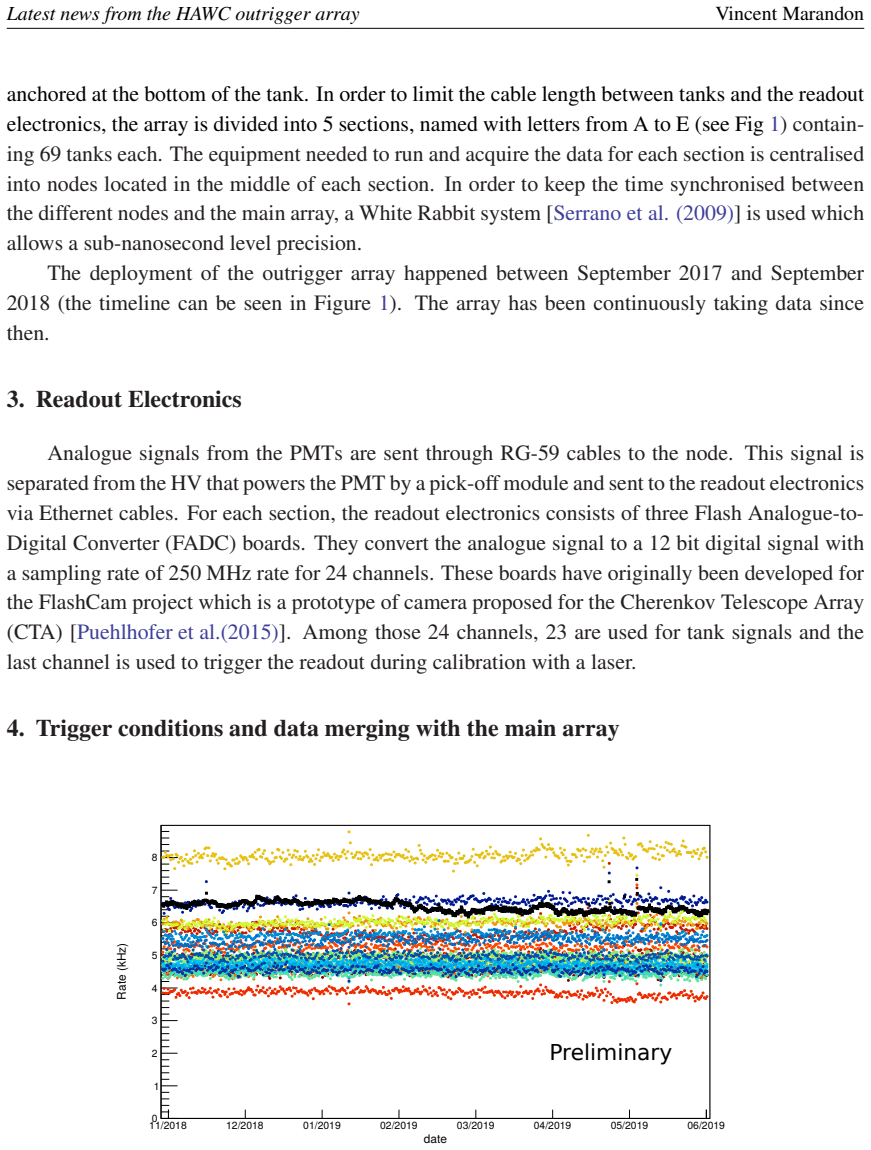
- domain assumption The trigger condition (at least 2 outrigger channels above 1 photoelectron within 160 ns) and the laser/occupancy calibration provide an unbiased sample of air-shower signals.
Cite this review
Pith. "Pith review of Latest news from the HAWC outrigger array." pith.science (2026). https://pith.science/paper/EOBFNMNE
@misc{pith2026190807634,
  author       = {Pith},
  title        = {Pith review of: Latest news from the HAWC outrigger array},
  year         = {2026},
  howpublished = {\url{https://pith.science/paper/EOBFNMNE}},
  note         = {Machine review of arXiv:1908.07634}
}
read the original abstract
The High Altitude Water Cherenkov (HAWC) observatory is a very high energy gamma-ray detector located in Mexico. In late 2018, the HAWC collaboration completed a major upgrade consisting of the addition of a sparse outrigger array of 345 small water Cherenkov detectors (WCDs) surrounding the 300 WCDs of the main array and extending the instrumented area by a factor of 4. It provides an improved reconstruction of the showers whose core and footprint are not well contained in the array and increases the effective area in the range of a few TeV to beyond 100 TeV. This improvement in sensitivity will help to have a better understanding of the Galactic sources that accelerate particles up to the knee of the cosmic ray spectrum. In this contribution, we will show the current status, the performance, and the first results from the HAWC outrigger array.
Figures


Figures from the paper (3 more)


Forward citations
Cited by 1 Pith paper
-
HAWC Performance Enhanced by Machine Learning in Gamma-Hadron Separation
Using 20 event features and a unified training set, an MLP improves HAWC gamma-hadron separation, increasing Crab Nebula significance by 19% and differential sensitivity by 23-40%.
Reference graph
Works this paper leans on
-
[1]
U., Albert, A., Alfaro, R., et al.\ 2017, , 843, 39
Abeysekara, A. U., Albert, A., Alfaro, R., et al.\ 2017, , 843, 39
work page 2017
-
[2]
The Calibration System of the HAWC Gamma-Ray Observatory
Ayala Solares, H. A., Gerhardt, M., Hui, C. M., et al.\ 2015, arXiv e-prints, arXiv:1508.04312
work page Pith review arXiv 2015
-
[3]
U., Albert, A., et al.\ 2019, arXiv e-prints, arXiv:1905.12518
HAWC Collaboration, Abeysekara, A. U., Albert, A., et al.\ 2019, arXiv e-prints, arXiv:1905.12518
arXiv 2019
- [4]
-
[5]
Puehlhofer, G., Bauer, C., Bernhard, S., et al.\ 2015, 34th International Cosmic Ray Conference (ICRC2015), 1039
work page 2015
-
[6]
J. Serrano, P. Alvarez, M. Cattin, E. G. Cota, P. M. J. H. Lewis, T. Włostowski et al., The White Rabbit Project in Proceedings of ICALEPCS TUC004, Kobe, Japan, 2009
work page 2009
Reviewed August 14, 2026 · model on record in the stance chip above.
Discussion (0). Continue with ORCID to comment.