REVIEW 3 major objections 4 minor 33 references
Transparent Negative Index of Refraction Metamaterial Using a Wire Array in a Magnetic Host
T0 review · 3 major / 4 minor · reviewed 2026-08-14 · deepseek-v4-flash
Pith's one-line read A ferrite block threaded with cladded wires transmits microwaves with a negative refractive index.
desk verdict A ferrite-block/cladded-wire sample shows a transmission window matching the authors' independently parametrized predicted n<0 band, but the paper infers negative index from transmission amplitude alone, with no phase or refraction measurement. read the letter →
The pith
A machine-rendered reading of the paper's core claim, the machinery that carries it, and where it could break.
The reading
What carries the argument
The working mechanism is the wire-array plasma response, with plasma frequency $\omega_p^2 = n e^2/(m_{\mathrm{eff}}\epsilon_0)$, where the effective electron mass is governed by the wire inductance. In a negative-permeability host the inductance is negative, so an unclad wire array would have positive permittivity; surrounding each wire with a non-magnetic cladding whose outer radius is about the geometric mean of wire radius and lattice constant restores negative permittivity. The second load-bearing piece is the demagnetization correction: the drilled holes give negative demagnetization factors ranging from -0.16 near the center to -0.05 near a corner, lowering the internal field of the sample at 300 Oe to match the solid control at 1 kOe and keeping both in the $\mu<0$ regime. The predicted propagation constant from the Dewar 2005b calculation then gives Re(k)<0 and small loss from 11 to 14 GHz.
What would settle it
Measure the transmission phase or the deflection through a wedge of the ferrite/wire block at 12–14 GHz: negative refraction reverses the phase advance or prism deflection compared with a positive-index sample, while ordinary transmission effects would not. Also, measure the internal field directly, for example by ferromagnetic resonance on a holed sample versus a solid one, to check the calculated -0.16 to -0.05 demagnetization factors.
Extended reading notes
Core claim
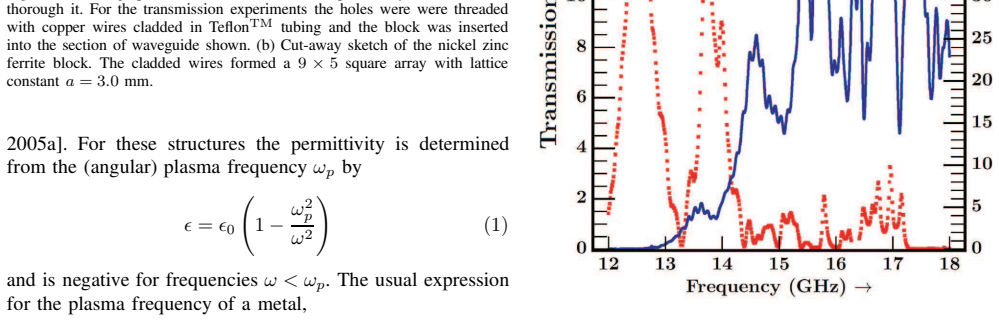
The central discovery is that a nickel-zinc ferrite host combined with a cladded copper wire array exhibits a negative index of refraction with measurable transparency, rather than merely a stopband. The magnetized ferrite provides $\mu<0$ below about 16 GHz; the wire array provides $\epsilon<0$ through its plasma response. The dielectric cladding is load-bearing: in a negative-permeability host the wire inductance becomes negative, which would make the effective electron mass negative and flip the wire array permittivity positive, so the cladding isolates enough inductive energy to restore $\epsilon<0$. The measured transmission is largest in the 12–14 GHz range, where the propagation-constant calculation gives Re(k)<0 with small Im(k), and the paper attributes the lower peak transmission relative to plain ferrite to resistive losses in the wires.
Load-bearing premise
The load-bearing premise is that the drilled holes lower the internal magnetic field at 300 Oe enough to match the solid block at 1 kOe, and that the 9-by-5 wire array can be treated as a homogeneous effective medium at 12–14 GHz; if either premise fails, the observed transmission window need not indicate a negative index.
Editorial extensions
If this is right
- With proper impedance matching, the structure could reach roughly 5 dB insertion loss, making it usable in microwave devices.
- Reversing the applied magnetic field should reverse the coupling direction in a directional coupler built from this material.
- The waveguide cross-section could be reduced to about 5 mm by 1 mm, so the design supports miniaturization.
- The operating frequency can be shifted by changing the bias field, offering tunability that fixed split-ring designs lack.
- The same ferrite-host scheme is proposed as a route to terahertz negative-index materials using ferrimagnets or antiferromagnets with tunable plasma frequencies.
Reading between the lines
- The paper reports only transmitted power, so a phase or wedge measurement at 12–14 GHz would be the natural next experiment to confirm that the transmission is actually negative refraction rather than an impedance or loss effect.
- Because the demagnetization compensation is calculated, not measured, the comparison to the solid control block would be the first thing to check if the negative-index interpretation is challenged.
- Treating a 9-by-5 array with 3 mm lattice constant as a homogeneous medium at 12–14 GHz could be tested by varying the array size or lattice constant and checking that the transmission window shifts as the effective-medium calculation predicts.
- The terahertz extrapolation is testable in principle by pairing a semiconductor whose plasma frequency can be temperature-tuned with an antiferromagnetic resonance, provided the cladding geometry can be scaled down.
Signed reviews
Editorial analysis
A structured set of objections, weighed in public.
Referee Report
Summary. The paper reports microwave transmission measurements over 12-18 GHz through a ferrite block containing a 9x5 square array of Teflon-cladded copper wires, and compares the result with transmission through a similar solid ferrite block. The authors identify a transmission passband near 12-14 GHz and associate it with a theoretically computed band in which the real part of the propagation constant is negative, concluding that the sample exhibits a negative index of refraction with transparency. The paper also suggests applications such as tunable directional couplers and argues that the design is simpler than wire/split-ring metamaterials.
Significance. If the central claim were established, the design would be a notable simplification of negative-index metamaterials: the split-ring resonators are replaced by a magnetic ferrite host, and the operating band is tunable by the applied magnetic field. A genuine strength is that the theoretical propagation-constant calculation is parameterized by independently measured quantities (FMR magnetization, g-factor, and ferrite permittivity from mode spacing) rather than by fitting the transmission data. However, the experiment as reported does not uniquely establish a negative index: only transmitted power is measured, with no phase, refraction, or retrieval of effective constitutive parameters. The result is therefore best characterized as a promising candidate, not a definitive demonstration of n<0.
major comments (3)
- [Section III, Fig. 2] The only observable reported for the metamaterial is transmitted power in percent as a function of frequency. No phase, refraction angle, or S-parameter retrieval of effective permittivity, permeability, or index is provided, so the identification of the 12-14 GHz passband with n<0 is not unique. A transmission maximum can also arise from a positive-index passband, a Fabry-Perot resonance, or an impedance match produced by the wire array, even if the ferrite permeability is not negative. The Fig. 2 caption statement that 'the significant transmission ... demonstrates transparency for n<0' is therefore stronger than the data warrant; a phase-sensitive measurement or a direct refraction experiment is needed to support the central claim.
- [Section III, Fig. 2] The comparison between the holed wire-loaded block at 300 Oe and the solid control at 1.0 kOe rests on calculated demagnetization factors between -0.16 near the center and -0.05 near a corner, which are not measured and are explicitly acknowledged to be inhomogeneous. Section III states that this inhomogeneity 'may have also led to a decrease in the observed transmission.' If the calculated compensation is inaccurate, the ferrite in the holed sample could have positive permeability in the measured band, in which case the control comparison would not demonstrate that μ<0 was present. The authors should provide direct evidence that the internal field in the actual hole-array sample puts the ferrite in the μ<0 regime, for example from FMR on the holed block or from a retrieval analysis.
- [Section IV, Fig. 3] The propagation-constant calculation in Fig. 3 assumes an infinite periodic medium and then is identified with the measured 9x5 finite array. At 12-14 GHz, with lattice constant a=3.0 mm and calculated index magnitudes up to 4.5, the in-medium wavelength is only a few lattice constants, so the validity of an effective-medium (homogenized ε and μ) description is not obvious. The calculation itself includes a Bragg reflection below 11 GHz, which indicates that lattice effects are non-negligible in this frequency range. The paper should quantify the ratio of wavelength to lattice constant and provide a convergence or validation test for the homogenization of the 9x5 array before using computed Re(k)<0 as the definition of the sample's index band.
minor comments (4)
- [Section II, Fig. 1 caption] There are several typographical errors in the text and figure captions, including 'holes drilled thorough it' and 'the holes were were threaded'; these should be corrected.
- [Section I] The word 'INTRODUCITON' in the section heading is misspelled and should be 'INTRODUCTION'.
- [References] The reference list has inconsistent formatting (e.g., irregular spacing and stray capitalizations such as 'Y ang' and 'Moorish'); the Morrish reference should be checked for the correct spelling.
- [Section IV] The paper refers to the calculation in Dewar [2005b] but does not reproduce the dispersion relation or the effective-medium formulas; including the key equations would improve reproducibility.
Circularity Check
No significant circularity: the negative-index calculation uses independently measured ferrite parameters and is tested against new transmission data, not fitted to it.
full rationale
The paper's central comparison is between a measured transmission window (Fig. 2) and a calculated propagation constant (Fig. 3). The calculated k is taken from Dewar [2005b] and evaluated using parameters that are independent of the transmission measurement: magnetization M = (3.80 ± 0.21) × 10^5 A/m and g = 2.006 ± 0.049 from ferromagnetic resonance on a separate small sample, and ferrite permittivity ε = (4.45 ± 0.5)ε0 from mode-spacing at high field in a wire-free block. None of these inputs is adjusted to make the predicted 11–14 GHz negative-k band match the observed 12–14 GHz transmission. The measured transmission therefore constitutes an externally falsifiable test of the cited theory, albeit a limited one: the paper reports transmitted power only and performs no phase-sensitive retrieval of the index of refraction. That limitation affects the strength of the demonstration, not its circularity. The design rule for the dielectric cladding radius is attributed to the same author's prior work (Dewar 2002, 2005a, 2005b), and the theoretical prediction is self-cited, but this is normal scholarly continuity rather than a reduction of the conclusion to its inputs: the experiment could in principle have disagreed with the predicted band. The calculated demagnetization correction (-0.16 to -0.05) is an assumption about internal field, not a fitted parameter. No equation in the paper is equivalent to an input by construction, and no fitted parameter is renamed as a prediction. Hence the circularity score is 0.
Assumptions & free parameters
free parameters (1)
- Teflon cladding outer radius =
0.8 mm (tube outer radius; geometric-mean rule gives ~0.66 mm)
assumptions (5)
- standard math Wire-array effective permittivity is given by ε = ε0(1 - ωp²/ω²) with the Pendry-modified plasma frequency (Eqs. 1-2)
- domain assumption A non-magnetic dielectric cladding with outer radius near the geometric mean of wire radius and lattice constant restores ε<0 in a magnetic host with μ<0
- ad hoc to paper The holes in the ferrite create negative demagnetization factors between -0.16 (center) and -0.05 (corner), making the internal field of the holed sample at 300 Oe approximately equal to the solid sample at 1 kOe
- domain assumption The propagation constant calculation of Dewar 2005b is valid for this finite, waveguide-loaded structure
- ad hoc to paper The 9x5 array with lattice constant 3 mm can be homogenized into effective ε and μ at 12-14 GHz
Cite this review
Pith. "Pith review of Transparent Negative Index of Refraction Metamaterial Using a Wire Array in a Magnetic Host." pith.science (2026). https://pith.science/paper/EOGY27UP
@misc{pith2026190801378,
  author       = {Pith},
  title        = {Pith review of: Transparent Negative Index of Refraction Metamaterial Using a Wire Array in a Magnetic Host},
  year         = {2026},
  howpublished = {\url{https://pith.science/paper/EOGY27UP}},
  note         = {Machine review of arXiv:1908.01378}
}
read the original abstract
We have made measurements of microwave transmission over the 12 - 18 GHz range and through a simple metamaterial exhibiting a negative index of refraction. The metamaterial consisted of an array of wires cladded in dielectric embedded in a magnetic ferrite. The ferrite replaced the cut-ring structure usually used to create the negative permeability. The dielectric cladding decoupled the ferrite from the wires, thereby allowing the wire array permittivity to be simultaneously negative with the permeability. The simplicity of the design allows for miniaturization of potential microwave devices based on this metamaterial.
Figures


Reference graph
Works this paper leans on
-
[1]
11em plus .33em minus .07em 4000 4000 100 4000 4000 500 `\.=1000 = #1 \@IEEEnotcompsoconly \@IEEEcompsoconly #1 * [1] 0pt [0pt][0pt] #1 * [1] 0pt [0pt][0pt] #1 * \| ** #1 \@IEEEauthorblockNstyle \@IEEEcompsocnotconfonly \@IEEEauthorblockAstyle \@IEEEcompsocnotconfonly \@IEEEcompsocconfonly \@IEEEauthordefaulttextstyle \@IEEEcompsocnotconfonly \@IEEEauthor...
work page 2000
-
[2]
\, -4.50truemm Barzilai G, Gerosa G (1958), ``Modes in rectangular guides filled with magnetized ferrite,'' Il Nuovo Cimento, vol. 7, pp. 685--697, doi: 10.1007/BF02781572
-
[3]
\, -4.50truemm Bi K, Zhou J, Zhao H, Liu X, Lan C (2013), ``Tunable dual-band negative refractive index in ferrite-based metamaterials,'' Opt. Express, vol. 21, pp. 10746--10752, doi: 10.1364/OE21.010746
-
[4]
\, -4.50truemm Bi K, Guo Y, Zhou J, Dong G, Zhao H, Zhao Q, Xiao Z, Liu X, Lan C (2014), ``Negative near zero refraction metamaterials based on permanent magnetic ferrites,'' Sci. Rep., vol. 4, 4139, doi: 10.1038/srep04139
-
[5]
224--227, doi: 10.1038/nphoton.2007.28
\, -4.50truemm Cai W, Chettiar U K, Kildishev A V, Shalaev V M (2007), ``Optical cloaking with metamaterials,'' Nature Photon., vol 1, pp. 224--227, doi: 10.1038/nphoton.2007.28
-
[6]
\, -4.50truemm Chen H, Chen M (2011a), ``Flipping photons backward: reversed Cherenkov radiation,'' Materials Today, vol. 14, pp. 34--41, doi: 10.1016/S1369-7021(11)70020-7
-
[7]
\, -4.50truemm Chen J, Wang Y, Jia B, Geng T, Li X, Feng L, Qian W, Liang B, Zhang X, Zhuang S (2011b), ``Observation of the inverse Doppler effect in negative-index materials at optical frequencies,'' Nature Photon., vol. 5, pp. 239--242, doi: 10.1038/nphoton.2011.130
-
[8]
\, -4.50truemm Cochran J F, Heinrich B, Dewar G (1977), ``Ferromagnetic antiresonance transmission through Supermalloy at 24 GHz,'' Can. J. Phys., vol. 55, pp. 787--805, doi: 10.1139/p77-110
Show all 33 references
-
[9]
\, -4.50truemm Dewar G (2002), ``The applicability of ferrimagnetic hosts to nanostructured negative index of refraction (left-handed) materials,'' in Complex mediums III: beyond linear isotropic dielectrics, vol. 4806, A. Lakhtakia, G. Dewar, and M. McCall, Eds. Bellingham, W...
2002 doi
-
[10]
\, -4.50truemm Dewar G (2005a), ``A thin wire array and magnetic host structure with n<0 ,'' J. Appl. Phys., vol. 97, 10Q101, doi: 10.1063/1.1846032
2005 doi
-
[11]
Phys., vol
\, -4.50truemm Dewar G (2005b), ``Minimization of losses in a structure having a negative index of refraction,'' New J. Phys., vol. 7, 161, doi: 10.1088/1367-2630/7/1/161
2005 doi
-
[12]
14, 14901, doi: 10.1038/ncomms14901
\, -4.50truemm Duan Z, Tang X, Wang Z, Zhang Y, Chen X, Chen M, Gong Y (2017), ``Observation of the reversed Cherenkov radiation,'' Nature Comm., vol. 14, 14901, doi: 10.1038/ncomms14901
2017 doi
-
[13]
\, -4.50truemm Gu Y, Wu R, Yang Y, Poo Y, Chen P, Lin Z (2013), ``Self-biased magnetic left-handed material,'' Appl. Phys. Lett., vol. 102, 231914, doi: 10.1063/1.4811250
2013 doi
-
[14]
\, -4.50truemm Guenneau S, Puvirajesinghe T M (2013), ``Fick's second law transformed: one path to cloaking in mass diffusion,'' J. R. Soc. Interface, vol. 10, 20130106, doi: 10.1098/rsif.2013.0106
2013
-
[15]
\, -4.50truemm He P, Gao J, Chen Y, Parimi P V, Vittoria C, Harris V G (2009), ``Q-band tunable negative refractive index matamaterial using Sc-doped BaM hexaferite,'' J. Phys. D: Appl. Phys., vol. 42, 155005, doi: 10.1088/0022-3727/42/15/155005
2009 doi
-
[16]
Phys., vol
\, -4.50truemm Leonhardt U, Philbin T G (2007), ``Quantum levitation by left-handed metamaterials,'' New J. Phys., vol. 9, 254, doi: 10.1088/1367-2630/9/8/254
2007 doi
-
[17]
New York: John Wiley & Sons, pp
\, -4.50truemm Moorish A H (1965), The Physical Principles of Magnetism. New York: John Wiley & Sons, pp. 607-616, doi: 10.1002/9780470546581
1965 doi
-
[18]
\, -4.50truemm Pendry J B, Holden A J, Stewart W J, Youngs I (1996), ``Extremely low frequency plasmons in metallic mesostructures,'' Phys. Rev. Lett., vol. 76, pp. 4773--4776, doi: 10.1103/PhysRevLett.76.4773
1996 doi
-
[19]
\, -4.50truemm Pendry J B (2000), ``Negative refraction makes a perfect lens,'' Phys. Rev. Lett., vol. 85, pp. 3966--3969, doi: 10.1103/PhysRevLett.85.3966
2000 doi
-
[20]
Schurig D, Smith D R(2006), ``Controlling Electromagnetic Fields,'' Science, vol
\, -4.50truemm Pendry J B, D. Schurig D, Smith D R(2006), ``Controlling Electromagnetic Fields,'' Science, vol. 312, pp. 1780--1782, doi: 10.1126/science.1125907
2006 doi
-
[21]
\, -5.50truemm Pimenov A, Loidl A, Gehrke K, Moshnyaga V, Samwer K (2007), ``Negative refraction observed in a metallic ferromagnet in the gigahertz frequency range,'' Phys. Rev. Lett., vol. 98, 197401, doi: 10.1103/PhysRevLett.98.197401
2007 doi
-
[22]
\, -4.50truemm Pokrovsky A L, Efros A L (2002), ``Electrodynamics of metallic photonic crystals and the problem of left-handed materials,'' Phys. Rev. Lett. vol. 89, 093901, doi: 10.1103/PhysRevLett.89.093901
2002 doi
-
[23]
\, -4.50truemm Rachford F J, Armstead D N, Harris V G, Vittoria C (2007), ``Simulations of Ferrite-Dielectric-Wire Composite Negative Index Materials,'' Phys. Rev. Lett., vol 99, 057202, doi: 10.1103/PhysRevLett.99.057202
2007 doi
-
[24]
Rep., vol
\, -5.50truemm Restrepo-Fl\'orez J M, Maldovan M (2016), ``Mass separation by metamaterials,'' Sci. Rep., vol. 6, 21971, doi: 10.1038/srep21971
2016 doi
-
[25]
Starr A F, and Smith D R(2006), ``Metamaterial electromagnetic cloak at microwave frequencies,'' Science, vol
\, -4.50truemm Schurig D, Mock J J, Justice B J, Cummer S A, Pendry J B, A. Starr A F, and Smith D R(2006), ``Metamaterial electromagnetic cloak at microwave frequencies,'' Science, vol. 314, pp. 977--980, doi: 10.1126/science.1133628
2006 doi
-
[26]
\, -4.50truemm Shalaev V M (2007), ``Optical negative-index metamaterials,'' Nature Photon., vol. 1, pp. 41--48, doi: 10.1038/nphoton.2006.49
2007 doi
-
[27]
\, -4.50truemm Shelby R A, Smith D R, Schultz S (2001), ``Experimental verification of a negative index of refraction,'' Science, vol. 292, pp. 77--79, doi: 10.1126/science.1058847
2001 doi
-
[28]
\, -4.50truemm Smith D R, Padilla W J, Vier D C, Nemat-Nasser S C, Schultz S (2000), ``Composite medium with simultaneously negative permeability and permittivity,'' Phys. Rev. Lett., vol. 84, pp. 4184--4187, doi: 10.1103/PhysRevLett.84.4184. \, -4.850truemm Veselago V G (1968...
2000 doi
-
[29]
Phys., vol
\, -4.50truemm Wee W H, Pendry J B (2009), ``Shrinking optical devices,'' New J. Phys., vol. 11, 073033, doi: 10.1088/1367-2630/11/7/073033
2009 doi
-
[30]
10, pp 379--390, doi: 10.1016/j.crhy.2009.01.002
\, -4.50truemm Wood B (2009), ``Metamaterials and invisibility,'' Comptes Rendus Physique, vol. 10, pp 379--390, doi: 10.1016/j.crhy.2009.01.002
2009 doi
-
[31]
\, -4.50truemm Yang T, Chen H, Luo X, Ma H (2008), ``Superscatterer: Enhancement of scattering with complementary media,'' Optics Express, vol. 16, pp. 18545--18550, doi: 10.1364/OE.16.018545
2008 doi
-
[32]
\, -4.0truemm Zhao H, Zhou J, Zhao Q, Bo L, Kang L (2007), ``Magnetotunable left-handed material consisting of yittrium iron garnet slab and metallic wires,'' Appl. Phys. Lett., vol. 91, 131107, doi: 10.1063/1.2790500
2007 doi
-
[33]
Express, vol
\, -4.50truemm Zhao H, Zhou J, Kang L, Zhao Q (2009), ``Tunable two-dimensional left-handed material consisting of ferrite rods and metallic wires,'' Opt. Express, vol. 17, pp. 13373--13380, doi: 10.1364/OE.17.013373
2009 doi
Reviewed August 14, 2026 · model on record in the stance chip above.
Discussion (0). Continue with ORCID to comment.