REVIEW 3 major objections 4 minor 40 references
Quantum-Assisted Recursive Algorithm for Solving the Exact Cover Problem
T0 review · 3 major / 4 minor · reviewed 2026-08-15 · deepseek-v4-flash
Pith's one-line read QARA uses one QAOA layer and recursive pruning to find exact-cover solutions roughly 60% more often than QAOA or RQAOA.
desk verdict A sensible recursive-QAOA heuristic for exact cover with real gains over vanilla QAOA, but the quantum-vs-random comparison is confounded and the headline numbers don't match the body. read the letter →
The pith
A machine-rendered reading of the paper's core claim, the machinery that carries it, and where it could break.
The reading
What carries the argument
The carrying mechanism is quantum pruning based on the single-qubit expectation $M_i = \langle \psi(\boldsymbol{\gamma}_p^*, \boldsymbol{\beta}_p^*) | Z_i | \psi(\boldsymbol{\gamma}_p^*, \boldsymbol{\beta}_p^*) \rangle$ computed from the optimized one-layer QAOA output state. The subset with the strongest selection bias, $S_{i^*} = \arg\max_i |M_i|$, is forced to 1 if $M_{i^*} < 0$ and to 0 if $M_{i^*} > 0$; forcing it to 1 simultaneously eliminates every subset that shares an element with it, so a single quantum decision can fix many variables. Classical pruning complements this by deterministically selecting subsets that cover an element appearing nowhere else. A local verification and rollback mechanism, capped at $\lceil \log m \rceil$ rollbacks per pruning phase, checks only whether every remaining uncovered element is still coverable, rejecting reductions that violate completeness.
What would settle it
Generate a set of exact-cover instances with a unique cover and record, for each, whether the subset with largest $|M_i|$ at one-layer QAOA depth is actually in the unique cover; if the fraction of correct identifications is at or below the random baseline of $1/m$, the central quantum-guidance claim fails. A complementary check is to run QARA with the largest-$|M_i|$ choice replaced by a random subset selection while keeping the rollback mechanism; if the success probability stays at the 16.4%-higher level, the gain is from the rollback and not from the quantum information.
Extended reading notes
Core claim
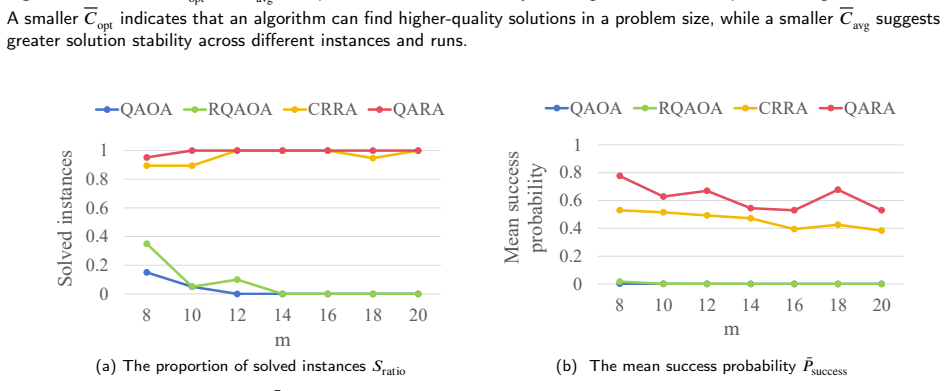
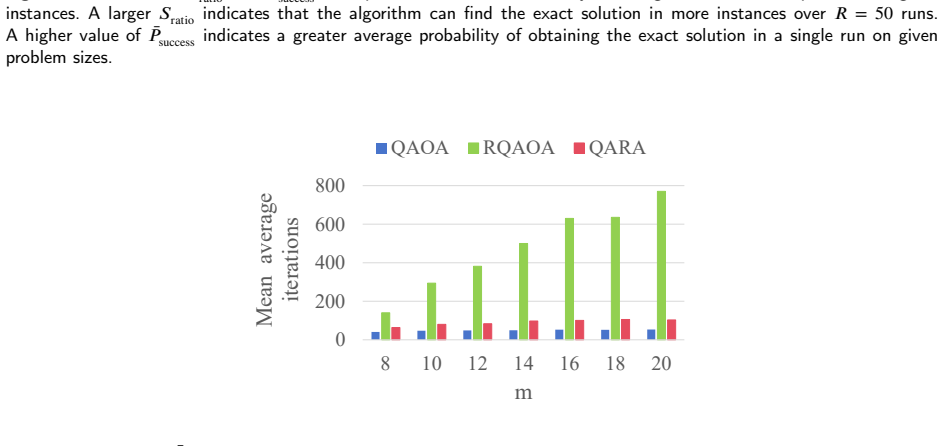
QARA's central claim is that quantum information extracted from the output state of a one-layer QAOA run can reliably guide problem reduction for exact cover. In each quantum pruning step, the algorithm computes the single-qubit expectation $M_i = \langle \psi | Z_i | \psi \rangle$ for every remaining subset, fixes the subset with the largest $|M_i|$ to the state indicated by the sign of $M_i$, and, if that subset is selected, deletes all subsets sharing elements with it. A local completeness check decides whether to roll back and repeat the reduction. On the paper's 140 benchmark instances, this recipe yields a single-run exact-solution probability approximately 60% higher than QAOA and RQAOA at one-layer depth, an approximately 81% reduction in parameter-optimization iterations relative to RQAOA, and an approximately 16.4% improvement over the random classical counterpart CRRA. The rollback mechanism is shown by ablation to improve both average solution quality and success probability.
Load-bearing premise
The load-bearing premise is that the sign of the single-qubit expectation $M_i$ from a one-layer QAOA output identifies a subset that belongs to at least one exact cover often enough that forcing its state and deleting all conflicting subsets still leaves a solvable problem; the paper provides no proof or error bound for this, only the observed 16.4% gap over random reduction.
Editorial extensions
If this is right
- At one-layer QAOA depth, QARA's single-run probability of returning an exact solution is roughly 60% higher than that of plain QAOA and RQAOA, and the gap grows with instance size.
- QARA consumes about 81% fewer parameter-optimization iterations per run than RQAOA, because one quantum pruning step can fix multiple subsets at once.
- Compared with the random classical reduction algorithm CRRA, QARA shows roughly 16.4% higher success probability, indicating that the quantum-state information contributes to the reduction choices.
- Removing the local verification and rollback mechanism degrades both average solution quality and success probability, at a saving of about 30% of iteration cost.
- QARA's reduction rules guarantee that no element is covered more than once, so every run produces a candidate consistent with the uniqueness constraint of exact cover.
Reading between the lines
- The same alternating classical and quantum pruning loop could transfer to other problems with exact-once coverage constraints, such as set packing or exact hitting set variants.
- Because the rollback cap is $\lceil \log m \rceil$ and each quantum pruning phase runs a full QAOA optimization, the total quantum cost on larger instances would depend mainly on the number of pruning phases; testing beyond $m=20$ would show whether the 60% advantage persists.
- A controlled variant that uses random subset choice but keeps the rollback mechanism would separate the contribution of the bias heuristic from the contribution of rollback, which the current aggregate metrics do not isolate.
- Benchmarking instances with a unique exact cover, rather than averaging over all instances, would clarify when the sign of $M_i$ is most reliable and when quantum guidance matters most.
Signed reviews
Editorial analysis
A structured set of objections, weighed in public.
Referee Report
Summary. The paper proposes QARA, a recursive hybrid algorithm for the exact cover problem. QARA alternates classical deterministic pruning (selecting a subset that uniquely covers an element and deleting conflicting subsets) with quantum pruning, in which a one-layer QAOA is run on the current instance, the expectation values M_i = <Z_i> are computed, and the subset with the largest |M_i| is fixed to 0 or 1 according to the sign of M_i. After each quantum reduction, a local completeness check is performed and, if it fails, the reduction is rolled back up to ceil(log m) times. The authors report numerical results on 140 instances (m = 8,...,20, m=n, 20 instances per size, 50 runs each), comparing QARA with QAOA, RQAOA, and a classical random recursive algorithm (CRRA). They claim QARA improves success probability by approximately 60% over QAOA and RQAOA, consumes approximately 81% fewer parameter-optimization iterations than RQAOA, and outperforms CRRA by about 16.4% in success probability, which they attribute to quantum information. An ablation study shows that the rollback mechanism improves C_avg and P_success at the cost of ~30% more iterations.
Significance. If the empirical claims hold, QARA is a useful heuristic for exact cover at shallow QAOA depth: the recursive framework is clearly described, the reduction rules preserve the uniqueness constraint, and the rollback mechanism is a sensible practical safeguard. The inclusion of CRRA as a classical analogue and the ablation study are good experimental practices that show the authors are aware of control conditions. The main scientific claim, however, is that quantum information extracted from a one-layer QAOA provides a 16.4% success-probability gain over random guidance. That claim is currently not cleanly supported because CRRA is not action-matched to QARA, and because no confidence intervals are reported. The quantum-vs-classical comparison is therefore the weakest part of the paper, even though the central algorithmic proposal and the comparison against QAOA/RQAOA are likely defensible after additional statistical reporting.
major comments (3)
- [Section 4.2 (CRRA baseline) and Section 3.2.1, Eq. (7)] The CRRA baseline is not matched to QARA in the action space. Section 4.2 states that when classical pruning stalls, CRRA randomly selects a subset and sets its state to 1, whereas QARA (Section 3.2.1, Eq. (7)) sets the chosen subset to 0 if M_i* > 0 and to 1 if M_i* < 0. Setting a subset to 1 removes all conflicting subsets, while setting it to 0 removes only that subset, so the two algorithms differ both in how the subset is chosen (quantum expectation values vs. uniform random) and in what action is applied (0/1 vs. always 1). The reported ~16.4% success-probability gap (Section 4.4) could therefore be produced entirely by the action asymmetry rather than by information in the QAOA state. I request a matched control: a classical random algorithm that chooses a subset uniformly at random and then chooses 0 or 1 according to a fixed coin (or with the empirically observed QARA action frequencies), under the same rollback limit. To further support the attribution of the gap to quantum information, the paper should also report the empirical frequency with which QARA chooses x=1 vs. x=0 and the per-decision agreement rate between QARA's pruning choices and the optimal exact cover. Without this control, the quantum-information claim is not supported.
- [Section 4.3 and Section 4.4] All central quantitative claims—the ~60% improvement over QAOA/RQAOA, the ~16.4% over CRRA, and the ~81% iteration reduction—are ratios of means computed from only 20 instances per problem size and 50 runs per instance. The paper reports no confidence intervals, standard deviations, or significance tests for P_success, C_opt, C_avg, or T_ITR. The curves in Figs. 3–5 show large variability across instance sizes, and it is plausible that some of the reported differences are within sampling error, especially for small m. The authors should report standard errors or bootstrap confidence intervals for every metric, provide per-instance scatter plots, and ideally a paired statistical test when comparing algorithms on the same instances. This is necessary before the magnitudes of the claimed improvements can be evaluated.
- [Section 4.1 (Dataset)] The random-instance generation is underspecified. The only conditions given are m=n, a guarantee that each instance has at least one exact cover, and a requirement that each element appears in at least two subsets. No distribution over subset sizes, coverage counts, conflict density, or number of alternative exact covers is provided, and no code or dataset is released (Section 7 only offers data from the corresponding author upon request). Because the success probability of a recursive pruning algorithm is likely sensitive to instance structure—for example, instances with many exact covers may be easy for both QARA and CRRA—the absence of this information makes the reported averages hard to interpret or reproduce. The authors should specify the generator, release the instances and code, or at minimum report instance-level difficulty statistics such as the number of valid exact covers and the distribution of subset sizes.
minor comments (4)
- [Algorithm 1, line 25] The expression for M_i is missing the bra on the right-hand side; it should be written as M_i = ⟨ψ(γ_p*,β_p*)| Z_i |ψ(γ_p*,β_p*)⟩.
- [Abstract and Section 4.1] The phrase 'subset sizes ranging from 8 to 20' is ambiguous; it should be 'number of subsets' or 'subset collection size m' to avoid confusion with the sizes of the individual subsets.
- [Section 4.2] The stopping criterion for QAOA parameter optimization is not fully specified: the text mentions a change below 0.01 for three consecutive iterations, but does not state the maximum number of iterations, the learning rate schedule for Adam, or whether expectation values are obtained from a statevector simulator or from finite-shot sampling. These details affect the reported T_ITR and the reproducibility of the M_i estimates.
- [Section 1, reference [38]] The sentence 'Vikstål et al. pioneered the use of QAOA for this problem' may confuse readers, since reference [38] is titled 'Tail-Assignment Problem'; please clarify that the tail-assignment problem is being used as an instance of exact cover, or rephrase the attribution.
Circularity Check
No circularity: QARA's heuristic use of QAOA expectation values is empirically benchmarked, not derived from its own outputs; any QARA/CRRA mismatch is a control-design concern, not a circular step.
full rationale
I walked the paper's claimed derivation chain and found no step in which an output is equivalent, by construction or by fitted parameter, to an input. The central quantity M_i = <Z_i> (Eq. 7, Section 3.2.1) is an observable extracted from the optimized QAOA output state and is used as a heuristic guide for choosing which subset to prune; the reported success probability P_success (Eq. 10, Section 4.3) is an empirically measured frequency over 50 runs on 140 instances, not an analytical consequence of M_i. The rollback limit ceil(log m) and the convergence threshold (0.01 over three iterations) are hand-set hyperparameters, not constants fitted to the reported metrics. The comparison with CRRA is an external benchmark: CRRA differs from QARA in both selection source (random versus QAOA-guided) and available action (always fixing the chosen subset to 1 versus fixing it to 0 or 1 by the sign of M_i*), so the 16.4% success-probability gap may be confounded by action-space asymmetry, but that is an experimental-design/correctness concern rather than circular reasoning. Self-citations in the paper (e.g., refs. 21, 28, 39) support contextual claims about QAOA variants and initialization and are not load-bearing for QARA's core empirical claim. No fitted parameter is renamed as a prediction, no uniqueness theorem from the authors' prior work is invoked to force the choice of reduction rule, and the problem-tailored reduction rules are stated directly from the exact-cover completeness and uniqueness conditions. The paper is self-contained against external benchmarks, so the honest finding is no significant circularity (score 0).
Assumptions & free parameters
free parameters (3)
- QAOA layer depth p =
1
- Rollback budget =
ceil(log m), where m is the current subproblem size
- QAOA parameter optimization stopping threshold =
0.01 change in expected cost for three consecutive iterations
assumptions (4)
- standard math For each element e_j, exact cover requires sum_i c_{S_i,e_j} x_i = 1, and the squared objective C(x) equals zero if and only if x is an exact cover.
- domain assumption The one-layer QAOA output state, after parameter optimization, has single-qubit expectation values M_i whose signs indicate a subset whose forced state preserves an exact cover often enough to guide pruning.
- domain assumption The local verification check that every remaining element is covered by at least one remaining subset, combined with rollback up to ceil(log m), is sufficient to keep the search on a useful path.
- domain assumption Randomly generated instances with m=n, at least one exact cover, and each element in at least two subsets are representative of exact cover applications.
Cite this review
Pith. "Pith review of Quantum-Assisted Recursive Algorithm for Solving the Exact Cover Problem." pith.science (2026). https://pith.science/paper/EOHEY2VR
@misc{pith2026250910811,
  author       = {Pith},
  title        = {Pith review of: Quantum-Assisted Recursive Algorithm for Solving the Exact Cover Problem},
  year         = {2026},
  howpublished = {\url{https://pith.science/paper/EOHEY2VR}},
  note         = {Machine review of arXiv:2509.10811}
}
read the original abstract
The exact cover problem is an NP-complete problem with broad applications. Studies show that although applying the Quantum Approximate Optimization Algorithm (QAOA) to this problem can yield improved solution quality with deeper circuit depth, it can limit the algorithm's applicability on noisy intermediate-scale quantum devices. To improve solution quality at shallow depth, we propose a Quantum-Assisted Recursive Algorithm (QARA) for solving the exact cover problem. QARA addresses the problem by alternately applying classical and quantum pruning. Classical pruning is a repeatable pre-processing step to simplify the problem. When the classical pruning cannot promote the problem simplification, quantum pruning is invoked. During quantum pruning, QARA extracts information from the QAOA's output state to identify the subset with the strongest selection bias. This subset is then used to prune the problem based on our problem-tailored reduction rules. Furthermore, QARA incorporates a local verification and rollback mechanism to assistively judge the effectiveness of the quantum simplification. After quantum pruning, classical pruning is applied again to the reduced problem if the remaining subsets and element set are not null. This alternating process repeats until the original problem is fully resolved. In our numerical simulations, we evaluate the performance of QARA at one-layer depth on 140 instances with subset sizes ranging from 8 to 20. Numerical results show that the probability of QARA in finding an exact solution is approximately 60\% higher than that of both QAOA and Recursive QAOA, highlighting its efficiency.
Figures


Figures from the paper (5 more)


Reference graph
Works this paper leans on
-
[1]
E.Farhi,J.Goldstone,S.Gutmann,AQuantumApproximateOptimizationAlgorithm(2014),arXiv:1411.4028 [quant-ph]
arXiv 2014
-
[2]
M. Cerezo, A. Arrasmith, R. Babbush, S. C. Benjamin, S. Endo, K. Fujii, J. R. McClean, K. Mitarai, X. Yuan, L. Cincio, P. J. Coles, Variational quantum algorithms, Nat. Rev. Phys.3(2021) 625–644. https://doi.org/10.1038/s42254-021-00348-9
-
[3]
R. LaRose, A. Tikku, E. O’Neel-Judy, L. Cincio, P. Coles, Variational quantum state diagonalization, npj Quantum Inf.5(2019) 8. https://doi.org/10.1038/s41534-019-0167-6
-
[4]
H.-L. Liu, Y.-S. Wu, L.-C. Wan, S.-J. Pan, S.-J. Qin, F. Gao, Q.-Y. Wen, Variational quantum algorithm for the Poisson equation, Phys. Rev. A104(2021) 022418. https://doi.org/10.1103/PhysRevA.104.022418
-
[5]
C. Bravo-Prieto, R. LaRose, M. Cerezo, Y. Subasi, L. Cincio, P. J. Coles, Variational Quantum Linear Solver, Quantum7(2023) 1188. https://doi.org/10.22331/q-2023-11-22-1188
-
[6]
Z. He, H. Chen, Y. Zhou, H. Situ, Y. Li, L. Li, Self-supervised representation learning for Bayesian quantum architecture search, Phys. Rev. A111(2025) 032403. https://doi.org/10.1103/PhysRevA.111.032403
-
[7]
J. Su, J. Fan, S. Wu, G. Li, S. Qin, F. Gao, Topology-driven quantum architecture search framework, Sci. China Inf. Sci.68(2025) 8. http://dx.doi.org/10.1007/s11432-024-4486-x
-
[8]
Preskill, Quantum Computing in the NISQ era and beyond, Quantum2(2018) 79
J. Preskill, Quantum Computing in the NISQ era and beyond, Quantum2(2018) 79. https://doi.org/10.22331/q- 2018-08-06-79
doi:10.22331/q- 2018
Show all 40 references
-
[9]
https://doi.org/10.1016/j.physa.2023.129089
S.-S.Wang,H.-L.Liu,Y.-Q.Song,F.Gao,S.-J.Qin,Q.-Y.Wen,Quantumalternatingoperatoransatzforsolving the minimum exact cover problem, Physica A626(2023) 129089. https://doi.org/10.1016/j.physa.2023.129089
2023
-
[10]
Soft Comput.118(2022) 108554
Y.J.Zhang,X.D.Mu,X.W.Liu,X.Y.Wang,X.Zhang,K.Li,T.Y.Wu,D.Zhao,C.Dong,Applyingthequantum approximate optimization algorithm to the minimum vertex cover problem, Appl. Soft Comput.118(2022) 108554. https://doi.org/10.1016/j.asoc.2022.108554
2022
-
[11]
Tomesh, Z
T. Tomesh, Z. H. Saleem, M. Suchara, Quantum Local Search with the Quantum Alternating Operator Ansatz, Quantum6(2022) 781. https://doi.org/10.22331/q-2022-08-22-781
2022 doi
-
[12]
N. Xie, X. Lee, D. Cai, Y. Saito, N. Asai, H. C. Lau, A feasibility-preserved quantum approximate solver for the capacitated vehicle routing problem, Quantum Inf. Process.23(2024) 291. https://doi.org/10.1007/s11128-024- 04497-5
2024 doi
-
[13]
Wang, H.-L
S.-S. Wang, H.-L. Liu, Y.-M. Li, F. Gao, S.-J. Qin, Q.-Y. Wen, Variational Quantum Algorithm-Preserving Feasible Space for Solving the Uncapacitated Facility Location Problem, Adv. Quantum Technol.7(2024) 2400201. https://doi.org/10.1002/qute.202400201
2024 doi
-
[14]
China Phys
L.Li,J.Li,Y.Song,S.Qin,Q.Wen,F.Gao,Anefficientquantumproactiveincrementallearningalgorithm,Sci. China Phys. Mech. Astron.68(2025) 1–9. https://doi.org/10.1007/s11433-024-2501-4. X.-H. Ni et al.:Preprint submitted to ElsevierPage 17 of 19 QARA for Solving the Exact Cover Problem
2025 doi
-
[15]
Wurtz, D
J. Wurtz, D. Lykov, Fixed-angle conjectures for the quantum approximate optimization algorithm on regular MaxCut graphs, Phys. Rev. A104(2021) 052419. https://doi.org/10.1103/PhysRevA.104.052419
2021 doi
-
[16]
Z.Wang,N.C.Rubin,J.M.Dominy,E.G.Rieffel,𝑋𝑌mixers:Analyticalandnumericalresultsforthequantum alternating operator ansatz, Phys. Rev. A101(2020) 012320. https://doi.org/10.1103/PhysRevA.101.012320
2020 doi
-
[17]
Hadfield, T
S. Hadfield, T. Hogg, E. G. Rieffel, Analytical framework for quantum alternating operator ansätze, Quantum Sci. Technol.8(2022) 015017. https://doi.org/10.1088/2058-9565/aca3ce
2022 doi
-
[18]
Lykov, J
D. Lykov, J. Wurtz, C. Poole, M. Saffman, T. Noel, Y. Alexeev, Sampling frequency thresholds for the quantum advantage of the quantum approximate optimization algorithm, npj Quantum Inf.9(2023) 73
2023
-
[19]
J. Cook, S. Eidenbenz, A. Bärtsch, The quantum alternating operator ansatz on maximum k-vertex cover, in: *2020IEEEInternationalConferenceonQuantumComputingandEngineering(QCE)*,IEEE,2020,pp.83–92
2020
-
[20]
Brandhofer, D
S. Brandhofer, D. Braun, V. Dehn, G. Hellstern, M. Hüls, Y. Ji, I. Polian, A. S. Bhatia, T. Wellens, Benchmarking the performance of portfolio optimization with QAOA, Quantum Inf. Process.22(2022) 1. http://dx.doi.org/10.1007/s11128-022-03766-5
2022 doi
-
[21]
X.-H.Ni,L.-X.Li,Y.-Q.Song,Z.-P.Jin,S.-J.Qin,F.Gao,Progressivequantumalgorithmformaximumindepen- dentsetwithquantumalternatingoperatoransatz,Chin.Phys.B34(2025)070304.https://doi.org/10.1088/1674- 1056/addd83
2025 doi
-
[22]
Zhou, S.-T
L. Zhou, S.-T. Wang, S. Choi, H. Pichler, M. D. Lukin, Quantum Approximate Optimization Algorithm: Performance, Mechanism, and Implementation on Near-Term Devices, Phys. Rev. X10(2020) 021067. https://doi.org/10.1103/PhysRevX.10.021067
2020 doi
-
[23]
Process.19(2020) 7
M.Willsch,D.Willsch,F.Jin,H.DeRaedt,K.Michielsen,Benchmarkingthequantumapproximateoptimization algorithm, Quantum Inf. Process.19(2020) 7. http://dx.doi.org/10.1007/s11128-020-02692-8
2020 doi
-
[24]
Bengtsson, P
A. Bengtsson, P. Vikstål, C. Warren, M. Svensson, X. Gu, A. F. Kockum, P. Krantz, C. Križan, D. Shiri, I.- M. Svensson, G. Tancredi, G. Johansson, P. Delsing, G. Ferrini, J. Bylander, Improved Success Probability with Greater Circuit Depth for the Quantum Approximate Optimizat...
2020 doi
-
[25]
S. H. Sack, M. Serbyn, Quantum annealing initialization of the quantum approximate optimization algorithm, Quantum5(2021) 491. https://doi.org/10.22331/q-2021-07-01-491
2021 doi
-
[26]
L. Zhu, H. L. Tang, G. S. Barron, F. A. Calderon-Vargas, N. J. Mayhall, E. Barnes, S. E. Economou, Adaptive quantumapproximateoptimizationalgorithmforsolvingcombinatorialproblemsonaquantumcomputer,Phys. Rev. Res.4(2022) 033029. https://doi.org/10.1103/PhysRevResearch.4.033029
2022 doi
-
[27]
Yanakiev, N
N. Yanakiev, N. Mertig, C. K. Long, D. R. M. Arvidsson-Shukur, Dynamic adaptive quantum ap- proximate optimization algorithm for shallow, noise-resilient circuits, Phys. Rev. A109(2024) 032420. https://link.aps.org/doi/10.1103/PhysRevA.109.032420
2024 doi
-
[28]
Ni, Y.-S
X.-H. Ni, Y.-S. Wu, B.-B. Cai, W.-M. Li, S.-J. Qin, F. Gao, An Adaptive Mixer Allocation Algorithm for the Quantum Alternating Operator Ansatz (2024), arXiv:2412.19621 [quant-ph]
2024
-
[29]
Rep.12(2022) 6781
R.Herrman,P.C.Lotshaw,J.Ostrowski,T.S.Humble,G.Siopsis,Multi-anglequantumapproximateoptimiza- tion algorithm, Sci. Rep.12(2022) 6781
2022
-
[30]
Bravyi, A
S. Bravyi, A. Kliesch, R. Koenig, E. Tang, Obstacles to Variational Quantum Optimization from Symmetry Protection, Phys. Rev. Lett.125(2020) 260505. https://doi.org/10.1103/PhysRevLett.125.260505
2020 doi
-
[31]
Vijendran, A
V. Vijendran, A. Das, D. E. Koh, S. M. Assad, P. K. Lam, An expressive ansatz for low-depth quantum approximate optimisation, Quantum Sci. Technol.9(2024) 025010. https://doi.org/10.1088/2058-9565/ad200a. X.-H. Ni et al.:Preprint submitted to ElsevierPage 18 of 19 QARA for Sol...
2024 doi
-
[32]
11(2024) 1
Y.J.Patel,S.Jerbi,T.Bäck,V.Dunjko,ReinforcementlearningassistedrecursiveQAOA,EPJQuantumTechnol. 11(2024) 1. http://dx.doi.org/10.1140/epjqt/s40507-023-00214-w
2024 doi
-
[33]
J. R. Finžgar, A. Kerschbaumer, M. J.A. Schuetz, C. B. Mendl, H. G. Katzgraber, Quantum-Informed Recursive Optimization Algorithms, PRX Quantum5(2024) 020327. https://doi.org/10.1103/PRXQuantum.5.020327
2024 doi
-
[34]
L. T. Brady, S. Hadfield, Iterative quantum algorithms for maximum independent set, Phys. Rev. A110(2024) 052435. https://doi.org/10.1103/PhysRevA.110.052435
2024 doi
-
[35]
http://dx.doi.org/10.22331/q-2022-03-30-678
S.Bravyi,A.Kliesch,R.Koenig,E.Tang,Hybridquantum-classicalalgorithmsforapproximategraphcoloring, Quantum6(2022) 678. http://dx.doi.org/10.22331/q-2022-03-30-678
2022 doi
-
[36]
Adv.9(2023) adi0487
M.Dupont,B.Evert,M.J.Hodson,B.Sundar,S.Jeffrey,Y.Yamaguchi,D.Feng,F.B.Maciejewski,S.Hadfield, M.S.Alam,Z.Wang,S.Grabbe,P.A.Lott,E.G.Rieffel,D.Venturelli,M.J.Reagor,Quantum-enhancedgreedy combinatorial optimization solver, Sci. Adv.9(2023) adi0487. http://dx.doi.org/10.1126/sci...
2023 doi
-
[37]
Huang, Y.-C
C.-F. Huang, Y.-C. Tseng, The coverage problem in a wireless sensor network, in: *WSNA ’03: Proceedings of the1stACMinternationalworkshoponWirelesssensornetworksandapplications*,ACM,NewYork,NY,USA, 2003, pp. 115–121. https://doi.org/10.1145/941350.941367
2003
-
[38]
Vikstål, M
P. Vikstål, M. Grönkvist, M. Svensson, M. Andersson, G. Johansson, G. Ferrini, Applying the Quantum Approximate Optimization Algorithm to the Tail-Assignment Problem, Phys. Rev. Appl.14(2020) 034009. https://doi.org/10.1103/PhysRevApplied.14.034009
2020 doi
-
[39]
Ni, B.-B
X.-H. Ni, B.-B. Cai, H.-L. Liu, S.-J. Qin, F. Gao, Q.-Y. Wen, Multilevel Leapfrogging Initialization Strategy for Quantum Approximate Optimization Algorithm, Adv. Quantum Technol.7(2024) 2300419. https://doi.org/10.1002/qute.202300419
2024 doi
-
[40]
X.Xuetal.,MindSporeQuantum:AUser-Friendly,High-Performance,andAI-CompatibleQuantumComputing Framework (2024), arXiv:2406.17248 [quant-ph]. X.-H. Ni et al.:Preprint submitted to ElsevierPage 19 of 19
2024 arXiv
Reviewed August 15, 2026 · model on record in the stance chip above.
Discussion (0). Continue with ORCID to comment.