REVIEW 3 major objections 3 minor 80 references
Isotonic Regression Discontinuity Designs
T0 review · 3 major / 3 minor · reviewed 2026-08-14 · deepseek-v4-flash
Pith's one-line read Boundary-corrected isotonic regression is consistent at regression-discontinuity cutoffs, and a trimmed wild bootstrap makes inference work without subsampling or smoothing.
desk verdict Solid boundary asymptotic theory for isotonic regression in RDDs; the main claims hold up, with a scope restriction on m'(0)>0 and a minor typo in Theorem 2.2, and it deserves peer review. read the letter →
The pith
A machine-rendered reading of the paper's core claim, the machinery that carries it, and where it could break.
The reading
What carries the argument
The load-bearing object is the greatest convex minorant (GCM) of the cumulative sum diagram $(F_n, M_n)$, whose left derivative at any point equals the isotonic regression estimate. Boundary correction evaluates that derivative at $x = c n^{-a}$, a point that approaches zero fast enough to remove the extreme-value bias but slowly enough that local observations accumulate. The quadratic drift $t^2 c m'(0)/2$ in the limiting Brownian-plus-parabola process comes from the regression slope at the boundary and disappears for $a > 1/3$, which is exactly why the trimmed wild bootstrap can be consistent: trimming removes the estimated quadratic term that the bootstrap cannot reproduce.
What would settle it
Generate data with $Y = 1 + \varepsilon$, $X$ uniform on $[0,1]$, and $\varepsilon$ i.i.d. standard normal, so $m'(0)=0$. Compute $n^{1/3}(\hat m(c n^{-1/3}) - 1)$ for large $n$ across many replications and compare its distribution with the theorem's Brownian-plus-parabola GCM limit: with no quadratic drift the observed distribution must diverge from that limit, confirming the strict-slope assumption is load-bearing.
Extended reading notes
Core claim
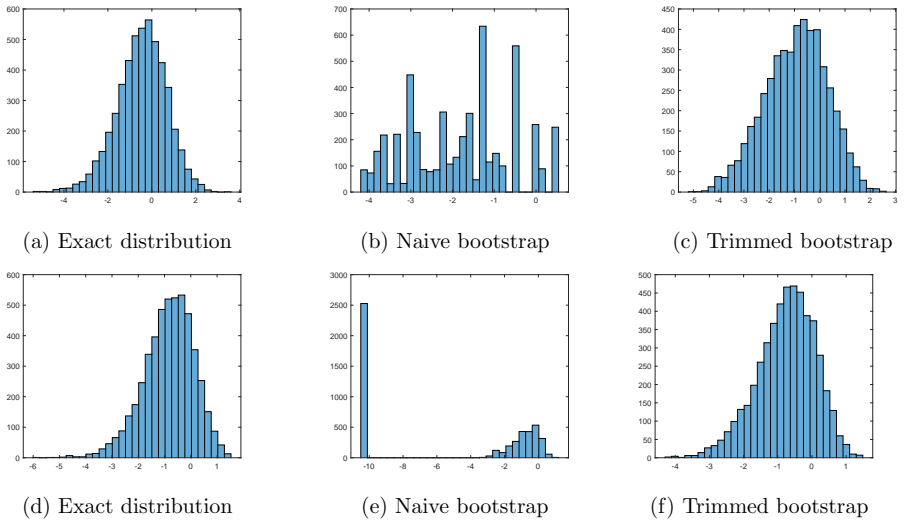
The central discovery is that the boundary-corrected isotonic estimator $\hat m(c n^{-a})$ is consistent for $m(0)$ and, for $a \in [1/3,1)$, converges at rate $n^{(1-a)/2}$ to a functional of the greatest convex minorant of Brownian motion. At $a=1/3$ the rate is $n^{1/3}$ and the limit is the left derivative at 1 of the greatest convex minorant of $\sqrt{\sigma^2(0)/(c f(0))}\,W_t + (t^2 c/2) m'(0)$, the boundary analogue of the interior-point cube-root law. For $a \in (1/3,1)$ the same limit holds under only $\gamma$-Hölder smoothness, and the trimmed wild bootstrap—which replaces the fitted curve on $[0, c n^{-a}]$ by its boundary value before generating multiplier residuals—is consistent without subsampling or smoothing. In the sharp RDD, $n^{1/3}(\hat\theta - \theta)$ converges to the difference of two independent such slope functionals on either side of the cutoff; in fuzzy designs a joint limit with isotonic treatment-probability fits applies. The paper also proves that the uncorrected estimator at the extreme observation $X_{(1)}$ is inconsistent and systematically understates $m(0)$.
Load-bearing premise
The recommended cube-root point estimator and its stated limiting distribution require the conditional mean to be strictly increasing at the cutoff ($m'(0)>0$); if the mean is flat near the cutoff, the quadratic drift in the limiting process disappears and the stated result no longer applies.
Editorial extensions
If this is right
- At $a = 1/3$, the boundary-corrected isotonic estimator achieves the same $n^{1/3}$ rate and non-normal GCM limit as the interior-point estimator, but for the boundary parameter $m(0)$.
- For $a \in (1/3,1)$, valid confidence intervals follow from the trimmed wild bootstrap without subsampling or nonparametric smoothing; the rule-of-thumb $a = 1/2$ gives $n^{-1/4}$ rate.
- The sharp RDD limit is the difference of two independent GCM slope functionals, giving a formal asymptotic distribution for monotone sharp designs.
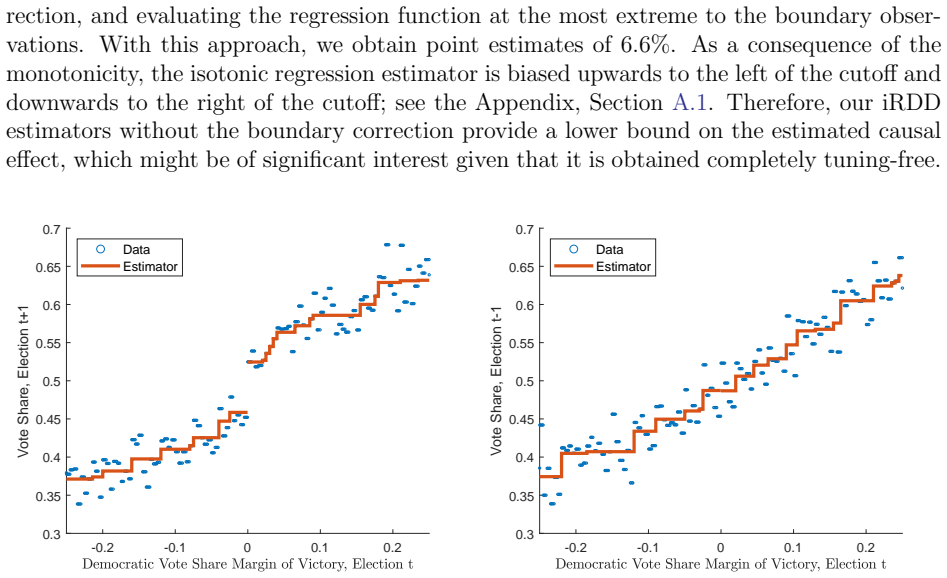
- The uncorrected boundary estimator is inconsistent and tends to understate $m(0)$, so a tuning-free isotonic RDD estimate acts as a lower bound on the causal effect.
- Simulations across monotone designs, including heteroskedastic and steep cases, show large MSE reductions for the iRDD estimator relative to local polynomial and $k$-nearest-neighbor estimators.
Reading between the lines
- The same boundary-correction-plus-trimming recipe should transfer to other shape-constrained estimators whose limits are GCM functionals, such as monotone density estimation at zero, where bootstrap consistency is otherwise delicate.
- Because the uncorrected boundary estimate is biased toward zero effect, one-sided inference on it could be made entirely tuning-free; the paper notes the lower-bound property but does not develop that inference.
- The simulation pattern in which larger $c$ raises bootstrap coverage suggests a data-driven coverage-optimal $c$ could close the remaining gap between nominal and empirical coverage; the paper leaves that choice open.
- A flat regression at the cutoff, where $m'(0)=0$, is excluded by the point-estimation theory; testing whether a pre-test for positive slope can select between the $a=1/3$ and $a>1/3$ regimes would be a direct follow-up.
Signed reviews
Editorial analysis
A structured set of objections, weighed in public.
Referee Report
Summary. The paper develops asymptotic theory for the isotonic regression estimator evaluated at boundary points of the covariate support, motivated by monotone regression discontinuity designs (iRDD). It shows that the natural estimator evaluated at the closest boundary observation is inconsistent, introduces boundary-corrected estimators evaluated at c n^{-a}, and derives their limit distributions for slow, cube-root, and fast correction rates (Theorem 2.1). It further proposes a trimmed wild bootstrap for the fast-correction regime and proves its consistency (Theorem 2.2), with sharp and fuzzy RDD analogues (Theorems 3.1-3.3). Monte Carlo experiments show large MSE improvements over local polynomial and k-NN estimators, and the method is applied to estimate the incumbency advantage in U.S. House elections. The proofs are detailed and, apart from the issues listed below, internally consistent.
Significance. If the stated results hold after the corrections requested below, this is a substantial contribution to both shape-constrained regression and regression discontinuity methodology. The paper provides a self-contained derivation of boundary limit theory for isotonic regression, including a novel treatment of tightness without strong approximation, and demonstrates that a wild bootstrap works at the boundary without subsampling or smoothing—a property known to fail at interior points. The explicit limit distributions, the consistent bootstrap procedure, and the detailed Monte Carlo evidence make the results immediately usable in practice. The empirical application to incumbency effects illustrates the method's relevance. The proofs are rigorous and the derivation is not circular; the main weakness is that one bootstrap theorem is misstated and another central theorem is stated without proof.
major comments (3)
- [Section 2.3, Theorem 2.2] The displayed statement compares two bootstrap probabilities, but the second term, Pr^*( n^{(1-a)/2}(\hat m(cn^{-a}) - m(0)) \le u ), is a random indicator conditional on the data because the event inside is measurable with respect to the original sample. As printed, the theorem is therefore false; it should be the unconditional probability Pr( n^{(1-a)/2}(\hat m(cn^{-a}) - m(0)) \le u ). The proof in the appendix actually establishes convergence of the bootstrap CDF to Pr( DL_{[0,\infty)}(\sqrt{\sigma^2(0)/(c f(0))} W_t )(1) \le u ) and then invokes Theorem 2.1(ii) for the unconditional limit, so the intended statement is clear and the correction is a single symbol. Note that Theorem 3.3 states the analogous result correctly with an unconditional probability, confirming the typo.
- [Section 3.4, Theorem 3.3] Theorem 3.3 is a central result for inference in the sharp iRDD and is used in the empirical application, but no proof is provided in the Appendix or Supplementary Material. The Appendix's "Proofs of main results" covers Theorems 2.1, 2.2, 3.1, 3.2, and Remark 2.1 only; Theorem 3.3 is stated and then the section moves on. Since the theorem concerns the bootstrap distribution of a difference of two boundary-corrected estimators, a proof or a detailed derivation from Theorem 2.2 together with the independence of the two sides must be added.
- [Section 3.3, Theorem 3.2] The fuzzy RDD theorem does not explicitly require p_+ \neq p_- (or p_+ > p_-), which is necessary for the denominator p_+ - p_- in the limit expression and for the fuzzy estimator to be well defined. The assumptions list p \in M[-1,1], p'_\pm > 0, and p_\pm \in (0,1), but a nondecreasing p can satisfy these with p_+ = p_-. The identification condition from Section 3.1, namely the discontinuity in the treatment assignment probability, should be added as an explicit assumption in Theorem 3.2.
minor comments (3)
- [Section 2.2, Assumption 2.1(iv)] The cube-root boundary limit at a = 1/3 requires m'(0) > 0, so the flat case m'(0) = 0 is outside the scope of the stated distribution. Since the paper recommends a = 1/3 for point estimation, a remark explaining that the limit changes when the derivative vanishes and that the method is not designed for that case would help readers assess applicability.
- [Table SM.4] At the recommended rule-of-thumb c = 1, the empirical coverage is approximately 0.85-0.91 for a nominal 95% level across n = 200, 500, 1000, which is a noticeable finite-sample undercoverage. The paper reports these numbers and notes that coverage improves with larger c, but given that c = 1 is the default recommendation used in the empirical section, a more explicit acknowledgment of this undercoverage would be appropriate.
- [Section 3.4, Theorem 3.3] The notation \check\theta and \check\theta^* is introduced in the text preceding the theorem, but the theorem statement should either define these quantities or reference the paragraph where they are defined, to avoid ambiguity for a reader who goes directly to the theorem.
Circularity Check
No circularity: the derivation chain is self-contained and does not reduce any prediction to its inputs.
full rationale
The paper's central claims are consistency and limit distributions for boundary-corrected isotonic regression estimators under Assumptions 2.1 and 3.1, plus a bootstrap consistency result. The proof of Theorem 2.1 constructs the empirical process Zn1/Zn2 and obtains the limit directly from covariance computations, Taylor expansions, VC-type maximal inequalities, and the Kim–Pollard argmax continuous mapping theorem; no target limit is assumed. Theorem 2.2's bootstrap proof explicitly uses Theorem 2.1(ii) to control the trimming term, which is normal proof structure rather than circularity, because the bootstrap target is the unconditional distribution of n^{(1-a)/2}(mhat(cn^{-a}) - m(0)), and the proof also establishes the bootstrap process converges to the same Brownian-motion functional independently. The RDD results in Theorems 3.1 and 3.2 follow from Theorem 2.1 applied to each side and the independence of the two samples; no result is used as an input in its own derivation. The tuning choices c=1, a=1/3 for point estimation and a=1/2 for inference are rules of thumb stated without fitting to the application data, and the empirical incumbency estimate is a fresh application of the derived estimator, not a prediction of fitted values. The supplementary MSE-optimal choice of c derived in Proposition SM.2.2 uses the paper's own limit theorem to compute a benchmark, but this is not a fitted-input-called-prediction step. The only notable issue found is a statement-level typo in Theorem 2.2, where the second probability should be unconditional, but the proof establishes the intended unconditional consistency, so this is not a circularity defect. Overall, no load-bearing step is equivalent by construction to its own assumptions.
Assumptions & free parameters
free parameters (2)
- c =
1 (rule-of-thumb; MC considers c*=0.345 from Kulikov-Lopuhaä)
- a =
1/3 for point estimation, 1/2 for inference
assumptions (9)
- domain assumption i.i.d. sample (Y_i,X_i) with E[|epsilon|^{2+delta}|X] <= C and bounded m
- domain assumption density f of X uniformly bounded away from 0 and infinity, f(0) exists
- domain assumption conditional variance sigma^2 bounded with sigma^2(0) existing
- domain assumption m continuously differentiable near 0 with m'(0) > 0, or gamma-Hölder with gamma > (1-a)/(2a) for a > 1/3
- domain assumption monotonicity m in M[0,1]
- domain assumption For fuzzy designs: p monotone, differentiable with p'_plus and p'_minus > 0, p_plus and p_minus in (0,1)
- domain assumption Potential outcomes framework and unconfoundedness/CI for fuzzy designs
- standard math Argmax continuous mapping theorem and Donsker properties for VC subgraph classes
- domain assumption Bootstrap multipliers eta_i i.i.d., mean 0, variance 1, finite 2+delta moment
Cite this review
Pith. "Pith review of Isotonic Regression Discontinuity Designs." pith.science (2026). https://pith.science/paper/EOIIWJQ2
@misc{pith2026190805752,
  author       = {Pith},
  title        = {Pith review of: Isotonic Regression Discontinuity Designs},
  year         = {2026},
  howpublished = {\url{https://pith.science/paper/EOIIWJQ2}},
  note         = {Machine review of arXiv:1908.05752}
}
read the original abstract
This paper studies the estimation and inference for the isotonic regression at the boundary point, an object that is particularly interesting and required in the analysis of monotone regression discontinuity designs. We show that the isotonic regression is inconsistent in this setting and derive the asymptotic distributions of boundary corrected estimators. Interestingly, the boundary corrected estimators can be bootstrapped without subsampling or additional nonparametric smoothing which is not the case for the interior point. The Monte Carlo experiments indicate that shape restrictions can improve dramatically the finite-sample performance of unrestricted estimators. Lastly, we apply the isotonic regression discontinuity designs to estimate the causal effect of incumbency in the U.S. House elections.
Figures

Reference graph
Works this paper leans on
-
[1]
A. Abadie and M. Cattaneo. Econometric methods for program evaluation. Annual Review of Economics, 10: 0 465--503, 2018. doi:10.1146/annurev-economics-080217-053402
-
[2]
A. Abdulkadiroǧlu, J. Angrist, and P. Pathak. The elite illusion: Achievement effects at boston and new york exam schools. Econometrica, 82 0 (1): 0 137--196, 2014. doi:10.3982/ECTA10266
-
[3]
J. Abrevaya and J. Huang. On the bootstrap of the maximum score estimator. Econometrica, 73 0 (4): 0 1175--1204, 2005. doi:10.1111/j.1468-0262.2005.00613.x
arXiv 2005
-
[4]
D. Anevski and O. Hössjer. Monotone regression and density function estimation at a point of discontinuity. Journal of Nonparametric Statistics, 14 0 (3): 0 279--294, 2002. doi:10.1080/10485250212380
-
[5]
J. Angrist and M. Rokkanen. Wanna get away? regression discontinuity estimation of exam school effects away from the cutoff. Journal of the American Statistical Association, 110 0 (512): 0 1331--1344, 2015. doi:10.1080/01621459.2015.1012259
arXiv 2015
-
[6]
J. D. Angrist and J.-S. Pischke. Mostly harmless econometrics: An empiricist's companion. Princeton University Press, 2008. doi:10.1515/9781400829828
-
[7]
T. Armstrong. Adaptive testing on a regression function at a point. Annals of Statistics, 43 0 (5): 0 2086--2101, 2015. doi:10.1214/15-AOS1342
-
[8]
M. Ayer, H. D. Brunk, G. M. Ewing, W. T. Reid, and E. Silverman. An empirical distribution function for sampling with incomplete information. The Annals of Mathematical Statistics, 26 0 (4): 0 641--647, 1955. doi:10.1214/aoms/1177728423s
arXiv 1955
Show all 80 references
-
[9]
Balabdaoui, H
F. Balabdaoui, H. Jankowski, M. Pavlides, A. Seregin, and J. Wellner. On the grenander estimator at zero. Statistica Sinica, 21 0 (2): 0 873--899, 2011. doi:10.5705/ss.2011.038a
2011 doi
-
[10]
R. E. Barlow, D. Bartholomew, J. Bremner, and H. Brunk. Statistical inference under order restrictions: The theory and application of isotonic regression. Wiley New York, 1972
1972
-
[11]
Baum-Snow and J
N. Baum-Snow and J. Marion. The effects of low income housing tax credit developments on neighborhoods. Journal of Public Economics, 93 0 (5-6): 0 654--666, 2009. doi:10.1016/j.jpubeco.2009.01.001
2009 doi
-
[12]
Bertanha
M. Bertanha. Regression discontinuity design with many thresholds. Journal of Econometrics, 218 0 (1): 0 216--241, 2020. doi:10.1016/j.jeconom.2019.09.010
2020 doi
-
[13]
H. Brunk. On an inequality for convex functions. Proceedings of the American Mathematical Society, 7 0 (5): 0 817--824, 1956. doi:10.1090/S0002-9939-1956-0081371-9
1956 doi
-
[14]
H. Brunk. Estimation of isotonic regression. In Nonparametric Techniques in Statistical Inference, pages 177--197. Cambridge University Press, 1970
1970
-
[15]
Buettner
T. Buettner. The incentive effect of fiscal equalization transfers on tax policy. Journal of Public Economics, 90 0 (3): 0 477--497, 2006. doi:10.1016/j.jpubeco.2005.09.004
2006 doi
-
[16]
Bugni and I
F. Bugni and I. Canay. Testing continuity of a density via g-order statistics in the regression discontinuity design. Journal of Econometrics, 2020. doi:10.1016/j.jeconom.2020.02.004
2020 doi
-
[17]
Calonico, M
S. Calonico, M. Cattaneo, and R. Titiunik. Robust nonparametric confidence intervals for regression-discontinuity designs. Econometrica, 82 0 (6): 0 2295--2326, 2014. doi:10.3982/ECTA11757
2014 doi
-
[18]
Calonico, M
S. Calonico, M. Cattaneo, M. Farrell, and R. Titiunik. Regression discontinuity designs using covariates. Review of Economics and Statistics, 101 0 (3): 0 442--451, 2019. doi:10.1162/rest_a_00760
2019 doi
-
[19]
Calonico, M
S. Calonico, M. D. Cattaneo, and M. H. Farrell. Optimal bandwidth choice for robust bias-corrected inference in regression discontinuity designs. The Econometrics Journal, 23 0 (2): 0 192--210, 2020. doi:10.1093/ectj/utz022
2020 doi
-
[20]
Canay and V
I. Canay and V. Kamat. Approximate permutation tests and induced order statistics in the regression discontinuity design. Review of Economic Studies, 85 0 (3): 0 1577--1608, 2018. doi:10.1093/restud/rdx062
2018 doi
-
[21]
D. Card, R. Chetty, and A. Weber. Cash-on-hand and competing models of intertemporal behavior: New evidence from the labor market. Quarterly Journal of Economics, 122 0 (4): 0 1511--1560, 2007. doi:10.1162/qjec.2007.122.4.1511
2007 doi
-
[22]
D. Card, C. Dobkin, and N. Maestas. The impact of nearly universal insurance coverage on health care utilization: Evidence from medicare. American Economic Review, 98 0 (5): 0 2242--2258, 2008. doi:10.1257/aer.98.5.2242
2008 doi
-
[23]
Carpenter and C
C. Carpenter and C. Dobkin. The effect of alcohol consumption on mortality: Regression discontinuity evidence from the minimum drinking age. American Economic Journal: Applied Economics, 1 0 (1): 0 164--182, 2009. doi:10.1257/app.1.1.164
2009 doi
-
[24]
Cattaneo, M
M. Cattaneo, M. Jansson, and X. Ma. Simple local polynomial density estimators. Journal of the American Statistical Association, 115 0 (531): 0 1449--1455, 2020 a . doi:10.1080/01621459.2019.1635480
2020
-
[25]
Cattaneo, M
M. Cattaneo, M. Jansson, and K. Nagasawa. Bootstrap-based inference for cube root asymptotics. Econometrica, 88 0 (5): 0 2203--2219, 2020 b . doi:10.3982/ECTA17950
2020 doi
-
[26]
M. D. Cattaneo, N. Idrobo, and R. Titiunik. A Practical Introduction to Regression Discontinuity Designs: Foundations. Cambridge University Press, 2020 c . doi:10.1017/9781108684606
2020 doi
-
[27]
K. Y. Chay and M. Greenstone. Does air quality matter? evidence from the housing market. Journal of political Economy, 113 0 (2): 0 376--424, 2005. doi:10.1086/427462
2005 doi
-
[28]
Chernozhukov, W
V. Chernozhukov, W. K. Newey, and A. Santos. Constrained conditional moment restriction models. arXiv:1509.06311, 2015
2015 arXiv
-
[29]
Chetverikov
D. Chetverikov. Testing regression monotonicity in econometric models. Econometric Theory, 35 0 (4): 0 729--776, 2019. doi:10.1017/S0266466618000282
2019 doi
-
[30]
Chetverikov, A
D. Chetverikov, A. Santos, and A. Shaikh. The econometrics of shape restrictions. Annual Review of Economics, 10: 0 31--63, 2018. doi:10.1146/annurev-economics-080217-053417
2018 doi
-
[31]
H. Chiang. How accountability pressure on failing schools affects student achievement. Journal of Public Economics, 93 0 (9-10): 0 1045--1057, 2009. doi:10.1016/j.jpubeco.2009.06.002
2009 doi
-
[32]
D. Clark. Selective schools and academic achievement. The BE Journal of Economic Analysis & Policy, 10 0 (1), 2010. doi:10.2202/1935-1682.1917
2010
-
[33]
M. C. Cummings Jr. Congressmen and the Electorate: Elections for the U. S. House and the President, 1920--1964. Free Press, New York, 1967
1920
-
[34]
Delgado, J
M. Delgado, J. Rodríguez-Poo, and M. Wolf. Subsampling inference in cube root asymptotics with an application to manski's maximum score estimator. Economics Letters, 73 0 (2): 0 241--250, 2001. doi:10.1016/S0165-1765(01)00494-3
2001 doi
-
[35]
Duflo, P
E. Duflo, P. Dupas, and M. Kremer. Peer effects, teacher incentives, and the impact of tracking: Evidence from a randomized evaluation in kenya. American Economic Review, 101 0 (5): 0 1739--1774, 2011. doi:10.1257/aer.101.5.1739
2011 doi
-
[36]
Durot and H
C. Durot and H. Lopuhaä. Limit theory in monotone function estimation. Statistical Science, 33 0 (4): 0 547--567, 2018. doi:10.1214/18-STS664
2018 doi
-
[37]
J. C. Escanciano and M. D. Cattaneo. Regression discontinuity designs: theory and applications (Advances in Econometrics, volume 38). Emerald Group Publishing, 2017. doi:10.1108/s0731-9053201738
2017 doi
-
[38]
Fan and I
J. Fan and I. Gijbels. Variable bandwidth and local linear regression smoothers. Annals of Statistics, 20 0 (4): 0 2008--2036, 1992. doi:10.1214/aos/1176348900s
2008
-
[39]
Ferreira
F. Ferreira. You can take it with you: Proposition 13 tax benefits, residential mobility, and willingness to pay for housing amenities. Journal of Public Economics, 94 0 (9-10): 0 661--673, 2010. doi:10.1016/j.jpubeco.2010.04.003
2010 doi
-
[40]
Gelman and G
A. Gelman and G. Imbens. Why high-order polynomials should not be used in regression discontinuity designs. Journal of Business and Economic Statistics, 37 0 (3): 0 447--456, 2019. doi:10.1080/07350015.2017.1366909
2019
-
[41]
Greenstone and J
M. Greenstone and J. Gallagher. Does hazardous waste matter? evidence from the housing market and the superfund program. The Quarterly Journal of Economics, 123 0 (3): 0 951--1003, 2008. doi:10.1162/qjec.2008.123.3.951
2008 doi
-
[42]
Grenander
U. Grenander. On the theory of mortality measurement. Scandinavian Actuarial Journal, 1956 0 (2): 0 125--153, 1956. doi:10.1080/03461238.1956.10414944
1956
-
[43]
Groeneboom
P. Groeneboom. The concave majorant of brownian motion. Annals of Probability, 11 0 (4): 0 1016--1027, 1983. doi:10.1214/aop/1176993450
1983
-
[44]
Groeneboom and G
P. Groeneboom and G. Jongbloed. Nonparametric estimation under shape constraints. Cambridge University Press, 2014. doi:10.1017/cbo9781139020893
2014 doi
-
[45]
Guntuboyina and B
A. Guntuboyina and B. Sen. Nonparametric shape-restricted regression. Statistical Science, 33 0 (4): 0 568--594, 2018. doi:10.1214/18-STS665
2018 doi
-
[46]
J. Hahn, P. Todd, and W. Van Der Klaauw. Identification and estimation of treatment effects with a regression-discontinuity design. Econometrica, 69 0 (1): 0 201--209, 2001. doi:10.1111/1468-0262.00183
2001
-
[47]
Han and K
Q. Han and K. Kato. Berry-esseen bounds for chernoff-type non-standard asymptotics in isotonic regression. arXiv:1910.09662, 2019
1910 arXiv
-
[48]
Hoekstra
M. Hoekstra. The effect of attending the flagship state university on earnings: A discontinuity-based approach. Review of Economics and Statistics, 91 0 (4): 0 717--724, 2009. doi:10.1162/rest.91.4.717
2009 doi
-
[49]
P. W. Holland. Statistics and causal inference. Journal of the American Statistical Association, 81 0 (396): 0 945--960, 1986. doi:10.2307/2289064
1986 doi
-
[50]
Imbens and T
G. Imbens and T. Lemieux. Regression discontinuity designs: A guide to practice. Journal of Econometrics, 142 0 (2): 0 615--635, 2008. doi:10.1016/j.jeconom.2007.05.001
2008 doi
-
[51]
Imbens and J
G. Imbens and J. Wooldridge. Recent developments in the econometrics of program evaluation. Journal of Economic Literature, 47 0 (1): 0 5--86, 2009. doi:10.1257/jel.47.1.5
2009 doi
-
[52]
B. A. Jacob and L. Lefgren. Remedial education and student achievement: A regression-discontinuity analysis. Review of economics and statistics, 86 0 (1): 0 226--244, 2004. doi:10.1162/003465304323023778
2004 doi
-
[53]
Kaniel and R
R. Kaniel and R. Parham. Wsj category kings – the impact of media attention on consumer and mutual fund investment decisions. Journal of Financial Economics, 123 0 (2): 0 337--356, 2017. doi:10.1016/j.jfineco.2016.11.003
2017 doi
-
[54]
Kim and D
J. Kim and D. Pollard. Cube root asymptotics. Annals of Statistics, 18 0 (1): 0 191--219, 1990. doi:10.1214/aos/1176347498
1990
-
[55]
Koltchinskii
V. Koltchinskii. Komlos-major-tusnady approximation for the general empirical process and haar expansions of classes of functions. Journal of Theoretical Probability, 7 0 (1): 0 73--118, 1994. doi:10.1007/BF02213361
1994 doi
-
[56]
M. R. Kosorok. Bootstrapping the grenander estimator. In Beyond parametrics in interdisciplinary research: Festschrift in honor of Professor Pranab K. Sen, volume 1, pages 282--292. Institute of Mathematical Statistics, 2008 a . doi:10.1214/193940307000000202
2008 doi
-
[57]
M. R. Kosorok. Introduction to empirical processes and semiparametric inference. Springer, 2008 b . doi:10.1007/978-0-387-74978-5
2008 doi
-
[58]
Kulikov and H
V. Kulikov and H. Lopuha\" a . The behavior of the npmle of a decreasing density near the boundaries of the support. Annals of Statistics, 34 0 (2): 0 742--768, 2006. doi:10.1214/009053606000000100
2006 doi
-
[59]
R. Lalive. Unemployment benefits, unemployment duration, and post-unemployment jobs: A regression discontinuity approach. American Economic Review, 97 0 (2): 0 108--112, 2007. doi:10.1257/aer.97.2.108
2007 doi
-
[60]
Lazarus, D
E. Lazarus, D. Lewis, J. Stock, and M. Watson. Har inference: Recommendations for practice. Journal of Business and Economic Statistics, 36 0 (4): 0 541--559, 2018. doi:10.1080/07350015.2018.1506926
2018
-
[61]
D. Lee. Randomized experiments from non-random selection in u.s. house elections. Journal of Econometrics, 142 0 (2): 0 675--697, 2008. doi:10.1016/j.jeconom.2007.05.004
2008 doi
-
[62]
Lee and T
D. Lee and T. Lemieux. Regression discontinuity designs in economics. Journal of Economic Literature, 48 0 (2): 0 281--355, 2010. doi:10.1257/jel.48.2.281
2010 doi
-
[63]
L\' e ger and B
C. L\' e ger and B. Macgibbon. On the bootstrap in cube root asymptotics. Canadian Journal of Statistics, 34 0 (1): 0 29--44, 2006. doi:10.1002/cjs.5550340104
2006 doi
-
[64]
Litschig and K
S. Litschig and K. Morrison. The impact of intergovernmental transfers on education outcomes and poverty reduction. American Economic Journal: Applied Economics, 5 0 (4): 0 206--240, 2013. doi:10.1257/app.5.4.206
2013 doi
-
[65]
R. Y. Liu. Bootstrap procedures under some non-i.i.d. models. Annals of Statistics, 16 0 (4): 0 1696--1708, 1988. doi:10.1214/aos/1176351062
1988
-
[66]
Lucas and I
A. Lucas and I. Mbiti. Effects of school quality on student achievement: Discontinuity evidence from kenya. American Economic Journal: Applied Economics, 6 0 (3): 0 234--263, 2014. doi:10.1257/app.6.3.234
2014 doi
-
[67]
Ludwig and D
J. Ludwig and D. Miller. Does head start improve children's life chances? evidence from a regression discontinuity design. Quarterly Journal of Economics, 122 0 (1): 0 159--208, 2007. doi:10.1162/qjec.122.1.159
2007 doi
-
[68]
Matsudaira
J. Matsudaira. Mandatory summer school and student achievement. Journal of Econometrics, 142 0 (2): 0 829--850, 2008. doi:10.1016/j.jeconom.2007.05.015
2008 doi
-
[69]
J. McCrary. Manipulation of the running variable in the regression discontinuity design: A density test. Journal of Econometrics, 142 0 (2): 0 698--714, 2008. doi:10.1016/j.jeconom.2007.05.005
2008 doi
-
[70]
Patra, E
R. Patra, E. Seijo, and B. Sen. A consistent bootstrap procedure for the maximum score estimator. Journal of Econometrics, 205 0 (2): 0 488--507, 2018. doi:10.1016/j.jeconom.2018.04.001
2018 doi
-
[71]
B. P. Rao. Estimation of a unimodal density. Sankhy \=a : Indian Journal of Statistics, Series A , 31 0 (1): 0 23--36, 1969
1969
-
[72]
W. Rudin. Principles of mathematical analysis. McGraw-Hill New York, 1976
1976
-
[73]
Schmieder, T
J. Schmieder, T. von wachter, and S. Bender. The effects of extended unemployment insurance over the business cycle: Evidence from regression discontinuity estimates over 20 years. Quarterly Journal of Economics, 127 0 (2): 0 701--752, 2012. doi:10.1093/qje/qjs010
2012 doi
-
[74]
B. Sen, M. Banerjee, and M. Woodroofe. Inconsistency of bootstrap: The grenander estimator. Annals of Statistics, 38 0 (4): 0 1953--1977, 2010. doi:10.1214/09-AOS777
1953 doi
-
[75]
Shigeoka
H. Shigeoka. The effect of patient cost sharing on utilization, health, and risk protection. American Economic Review, 104 0 (7): 0 2152--2184, 2014. doi:10.1257/aer.104.7.2152
2014 doi
-
[76]
Thistlethwaite and D
D. Thistlethwaite and D. Campbell. Regression-discontinuity analysis: An alternative to the ex post facto experiment. Journal of Educational Psychology, 51 0 (6): 0 309--317, 1960. doi:10.1037/h0044319
1960 doi
-
[77]
A. W. van der Vaart and J. A. Wellner. Weak convergence and empirical processes: with applications to statistics. Springer, New York, 1996. doi:10.1007/978-1-4757-2545-2
1996 doi
-
[78]
Woodroofe and J
M. Woodroofe and J. Sun. A penalized maximum likelihood estimate of f(0+) when f is non-increasing. Statistica Sinica, 3 0 (2): 0 501--515, 1993
1993
-
[79]
F. Wright. The asymptotic behavior of monotone regression estimates. Annals of Statistics, 9 0 (2): 0 443--448, 1981. doi:10.1214/aos/1176345411
1981
-
[80]
C. Wu. Jackknife, bootstrap and other resampling methods in regression analysis. Annals of Statistics, 14 0 (4): 0 1261--1295, 1986. doi:10.1214/aos/1176350142
1986
Reviewed August 14, 2026 · model on record in the stance chip above.
Discussion (0). Continue with ORCID to comment.