REVIEW 2 major objections 6 minor 1 cited by
Agent psychometrics: Task-level performance prediction in agentic coding benchmarks
T0 review · 2 major / 6 minor · reviewed 2026-08-02 · deepseek-v4-flash
Pith's one-line read Agentic coding success can be predicted task-by-task from additive LLM and scaffold abilities.
desk verdict Solid workshop-grade paper: the additive LLM+scaffold ability decomposition is the genuinely new piece, held-out-agent results back it up, but missing error bars, nested model selection, and an overstated abstract keep it from being more than that. read the letter →
The pith
A machine-rendered reading of the paper's core claim, the machinery that carries it, and where it could break.
The reading
What carries the argument
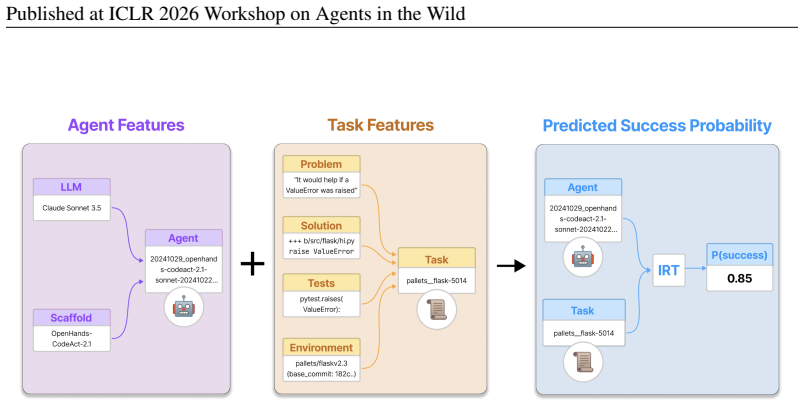
The central object is the augmented IRT model P(y=1) = σ(θ_LLM + θ_scaffold − β_task). θ_LLM and θ_scaffold are per-LLM and per-scaffold latent ability parameters; their additive combination is what allows heterogeneous leaderboards to be stitched together when full agents rarely overlap. β_task is a task difficulty that is predicted by a linear model from static features: embeddings from an instruction-tuned LLM and a fixed set of LLM-judged rubric scores (solution hint, required domain knowledge, verification difficulty, and so on), sometimes concatenated. This machinery turns the two sources of evaluation cost—new tasks and new agent configurations—into predictions from cheap, static inpu
What would settle it
On a benchmark where at least one LLM is paired with many scaffolds and one scaffold with many LLMs, fit both the additive model and a model with pairwise interaction terms; if the interaction model yields materially better held-out AUC-ROC or more accurate calibration, the additive decomposition is insufficient. A complementary check is to evaluate a held-out LLM-scaffold pair never seen together and compare per-task predicted probabilities against actual pass rates—systematic signed errors would show that θ_LLM + θ_scaffold misses a dependency.
Extended reading notes
Core claim
The paper's central claim is that standard Item Response Theory, extended with task features and an additive LLM-scaffold ability decomposition, accurately predicts task-level success in the agentic coding regime. The model sets P(success) = σ(θ_LLM + θ_scaffold − β_task), where θ_LLM and θ_scaffold are latent abilities for every observed LLM and scaffold, and β_task is a latent task difficulty predicted from task embeddings and LLM-as-a-judge rubric features. On held-out responses the method performs on par with standard IRT, while adding the ability to predict held-out LLM-scaffold combinations (AUC-ROC 0.921–0.936) and entire held-out benchmarks (AUC-ROC 0.677–0.735), beating the baseline
Load-bearing premise
The load-bearing premise is that an agent's ability is exactly the sum of its LLM's ability and its scaffold's ability, with no interaction; the authors validate this on limited scaffold diversity in one benchmark and explicitly caution that co-adapted model-scaffold pairs could break it.
Editorial extensions
If this is right
- Benchmark designers can estimate the difficulty of new tasks without running any agent evaluation, by extracting task features and reading off the predicted difficulty.
- Agent developers can estimate ability on a benchmark from a small adaptively chosen subset of tasks, with the paper showing gains over random selection at budgets below about 30 tasks.
- Leaderboards from different benchmarks can be placed on a common ability scale through shared LLM and scaffold parameters, making cross-benchmark comparison possible.
- The learned scaffold abilities give a quantitative ranking of scaffolds, so scaffold choice can be informed by a stable contribution term rather than full re-evaluation.
- Task-level success probabilities can be used to select reinforcement-learning rollouts near an agent's current ability, improving the training signal.
Reading between the lines
- If the additive decomposition holds broadly, then scaffold contribution is LLM-independent: the same scaffold advantage applies to any model, so scaffold rankings should transfer across LLM generations without fresh evaluations.
- The same recipe—feature-predicted task difficulty plus additive component abilities—is directly portable to other agentic domains (web automation, tool use, database agents) whenever the agent is an LLM plus a scaffold and tasks can be encoded as text-plus-artifacts.
- A natural stress test is to refit the model with an interaction term on data where each LLM has several scaffolds; if interaction terms consistently improve held-out prediction, the additivity assumption is false.
- The method's current dependence on reference solutions and test patches means difficulty prediction is strongest after a task is fully specified; predicting from the problem statement and repository alone, which the ablation suggests is weaker, would be a useful extension for very early task drafting.
Editorial analysis
A structured set of objections, weighed in public.
Referee Report
Summary. The paper proposes AgentPsychometrics, an IRT-based framework for predicting binary success/failure of LLM coding agents on individual agentic coding tasks. Task difficulty is modeled from rich features (embeddings, LLM-as-a-judge rubric features, repository/test/solution artifacts), and agent ability is decomposed additively as the sum of an LLM ability and a scaffold ability (Eq. 1). The framework is evaluated on four benchmarks (SWE-bench Verified, SWE-bench Pro, Terminal-Bench 2.0, GSO) in four held-out settings: held-out tasks, held-out random responses, held-out LLM-scaffold combinations, and held-out benchmarks. Headline results are AUC-ROC 0.921--0.936 for New Agents (Table 4) and 0.677--0.735 for New Benchmarks (Table 5), beating baselines; an adaptive task-selection application is also presented.
Significance. If the additive decomposition is valid, the paper makes a practical contribution: it aggregates sparse leaderboard data across benchmarks that share LLMs or scaffolds, and it can predict task-level outcomes for unseen tasks without running expensive agent evaluations. The strengths of the paper are its public code release, the breadth of feature-source ablations, the use of standard IRT as a reference point, and a concrete downstream application. The principal risk is that the load-bearing assumption of zero LLM--scaffold interaction is validated only indirectly; the paper itself concedes in Section 6 that the independence 'may cease to hold.' Because all multi-benchmark stitching and held-out-agent predictions inherit this assumption, the evidence needs to be strengthened rather than assumed.
major comments (2)
- [§3.2.2 (Eq. 1), §6, App. D.3/G.1, Fig. 2] Eq. (1) is the linchpin of the multi-benchmark stitching and of the New Agents / New Benchmarks claims, but the current validation does not rule out material LLM×scaffold interactions. The New Responses experiment (App. G.1, Table 12) holds out random responses while keeping every agent in training, so any interaction shared by observed pairs is absorbed into the fitted additive parameters; it cannot detect the misspecification that matters for unseen pairs. The fixed-scaffold check (Fig. 2) is n=32 on one benchmark and mostly confirms LLM ordering. The functional form itself was selected on SWE-bench Verified among five candidates (App. D.3), making the additive choice partly in-sample. If true ability is θ_m + θ_s + γ_ms, predictions for held-out combinations omit γ, and since scaffold usage is correlated with benchmark composition, Table 5 inherits this bias. Please add a direct inter
- [Tables 2, 4, 5; §4] No confidence intervals or significance tests are reported for the headline AUCs, despite 5-fold CV and text claiming that predictors 'significantly beat the baseline.' In Table 5 the gaps are modest and inconsistent across feature types (e.g., Combined 0.677 vs. LLM-as-judge 0.696 on SWE-bench Pro; Combined 0.719 vs. LLM-as-judge 0.735 on GSO), so the 'Combined' advantage is not stable in the out-of-distribution setting. Report bootstrap CIs or paired fold-wise tests, and state how many held-out agents and tasks contribute to each fold, especially after filtering agents with novel LLMs/scaffolds.
minor comments (6)
- [§2.2] The paragraph beginning 'Several works have explored using IRT...' is repeated almost verbatim; remove the duplicate.
- [§5.3, Table 5] Combining feature vectors does not consistently beat the individual LLM-as-judge vectors in the held-out-benchmark setting; the text should acknowledge this rather than implying combination is always beneficial.
- [App. D.3] The formulas for 'Product' and 'L2 norms' need sign conventions; as written, sign(θ_m+θ_s)θ_mθ_s and sign(θ_m+θ_s)√(θ_m²+θ_s²) are hard to interpret without further definition.
- [Fig. 2] Report a confidence interval for r=0.974 and state whether the n=32 points are distinct LLMs; also fix spacing artifacts in the axis labels.
- [§5.3, Tables 4--5] State the number of held-out agents and tasks per fold. The filtering of agents with novel LLMs/scaffolds is described but counts are omitted, making the strength of the held-out claims hard to assess.
- [General] Because benchmark designers are the stated end users, AUC-ROC alone does not guarantee well-calibrated difficulty estimates; a calibration check (Brier score or reliability diagram) would strengthen the practical claims.
Circularity Check
No significant circularity: held-out agent and benchmark predictions are genuine out-of-sample evaluations of an empirically tested additive model; no load-bearing reduction to fitted inputs.
full rationale
The paper's central predictions are true out-of-sample evaluations. Task difficulties are first estimated by IRT from training responses, then a ridge regressor is trained to predict those frozen difficulty values from task features and evaluated on held-out tasks or whole held-out benchmarks; this is a standard two-stage supervised pipeline, not a re-use of the label as a prediction. The additive decomposition θ_agent = θ_LLM + θ_scaffold (Eq. 1) is an explicit modeling assumption, not a tautology: θ_LLM and θ_scaffold are fitted from responses of other agents sharing those components, and the 'New Responses' experiment compares this constrained model against unconstrained standard IRT on held-out responses, while 'New Agents' and 'New Benchmarks' hold out entire LLM-scaffold combinations or benchmarks. The functional form was selected among five candidates on validation folds (Appendix D.3), which is model selection, not circularity. The Terminal-Bench fixed-scaffold correlation (Figure 2) is a consistency check between two models fit on overlapping data; it is not an independent prediction, but it is not load-bearing because the additivity claim is also supported by the held-out response comparison. There are no self-citations and no imported uniqueness theorems. The acknowledged limitation that scaffold–LLM co-adaptation may break independence (Section 6) is an external-validity concern, not a circular-derivation concern.
Assumptions & free parameters
free parameters (8)
- Task difficulty parameters β_j (one per task) =
Estimated via SVI IRT on response data; values not listed in main text
- LLM ability parameters θ_m (one per LLM) =
Range -5.014 (GPT-3.5) to 3.660 (Gemini 3.1 Pro) in Table 13
- Scaffold ability parameters θ_s (one per scaffold) =
Range -2.954 (RAG) to 1.453 (AgentScope) in Table 14
- Embedding backbone selection =
DeepSeek-R1-Distill-Qwen-32B chosen by best SWE-bench Verified AUC (0.824±0.020 among 17 backbones)
- LLM-as-judge feature extraction models =
Claude Opus 4.6 for judge features; GPT-5.4 for auditor agent
- Manual 15-feature LLM-as-judge subset =
10 statement + 1 test + 1 solution + 3 environment features
- Ridge regularization hyperparameters =
Chosen by 5-fold cross-validation MSE within training set
- Terminal-Bench 2.0 pass threshold =
At least 50% of attempts successful
assumptions (6)
- standard math One-dimensional 1PL IRT: P(y=1|θ,β)=σ(θ-β)
- domain assumption Agent ability is additive: θ_agent = θ_LLM + θ_scaffold
- domain assumption Cross-benchmark comparability of ability and difficulty scales in multi-benchmark IRT
- domain assumption IRT difficulty estimates from response data are a valid regression target for task features
- domain assumption Task feature-difficulty relationships transfer out-of-distribution to new benchmarks
- standard math SVI with hierarchical priors resolves identifiability of additive ability parameters
Cite this review
Pith. "Pith review of Agent psychometrics: Task-level performance prediction in agentic coding benchmarks." pith.science (2026). https://pith.science/paper/EPDCRWPQ
@misc{pith2026260400594,
  author       = {Pith},
  title        = {Pith review of: Agent psychometrics: Task-level performance prediction in agentic coding benchmarks},
  year         = {2026},
  howpublished = {\url{https://pith.science/paper/EPDCRWPQ}},
  note         = {Machine review of arXiv:2604.00594}
}
read the original abstract
As the focus in LLM-based coding shifts from static single-step code generation to multi-step agentic interaction with tools and environments, understanding which tasks will challenge agents and why becomes increasingly difficult. This is compounded by current practice: agent performance is typically measured by aggregate pass rates on benchmarks, but single-number metrics obscure the diversity of tasks within a benchmark. We present a framework for predicting success or failure on individual tasks tailored to the agentic coding regime. Our approach augments Item Response Theory (IRT) with rich features extracted from tasks, including issue statements, repository contexts, solutions, and test cases, and introduces a novel decomposition of agent ability into LLM and scaffold ability components. This parameterization enables us to aggregate evaluation data across heterogeneous leaderboards and accurately predict task-level performance for unseen benchmarks, as well as unseen LLM-scaffold combinations. Our methods have practical utility for benchmark designers, who can better calibrate the difficulty of their new tasks without running computationally expensive agent evaluations.
Figures


Figures from the paper (1 more)

Forward citations
Cited by 1 Pith paper
-
Messier: A High-Resolution Corpus for Cross-Benchmark Agent Evaluation
A unified corpus of 957k trial outcomes shows frontier progress is uneven and strict all-pass aggregation obscures capability and can reorder agents.
Reference graph
Works this paper leans on
-
[1]
Explore the working directory to understand the project structure
-
[2]
Read the problem statement (provided as input)
-
[3]
Try to understand the scope and complexity of the task
-
[4]
Check available tools, tests, and dependencies
-
[5]
value" (1-5 integer) and
Rate the environment on the 8 axes below ## Features to Assess (1-5 scale) ### Fix Localization (fix_localization: 1-5) How spread out is the likely solution? - 1: Solution requires changes across many modules/packages - 2: Solution spans multiple files across different directories - 3: Solution spans 2-3 files in the same module - 4: Solution is in 1-2 c...
2026
-
[2025]
hello") plt.subplot(3, 3, 4) plt.imshow(data) + plt.ylabel(
URLhttps://satsuite.collegeboard.org/media/pdf/ sat-sd-essay-understanding-scores-educators.pdf. Xiang Deng, Jeff Da, Edwin Pan, Yannis Yiming He, Charles Ide, Kanak Garg, Niklas Lauffer, Andrew Park, Nitin Pasari, Chetan Rane, Karmini Sampath, Maya Krishnan, Srivatsa Kundurthy, Sean Hendryx, Zifan Wang, Vijay Bharadwaj, Jeff Holm, Raja Aluri, Chen Bo Cal...
arXiv 2025
Reviewed August 2, 2026 · model on record in the stance chip above.
Discussion (0). Sign in to comment.