Getting to know the Stellar Clusters in NGC 1569: Bayesian inference of stellar cluster properties in a dwarf starburst galaxy
Pith reviewed 2026-06-27 09:00 UTC · model grok-4.3
The pith
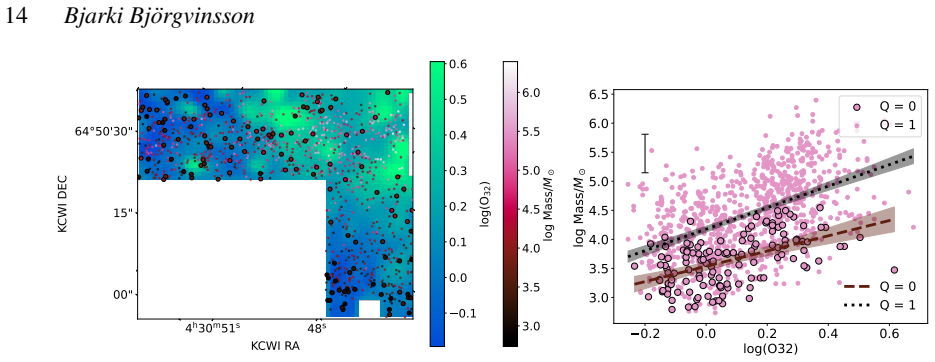
Bayesian forward modeling of clusters in NGC 1569 reveals truncation mass varying with galactocentric distance and positive correlations of cluster mass with local metallicity and gas ionization.
A machine-rendered reading of the paper's core claim, the machinery that carries it, and where it could break.
Core claim
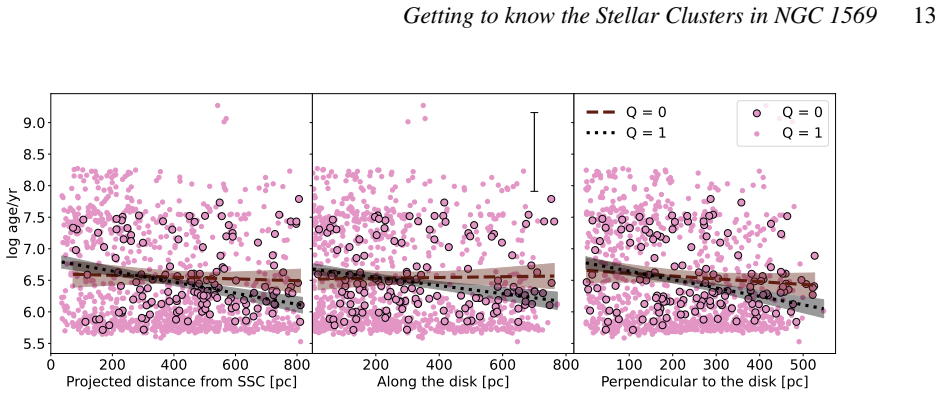
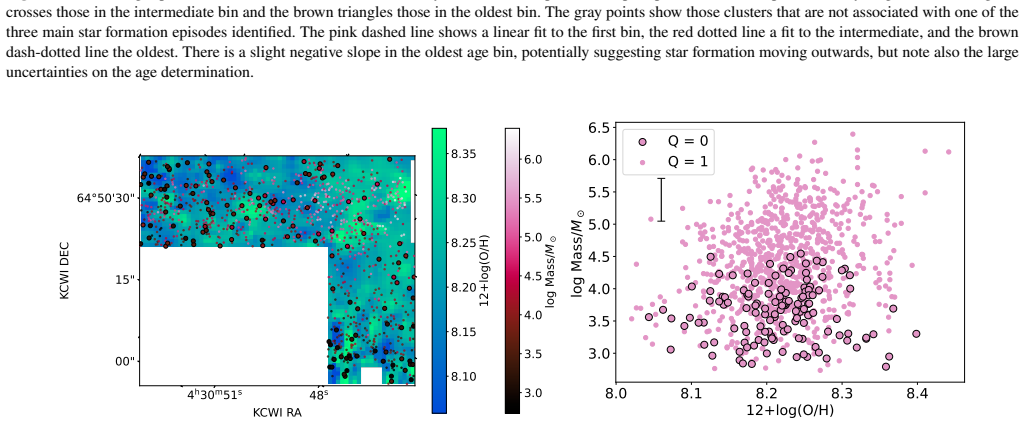
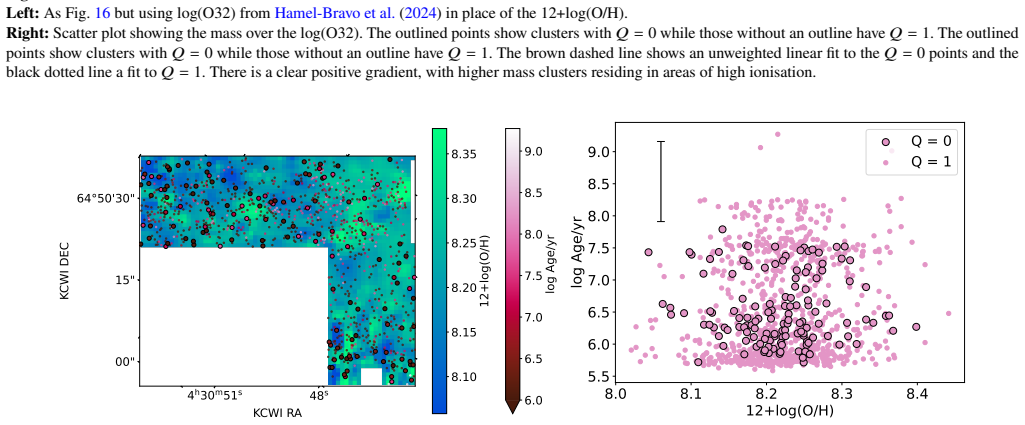
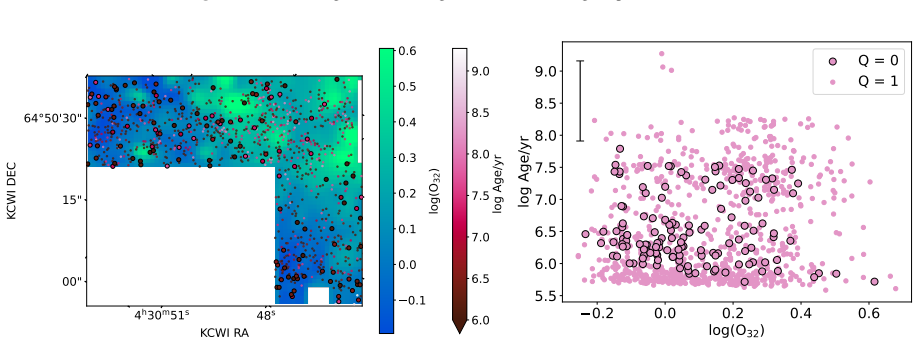
Using forward modeling that incorporates stochastic initial mass function sampling, the authors derive posterior probability distributions for cluster mass and age. They report that the truncation mass of the cluster mass function varies with galactocentric distance, particularly moving off the disk, consistent with a dependence on the density of the interstellar medium. Cluster mass positively correlates with metallicity, suggesting that massive clusters preferentially form in pre-enriched gas, and with the ionization state of the gas, reflecting the increased prevalence of high-mass stars in high-mass clusters.
What carries the argument
Bayesian forward modelling of cluster photometry that accounts for stochastic sampling of the initial mass function
If this is right
- The truncation mass of the cluster mass function varies with galactocentric distance, consistent with dependence on interstellar medium density.
- Cluster mass positively correlates with metallicity, indicating massive clusters preferentially form in pre-enriched gas.
- Cluster mass correlates with the ionization state of the gas, reflecting greater prevalence of high-mass stars in high-mass clusters.
- Current photometric coverage yields reasonably strong constraints on cluster parameters even without additional ultraviolet or near-infrared data.
Where Pith is reading between the lines
- If the correlations hold across galaxies, star formation models must treat local gas density and metallicity as controlling variables for the upper end of the cluster mass function.
- The same Bayesian approach could be applied to clusters in other nearby starburst systems to test whether the reported relations are universal.
- Adding longer-wavelength photometry would likely reduce remaining age-mass degeneracies and sharpen the measured correlations.
Load-bearing premise
The forward modelling method properly accounts for uncertainties due to stochastic sampling of the initial mass function and the identified clusters are correctly associated with the local interstellar medium conditions measured by spectroscopy.
What would settle it
Independent measurements showing no change in cluster mass function truncation mass with galactocentric distance, or no correlation between cluster mass and local metallicity, in NGC 1569 would falsify the reported relations.
Figures
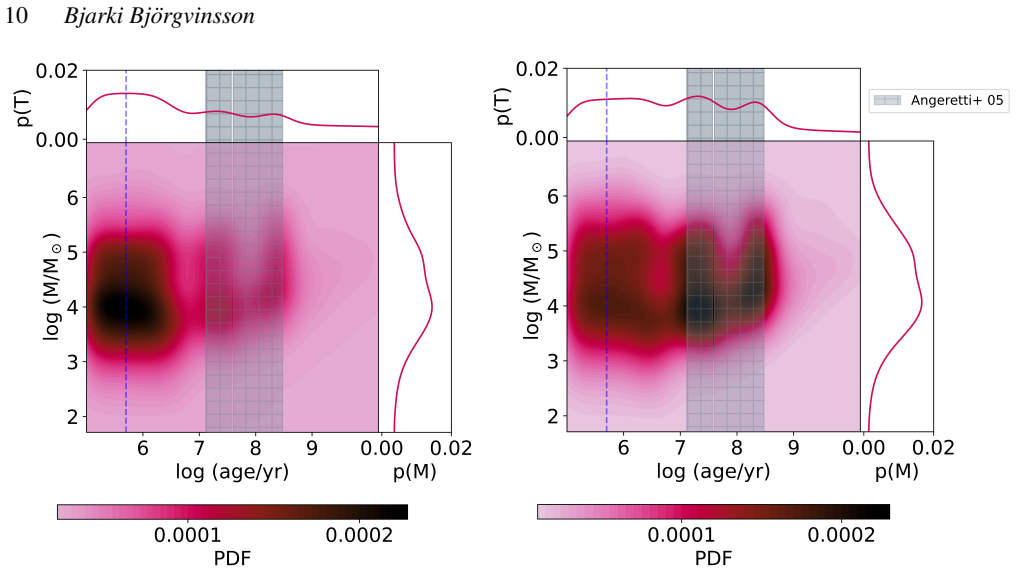
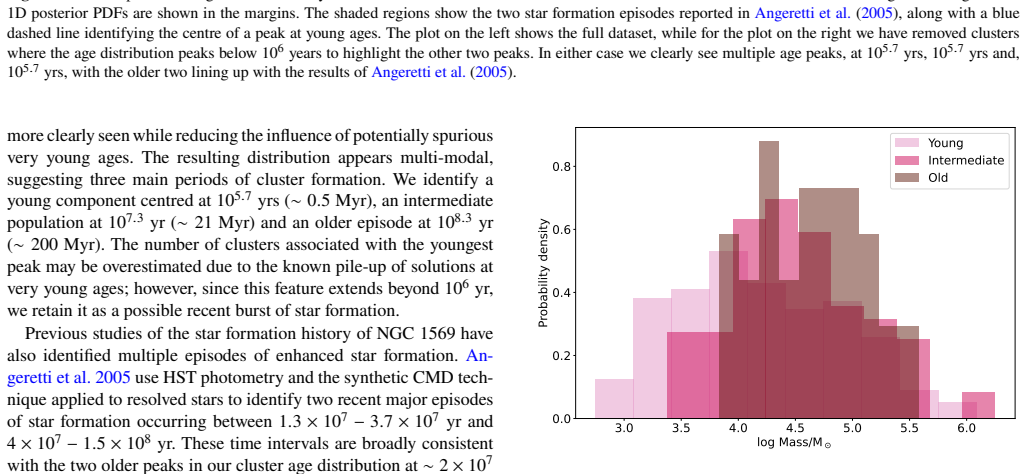
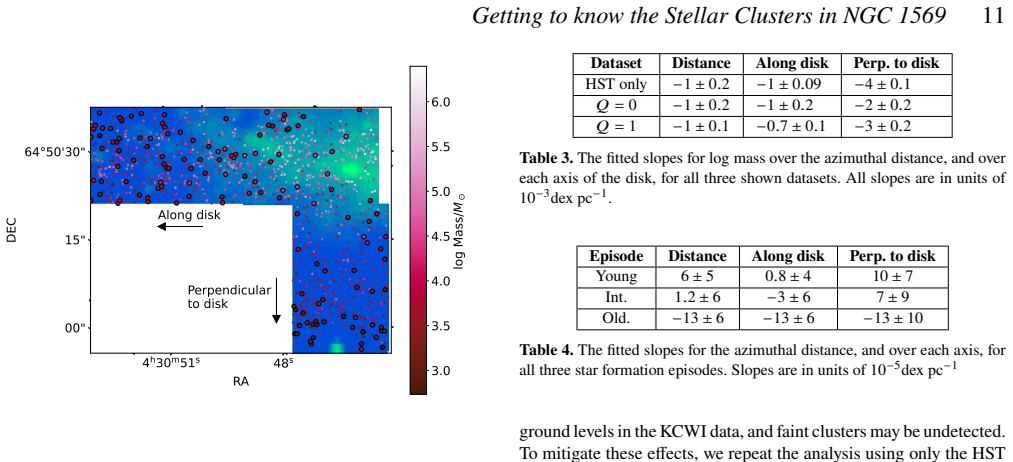
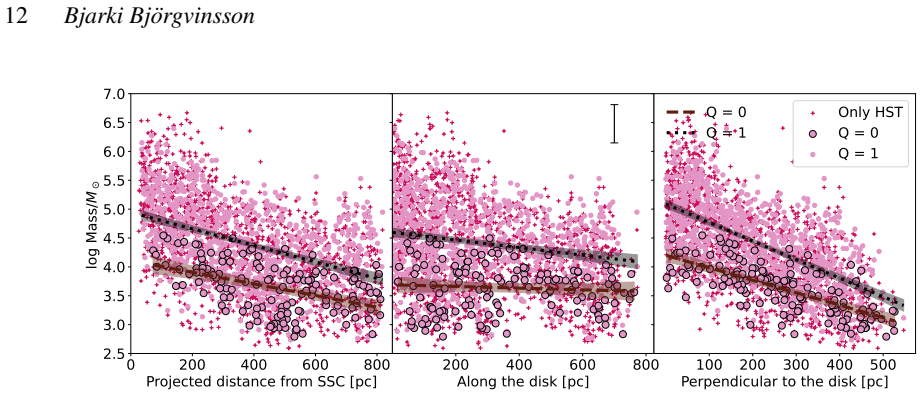
read the original abstract
We present a Bayesian analysis of star clusters in the dwarf starburst galaxy NGC 1569 based on high-resolution Hubble Space Telescope imaging combined with integral-field spectroscopy from the Keck Cosmic Web Imager, obtained as part of the DUVET survey. For each cluster identified, we infer posterior probability distributions for mass and age using a forward modelling method that properly accounts for uncertainties due to stochastic sampling of the IMF. We investigate how the inferred properties depend on photometric coverage by repeating the analysis with different filter combinations, including mock extensions to the ultraviolet and near-infrared that emulate the addition of HST UV bands and James Webb Space Telescope imaging. We find that, while inclusion of these wavelength regimes further breaks age and mass degeneracies, the currently available data yields reasonably strong constraints on cluster parameters. We compare inferred cluster properties to the conditions of the local interstellar medium, and find evidence for multiple interesting correlations. The truncation mass of the cluster mass function varies with galactocentric distance, particularly moving off the disk, consistent with a dependence on the density of the interstellar medium. Cluster mass positively correlates with metallicity, suggesting that massive clusters preferentially form in pre-enriched gas, and the ionisation state of the gas, reflecting the increased prevalence of high-mass stars in high-mass clusters. These results demonstrate the power of Bayesian, initial mass function-aware modelling for resolving cluster populations in nearby starburst dwarfs and provide new insight into how cluster formation and feedback respond to local galactic conditions.
Editorial analysis
A structured set of objections, weighed in public.
Referee Report
Summary. The manuscript presents a Bayesian forward-modeling analysis of stellar clusters in the dwarf starburst galaxy NGC 1569, combining HST photometry with Keck Cosmic Web Imager IFS data from the DUVET survey. For each cluster it derives posterior distributions on mass and age while accounting for stochastic IMF sampling, then reports correlations between the inferred cluster properties and local ISM conditions extracted from the IFS, including a galactocentric-distance dependence of the cluster mass function truncation mass (linked to ISM density) and positive correlations of cluster mass with gas metallicity and ionization state.
Significance. If the forward-model posteriors and spatial associations are robust, the work demonstrates the practical value of IMF-stochasticity-aware Bayesian fitting for resolving cluster populations in nearby starbursts and supplies falsifiable environmental trends that can be tested against simulations of clustered star formation and feedback.
major comments (2)
- [Methods (forward modelling and posterior validation)] The load-bearing step for all reported correlations is the forward-modeling procedure that is asserted to 'properly account for uncertainties due to stochastic sampling of the IMF.' Without explicit recovery tests on mock clusters spanning the observed mass range (particularly below ~10^4 M_⊙) or a description of the likelihood and prior implementation, residual mass biases cannot be ruled out; such biases would directly propagate into the fitted CMF truncation mass and the reported mass-metallicity/ionization slopes.
- [Results (cluster-ISM spatial association)] The correlations with local ISM conditions (metallicity, ionization state, density) rest on the assumption that each cluster is correctly paired to the IFS-extracted gas properties. The manuscript does not quantify the impact of spatial-resolution mismatch, projection effects, or aperture choice on the association; any systematic offset would undermine the claimed dependence of truncation mass on galactocentric distance/ISM density.
minor comments (2)
- [Abstract] The abstract states that 'inclusion of these wavelength regimes further breaks age and mass degeneracies' but does not report quantitative metrics (e.g., reduction in posterior width or degeneracy parameter) for the different filter combinations tested.
- [Throughout] Notation for the cluster mass function truncation mass (M_trunc or similar) should be defined explicitly the first time it appears and used consistently in figures and text.
Simulated Author's Rebuttal
We thank the referee for their detailed and constructive report. We have carefully considered the major comments and have revised the manuscript to address the concerns regarding the validation of the forward-modeling procedure and the robustness of the cluster-ISM associations. Our responses to each point are provided below.
read point-by-point responses
-
Referee: [Methods (forward modelling and posterior validation)] The load-bearing step for all reported correlations is the forward-modeling procedure that is asserted to 'properly account for uncertainties due to stochastic sampling of the IMF.' Without explicit recovery tests on mock clusters spanning the observed mass range (particularly below ~10^4 M_⊙) or a description of the likelihood and prior implementation, residual mass biases cannot be ruled out; such biases would directly propagate into the fitted CMF truncation mass and the reported mass-metallicity/ionization slopes.
Authors: We agree that explicit validation is essential for the credibility of the results. The original manuscript described the forward-modeling approach at a high level but did not include detailed recovery tests or full specification of the likelihood and priors. In the revised manuscript, we have added a new appendix section that fully specifies the Bayesian model, including the likelihood function (based on comparing observed photometry to stochastic SSP models) and the priors on mass, age, and extinction. We have also conducted recovery tests using 500 mock clusters with input masses from 500 to 10^5 M_⊙, ages 1-100 Myr, generated with stochastic IMF sampling. The tests show that the median posterior masses recover the true values with a bias of less than 0.05 dex and scatter of 0.2 dex across the range, including below 10^4 M_⊙. These results indicate that any residual biases are too small to affect the reported correlations with CMF truncation mass or mass-metallicity slopes. We have updated the methods section to reference this validation. revision: yes
-
Referee: [Results (cluster-ISM spatial association)] The correlations with local ISM conditions (metallicity, ionization state, density) rest on the assumption that each cluster is correctly paired to the IFS-extracted gas properties. The manuscript does not quantify the impact of spatial-resolution mismatch, projection effects, or aperture choice on the association; any systematic offset would undermine the claimed dependence of truncation mass on galactocentric distance/ISM density.
Authors: We acknowledge that the spatial association between clusters and IFS gas properties requires careful consideration of resolution and projection effects. The original analysis used the nearest IFS spaxel to each cluster position for association. To address the referee's concern, we have added a dedicated subsection in the results that quantifies these effects. Specifically, we performed a sensitivity analysis by varying the aperture size from 1 to 3 spaxels and by simulating projection effects using the galaxy's inclination. Additionally, we used the IFS data to estimate local density variations and confirmed that the galactocentric distance trend in truncation mass aligns with independent density maps. The correlations remain significant, with the slope of the mass-metallicity relation changing by less than 10% under different association choices. We have included these tests and a discussion of limitations in the revised manuscript. revision: yes
Circularity Check
No circularity: derivation is data-driven from photometry and IFS measurements
full rationale
The paper performs Bayesian forward modelling of HST photometry to obtain cluster mass and age posteriors, explicitly marginalizing over stochastic IMF sampling, then compares those posteriors to independently measured local ISM properties from Keck IFS data. No step reduces a claimed correlation or truncation mass to a fitted parameter by construction, no self-citation chain is invoked to justify uniqueness or an ansatz, and the reported trends (CMF truncation vs. galactocentric distance, mass vs. metallicity/ionization) are presented as empirical outcomes of the data rather than reparameterizations of the input model. The analysis therefore remains self-contained against external photometric and spectroscopic observables.
Axiom & Free-Parameter Ledger
Reference graph
Works this paper leans on
-
[1]
Star. Annu. Rev. Astron. Astrophys. , author =. 2019 , note =. doi:10.1146/annurev-astro-091918-104430 , abstract =
-
[3]
Mon. Not. R. Astron. Soc. , author =. 2015 , pages =. doi:10.1093/mnras/stv1374 , abstract =
-
[4]
Observatory, Lowell , year =
-
[5]
Monthly Notices of the Royal Astronomical Society , author =
Star cluster formation in the most extreme environments:. Monthly Notices of the Royal Astronomical Society , author =. 2020 , note =. doi:10.1093/mnras/staa2380 , abstract =
-
[6]
Monthly Notices of the Royal Astronomical Society , author =
The. Monthly Notices of the Royal Astronomical Society , author =. 2022 , pages =. doi:10.1093/mnras/stac420 , abstract =
-
[7]
Cool. Astron Astrophys Rev , author =. 2020 , note =. doi:10.1007/s00159-019-0121-9 , abstract =
-
[8]
ApJ , author =. 2012 , note =. doi:10.1088/0004-637X/745/2/145 , language =
-
[9]
Deep Photometry of NGC 1569: Understanding the Closest and Strongest Starburst of the Nearby Universe
-
[10]
Dwarf. ApJ , author =. 2023 , note =. doi:10.3847/1538-4357/ad0134 , abstract =
-
[11]
The. ApJ , author =. 2021 , note =. doi:10.3847/1538-4357/abd551 , abstract =
-
[12]
Monthly Notices of the Royal Astronomical Society , author =
Observing the influence of the youngest super star clusters in. Monthly Notices of the Royal Astronomical Society , author =. 2021 , note =. doi:10.1093/mnras/stab643 , abstract =
-
[13]
Monthly Notices of the Royal Astronomical Society , author =
A spatially resolved radio spectral index study of the dwarf irregular galaxy. Monthly Notices of the Royal Astronomical Society , author =. 2018 , pages =. doi:10.1093/mnras/sty028 , abstract =
-
[15]
A. ApJ , author =. 2008 , pages =. doi:10.1086/592949 , language =
-
[16]
The. AJ , author =. 2001 , note =. doi:10.1086/319407 , language =
-
[17]
Monthly Notices of the Royal Astronomical Society , author =
The. Monthly Notices of the Royal Astronomical Society , author =. 2017 , note =. doi:10.1093/mnras/stw2827 , abstract =
-
[18]
DUVET: Resolved direct metallicity measurements in the outflow of starburst galaxy NGC 1569. , keywords =. doi:10.1093/mnras/stae983 , archivePrefix =. 2404.04600 , primaryClass =
-
[19]
SExtractor: Software for source extraction. , keywords =. doi:10.1051/aas:1996164 , adsurl =
-
[20]
MPDAF: MUSE Python Data Analysis Framework
-
[21]
Dynamics of starbursting dwarf galaxies: III
Lelli, Federico and Verheijen, Marc and Fraternali, Filippo , year=. Dynamics of starbursting dwarf galaxies: III. A H I study of 18 nearby objects , volume=. doi:10.1051/0004-6361/201322657 , journal=
-
[22]
The initial mass function : from Salpeter 1955 to 2005
The Initial Mass Function: From Salpeter 1955 to 2005. The Initial Mass Function 50 Years Later , year = 2005, editor =. doi:10.1007/978-1-4020-3407-7_5 , archivePrefix =. astro-ph/0409465 , primaryClass =
work page internal anchor Pith review Pith/arXiv arXiv doi:10.1007/978-1-4020-3407-7_5 1955
-
[23]
The Initial Mass Function of Stars: Evidence for Uniformity in Variable Systems
The Initial Mass Function of Stars: Evidence for Uniformity in Variable Systems. Science , keywords =. doi:10.1126/science.1067524 , archivePrefix =. astro-ph/0201098 , primaryClass =
work page internal anchor Pith review Pith/arXiv arXiv doi:10.1126/science.1067524
-
[24]
Annual Review of Astronomy and Astrophysics , author =
Young. Annual Review of Astronomy and Astrophysics , author =. 2010 , note =. doi:10.1146/annurev-astro-081309-130834 , abstract =
-
[25]
Clusters in the inner spiral arms of. A&A , author =. 2003 , note =. doi:10.1051/0004-6361:20021384 , abstract =
-
[26]
The Astrophysical Journal , volume=
Analyzing star cluster populations with stochastic models: the hubble space telescope/wide field camera 3 sample of clusters in M83 , author=. The Astrophysical Journal , volume=. 2012 , publisher=
2012
-
[27]
Mass distributions of star clusters for different star formation histories in a galaxy cluster environment , volume =. A&A , author =. 2015 , note =. doi:10.1051/0004-6361/201425296 , abstract =
-
[28]
Disentangling the independently controllable factors of variation by interacting with the world
Embedded. Annual Review of Astronomy and Astrophysics , author =. 2003 , note =. doi:10.1146/annurev.astro.41.011802.094844 , abstract =
work page internal anchor Pith review Pith/arXiv arXiv doi:10.1146/annurev.astro.41.011802.094844 2003
-
[29]
Arce and Yancy Shirley and Colton Glasgow , title =
Shuo Kong and Héctor G. Arce and Yancy Shirley and Colton Glasgow , title =. The Astrophysical Journal , abstract =. 2021 , month =. doi:10.3847/1538-4357/abefe7 , url =
-
[30]
2024 , eprint=
The role of turbulence in high-mass star formation: Subsonic and transonic turbulence are ubiquitously found at early stages , author=. 2024 , eprint=
2024
-
[31]
McKee, Christopher F. and Tan, Jonathan C. , year=. The Formation of Massive Stars from Turbulent Cores , volume=. The Astrophysical Journal , publisher=. doi:10.1086/346149 , number=
-
[32]
Global collapse of molecular clouds as a formation mechanism for the most massive stars , volume =. A&A , author =. 2013 , note =. doi:10.1051/0004-6361/201321318 , abstract =
-
[33]
Monthly Notices of the Royal Astronomical Society , volume=
JCMT HARP CO 3--2 observations of molecular outflows in W5 , author=. Monthly Notices of the Royal Astronomical Society , volume=. 2011 , publisher=
2011
-
[34]
The Astrophysical Journal , volume=
Outflow-driven turbulence in molecular clouds , author=. The Astrophysical Journal , volume=. 2009 , publisher=
2009
-
[35]
Narayanan, Gopal and Snell, Ronald and Bemis, Ashley , title = ". Monthly Notices of the Royal Astronomical Society , volume =. 2012 , month =. doi:10.1111/j.1365-2966.2012.21579.x , url =
-
[36]
, year = 1969, month = jan, volume =
Numerical calculations of the dynamics of collapsing proto-star. , year = 1969, month = jan, volume =. doi:10.1093/mnras/145.3.271 , adsurl =
-
[37]
Detection of Irregular, Submillimeter Opaque Structures in the Orion Molecular Clouds: Protostars within 10,000 yr of Formation?. , keywords =. doi:10.3847/1538-4357/ab659e , archivePrefix =. 2001.04997 , primaryClass =
-
[38]
Physical. Space Sci Rev , author =. 2020 , keywords =. doi:10.1007/s11214-020-00693-8 , abstract =
-
[39]
Krumholz, M. R. and Bate, M. R. and Arce, H. G. and Dale, J. E. and Gutermuth, R. and Klein, R. I. and Li, Z. -Y. and Nakamura, F. and Zhang, Q. , month = jan, year =. Star. doi:10.2458/azu_uapress_9780816531240-ch011 , note =
-
[40]
Evolution of Massive Protostars with High Accretion Rates
Evolution of Massive Protostars with High Accretion Rates. , keywords =. doi:10.1088/0004-637X/691/1/823 , archivePrefix =. 0806.4122 , primaryClass =
work page internal anchor Pith review Pith/arXiv arXiv doi:10.1088/0004-637x/691/1/823
-
[41]
The Astrophysical Journal , author =. 2009 , note =. doi:10.1088/0004-637X/709/1/27 , abstract =
-
[42]
The Astrophysical Journal , author =
Protostellar. The Astrophysical Journal , author =. 2007 , note =. doi:10.1086/517515 , abstract =
-
[43]
Monthly Notices of the Royal Astronomical Society , author =. 2021 , pages =. doi:10.1093/mnras/stab278 , abstract =
-
[44]
The Astrophysical Journal , author =
Radiation-. The Astrophysical Journal , author =. 2007 , note =. doi:10.1086/510664 , abstract =
-
[45]
Mass-loss predictions for. Astronomy & Astrophysics , author =. 2001 , note =. doi:10.1051/0004-6361:20010127 , abstract =
-
[46]
Monthly Notices of the Royal Astronomical Society , author =
On the. Monthly Notices of the Royal Astronomical Society , author =. 2018 , pages =. doi:10.1093/mnras/sty1127 , abstract =
-
[47]
Monthly Notices of the Royal Astronomical Society , author =
Formation and. Monthly Notices of the Royal Astronomical Society , author =. 2016 , pages =. doi:10.1093/mnras/stw2307 , abstract =
-
[48]
Hydrodynamics , author=
Feedback from winds and supernovae in massive stellar clusters--I. Hydrodynamics , author=. Monthly Notices of the Royal Astronomical Society , volume=. 2013 , publisher=
2013
-
[49]
The Astrophysical Journal , volume=
One-dimensional dynamical models of the Carina nebula bubble , author=. The Astrophysical Journal , volume=. 2009 , publisher=
2009
-
[50]
Cosmicflows-2: The Data. , keywords =. doi:10.1088/0004-6256/146/4/86 , archivePrefix =. 1307.7213 , primaryClass =
work page internal anchor Pith review Pith/arXiv arXiv doi:10.1088/0004-6256/146/4/86
-
[51]
A z = 0 Multiwavelength Galaxy Synthesis. I. A WISE and GALEX Atlas of Local Galaxies. , keywords =. doi:10.3847/1538-4365/ab3925 , archivePrefix =. 1910.13470 , primaryClass =
-
[52]
The Astronomical Journal , author =
The. The Astronomical Journal , author =. 2000 , note =. doi:10.1086/316810 , abstract =
-
[53]
The Astrophysical Journal , abstract =
Laura Greggio and Monica Tosi and Mark Clampin and Guido De Marchi and Claus Leitherer and Antonella Nota and Marco Sirianni , title =. The Astrophysical Journal , abstract =. 1998 , month =. doi:10.1086/306100 , url =
-
[54]
Star cluster formation and evolution in the dwarf starburst galaxy. Monthly Notices of the Royal Astronomical Society , author =. 2004 , pages =. doi:10.1111/j.1365-2966.2004.07171.x , abstract =
-
[55]
Gemini. Monthly Notices of the Royal Astronomical Society , author =. 2007 , pages =. doi:10.1111/j.1365-2966.2007.12346.x , abstract =
-
[56]
Legacy ExtraGalactic UV Survey with The Hubble Space Telescope: Stellar Cluster Catalogs and First Insights Into Cluster Formation and Evolution in NGC 628. , keywords =. doi:10.3847/1538-4357/aa7132 , archivePrefix =. 1705.01588 , primaryClass =
work page internal anchor Pith review Pith/arXiv arXiv doi:10.3847/1538-4357/aa7132
-
[57]
Fraction of stars in clusters for the LEGUS dwarf galaxies. , keywords =. doi:10.1093/mnras/stac3748 , archivePrefix =. 2212.07519 , primaryClass =
-
[58]
The Astrophysical Journal , author =
Star. The Astrophysical Journal , author =. 2015 , note =. doi:10.1088/0004-637X/812/2/147 , abstract =
-
[59]
Ionizing feedback from massive stars in massive clusters - II. Disruption of bound clusters by photoionization. , keywords =. doi:10.1111/j.1365-2966.2012.21205.x , archivePrefix =. 1205.0360 , primaryClass =
-
[60]
Monthly Notices of the Royal Astronomical Society , author =
The impact of pre-supernova feedback and its dependence on environment , volume =. Monthly Notices of the Royal Astronomical Society , author =. 2021 , pages =. doi:10.1093/mnras/stab2726 , abstract =
-
[61]
Stellar Feedback in Molecular Clouds and its Influence on the Mass Function of Young Star Clusters
Stellar Feedback in Molecular Clouds and its Influence on the Mass Function of Young Star Clusters. , keywords =. doi:10.1088/2041-8205/710/2/L142 , archivePrefix =. 0910.2238 , primaryClass =
work page internal anchor Pith review Pith/arXiv arXiv doi:10.1088/2041-8205/710/2/l142 2041
-
[62]
Rowland, Lucie E. and McLeod, Anna F. and Fattahi, Azadeh and Belfiore, Francesco and Cresci, Giovanni and Hunt, Leslie and Krumholz, Mark and Kumari, Nimisha and Marasco, Antonino and Venturi, Giacomo , year=. Pre-supernova stellar feedback in nearby starburst dwarf galaxies , volume=. doi:10.1051/0004-6361/202348029 , journal=
-
[63]
Thompson, Todd A. and Krumholz, Mark R. , year=. Sub-Eddington star-forming regions are super-Eddington: momentum-driven outflows from supersonic turbulence , volume=. Monthly Notices of the Royal Astronomical Society , publisher=. doi:10.1093/mnras/stv2331 , number=
-
[64]
The Disruption of Giant Molecular Clouds by Radiation Pressure & the Efficiency of Star Formation in Galaxies. , keywords =. doi:10.1088/0004-637X/709/1/191 , archivePrefix =. 0906.5358 , primaryClass =
work page internal anchor Pith review Pith/arXiv arXiv doi:10.1088/0004-637x/709/1/191
-
[65]
Radiation pressure limits on the star formation efficiency and surface density of compact stellar systems. , keywords =. doi:10.1093/mnras/sty2659 , archivePrefix =. 1808.01726 , primaryClass =
work page internal anchor Pith review Pith/arXiv arXiv doi:10.1093/mnras/sty2659
-
[66]
Monthly Notices of the Royal Astronomical Society , volume =
Barnes, A T and Glover, S C O and Kreckel, K and Ostriker, E C and Bigiel, F and Belfiore, F and Bešlić, I and Blanc, G A and Chevance, M and Dale, D A and Egorov, O and Eibensteiner, C and Emsellem, E and Grasha, K and Groves, B A and Klessen, R S and Kruijssen, J M D and Leroy, A K and Longmore, S N and Lopez, L and McElroy, R and Meidt, S E and Murphy,...
-
[67]
Laura A. Lopez and Mark R. Krumholz and Alberto D. Bolatto and J. Xavier Prochaska and Enrico Ramirez-Ruiz , title =. The Astrophysical Journal , abstract =. 2011 , month =. doi:10.1088/0004-637X/731/2/91 , url =
-
[68]
Monthly Notices of the Royal Astronomical Society , volume =
Chevance, Mélanie and Kruijssen, J M Diederik and Krumholz, Mark R and Groves, Brent and Keller, Benjamin W and Hughes, Annie and Glover, Simon C O and Henshaw, Jonathan D and Herrera, Cinthya N and Kim, Jaeyeon and Leroy, Adam K and Pety, Jérôme and Razza, Alessandro and Rosolowsky, Erik and Schinnerer, Eva and Schruba, Andreas and Barnes, Ashley T and B...
-
[69]
Annual Review of Astronomy and Astrophysics , author =
Protostellar. Annual Review of Astronomy and Astrophysics , author =. 2016 , note =. doi:10.1146/annurev-astro-081915-023341 , abstract =
-
[70]
Monthly Notices of the Royal Astronomical Society , volume =
Lucas, William E and Bonnell, Ian A and Dale, James E , title = ". Monthly Notices of the Royal Astronomical Society , volume =. 2020 , month =. doi:10.1093/mnras/staa451 , url =
-
[71]
Probing the chemo-dynamical evolution of disc galaxies
The. 2022 , pages =. doi:10.1051/0004-6361/202141727 , journal =
-
[72]
The Astrophysical Journal , author =
The. The Astrophysical Journal , author =. 2018 , note =. doi:10.3847/1538-4357/aad597 , abstract =
-
[73]
ACStools: Python tools for Hubble Space Telescope Advanced Camera for Surveys data
-
[74]
Structure in the Superstar Clusters in NGC 1569
-
[75]
Resolving stellar populations with crowded field 3D spectroscopy
Resolving stellar populations with crowded field 3D spectroscopy. , keywords =. doi:10.1051/0004-6361/201220476 , archivePrefix =. 1211.0445 , primaryClass =
work page internal anchor Pith review Pith/arXiv arXiv doi:10.1051/0004-6361/201220476
-
[76]
astropy/photutils: 1.13.0 , month = jun, year = 2024, publisher =
Larry Bradley and Brigitta Sip. astropy/photutils: 1.13.0 , month = jun, year = 2024, publisher =. doi:10.5281/zenodo.12585239 , url =
-
[77]
Luridiana, V. and Morisset, C. and Shaw, R. A. , year=. PyNeb: a new tool for analyzing emission lines: I. Code description and validation of results , volume=. doi:10.1051/0004-6361/201323152 , journal=
-
[78]
The Relationship between Infrared, Optical, and Ultraviolet Extinction. , keywords =. doi:10.1086/167900 , adsurl =
-
[79]
Measuring Reddening with SDSS Stellar Spectra and Recalibrating SFD
Measuring Reddening with Sloan Digital Sky Survey Stellar Spectra and Recalibrating SFD. , keywords =. doi:10.1088/0004-637X/737/2/103 , archivePrefix =. 1012.4804 , primaryClass =
work page internal anchor Pith review Pith/arXiv arXiv doi:10.1088/0004-637x/737/2/103
-
[80]
Astronomical Data Analysis Software and Systems XIV , year = 2005, editor =
TOPCAT & STIL: Starlink Table/VOTable Processing Software. Astronomical Data Analysis Software and Systems XIV , year = 2005, editor =
2005
-
[81]
The Astrophysical Journal , author =
Effective. The Astrophysical Journal , author =. 2017 , note =. doi:10.3847/1538-4357/aa719e , abstract =
-
[82]
Monthly Notices of the Royal Astronomical Society , author =
Radii of young star clusters in nearby galaxies , volume =. Monthly Notices of the Royal Astronomical Society , author =. 2021 , pages =. doi:10.1093/mnras/stab2907 , abstract =
discussion (0)
Sign in with ORCID, Apple, or X to comment. Anyone can read and Pith papers without signing in.