REVIEW 3 major objections 5 minor 8 references
On the statistical mechanics of life: Schr\"odinger revisited
T0 review · 3 major / 5 minor · reviewed 2026-08-14 · deepseek-v4-flash
Pith's one-line read Life is not a local fight against entropy; it is an entropically favored process in which structure opens channels for entropy to grow.
desk verdict A readable and honest conceptual reframing of life as entropically favored, but the central mechanism remains an unquantified hypothesis rather than a derived result. read the letter →
The pith
A machine-rendered reading of the paper's core claim, the machinery that carries it, and where it could break.
The reading
What carries the argument
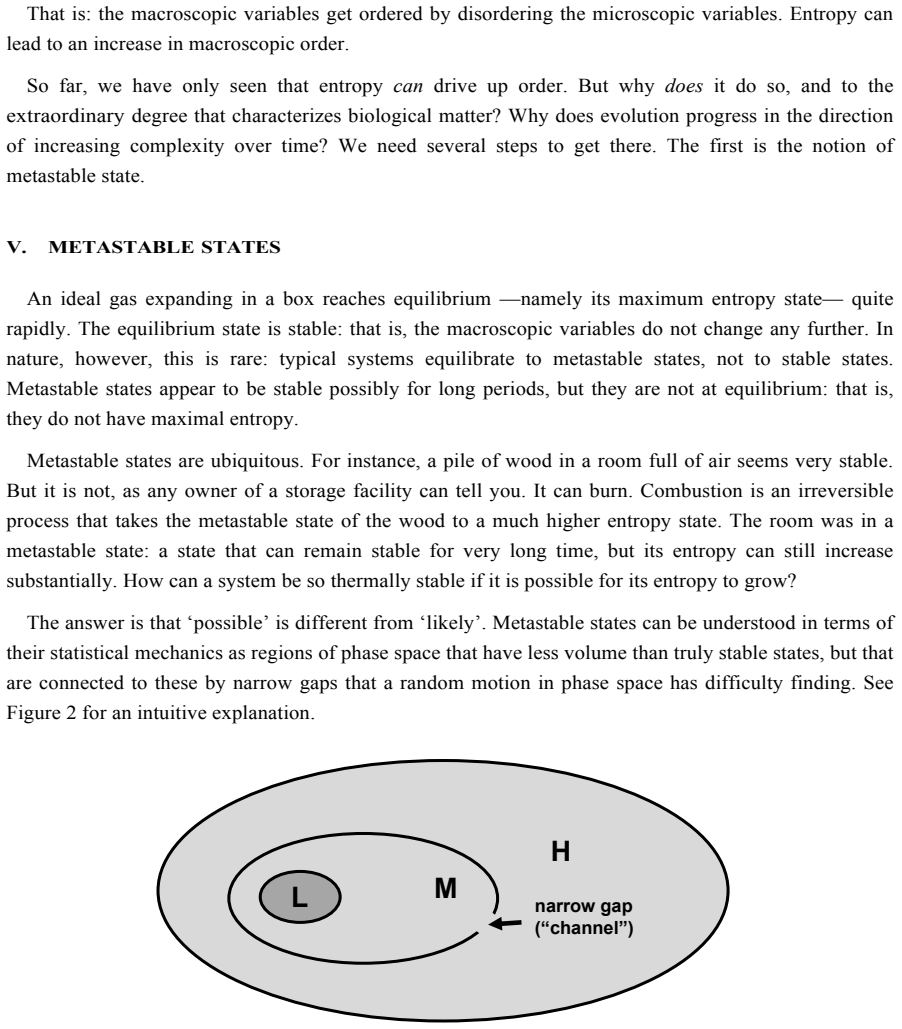
The mechanism is a phase-space picture of Boltzmann statistics. Low-entropy states sit in tiny regions of phase space; real systems get trapped in metastable regions, and entropy grows only when random motion finds a narrow 'channel' to a larger region. The paper's central move is to identify biological order with such channels: enzymes, organized cells, and especially the double-stranded DNA molecule are ordered configurations that allow entropy-increasing reactions to happen that would otherwise not occur. Order is made quantitative as Shannon's relative information, $I = \ln_2 N_a + \ln_2 N_b - \ln_2 N_{ab}$, a measure of correlation between degrees of freedom, and the key diachronic idea is that DNA's replication produces correlation across time, so that a sequence of bases now is correlated with the sequence in the distant past. That long-range temporal correlation is what makes the whole structure entropically favored: it re-opens the entropy-growing channel again and again.
What would settle it
Build a closed chemical system with a metastable mixture and an ordered catalyst that opens a large entropy-increasing reaction pathway; if random motion does not find and traverse that channel on any timescale—for example, if the catalyzed reaction never proceeds without external intervention—the paper's premise that channel-finding is generically inevitable fails.
Extended reading notes
Core claim
The paper's central claim is that life does not contradict the second law of thermodynamics but is one of its expressions. Entropy growth in a closed system can accompany growing macroscopic order—the authors' examples are balls settling on a floor, oil separating from water, and snowflakes forming—because energy moves from macroscopic to microscopic variables. In this light, metabolism is a microscopic, entropy-increasing process, and macroscopic structure, complexity, and homeostasis are entropically favored because they open channels for entropy to grow. DNA is the paradigm: its double strand carries Shannon information as correlation, and its semi-conservative replication creates correlation across time, preserving information for billions of years; that long temporal order repeatedly opens channels for entropy growth, which is why it persists. The paper's summary states this directly: structure is order, order is measured by correlations, and the reason for this order is that it opens channels for entropy to grow in the intricate energetic structure of the state space.
Load-bearing premise
The argument rests on the assumption that a system trapped in a metastable state will, over time, randomly find and pass through any narrow channel to a higher-entropy state whenever one exists, so that any structure which opens such a channel becomes entropically favored.
Editorial extensions
If this is right
- Life's existence, early appearance, and four-billion-year resilience stop being thermodynamically puzzling: if the thesis is right, living systems are expected, not anomalous, outputs of the second law.
- Metabolic networks should be analyzed as entropy-producing channels: their thermodynamic role is to increase total entropy, so the relevant question about any biochemical pathway is how much entropy it can let flow, not how well it preserves order.
- Evolution's major transitions—replicating molecules, cells, chromosomes, photosynthesis, neurons, language—are direct consequences of the channel picture: each new structure opens previously inaccessible regions of phase space, producing a stepwise jump in complexity and diversity.
- Arguments that life is wildly improbable because it is unique commit a category error; what matters is whether some structure capable of opening entropy channels is likely to arise, and the authors contend the answer is yes under Earth-like conditions.
- Human culture, technology, and even money are, in this view, new diachronic information-carrying structures that open further entropy-growing channels, which is why their effects on the biosphere are so large and so fast.
Reading between the lines
- Beyond the paper: a quantitative test suggests itself—compare the total entropy production of a living system with an equivalent non-living reactive mixture; if the thesis is right, life should be a net enhancer of entropy production rather than a suppressor.
- Beyond the paper: the channel-finding premise could be simulated in a simple autocatalytic reaction network, asking whether structures with longer temporal correlations are systematically selected when the dynamics is purely random motion in a rugged energy landscape; the paper provides no such model or estimate.
- Beyond the paper: the paper's dark claim that information-elaborating civilizations tend toward self-destruction within centuries is a falsifiable sociological hypothesis; the longevity statistics of complex societies on Earth provide a partial test, and any future detection of technosignatures would give another.
- Beyond the paper: if extinctions are occasional channel openings into lower-order, higher-entropy regions, one can look for a correlation between mass-extinction events and jumps in global entropy production in Earth history; the paper does not attempt this test.
Signed reviews
Editorial analysis
A structured set of objections, weighed in public.
Referee Report
Summary. The paper revisits Schrödinger's 'What is Life?' and argues that life should not be viewed as a local struggle against entropy but as an entropically favored phenomenon. It begins by giving examples (bouncing balls, oil and water, snowflake formation) intended to show that entropy increase can accompany macroscopic order. It then defines order via correlations and Shannon relative information, introduces metastable states and channels between them, and proposes that biological structure—especially DNA and enzymatic machinery—is selected because it opens channels through which entropy can grow. Metabolism is described as directly driven by the second law, and long-range temporal correlations (inheritance) are said to be entropically favorable because they sustain repeated entropy production. The paper closes with applications to evolutionary transitions and to the future of humanity. No new quantitative model is presented; the argument is conceptual and largely qualitative.
Significance. If substantiated, the central claim would reframe discussions of life's origin and persistence, making life a statistically expected outgrowth of the second law rather than a rare fluctuation. The paper has real strengths: the examples in Section II correctly illustrate that entropy increase can produce macroscopic order; the definitions in Section IV of Boltzmann entropy and Shannon relative information are standard and clearly presented; and the discussion of the 'lottery ambiguity' in Section XI is a useful clarification of a common probabilistic error. The authors also engage with relevant literature, including England (2013) and Perunov et al. (2016). However, the key assertion that life is entropically favored because structure opens channels for entropy growth remains an interpretive hypothesis rather than a derived result, and the paper itself concedes in Section XI that no computation of life's probability is provided.
major comments (3)
- [IX. The Statistical Underpinning of Life; XIV. Summary] The central probabilistic premise is unquantified. The statements 'If this is anywhere possible, there is no reason for it not to happen' (Section IX) and 'If it can, it does it, simply for probabilistic reasons' (Section XIV) convert the existence of a channel into the assertion that the system will find and traverse it. In stochastic dynamics, however, escape from a metastable basin through a narrow channel or over a barrier is governed by transition rates that can be exponentially small (Kramers/Eyring theory); a larger final phase-space volume does not by itself make traversal likely on any finite timescale. The paper provides no estimate of such rates or of the relevant timescales. This missing link is load-bearing because the claim that life is entropically favored depends on channels being discovered and crossed. The authors' own concession in Section XI—'We are not claiming that we have computed that life is probable'—confirms that this quantitative step is absent.
- [II. Entropy and Order; XI. The Improbability of Life Revisited] There is a circularity in using life's existence as evidence for entropic favorability and then invoking entropic favorability to explain life's persistence. Section II states that the early appearance and resilience of life 'implies that life must be an entropically favored phenomenon,' and Section XI says 'We can only reason a posteriori, and take the existence of the biosphere, its resilience and its early appearance as argument for their likelihood.' Section XIV then uses entropic favorability to explain that persistence. If the only evidence for the explanation is the phenomenon to be explained, the argument provides no independent support. To avoid circularity, the paper would need either an independent estimate of the relevant probabilities/rates or a falsifiable prediction that could be checked against observations.
- [VII. The Phase Space of Biological Systems and Percolation in It; VIII. Correlations in Time and Information] The mechanism by which 'structure opens channels' is described only metaphorically. The paper does not specify a concrete coarse-graining of the biological phase space, nor does it define what an enzyme or a DNA sequence does to the connectivity of metastable basins in a way that could be analyzed or simulated. In particular, the statement in Section VIII that long-term temporal correlations 'favor entropy growth' is not backed by a model showing that diachronic structure increases the entropy production rate or the likelihood of reaching higher-entropy regions. A minimal transition-network model, even a toy one, would make the central claim more concrete and would allow the channel-opening hypothesis to be tested.
minor comments (5)
- [IV. Correlation and Information] The symbols V_micro and V_macro appear in equations (6) and (7) but are not defined in the text; please define them explicitly (e.g., as phase-space volumes for microstates and macrostates). Also, the rendered text uses 'l n' instead of 'ln' in several equations.
- [VII. The Phase Space of Biological Systems and Percolation in It] The parenthetical '(crf.: Ramstead, Badcock and Friston 2018)' should read '(cf. Ramstead, Badcock and Friston 2018)'.
- [IX. The Statistical Underpinning of Life; XIII. A Recent Step: Humanity] There are typographical errors: 'stucture' should be 'structure' in Section IX, and 'wich' should be 'which' in Section XIII. These should be corrected before publication.
- [XV. References] The Schnakenberg reference contains garbled text: 'riiacroscopic' and 'roaster equation systems' should likely be 'macroscopic' and 'master equation systems,' respectively.
- [Figures 2 and 3] The figure captions describe the diagrams as intuitive and oversimplified; it would help the reader if the axes and the meaning of regions L, M, and H were labeled explicitly in the figures themselves.
Circularity Check
Explanatory circle: the persistence of life is used as evidence that life is entropically favored, and that same favorability is then used to explain life's persistence.
-
other
[Sections II, XI, and XIV]
"The (early) appearance and the tenacious resilience of life on Earth over 4 billion years makes it obvious that life cannot be a 'struggle against entropy' in any sense: it can only be an entropically favored phenomenon. ... We can only reason a posteriori, and take the existence of the biosphere, its resilience and its early appearance as argument for their likelihood. ... If it can, it does it, simply for probabilistic reasons, those underpinning the second law."
The persistence of life is first asserted to imply that life is entropically favored (Section II). The same persistence is then offered as evidence for the likelihood of the process (Section XI), and the principle 'If it can, it does it' is invoked to explain why structure and persistence occur (Section XIV). Thus the explanatory conclusion that life persists because it is entropically favored is supported only by the observation of persistence itself, with no independent transition-rate or probability estimate. The paper explicitly concedes it has not computed that life is probable, so the central claim reduces to an a posteriori restatement of the phenomenon it is meant to explain.
full rationale
The paper is an interpretive essay rather than a quantitative derivation, so most of its claims are not circular in an equation-level sense. It contains no fitted parameters masquerading as predictions, and its self-citations (Rovelli on time arrows, time perception, and meaning) are not load-bearing for the central thermodynamic argument. However, the central claim that life is an entropically favored phenomenon is supported by exactly the fact it is supposed to explain: life appeared early and persisted. The paper says so explicitly in Section II ('appearance and resilience ... implies life must be entropically favored') and in Section XI ('We can only reason a posteriori, and take the existence of the biosphere, its resilience and its early appearance as argument for their likelihood'). The channel-finding principle in Section XIV ('If it can, it does it') then converts this a posteriori observation into a general mechanism, but no estimate of channel-finding rates or transition probabilities is given. This is not a hidden statistical fit, but it is an explanatory circle: the persistence of life is both the evidence for entropic favorability and the phenomenon that entropic favorability is invoked to explain. The absence of a quantitative rate estimate is a separate correctness risk, but the a posteriori inference makes the central claim partially circular, warranting a score of 6 rather than a lower score.
Assumptions & free parameters
assumptions (4)
- domain assumption The past low-entropy initial macro-state of the universe is taken as a fact, not derived.
- domain assumption The second law applies to macroscopic variables defined by arbitrary coarse grainings, including DNA nucleotide sequences.
- ad hoc to paper A system in a metastable state will eventually find and traverse a narrow channel to a higher-entropy region if one exists.
- ad hoc to paper The existence and persistence of the biosphere license inference about the likelihood of life.
Cite this review
Pith. "Pith review of On the statistical mechanics of life: Schr\"odinger revisited." pith.science (2026). https://pith.science/paper/EPORPNQ2
@misc{pith2026190808374,
  author       = {Pith},
  title        = {Pith review of: On the statistical mechanics of life: Schr\"odinger revisited},
  year         = {2026},
  howpublished = {\url{https://pith.science/paper/EPORPNQ2}},
  note         = {Machine review of arXiv:1908.08374}
}
read the original abstract
We study the statistical underpinnings of life. We question some common assumptions about the thermodynamics of life and illustrate how, contrary to widespread belief, even in a closed system entropy growth can accompany an increase in macroscopic order. We consider viewing metabolism in living things as microscopic variables directly driven by the second law of thermodynamics, while viewing the macroscopic variables of structure, complexity and homeostasis as mechanisms that are entropically favored because they open channels for entropy to grow via metabolism. This perspective reverses the conventional relation between structure and metabolism, by emphasizing the role of structure for metabolism rather than the other way around. Structure extends in time, preserving information along generations, particularly in the genetic code, but also in human culture. We also consider why the increase in order/complexity over time is often stepwise and sometimes collapses catastrophically. We point out the relevance of the notions of metastable states and channels between these, which are discovered by random motion of the system and lead it into ever-larger regions of the phase space, driven by thermodynamics. We note that such changes in state can lead to either increase or decrease in order; and sometimes to complete collapse, as in biological extinction. Finally, we comment on the implications of these dynamics for the future of humanity.
Figures


Reference graph
Works this paper leans on
-
[4]
This leads us a formal definition of order: we say that there is order if S(an)=klogW(an) <latexit sha1_base64="YAFxrdlkhm6jZGHunZkpQQD2i0E=">AAAB/XicbVDLSsNAFL2pr1pf8bFzM1iEuimJCroRCm5cVrQPaEOZTCft0MkkzEyEGoq/4saFIm79D3f+jdM0C209cOHMOfcy9x4/5kxpx/m2CkvLK6trxfXSxubW9o69u9dUUSIJbZCIR7LtY0U5E7Shmea0HUuKQ5/Tlj+6nvqtByoVi8S9HsfUC/FAsIARrI3Usw/uKrgnTq5GXR4NUCt...
work page 2012
-
[8]
(1977) Self‐Organisation in Non‐ Equilibrium Systems, Wiley, New York
Nicolis, G., Prigogine, I. (1977) Self‐Organisation in Non‐ Equilibrium Systems, Wiley, New York. Perunov, N., Marsland, R.A., England, J. L. (2016) Statistical Physics of Adaptation, Physical Review X, 6: 021036. Pollack, A. and R. (2015), The Course of Nature, p. 103, Stony Creek Press. Pollack, R. (2015) Is there Intelligent Life in the Universe? Trace...
work page 1977
-
[12]
Development of symbolic reasoning and language in humans, enabling transmission of accumulated information across time and space. The reason for this step structure becomes particularly transparent in the light of the statistical interpretation of life developed here, and supports it: if life is the opening of stable channels for entropy to growth, then e...
work page 1981
-
[15]
(2019) Effective Fluctuation and Response Theory, Journal of Statistical Physics 176:94–168
Polettini, M., Esposito M. (2019) Effective Fluctuation and Response Theory, Journal of Statistical Physics 176:94–168. Prigogine, I. (1967) Introduction to Thermodynamics of Irreversible Processes. Wiley Interscience, New York. Ramstead, M.J.D, Badcock, P.B., Friston, K.J. (2018) Answering Schrödinger’s question: A free-energy formulation, Physics of Lif...
work page 2019
-
[379]
Still, S., Sivak, D. A., Bell, A. J., and Crooks, G. E. (2012) Thermodynamics of Prediction, Phys. Rev. Lett. 109:120604. Szathmary, E., Maynard Smith J. (1995) The major evolutionary transitions. Nature 374:227–232
work page 2012
-
[2015]
The chances of bringing about the end of intelligent life by self-destruction seem to be very high, be it via climate change, mass extinction, nuclear war or something else. We do not know whether the very recent life’s experiment that our species represents is a dead-end or a step with some future. Reason and far-sighted behaviours might perhaps be able ...
work page 1947
-
[2018]
Life has found effective ways to maximize its capacity for exploring the space of possibilities. One of these is sexual reproduction. A second is movement, which allows an organism to explore a vastly greater region of the phase space than before - an effect that is multiplied when other organisms also 17 move, opening up possibilities for new selection f...
work page 2018
-
[2019]
Abstract We study the statistical underpinnings of life. We question some common assumptions about the thermodynamics of life and illustrate how, contrary to widespread belief, even in a closed system entropy growth can accompany an increase in macroscopic order. We consider viewing metabolism in living things as microscopic variables directly driven by t...
work page 1967
Reviewed August 14, 2026 · model on record in the stance chip above.
Discussion (0). Continue with ORCID to comment.