REVIEW 4 major objections 6 minor 6 references
Splat and Replace: 3D Reconstruction with Repetitive Elements
T0 review · 4 major / 6 minor · reviewed 2026-08-07 · deepseek-v4-flash
Pith's one-line read The paper shows that merging registered copies of repetitive objects into a shared 3D template repairs occluded and poorly captured regions, improving novel view synthesis by 1.59 dB PSNR over the second-best baseline on real scenes.
desk verdict A solid, well-tested method for repetition-aware 3DGS with a clever render-to-match registration; the SH-offset appearance model is a disclosed limitation, not a hidden flaw. read the letter →
The pith
A machine-rendered reading of the paper's core claim, the machinery that carries it, and where it could break.
The reading
What carries the argument
The central mechanism is the shared Gaussian template: after registering all instances into the coordinate frame of the largest instance, the method takes the union of their 3D Gaussian primitives and re-optimizes it so that gradients from every instance's training views flow into one common set of geometry parameters. Appearance variation is carried by per-instance spherical-harmonic offsets added to a shared color term, with a fixed mixing weight $\lambda=0.8$ and an $\ell^1$ penalty. Registration, the fragile step, is handled by leveraging 3DGS's own renderability: the method renders dense virtual views of each instance, uses a fast matcher to select candidate pairs, a dense learned matcher to find 2D correspondences, lifts them to 3D with depth rendered from the splat, and solves with PnP-RANSAC, then refines with ICP and joint pose optimization.
What would settle it
Render a synthetic scene with two identical objects lit by opposing strong directional lights so one copy has a pronounced specular highlight, train the method as described, and compare masked-region PSNR on held-out views against per-instance 3DGS; the central claim fails if the shared template does not beat private reconstruction in those regions.
Extended reading notes
Core claim
On the paper's own terms, the discovery is that a union of registered Gaussian primitives, optimized as a single object, is a better model of each repeated instance than the instance's private reconstruction. Every instance is mapped into template space by a rigid transform; the template's positions, covariances, and opacities are shared, while color is written $c_{\ell m} = \lambda c^{\ell m}_{\mathrm{shared}} + (1-\lambda)c^{\ell m}_{\mathrm{offset}}$ with $\lambda=0.8$ and an $\ell^1$ penalty keeping offsets small. Because all instance renderings backpropagate into the same template, an occluded chair borrows geometry from a visible chair and a distant bust borrows detail from a close one. The authors support the claim with synthetic and real scenes, showing consistent gains in PSNR, SSIM, LPIPS, and KID, and with registration ablations in which their pipeline reaches roughly half a degree of rotation error while a point-feature global registration baseline fails at about 50 degrees.
Load-bearing premise
The method assumes that two copies of the same object differ only by small light-dependent shifts in color, so copies with strong illumination differences or shiny specular highlights cannot be fused without degrading appearance.
Editorial extensions
If this is right
- For scenes containing several visible copies of an object, novel views of occluded or poorly covered instances improve without additional capture.
- Distant or tiny instances inherit fine detail from a well-covered repetition, enabling zoomed-in renderings that would otherwise be blurry.
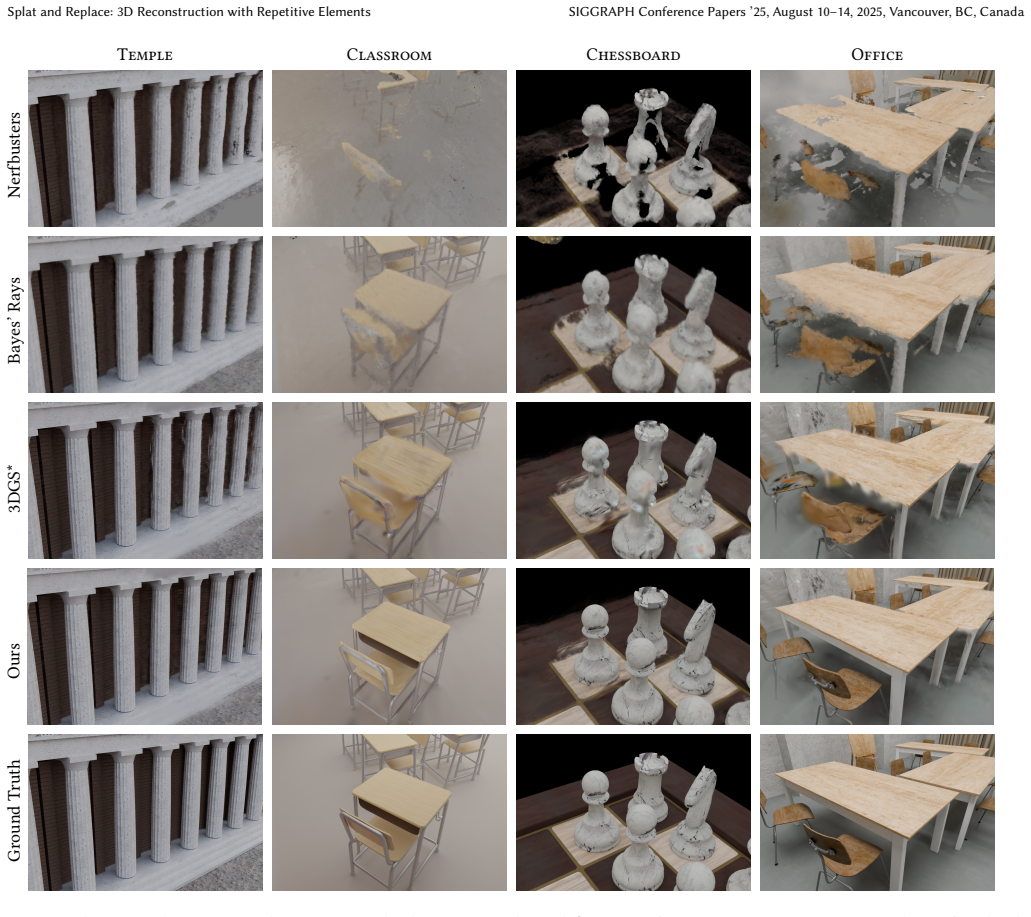
- Improvements concentrate in the replaced instance regions: masked-region PSNR rises by 2.72 dB on real scenes and by 1.28 dB on additional large-scale real benchmark scenes, with full-image gains largest on synthetic scenes.
- Background and non-repetitive parts are untouched by the shared representation, so artifacts there remain.
- Shared geometry with per-instance SH offsets matches a shared-MLP alternative in quality while training more than one and a half times faster.
Reading between the lines
- An implication the paper leaves implicit is a testable boundary: the reconstruction gain over private per-instance models should shrink as lighting contrast between copies grows, since the shared model only absorbs small color offsets.
- The registration recipe is representation-agnostic; nothing in it depends on Gaussian splatting specifically, so it could register instances in other neural fields that can render views and depth.
- The contrastive features used for segmentation already encode instance identity, so clustering them could automate the user-click step; the paper does not demonstrate this.
- If the template is compact, replacing N copies with one template plus small offsets could cut memory for repetitive scenes, but compact appearance encoding remains an open direction the paper only lists as future work.
Editorial analysis
A structured set of objections, weighed in public.
Referee Report
Summary. The paper proposes a method to exploit repeated object instances in 3D scenes to improve 3D Gaussian Splatting reconstruction and novel view synthesis. After a base 3DGS reconstruction, instances are segmented by distilling per-Gaussian contrastive features supervised by GroundingDINO/SAM-HQ masks and user clicks, with opacity/scale regularization and space-carving post-processing. Instances are registered by rendering virtual views, matching them with XFeat and MASt3R, lifting matches to 3D with rendered depth, and solving PnP-RANSAC with ICP and pose refinement. A shared template is formed as the union of registered Gaussians; geometry and base spherical-harmonic coefficients are shared, while per-instance appearance is modeled as a penalized SH offset (Eq. 3), and all instances are fine-tuned jointly. Experiments on four synthetic and four real scenes, plus ScanNet++/DL3DV scenes, report large gains over Nerfbusters, Bayes' Rays, Nerfacto, 3DGS, and a stronger 3DGS* baseline, with ablation studies for segmentation, registration, and the shared appearance model.
Significance. The paper is a solid empirical contribution to 3D scene reconstruction. If the reported results hold, the method provides a practical way to turn repeated elements from a liability into a strong multi-view regularization signal, with modest user interaction and no extra capture requirements. The evaluation is unusually thorough for the target domain: four synthetic scenes with ground-truth depth/masks, four real scenes, held-out test trajectories, masked-region metrics, an improved 3DGS* baseline, and component ablations. The authors ship code and data. The main caveat is that the appearance-variation model is only demonstrated in a mild regime; the paper's own limitations section concedes that strong illumination changes and specular highlights are not handled. This is an important boundary condition for the central claim but does not invalidate the method within its stated scope.
major comments (4)
- [Sec. 4.3, Eq. (3)] The claim that the method 'account[s] for appearance variations across instances' rests on the SH-offset model c = λ c_shared + (1−λ)c_offset with fixed λ=0.8 and an ℓ1 penalty on the offset. The paper does not ablate λ, does not report the learned offset magnitudes, and does not test scenes with pronounced per-instance appearance differences; Table 2 only removes the offset or the shared component on mild synthetic scenes, and Sec. 5.4 concedes that strong illumination changes and strong specular highlights are not handled. Because the reported gains (e.g., 1.59 dB overall and 2.72 dB masked on real scenes) could degrade sharply outside this mild-appearance regime, the paper should either add a sensitivity analysis for λ and at least one stress-test scene with large per-instance appearance variation, or explicitly restrict the abstract and introduction claims to the demonstrated regime.
- [Sec. 5.2, Table 1] For real scenes, the masked-region metrics are computed on masks produced by the same GroundingDINO/SAM-HQ pipeline that seeds the 3D segmentation, so metric quality is coupled to mask quality. Please state whether the real masked metrics use the predicted 2D masks or any manual correction, report the mask accuracy on real scenes (e.g., IoU against hand-labeled masks for a subset), and clarify how mask errors propagate into the reported 2.72 dB masked improvement.
- [Sec. 5.2 (ScanNet++/DL3DV)] The claimed average improvement of 1.28 dB PSNR on the masked regions for ScanNet++/DL3DV is not backed by a table or per-scene numbers; only qualitative examples are given in Fig. 8. Please add a supplementary table with per-scene PSNR/SSIM/LPIPS and the baselines used (3DGS* only?) so the reader can verify this claim.
- [Sec. 5.3, Table 3] The registration evaluation in Table 3 reports MAE(R) and MAE(t), but the ground-truth transformations for the synthetic scenes are not defined. Please specify how the ground-truth pose is obtained (e.g., Blender object transforms), over which instances/scenes the errors are averaged, and how the two w/o ICP rows are to be read (one for the proposed pipeline and one for FPFH).
minor comments (6)
- [Sec. 1, Contributions] The word 'constrastive' in the second contribution bullet should be 'contrastive'.
- [Sec. 5.1] The sentence 'For synthetic scene, Office, Temple, Chessboard and Classroom' should read 'For the synthetic scenes Office, Temple, Chessboard, and Classroom'.
- [Sec. 5.4] The mAcc/mIoU values (0.969 vs 0.966, etc.) are introduced without defining the segmentation protocol or dataset used; add a sentence or a reference to a supplementary table.
- [Sec. 5.3, Table 2] The table reports results on 'two synthetic scenes' but the scenes are not named; specify which two and why only two are used.
- [Eq. (2)] The notation for lifting matches to 3D is only defined for one point set; clarify that the same operation is applied to Q2D to obtain Q3D.
- [Sec. 5.3, Fig. 7] The FPFH comparison is qualitative in the figure; while Table 3 provides quantitative rotation/translation errors, a point-cloud geometry metric (e.g., Chamfer distance after alignment) would strengthen the claim that the proposed registration is superior for 3DGS data.
Circularity Check
No significant circularity: the shared-representation gains are measured on held-out test views against external baselines, and no prediction reduces by construction to a fitted input or self-citation.
full rationale
The paper's central claim is an empirical one: after segmenting, registering, and sharing Gaussian primitives across repetitive instances, fine-tuning a union template with per-instance SH offsets improves held-out novel views. The evaluation in Table 1 compares against 3DGS, 3DGS*, Nerfbusters, BayesRays, and Nerfacto on test trajectories not used in training. The shared representation is not defined in terms of the reported metric; PSNR/SSIM/LPIPS/KID are computed from rendered versus ground-truth pixels, so the result does not reduce to a fitted parameter. Equation 3 is an appearance model whose mixing weight lambda=0.8 is hand-set and whose effect is ablated (Table 2: w/o offset 26.63 vs 27.33; w/o shared 25.19), not a parameter fitted to the test set. The registration stage is validated against ground-truth synthetic rotations (MAE 0.49 degrees), and the only author-overlap citations (3DGS, hierarchical 3DGS, GigaPose) supply off-the-shelf tools rather than premises that already contain the claimed result. Masked-region metrics use SAM-HQ masks that also seed the method's segmentation, but the metric itself is rendering error against held-out ground truth within those regions, so this is an evaluation-region choice, not a circular derivation. No prediction in the paper is equivalent by construction to its inputs.
Assumptions & free parameters
free parameters (6)
- lambda (SH mixing weight) =
0.8
- tau (segmentation feature threshold) =
0.1
- contrastive margin =
0.3
- pixel sampling counts M_u, M_s =
4096 each
- k (candidate view pairs) =
10
- lambda_opacity, lambda_scale =
not reported
assumptions (5)
- domain assumption Repeated instances are rigidly related and share a common geometry
- domain assumption 2D appearance matching on rendered views of Gaussian splats produces correspondences on the same physical object
- domain assumption Depth from 3DGS is sufficiently accurate for back-projection of 2D matches to 3D
- ad hoc to paper Instance appearance differences are well modeled by small linear offsets to shared Spherical Harmonic coefficients
- standard math Standard PnP, RANSAC and ICP convergence assumptions
Cite this review
Pith. "Pith review of Splat and Replace: 3D Reconstruction with Repetitive Elements." pith.science (2026). https://pith.science/paper/EPRHEHHW
@misc{pith2026250606462,
  author       = {Pith},
  title        = {Pith review of: Splat and Replace: 3D Reconstruction with Repetitive Elements},
  year         = {2026},
  howpublished = {\url{https://pith.science/paper/EPRHEHHW}},
  note         = {Machine review of arXiv:2506.06462}
}
read the original abstract
We leverage repetitive elements in 3D scenes to improve novel view synthesis. Neural Radiance Fields (NeRF) and 3D Gaussian Splatting (3DGS) have greatly improved novel view synthesis but renderings of unseen and occluded parts remain low-quality if the training views are not exhaustive enough. Our key observation is that our environment is often full of repetitive elements. We propose to leverage those repetitions to improve the reconstruction of low-quality parts of the scene due to poor coverage and occlusions. We propose a method that segments each repeated instance in a 3DGS reconstruction, registers them together, and allows information to be shared among instances. Our method improves the geometry while also accounting for appearance variations across instances. We demonstrate our method on a variety of synthetic and real scenes with typical repetitive elements, leading to a substantial improvement in the quality of novel view synthesis.
Figures


Figures from the paper (5 more)


Reference graph
Works this paper leans on
-
[3]
In The Eleventh International Conference on Learning Representations
NeRF-SOS: Any-View Self-supervised Object Segmentation on Complex Scenes. In The Eleventh International Conference on Learning Representations . Ben Fei, Jingyi Xu, Rui Zhang, Qingyuan Zhou, Weidong Yang, and Ying He. 2024. 3d gaussian splatting as new era: A survey. IEEE Transactions on Visualization and Computer Graphics (2024). Martin A. Fischler and R...
arXiv 2024
-
[5]
In Computer Graphics Forum, Vol
A Diffusion Approach to Radiance Field Relighting using Multi-Illumination Synthesis. In Computer Graphics Forum, Vol. 43. Wiley Online Library, e15147. Guilherme Potje, Felipe Cadar, André Araujo, Renato Martins, and Erickson R. Nascimento. 2024. XFeat: Accelerated Features for Lightweight Image Matching. 2682–2691. https://openaccess.thecvf.com/content/...
-
[6]
doi:10.48550/arXiv.2312.14132 arXiv:2312.14132 [cs]
DUSt3R: Geometric 3D Vision Made Easy. doi:10.48550/arXiv.2312.14132 arXiv:2312.14132 [cs]. Yue Wang and Justin M Solomon. 2019. Deep closest point: Learning representations for point cloud registration. In Proceedings of the IEEE/CVF international conference on computer vision. 3523–3532. Zhou Wang, A.C. Bovik, H.R. Sheikh, and E.P. Simoncelli. 2004. Ima...
-
[2022]
Yash Bhalgat, Iro Laina, João F Henriques, Andrew Zisserman, and Andrea Vedaldi
Mip-NeRF 360: Unbounded Anti-Aliased Neural Radiance Fields.CVPR (2022). Yash Bhalgat, Iro Laina, João F Henriques, Andrew Zisserman, and Andrea Vedaldi. 2023. Contrastive Lift: 3D Object Instance Segmentation by Slow-Fast Contrastive Fusion. In Thirty-seventh Conference on Neural Information Processing Systems . https: //openreview.net/forum?id=bbbbbov4X...
arXiv 2022
-
[2023]
Structure from Duplicates: Neural Inverse Graphics from a Pile of Objects. https://openreview.net/forum?id=7irm2VJARb Seokhun Choi, Hyeonseop Song, Jaechul Kim, Taehyeong Kim, and Hoseok Do. 2024. Click-Gaussian: Interactive Segmentation to Any 3D Gaussians. In ECCV. Seokhun Choi, Hyeonseop Song, Jaechul Kim, Taehyeong Kim, and Hoseok Do. 2025. Click-gaus...
arXiv 2024
-
[2024]
http: //arxiv.org/abs/2403.18118 arXiv:2403.18118 [cs]
EgoLifter: Open-world 3D Segmentation for Egocentric Perception. http: //arxiv.org/abs/2403.18118 arXiv:2403.18118 [cs]. Xiaoshui Huang, Guofeng Mei, Jian Zhang, and Rana Abbas. 2021. A comprehensive survey on point cloud registration. arXiv preprint arXiv:2103.02690 (2021). Jihyeon Je, Jiayi Liu, Guandao Yang, Boyang Deng, Shengqu Cai, Gordon Wetzstein, ...
arXiv 2021
Reviewed August 7, 2026 · model on record in the stance chip above.
Discussion (0). Sign in to comment.