Performance Analysis for Heterogeneous Air-Ground ISAC in Coordinated Multipoint Networks
Pith reviewed 2026-06-25 19:33 UTC · model grok-4.3
The pith
A CoMP-based heterogeneous air-ground ISAC architecture with hybrid mono/bi-static sensing supports terrestrial communication and aerial sensing while exposing performance trade-offs under cooperation and density changes.
A machine-rendered reading of the paper's core claim, the machinery that carries it, and where it could break.
Core claim
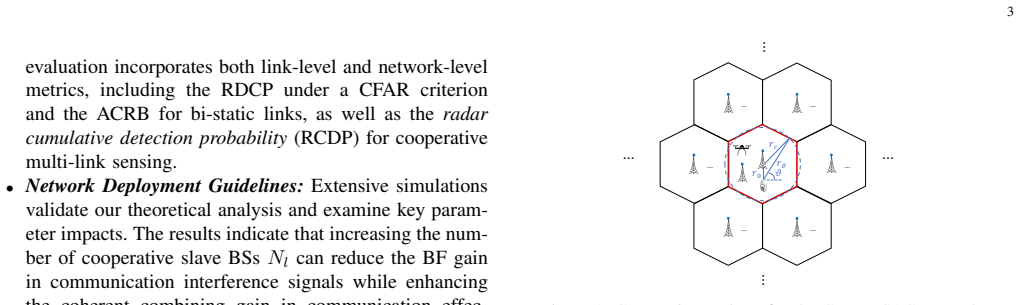
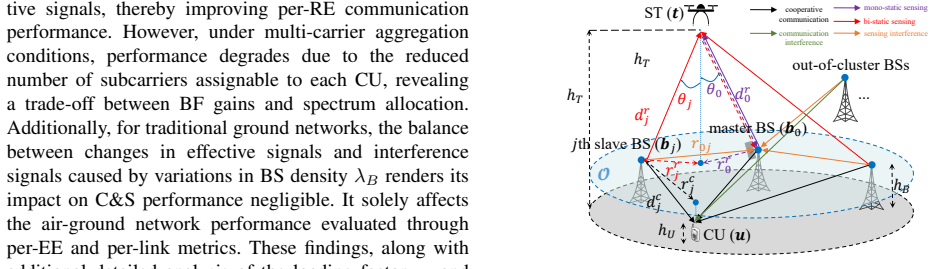
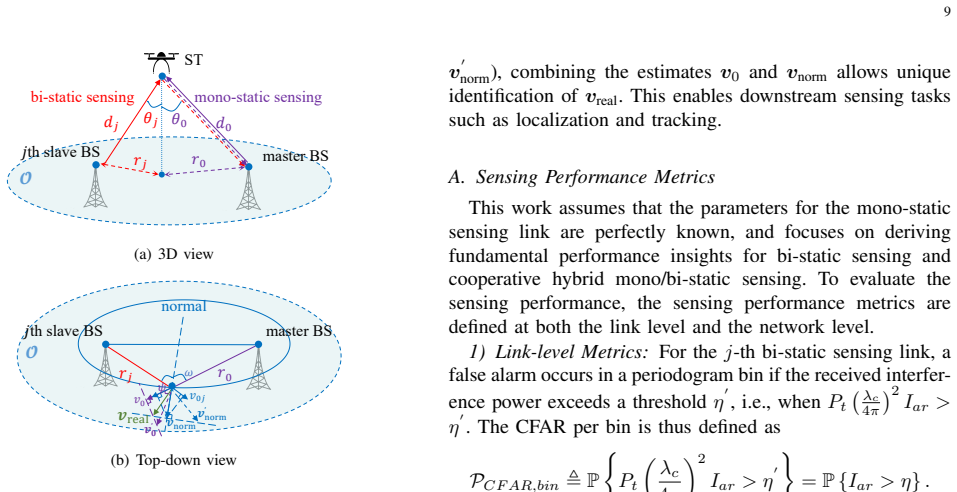
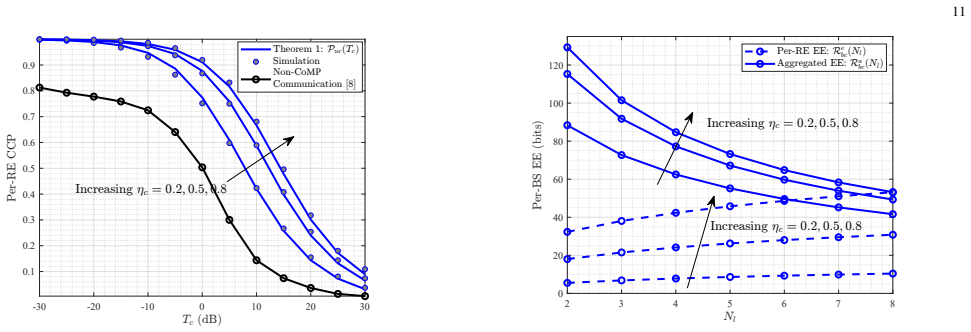
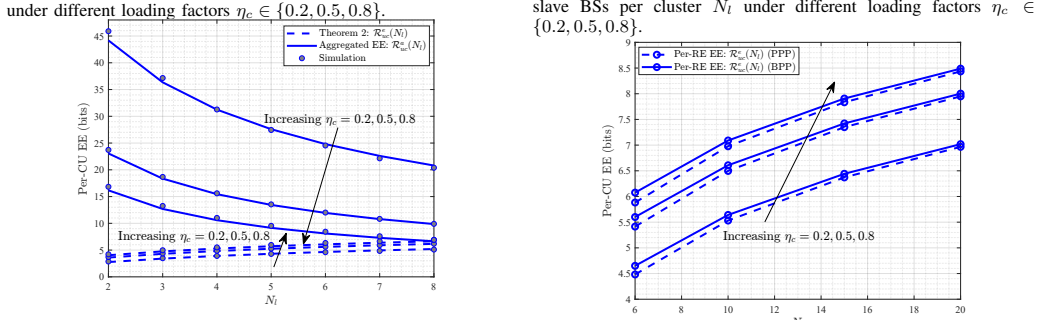
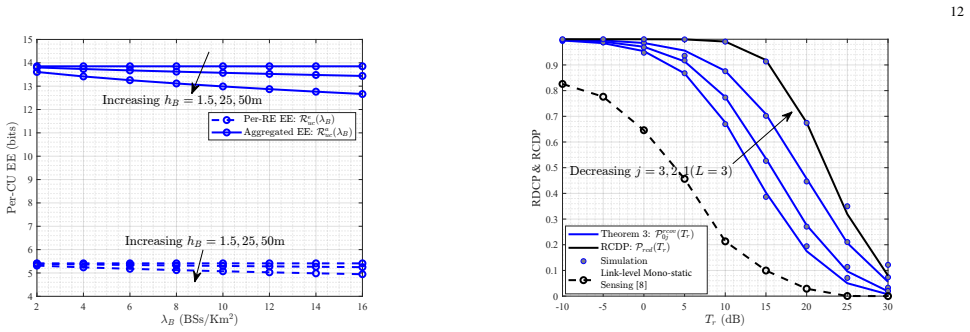
A heterogeneous air-ground ISAC network architecture based on CoMP is proposed, which incorporates a cooperative hybrid mono/bi-static sensing scheme to enhance spatial diversity and sensing capability. In the proposed architecture, a two-tier base station deployment is adopted: master BSs are arranged in a hexagonal lattice, while slave BSs follow a Poisson point process distribution. This structure concurrently supports communication for terrestrial users and sensing for aerial targets. A holistic performance analysis framework for both C&S is further developed, accounting for key channel and network parameters. Simulation results reveal inherent trade-offs between C&S performance, especia
What carries the argument
The cooperative hybrid mono/bi-static sensing scheme in the two-tier CoMP architecture, which combines master and slave base stations to deliver spatial diversity for sensing aerial targets while serving terrestrial communication.
If this is right
- Trade-offs between communication and sensing performance emerge particularly under multi-BS cooperation.
- Changes in network density alter the balance between C&S metrics.
- The analysis framework incorporates effects from key channel and network parameters in the two-tier setup.
- The results supply practical guidance for deploying scalable ISAC networks in low-altitude economy scenarios.
Where Pith is reading between the lines
- If the model assumptions hold, operators may need to tune cooperation levels to maintain sensing performance as density increases.
- The two-tier structure could guide similar integrated designs in other environments with mixed user types.
- Incorporating explicit mobility models for aerial targets would test whether the reported trade-offs persist.
Load-bearing premise
The two-tier BS deployment model with master stations in a hexagonal lattice and slave stations as a Poisson point process, together with the assumed channel and network parameters, accurately captures real air-ground propagation, interference, and mobility effects without significant unmodeled factors that would alter the reported C&S trade-offs.
What would settle it
Field measurements of communication rates and sensing detection probabilities in a real air-ground environment under comparable multi-BS cooperation levels and densities that deviate from the simulated trade-off curves.
Figures
read the original abstract
The emergence of the \textit{low-altitude economy} (LAE) calls for highly integrated and reliable wireless systems that can simultaneously support \textit{communication and sensing} (C\&S) functions. Although \textit{integrated sensing and communication} (ISAC) has been widely studied, most existing works focused on link-level or single-cell architectures in terrestrial environments, leaving the potential of network-level cooperative air-ground ISAC largely unexplored. To bridge this gap, a heterogeneous air-ground ISAC network architecture based on \textit{coordinated multipoint} (CoMP) is proposed, which incorporates a cooperative hybrid mono/bi-static sensing scheme to enhance spatial diversity and sensing capability. In the proposed architecture, a two-tier \textit{base station} (BS) deployment is adopted: master BSs are arranged in a hexagonal lattice, while slave BSs follow a Poisson point process distribution. This structure concurrently supports communication for terrestrial users and sensing for aerial targets. A holistic performance analysis framework for both C\&S is further developed, accounting for key channel and network parameters. Simulation results reveal inherent trade-offs between C\&S performance, especially under multi-BS cooperation and varying network density. These findings provide practical guidance for the deployment of scalable and efficient ISAC networks in LAE scenarios.
Editorial analysis
A structured set of objections, weighed in public.
Referee Report
Summary. The manuscript proposes a heterogeneous air-ground ISAC network architecture based on CoMP for low-altitude economy scenarios. It features a two-tier BS deployment (master BSs on hexagonal lattice, slave BSs as PPP), a cooperative hybrid mono/bi-static sensing scheme to improve spatial diversity, a holistic performance analysis framework accounting for channel and network parameters, and simulation results that reveal trade-offs between communication and sensing performance under multi-BS cooperation and varying network density.
Significance. If the analysis framework and reported trade-offs hold, the work would provide practical guidance for deploying scalable ISAC networks in air-ground LAE settings by quantifying C&S performance under cooperation. The extension of ISAC to network-level cooperative heterogeneous architectures using standard stochastic geometry tools is a positive contribution.
major comments (1)
- [System Model] System Model section: The two-tier deployment (master BSs in hexagonal lattice, slave BSs as PPP) together with the assumed channel parameters is load-bearing for the central claim of inherent C&S trade-offs; the manuscript provides no sensitivity analysis or comparison to alternative models (e.g., fully random deployment or inclusion of mobility) to confirm that unmodeled air-ground propagation and interference effects would not alter the reported trade-offs. A concrete test would be to vary the lattice spacing and PPP intensity and verify persistence of the multi-BS cooperation gains.
minor comments (1)
- [Abstract] Abstract: The description of the 'holistic performance analysis framework' does not name the specific metrics (e.g., achievable rate, sensing SNR, detection probability) or the exact stochastic geometry tools employed, which would improve immediate readability.
Simulated Author's Rebuttal
We thank the referee for their thorough review and valuable suggestions. Below we provide a point-by-point response to the major comment.
read point-by-point responses
-
Referee: [System Model] System Model section: The two-tier deployment (master BSs in hexagonal lattice, slave BSs as PPP) together with the assumed channel parameters is load-bearing for the central claim of inherent C&S trade-offs; the manuscript provides no sensitivity analysis or comparison to alternative models (e.g., fully random deployment or inclusion of mobility) to confirm that unmodeled air-ground propagation and interference effects would not alter the reported trade-offs. A concrete test would be to vary the lattice spacing and PPP intensity and verify persistence of the multi-BS cooperation gains.
Authors: The referee correctly notes that the system model is central to our claims. The two-tier deployment is motivated by practical LAE scenarios, with master BSs on a hexagonal lattice representing fixed, planned infrastructure and slave BSs as PPP for random additional nodes. This allows us to analyze the benefits of cooperation in a heterogeneous setting using stochastic geometry. Our existing simulations vary the overall network density and show that the C&S trade-offs and cooperation gains hold. To directly address the suggestion, we will add in the revised version explicit sensitivity analysis by varying the lattice spacing (affecting master BS density) and PPP intensity, as well as a comparison case with fully random deployment. This will confirm the persistence of the gains. We note that incorporating mobility would entail a major extension to the static channel models used and is left for future research. revision: partial
Circularity Check
No significant circularity detected
full rationale
The paper's core claims rest on a proposed two-tier BS deployment (hexagonal masters + PPP slaves) and hybrid mono/bi-static CoMP sensing, with performance metrics derived via standard stochastic geometry and channel models. No load-bearing step reduces by construction to a fitted parameter, self-citation chain, or renamed input; the abstract and context indicate independent modeling choices whose outputs are not forced by definition. This is the typical non-circular case for simulation-based network analysis.
Axiom & Free-Parameter Ledger
axioms (2)
- domain assumption Master BSs follow hexagonal lattice and slave BSs follow Poisson point process distributions
- domain assumption Standard models for air-ground channels and interference apply without modification
Reference graph
Works this paper leans on
-
[1]
Integrated sensing and communication for low altitude economy: Opportunities and challenges,
Y . Jiang, X. Li, G. Zhu, H. Li, J. Deng, K. Han, C. Shen, Q. Shi, and R. Zhang, “Integrated sensing and communication for low altitude economy: Opportunities and challenges,”IEEE Commun. Mag., vol. 63, no. 12, pp. 72–78, 2025
2025
-
[2]
Air-ground integrated sensing and communications: Opportunities and challenges,
Z. Fei, X. Wang, N. Wu, J. Huang, and J. A. Zhang, “Air-ground integrated sensing and communications: Opportunities and challenges,” IEEE Commun. Mag., vol. 61, no. 5, pp. 55–61, 2023
2023
-
[3]
On the design of beamforming feedback for wi-fi sensing,
Y . Jiang, X. Zhu, R. Du, Y . Lv, T. X. Han, D. X. Yang, Y . Zhang, Y . Li, and Y . Gong, “On the design of beamforming feedback for wi-fi sensing,” vol. 11, no. 10, pp. 2036–2040, 2022
2036
-
[4]
On the design and performance of QRD-based beamforming feedback for Wi-Fi sensing,
Y . Jiang, Y . Gong, Y . Zeng, Y . Lv, T. X. Han, R. Ding, and R. Du, “On the design and performance of QRD-based beamforming feedback for Wi-Fi sensing,” vol. 23, no. 5, pp. 5261–5271, 2023
2023
-
[5]
Integrated sensing and communications: Toward dual-functional wire- less networks for 6G and beyond,
F. Liu, Y . Cui, C. Masouros, J. Xu, T. X. Han, Y . C. Eldar, and S. Buzzi, “Integrated sensing and communications: Toward dual-functional wire- less networks for 6G and beyond,”IEEE J. Sel. Areas Commun., vol. 40, no. 6, pp. 1728–1767, 2022
2022
-
[6]
Symbiotic sensing and communication: Framework and beamforming design,
F. Xia, Z. Fei, X. Wang, W. Yuan, Q. Wu, Y . Liu, and T. Q. Quek, “Symbiotic sensing and communication: Framework and beamforming design,”IEEE Trans. Wireless Commun., vol. 24, no. 3, pp. 2417–2434, 2025
2025
-
[7]
Network-level ISAC: An analytical study of antenna topologies ranging from massive to cell-free mimo,
K. Meng, C. Masouros, G. Chen, and F. Liu, “Network-level ISAC: An analytical study of antenna topologies ranging from massive to cell-free mimo,”IEEE Trans. Wireless Commun., early access, 2024
2024
-
[8]
Network-level performance analysis for air-ground integrated sensing and communication,
Y . Jiang, X. Li, G. Zhu, K. Han, K. Meng, W. Yang, C. Liu, Q. Shi, and R. Zhang, “Network-level performance analysis for air-ground integrated sensing and communication,”IEEE Trans. Wireless Commun., vol. 24, no. 8, pp. 6931–6946, 2025
2025
-
[9]
Stoyan, W
D. Stoyan, W. S. Kendall, and J. Mecke,Stochastic Geometry and Its Applications. New York, NY , USA: Wiley, 1995
1995
-
[10]
Haenggi,Stochastic geometry for wireless networks
M. Haenggi,Stochastic geometry for wireless networks. Cambridge, U.K.: Cambridge Univ. Press, 2012
2012
-
[11]
Performance tradeoffs of joint radar-communication networks,
P. Ren, A. Munari, and M. Petrova, “Performance tradeoffs of joint radar-communication networks,”IEEE Wireless Commun. Lett., vol. 8, no. 1, pp. 165–168, 2018
2018
-
[12]
Performance analysis of integrated sensing and communication networks with blockage effects,
Z. Sun, S. Yan, N. Jiang, J. Zhou, and M. Peng, “Performance analysis of integrated sensing and communication networks with blockage effects,” IEEE Trans. Veh. Technol., vol. 73, no. 11, pp. 16 876–16 891, 2024
2024
-
[13]
Coverage and rate of joint communication and parameter estimation in wireless networks,
N. R. Olson, J. G. Andrews, and R. W. Heath, “Coverage and rate of joint communication and parameter estimation in wireless networks,” IEEE Trans. Inf. Theory, vol. 70, no. 1, pp. 206–243, 2023
2023
-
[14]
Rethink- ing dense cells for integrated sensing and communications: A stochastic geometric view,
A. Salem, K. Meng, C. Masouros, F. Liu, and D. L ´opez-P´erez, “Rethink- ing dense cells for integrated sensing and communications: A stochastic geometric view,”IEEE Open J. Commun. Soc., vol. 5, pp. 2226–2239, 2024
2024
-
[15]
Network-level integrated sensing and communication: Interference management and bs coordina- tion using stochastic geometry,
K. Meng, C. Masouros, G. Chen, and F. Liu, “Network-level integrated sensing and communication: Interference management and bs coordina- tion using stochastic geometry,”IEEE Trans. Wireless Commun., vol. 12, no. 1, pp. 19 365–19 381, 2024
2024
-
[16]
Coverage and rate analysis for integrated sensing and communication networks,
X. Gan, C. Huang, Z. Yang, X. Chen, J. He, Z. Zhang, C. Yuen, Y . L. Guan, and M. Debbah, “Coverage and rate analysis for integrated sensing and communication networks,”IEEE J. Sel. Areas Commun., vol. 42, no. 9, pp. 2213–2227, 2024
2024
-
[17]
A stochastic analysis of network MIMO systems,
K. Hosseini, W. Yu, and R. S. Adve, “A stochastic analysis of network MIMO systems,”IEEE Trans. Signal Process., vol. 64, no. 16, pp. 4113– 4126, 2016
2016
-
[18]
Cooperative ISAC Networks: Performance Analysis, Scaling Laws and Optimiza- tion,
K. Meng, C. Masouros, A. P. Petropulu, and L. Hanzo, “Cooperative ISAC Networks: Performance Analysis, Scaling Laws and Optimiza- tion,”IEEE Trans. Wireless Commun., vol. 24, no. 2, pp. 877–892, 2024
2024
-
[19]
Cover- age analysis for air-ground integrated-sensing-and-communication net- works,
Y . Jiang, F. Meng, X. Li, X. Li, G. Zhu, K. Han, and Q. Shi, “Cover- age analysis for air-ground integrated-sensing-and-communication net- works,” inProc. IEEE Int. Conf. Ubiquitous Commun., Xi’an, China, 2024. 14
2024
-
[20]
A tractable approach to coverage and rate in cellular networks,
J. G. Andrews, F. Baccelli, and R. K. Ganti, “A tractable approach to coverage and rate in cellular networks,”IEEE Trans. Commun., vol. 59, no. 11, pp. 3122–3134, 2011
2011
-
[21]
Performance analysis of asynchronous multicarrier wireless networks,
X. Lin, L. Jiang, and J. G. Andrews, “Performance analysis of asynchronous multicarrier wireless networks,”IEEE Trans. Commun., vol. 63, no. 9, pp. 3377–3390, 2015
2015
-
[22]
Stochastic geometry analysis of multi-user asynchronous OFDM wireless networks,
A. Ali, R. Vesilo, and M. Di Renzo, “Stochastic geometry analysis of multi-user asynchronous OFDM wireless networks,”IEEE Wireless Commun. Lett., vol. 8, no. 3, pp. 845–848, 2019
2019
-
[23]
Waveform design and signal processing aspects for fusion of wireless communications and radar sensing,
C. Sturm and W. Wiesbeck, “Waveform design and signal processing aspects for fusion of wireless communications and radar sensing,”Proc. of the IEEE, vol. 99, no. 7, pp. 1236–1259, 2011
2011
-
[24]
OFDM radar algorithms in mobile communication net- works,
M. Braun, “OFDM radar algorithms in mobile communication net- works,”Ph.D. Thesis at Karlsruher Institute of Technology, 2014
2014
-
[25]
On the optimality of multiantenna broad- cast scheduling using zero-forcing beamforming,
T. Yoo and A. Goldsmith, “On the optimality of multiantenna broad- cast scheduling using zero-forcing beamforming,”IEEE J. Sel. Areas Commun., vol. 24, no. 3, pp. 528–541, 2006
2006
-
[26]
Spectral efficiency of dynamic coordinated beamforming: A stochastic geometry approach,
R. Schmidt, “Spectral efficiency of dynamic coordinated beamforming: A stochastic geometry approach,”IEEE Trans. Wireless Commun., vol. 14, no. 1, pp. 230–241, 2014
2014
-
[27]
On the optimal feedback rate in interference-limited multi-antenna cellular systems,
J. Park, N. Lee, J. G. Andrews, and R. W. Heath, “On the optimal feedback rate in interference-limited multi-antenna cellular systems,” IEEE Trans. Wireless Commun., vol. 15, no. 8, pp. 5748–5762, 2016
2016
-
[28]
I. S. Gradshteyn and I. M. Ryzhik,Table of Integrals, Series, and Products. New York, NY , USA: Academic Press, 2007
2007
-
[29]
A novel approach to OFDM radar processing,
C. Sturm, E. Pancera, T. Zwick, and W. Wiesbeck, “A novel approach to OFDM radar processing,” inProc. IEEE Radar Conf., 2009, pp. 1–4
2009
-
[30]
Delay and Doppler processing for multi-target detection with IEEE 802.11 OFDM signaling,
D. H. Nguyen and R. W. Heath, “Delay and Doppler processing for multi-target detection with IEEE 802.11 OFDM signaling,” inProc. IEEE ICASSP, 2017, pp. 3414–3418
2017
-
[31]
Forbes, M
C. Forbes, M. Evans, N. Hastings, and B. Peacock,Statistical distribu- tions. Hoboken, NJ, USA: John Wiley & Sons, 2011
2011
-
[32]
A. M. Mathai,An introduction to geometrical probability: distributional aspects with applications. Amsterdam, Holland: Gordon and Breach, 1999
1999
-
[33]
Introduction to probability and random variables,
G. P. Wadsworth, “Introduction to probability and random variables,”J. Appl. Mechanics, vol. 28, no. 2, p. 319, 1961
1961
-
[34]
A useful lemma for capacity analysis of fading inter- ference channels,
K. A. Hamdi, “A useful lemma for capacity analysis of fading inter- ference channels,”IEEE Trans. Commun., vol. 58, no. 2, pp. 411–416, 2010
2010
-
[35]
Sensing Performance Analysis in Cooperative Air-Ground ISAC Networks for LAE,
Y . Jiang, X. Li, G. Zhu, X. Cao, K. Han, B. Zhou, and X. Wang, “Sensing Performance Analysis in Cooperative Air-Ground ISAC Networks for LAE,”arXiv preprint arXiv: 2510.03642, 2025
arXiv 2025
-
[36]
Note on the inversion theorem,
J. Gil-Pelaez, “Note on the inversion theorem,”Biometrika, vol. 38, no. 3-4, pp. 481–482, 1951. APPENDIX A. Proof of Corollary 1 In the CoMP architecture, the typical CU receives coherent signals from multiple transmission points. Consequently, both the desired signal and interference are aggregated at the cluster level prior to power calculation. The ana...
1951
discussion (0)
Sign in with ORCID, Apple, or X to comment. Anyone can read and Pith papers without signing in.