REVIEW 4 major objections 5 minor 35 references
Deep Neural Network for Semantic-based Text Recognition in Images
T0 review · 4 major / 5 minor · reviewed 2026-08-14 · deepseek-v4-flash
Pith's one-line read A text recognition pipeline that groups words into phrases and corrects them with a sequence-to-sequence model reads 90% of catalog words and 71% of handwritten sign words, beating isolated-word recognition by 4.68 and 5.46 percentage…
desk verdict A plausible context-aware text-recognition pipeline with two new datasets, but the TGA grouping step is under-specified and the evaluation lacks ablations and error bars. read the letter →
The pith
A machine-rendered reading of the paper's core claim, the machinery that carries it, and where it could break.
The reading
What carries the argument
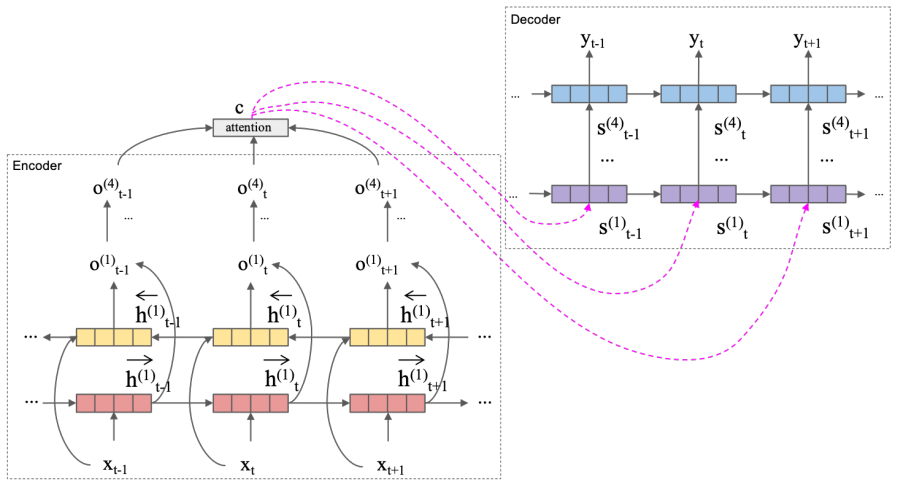
The load-bearing mechanism is the combination of the Text Grouping and Arranging (TGA) algorithm and the sequence-to-sequence correction model. TGA is a flood-fill-like grouping step that starts from a seed word box, absorbs neighboring boxes judged by a geometric same-group test, and then arranges the grouped boxes by sorting on horizontal then vertical coordinates under an assumed left-to-right, top-to-bottom reading order. The correction model is a character-level attention-based sequence-to-sequence network whose encoder is four bidirectional LSTM layers and whose decoder is four LSTM layers with global attention; it is trained to map noisy recognized phrases to clean phrases. The argument lives in the fact that correction operates on phrases rather than single words, so domain knowledge can repair recognition errors such as missing or substituted letters.
What would settle it
Run the full pipeline on the protest-sign test set, then rerun it feeding the corrector ground-truth group and order labels instead of TGA's output; if accuracy under TGA's output is no lower than with ground-truth order even on images where TGA visibly misgroups, then the claim that correct grouping and arranging drives the gain is unsupported.
Extended reading notes
Core claim
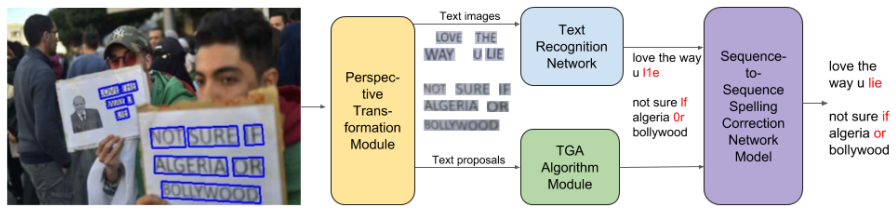
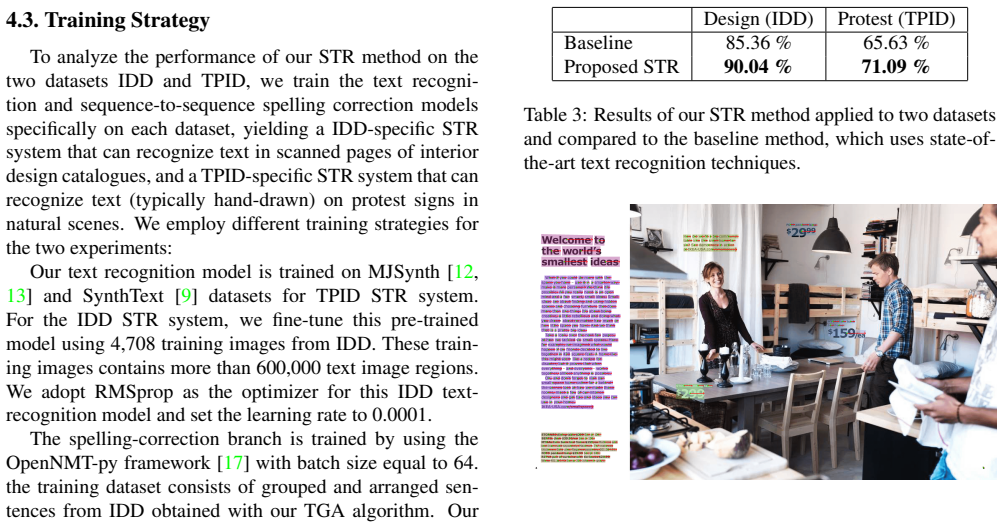
The central claim is that semantic coherence within a region of text is useful signal for text recognition, and that a model which explicitly groups and orders text regions can exploit it. The paper implements this as STR: a pipeline in which a perspective transformation normalizes each word box, a CTC-trained CNN–BiLSTM recognizer reads each word, TGA groups boxes into semantic units and sorts them in reading order, and a sequence-to-sequence network with global attention corrects the resulting phrase. The paper claims the correction module is what turns inaccurate single-word output such as 'REFUGEES WELCONE HERE' into the correct 'REFUGEES WELCOME HERE,' and reports word accuracy of 90.04% on the catalog dataset and 71.09% on the protest-sign dataset, outperforming the isolated-word baseline by 4.68 and 5.46 percentage points.
Load-bearing premise
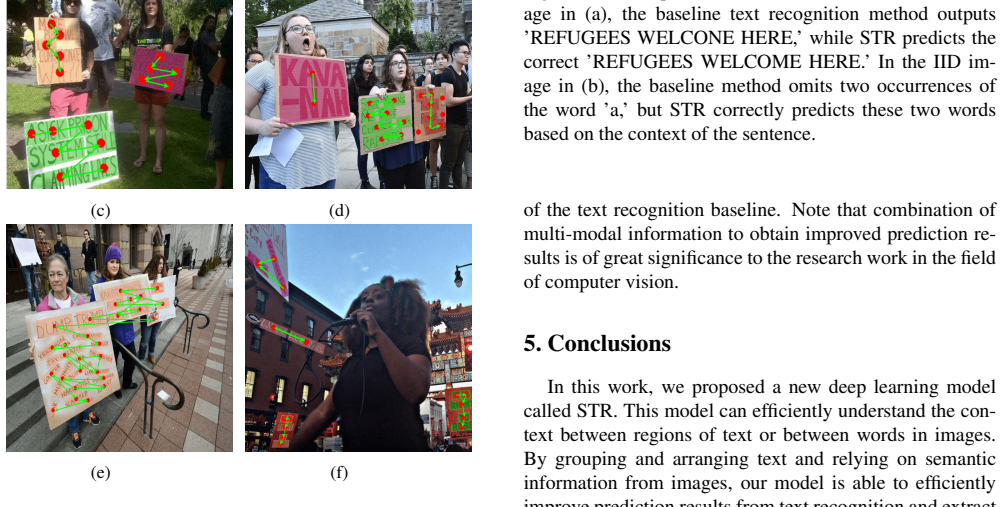
The load-bearing premise is that whether two neighboring word boxes belong to the same phrase can be decided just from where the boxes sit on the page; the paper itself notes on protest-sign images that this grouping and the assumed left-to-right, top-to-bottom order sometimes fail, but it does not quantify how often, and such failures hand the correction model a scrambled sequence that could make accuracy worse.
Editorial extensions
If this is right
- The correction module can repair errors that isolated-word recognition makes, such as missing or substituted characters, without retraining the visual model.
- TGA provides whole-phrase output from scattered word boxes, so layout-aware grouping enables sentence- and paragraph-level outputs from word spotters.
- The method works on both machine-printed catalog pages and handwritten protest signs, so semantic post-processing generalizes across very different text domains.
- The gap between 90% accuracy on catalogs and 71% on protest signs indicates that grouping and ordering difficulty, not just per-word recognition difficulty, controls overall accuracy.
Reading between the lines
- A strong language prior may account for much of the measured gain, so a fair ablation would compare STR's corrector against a simpler n-gram or language-model corrector over the same recognized words.
- TGA's purely geometric grouping and strict reading-order assumption could be replaced by a learned layout model, which would likely extend the method to rotated or multi-column text.
- The two group-labeled datasets are a reusable asset: they enable future benchmarking of layout-aware text recognition beyond this pipeline.
- Because the correction stage operates on character sequences, the same architecture is applicable to other noisy text streams, such as raw OCR output followed by spelling correction.
Signed reviews
Editorial analysis
A structured set of objections, weighed in public.
Referee Report
Summary. The paper proposes a semantic-based text recognition (STR) pipeline for images containing multi-word text. The pipeline consists of a perspective transformation module, an isolated-word recognition network, a Text Grouping and Arranging (TGA) algorithm that groups and orders word bounding boxes into sentences or paragraphs, and a sequence-to-sequence spelling-correction model that uses the grouped context to fix recognition errors. The authors introduce two new datasets: the Interior Design Dataset (IDD) of scanned catalog pages and the Text-containing Protest Image Dataset (TPID) of protest signs. Reported word-level accuracies are 90.04% on IDD versus an 85.36% baseline, and 71.09% on TPID versus a 65.63% baseline, corresponding to improvements of 4.68 and 5.46 percentage points. The central claim is that semantic context, obtained by grouping and ordering text regions, improves text recognition accuracy.
Significance. If made fully reproducible, the contribution is useful: TGA addresses a layout-analysis problem that standard scene-text benchmarks do not cover, and the sequence-to-sequence correction module provides a clear way to inject domain language knowledge into a vision pipeline. The two new datasets with phrase- and paragraph-level group labels are a genuine resource for the community. The paper also has the merit of being transparent about its architecture, and the authors state an intention to release code and data. However, the current evidence is suggestive rather than conclusive: the TGA algorithm is underspecified to the point of non-reproducibility, the evaluation uses ground-truth bounding boxes and no detector, and the reported gains are not supported by ablations or statistical testing. The core idea is plausible, but the paper as written does not yet allow an independent implementation to verify the claimed improvements.
major comments (4)
- [Section 3.4.1, Algorithm 1] The SameGroup(seed, bi) predicate used in Algorithm 1, line 9, is never defined. The manuscript states only that grouping "relies on geometric information," but gives no metric, threshold, learned model, or visual criterion for deciding whether two bounding boxes belong to the same semantic group. Since TGA is the first of the paper's two main contributions and its output is the input to the sequence-to-sequence correction model, this omission prevents an independent implementation of the method. The authors need to specify SameGroup exactly, including all parameters and tie-breaking behavior.
- [Section 3.4.2, Algorithm 2] Algorithm 2 depends on FindNexttext and DeleteSubLine, neither of which is specified. The comment in line 8 says "Find pointer to next region on same line," but the manuscript does not define how lines are detected, how the "most text regions" line is chosen in DeleteSubLine, or how vertical sorting is performed with ties. These details directly determine the reading order fed to the correction model, so the arranging step is not reproducible as written. The authors should provide a precise, implementable specification for both functions, including handling of multi-column layouts and rotated text.
- [Section 3.2 and Section 4.4] The evaluation uses ground-truth bounding boxes rather than a text detector: Section 3.2 states that cropped text regions are obtained by relying on the coordinates of ground-truth bounding boxes, and Section 4.4 does not report any detector-based end-to-end evaluation. The paper's framing as a "text spotting" system is therefore not supported by the experiments; the reported numbers measure recognition and correction only under oracle localization. The authors should either evaluate with an actual text detector, or clearly reposition the contribution as a recognition-plus-parsing method and remove claims that conflate detection with recognition.
- [Section 4.4, Table 3] The reported improvements of 4.68 and 5.46 percentage points are presented without error bars, statistical significance tests, or ablation studies. In particular, there is no experiment that separates the contribution of TGA from the contribution of the sequence-to-sequence correction model, and no quantitative evaluation of TGA's grouping and ordering error rate. This matters because the paper itself acknowledges TGA failures on TPID signs (Section 4.4, Figure 5e and 5f), and the correction model may either compensate for or amplify those failures. The authors should add ablations such as: baseline with oracle grouping only, baseline with the correction model and oracle grouping, and baseline with both modules; they should also report confidence intervals or significance tests for the word-accuracy differences.
minor comments (5)
- [Table 1] The table header contains the typo "Configuation"; it should read "Configuration."
- [Section 3.3] The phrase "translating perfume results into a label sequence" appears to be a typo; it should read "translating prediction results into a label sequence."
- [Section 4.3] There are inconsistent spellings: "NVNDIA" should be "NVIDIA," and the abbreviation "IID STR systems" should be "IDD STR systems" for consistency with the dataset name.
- [Algorithm 1] Line 3 says the grouping process starts from a "randomly selected" text bounding box, but Algorithm 1 uses a deterministic Dequeue operation. The authors should clarify whether the grouping result is invariant to the initial choice and queue order, or provide a deterministic selection rule.
- [Section 4.1] The baseline method is described only as using "state-of-the-art isolated-word recognition techniques." The paper should specify the exact baseline architecture, training procedure, and hyperparameters so that the comparison in Table 3 is fully reproducible.
Circularity Check
No circularity found: the STR gains are measured on held-out words through a conventional supervised correction model, and the TGA specification gaps are reproducibility concerns, not self-referential derivations.
full rationale
The paper's derivation chain is not circular. The claimed improvement (90% vs 85.36% on IDD and 71.09% vs 65.63% on TPID, Table 3) comes from a sequence-to-sequence spelling-correction module trained on training splits of the same two datasets and evaluated on held-out test words; this is standard supervised learning, not a fitted parameter disguised as a prediction. No equation reduces the reported output to the training targets by construction: the context-vector and attention equations (Eqs. 3-7) are generic sequence-to-sequence machinery, and the loss (Eq. 8) is a standard cross-entropy objective. There are no load-bearing self-citations: the reference list contains no prior work by Zheng, Wang, or Betke, and no uniqueness theorem is imported from the authors' earlier papers. The TGA algorithm's SameGroup predicate is left undefined in Algorithm 1, and Algorithm 2's FindNexttext/DeleteSubLine are not fully specified; the paper itself acknowledges TGA failures on TPID signs (Section 4.4, Figure 5e-5f). These are reproducibility and robustness limitations rather than evidence that the reported gains reduce to the method's inputs. The use of domain-specific training data for a language-model-style corrector is a legitimate modeling choice, and the claimed generality rests on testing two distinct domains rather than on an external benchmark; that is a strength/weakness tradeoff, not circularity.
Assumptions & free parameters
assumptions (4)
- domain assumption SameGroup(seed, bi) in Algorithm 1 can correctly identify bounding boxes belonging to the same semantic group using only geometric information.
- domain assumption Reading order within a group is always left to right and top to bottom, so a simple coordinate sort arranges words correctly.
- domain assumption A sequence-to-sequence model trained on target-domain text can correct OCR errors without introducing new errors that offset the gains.
- domain assumption Ground-truth bounding boxes are available for all text regions, so text detection errors are not considered.
Cite this review
Pith. "Pith review of Deep Neural Network for Semantic-based Text Recognition in Images." pith.science (2026). https://pith.science/paper/ER4X2XHG
@misc{pith2026190801403,
  author       = {Pith},
  title        = {Pith review of: Deep Neural Network for Semantic-based Text Recognition in Images},
  year         = {2026},
  howpublished = {\url{https://pith.science/paper/ER4X2XHG}},
  note         = {Machine review of arXiv:1908.01403}
}
read the original abstract
State-of-the-art text spotting systems typically aim to detect isolated words or word-by-word text in images of natural scenes and ignore the semantic coherence within a region of text. However, when interpreted together, seemingly isolated words may be easier to recognize. On this basis, we propose a novel "semantic-based text recognition" (STR) deep learning model that reads text in images with the help of understanding context. STR consists of several modules. We introduce the Text Grouping and Arranging (TGA) algorithm to connect and order isolated text regions. A text-recognition network interprets isolated words. Benefiting from semantic information, a sequenceto-sequence network model efficiently corrects inaccurate and uncertain phrases produced earlier in the STR pipeline. We present experiments on two new distinct datasets that contain scanned catalog images of interior designs and photographs of protesters with hand-written signs, respectively. Our results show that our STR model outperforms a baseline method that uses state-of-the-art single-wordrecognition techniques on both datasets. STR yields a high accuracy rate of 90% on the catalog images and 71% on the more difficult protest images, suggesting its generality in recognizing text.
Figures

Figures from the paper (3 more)

Reference graph
Works this paper leans on
-
[1]
S. Ahmadi. Attention-based encoder-decoder networks for spelling and grammatical error correction. CoRR, abs/1810.00660, 2018. 6
arXiv 2018
-
[2]
L. E. Asri, J. He, and K. Suleman. A sequence- to-sequence model for user simulation in spoken dia- logue systems. In Interspeech 2016, September 8-12, 2016, San Francisco, USA , pages 1151–1155. ISCA, 2016. http://arxiv.org/abs/1607.00070. 5
arXiv 2016
-
[3]
D. Bahdanau, K. Cho, and Y . Bengio. Neural machine translation by jointly learning to align and translate. CoRR, abs/1409.0473, 2014. 3, 5, 6
arXiv 2014
-
[4]
F. Bai, Z. Cheng, Y . Niu, S. Pu, and S. Zhou. Edit proba- bility for scene text recognition. In The IEEE Conference on Computer Vision and Pattern Recognition (CVPR) , June
-
[5]
K. Cho, B. van Merrienboer, C ¸ . G ¨ulc ¸ehre, F. Bougares, H. Schwenk, and Y . Bengio. Learning phrase representations using RNN encoder-decoder for statistical machine transla- tion. CoRR, abs/1406.1078, 2014. 3
arXiv 2014
- [6]
-
[7]
S. Ghosh and P. O. Kristensson. Neural networks for text correction and completion in keyboard decoding. CoRR, abs/1709.06429, 2017. 3, 6
arXiv 2017
-
[8]
A. Graves, S. Fern ´andez, F. Gomez, and J. Schmidhu- ber. Connectionist temporal classification: Labelling unseg- mented sequence data with recurrent neural networks. In Proceedings of the 23rd International Conference on Ma- chine Learning, ICML ’06, pages 369–376, New York, NY , USA, 2006. ACM. 4
work page 2006
Show all 35 references
-
[9]
Gupta, A
A. Gupta, A. Vedaldi, and A. Zisserman. Synthetic data for text localisation in natural images. In IEEE Conference on Computer Vision and Pattern Recognition, 2016. 7
2016
-
[10]
T. He, W. Huang, Y . Qiao, and J. Yao. Text-attentional con- volutional neural network for scene text detection. IEEE Transactions on Image Processing , 25(6):2529–2541, June
-
[11]
Hochreiter and J
S. Hochreiter and J. Schmidhuber. Long short-term memory. Neural computation, 9(8):1735–1780, 1997. 5
1997
-
[12]
Jaderberg, K
M. Jaderberg, K. Simonyan, A. Vedaldi, and A. Zisserman. Reading text in the wild with convolutional neural networks. arXiv preprint arXiv:1412.1842, 2014. 7
2014 arXiv
-
[13]
Jaderberg, K
M. Jaderberg, K. Simonyan, A. Vedaldi, and A. Zisserman. Synthetic data and artificial neural networks for natural scene text recognition. arXiv preprint arXiv:1406.2227, 2014. 7
2014 arXiv
-
[14]
Jaderberg, K
M. Jaderberg, K. Simonyan, A. Vedaldi, and A. Zisserman. Reading text in the wild with convolutional neural networks. International Journal of Computer Vision, 116(1):1–20, Jan
-
[15]
S. Jean, K. Cho, R. Memisevic, and Y . Bengio. On using very large target vocabulary for neural machine translation. CoRR, abs/1412.2007, 2014. 3
2007 arXiv
-
[16]
Karatzas, F
D. Karatzas, F. Shafait, S. Uchida, M. Iwamura, L. G. i Big- orda, S. R. Mestre, J. Mas, D. F. Mota, J. A. Almazan, and L. P. De Las Heras. ICDAR 2013 robust reading competi- tion. In 2013 12th International Conference on Document Analysis and Recognition, pages 1484–1493. IEE...
2013
-
[17]
Klein, Y
G. Klein, Y . Kim, Y . Deng, J. Senellart, and A. M. Rush. OpenNMT: Open-source toolkit for neural machine transla- tion. In Proc. ACL, 2017. 7
2017
-
[18]
J. Lin, X. Sun, S. Ma, and Q. Su. Global encoding for ab- stractive summarization. CoRR, abs/1805.03989, 2018. 3
2018 arXiv
-
[19]
Luong, H
M. Luong, H. Pham, and C. D. Manning. Effective approaches to attention-based neural machine translation. CoRR, abs/1508.04025, 2015. 5, 6, 7
2015 arXiv
-
[20]
Mishra, K
A. Mishra, K. Alahari, and C. Jawahar. Scene text recog- nition using higher order language priors. In BMVC-British Machine Vision Conference. BMV A, 2012. 6
2012
-
[21]
Nallapati, B
R. Nallapati, B. Xiang, and B. Zhou. Sequence-to-sequence RNNs for text summarization. In Workshop track, Inter- national Conference on Learning Representations (ICLR) , pages 1–4, May 2016. 5
2016
-
[22]
Nallapati, B
R. Nallapati, B. Zhou, C. dos Santos, C ¸ . G ¨ulc ¸ehre, and B. Xiang. Abstractive text summarization using sequence-to- sequence RNNs and beyond. CoRR, abs/1602.06023:1–12, Aug. 2016. 5
2016 arXiv
-
[23]
Schuster and K
M. Schuster and K. K. Paliwal. Bidirectional recurrent neural networks. IEEE Transactions on Signal Processing , 45(11):2673–2681, 1997. 2
1997
-
[24]
B. Shi, X. Bai, and C. Yao. An end-to-end trainable neural network for image-based sequence recognition and its appli- cation to scene text recognition. arXiv:1507.05717, 2015. 1, 2, 3
2015 arXiv
-
[25]
B. Shi, X. Wang, P. Lyu, C. Yao, and X. Bai. Robust scene text recognition with automatic rectification. In The IEEE Conference on Computer Vision and Pattern Recognition (CVPR), June 2016. 2
2016
-
[26]
Simonyan and A
K. Simonyan and A. Zisserman. Very deep convolu- tional networks for large-scale image recognition. CoRR, abs/1409.1556, 2014. 3
2014 arXiv
-
[27]
Sriram, H
A. Sriram, H. Jun, S. Satheesh, and A. Coates. Cold fu- sion: Training seq2seq models together with language mod- els. CoRR, abs/1708.06426, 2017. 3
2017 arXiv
-
[28]
D. Sundby. Spelling correction using n-grams. Technical notes, 2009. 3
2009
-
[29]
Sutskever, O
I. Sutskever, O. Vinyals, and Q. V . Le. Sequence to se- quence learning with neural networks. In Z. Ghahramani, M. Welling, C. Cortes, N. D. Lawrence, and K. Q. Wein- berger, editors, Advances in Neural Information Process- ing Systems 27 , pages 3104–3112. Curran Associates, Inc.,
-
[30]
Thompson
A. Thompson. All the news: 143,000 articles from 15 Amer- ican publications. https://www.kaggle.com/snapcrack/all- the-news, Aug 2017. 7
2017
-
[31]
Vinyals, L
O. Vinyals, L. Kaiser, T. Koo, S. Petrov, I. Sutskever, and G. E. Hinton. Grammar as a foreign language. CoRR, abs/1412.7449, 2014. 3
2014 arXiv
-
[32]
Vinyals and Q
O. Vinyals and Q. V . Le. A neural conversational model. CoRR, abs/1506.05869, 2015. 3
2015 arXiv
-
[33]
K. Wang, B. Babenko, and S. Belongie. End-to-end scene text recognition. In 2011 International Conference on Com- puter Vision, pages 1457–1464. IEEE, 2011. 6
2011
-
[34]
D. Won, Z. C. Steinert-Threlkeld, and J. Joo. Protest activity detection and perceived violence estimation from social me- dia images. In Proceedings of the 25th ACM international conference on Multimedia, pages 786–794. ACM, 2017. 6
2017
-
[35]
Y . Wu, M. Schuster, Z. Chen, Q. V . Le, M. Norouzi, W. Macherey, M. Krikun, Y . Cao, Q. Gao, K. Macherey, J. Klingner, A. Shah, M. Johnson, X. Liu, L. Kaiser, S. Gouws, Y . Kato, T. Kudo, H. Kazawa, K. Stevens, G. Kurian, N. Patil, W. Wang, C. Young, J. Smith, J. Riesa, A. Ru...
2016 arXiv
Reviewed August 14, 2026 · model on record in the stance chip above.
Discussion (0). Continue with ORCID to comment.