REVIEW 6 major objections 5 minor 1 cited by
Unsupervised Ultra-High-Resolution UAV Low-Light Image Enhancement: A Benchmark, Metric and Framework
T0 review · 6 major / 5 minor · reviewed 2026-08-05 · deepseek-v4-flash
Pith's one-line read The paper claims that a 1.32K-parameter unsupervised network can enhance 4K UAV night imagery at 23.8 FPS while producing better perceptual quality than heavier models, and proposes U3D and EEI to benchmark and measure that claim.
desk verdict Useful new UAV low-light dataset and fast baseline, but the EEI-based SOTA claim is undermined by a contradiction between the metric's quality term and the paper's own qualitative assessment. read the letter →
The pith
A machine-rendered reading of the paper's core claim, the machinery that carries it, and where it could break.
The reading
What carries the argument
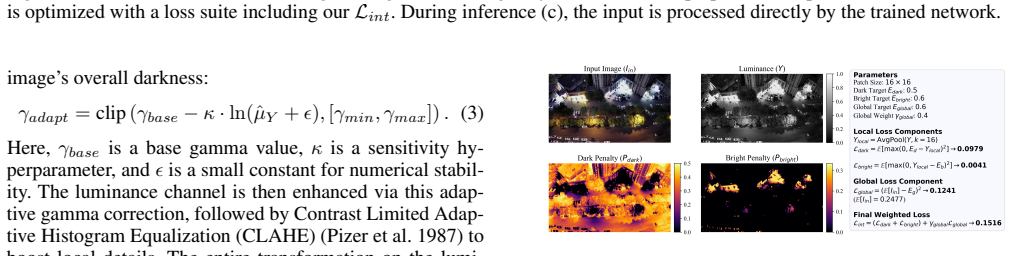
EEI = QPI · E_norm, the yardstick: QPI is the average of NIQE and BRISQUE; E_norm weights time 0.8, complexity 0.1, memory 0.1, all normalized against MobileNetV2 at 4K on the same device. U3LIE, the method it measures, is a curve-estimation network with 1.32K parameters that learns a pixel-wise enhancement map A. Two training-only designs carry quality: APA, a preprocessing pipeline (adaptive gamma, CLAHE, color correction, highlight suppression) normalizing extreme inputs; and L_int, which penalizes local patches outside [0.5, 0.6] and pulls the global mean to 0.6. Training uses non-reference losses only.
What would settle it
Carry out a paired human study on U3D test images, asking raters to compare U3LIE against DCE++, CycleGAN, and the input, then compute the correlation between mean opinion scores and EEI. If a rival method ranks above U3LIE in human opinion (or if PI has near-zero correlation with the ratings), the EEI ranking and the quality claim fail. Alternatively, re-run the EEI table with the memory weight raised from 0.1 to 0.8; if U3LIE falls out of the top spot, its claimed SOTA is an artifact of the 80% speed weight.
Extended reading notes
Core claim
U3LIE is a curve-estimation network: it learns a pixel-wise map A that parameterizes an iterative illumination curve, with a 1.32K-parameter architecture, and it runs at native 4K resolution without downsampling. Two training-only designs carry the quality: APA, a preprocessing pipeline (adaptive gamma, CLAHE, color correction, highlight suppression) that normalizes extreme inputs; and L_int, a loss that penalizes local patches whose mean luminance leaves [0.5, 0.6] and pulls the global mean to 0.6. The paper also defines EEI = QPI × E_norm, where QPI is the average of NIQE and BRISQUE and E_norm weights time 0.8, complexity 0.1, memory 0.1 against a MobileNetV2 4K baseline. Reported result:
Load-bearing premise
The entire quality claim rests on the assumption that the average of two automatic, no-reference image-quality scores (NIQE and BRISQUE) faithfully measures how good an enhanced aerial night image looks; if those scores disagree with human perception or downstream vision tasks, the reported state-of-the-art quality is unsupported.
Editorial extensions
If this is right
- 4K UAV low-light enhancement becomes real-time feasible: 23.8 FPS on a single RTX 3090 with 1.32K parameters and 9.91G FLOPs, roughly 3× faster than RUAS/Zero-DCE-class models.
- EEI gives researchers a single number that ranks methods by quality and deployment cost, so a model that is fast but distorts scenes (low PI) is penalized just like a model that is high-quality but cannot run at 4K.
- Because EEI normalizes to a per-device MobileNetV2 baseline, the authors' cross-platform measurements indicate rankings stay stable within ~10% across different GPUs, making the benchmark usable on edge hardware.
- The ablation results imply APA and L_int are complementary: APA alone improves PI from 21.13 to 20.21, L_int alone to 19.46, and together to 17.11, showing the gain is not from either trick alone.
- Unsupervised training with these losses removes dependence on aligned day/night pairs, which are practically unobtainable for moving drones.
Reading between the lines
- Because EEI's default weights put 80% on speed, the SOTA ranking partly reflects a taste preference for tiny real-time models; an obvious stress test is to re-rank with per-application weights (e.g., memory-heavy edge deployment) or with a human-opinion quality term instead of NIQE/BRISQUE.
- The APA + L_int recipe is domain-agnostic: the same training-only normalization should transfer to other unpaired, high-dynamic-range, UHR settings such as surveillance footage or satellite imaging, and it gives a concrete baseline for those fields.
- The paper's stated failure case — near-total darkness with no recoverable signal — suggests the next bottleneck is sensor SNR, not network capacity, so temporal or thermal fusion is the natural next experiment.
- EEI's hardware-agnostic claim is demonstrated only on three NVIDIA GPUs; extending the calibration study to CPUs, NPUs, and FPGAs would either confirm the framework or reveal device classes where the MobileNetV2 baseline is not representative.
Editorial analysis
A structured set of objections, weighed in public.
Referee Report
Summary. The paper targets unsupervised low-light image enhancement for ultra-high-resolution (4K) UAV imagery. It contributes (i) the U3D dataset of 1,000 unpaired low-light/daytime aerial images with an evaluation toolkit containing 12 baselines, (ii) a new composite metric, the Edge Efficiency Index (EEI), that multiplies a perceptual-quality term (PI, the average of NIQE and BRISQUE) by a weighted efficiency factor covering runtime, complexity, and memory, and (iii) the U3LIE framework, a lightweight DCE++-style curve-estimation network trained with a luminance-interval loss and an adaptive pre-enhancement augmentation. The authors report that U3LIE processes 4K images at 23.8 FPS on an RTX 3090, requires 1.32K parameters, and achieves an EEI of 16.03, claimed to be 3.5× better than DCE++ (56.39). They also report a PI of 17.11 for U3LIE, state that it is comparable to heavyweight GAN baselines, and provide ablations of APA and L_int.
Significance. If the claims were fully supported, the paper would be a useful contribution to aerial low-light vision: it provides a new domain-specific dataset, a benchmark toolkit, a deployment-oriented metric, and an efficient architecture. The dataset and toolkit are likely to be genuinely useful to the community, and the release of code and data is a concrete strength. The efficiency numbers (1.32K parameters, 9.91G FLOPs, 23.8 FPS at 4K) are striking, and the architecture follows a sensible recipe of combining lightweight curve estimation with two training-only regularizers. However, the central SOTA quality-efficiency claim rests on the EEI metric, which has a load-bearing flaw: its perceptual-quality component is the PI score, and the paper's own results show PI ranking a method that it visually condemns as severely color-distorted above the proposed method. Because the same metric is also used for model selection, the headline ranking is substantially self-defined. The paper is therefore currently more convincing as a dataset/engineering contribution than as a certified SOTA method.
major comments (6)
- [Edge Efficiency Index (EEI), Eq. (1); Table 1; Qualitative Results] The core SOTA claim (EEI=16.03) depends on QPI=PI in Eq. (1). Table 1 shows CycleGAN has PI=5.76 (NIQE=2.97, BRISQUE=8.55), dramatically better than U3LIE's PI=17.11, yet the Qualitative Results section explicitly states that CycleGAN and NeRCo "fail to maintain color fidelity" and "introduce severe color artifacts." If PI is the quality component of EEI, then either (a) PI does not capture the color artifacts that the paper itself considers disqualifying, making EEI's quality term invalid for this domain, or (b) U3LIE's quality is, by the paper's own metric, materially worse than CycleGAN's. The text's claim that U3LIE is "comparable to heavyweight GAN-based approaches" is contradicted by the very PI numbers in Table 1 (17.11 vs 5.76). This is a load-bearing internal contradiction that must be resolved, e.g., by replacing/adjusting QPI, adding a user study, or softening the SOTA-quality
- [Implementation Details (model selection); Eq. (2)] The paper selects the final model by the best EEI on the validation set and reports EEI on the test set. Since EEI's weights (wt=0.8, wc=0.1, wr=0.1) are chosen by hand and the metric is introduced in the same paper, the SOTA ranking is partly a self-fulfilling construction. The perceptual-quality contradiction above makes this circularity acute. The authors should show that the ranking is robust to reasonable weight choices, and ideally validate with an independent perceptual study or established NRIQA metrics not used for model selection.
- [Eq. (2) and Appendix B (EEI robustness)] The EEI default weights are justified only by a generic statement about real-time UAV applications; no sensitivity analysis is performed for the main comparison in Table 1. Appendix B ablates weights only for DCE++ light, not for the full set of compared methods, so the paper does not demonstrate that the SOTA ranking is stable under plausible weight variations. Given that wt dominates at 0.8, a small change in the weighting of memory/complexity could materially reorder the comparison; this needs to be addressed.
- [Adaptive Pre-enhancement Augmentation (APA) and Implementation Details] The APA pipeline has many free hyperparameters (bilateral filter d, sigma_color, sigma_space; gamma_base, kappa; alpha_red; beta_sat; eta_supp), but the implementation details only report loss weights and L_int settings. None of the APA parameters are given. Because APA is a central claimed contribution and directly affects training, the paper is not reproducible as written. Please provide all APA parameter values, or a table of them.
- [Experiments: Experimental Setup; Appendix Table 6] The claim "ideal for real-time on-board deployment" is extrapolated from an RTX 3090 desktop GPU. The appendix's own cross-platform table shows that a similar lightweight model (DCE++ light) runs at only 2.55 FPS on a Jetson Xavier at 4K resolution, far below real time. The paper makes no attempt to measure U3LIE on actual UAV hardware (e.g., Jetson, embedded GPU). The claim should be reworded to "real-time on a high-end desktop GPU," or actual embedded measurements should be provided.
- [Tables 1-3 and Implementation Details] All quantitative results come from a single run with a fixed seed; no error bars, confidence intervals, or multiple-seed results are reported. Given the small test set (100 images) and the use of NRIQA metrics with known instability, readers cannot assess whether the reported differences are statistically meaningful. This is particularly important for the small PI differences between U3LIE rows in Table 3 (e.g., 17.10 vs 16.90 with a "CD" annotation). Please report mean±std over at least three seeds or a bootstrap confidence interval.
minor comments (5)
- [Implementation Details] Typo: "weight decay of 10e−4" should be 1e−4 (or 10^{-4}).
- [Table 3] Row 6 reports "16.9(CD)" but the final configuration row reports "17.1098" while the main text says the final choice achieves "the best PI score." Clarify whether 16.9 is a valid score and why it is rejected solely for color distortion, or whether the table should be annotated consistently with the EEI values in Table 1.
- [Edge Efficiency Index (EEI)] The notation is inconsistent: the main text uses QPI and Enorm in Eq. (1), while Appendix B redefines EEI as PI × (...) and omits the resolution-normalization in the factor definitions. Please unify notation and explicitly relate the main-text equations to Algorithm 1.
- [Conclusion and Future Work] The conclusion mentions "quantify the benefit to downstream tasks" but no downstream tasks are evaluated. Consider adding a short downstream-task experiment (e.g., detection) to support the practical value claim, even in the appendix.
- [Figure 2] The statistical overlap in Fig. 2 is used to claim "unbiased data partitioning"; this is reasonable, but the figure would be more informative if it also reported the quantitative overlap or a distance metric between distributions.
Circularity Check
No circularity: EEI and U3LIE are independently defined; the SOTA claim is metric-contingent but not reduced by construction.
full rationale
The claimed derivation chain is not circular. U3LIE's architecture (a modified DCE++ backbone), APA, and L_int are defined independently of EEI; there is no equation in which U3LIE is constructed from EEI or EEI is fitted to U3LIE. EEI is a proposed composite metric (Eq. 1: EEI = QPI · E_norm) with QPI taken as the known PI = average of NIQE and BRISQUE, and E_norm normalized against an external MobileNetV2 baseline with fixed weights (0.8/0.1/0.1). The reported EEI=16.03 is a measurement under that metric, not a quantity forced by the metric's definition. Checkpoint selection uses EEI on the held-out validation set, with final numbers reported on the test set; this is standard model selection, not a fitted input renamed as a prediction. The self-citations (Zhu et al. 2024a,b) are background references and are not load-bearing. The appendix's own weight-ablation shows EEI rankings can shift with weighting policy, so the 'SOTA' label is contingent on the chosen default weights; that is a metric-validity and community-acceptance concern, not circularity. A separate internal inconsistency does exist: Table 1 gives CycleGAN the best PI (5.76) while the Qualitative Results state that CycleGAN and NeRCo 'fail to maintain color fidelity' and introduce 'severe color artifacts,' which undermines QPI as a measure of artifacts. This is an evidence-validity problem, but it is not an equation-level reduction of the paper's central claim to its own inputs, and it does not constitute circularity under the stated criteria.
Assumptions & free parameters
free parameters (6)
- EEI weights (wt, wc, wr) =
0.8, 0.1, 0.1
- L_int targets (Edark, Ebright, Eglobal) =
0.5, 0.6, 0.6
- Loss weights (lambda_tv, lambda_spa, lambda_col, lambda_int) =
100, 4.0, 20.0, 200
- L_int patch size =
16x16
- APA hyperparameters (gamma_base, lambda, alpha_red, beta_sat, eta_supp, bilateral filter params) =
Not reported in paper
- L_int global weight gamma_global =
0.4
assumptions (5)
- domain assumption NIQE and BRISQUE are valid no-reference proxies for perceptual quality of enhanced images.
- domain assumption The DCE++ curve-based architecture is a suitable backbone for unsupervised UAV low-light enhancement.
- domain assumption The U3D train/val/test split is unbiased and representative.
- domain assumption MobileNetV2 at 4K is a fair hardware baseline for normalizing efficiency factors.
- ad hoc to paper The selected hyperparameters in Table 3 do not overfit to the test set.
invented entities (4)
-
U3D dataset
independent evidence
-
Edge Efficiency Index (EEI)
-
Adaptive Pre-enhancement Augmentation (APA)
-
Luminance Interval Loss (L_int)
Cite this review
Pith. "Pith review of Unsupervised Ultra-High-Resolution UAV Low-Light Image Enhancement: A Benchmark, Metric and Framework." pith.science (2026). https://pith.science/paper/ERDDMNWP
@misc{pith2026250901373,
  author       = {Pith},
  title        = {Pith review of: Unsupervised Ultra-High-Resolution UAV Low-Light Image Enhancement: A Benchmark, Metric and Framework},
  year         = {2026},
  howpublished = {\url{https://pith.science/paper/ERDDMNWP}},
  note         = {Machine review of arXiv:2509.01373}
}
read the original abstract
Low light conditions significantly degrade Unmanned Aerial Vehicles (UAVs) performance in critical applications. Existing Low-light Image Enhancement (LIE) methods struggle with the unique challenges of aerial imagery, including Ultra-High Resolution (UHR), lack of paired data, severe non-uniform illumination, and deployment constraints. To address these issues, we propose three key contributions. First, we present U3D, the first unsupervised UHR UAV dataset for LIE, with a unified evaluation toolkit. Second, we introduce the Edge Efficiency Index (EEI), a novel metric balancing perceptual quality with key deployment factors: speed, resolution, model complexity, and memory footprint. Third, we develop U3LIE, an efficient framework with two training-only designs-Adaptive Pre-enhancement Augmentation (APA) for input normalization and a Luminance Interval Loss (L_int) for exposure control. U3LIE achieves SOTA results, processing 4K images at 23.8 FPS on a single GPU, making it ideal for real-time on-board deployment. In summary, these contributions provide a holistic solution (dataset, metric, and method) for advancing robust 24/7 UAV vision. The code and datasets are available at https://github.com/lwCVer/U3D_Toolkit.
Figures


Figures from the paper (7 more)


Forward citations
Cited by 1 Pith paper
-
Overcoming Attention Drift: Homogeneity-Heterogeneity Guided Feature Aggregation for Low-Light Remote Sensing Image Enhancement
A dual-prior attention module adds semantic homogeneity and geometric boundary constraints to low-light remote sensing enhancement and outperforms prior methods on most tested benchmarks.
Reference graph
Works this paper leans on
-
[1]
, " * write output.state after.block = add.period write newline
ENTRY address archivePrefix author booktitle chapter edition editor eid eprint howpublished institution isbn journal key month note number organization pages publisher school series title type volume year label extra.label sort.label short.list INTEGERS output.state before.all mid.sentence after.sentence after.block FUNCTION init.state.consts #0 'before.a...
-
[2]
write newline
" write newline "" before.all 'output.state := FUNCTION n.dashify 't := "" t empty not t #1 #1 substring "-" = t #1 #2 substring "--" = not "--" * t #2 global.max substring 't := t #1 #1 substring "-" = "-" * t #2 global.max substring 't := while if t #1 #1 substring * t #2 global.max substring 't := if while FUNCTION word.in bbl.in capitalize " " * FUNCT...
-
[3]
Blau, Y.; and Michaeli, T. 2018. The Perception - Distortion Tradeoff . In Proc. IEEE Conf. Comput. Vis. Pattern Recog., 6228--6237
work page 2018
-
[4]
Bozcan, I.; and Kayacan, E. 2020. AU-AIR: A multi-modal unmanned aerial vehicle dataset for low altitude traffic surveillance. In 2020 IEEE International Conference on Robotics and Automation (ICRA), 8504--8510
work page 2020
-
[5]
Bychkovsky, V.; Paris, S.; Chan, E.; and Durand, F. 2011. Learning photographic global tonal adjustment with a database of input/output image pairs. In 2011 IEEE Conference on Computer Vision and Pattern Recognition, 97--104
work page 2011
-
[6]
Cai, Y.; Bian, H.; Lin, J.; Wang, H.; Timofte, R.; and Zhang, Y. 2023. Retinexformer: One-stage Retinex -based Transformer for Low -light Image Enhancement . In Proc. IEEE Conf. Int. Conf. Comput. Vis., 12470--12479
work page 2023
-
[7]
Chen, C.; Chen, Q.; Xu, J.; and Koltun, V. 2018. Learning to See in the Dark . In Proc. IEEE Conf. Comput. Vis. Pattern Recog., 3291--3300
work page 2018
-
[8]
Du, D.; Qi, Y.; Yu, H.; Yang, Y.; Duan, K.; Li, G.; Zhang, W.; Huang, Q.; and Tian, Q. 2018. The unmanned aerial vehicle benchmark: Object detection and tracking. In Proceedings of the European conference on computer vision (ECCV), 370--386
work page 2018
Show all 44 references
-
[9]
Du, D.; Zhu, P.; Wen, L.; Bian, X.; Lin, H.; Hu, Q.; Peng, T.; Zheng, J.; Wang, X.; Zhang, Y.; Bo, L.; Shi, H.; Zhu, R.; Kumar, A.; Li, A.; Zinollayev, A.; Askergaliyev, A.; Schumann, A.; Mao, B.; Lee, B.; Liu, C.; Chen, C.; Pan, C.; Huo, C.; Yu, D.; Cong, D.; Zeng, D.; Pailla...
2019
-
[10]
C.; Hou, J.; Kwong, S.; and Cong, R
Guo, C.; Li, C.; Guo, J.; Loy, C. C.; Hou, J.; Kwong, S.; and Cong, R. 2020. Zero- Reference Deep Curve Estimation for Low - Light Image Enhancement . In Proc. IEEE Conf. Comput. Vis. Pattern Recog., 1777--1786
2020
-
[11]
Guo, X.; Li, Y.; and Ling, H. 2017. LIME: Low-light image enhancement via illumination map estimation. IEEE Transactions on image processing, 26(2): 982--993
2017
-
[12]
Jiang, Y.; Gong, X.; Liu, D.; Cheng, Y.; Fang, C.; Shen, X.; Yang, J.; Zhou, P.; and Wang, Z. 2021. EnlightenGAN: Deep Light Enhancement Without Paired Supervision . IEEE Trans. Image Process., 30: 2340--2349
2021
-
[13]
Lee, C.-H.; Lee, C.; and Kim, C.-S. 2013. Contrast enhancement based on layered difference representation of 2D histograms. IEEE Transactions on Image Processing, 22(12): 5372--5384
2013
-
[14]
Li, C.; Guo, C.; and Loy, C. C. 2022. Learning to Enhance Low - Light Image via Zero - Reference Deep Curve Estimation . IEEE Trans. Pattern Anal. Mach. Intell., 44(8): 4225--4238
2022
-
[15]
Li, H.; Hu, X.; and Wang, H. 2025. Interpretable Unsupervised Joint Denoising and Enhancement for Real - World low-light Scenarios . Proc. Int. Conf. Learn. Rep
2025
-
[16]
Liang, Z.; Li, C.; Zhou, S.; Feng, R.; and Loy, C. C. 2023. Iterative Prompt Learning for Unsupervised Backlit Image Enhancement . In Proc. IEEE Conf. Int. Conf. Comput. Vis., 8060--8069
2023
-
[17]
Liu, R.; Ma, L.; Zhang, J.; Fan, X.; and Luo, Z. 2021. Retinex-inspired Unrolling with Cooperative Prior Architecture Search for Low -light Image Enhancement . In Proc. IEEE Conf. Comput. Vis. Pattern Recog., 10556--10565
2021
-
[18]
P.; and Chan, C
Loh, Y. P.; and Chan, C. S. 2019. Getting to know low-light images with the Exclusively Dark dataset. Computer Vision and Image Understanding, 178: 30--42
2019
-
[19]
Lv, F.; Lu, F.; Wu, J.; and Lim, C. 2018. MBLLEN: Low-Light Image/Video Enhancement Using CNNs. In Proc. Brit. Mach. Vis. Conf., 220
2018
-
[20]
Ma, L.; Ma, T.; Liu, R.; Fan, X.; and Luo, Z. 2022. Toward Fast , Flexible , and Robust Low - Light Image Enhancement . In Proc. IEEE Conf. Comput. Vis. Pattern Recog., 5627--5636
2022
-
[21]
K.; and Bovik, A
Mittal, A.; Moorthy, A. K.; and Bovik, A. C. 2012. No- Reference Image Quality Assessment in the Spatial Domain . IEEE Trans. Image Process., 21(12): 4695--4708
2012
-
[22]
Completely Blind
Mittal, A.; Soundararajan, R.; and Bovik, A. C. 2012. Making a " Completely Blind " Image Quality Analyzer . IEEE Signal Processing Letters, 20(3): 209--212
2012
-
[23]
A.; Zhang, R.; and Zhu, J.-Y
Park, T.; Efros, A. A.; Zhang, R.; and Zhu, J.-Y. 2020. Contrastive Learning for Unpaired Image -to- Image Translation . In Proc. Eur. Conf. Comput. Vis., 319--345
2020
-
[24]
M.; Amburn, E
Pizer, S. M.; Amburn, E. P.; Austin, J. D.; Cromartie, R.; Geselowitz, A.; Greer, T.; Ter Haar Romeny, B.; Zimmerman, J. B.; and Zuiderveld, K. 1987. Adaptive histogram equalization and its variations. Computer vision, graphics, and image processing, 39(3): 355--368
1987
-
[25]
Sakaridis, C.; Dai, D.; and Van Gool, L. 2019. Guided curriculum model adaptation and uncertainty-aware evaluation for semantic nighttime image segmentation. In Proceedings of the IEEE/CVF International Conference on Computer Vision, 7374--7383
2019
-
[26]
G.; Zhu, M.; Zhmoginov, A.; and Chen, L.-C
Sandler, M.; Howard, A. G.; Zhu, M.; Zhmoginov, A.; and Chen, L.-C. 2018. MobileNetV2: Inverted Residuals and Linear Bottlenecks . In Proc. IEEE Conf. Comput. Vis. Pattern Recog., 4510--4520
2018
-
[27]
Shi, Y.; Liu, D.; Zhang, L.; Tian, Y.; Xia, X.; and Fu, X. 2024. ZERO- IG : Zero- Shot Illumination - Guided Joint Denoising and Adaptive Enhancement for Low - Light Images . In Proc. IEEE Conf. Comput. Vis. Pattern Recog., 3015--3024
2024
-
[28]
Tan, X.; Xu, K.; Cao, Y.; Zhang, Y.; Ma, L.; and Lau, R. W. H. 2021. Night-Time Scene Parsing With a Large Real Dataset. IEEE Transactions on Image Processing, 30: 9085--9098
2021
-
[29]
Wang, S.; Zheng, J.; Hu, H.-M.; and Li, B. 2013. Naturalness preserved enhancement algorithm for non-uniform illumination images. IEEE Transactions on Image Processing, 22(9): 3538--3548
2013
-
[30]
Wang, T.; Zhang, K.; Shen, T.; Luo, W.; Stenger, B.; and Lu, T. 2023. Ultra- High - Definition Low - Light Image Enhancement : A Benchmark and Transformer - Based Method . In Proc. AAAI Conf. Artif. Intell., 2654--2662
2023
-
[31]
Wang, W.; Wei, C.; Yang, W.; and Liu, J. 2018. GLADNet: Low- Light Enhancement Network with Global Awareness . In IEEE International Conference on Automatic Face & Gesture Recognition ( FG ) , 751--755
2018
-
[32]
Wang, Y.; Wan, R.; Yang, W.; Li, H.; Chau, L.-P.; and Kot, A. C. 2022. Low- Light Image Enhancement with Normalizing Flow . In Proc. AAAI Conf. Artif. Intell., 2604--2612
2022
-
[33]
C.; Sheikh, H
Wang, Z.; Bovik, A. C.; Sheikh, H. R.; and Simoncelli, E. P. 2004. Image Quality Assessment: From Error Visibility to Structural Similarity. IEEE Trans. Image Process., 13(4): 600--612
2004
-
[34]
Wei, C.; Wang, W.; Yang, W.; and Liu, J. 2018. Deep Retinex Decomposition for Low-Light Enhancement. In Proc. Brit. Mach. Vis. Conf., 155
2018
-
[35]
Wu, W.; Weng, J.; Zhang, P.; Wang, X.; Yang, W.; and Jiang, J. 2022. URetinex- Net : Retinex-based Deep Unfolding Network for Low -light Image Enhancement . In Proc. IEEE Conf. Comput. Vis. Pattern Recog., 5891--5900
2022
-
[36]
Yan, H.; Li, A.; Zhang, X.; Liu, Z.; Shi, Z.; Zhu, C.; and Zhang, L. 2025 a . MobileIE: An Extremely Lightweight and Effective ConvNet for Real - Time Image Enhancement on Mobile Devices . Proc. IEEE Conf. Int. Conf. Comput. Vis
2025
-
[37]
Yan, Q.; Feng, Y.; Zhang, C.; Pang, G.; Shi, K.; Wu, P.; Dong, W.; Sun, J.; and Zhang, Y. 2025 b . HVI: A New Color Space for Low -light Image Enhancement . In Proc. IEEE Conf. Comput. Vis. Pattern Recog., volume abs/2502.20272, 5678--5687
2025 arXiv
-
[38]
Yang, S.; Ding, M.; Wu, Y.; Li, Z.; and Zhang, J. 2023. Implicit Neural Representation for Cooperative Low -light Image Enhancement . In Proc. IEEE Conf. Int. Conf. Comput. Vis., 12872--12881
2023
-
[39]
Yang, W.; Wang, S.; Fang, Y.; Wang, Y.; and Liu, J. 2020. From Fidelity to Perceptual Quality : A Semi - Supervised Approach for Low - Light Image Enhancement . In Proc. IEEE Conf. Comput. Vis. Pattern Recog., 3060--3069
2020
-
[40]
Yu, F.; Chen, H.; Wang, X.; Xian, W.; Chen, Y.; Liu, F.; Madhavan, V.; and Darrell, T. 2020. BDD100K : A Diverse Driving Dataset for Heterogeneous Multitask Learning. In Proc. IEEE Conf. Comput. Vis. Pattern Recog., 2636--2645
2020
-
[41]
Zhang, Y.; Zhang, J.; and Guo, X. 2019. Kindling the Darkness - A Practical Low -light Image Enhancer . In Proc. ACM Multimedia, 1632--1640
2019
-
[42]
Zhu, J.-Y.; Park, T.; Isola, P.; and Efros, A. A. 2017. Unpaired Image -to- Image Translation Using Cycle - Consistent Adversarial Networks . In Proc. IEEE Conf. Int. Conf. Comput. Vis., 2242--2251
2017
-
[43]
Zhu, L.; Yang, W.; Chen, B.; Zhu, H.; Meng, X.; and Wang, S. 2024 a . Temporally Consistent Enhancement of Low-Light Videos via Spatial-Temporal Compatible Learning. Int. J. Comput. Vis., 1--21
2024
-
[44]
Zhu, L.; Yang, W.; Chen, B.; Zhu, H.; Ni, Z.; Mao, Q.; and Wang, S. 2024 b . Unrolled Decomposed Unpaired Learning for Controllable Low - Light Video Enhancement . In Proc. Eur. Conf. Comput. Vis., 329--347
2024
Reviewed August 5, 2026 · model on record in the stance chip above.
Discussion (0). Continue with ORCID to comment.