REVIEW 2 major objections 5 minor 41 references
Continuum percolation expressed in terms of density distributions
T0 review · 2 major / 5 minor · reviewed 2026-08-14 · deepseek-v4-flash
Pith's one-line read The paper claims that in one-dimensional nearest-neighbor fluids, the pair connectedness follows exactly from the pair correlation function through a Volterra integral equation.
desk verdict The one-dimensional relation is real and useful, but the printed equations mix two normalizations of ω', so the derivation cannot be followed as written. read the letter →
The pith
A machine-rendered reading of the paper's core claim, the machinery that carries it, and where it could break.
The reading
What carries the argument
The load-bearing object is a Volterra integral equation of the second kind whose kernel is the nearest-neighbor distribution $\omega'$. In one dimension, ordered $n$-point correlation functions factorize into products of pair functions, so $\omega'$ is a functional of $g$ alone and the connectivity diagrams reduce to ordered chains that the Volterra resolvent sums exactly. In the generalized setting, the same chain carcass remains but the kernel becomes the constrained ratio $p(0|\tau,r)/p(0)$, replacing exactness by a closure problem for a geometrically interpretable observable.
What would settle it
Take a one-dimensional fluid with a strictly nearest-neighbor pair potential such as the inverse-square potential $V_\varepsilon$ used in the paper, measure $g(r)$ in simulation, build $\omega'$ from Eq. (22), solve Eq. (25), and compare the predicted pair connectedness with the simulated $P(r)$. If the two differ by more than statistical error at any density, the claimed exactness fails.
Extended reading notes
Core claim
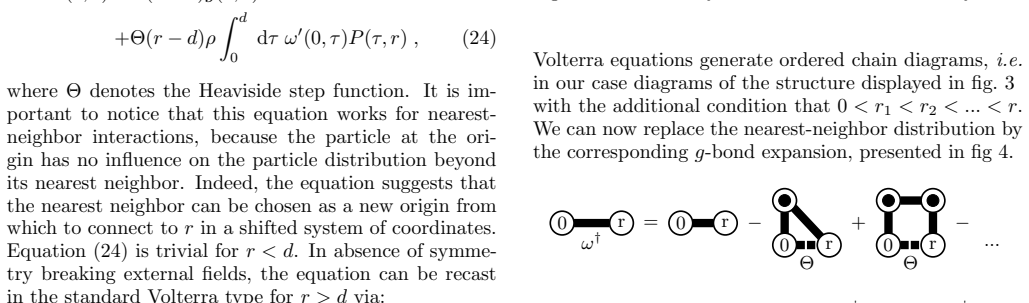
The central discovery is an exact integral equation for the pair connectedness $P(0,r)$, the density of particles connected to a tagged particle at the origin by overlapping connectivity shells of diameter $d$. For one-dimensional nearest-neighbor systems the equation is $$P(0,r)=\Theta(d-r)g(0,r)+\Theta(r-d)\rho\int_0^d d\tau\,\omega'(0,\tau)P(\tau,r),$$ where $g$ is the pair correlation function and $\omega'$ is the nearest-neighbor distribution. Because ordered correlations factorize for these systems, $\omega'$ is itself determined by $g$ through another Volterra equation, so $P$ follows from $g$ alone without any closure. The paper shows the chain diagrams generated by this equation reproduce the standard connectivity diagrammatic expansion, and it uses the equation to recover the previously known analytic solutions for the one-dimensional ideal gas and hard rods. In higher dimensions and for long-ranged potentials the same equation holds with a constrained conditional probability in the kernel, which must then be approximated or sampled.
Load-bearing premise
The load-bearing premise is that, for ordered one-dimensional configurations, higher-order correlations factor into products of two-particle correlations; if this factorization fails, as it does for interactions beyond nearest neighbors, the nearest-neighbor distribution is not determined by $g$ alone and Eq. (24) is no longer exact.
Editorial extensions
If this is right
- For one-dimensional nearest-neighbor fluids, the pair connectedness can be computed exactly from $g$ without closures, so any analytic or simulated pair structure yields connectivity predictions.
- The known analytic pair connectedness for the one-dimensional ideal gas and hard rods is recovered as a special case, unifying two previously unrelated derivations.
- External fields do not break the exact scheme; they only make the kernel position-dependent through the one-particle density.
- For long-range interactions and higher dimensions, the equation still holds but with a conditional probability in the kernel that can be sampled in simulation or approximated geometrically, as illustrated for the three-dimensional ideal gas.
- The relation is invertible: pair connectedness determines the nearest-neighbor kernel, so in these systems $g$ and $P$ carry the same information.
Reading between the lines
- Because $P$ is a functional of $g$ in one dimension, approximate liquid-state closures could be benchmarked by how well their predicted $g$ reproduces a simulated pair connectedness, giving a stricter test than structure alone.
- The geometric closure used for the three-dimensional ideal gas suggests a testable route: replace the conditional probability $c(r,t,u)$ with a directly measured quantity, converting the Fredholm equation into an exact numerical procedure for arbitrary three-dimensional fluids.
- The one-dimensional invertibility implies that percolation observables such as cluster-size distributions should also be derivable from $g$ by iterating the same Volterra chain, although the paper does not carry out that construction.
Signed reviews
Editorial analysis
A structured set of objections, weighed in public.
Referee Report
Summary. The manuscript develops an integral-equation formalism for continuum percolation in which the pair connectedness P is expressed through the nearest-neighbor distribution. For one-dimensional systems with nearest-neighbor interactions, the authors further relate the nearest-neighbor distribution to the pair correlation function g via a Volterra equation (Eqs. (22)–(23)), yielding a closed equation (Eq. (24)) for P in terms of g alone. The approach is shown to reproduce the two known exact one-dimensional solutions, for ideal fully penetrable rods (Domb) and for hard rods (Drory), and the paper compares favorably with Monte Carlo simulations for a repulsive nearest-neighbor potential and for a Lennard-Jones fluid. Extensions to external fields, long-ranged interactions, and a three-dimensional ideal gas with a geometric closure are outlined.
Significance. If the one-dimensional results are correct, the paper provides a unified and computationally simple route from the pair correlation function to the pair connectedness for arbitrary nearest-neighbor interactions, avoiding system-specific derivations. The reproduction of both known exact solutions is a strong check, and the Monte Carlo comparisons add credible numerical support. A notable strength is that the kernel in the generalized integral equation is built from a physically observable conditional probability, which in principle can be sampled in simulations—an advantage over the direct connectivity in the Ornstein–Zernike approach. However, the central exactness claim is currently obscured by an internal normalization inconsistency in the printed equations, which must be resolved before readers can implement the method.
major comments (2)
- [Section III, Eqs. (18)–(27)] The normalization of ω' is inconsistent between Eq. (18) and the equations used to obtain the kernel. Eq. (18) defines ω'(τ)=ω(τ)P(empty|particle at τ)=ρg(τ)P(...), giving ω' units of inverse length, whereas Eqs. (22)–(25) and the ideal-gas solution Eq. (33) require ω' to be dimensionless, namely the ratio of the nearest-neighbor probability density to ρ. As a consequence, Eq. (27), which reads K(r)=ρg(r)-∫ K(r-x)g(x)dx, is dimensionally inconsistent and does not follow from Eq. (22). With ω' dimensionless, the correct relation is K(r)=g(r)-ρ∫_0^r K(r-x)g(x)dx. The authors should adopt one convention throughout (for instance ω' = (nearest-neighbor probability density)/ρ) and correct Eqs. (18) and (27). As printed, a reader implementing the method cannot reproduce the Domb or Drory solutions.
- [Section III, after Eq. (28)] The claimed equivalence of Eq. (25) to Coniglio's expansion (Eq. (8)) is established through an informal cancellation-diagram argument. In particular, the treatment of configurations with multiple outlying particles is summarized by 'we can repeat this procedure,' and the final conclusion that 'both expansions can indeed be brought in perfect unison' is asserted rather than demonstrated. Since exactness of the one-dimensional integral equation is the central claim, the authors should either supply a complete proof, for example a probabilistic derivation of Eq. (22) from the factorization Eq. (19), or explicitly present the diagrammatic equivalence as a consistency check supported by the two exact benchmarks rather than as a proof.
minor comments (5)
- [Abstract] The phrase 'how the formalism can applied' should be 'can be applied'.
- [Eq. (35)] The integral is printed as ρ∫_r^d ... but for r>d the limits should be ρ∫_d^r ...; the lower limit appears to be a typo.
- [Figure 10 and surrounding text] The sentence 'at larger, a slight discrepancy' is incomplete; it should read 'at larger r' or similar.
- [Section IV C, Eq. (63)] The three-dimensional closure is presented as a 'purely geometrical treatment,' but the proportionality constant is fixed only by the limiting condition Eq. (61); the approximation is uncontrolled. The manuscript is appropriately cautious elsewhere, but this phrase overstates the systematic character of the choice.
- [Section IV A, Eq. (45)] The notation ρ(1) is used both for the density profile in the presence of the external field and for the bulk density; this should be clarified to avoid confusion.
Circularity Check
No circularity: the one-dimensional derivation is a parameter-free relation between g and P; benchmark and simulation comparisons are independent validation, not inputs.
full rationale
The paper's central result, Eq. (24), is a renewal-type integral equation whose kernel is the nearest-neighbor distribution ω'. Eq. (22) determines ω' from g via a Volterra equation under the exact factorization Eq. (19) for one-dimensional nearest-neighbor systems, cited to independent prior work (Salsburg, Zwanzig, and Kirkwood). Neither the target quantity P nor the known exact solutions are inserted into these equations as inputs; Domb's and Drory's results are recovered as solutions and used only as independent benchmarks. The three-dimensional treatment is explicitly approximate: the closure c(t,u) is chosen from geometric volume arguments and the stated limiting conditions, not fitted to the simulation curves, and the resulting agreement is presented with caveats. No load-bearing step is justified by a self-citation, and no fitted parameter is renamed as a prediction. A separate, non-circularity concern exists: the printed normalization of ω' appears inconsistent between Eq. (18)/Eq. (22) and Eq. (27), which affects reproducibility of the derivation as written, but this is a correctness or typographical issue rather than a circularity. Under the circularity rubric, the derivation chain is self-contained and the score is 0.
Assumptions & free parameters
assumptions (5)
- domain assumption In one-dimensional nearest-neighbor systems, distribution functions factorize as g^(n+1)(r1,...,r_{n+1}) = g^(n)(r1,...,rn) g^(2)(rn,r_{n+1}) for ordered positions r1 < ... < r_{n+1}, Eq. (19).
- standard math The pair connectedness admits the diagrammatic expansion of Coniglio, Eqs. (7)-(8), with connectivity bonds f-dagger and blocking bonds f-star.
- standard math Volterra equations of the second kind have unique L2 solutions via iterated kernels, Eqs. (10)-(15).
- ad hoc to paper For the three-dimensional ideal gas, the constrained cluster probability c(r,t,u) is approximated by the geometric closure c = 1 + (3/4)t - (17/16)t^3 for u >= d, Eq. (63).
- ad hoc to paper For long-ranged interactions, the nearest-neighbor distribution sampled from simulation can be used as input to Eq. (50), and the Bayes factor p(0|tau,r)/p(0) can be approximated as unity.
Cite this review
Pith. "Pith review of Continuum percolation expressed in terms of density distributions." pith.science (2026). https://pith.science/paper/ERGRGIQL
@misc{pith2026190806776,
  author       = {Pith},
  title        = {Pith review of: Continuum percolation expressed in terms of density distributions},
  year         = {2026},
  howpublished = {\url{https://pith.science/paper/ERGRGIQL}},
  note         = {Machine review of arXiv:1908.06776}
}
read the original abstract
We present a new approach to derive the connectivity properties of pairwise interacting n-body systems in thermal equilibrium. We formulate an integral equation that relates the pair connectedness to the distribution of nearest neighbors. For one-dimensional systems with nearest-neighbor interactions, the nearest-neighbor distribution is, in turn, related to the pair correlation function g through a simple integral equation. As a consequence, for those systems, we arrive at an integral equation relating g to the pair connectedness, which is readily solved even analytically if g is specified analytically. We demonstrate the procedure for a variety of pair-potentials including fully penetrable spheres as well as impenetrable spheres, the only two systems for which analytical results for the pair connectedness exist. However, the approach is not limited to nearest-neighbor interactions in one dimension. Hence, we also outline the treatment of external fields and long-ranged interactions, and we illustrate how the formalism can applied to higher-dimensional systems using the three-dimensional ideal gas as an example.
Figures



Figures from the paper (10 more)


Reference graph
Works this paper leans on
-
[1]
B. Bollob´ as and O. Riordan, Percolation (Cambridge University Press, 2006)
work page 2006
-
[2]
Stauffer and A
D. Stauffer and A. Aharony, Introduction to percolation theory (Taylor & Francis, 2018)
2018
-
[3]
N. A. Seaton and E. D. Glandt, The Journal of chemical physics 86, 4668 (1987)
work page 1987
-
[4]
S. B. Lee and S. Torquato, The Journal of chemical physics 89, 6427 (1988)
work page 1988
-
[5]
M. D. Rintoul and S. Torquato, Journal of Physics A: Mathematical and General 30, L585 (1997)
work page 1997
-
[6]
M. A. Miller and D. Frenkel, Physical review letters 90, 135702 (2003)
work page 2003
-
[7]
R. Consiglio, D. R. Baker, G. Paul, and H. E. Stan- ley, Physica A: Statistical Mechanics and its Applications 319, 49 (2003)
work page 2003
- [8]
Show all 41 references
-
[9]
Coniglio, U
A. Coniglio, U. De Angelis, and A. Forlani, Journal of Physics A: Mathematical and General 10 (1977)
1977
-
[10]
DeSimone, S
T. DeSimone, S. Demoulini, and R. M. Stratt, The Jour- nal of chemical physics 85 (1986)
1986
-
[11]
A. V. Kyrylyuk and P. van der Schoot, Proceedings of the National Academy of Sciences 105, 8221 (2008)
2008
-
[12]
Y. C. Chiew and G. Stell, The Journal of chemical physics 90, 4956 (1989)
1989
-
[13]
A. P. Chatterjee, The Journal of Chemical Physics 113, 9310 (2000)
2000
-
[14]
Cardy, Scaling and renormalization in statistical physics, Vol
J. Cardy, Scaling and renormalization in statistical physics, Vol. 5 (Cambridge university press, 1996)
1996
-
[15]
Meester and R
R. Meester and R. Roy, Continuum percolation, Vol. 119 (Cambridge University Press, 1996)
1996
-
[16]
Grimmett, Percolation (Springer, 1999)
G. Grimmett, Percolation (Springer, 1999)
1999
-
[17]
Smirnov, Comptes Rendus de l’Acad´ emie des Sciences- Series I-Mathematics 333, 239 (2001)
S. Smirnov, Comptes Rendus de l’Acad´ emie des Sciences- Series I-Mathematics 333, 239 (2001)
2001
-
[18]
J. L. Cardy, Journal of Physics A: Mathematical and General 25, L201 (1992)
1992
-
[19]
Bollob´ as,Random graphs, 73 (Cambridge university press, 2001)
B. Bollob´ as,Random graphs, 73 (Cambridge university press, 2001)
2001
-
[20]
M. F. Sykes and J. W. Essam, Journal of Mathematical Physics 5, 1117 (1964)
1964
-
[21]
Smirnov and W
S. Smirnov and W. Werner, Mathematical Research Let- ters 8, 729 (2001)
2001
-
[22]
Drwenski, S
T. Drwenski, S. Dussi, M. Dijkstra, R. van Roij, and P. van der Schoot, The Journal of chemical physics 147, 224904 (2017)
2017
-
[23]
Meyer, P
H. Meyer, P. van der Schoot, and T. Schilling, The Jour- nal of chemical physics 143, 044901 (2015)
2015
-
[24]
Nigro, C
B. Nigro, C. Grimaldi, P. Ryser, A. P. Chatterjee, and P. van der Schoot, Physical review letters 110, 015701 (2013)
2013
-
[25]
S. Kale, F. A. Sabet, I. Jasiuk, and M. Ostoja- Starzewski, Journal of Applied Physics 118, 154306 (2015)
2015
-
[26]
R. M. Mutiso, M. C. Sherrott, J. Li, and K. I. Winey, Physical Review B 86, 214306 (2012)
2012
-
[27]
Jadrich and K
R. Jadrich and K. S. Schweizer, The Journal of chemical physics 135, 234902 (2011)
2011
-
[28]
Schilling, M
T. Schilling, M. A. Miller, and P. van der Schoot, EPL (Europhysics Letters) 111, 56004 (2015)
2015
-
[29]
L. S. Schulman, Journal of Physics A: Mathematical and General 16, L639 (1983)
1983
-
[30]
Domb, in Mathematical Proceedings of the Cambridge Philosophical Society , Vol
C. Domb, in Mathematical Proceedings of the Cambridge Philosophical Society , Vol. 43 (Cambridge University Press, 1947) pp. 329–341
1947
-
[31]
Vericat, R
F. Vericat, R. Gianotti, and A. Rodriguez, Journal of Physics A: Mathematical and General 20, 6155 (1987)
1987
-
[32]
Drory, Physical Review E 55, 3878 (1997)
A. Drory, Physical Review E 55, 3878 (1997)
1997
-
[33]
Hansen and I
J.-P. Hansen and I. R. McDonald, Theory of simple liq- uids (Elsevier, 1990)
1990
-
[34]
T. L. Hill, The Journal of Chemical Physics 23, 617 (1955)
1955
-
[35]
F. G. Tricomi, Integral equations, Vol. 5 (Courier Corpo- ration, 1985)
1985
-
[36]
ρ(1)(r) is defined as the grand-canonical ensemble average over all configurations featuring a particle at r
-
[37]
Torquato, B
S. Torquato, B. Lu, and J. Rubinstein, Physical Review A 41, 2059 (1990)
1990
-
[38]
Z. W. Salsburg, R. W. Zwanzig, and J. G. Kirkwood, The Journal of Chemical Physics 21, 1098 (1953)
1953
-
[39]
Zernike and J
F. Zernike and J. A. Prins, Zeitschrift f¨ ur Physik A Hadrons and nuclei 41, 184 (1927)
1927
-
[40]
Torquato, Random heterogeneous materials: mi- crostructure and macroscopic properties , Vol
S. Torquato, Random heterogeneous materials: mi- crostructure and macroscopic properties , Vol. 16 (Springer Science & Business Media, 2013)
2013
-
[41]
J. K. Percus, Journal of Statistical Physics 15, 505 (1976)
1976
Reviewed August 14, 2026 · model on record in the stance chip above.
Discussion (0). Continue with ORCID to comment.