REVIEW 5 major objections 4 minor 46 references
JAQ: Joint Efficient Architecture Design and Low-Bit Quantization with Hardware-Software Co-Exploration
T0 review · 5 major / 4 minor · reviewed 2026-08-10 · deepseek-v4-flash
Pith's one-line read JAQ claims the first joint co-search over network architecture, 2-to-8-bit mixed precision, and accelerator design, reporting about 7% higher ImageNet Top-1 accuracy than the prior joint-search method and 0.15-second-per-iteration…
desk verdict Real engineering step in low-bit HW-SW co-search, but the search ranks candidates with only 3% of activations quantized and never shows that ranking survives full quantization — so the 7% ImageNet claim rests on an untested transfer. read the letter →
The pith
A machine-rendered reading of the paper's core claim, the machinery that carries it, and where it could break.
The reading
What carries the argument
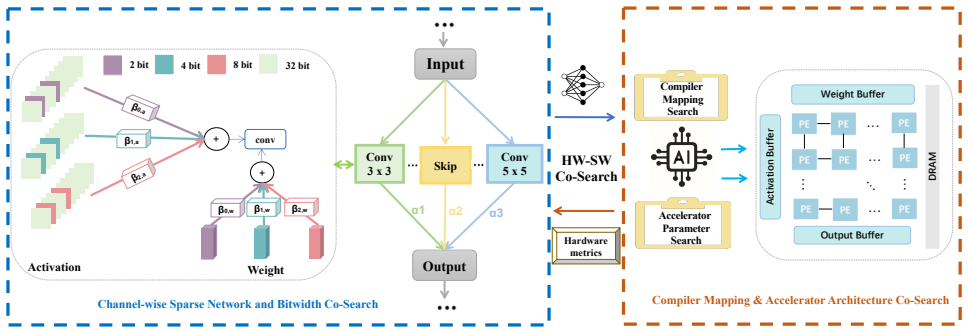
The load-bearing object is the joint differentiable objective $L_{CE}(w, N(\alpha), M(\beta)) + \lambda E_{HW}(H(\gamma), N(\alpha), M(\beta))$, optimized end-to-end over three coupled parameter sets: architecture $\alpha$, bitwidth $\beta$, and accelerator $\gamma$. Two mechanisms carry it. CSQ (Eq. 6 and Eq. 8) restricts activation quantization during search to the top $K\%$ of channels ranked by BatchNorm scale factors, so the memory cost of quantized activations does not scale with the number of bitwidth candidates; this is what lets 2-bit options enter the search without collapsing it. BatchTile packs every candidate tiling strategy for every operator into a single batched evaluation through a hardware generation network, turning the discrete compiler-mapping search into one forward pass rather than a per-tile enumeration; this is what brings per-iteration accelerator search to 0.15 seconds.
What would settle it
Retrain the K=3% searched subnet with full 2/4/8-bit quantization and measure validation accuracy; then repeat the search with all activation channels quantized (K=100%) or with a low-bit constrained baseline under the same retraining budget. If the K=3% subnet does not match or beat the constrained-search subnet, the near-full-precision ranking does not transfer to the low-bit regime.
Extended reading notes
Core claim
On its own terms, JAQ's discovery is that ultra-low-precision joint search fails not because the search space is too large but because existing differentiable co-search has two tractable bottlenecks: activation memory and compiler-mapping evaluation. Both can be removed without giving up end-to-end differentiability. The paper formulates joint optimization as minimizing cross-entropy plus a hardware cost over architecture parameters $\alpha$, bitwidth parameters $\beta$, and accelerator parameters $\gamma$, and solves it with Gumbel-Softmax classifiers so the accelerator parameters are differentiable too. Channel-wise sparse quantization (CSQ) keeps the top $K=3\%$ of activation channels quantized while the rest stay full precision, with the top channels selected by BatchNorm scale factors; this cuts GPU memory roughly fivefold and eliminates the parameter coupling and misguided-search failures the paper documents in Auto-NBA when 2-bit options enter the search. BatchTile feeds many (operator, accelerator, tiling) triples as a batch through the hardware energy/latency estimator, compressing the compiler-mapping search to about 0.15 seconds per iteration. The reported outcome is a searched subnet, bitwidth assignment, and accelerator that jointly beat the previous joint-search method by about 7 Top-1 accuracy points on ImageNet while keeping comparable or better hardware cost.
Load-bearing premise
The search-stage ranking is done while only the top 3% of activation channels are quantized, so the architecture and bitwidth choices are effectively chosen in a nearly full-precision model; the entire result rests on those choices still being near-optimal after the final fully quantized retraining.
Editorial extensions
If this is right
- JAQ's ImageNet result is a specific FBNet-style subnet with mixed 2/4/8-bit weights and activations paired with a co-searched accelerator (PE array, cache sizes, dataflow), reaching around 70% Top-1 accuracy at hardware cost comparable to or better than Auto-NBA.
- CSQ reduces GPU memory by roughly 5x relative to unoptimized joint search and removes the parameter coupling and misguided-search failures that the paper shows for Auto-NBA when 2-bit options are available.
- BatchTile cuts per-iteration hardware search from about 30 seconds (Auto-NBA) to 0.15 seconds, bringing the full ImageNet co-search to about 160 GPU-hours.
- By adjusting the cost weights in Eq. 9, the same pipeline can be tilted toward latency, area, or energy, and the returned accelerator changes accordingly (for example, making the search latency-sensitive yields a lower-latency accelerator, while an area-sensitive weight yields a much smaller one).
Reading between the lines
- The search stage ranks architectures and bitwidths while only the top 3% of activation channels are quantized, so a direct test of whether that near-full-precision ranking matches the fully quantized retrained accuracy would settle how much of the reported 7-point gain is real search improvement versus retraining artifact.
- The same BatchTile mechanism could transfer to transformer or LLM workloads, where tile mapping on tensor cores or NPUs dominates compile time and where low-bit weight-only quantization is already standard.
- Because the accelerator search needs only a cost estimator and a user-defined search space, JAQ could become a per-device customization tool: finding a fresh accelerator configuration for each target deployment becomes cheap enough to run on a single GPU overnight.
Editorial analysis
A structured set of objections, weighed in public.
Referee Report
Summary. The paper proposes JAQ, a differentiable framework that jointly searches a CNN architecture, per-layer mixed-precision bitwidths (2/4/8 bits for weights and activations), and an accelerator configuration (PE array, caches, dataflow, and compiler tiling). To reduce GPU memory during search, it introduces channel-wise sparse quantization (CSQ), which quantizes only the top K=3% most sensitive activation channels per layer (Eq. 6 and Eq. 8) while leaving the rest in full precision. To speed up hardware search, it proposes BatchTile, which encodes tiling options as batches so that compiler mapping and accelerator parameters can be evaluated quickly with a learned estimator. The searched subnet is then retrained fully quantized. Experiments on CIFAR-10, CIFAR-100, and ImageNet compare JAQ with Auto-NBA and report roughly 7% higher ImageNet Top-1 accuracy at similar or lower estimated hardware cost, plus a per-iteration accelerator search time of 0.15 seconds.
Significance. If the claims hold, JAQ would be a useful step toward end-to-end software/hardware co-design at very low bitwidths: it is, to my knowledge, the first published framework that jointly searches architecture, 2-to-8-bit mixed quantization, and accelerator configuration, and it identifies a genuine failure mode of Auto-NBA under low-bit search (the 'misguided search' phenomenon in Table 6 and Appendix B). The CSQ memory reduction and the BatchTile speedup are practical contributions, and the released code improves reproducibility. The significance is currently tempered by two unverified assumptions: (i) the CSQ proxy with K=3% activation-channel quantization ranks subnets and bitwidths the same way as fully quantized deployment, and (ii) the hardware estimator used as the search objective gives trustworthy absolute energy/latency/area numbers. Both are testable, so the paper's contribution is defensible but needs additional evidencebefore the headline claims can be accepted at face value.
major comments (5)
- [§3.2, Eq. (6), Eq. (8); Experimental Settings; Retraining] The CSQ proxy-transfer assumption is untested and load-bearing. During search, only the top K=3% of activation channels per layer are quantized (Eq. 6 with K=3 in Experimental Settings); the remaining 97% flow at full precision. The final subnet is retrained with all activations quantized to 2/4/8 bits. The paper never shows that the near-full-precision search ranking of architecture parameters α and activation-bitwidth parameters βa is preserved under full quantization. Table 6 only varies K from 1 to 5 inside the proxy; it does not compare against K=100 (all channels quantized) or a fully-quantized ranking oracle. Since the headline 7% ImageNet advantage over Auto-NBA (Table 3) is measured after full quantization, this transfer assumption must be validated. Please add a fully-quantized search/oracle comparison, or at least rank a sample of searched subnets under both the proxy and full quantization and report rank correlation.
- [§3.3, Eq. (9); Tables 3 and 5] The hardware-efficiency claims are circular as reported. The hardware cost function EHW in Eq. (9) is both the search objective and the source of the reported energy/latency/area/EDAP numbers in Tables 3 and 5. No independent calibration of this estimator against a synthesized accelerator, an FPGA prototype, or an established cycle-accurate simulator is provided. Thus the tables do not provide external evidence that JAQ actually improves hardware efficiency. Please validate the estimator on at least one concrete accelerator configuration and report estimation error, or explicitly state that all hardware numbers are model predictions rather than measured results.
- [§4.2, Table 3] The accuracy comparison is against a single baseline, Auto-NBA, with no multiple seeds or error bars, despite the abstract's claim of 'approximately 7% higher Top-1 accuracy compared to previous methods.' DANCE, NAAS, OQAT, and BatchQuant are mentioned in Table 4 but are not compared on accuracy in the joint-search setting. Please add at least one additional joint-search baseline and report mean±standard deviation over multiple runs, or justify why a single run is sufficient for the claimed margin.
- [§3.1, Eq. (1)] Equation (1) is not Gumbel-Softmax as written. The equation uses ε ∼ U(0,1), which is additive uniform noise, whereas Gumbel-Softmax requires Gumbel noise (e.g., −log(−log U)). If the implementation actually uses Gumbel noise, the equation must be corrected; if uniform noise is used, the term 'Gumbel-Softmax' should be removed and the effect on architecture-parameter optimization should be discussed. This is a central search mechanism, so the discrepancy must be resolved.
- [Table 6 vs. Experimental Settings] There is a mismatch in the bitwidth search space. The main text and Experimental Settings state that each layer has three bitwidth options in [2,4,8], but Table 6's caption says the ablation searches over 2, 3, and 4-bit bitwidths. Please reconcile the two; if the main experiments also used 2/3/4, the text and tables must be updated, since the 'misguided search' analysis in Table 6 is used to justify the CSQ design and should be on the same search space as the main results.
minor comments (4)
- [Abstract] There is a typo in the abstract: 'Specifical' should be 'Specifically'.
- [Table 2] The header row 'B/b OW/ow OH/oh IC/ic OC/oc' is hard to parse; please define the uppercase and lowercase symbols in the caption or text.
- [Table 4 and Table 7] Table 4 reports total search time in GPU hours (160 for JAQ, 180 for Auto-NBA), while Table 7 reports per-iteration accelerator search time in seconds. Please clarify this distinction in the text so readers do not confuse per-iteration speed with total search cost.
- [Eq. (8)] The summation index set for Γl_j is written as 'j ∈ N^{l−1}' but the domain of j is not defined before use; please specify the channel index range explicitly.
Circularity Check
No circularity in the accuracy chain; one in-sample hardware-cost reporting issue lowers the hardware-efficiency claims.
-
fitted input called prediction
[JAQ Framework, Eq. 9; Experiments, Co-exploration Results, Tables 3 and 5]
"Combining these three metrics, the hardware cost function included in Eq. 4 is: EHW = λE · Energy + λL · Latency + λA · Area, (9) ... As shown in Tab. 5, for instance, increasing the λL results in a low latency in the final result. Conversely, increasing the λA leads to a tiny area for the accelerator."
The accelerator parameters γ and tiling strategies are selected by minimizing EHW (Eq. 9); the same EHW-based Energy/Latency/Area values are then reported as the achieved hardware performance in Table 3 (EDAP) and Table 5 (Latency/Energy/Area). No independent hardware measurement or external simulator is run, so the reported efficiency numbers are in-sample values of the very cost model that was minimized during search. The 'hardware-efficient design' result is therefore partly forced by construction: minimizing the estimator guarantees the reported estimator values improve, and the tables cannot validate the accelerator on real hardware or an independent cost model.
full rationale
The central accuracy claim is not circular: the searched subnet and bitwidth allocation are retrained from scratch (600 epochs on CIFAR, 180 on ImageNet) and evaluated on held-out test data, independent of the search objective. The comparison with Auto-NBA is a genuine empirical comparison. The K=3 sparse-quantization search proxy is a transfer-risk concern rather than circularity, because it does not define the final accuracy. The main circularity-adjacent issue is that the hardware-efficiency metrics (energy, latency, area, EDAP) are produced by the same estimator used as the search objective (Eq. 9, following Choi et al. 2021), so the reported hardware numbers are in-sample and do not constitute independent validation. This does not undermine the ImageNet accuracy result or the 0.15s search-time measurement, but it means the hardware-efficiency claims should be read as cost-model evaluations rather than measured hardware performance. No load-bearing self-citation or definitional equivalence was found.
Assumptions & free parameters
free parameters (4)
- K (top % of activation channels quantized during search) =
3
- λ (Lagrange multiplier) =
0.0005, 0.001, 0.002, 0.004 (CIFAR); 0.001, 0.002, 0.005 (ImageNet)
- λE, λL, λA (hardware cost weights) =
0.33 each in main experiments; 0.1/0.8/0.1 and 0.1/0.1/0.8 in sensitivity experiments
- Gumbel-Softmax temperature τ =
initial 5
assumptions (4)
- domain assumption Batch-normalization scale factors γ reliably rank activation-channel importance for quantization.
- domain assumption The internal Energy & Latency Estimator (following Choi et al. 2021) predicts real accelerator latency, energy, and area accurately for the BitFusion template.
- ad hoc to paper The ranking of subnets under CSQ (only 3% of activation channels quantized) transfers to the fully quantized retrained subnet.
- standard math Gumbel-Softmax with straight-through estimation gives faithful gradients for discrete architecture and bitwidth choices.
Cite this review
Pith. "Pith review of JAQ: Joint Efficient Architecture Design and Low-Bit Quantization with Hardware-Software Co-Exploration." pith.science (2026). https://pith.science/paper/ERJYFKUG
@misc{pith2026250105339,
  author       = {Pith},
  title        = {Pith review of: JAQ: Joint Efficient Architecture Design and Low-Bit Quantization with Hardware-Software Co-Exploration},
  year         = {2026},
  howpublished = {\url{https://pith.science/paper/ERJYFKUG}},
  note         = {Machine review of arXiv:2501.05339}
}
read the original abstract
The co-design of neural network architectures, quantization precisions, and hardware accelerators offers a promising approach to achieving an optimal balance between performance and efficiency, particularly for model deployment on resource-constrained edge devices. In this work, we propose the JAQ Framework, which jointly optimizes the three critical dimensions. However, effectively automating the design process across the vast search space of those three dimensions poses significant challenges, especially when pursuing extremely low-bit quantization. Specifical, the primary challenges include: (1) Memory overhead in software-side: Low-precision quantization-aware training can lead to significant memory usage due to storing large intermediate features and latent weights for back-propagation, potentially causing memory exhaustion. (2) Search time-consuming in hardware-side: The discrete nature of hardware parameters and the complex interplay between compiler optimizations and individual operators make the accelerator search time-consuming. To address these issues, JAQ mitigates the memory overhead through a channel-wise sparse quantization (CSQ) scheme, selectively applying quantization to the most sensitive components of the model during optimization. Additionally, JAQ designs BatchTile, which employs a hardware generation network to encode all possible tiling modes, thereby speeding up the search for the optimal compiler mapping strategy. Extensive experiments demonstrate the effectiveness of JAQ, achieving approximately 7% higher Top-1 accuracy on ImageNet compared to previous methods and reducing the hardware search time per iteration to 0.15 seconds.
Figures


Figures from the paper (2 more)


Reference graph
Works this paper leans on
-
[1]
, " * write output.state after.block = add.period write newline
ENTRY address archivePrefix author booktitle chapter edition editor eid eprint howpublished institution isbn journal key month note number organization pages publisher school series title type volume year label extra.label sort.label short.list INTEGERS output.state before.all mid.sentence after.sentence after.block FUNCTION init.state.consts #0 'before.a...
-
[2]
write newline
" write newline "" before.all 'output.state := FUNCTION n.dashify 't := "" t empty not t #1 #1 substring "-" = t #1 #2 substring "--" = not "--" * t #2 global.max substring 't := t #1 #1 substring "-" = "-" * t #2 global.max substring 't := while if t #1 #1 substring * t #2 global.max substring 't := if while FUNCTION word.in bbl.in capitalize " " * FUNCT...
-
[3]
S.; Dudziak, .; Chau, T.; Lee, R.; Kim, H.; and Lane, N
Abdelfattah, M. S.; Dudziak, .; Chau, T.; Lee, R.; Kim, H.; and Lane, N. D. 2020. Best of both worlds: Automl codesign of a cnn and its hardware accelerator. In 2020 57th ACM/IEEE Design Automation Conference (DAC), 1--6. IEEE
work page 2020
-
[4]
Bai, H.; Cao, M.; Huang, P.; and Shan, J. 2021. Batchquant: Quantized-for-all architecture search with robust quantizer. Advances in Neural Information Processing Systems, 34: 1074--1085
work page 2021
-
[5]
Bengio, Y.; L \'e onard, N.; and Courville, A. 2013. Estimating or propagating gradients through stochastic neurons for conditional computation. arXiv preprint arXiv:1308.3432
arXiv 2013
-
[6]
Cai, H.; Gan, C.; Wang, T.; Zhang, Z.; and Han, S. 2019. Once-for-all: Train one network and specialize it for efficient deployment. arXiv preprint arXiv:1908.09791
arXiv 2019
-
[7]
Chen, Y.; Luo, T.; Liu, S.; Zhang, S.; He, L.; Wang, J.; Li, L.; Chen, T.; Xu, Z.; Sun, N.; et al. 2014. Dadiannao: A machine-learning supercomputer. In 2014 47th Annual IEEE/ACM International Symposium on Microarchitecture, 609--622. IEEE
work page 2014
-
[8]
Chen, Y.-H.; Krishna, T.; Emer, J. S.; and Sze, V. 2016. Eyeriss: An energy-efficient reconfigurable accelerator for deep convolutional neural networks. IEEE journal of solid-state circuits, 52(1): 127--138
work page 2016
Show all 46 references
-
[9]
I.-J.; Srinivasan, V.; and Gopalakrishnan, K
Choi, J.; Wang, Z.; Venkataramani, S.; Chuang, P. I.-J.; Srinivasan, V.; and Gopalakrishnan, K. 2018. Pact: Parameterized clipping activation for quantized neural networks. arXiv preprint arXiv:1805.06085
2018 arXiv
-
[10]
Choi, K.; Hong, D.; Yoon, H.; Yu, J.; Kim, Y.; and Lee, J. 2021. Dance: Differentiable accelerator/network co-exploration. In 2021 58th ACM/IEEE Design Automation Conference (DAC), 337--342. IEEE
2021
-
[11]
W.; and Keutzer, K
Dong, Z.; Yao, Z.; Gholami, A.; Mahoney, M. W.; and Keutzer, K. 2019. Hawq: Hessian aware quantization of neural networks with mixed-precision. In Proceedings of the IEEE/CVF International Conference on Computer Vision, 293--302
2019
-
[12]
Du, Z.; Fasthuber, R.; Chen, T.; Ienne, P.; Li, L.; Luo, T.; Feng, X.; Chen, Y.; and Temam, O. 2015. ShiDianNao: Shifting vision processing closer to the sensor. In Proceedings of the 42nd annual international symposium on computer architecture, 92--104
2015
-
[13]
K.; McKinstry, J
Esser, S. K.; McKinstry, J. L.; Bablani, D.; Appuswamy, R.; and Modha, D. S. 2019. Learned step size quantization. arXiv preprint arXiv:1902.08153
2019 arXiv
-
[14]
Fu, Y.; Zhang, Y.; Yu, Z.; Li, S.; Ye, Z.; Li, C.; Wan, C.; and Lin, Y. C. 2023. Gpt4aigchip: Towards next-generation ai accelerator design automation via large language models. In 2023 IEEE/ACM International Conference on Computer Aided Design (ICCAD), 1--9. IEEE
2023
-
[15]
Fu, Y.; Zhang, Y.; Zhang, Y.; Cox, D.; and Lin, Y. 2021. Auto-NBA: Efficient and effective search over the joint space of networks, bitwidths, and accelerators. In International Conference on Machine Learning, 3505--3517. PMLR
2021
-
[16]
Y.; Yu, J.; Park, N.; Kim, Y.; and Lee, J
Hong, D.; Choi, K.; Lee, H. Y.; Yu, J.; Park, N.; Kim, Y.; and Lee, J. 2022. Enabling hard constraints in differentiable neural network and accelerator co-exploration. In Proceedings of the 59th ACM/IEEE Design Automation Conference, 589--594
2022
-
[17]
Huang, X.; Shen, Z.; Li, S.; Liu, Z.; Xianghong, H.; Wicaksana, J.; Xing, E.; and Cheng, K.-T. 2022. Sdq: Stochastic differentiable quantization with mixed precision. In International Conference on Machine Learning, 9295--9309. PMLR
2022
-
[18]
Jang, E.; Gu, S.; and Poole, B. 2016. Categorical reparameterization with gumbel-softmax. arXiv preprint arXiv:1611.01144
2016 arXiv
-
[19]
H.-M.; Zhuge, Q.; Gu, S.; Dasgupta, S.; Shi, Y.; and Hu, J
Jiang, W.; Yang, L.; Sha, E. H.-M.; Zhuge, Q.; Gu, S.; Dasgupta, S.; Shi, Y.; and Hu, J. 2020. Hardware/software co-exploration of neural architectures. IEEE Transactions on Computer-Aided Design of Integrated Circuits and Systems, 39(12): 4805--4815
2020
-
[20]
P.; Young, C.; Patil, N.; Patterson, D.; Agrawal, G.; Bajwa, R.; Bates, S.; Bhatia, S.; Boden, N.; Borchers, A.; et al
Jouppi, N. P.; Young, C.; Patil, N.; Patterson, D.; Agrawal, G.; Bajwa, R.; Bates, S.; Bhatia, S.; Boden, N.; Borchers, A.; et al. 2017. In-datacenter performance analysis of a tensor processing unit. In Proceedings of the 44th annual international symposium on computer archit...
2017
-
[21]
H.; Yoo, S.; and Kim, H.-S
Kim, H.-B.; Lee, J. H.; Yoo, S.; and Kim, H.-S. 2024. MetaMix: Meta-state Precision Searcher for Mixed-precision Activation Quantization. In Proceedings of the AAAI Conference on Artificial Intelligence, volume 38, 13132--13141
2024
-
[22]
Li, C.; Yu, Z.; Fu, Y.; Zhang, Y.; Zhao, Y.; You, H.; Yu, Q.; Wang, Y.; and Lin, Y. 2021. Hw-nas-bench: Hardware-aware neural architecture search benchmark. arXiv preprint arXiv:2103.10584
2021 arXiv
-
[23]
M.; Anagnostopoulos, I.; Li, R.; and Shu, T
Li, Y.; Baik, J.; Rahman, M. M.; Anagnostopoulos, I.; Li, R.; and Shu, T. 2023. Pareto Optimization of CNN Models via Hardware-Aware Neural Architecture Search for Drainage Crossing Classification on Resource-Limited Devices. In Proceedings of the SC'23 Workshops of The Intern...
2023
-
[24]
Li, Y.; Hao, C.; Zhang, X.; Liu, X.; Chen, Y.; Xiong, J.; Hwu, W.-m.; and Chen, D. 2020. Edd: Efficient differentiable dnn architecture and implementation co-search for embedded ai solutions. In 2020 57th ACM/IEEE Design Automation Conference (DAC), 1--6. IEEE
2020
-
[25]
Lin, Y.; Yang, M.; and Han, S. 2021. Naas: Neural accelerator architecture search. In 2021 58th ACM/IEEE Design Automation Conference (DAC), 1051--1056. IEEE
2021
-
[26]
Liu, D.; Chen, T.; Liu, S.; Zhou, J.; Zhou, S.; Teman, O.; Feng, X.; Zhou, X.; and Chen, Y. 2015. Pudiannao: A polyvalent machine learning accelerator. ACM SIGARCH Computer Architecture News, 43(1): 369--381
2015
-
[27]
Liu, H.; Simonyan, K.; and Yang, Y. 2018. Darts: Differentiable architecture search. arXiv preprint arXiv:1806.09055
2018 arXiv
-
[28]
Liu, Z.; Li, J.; Shen, Z.; Huang, G.; Yan, S.; and Zhang, C. 2017. Learning efficient convolutional networks through network slimming. In Proceedings of the IEEE international conference on computer vision, 2736--2744
2017
-
[29]
Lou, W.; Qian, J.; Gong, L.; Wang, X.; Wang, C.; and Zhou, X. 2023. NAF: Deeper Network/Accelerator Co-Exploration for Customizing CNNs on FPGA. In 2023 Design, Automation & Test in Europe Conference & Exhibition (DATE), 1--6. IEEE
2023
-
[30]
Markov, I.; Vladu, A.; Guo, Q.; and Alistarh, D. 2023. Quantized distributed training of large models with convergence guarantees. In International Conference on Machine Learning, 24020--24044. PMLR
2023
-
[31]
Nagel, M.; Fournarakis, M.; Bondarenko, Y.; and Blankevoort, T. 2022. Overcoming oscillations in quantization-aware training. In International Conference on Machine Learning, 16318--16330. PMLR
2022
-
[32]
W.; and Dally, W
Parashar, A.; Rhu, M.; Mukkara, A.; Puglielli, A.; Venkatesan, R.; Khailany, B.; Emer, J.; Keckler, S. W.; and Dally, W. J. 2017. SCNN: An accelerator for compressed-sparse convolutional neural networks. ACM SIGARCH computer architecture news, 45(2): 27--40
2017
-
[33]
Qin, Y.; Wang, X.; Zhang, Z.; and Zhu, W. 2021. Graph differentiable architecture search with structure learning. Advances in neural information processing systems, 34: 16860--16872
2021
-
[34]
Rashid, H.-A.; Kallakuri, U.; and Mohsenin, T. 2024. TinyM2Net-V2: A Compact Low-power Software Hardware Architecture for M ulti m odal Deep Neural Networks. ACM Transactions on Embedded Computing Systems, 23(3): 1--23
2024
-
[35]
S.; and Cristal, A
Reggiani, E.; Pappalardo, A.; Doblas, M.; Moreto, M.; Olivieri, M.; Unsal, O. S.; and Cristal, A. 2023. Mix-GEMM: An efficient HW-SW Architecture for Mixed-Precision Quantized Deep Neural Networks Inference on Edge Devices. In 2023 IEEE International Symposium on High-Performa...
2023
-
[36]
K.; Chandra, V.; and Esmaeilzadeh, H
Sharma, H.; Park, J.; Suda, N.; Lai, L.; Chau, B.; Kim, J. K.; Chandra, V.; and Esmaeilzadeh, H. 2018. Bit fusion: Bit-level dynamically composable architecture for accelerating deep neural network. In 2018 ACM/IEEE 45th Annual International Symposium on Computer Architecture ...
2018
-
[37]
Shen, M.; Liang, F.; Gong, R.; Li, Y.; Li, C.; Lin, C.; Yu, F.; Yan, J.; and Ouyang, W. 2021. Once quantization-aware training: High performance extremely low-bit architecture search. In Proceedings of the IEEE/CVF International Conference on Computer Vision, 5340--5349
2021
-
[38]
R.; Venkatesan, R.; Dai, S.; Khailany, B.; and Raghunathan, A
Stevens, J. R.; Venkatesan, R.; Dai, S.; Khailany, B.; and Raghunathan, A. 2021. Softermax: Hardware/software co-design of an efficient softmax for transformers. In 2021 58th ACM/IEEE Design Automation Conference (DAC), 469--474. IEEE
2021
-
[39]
Tang, C.; Ouyang, K.; Wang, Z.; Zhu, Y.; Ji, W.; Wang, Y.; and Zhu, W. 2022. Mixed-precision neural network quantization via learned layer-wise importance. In European Conference on Computer Vision, 259--275. Springer
2022
-
[40]
L.; Jiang, H.; Xu, J.; Cao, T.; Zhang, Q.; Yang, Y.; Wang, Z.; and Yang, M
Tang, C.; Zhang, L. L.; Jiang, H.; Xu, J.; Cao, T.; Zhang, Q.; Yang, Y.; Wang, Z.; and Yang, M. 2023. Elasticvit: Conflict-aware supernet training for deploying fast vision transformer on diverse mobile devices. In Proceedings of the IEEE/CVF International Conference on Comput...
2023
-
[41]
Umuroglu, Y.; Rasnayake, L.; and Sj \"a lander, M. 2018. Bismo: A scalable bit-serial matrix multiplication overlay for reconfigurable computing. In 2018 28th International Conference on Field Programmable Logic and Applications (FPL), 307--3077. IEEE
2018
-
[42]
Wang, K.; Liu, Z.; Lin, Y.; Lin, J.; and Han, S. 2019. Haq: Hardware-aware automated quantization with mixed precision. In Proceedings of the IEEE/CVF conference on computer vision and pattern recognition, 8612--8620
2019
-
[43]
Wu, B.; Dai, X.; Zhang, P.; Wang, Y.; Sun, F.; Wu, Y.; Tian, Y.; Vajda, P.; Jia, Y.; and Keutzer, K. 2019. Fbnet: Hardware-aware efficient convnet design via differentiable neural architecture search. In Proceedings of the IEEE/CVF conference on computer vision and pattern rec...
2019
-
[44]
Xu, S.; Li, Y.; Lin, M.; Gao, P.; Guo, G.; L \"u , J.; and Zhang, B. 2023. Q-detr: An efficient low-bit quantized detection transformer. In Proceedings of the IEEE/CVF Conference on Computer Vision and Pattern Recognition, 3842--3851
2023
-
[45]
You, H.; Sun, Z.; Shi, H.; Yu, Z.; Zhao, Y.; Zhang, Y.; Li, C.; Li, B.; and Lin, Y. 2023. Vitcod: Vision transformer acceleration via dedicated algorithm and accelerator co-design. In 2023 IEEE International Symposium on High-Performance Computer Architecture (HPCA), 273--286. IEEE
2023
-
[46]
L.; Yang, Y.; Jiang, Y.; Zhu, W.; and Liu, Y
Zhang, L. L.; Yang, Y.; Jiang, Y.; Zhu, W.; and Liu, Y. 2020. Fast hardware-aware neural architecture search. In Proceedings of the IEEE/CVF Conference on Computer Vision and Pattern Recognition Workshops, 692--693
2020
Reviewed August 10, 2026 · model on record in the stance chip above.
Discussion (0). Continue with ORCID to comment.