REVIEW 3 major objections 4 minor 28 references
An Image Fusion Scheme for Single-Shot High Dynamic Range Imaging with Spatially Varying Exposures
T0 review · 3 major / 4 minor · reviewed 2026-08-14 · deepseek-v4-flash
Pith's one-line read Segmenting a dual-ISO image by brightness and re-exposing each region yields better HDR fusion than fusing the two originals.
desk verdict A competent extension of the authors' own exposure-compensation work to dual-ISO single-shot HDR, but the evaluation is weaker than the abstract claims and the controlled test is partly rigged by matching the 0.18 target. read the letter →
The pith
A machine-rendered reading of the paper's core claim, the machinery that carries it, and where it could break.
The reading
What carries the argument
The load-bearing mechanism is the scene-segmentation-based exposure compensation operator. It works in five steps: local contrast enhancement on each input luminance image, Gaussian-mixture segmentation of the two-dimensional luminance vectors, per-segment scaling to a geometric mean of 0.18, combination of adjusted luminance with the original raw pixel values, and demosaicing of the resulting 2S raw images. The scaling formula is the heart of the argument: $\alpha_{s,k} = 0.18 / g(L'_k | R_s)$, where $g$ is the geometric mean of the locally contrast-enhanced luminance in segment $R_s$. Because the geometric mean is computed per segment, a dark region in a dark exposure is boosted and a bright region in a bright exposure is pulled down, so each of the 2S images exposes one part of the scene clearly, and any multi-exposure fusion method can be dropped in afterward.
What would settle it
Generate dual-ISO inputs from an HDR scene whose 0EV image has geometric mean 0.05 or 0.5 instead of 0.18, run the proposed pipeline and the two-image fusion baseline, and compare against the reference: if the method still wins and renders relative luminance correctly, the middle-gray anchor generalizes; if it visibly re-lights dark or bright regions that the reference keeps as they are, or its scores drop below the baseline, the anchor is the decisive assumption.
Extended reading notes
Core claim
Two images from a spatially varying exposure sensor contain complementary information that conventional two-image fusion does not fully exploit. The paper's central claim is that a scene-segmentation-based exposure compensation can expand the pair into a 2S-image exposure stack: a Gaussian mixture model groups pixels by their joint luminance in the low- and high-exposure images, each group is treated as a scene region, and each region's luminance in each exposure is scaled by $\alpha_{s,k} = 0.18 / g(L'_k | R_s)$ so the region's geometric mean lands on middle gray. The rescaled images are recombined with the originals and demosaiced, giving 2S RGB images that any multi-exposure fusion algorithm can fuse. The experiments show higher TMQI and MEF-SSIM than the no-correction, dual-ISO-baseline, and two-image-fusion alternatives, and higher statistical naturalness and discrete entropy on real dual-ISO photographs.
Load-bearing premise
Every segmented region is assumed to be best displayed when its geometric-mean luminance equals 0.18 (middle gray), and because the synthetic test images are generated with exactly that target, intentionally dark or bright regions may be re-lit incorrectly and the evaluation may favour this normalization.
Editorial extensions
If this is right
- Because the 2S generated images are ordinary multi-exposure inputs, any existing multi-exposure fusion algorithm can replace the one used in the paper, so the gain is not tied to a particular fusion rule.
- Exposure values no longer need to be fixed before shooting: the per-region scaling sets them automatically from the two captured images.
- The quality advantage over two-image fusion grows with the exposure gap, so the scheme is most useful in high-contrast scenes where two-image methods struggle.
- Both TMQI and MEF-SSIM improve, indicating the output is more faithful to the underlying HDR scene and more locally consistent at the same time.
Reading between the lines
- Because the pipeline needs only two aligned images with different exposures, it should transfer to other spatially varying exposure schemes, such as row-wise exposure-time alternation or Quad Bayer long/short integration; dual-ISO capture is a test case rather than a requirement.
- The 0.18 middle-gray anchor is a normalization choice, not a perceptual law; a scene-dependent target could preserve intentionally dark or bright regions while keeping the automatic-exposure benefit.
- The synthesized multi-exposure stack could act as preprocessing for learning-based HDR reconstruction, giving a deep model aligned exposures to work from.
- Testing at wider exposure gaps (for example ±5 EV or ±6 EV) would show how far the advantage extends, since the reported gain already grows from ±1 EV to ±4 EV.
Signed reviews
Editorial analysis
A structured set of objections, weighed in public.
Referee Report
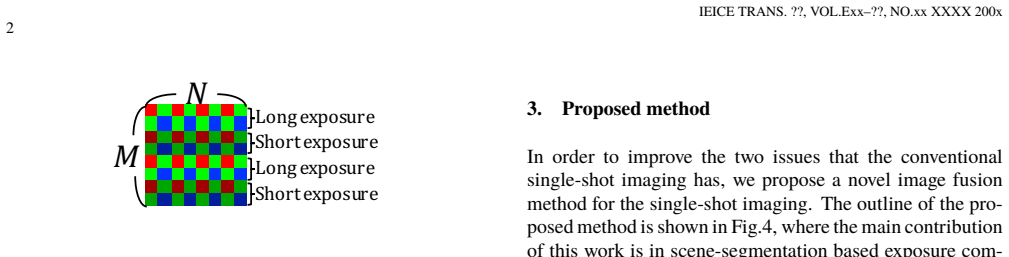
Summary. The paper proposes a multi-exposure image fusion scheme for single-shot high dynamic range imaging with spatially varying exposures (SVE), focusing on dual-ISO captures. The pipeline is: separate the dual-ISO raw image into low- and high-exposure components, apply a dodging-and-burning local contrast enhancement, segment the luminance pair with a variational Bayesian Gaussian mixture model, compute per-segment exposure scale factors that force the geometric mean luminance of each segment to 0.18, generate 2S adjusted raw images, demosaic, and fuse them with Mertens et al.'s exposure fusion. The method is evaluated on 28 HDR-derived synthetic SVE images using TMQI and MEF-SSIM, and on 9 real dual-ISO photographs using statistical naturalness and discrete entropy. The authors conclude that the proposed scheme is effective compared with conventional MEF schemes with exposure compensation.
Significance. If the claimed advantage holds, the method would make dual-ISO single-shot HDR more practical by increasing the effective number of exposures and automatically compensating exposure in a scene-adaptive way, while avoiding ghost artifacts inherent in multi-shot approaches. The algorithm is described in enough detail to be implemented, and the ablation of local contrast enhancement provides useful component-level evidence. The central derivation is straightforward and not internally inconsistent. However, the experimental evidence as presented does not yet establish the general effectiveness claim: the synthetic evaluation is aligned with the method's own 0.18 target, the real-camera results are mixed, and no statistical significance analysis is provided.
major comments (3)
- [Sec. 4.1 A and Sec. 3 C, Eq. (14)] The synthetic SVE inputs are generated from a 0EV image whose geometric mean luminance is explicitly set to 0.18 (Section 4.1 A, citing [21]). The exposure compensation in Eqs. (13)-(14) then sets alpha_{s,k} = 0.18 / g(L'_k | R_s), forcing every segmented region's geometric mean to the same 0.18 value. Thus the controlled comparison in Tables 1 and 2 tests the method under exactly the normalization that the compensation formula targets; it cannot separate the contribution of the fusion scheme from the effect of re-imposing the dataset generator's normalization. I request additional experiments on inputs with different global geometric means, or with the 0.18 target varied, together with a report of per-segment means before and after compensation.
- [Sec. 4.1 C and Sec. 4.2, Tables 1-4] The paper's stated conclusion that the proposed method 'had higher scores' is not uniformly supported. Yang et al. achieves higher MEF-SSIM at ±1 EV and ±2 EV in Table 2 (0.6805 vs. 0.6666 and 0.6772 vs. 0.6633), and in Table 4 Yang et al. has higher discrete entropy at ±3 EV (6.5076 vs. 6.0997). Moreover, all tables report averages without standard deviations, confidence intervals, or significance tests; many TMQI differences in Table 1 are below 0.002, which is unlikely to be meaningful. Please add per-image paired comparisons and significance tests, and qualify the abstract's general effectiveness claim accordingly.
- [Sec. 3 C, Eq. (14)] The rule alpha_{s,k} = 0.18 / g(L'_k | R_s) assumes that the optimal representation of every segmented region is middle gray. For intentionally dark or bright scene regions, this assumption distorts relative luminance, and it is in tension with the paper's claim that the proposed method preserves relative luminance (Section 4.1 C). The manuscript should either justify this target per region or add an experiment with scene-dependent targets to show that the fixed 0.18 choice is not the sole cause of the reported improvements.
minor comments (4)
- [Sec. 3, first paragraph] The phrase 'scene-segmentation based exposure competition' appears to be a typo for 'exposure compensation'.
- [References, [23]] Reference [23] is listed as 'Wiley Online Library, Exposure fusion: A simple and practical alternative to high dynamic range photography, 2009'; it should cite Mertens et al. with full author names and venue.
- [Sec. 2.1, Fig. 3] The dimensions after separation are given as M/2 x N for two raw images; the text should clarify that this refers to the number of rows after removing the other ISO rows, and that interpolation then restores the full M x N size.
- [Sec. 3 B] The phrasing 'drawing no attention to the structure of images' is awkward; consider rewording to 'the segmentation does not use spatial structure'.
Circularity Check
No circularity found: Eq. (14) is a fixed per-segment normalization applied to arbitrary inputs, not a parameter fitted to the evaluation metrics; self-citations document prior work rather than supplying the derivation.
full rationale
The derivation chain is self-contained. The paper fully specifies the algorithm: local contrast enhancement (Eq. (2)), GMM-based scene segmentation (Eqs. (6)–(11)), per-segment exposure compensation (Eqs. (12)–(14)), recombination of adjusted luminance with input images (Eq. (15)), and fusion by any MEF method (Eq. (16)). Eq. (14) sets alpha_{s,k} = 0.18 / g(L'_k | R_s), a fixed normalization of each segment's geometric mean luminance to middle gray, citing Reinhard et al. as an external standard. The alphas are computed deterministically from the input image and are not fitted to TMQI, MEF-SSIM, statistical naturalness, or discrete entropy; hence the reported scores are genuine outputs of the pipeline, not re-statements of fitted inputs. The synthetic dataset's 0.18 geometric-mean normalization matches the compensation target, which is a legitimate concern about experimental design and generalization to unnormalized inputs, but it is not a circularity in the derivation because Eq. (14) does not use the evaluation metrics or the dataset-generation rule as an input. References [13]–[16] are prior papers by the same group describing scene-segmentation-based exposure compensation, but the present manuscript re-specifies that machinery and applies it to dual-ISO spatially varying exposures; no load-bearing uniqueness theorem or unverified premise is imported solely through those citations. No step reduces an output quantity to an input quantity by definition.
Assumptions & free parameters
free parameters (4)
- Number of GMM components D =
10
- epsilon in geometric mean (Eq. 13) =
small value, not specified
- Bilateral filter parameters for local average La_k =
not specified
- Exposure scale factors alpha_{s,k} =
computed per image via Eq. (14)
assumptions (4)
- domain assumption Variational Bayesian inference with D=10 automatically prunes unnecessary Gaussian components without overfitting.
- domain assumption Scene segmentation can be based purely on per-pixel 2D luminance vectors (L'_low, L'_high), ignoring spatial structure and edges.
- domain assumption Every segmented scene region is best displayed with a geometric mean luminance of 0.18 (middle gray).
- domain assumption A dual-ISO sensor produces two clean exposure sub-images X_low and X_high that can be separated and interpolated without significant cross-talk or noise.
Cite this review
Pith. "Pith review of An Image Fusion Scheme for Single-Shot High Dynamic Range Imaging with Spatially Varying Exposures." pith.science (2026). https://pith.science/paper/ERUUPIC3
@misc{pith2026190808195,
  author       = {Pith},
  title        = {Pith review of: An Image Fusion Scheme for Single-Shot High Dynamic Range Imaging with Spatially Varying Exposures},
  year         = {2026},
  howpublished = {\url{https://pith.science/paper/ERUUPIC3}},
  note         = {Machine review of arXiv:1908.08195}
}
read the original abstract
This paper proposes a novel multi-exposure image fusion (MEF) scheme for single-shot high dynamic range imaging with spatially varying exposures (SVE). Single-shot imaging with SVE enables us not only to produce images without color saturation regions from a single-shot image, but also to avoid ghost artifacts in the producing ones. However, the number of exposures is generally limited to two, and moreover it is difficult to decide the optimum exposure values before the photographing. In the proposed scheme, a scene segmentation method is applied to input multi-exposure images, and then the luminance of the input images is adjusted according to both of the number of scenes and the relationship between exposure values and pixel values. The proposed method with the luminance adjustment allows us to improve the above two issues. In this paper, we focus on dual-ISO imaging as one of single-shot imaging. In an experiment, the proposed scheme is demonstrated to be effective for single-shot high dynamic range imaging with SVE, compared with conventional MEF schemes with exposure compensation.
Figures


Figures from the paper (9 more)


Reference graph
Works this paper leans on
-
[21]
Photographic tonereproductionfordigitalimages,
E. Reinhard, M. Stark, P. Shirley, and J. Ferwerda, “Photographic tonereproductionfordigitalimages,”ACMtransactionsongraphics (TOG), vol.21, no.3, pp.267–276, 2002
work page 2002
-
[1]
Ghost removal in high dynamic range images,
E.A. Khan, A.O. Akyuz, and E. Reinhard, “Ghost removal in high dynamic range images,” Image Processing, 2006 IEEE International Conference on, pp.2005–2008, IEEE, 2006
work page 2006
-
[2]
ComputationallyEfficientTruncatedNuclear NormMinimizationforHighDynamicRangeImaging,
C.LeeandE.Y.Lam,“ComputationallyEfficientTruncatedNuclear NormMinimizationforHighDynamicRangeImaging,”IEEETrans- actionsonImageProcessing,vol.25,no.9,pp.4145–4157,September 2016. GO et al.: AN IMAGE FUSION SCHEME FOR SINGLE-SHOT HIGH DYNAMIC RANGE IMAGING WITH SPATIALLY VARYING EXPOSURES 7 (a) Noexposurecompensation(±1EV) (b) Alex (±1EV) (c) Yang et al. (±1...
work page 2016
-
[3]
Pseudo multi- exposure fusion using a single image,
Y. Kinoshita, T. Yoshida, S. Shiota, and H. Kiya, “Pseudo multi- exposure fusion using a single image,” Asia-Pacific Signal and In- formation Processing Association Annual Summit and Conference (APSIPA ASC), pp.263–269, IEEE, 2017
work page 2017
-
[4]
A pseudo multi-exposure fusion method using single image,
Y. Kinoshita, S. Shiota, and H. Kiya, “A pseudo multi-exposure fusion method using single image,” IEICE Transactions on Funda- mentals of Electronics, Communications and Computer Sciences, vol.101, no.11, pp.1806–1814, 2018
work page 2018
-
[5]
A versatile hdr video production system,
M.D. Tocci, C. Kiser, N. Tocci, and P. Sen, “A versatile hdr video production system,” ACM Transactions on Graphics (TOG), vol.30, no.4, p.41, 2011
work page 2011
-
[6]
Dynamic range improvement for some canon dslrs by alter- nating iso during sensor readout
A1EX, “Dynamic range improvement for some canon dslrs by alter- nating iso during sensor readout.”http://acoutts.com/a1ex/ 0 0.1 0.2 0.3 0.4 0.5 0.6 0.7 0.8 0.9 Proposed No exposere compensation Alex Yang et al. MEF-SSIM MEF-SSIM 0 0.1 0.2 0.3 0.4 0.5 0.6 0.7 0.8 0.9 Proposed No exposere compensation Alex Yang et al. MEF-SSIM MEF-SSIM 0 0.1 0.2 0.3 0.4 0....
work page 2013
-
[7]
HDR reconstruction for alternating gain (ISO) sensor readout,
S. Hajsharif, J. Kronander, and J. Unger, “HDR reconstruction for alternating gain (ISO) sensor readout,” April 2014
work page 2014
Show all 28 references
-
[8]
High quality video in high dynamic range scenes from interlaced dual-iso footage,
R. Gil Rodríguez and M. Bertalmío, “High quality video in high dynamic range scenes from interlaced dual-iso footage,” 2016
2016
-
[9]
Single-shot high dynamic range imagingusingcodedelectronicshutter,
H. Cho, S.J. Kim, and S. Lee, “Single-shot high dynamic range imagingusingcodedelectronicshutter,”ComputerGraphicsForum, 2014
2014
-
[10]
Codedrollingshutter photography: Flexible space-time sampling,
J.Gu,Y.Hitomi,T.Mitsunaga,andS.Nayar,“Codedrollingshutter photography: Flexible space-time sampling,” Computational Pho- tography (ICCP), 2010 IEEE International Conference on, pp.1–8, 2010
2010
-
[11]
An and C
V.G. An and C. Lee, “Single-shot high dynamic range imaging via 8 IEICE TRANS. ??, VOL.Exx–??, NO.xx XXXX 200x (a) Noexposurecompensation(±1EV) (b) Alex (±1EV) (c) Yang et al. (±1EV) (d) Proposed method (±1EV) (e) Noexposurecompensation(±2EV) (f) Alex (±2EV) (g) Yang et al. (±...
2017
-
[12]
IMX294CJK | Sony Semiconductor Solutions
SONY, “IMX294CJK | Sony Semiconductor Solutions.”https:// www.sony-semicon.co.jp/products_en/new_pro/may_2017/ imx294cjk_e.html
-
[13]
Automatic exposure compen- sation for multi-exposure image fusion,
Y. Kinoshita, S. Shiota, and H. Kiya, “Automatic exposure compen- sation for multi-exposure image fusion,” IEEE International Confer- ence on Image Processing (ICIP), pp.883–887, 2018
2018
-
[14]
Multi-exposure image fusion based on exposure compensation,
Y. Kinoshita, T. Yoshida, S. Shiota, and H. Kiya, “Multi-exposure image fusion based on exposure compensation,” IEEE International Conference on Acoustics, Speech and Signal Processing (ICASSP), pp.1388–1392, 2018
2018
-
[15]
Kinoshita and H
Y. Kinoshita and H. Kiya, “Automatic exposure compensation us- 0 1 2 3 4 5 6 7 8 Proposed No exposere compensation Alex Yang et al. Entropy discrete entropy 0 1 2 3 4 5 6 7 8 Proposed No exposere compensation Alex Yang et al. Entropy discrete entropy 0 1 2 3 4 5 6 7 8 Proposed...
2018
-
[16]
Scene Segmentation-Based Luminance Adjustment for Multi-Exposure Image Fusion,
Y. Kinoshita and H. Kiya, “Scene Segmentation-Based Luminance Adjustment for Multi-Exposure Image Fusion,” IEEE Trans. Image Processing., pp.1–1, 2019, doi: 10.1109/TIP.2019.2906501
2019
-
[17]
Objective quality assessment of tone- mapped images,
H. Yeganeh and Z. Wang, “Objective quality assessment of tone- mapped images,” IEEE Transactions on Image Processing, vol.22, no.2, pp.657–667, 2013
2013
-
[18]
Perceptual quality assessment for multi-exposureimagefusion,
K. Ma, K. Zeng, and Z. Wang, “Perceptual quality assessment for multi-exposureimagefusion,”IEEETransactionsonImageProcess- ing, vol.24, no.11, pp.3345–3356, 2015
2015
-
[19]
Dodgingandburninginspiredinverse tonemappingalgorithm,
Y.Huo,F.Yang,andV.Brost,“Dodgingandburninginspiredinverse tonemappingalgorithm,”JournalofComputationalInformationSys- tems, vol.9, no.9, pp.3461–3468, 2013. GO et al.: AN IMAGE FUSION SCHEME FOR SINGLE-SHOT HIGH DYNAMIC RANGE IMAGING WITH SPATIALLY VARYING EXPOSURES 9
2013
-
[20]
Bishop, Pattern Recognition and Machine Learning (Infor- mation Science and Statistics), Springer-Verlag, Berlin, Heidelberg, 2006
C.M. Bishop, Pattern Recognition and Machine Learning (Infor- mation Science and Statistics), Springer-Verlag, Berlin, Heidelberg, 2006
2006
-
[22]
High-quality linear interpola- tion for demosaicing of bayer-patterned color images,
H.S. Malvar, L.w. He, and R. Cutler, “High-quality linear interpola- tion for demosaicing of bayer-patterned color images,” Acoustics, Speech, and Signal Processing, 2004. Proceedings.(ICASSP’04). IEEE International Conference on, pp.485 – 488, Institute of Elec- trical and El...
2004
-
[23]
Wiley Online Library, Exposure fusion: A simple and practical alternative to high dynamic range photography, 2009
2009
-
[24]
Multi-scalefusionoftwolarge- exposure-ratio images,
Y.Yang,W.Cao,S.Wu,andZ.Li,“Multi-scalefusionoftwolarge- exposure-ratio images,” IEEE Signal Processing Letters, vol.25, no.12, pp.1885–1889, 2018
2018
-
[25]
sIBL Archive
hdrlabs, “sIBL Archive.” http://www.hdrlabs.com/sibl/ archive.html
-
[26]
Magic Lantern
“Magic Lantern.”http://www.magiclantern.fm. Chihiro Go received his B.Eng. degree from Tokyo University of Agriculture and Tech- nology, Japan, in 2017. He is a Master course studentatTokyoMetropolitanUniversity,Japan. His research interests are in the area of image processing...
2017
-
[1987]
In 1982, he joined Tokyo Metropolitan University, where he became Full Professor in
1982
-
[2000]
He is a Fellow of IEEE, IEICE and ITE
From 1995 to 1996, he attended the Uni- versityofSydney,AustraliaasaVisitingFellow. He is a Fellow of IEEE, IEICE and ITE. He currently serves as President of APSIPA, and he served as Inaugural Vice President (Technical Activities)ofAPSIPAin2009-2013, andasRegionalDirector-at-...
1995
Reviewed August 14, 2026 · model on record in the stance chip above.
Discussion (0). Continue with ORCID to comment.