REVIEW 2 major objections 2 minor 47 references
Stellar: Scalable Multimodal Document Retrieval for Natural Language Queries
T0 review · 2 major / 2 minor · reviewed 2026-06-26 · grok-4.3
Pith's one-line read Stellar reduces memory overhead and query latency for multimodal document retrieval by 1-2 orders of magnitude without losing effectiveness.
desk verdict Stellar pairs MLLM sparse lexical filtering with clustered disk storage for late interaction to cut memory and latency in multimodal retrieval, but the filtering recall is the untested link that needs checking. read the letter →
The pith
A machine-rendered reading of the paper's core claim, the machinery that carries it, and where it could break.
The reading
What carries the argument
Lexical Representation-based Filtering (LRF) using a fine-tuned MLLM as sparse encoder combined with Efficient Disk-backed Late Interaction (DLI) using balanced clustering for on-disk storage.
What would settle it
Running the LRF step on a benchmark and finding that for some queries the gold relevant document is not in the filtered candidate set.
Extended reading notes
Core claim
Stellar introduces Lexical Representation-based Filtering that fine-tunes an MLLM as a sparse encoder for effective document pruning, paired with Efficient Disk-backed Late Interaction that uses balanced clustering to lay out token embeddings on disk and a cost model to load only needed ones into memory for late interaction.
Load-bearing premise
The fine-tuned MLLM used for lexical filtering will not exclude any truly relevant documents from the small candidate set passed to late interaction.
Editorial extensions
If this is right
- Multimodal document retrieval can now operate on corpora much larger than current memory limits allow.
- Production RAG systems can adopt late-interaction methods without requiring specialized high-RAM servers.
- Query response times improve enough to support interactive applications at scale.
- The same framework may extend to other embedding-based retrieval tasks that suffer from multi-vector memory costs.
Reading between the lines
- Success would shift design focus from in-memory indexes to hybrid disk-memory architectures for retrieval.
- Further gains might come from optimizing the clustering or cost model for specific hardware.
- Testing on even larger synthetic datasets could reveal where the filtering step starts to drop recall.
Signed reviews
Editorial analysis
A structured set of objections, weighed in public.
Referee Report
Summary. The paper introduces Stellar, a multimodal document retrieval framework for natural language queries that combines Lexical Representation-based Filtering (LRF) — fine-tuning an MLLM as a sparse encoder for candidate reduction — with Efficient Disk-backed Late Interaction (DLI) that stores token embeddings on disk and loads only necessary candidates via a balanced clustering layout and cost model. It claims 1-2 orders of magnitude reductions in memory and query latency versus prior late-interaction methods on four benchmarks plus a new large-scale dataset, while preserving retrieval effectiveness.
Significance. If the central effectiveness claim holds, Stellar would materially improve the practicality of token-level late-interaction retrieval in RAG pipelines by addressing the memory and latency bottlenecks that currently limit deployment at scale. The introduction of a new large-scale multimodal dataset is a concrete contribution that could support future work.
major comments (2)
- [§3.2 and §4] §3.2 (LRF) and §4 (experiments): the headline claim that effectiveness is uncompromised rests on the assumption that LRF produces a candidate set with sufficiently high recall that the subsequent DLI stage matches full-corpus late-interaction performance. The manuscript reports only end-to-end metrics; the critical intermediate recall@K (or equivalent) for the LRF sparse-encoder stage alone is not provided, leaving the load-bearing assumption unverified.
- [§4] §4 (experimental setup): the abstract and results claim reductions “without compromising retrieval effectiveness,” yet no details are given on the precise baselines, statistical significance testing, or whether any post-hoc threshold tuning was performed on the LRF candidate-set size; this information is required to assess whether the reported effectiveness numbers are robust.
minor comments (2)
- [Abstract] The abstract states positive outcomes on “four real-world benchmarks and a newly presented large-scale dataset” but provides no metric names, dataset sizes, or baseline references; adding one sentence with these specifics would improve readability.
- [§3.3] Notation for the cost model in DLI is introduced without an explicit equation number; cross-referencing the model to a numbered equation would aid reproducibility.
Simulated Author's Rebuttal
We thank the referee for their constructive feedback on our manuscript. We address each of the major comments below and outline the revisions we will make.
read point-by-point responses
-
Referee: [§3.2 and §4] §3.2 (LRF) and §4 (experiments): the headline claim that effectiveness is uncompromised rests on the assumption that LRF produces a candidate set with sufficiently high recall that the subsequent DLI stage matches full-corpus late-interaction performance. The manuscript reports only end-to-end metrics; the critical intermediate recall@K (or equivalent) for the LRF sparse-encoder stage alone is not provided, leaving the load-bearing assumption unverified.
Authors: We agree that the intermediate recall of the LRF stage is important to report for full transparency. While the end-to-end results demonstrate that Stellar achieves comparable effectiveness to full late-interaction methods, adding the LRF recall metrics will better support our claims. We will include these results in the revised manuscript, showing high recall at the chosen candidate sizes. revision: yes
-
Referee: [§4] §4 (experimental setup): the abstract and results claim reductions “without compromising retrieval effectiveness,” yet no details are given on the precise baselines, statistical significance testing, or whether any post-hoc threshold tuning was performed on the LRF candidate-set size; this information is required to assess whether the reported effectiveness numbers are robust.
Authors: We will provide additional details in the experimental setup section, including the exact list of baselines compared, results of statistical significance tests (e.g., p-values from t-tests), and clarification that the candidate set size was selected based on validation data without post-hoc tuning on the test sets. This will address concerns about robustness. revision: yes
Circularity Check
No circularity; empirical architecture validated by benchmarks
full rationale
The paper describes a retrieval system (LRF sparse filtering via fine-tuned MLLM plus disk-backed DLI) whose central claims are measured end-to-end effectiveness, memory, and latency on four benchmarks plus a new dataset. No equations, uniqueness theorems, or predictions are presented that reduce by construction to fitted inputs, self-citations, or renamed ansatzes. All load-bearing steps are external measurements rather than internal redefinitions.
Assumptions & free parameters
Cite this review
Pith. "Pith review of Stellar: Scalable Multimodal Document Retrieval for Natural Language Queries." pith.science (2026). https://pith.science/paper/ES6JX3RT
@misc{pith2026260619960,
  author       = {Pith},
  title        = {Pith review of: Stellar: Scalable Multimodal Document Retrieval for Natural Language Queries},
  year         = {2026},
  howpublished = {\url{https://pith.science/paper/ES6JX3RT}},
  note         = {Machine review of arXiv:2606.19960}
}
read the original abstract
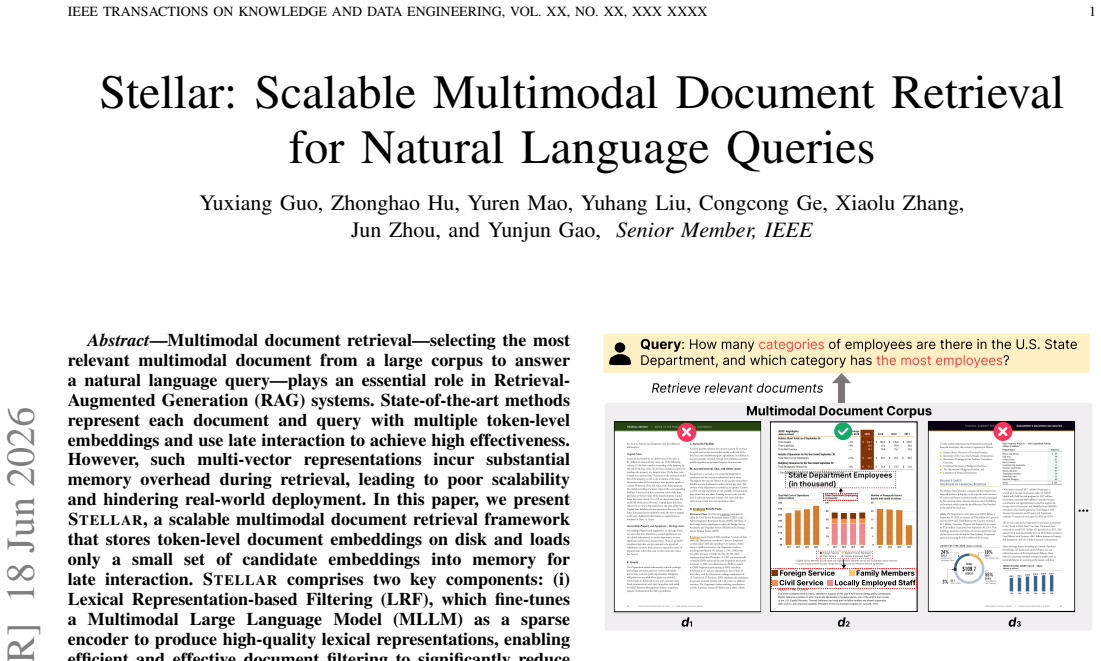
Multimodal document retrieval--selecting the most relevant multimodal document from a large corpus to answer a natural language query--plays an essential role in Retrieval-Augmented Generation (RAG) systems. State-of-the-art methods represent each document and query with multiple token-level embeddings and use late interaction to achieve high effectiveness. However, such multi-vector representations incur substantial memory overhead during retrieval, leading to poor scalability and hindering real-world deployment. In this paper, we present Stellar, a scalable multimodal document retrieval framework that stores token-level document embeddings on disk and loads only a small set of candidate embeddings into memory for late interaction. Stellar comprises two key components: (i) Lexical Representation-based Filtering (LRF), which fine-tunes a Multimodal Large Language Model (MLLM) as a sparse encoder to produce high-quality lexical representations, enabling efficient and effective document filtering to significantly reduce the candidate set; (ii) Efficient Disk-backed Late Interaction (DLI), which designs an on-disk token embedding storage layout guided by a balanced clustering algorithm, and dynamically loads only the necessary token embeddings into memory using a simple yet effective cost model. Extensive experiments on four real-world benchmarks and a newly presented large-scale dataset demonstrate that Stellar reduces memory overhead and query latency by 1-2 orders of magnitude compared to existing methods without compromising retrieval effectiveness.
Figures


Figures from the paper (3 more)


Reference graph
Works this paper leans on
-
[1]
Language models are few-shot learners,
T. B. Brown, B. Mann, N. Ryder, M. Subbiah, J. Kaplan, P. Dhariwal, A. Neelakantan, P. Shyam, G. Sastry, A. Askell, S. Agarwal, A. Herbert- V osset al., “Language models are few-shot learners,” inNeurIPS, 2020
2020
-
[2]
A. Hurst, A. Lerer, A. P. Goucher, A. Perelman, A. Ramesh, A. Clark, A. Ostrow, A. Welihinda, A. Hayes, A. Radfordet al., “Gpt-4o system card,”arXiv preprint arXiv:2410.21276, 2024
work page Pith review arXiv 2024
-
[3]
A survey on hallucination in large language models: Principles, taxonomy, challenges, and open questions,
L. Huang, W. Yu, W. Ma, W. Zhong, Z. Feng, H. Wang, Q. Chen, W. Peng, X. Feng, B. Qin, and T. Liu, “A survey on hallucination in large language models: Principles, taxonomy, challenges, and open questions,” ACM Trans. Inf. Syst., vol. 43, no. 2, pp. 42:1–42:55, 2025
2025
-
[4]
A survey on RAG meeting llms: Towards retrieval-augmented large language models,
W. Fan, Y . Ding, L. Ning, S. Wang, H. Li, D. Yin, T. Chua, and Q. Li, “A survey on RAG meeting llms: Towards retrieval-augmented large language models,” inSIGKDD, 2024, pp. 6491–6501
2024
-
[5]
Self-rag: Learning to retrieve, generate, and critique through self-reflection,
A. Asai, Z. Wu, Y . Wang, A. Sil, and H. Hajishirzi, “Self-rag: Learning to retrieve, generate, and critique through self-reflection,” inICLR, 2024
2024
-
[6]
FIT-RAG: black-box RAG with factual information and token reduction,
Y . Mao, X. Dong, W. Xu, Y . Gao, B. Wei, and Y . Zhang, “FIT-RAG: black-box RAG with factual information and token reduction,”ACM Trans. Inf. Syst., vol. 43, no. 2, pp. 40:1–40:27, 2025
2025
-
[7]
QAEA-DR: A unified text augmentation framework for dense retrieval,
H. Tan, S. Zhan, H. Lin, H. Zheng, and W. K. Chan, “QAEA-DR: A unified text augmentation framework for dense retrieval,”IEEE Trans. Knowl. Data Eng., vol. 37, no. 6, pp. 3669–3683, 2025
2025
-
[8]
Docdb: A database for unstructured document analysis,
Z. Li, Y . Zhong, C. Chai, Z. Sun, Y . Deng, Y . Yuan, G. Wang, and L. Cao, “Docdb: A database for unstructured document analysis,”Proc. VLDB Endow., vol. 18, no. 12, pp. 5387–5390, 2025
2025
Show all 47 references
-
[9]
Visrag: Vision-based retrieval-augmented generation on multi-modality documents,
S. Yu, C. Tang, B. Xu, J. Cui, J. Ran, Y . Yan, Z. Liu, S. Wang, X. Han, Z. Liu, and M. Sun, “Visrag: Vision-based retrieval-augmented generation on multi-modality documents,” inICLR, 2025
2025
-
[10]
Robust scene text recognition with automatic rectification,
B. Shi, X. Wang, P. Lyu, C. Yao, and X. Bai, “Robust scene text recognition with automatic rectification,” inCVPR, 2016, pp. 4168– 4176
2016
-
[11]
The probabilistic relevance frame- work: BM25 and beyond,
S. E. Robertson and H. Zaragoza, “The probabilistic relevance frame- work: BM25 and beyond,”Found. Trends Inf. Retr., vol. 3, no. 4, pp. 333–389, 2009
2009
-
[12]
C-pack: Pack- aged resources to advance general chinese embedding,
S. Xiao, Z. Liu, P. Zhang, and N. Muennighoff, “C-pack: Pack- aged resources to advance general chinese embedding,”CoRR, vol. abs/2309.07597, 2023
2023 arXiv
-
[13]
A survey on multimodal large language models,
S. Yin, C. Fu, S. Zhao, K. Li, X. Sun, T. Xu, and E. Chen, “A survey on multimodal large language models,”arXiv preprint arXiv:2306.13549, 2023
2023 arXiv
-
[14]
Colpali: Efficient document retrieval with vision language models,
M. Faysse, H. Sibille, T. Wu, B. Omrani, G. Viaud, C. Hudelot, and P. Colombo, “Colpali: Efficient document retrieval with vision language models,” inICLR, 2025
2025
-
[15]
Unifying multimodal retrieval via document screenshot embedding,
X. Ma, S. Lin, M. Li, W. Chen, and J. Lin, “Unifying multimodal retrieval via document screenshot embedding,” inEMNLP, 2024, pp. 6492–6505
2024
-
[16]
M3docrag: Multi-modal retrieval is what you need for multi-page multi-document understanding,
J. Cho, D. Mahata, O. Irsoy, Y . He, and M. Bansal, “M3docrag: Multi-modal retrieval is what you need for multi-page multi-document understanding,”arXiv preprint arXiv:2411.04952, 2024
2024
-
[17]
Colbert: Efficient and effective passage search via contextualized late interaction over BERT,
O. Khattab and M. Zaharia, “Colbert: Efficient and effective passage search via contextualized late interaction over BERT,” inSIGIR, 2020, pp. 39–48
2020
-
[18]
Building and better understanding vision-language models: insights and future directions
H. Laurenc ¸on, A. Marafioti, V . Sanh, and L. Tronchon, “Building and better understanding vision-language models: insights and future directions.” inarXiv preprint arXiv:2408.12637, 2024
2024
-
[19]
PLAID: an efficient engine for late interaction retrieval,
K. Santhanam, O. Khattab, C. Potts, and M. Zaharia, “PLAID: an efficient engine for late interaction retrieval,” inCIKM, 2022, pp. 1747– 1756
2022
-
[20]
Colbertv2: Effective and efficient retrieval via lightweight late interac- tion,
K. Santhanam, O. Khattab, J. Saad-Falcon, C. Potts, and M. Zaharia, “Colbertv2: Effective and efficient retrieval via lightweight late interac- tion,” inNAACL-HLT, 2022, pp. 3715–3734
2022
-
[21]
Effective multi-modal retrieval based on stacked auto-encoders,
W. Wang, B. C. Ooi, X. Yang, D. Zhang, and Y . Zhuang, “Effective multi-modal retrieval based on stacked auto-encoders,”Proc. VLDB Endow., vol. 7, no. 8, pp. 649–660, 2014
2014
-
[22]
Chameleon: Foundation models for fairness-aware multi-modal data augmentation to enhance coverage of minorities,
M. Erfanian, H. V . Jagadish, and A. Asudeh, “Chameleon: Foundation models for fairness-aware multi-modal data augmentation to enhance coverage of minorities,”Proc. VLDB Endow., vol. 17, no. 11, pp. 3470– 3483, 2024
2024
-
[23]
Alleviating the inconsistency of multimodal data in cross-modal retrieval,
T. Li, X. Yang, Y . Ke, B. Wang, Y . Liu, and J. Xu, “Alleviating the inconsistency of multimodal data in cross-modal retrieval,” inICDE, 2024, pp. 4643–4656
2024
-
[24]
MUST: an effective and scalable framework for multimodal search of target modality,
M. Wang, X. Ke, X. Xu, L. Chen, Y . Gao, P. Huang, and R. Zhu, “MUST: an effective and scalable framework for multimodal search of target modality,” inICDE, 2024, pp. 4747–4759
2024
-
[25]
Learning transferable visual models from natural language supervi- sion,
A. Radford, J. W. Kim, C. Hallacy, A. Ramesh, G. Goh, S. Agarwal, G. Sastry, A. Askell, P. Mishkin, J. Clark, G. Krueger, and I. Sutskever, “Learning transferable visual models from natural language supervi- sion,” inICML, 2021, pp. 8748–8763
2021
-
[26]
BLIP-2: bootstrapping language-image pre-training with frozen image encoders and large language models,
J. Li, D. Li, S. Savarese, and S. C. H. Hoi, “BLIP-2: bootstrapping language-image pre-training with frozen image encoders and large language models,” inICML, 2023, pp. 19 730–19 742
2023
-
[27]
Sigmoid loss for language image pre-training,
X. Zhai, B. Mustafa, A. Kolesnikov, and L. Beyer, “Sigmoid loss for language image pre-training,” inICCV, 2023, pp. 11 941–11 952
2023
-
[28]
Momentum contrast for unsupervised visual representation learning,
K. He, H. Fan, Y . Wu, S. Xie, and R. Girshick, “Momentum contrast for unsupervised visual representation learning,” inCVPR, 2020, pp. 9729–9738
2020
-
[29]
Efficient and robust approxi- mate nearest neighbor search using hierarchical navigable small world graphs,
Y . A. Malkov and D. A. Yashunin, “Efficient and robust approxi- mate nearest neighbor search using hierarchical navigable small world graphs,”IEEE Trans. Pattern Anal. Mach. Intell., vol. 42, no. 4, pp. 824–836, 2018
2018
-
[30]
Diskann: fast accurate billion-point nearest neighbor search on a single node,
S. J. Subramanya, Devvrit, R. Kadekodi, R. Krishaswamy, and H. V . Simhadri, “Diskann: fast accurate billion-point nearest neighbor search on a single node,” inNeurIPS, 2019, pp. 13 766–13 776
2019
-
[31]
Starling: An i/o-efficient disk-resident graph index framework for high-dimensional vector similarity search on data segment,
M. Wang, W. Xu, X. Yi, S. Wu, Z. Peng, X. Ke, Y . Gao, X. Xu, R. Guo, and C. Xie, “Starling: An i/o-efficient disk-resident graph index framework for high-dimensional vector similarity search on data segment,”Proc. ACM Manag. Data, vol. 2, no. 1, pp. 14:1–14:27, 2024
2024
-
[32]
Milvus: A purpose-built vector data management system,
J. Wang, X. Yi, R. Guo, H. Jin, P. Xu, S. Li, X. Wang, X. Guo, C. Li, X. Xu, K. Yu, Y . Yuan, Y . Zou, J. Long, Y . Cai, Z. Li, Z. Zhang, Y . Mo, J. Gu, R. Jiang, Y . Wei, and C. Xie, “Milvus: A purpose-built vector data management system,” inSIGMOD, 2021, pp. 2614–2627
2021
-
[33]
Splade v2: Sparse lexi- cal and expansion model for first stage retrieval,
M. Formal, X. Martinet, N. Thakur, H. Sajjad, C. Lioma, F. Scholer, M. Worring, M. Bendersky, and F. Diaz, “Splade v2: Sparse lexi- cal and expansion model for first stage retrieval,” inarXiv preprint arXiv:2106.05222, 2021
2021
-
[34]
Bert: Pre-training of deep bidirectional transformers for language understanding,
J. Devlin, M.-W. Chang, K. Lee, and K. Toutanova, “Bert: Pre-training of deep bidirectional transformers for language understanding,” inNAACL- HLT, 2019, pp. 4171–4186
2019
-
[35]
Stair: Learning sparse text and image representation in grounded tokens,
C. Chen, B. Zhang, L. Cao, J. Shen, T. Gunter, A. M. Jose, A. Toshev, Y . Zheng, J. Shlens, R. Pang, and Y . Yang, “Stair: Learning sparse text and image representation in grounded tokens,” inEMNLP, 2023, pp. 15 079–15 094
2023
-
[36]
Multimodal learned sparse retrieval with probabilistic expansion control,
T. Nguyen, M. Hendriksen, A. Yates, and M. de Rijke, “Multimodal learned sparse retrieval with probabilistic expansion control,” inECIR, 2024, pp. 114–131
2024
-
[37]
BIRDIE: nat- ural language-driven table discovery using differentiable search index,
Y . Guo, Z. Hu, Y . Mao, B. Zheng, Y . Gao, and M. Zhou, “BIRDIE: nat- ural language-driven table discovery using differentiable search index,” Proc. VLDB Endow., vol. 18, no. 7, pp. 2070–2083, 2025
-
[38]
Lora: Low-rank adaptation of large language models,
E. J. Hu, Y . Shen, P. Wallis, Z. Allen-Zhu, Y . Li, S. Wang, L. Wang, and W. Chen, “Lora: Low-rank adaptation of large language models,” inICLR, 2022
2022
-
[39]
I/o-efficient algorithms and environments,
J. S. Vitteret al., “I/o-efficient algorithms and environments,”ACM Computing Surveys, vol. 31, no. 2, pp. 256–257, 1999
1999
-
[40]
Pneuma:leveraging llms for tabular data representation and retrieval in an end-to-end system,
M. I. L. Balaka, D. Alexander, Q. Wang, Y . Gong, A. Krisnadhi, and R. Castro Fernandez, “Pneuma:leveraging llms for tabular data representation and retrieval in an end-to-end system,”Proc. ACM Manag. Data, vol. 3, no. 3, 2025
2025
-
[41]
Hierarchical multimodal trans- formers for multipage docvqa,
R. Tito, D. Karatzas, and E. Valveny, “Hierarchical multimodal trans- formers for multipage docvqa,”Pattern Recognit., vol. 144, p. 109834, 2023
2023
-
[42]
Infographicvqa,
M. Mathew, V . Bagal, R. Tito, D. Karatzas, E. Valveny, and C. V . Jawahar, “Infographicvqa,” inWACV, 2022, pp. 2582–2591
2022
-
[43]
Multimodal arxiv: A dataset for improving scientific comprehension of large vision-language models,
L. Li, Y . Wang, R. Xu, P. Wang, X. Feng, L. Kong, and Q. Liu, “Multimodal arxiv: A dataset for improving scientific comprehension of large vision-language models,” inACL, 2024, pp. 14 369–14 387
2024
-
[44]
Plotqa: Rea- soning over scientific plots,
N. Methani, P. Ganguly, M. M. Khapra, and P. Kumar, “Plotqa: Rea- soning over scientific plots,” inWACV, 2020, pp. 1527–1536
2020
-
[45]
Paddleocr: Multi-language ocr toolkit based on paddlepaddle,
“Paddleocr: Multi-language ocr toolkit based on paddlepaddle,” https: //github.com/PaddlePaddle/PaddleOCR, 2020
2020
-
[46]
Nv-embed: Improved techniques for training llms as generalist embedding models,
C. Lee, R. Roy, M. Xu, J. Raiman, M. Shoeybi, B. Catanzaro, and W. Ping, “Nv-embed: Improved techniques for training llms as generalist embedding models,” inICLR, 2025
2025
-
[47]
Qwen2-vl: Enhancing vision-language model’s perception of the world at any resolution,
P. Wang, S. Bai, S. Tan, S. Wang, Z. Fan, J. Bai, K. Chen, X. Liu, J. Wang, W. Ge, Y . Fan, K. Dang, M. Du, X. Ren, R. Men, D. Liu, C. Zhou, J. Zhou, and J. Lin, “Qwen2-vl: Enhancing vision-language model’s perception of the world at any resolution,”arXiv preprint arXiv:2409.1...
2024 arXiv
Reviewed June 26, 2026 · model on record in the stance chip above.
Discussion (0). Continue with ORCID to comment.