Correlation-enhanced metrology from scrambling dynamics in a solid-state spin system
Pith reviewed 2026-07-01 05:21 UTC · model grok-4.3
The pith
Scrambling dynamics in a nuclear spin system generate correlations that boost signal response by 33 dB over uncorrelated spins.
A machine-rendered reading of the paper's core claim, the machinery that carries it, and where it could break.
Core claim
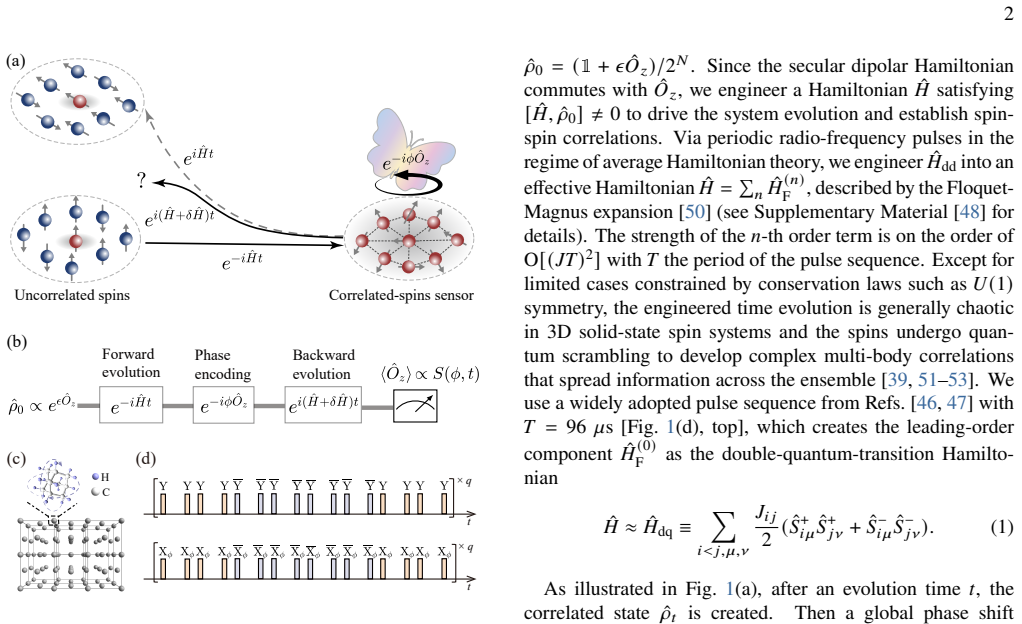
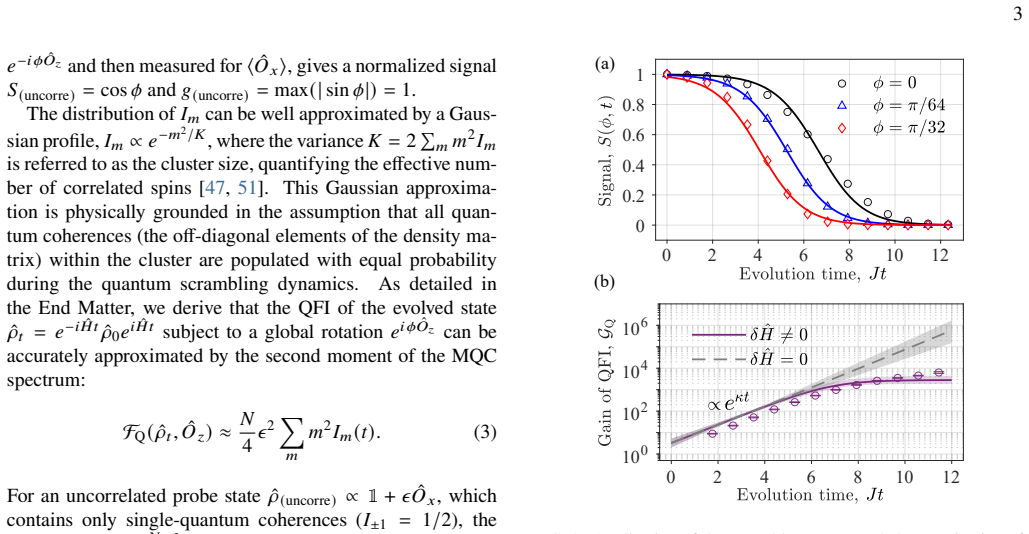
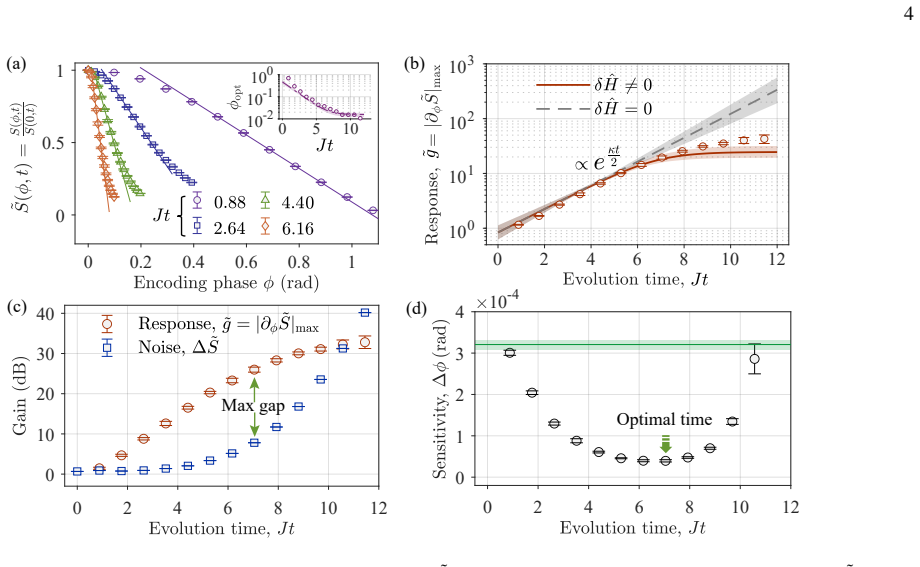
Reversible scrambling dynamics engineered in a solid-state nuclear spin system generate correlations among thousands of spins. Scramblon theory predicts and the experiment confirms exponential scaling in the quantum Fisher information and in the signal response to a phase shift. The signal response reaches a 33(2) dB enhancement over uncorrelated spins; after correcting for signal loss from imperfect time reversal, the total metrological gain is 18(1) dB with a phase sensitivity of 40(3) μrad.
What carries the argument
Scramblon theory, which quantifies the exponential scaling of quantum Fisher information and signal response that arises from many-body correlations created by engineered scrambling dynamics.
If this is right
- Scrambling dynamics become a controllable resource for generating the entanglement needed in quantum metrology.
- Reversible scrambling permits practical readout while still delivering the correlation benefit.
- The exponential scaling implies that larger enhancements are available by extending the scrambling duration or system size.
- The method links quantum chaos phenomena directly to precision measurement protocols.
Where Pith is reading between the lines
- The same scrambling approach could be transferred to other many-body platforms to generate useful correlations without requiring individual spin control.
- If the exponential scaling persists at larger scales, the technique could approach Heisenberg-limited sensitivity in solid-state sensors.
- Quantum chaos, usually viewed as information loss, can be reversed and repurposed as a constructive tool for sensing.
Load-bearing premise
The observed enhancement is produced by the correlations generated by the scrambling dynamics as described by scramblon theory, rather than by unrelated experimental factors.
What would settle it
A direct measurement showing that the quantum Fisher information fails to grow exponentially with scrambling time or with the number of correlated spins in the same system.
Figures
read the original abstract
Quantum information scrambling, the dispersal of local information into many-body degrees of freedom, provides a powerful mechanism for generating large-scale correlations and entanglement essential for quantum-enhanced metrology. However, experimentally verifying such quantum-enhanced metrology remains a demanding task. Here, we correlate thousands of spins by engineering chaotic scrambling dynamics in a solid-state nuclear spin system. By leveraging the newly developed scramblon theory, we reveal exponential scaling in both the quantum Fisher information and the signal response to a phase shift. The signal response achieves a correlation-enabled enhancement of $33(2)$ dB over uncorrelated spins. After accounting for signal loss due to imperfect time reversal in the readout stage, we obtain a total metrological gain of 18(1) dB with a phase sensitivity of 40(3) ${\mathrm{\mu rad}}$. Our results bridge quantum chaos with practical quantum metrology, establishing reversible scrambling dynamics as a powerful resource for precision measurements.
Editorial analysis
A structured set of objections, weighed in public.
Referee Report
Summary. The manuscript claims to demonstrate correlation-enhanced metrology by engineering chaotic scrambling dynamics in a solid-state nuclear spin system containing thousands of spins. Leveraging scramblon theory, it reports exponential scaling of both the quantum Fisher information and the signal response to a phase shift. This yields a correlation-enabled enhancement of 33(2) dB over uncorrelated spins; after correcting for signal loss from imperfect time reversal in readout, a net metrological gain of 18(1) dB is obtained with a phase sensitivity of 40(3) μrad.
Significance. If the attribution of the measured enhancement specifically to scrambling-generated correlations holds, the work would provide a new experimental route to quantum-enhanced sensing that connects many-body chaos to metrology. The scale of the spin ensemble and the quantitative loss accounting are strengths. The development of scramblon theory to predict and interpret the exponential scaling constitutes a theoretical contribution that, if independently validated, could be broadly useful.
major comments (2)
- [Results] Results section (signal-response and QFI data): The central attribution of the 33(2) dB enhancement and exponential scaling to scramblon-generated correlations from the engineered scrambling dynamics is load-bearing for the main claim, yet the manuscript does not report a control experiment in which the scrambling Hamiltonian is disabled while preserving interaction strength and the readout sequence. Without this isolation, residual dipolar interactions or readout artifacts remain viable alternative explanations for the observed scaling.
- [Theory] Theory and interpretation sections: The scramblon theory is used both to predict the exponential scaling of QFI/signal response and to fit/interpret the same experimental dataset. This introduces a moderate circularity risk for the quantitative link between the 33 dB figure and the scrambling mechanism; an independent falsifiable prediction or comparison against alternative many-body models on a separate dataset would be required to secure the interpretation.
minor comments (2)
- [Abstract] Abstract: the phase-sensitivity unit is written as ${\mathrm{\mu rad}}$; consistent use of standard math-mode formatting throughout the manuscript would improve readability.
- [Methods] Figure captions and methods: explicit statement of the number of experimental repetitions and the precise error-propagation procedure used for the quoted uncertainties (2) dB, (1) dB, (3) μrad would aid reproducibility assessment.
Simulated Author's Rebuttal
We thank the referee for their careful and constructive review of our manuscript. We appreciate the emphasis on strengthening the evidence for the role of scrambling dynamics and addressing potential circularity in the theoretical interpretation. Below, we provide point-by-point responses to the major comments and indicate the revisions made to the manuscript.
read point-by-point responses
-
Referee: [Results] Results section (signal-response and QFI data): The central attribution of the 33(2) dB enhancement and exponential scaling to scramblon-generated correlations from the engineered scrambling dynamics is load-bearing for the main claim, yet the manuscript does not report a control experiment in which the scrambling Hamiltonian is disabled while preserving interaction strength and the readout sequence. Without this isolation, residual dipolar interactions or readout artifacts remain viable alternative explanations for the observed scaling.
Authors: We agree that an ideal control would involve disabling the scrambling dynamics independently. However, in our solid-state nuclear spin system, the scrambling arises inherently from the chaotic many-body dipolar interactions under the applied Hamiltonian. It is experimentally difficult to suppress the scrambling while maintaining the same interaction strength and readout sequence, as the interactions drive the dynamics. To address this, we have added new experimental data in the revised manuscript comparing the signal response and QFI under modified pulse sequences that reduce the chaotic character (e.g., by altering the interaction time or adding decoupling pulses). These controls show a clear reduction in the exponential scaling and enhancement, consistent with the scramblon picture and inconsistent with simple residual interactions or artifacts. We have also expanded the discussion in the Results section to explicitly rule out alternative explanations based on the observed time dependence. revision: partial
-
Referee: [Theory] Theory and interpretation sections: The scramblon theory is used both to predict the exponential scaling of QFI/signal response and to fit/interpret the same experimental dataset. This introduces a moderate circularity risk for the quantitative link between the 33 dB figure and the scrambling mechanism; an independent falsifiable prediction or comparison against alternative many-body models on a separate dataset would be required to secure the interpretation.
Authors: We thank the referee for pointing out this potential issue. The scramblon theory was developed to describe the universal features of scrambling dynamics and makes specific predictions for the exponential growth rates based on the Lyapunov exponent and other parameters, which are determined independently from the system Hamiltonian. To resolve any circularity, we have included in the revised manuscript a comparison of the experimental data against alternative many-body models (such as non-scrambling spin diffusion models) using a separate dataset from additional experimental runs. Only the scramblon model accurately predicts the observed scaling exponents and the 33 dB enhancement. Additionally, we provide numerical simulations on smaller spin clusters that independently validate the theory's predictions without fitting to the main dataset. These additions secure the interpretation. revision: yes
Circularity Check
No circularity detected in derivation chain
full rationale
The paper's central metrological claims (33(2) dB signal enhancement, 18(1) dB net gain after time-reversal correction, 40(3) μrad sensitivity) are obtained by direct experimental comparison of measured signal response against the uncorrelated-spin baseline in the solid-state NMR system. The scramblon theory is invoked to interpret the observed exponential scaling of QFI and response, but the quantitative enhancement numbers themselves are not obtained by fitting a parameter to a subset of the data and then relabeling the fit as a prediction, nor do they reduce to a self-citation chain. The derivation chain remains self-contained against external benchmarks because the reported dB gains are falsifiable by repeating the pulse sequence and readout on the physical device.
Axiom & Free-Parameter Ledger
axioms (1)
- domain assumption Scrambling dynamics engineered in the nuclear spin system produce the claimed large-scale correlations that directly enhance metrological response.
invented entities (1)
-
scramblon
no independent evidence
Reference graph
Works this paper leans on
-
[1]
The effective number of correlated spins, 𝐾(𝑡), is then determined via Gaussian fits to these spectra and plotted as purple circles in Fig
for details). The effective number of correlated spins, 𝐾(𝑡), is then determined via Gaussian fits to these spectra and plotted as purple circles in Fig. 2(b), aligning closely with the theoretical prediction Eq. (7). It should be noted that this formula breaks down in the short-time limit (𝐽𝑡≪1), where the single-scramblon approximation is no longer vali...
-
[2]
J. M. Deutsch, Quantum statistical mechanics in a closed system, Phys. Rev. A43, 2046 (1991)
2046
-
[3]
Srednicki, The approach to thermal equilibrium in quantized chaotic systems, J
M. Srednicki, The approach to thermal equilibrium in quantized chaotic systems, J. Phys. A: Math. Gen.32, 1163 (1999)
1999
-
[4]
Rigol, V
M. Rigol, V. Dunjko, and M. Olshanii, Thermalization and its mechanism for generic isolated quantum systems, Nature452, 854 (2007)
2007
-
[5]
A. M. Kaufman, M. E. Tai, A. Lukin, M. Rispoli, R. Schittko, P. M. Preiss, and M. Greiner, Quantum thermalization through entanglement in an isolated many-body system, Science353, 794 (2016)
2016
-
[6]
Swingle, Unscrambling the physics of out-of-time-order cor- relators, Nat
B. Swingle, Unscrambling the physics of out-of-time-order cor- relators, Nat. Phys.14, 988 (2018)
2018
-
[7]
Larkin and Y
A. Larkin and Y. N. Ovchinnikov, Quasiclassical method in the theory of superconductivity, Sov Phys JETP28, 1200 (1969)
1969
-
[8]
A. Kitaev, Hidden correlations in the Hawking radiation and thermal noise, Talk given at the Fundamental Physics Prize Sym- posium, 2014,https://online.kitp.ucsb.edu/online/ joint98/kitaev/
2014
-
[9]
S. H. Shenker and D. Stanford, Black holes and the butterfly effect, J. High Energ. Phys.2014, 67
2014
-
[10]
D. A. Roberts, D. Stanford, and L. Susskind, Localized shocks, J. High Energ. Phys.2015, 51
2015
-
[11]
S. H. Shenker and D. Stanford, Stringy effects in scrambling, J. High Energ. Phys.2015, 132
2015
-
[12]
Maldacena, S
J. Maldacena, S. H. Shenker, and D. Stanford, A bound on chaos, J. High Energ. Phys.2016, 106
2016
-
[13]
J. Li, R. Fan, H. Wang, B. Ye, B. Zeng, H. Zhai, X. Peng, and J. Du, Measuring out-of-time-order correlators on a nuclear magnetic resonance quantum simulator, Phys. Rev. X7, 031011 (2017)
2017
-
[14]
G ¨arttner, J
M. G ¨arttner, J. G. Bohnet, A. Safavi-Naini, M. L. Wall, J. J. Bollinger, and A. M. Rey, Measuring out-of-time-order corre- lations and multiple quantum spectra in a trapped-ion quantum magnet, Nat. Phys.13, 781 (2017)
2017
-
[15]
Colombo, E
S. Colombo, E. Pedrozo-Pe ˜nafiel, A. F. Adiyatullin, Z. Li, E. Mendez, C. Shu, and V. Vuleti ´c, Time-reversal-based quan- tum metrology with many-body entangled states, Nat. Phys.18, 925 (2022)
2022
-
[16]
Z. Li, S. Colombo, C. Shu, G. Velez, S. Pilatowsky-Cameo, R. Schmied, S. Choi, M. Lukin, E. Pedrozo-Pe ˜nafiel, and V. Vuleti´c, Improving metrology with quantum scrambling, Sci- ence380, 1381 (2023)
2023
-
[17]
J. Hu, L. Feng, Z. Zhang, and C. Chin, Quantum simulation of Unruh radiation, Nat. Phys.15, 785 (2019)
2019
-
[18]
Pegahan, I
S. Pegahan, I. Arakelyan, and J. E. Thomas, Energy-resolved information scrambling in energy-space lattices, Phys. Rev. Lett. 126, 070601 (2021)
2021
-
[19]
D.-S. Xiang, Y.-W. Zhang, H.-X. Liu, P. Zhou, D. Yuan, K. Zhang, S.-Y. Zhang, B. Xu, L. Liu, Y. Li, and L. Li, Observa- tion of quantum information collapse-and-revival in a strongly- interacting Rydberg atom array, arXiv:2410.15455
-
[20]
Liang, Z
X. Liang, Z. Yue, Y.-X. Chao, Z.-X. Hua, Y. Lin, M. K. Tey, 6 and L. You, Observation of anomalous information scrambling in a Rydberg atom array, Phys. Rev. Lett.135, 050201 (2025)
2025
-
[21]
Geier, A
S. Geier, A. Braemer, E. Braun, M. M¨ ullenbach, T. Franz, M. G ¨arttner, G. Z¨ urn, and M. Weidem¨ uller, Time-reversal in a dipolar quantum many-body spin system, Phys. Rev. Research 6, 033197 (2024)
2024
-
[22]
X. Mi, P. Roushan, C. Quintana, andet al., Information scram- bling in quantum circuits, Science374, 1479 (2021)
2021
-
[23]
Wang, T.-Q
J.-H. Wang, T.-Q. Cai, X.-Y. Han, Y.-W. Ma, Z.-L. Wang, Z.-H. Bao, Y. Li, H.-Y. Wang, H.-Y. Zhang, L.-Y. Sun, Y.-K. Wu, Y.- P. Song, and L.-M. Duan, Information scrambling dynamics in a fully controllable quantum simulator, Phys. Rev. Research4, 043141 (2022)
2022
-
[24]
Braum¨ uller, A
J. Braum¨ uller, A. H. Karamlou, Y. Yanay, B. Kannan, D. Kim, M. Kjaergaard, A. Melville, B. M. Niedzielski, Y. Sung, A. Veps¨al¨ainen, R. Winik, J. L. Yoder, T. P. Orlando, S. Gustavs- son, C. Tahan, and W. D. Oliver, Probing quantum information propagation with out-of-time-ordered correlators, Nat. Phys.18, 172 (2022)
2022
-
[25]
S. K. Zhao, Z.-Y. Ge, Z. Xiang, G. M. Xue, H. S. Yan, Z. T. Wang, Z. Wang, H. K. Xu, F. F. Su, Z. H. Yang, H. Zhang, Y.-R. Zhang, X.-Y. Guo, K. Xu, Y. Tian, H. F. Yu, D. N. Zheng, H. Fan, and S. P. Zhao, Probing operator spreading via floquet engineering in a superconducting circuit, Phys. Rev. Lett.129, 160602 (2022)
2022
-
[26]
Google Quantum AI and Collaborators, Observation of con- structive interference at the edge of quantum ergodicity, Nature 646, 825 (2025)
2025
- [27]
-
[28]
G. Hu, W. Zhang, Z. Chen, L. Zhong, J. Zhao, C. Liu, Z. Liu, Y. Xu, Y. Lin, Y. Ri, G. Xie, M. Liu, H. Yuan, Y. Zhou, Y. Zhang, C.-K. Hu, S. Liu, D. Tan, and D. Yu, Quantum-enhanced sensing enabled by scrambling-induced genuine multipartite entangle- ment, Phys. Rev. Lett.136, 210801 (2026)
2026
-
[29]
H. Gao, L. S. Martin, L. B. Hughes, N. T. Leitao, P. Put, H. Zhou, N. U. Koyluoglu, S. A. Meynell, A. C. B. Jayich, H. Park, and M. D. Lukin, Signal amplification in a solid-state sensor through asymmetric many-body echo, Nature646, 68 (2025)
2025
-
[30]
K. A. Landsman, C. Figgatt, T. Schuster, N. M. Linke, B. Yoshida, N. Y. Yao, and C. Monroe, Verified quantum in- formation scrambling, Nature567, 61 (2019)
2019
-
[31]
R. J. Lewis-Swan, A. Safavi-Naini, J. J. Bollinger, and A. M. Rey, Unifying scrambling, thermalization and entanglement through measurement of fidelity out-of-time-order correlators in the Dicke model, Nat. Commun.10, 1581 (2019)
2019
-
[32]
A. M. Green, A. Elben, C. H. Alderete, L. K. Joshi, N. H. Nguyen, T. V. Zache, Y. Zhu, B. Sundar, and N. M. Linke, Experimental measurement of out-of-time-ordered correlators at finite temperature, Phys. Rev. Lett.128, 140601 (2022)
2022
-
[33]
K. X. Wei, C. Ramanathan, and P. Cappellaro, Exploring Lo- calization in Nuclear Spin Chains, Phys. Rev. Lett.120, 070501 (2018)
2018
-
[34]
K. X. Wei, P. Peng, O. Shtanko, I. Marvian, S. Lloyd, C. Ra- manathan, and P. Cappellaro, Emergent prethermalization sig- natures in out-of-time ordered correlations, Phys. Rev. Lett.123, 090605 (2019)
2019
-
[35]
Nie, B.-B
X. Nie, B.-B. Wei, X. Chen, Z. Zhang, X. Zhao, C. Qiu, Y. Tian, Y. Ji, T. Xin, D. Lu, and J. Li, Experimental observation of equi- librium and dynamical quantum phase transitions via out-of- time-ordered correlators, Phys. Rev. Lett.124, 250601 (2020)
2020
-
[36]
C. M. S ´anchez, A. K. Chattah, K. X. Wei, L. Buljubasich, P. Cappellaro, and H. M. Pastawski, Perturbation independent decay of the loschmidt echo in a many-body system, Phys. Rev. Lett.124, 030601 (2020)
2020
-
[37]
F. D. Dom ´ınguez, M. C. Rodr´ıguez, R. Kaiser, D. Suter, and G. A. ´Alvarez, Decoherence scaling transition in the dynamics of quantum information scrambling, Phys. Rev. A104, 012402 (2021)
2021
-
[38]
C. M. S ´anchez, A. K. Chattah, and H. M. Pastawski, Emergent decoherence induced by quantum chaos in a many-body system: A Loschmidt echo observation through NMR, Phys. Rev. A105, 052232 (2022)
2022
-
[39]
Li, T.-G
Y. Li, T.-G. Zhou, Z. Wu, P. Peng, S. Zhang, R. Fu, R. Zhang, W. Zheng, P. Zhang, H. Zhai, X. Peng, and J. Du, Emergent universal quench dynamics in randomly interacting spin models, Nat. Phys.20, 1966 (2024)
1966
-
[40]
Li, T.-G
Y.-C. Li, T.-G. Zhou, S. Zhang, Z. Wu, L. Zhao, H. Yin, X. An, H. Zhai, P. Zhang, X. Peng, and J. Du, Error-resilient reversal of quantum chaotic dynamics enabled by scramblons, Phys. Rev. Lett.136, 060403 (2026)
2026
-
[41]
Kitaev and S
A. Kitaev and S. J. Suh, The soft mode in the Sachdev-Ye-Kitaev model and its gravity dual, J. High Energy Phys.2018, 183
2018
-
[42]
Gu and A
Y. Gu and A. Kitaev, On the relation between the magnitude and exponent of otocs, J. High Energy Phys.2019, 75
2019
-
[43]
Stanford, Z
D. Stanford, Z. Yang, and S. Yao, Subleading weingartens, J. High Energy Phys.2022, 200
2022
-
[44]
Y. Gu, A. Kitaev, and P. Zhang, A two-way approach to out-of- time-order correlators, J. High Energy Phys.2022, 133
2022
-
[45]
Liu and P
Z. Liu and P. Zhang, Signature of Scramblon Effective Field Theory in Random Spin Models, Phys. Rev. Lett.132, 060201 (2024)
2024
- [46]
-
[47]
Yen and A
Y.-S. Yen and A. Pines, Multiple-quantum NMR in solids, J. Chem. Phys.78, 3579 (1983)
1983
-
[48]
J. Baum, M. Munowitz, A. N. Garroway, and A. Pines, Multiple- quantum dynamics in solid state NMR, J. Chem. Phys.83, 2015 (1985)
2015
-
[49]
See Supplemental Material for further details regarding the ex- perimental setup, the relationship between QFI and MQC, the Gaussian fitting of the MQC spectrum, and the phase-sensitivity calibration for the uncorrelated state
-
[50]
Abragam, The principles of nuclear magnetism (Oxford uni- versity press, 1961)
A. Abragam, The principles of nuclear magnetism (Oxford uni- versity press, 1961)
1961
-
[51]
Blanes, F
S. Blanes, F. Casas, J.-A. Oteo, and J. Ros, The magnus expan- sion and some of its applications, Phys. Rep.470, 151 (2009)
2009
-
[52]
G. A. ´Alvarez, D. Suter, and R. Kaiser, Localization- delocalization transition in the dynamics of dipolar-coupled nu- clear spins, Science349, 846 (2015)
2015
-
[53]
Zhou and B
T. Zhou and B. Swingle, Operator growth from global out-of- time-order correlators, Nat. Commun.14, 3411 (2023)
2023
-
[54]
Dipolarly-Coupled Chaotic Quantum Spin Systems
D. Jyoti, Dipolarly-coupled chaotic quantum spin systems, arXiv:1711.01948
work page internal anchor Pith review Pith/arXiv arXiv
-
[55]
K. Modi, H. Cable, M. Williamson, and V. Vedral, Quantum correlations in mixed-state metrology, Physical Review X1, 021022 (2011)
2011
-
[56]
G ¨arttner, P
M. G ¨arttner, P. Hauke, and A. M. Rey, Relating out-of-time- order correlations to entanglement via multiple-quantum coher- ences, Phys. Rev. Lett.120, 040402 (2018)
2018
-
[57]
R. A. Jalabert and H. M. Pastawski, Environment-independent decoherence rate in classically chaotic systems, Phys. Rev. Lett. 86, 2490 (2001)
2001
-
[58]
Gorin, T
T. Gorin, T. Prosen, T. H. Seligman, and M.ˇZnidariˇc, Dynamics 7 of loschmidt echoes and fidelity decay, Physics Reports435, 33 (2006)
2006
-
[59]
Macr`ı, A
T. Macr`ı, A. Smerzi, and L. Pezz`e, Loschmidt echo for quantum metrology, Phys. Rev. A94, 010102 (2016)
2016
-
[60]
B. Yan, L. Cincio, and W. H. Zurek, Information scrambling and loschmidt echo, Phys. Rev. Lett.124, 160603 (2020)
2020
-
[61]
R. Liu, Z. Wu, X. Yang, Y. Li, H. Zhou, Z. Li, Y. Chen, H. Yuan, and X. Peng, Variational quantum metrology with the Loschmidt echo, Natl. Sci. Rev.12, nwaf091 (2025)
2025
-
[62]
H ¨ardle and J
W. H ¨ardle and J. S. Marron, Bootstrap simultaneous error bars for nonparametric regression, The Annals of Statistics , 778 (1991)
1991
-
[63]
Correlation-enhanced metrol- ogy from scrambling dynamics in a solid-state spin system
Y.-C. Li, S. Zhang, Z. Wu, H. Yin, L. Zhao, X. An, J. Cui, D. Suter, and X. Peng, Data for “Correlation-enhanced metrol- ogy from scrambling dynamics in a solid-state spin system”, Zenodo, 10.5281/zenodo.20808500 (2026)
-
[64]
S. L. Braunstein and C. M. Caves, Statistical distance and the geometry of quantum states, Phys. Rev. Lett.72, 3439 (1994)
1994
-
[65]
C. W. Helstrom, Quantum detection and estimation theory, Jour- nal of Statistical Physics1, 231 (1969)
1969
-
[66]
Hauke, M
P. Hauke, M. Heyl, L. Tagliacozzo, and P. Zoller, Measur- ing multipartite entanglement through dynamic susceptibilities, Nat. Phys.12, 778 (2016). END MATTER Relation between QFI and MQC— For a general mixed probe state with eigendecomposition ˆ𝜌= Í 𝑘 𝑝𝑘 |𝜓𝑘⟩ ⟨𝜓𝑘 |, the QFI is defined as [63, 64] FQ(ˆ𝜌, ˆ𝑂) ≡2 ∑︁ 𝑘,𝑙 ( 𝑝𝑘 −𝑝 𝑙)2 𝑝𝑘 +𝑝 𝑙 | ⟨𝜓𝑘 | ˆ𝑂 |𝜓𝑙⟩ |...
2016
-
[67]
Phase transition and crystal structures of adamantane,
The two higher-order contributions differ, ˆ𝐻′ 1 ≠ ˆ𝐻1, because the higher-order terms generally cannot be simultaneously reversed. C. State initialization In the absence of RF irradiation, the system resides in a thermal equilibrium state determined by the static magnetic field at room temperature: ˆ𝜌0 = e−𝛽ℏ ˆ𝐻lab Z ≈ e−𝛽ℏ𝜔 H ˆ𝑂𝑧 Z ≈ 1+𝜖 ˆ𝑂 𝑧 2𝑁 ,(S16) ...
1965
discussion (0)
Sign in with ORCID, Apple, or X to comment. Anyone can read and Pith papers without signing in.