REVIEW 4 major objections 4 minor 65 references
Beyond the Crawl: Unmasking Browser Fingerprinting in Real User Interactions
T0 review · 4 major / 4 minor · reviewed 2026-08-09 · deepseek-v4-flash
Pith's one-line read Automated crawlers miss 45% of browser-fingerprinting websites that real users encounter, because login walls, bot detection, and consent banners hide fingerprinting code from synthetic visits.
desk verdict A real-user telemetry vs. automated crawl fingerprinting study with a genuinely interesting but currently overstated 45% miss-rate headline; deserves review with required revisions on the denominator. read the letter →
The pith
A machine-rendered reading of the paper's core claim, the machinery that carries it, and where it could break.
The reading
What carries the argument
The load-bearing machinery is an instrumented browser that records, for every loaded script, the number of calls to a fixed set of high-entropy JavaScript APIs along with processed features of arguments and return values. Scripts are labeled as fingerprinting by a conservative high-precision heuristic that flags Canvas, Canvas Font, Audio, and WebRTC fingerprinting from the observed call pattern. The same instrumentation runs in the human sessions and the automated crawl, so the comparison isolates the effect of real interaction rather than differences in measurement. For the model comparison, the paper uses a federated-learning training loop in which participants train locally and share only model updates, with differentially private noise added at aggregation, after pre-training on public crawl data.
What would settle it
Re-run the comparison on the same 14,895 URLs with an automated crawler that can log in, dismiss cookie banners, solve CAPTCHAs, and simulate clicks. If the crawler then detects fingerprinting on all 471 websites, the 45% gap is explained by those automatable steps rather than by a fundamental difference between human and synthetic browsing.
Extended reading notes
Core claim
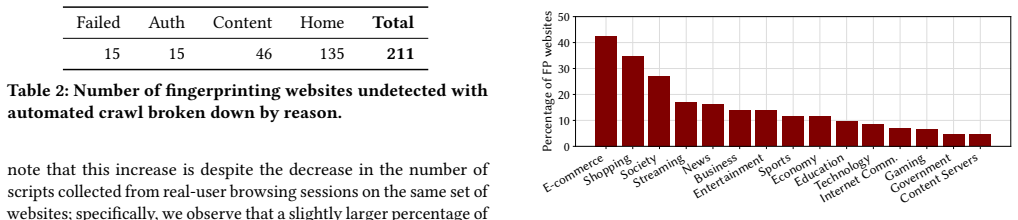
On the paper's own terms, the central claim is that automated crawls systematically miss fingerprinting code that real user interactions trigger. The authors instrumented human browsing sessions and an automated crawl of the same 14,895 URLs, applying the same conservative heuristic to both. Real sessions encountered 695 fingerprinting scripts on 471 websites; the crawl collected 498 scripts and failed to detect fingerprinting on 211 (45%) of those websites. The 211 misses comprise 15 pages the crawler could not load, 15 authentication pages, 46 content pages requiring in-page interaction, and 135 home pages where fingerprinting only fired after bot-detection or cookie-consent interactions. In addition, the real-user data contains JavaScript API calls, such as PDF-plugin enumeration and certain audio and WebRTC methods, that never appear in the crawl's fingerprinting scripts, which the paper treats as potential new fingerprinting vectors.
Load-bearing premise
The study assumes that 30 paid crowdworkers, told to visit a fixed list of sites, click at least ten links, accept cookie banners, and solve CAPTCHAs, behave enough like ordinary users that the scripts triggered in their sessions are the same ones ordinary browsing would trigger.
Editorial extensions
If this is right
- Prevalence estimates from crawl-based measurement are lower bounds, not point estimates; the 45% miss rate means existing numbers understate fingerprinting's reach.
- Detection models trained purely on crawled data inherit the crawler's blind spots; the paper's results show that fine-tuning on real-user telemetry, even under differential privacy, improves detection and cuts false positives roughly in half.
- Login walls, bot detection, and consent banners are not incidental crawl failures but structural filters that determine whether fingerprinting code is served, so crawl-based studies of tracking are biased toward pages with no such gates.
- New fingerprinting vectors, such as PDF-viewer plugin enumeration, are observable only when scripts run on real user devices, suggesting that crawl-only data hides both prevalence and technique.
Reading between the lines
- If the 45% gap holds across broader populations and browsers, then privacy tools built from crawl-derived blocklists will systematically under-protect users on exactly the login, content, and consent-gated pages where fingerprinting is most likely to be deployed.
- A natural follow-up experiment is to give crawlers credentials, automatic cookie acceptance, and scripted interaction; if the gap shrinks to near zero, most of the difference is automatable, and the residual is the portion that genuinely requires human behavior.
- The federated result suggests a concrete deployment path where browsers label executed scripts with the same heuristic and share only noisy model updates, never raw browsing traces, though scaling to millions of users would require addressing the extreme class imbalance in fingerprinting scripts.
Editorial analysis
A structured set of objections, weighed in public.
Referee Report
Summary. The paper reports a 10-week user study with 30 MTurk participants who installed a Chrome extension that collected script-execution telemetry while they visited 3,000 top-ranked websites (14,895 unique URLs). The authors compare fingerprinting prevalence in these real-user sessions with an automated Puppeteer crawl of the same URL list, reporting that 45% (211 of 471) of the fingerprinting websites detected in real-user sessions were missed by the crawl. They attribute the gap to authentication pages, bot-detection scripts, and cookie-consent gating, and they use the collected data to identify API-level signals (e.g., audio, WebRTC, PDF-viewer plugins) not found in crawl-only data. Finally, they evaluate FP-Fed, a differentially private federated learning system, fine-tuned on the real-user data, and report AUPRC 0.98 at ε=1 versus 0.96 for a centralized crawl-only model.
Significance. If the 45% finding holds up, it is an important challenge to the common methodology of using automated crawls for fingerprinting-prevalence measurement. The paper's strengths include a genuinely novel real-user telemetry dataset, a same-URL-list comparison that controls for URL discovery, the disclosure of the iframe instrumentation bug, public availability of the crawler code, and ethics approval. The federated-learning evaluation is a useful step toward privacy-preserving detection on real telemetry. However, the central claim needs additional analysis: the headline statistic is one-sided, the comparison is confounded by an asymmetric cookie-banner policy, and the directed-task nature of the study limits generalization to natural browsing. The FL result is also weaker than presented when the pre-training step and standard deviations are taken into account. These issues are fixable within the scope of the manuscript through additional analysis and more careful framing.
major comments (4)
- [Section 4.1 and the 'Chrome Extension Bug' paragraph in Section 4] The 45% figure is computed as the fraction of the 471 real-user-detected fingerprinting websites that the automated crawl missed, i.e., |RealUser-only| / |RealUser-detected|. Because the disclosed iframe bug ensures that some fingerprinting websites were detected only by the crawl, the denominator excludes a non-empty set of crawl-only websites. The paper does not report the size of that set, so the claim in the Conclusion that crawls 'heavily underestimated the prevalence of browser fingerprinting' is not established by the reported numbers. The authors should quantify the impact of the iframe bug and report the full union-based breakdown: websites (and scripts) detected by real users only, by the crawl only, and by both.
- [Section 4, 'Automated Crawl' vs Section 3.2 and Appendix A] The comparison is protocol-asymmetric: participants were instructed to accept cookie banners and solve CAPTCHAs, while the automated crawler was deliberately run without accepting cookie-consent banners. Section 4.2 itself reports that 4 of the 11 manually inspected home pages only start fingerprinting after user consent is received from a cookie banner. Therefore, the 45% gap conflates an inherent crawler limitation with a design choice: a crawler that accepted cookie banners would plausibly detect at least some of the 211 missed sites. The authors should run an additional crawl with cookie-banner acceptance (as in the prior work they cite, [36,53]) or otherwise bound the contribution of cookie-banner gating to the missed-website count.
- [Section 3.2 and Figure 1] The study uses directed task behavior, not natural browsing: participants were instructed to click at least 10 links per assigned website, accept cookie banners, and solve CAPTCHAs. The data in Figure 1 show an average of only 506 unique URLs per participant, far below the roughly 1,000 sub-pages expected if the 10-click instruction were followed on all 100 assigned sites. The paper does not discuss this non-compliance or the single-page-app confound, and it does not examine whether the 45% miss rate is driven by the most task-compliant participants. The abstract's phrasing 'real user interactions' is therefore too strong. The authors should report the distribution of sub-pages per site, analyze compliance, and test the sensitivity of the 45% figure to participant interaction depth.
- [Section 5.2 and Table 4] The abstract and conclusion describe the FL model as trained on real-user browsing sessions, but the evaluation actually pre-trains on the automated crawl and then fine-tunes on real-user data; the comparison is crawl+real-user versus crawl-only, not real-user versus crawl. Moreover, the reported differences (AUPRC 0.98±0.02 vs 0.96±0.03; false positives 3.4±2.6 vs 7.0±3.2) overlap within one standard deviation, so the claim that the real-user model 'outperforms' the crawl-only model at ε=1 is not supported by the reported statistics. The authors should provide confidence intervals or paired comparisons, and rephrase the contribution as 'fine-tuning on real-user telemetry improves over crawl-only training,' while acknowledging the pre-training step.
minor comments (4)
- [Section 3.5] There is a typo: 'w only collected pre-processed features' should read 'we only collected pre-processed features.'
- [Table 4 caption] The caption refers to 'Fed-FP', but the system is called FP-Fed throughout the paper; please fix the inconsistency.
- [Section 4.1 and Introduction] The abstract's phrasing 'automated crawls miss almost half (45%) of the fingerprinting websites encountered by real users' is a fair restatement of the conditional rate, but the Introduction's 'prevalence ... underestimated' overreaches given the missing union counts and the cookie-banner asymmetry; consider softer wording such as 'crawl-based studies may undercount such websites.'
- [Section 4.4] The navigator.plugins PDF-viewer signal is deprecated and has been documented as a fingerprinting vector; the claim that it is a 'potential new fingerprinting vector' should be tempered in light of that context, even though the paper does note the deprecation.
Circularity Check
No significant circularity; the central 45% claim is a direct empirical measurement, and the only self-citation is non-load-bearing.
full rationale
The paper's main claim, that automated crawls miss 45% of fingerprinting websites detected in real-user sessions, is a direct empirical comparison between two instrumented collectors over the same list of 14,895 URLs, using the same externally defined high-precision heuristic from Englehardt and Narayanan [29] and Iqbal et al. [33]. No parameter is fitted to produce the 45% figure, and no equation or definition reduces the comparison to its own input. The ML evaluation trains and tests models on labels generated by the same heuristic that operationally defines fingerprinting; this means the reported AUPRC measures how well the model reproduces that heuristic, but this is an acknowledged operationalization rather than a circular derivation, and the comparison between crawl-trained and real-user-fine-tuned models remains meaningful because both are evaluated on the same held-out real-user test set. The paper cites the authors' own prior system FP-Fed [8], but the central empirical claim does not depend on that citation; the study independently collects real-user telemetry and computes the miss rate from its own data. Protocol asymmetries, such as the automated crawler not accepting cookie banners and the disclosed iframe instrumentation bug, are validity concerns rather than circularity. Overall, the derivation chain is self-contained: the headline result is measured, not derived from a self-referential assumption.
Assumptions & free parameters
assumptions (4)
- domain assumption The Englehardt/Iqbal heuristic for Canvas, Canvas Font, WebRTC, and AudioContext fingerprinting is a low-false-positive ground truth.
- domain assumption The Chrome extension instrumentation captures the same API-call features as the reference instrumentation, apart from the disclosed iframe bug.
- domain assumption MTurk participants following the prescribed interaction protocol approximate real human browsing behavior well enough for prevalence comparison.
- domain assumption The Puppeteer-based crawler with the stealth plugin is a fair representative of automated crawlers used in prior fingerprinting research.
Cite this review
Pith. "Pith review of Beyond the Crawl: Unmasking Browser Fingerprinting in Real User Interactions." pith.science (2026). https://pith.science/paper/ESNISGXU
@misc{pith2026250201608,
  author       = {Pith},
  title        = {Pith review of: Beyond the Crawl: Unmasking Browser Fingerprinting in Real User Interactions},
  year         = {2026},
  howpublished = {\url{https://pith.science/paper/ESNISGXU}},
  note         = {Machine review of arXiv:2502.01608}
}
read the original abstract
Browser fingerprinting is a pervasive online tracking technique used increasingly often for profiling and targeted advertising. Prior research on the prevalence of fingerprinting heavily relied on automated web crawls, which inherently struggle to replicate the nuances of human-computer interactions. This raises concerns about the accuracy of current understandings of real-world fingerprinting deployments. As a result, this paper presents a user study involving 30 participants over 10 weeks, capturing telemetry data from real browsing sessions across 3,000 top-ranked websites. Our evaluation reveals that automated crawls miss almost half (45%) of the fingerprinting websites encountered by real users. This discrepancy mainly stems from the crawlers' inability to access authentication-protected pages, circumvent bot detection, and trigger fingerprinting scripts activated by specific user interactions. We also identify potential new fingerprinting vectors present in real user data but absent from automated crawls. Finally, we evaluate the effectiveness of federated learning for training browser fingerprinting detection models on real user data, yielding improved performance than models trained solely on automated crawl data.
Figures


Figures from the paper (1 more)

Reference graph
Works this paper leans on
-
[1]
Gunes Acar, Christian Eubank, Steven Englehardt, Marc Juarez, Arvind Narayanan, and Claudia Diaz. 2014. The Web Never Forgets: Persistent Tracking Mechanisms in the Wild. In ACM CCS
work page 2014
-
[2]
Gunes Acar, Marc Juarez, Nick Nikiforakis, Claudia Diaz, Seda Gürses, Frank Piessens, and Bart Preneel. 2013. FPDetective: Dusting the Web for Fingerprinters. In ACM CCS
work page 2013
-
[3]
Mohammed Adnan, Shivam Kalra, Jesse C Cresswell, Graham W Taylor, and Hamid R Tizhoosh. 2022. Federated learning and differential privacy for medical image analysis. Scientific reports 12, 1 (2022)
work page 2022
-
[4]
Seyed Ali Akhavani, Jordan Jueckstock, Junhua Su, Alexandros Kapravelos, Engin Kirda, and Long Lu. 2021. Browserprint: An Analysis of the Impact of Browser Features on Fingerprintability and Web Privacy. InInformation Security Confer- ence
work page 2021
-
[5]
Furkan Alaca and Paul C Van Oorschot. 2016. Device fingerprinting for aug- menting web authentication: classification and analysis of methods. In ACM CCS
work page 2016
-
[6]
Amazon. 2005. Amazon Mechanical Turk. https://www.mturk.com/
work page 2005
-
[7]
Amazon. 2022. We will be retiring Alexa.com on May 1, 2022. https://web.archive.org/web/20220102200605/https://support.alexa.com/hc/en- us/articles/4410503838999
arXiv 2022
-
[8]
Meenatchi Sundaram Muthu Selva Annamalai, Igor Bilogrevic, and Emiliano De Cristofaro. 2024. FP-Fed: Privacy-Preserving Federated Detection of Browser Fingerprinting. NDSS
work page 2024
Show all 65 references
-
[9]
Apple. 2023. Apple announces powerful new privacy and security features. https://www.apple.com/sg/newsroom/2023/06/apple-announces- powerful-new-privacy-and-security-features/
2023
-
[10]
Pouneh Nikkhah Bahrami, Umar Iqbal, and Zubair Shafiq. 2022. FP-Radar: Lon- gitudinal Measurement and Early Detection of Browser Fingerprinting. PETS (2022)
2022
-
[11]
Berstend. 2023. puppeteer-extra-plugin-stealth. https://github.com/berstend/ puppeteer-extra
2023
-
[12]
Hristo Bojinov, Yan Michalevsky, Gabi Nakibly, and Dan Boneh. 2014. Mobile Device Identification via Sensor Fingerprinting. arXiv:1408.1416 (2014)
2014 arXiv
-
[13]
Brave. 2024. Fingerprinting Protections. https://github.com/brave/brave-browser/ wiki/Fingerprinting-Protections
2024
-
[14]
Yinzhi Cao, Song Li, and Erik Wijmans. 2017. (Cross-)Browser Fingerprinting via OS and Hardware Level Features. In NDSS
2017
-
[15]
Chrome. 2024. Chrome User Experience Report. https://developer.chrome.com/ docs/crux/
2024
-
[16]
Cloudflare. 2024. Get Domain Details. https://developers.cloudflare.com/api/ operations/domain-intelligence-get-domain-details
2024
-
[17]
Low Pay Commission. 2024. National Minimum Wage in 2024. https://www.gov. uk/government/publications/the-national-minimum-wage-in-2024
2024
-
[18]
Luke Crouch. 2018. Improving privacy without breaking the web. https://blog. mozilla.org/data/2018/01/26/improving-privacy-without-breaking-the-web/
2018
-
[19]
Anupam Das, Gunes Acar, Nikita Borisov, and Amogh Pradeep. 2018. The Web’s Sixth Sense: A Study of Scripts Accessing Smartphone Sensors. In ACM CCS
2018
-
[20]
Soham De, Leonard Berrada, Jamie Hayes, Samuel L Smith, and Borja Balle. 2022. Unlocking High-Accuracy Differentially Private Image Classification through Scale. arXiv:2204.13650 (2022)
2022 arXiv
-
[21]
Djellel Difallah, Elena Filatova, and Panos Ipeirotis. 2018. Demographics and Dynamics of Mechanical Turk Workers. In ACM International Conference on Web Search and Data Mining
2018
-
[22]
Disconnect. 2018. Disconnect defends the digital you. https://disconnect.me
2018
-
[23]
MDN Web Docs. 2024. Navigator: plugins property. https://developer.mozilla. org/en-US/docs/Web/API/Navigator/plugins
2024
-
[24]
Cynthia Dwork and Aaron Roth. 2014. The Algorithmic Foundations of Differen- tial Privacy. Foundations and Trends in Theoretical Computer Science (2014)
2014
-
[25]
EasyList. 2024. EasyPrivacy. https://easylist.to/easylist/easyprivacy.txt
2024
-
[26]
Peter Eckersley. 2010. How Unique Is Your Web Browser?. In PETS
2010
-
[27]
EFF. 2023. PrivacyBadger. https://github.com/EFForg/privacybadgerfirefox/blob/ master/data/cookieblocklist.txt
2023
-
[28]
Steven Englehardt. 2020. Firefox 72 blocks third-party fingerprinting resources. https://blog.mozilla.org/security/2020/01/07/firefox-72-fingerprinting/
2020
-
[29]
Steven Englehardt and Arvind Narayanan. 2016. Online tracking: A 1-million-site Measurement and Analysis. In ACM CCS
2016
-
[30]
U Huws, S Dench, and Ron Iphofen. 2004. An EU code of ethics for socio-economic research. Institute for Employment Studies
2004
-
[31]
Muhammad Ikram, Hassan Jameel Asghar, Mohamed Ali Kaafar, Balachander Krishnamurthy, and Anirban Mahanti. 2017. Towards Seamless Tracking-Free Web: Improved Detection of Trackers via One-class Learning. PETS (2017)
2017
-
[32]
Iovation. 2019. Iovation Fraud Protection. https://web.archive.org/web/ 20191130164107/\https://www.iovation.com/fraudforce-fraud-detection- prevention
2019
-
[33]
Umar Iqbal, Steven Englehardt, and Zubair Shafiq. 2021. Fingerprinting the fingerprinters: Learning to detect browser fingerprinting behaviors. InIEEE S&P
2021
-
[34]
Peter Kairouz, Ziyu Liu, and Thomas Steinke. 2021. The Distributed Discrete Gaussian Mechanism for Federated Learning with Secure Aggregation. In ICML
2021
-
[35]
Pierre Laperdrix, Gildas Avoine, Benoit Baudry, and Nick Nikiforakis. 2019. Morel- lian analysis for browsers: Making web authentication stronger with canvas fin- gerprinting. In Detection of Intrusions and Malware, and Vulnerability Assessment
2019
-
[36]
Zengrui Liu, Jimmy Dani, Shujiang Wu, Yinzhi Cao, and Nitesh Saxena. 2024. Identified-and-Targeted: The First Early Evidence of the Privacy-Invasive Use of Browser Fingerprinting for Online Tracking. arXiv:2409.15656 (2024)
2024 arXiv
-
[37]
Ingrid Lunden. 2018. Relx acquires ThreatMetrix for $817M to ramp up in risk- based authentication. https://techcrunch.com/2018/01/29/relx-threatmetrix-risk- authentication-lexisnexis/?guccounter=1
2018
-
[38]
Any person... a pamphleteer
Jonathan R Mayer. 2009. “Any person... a pamphleteer”: Internet Anonymity in the Age of Web 2.0. Undergraduate Senior Thesis, Princeton University 85 (2009)
2009
-
[39]
H Brendan McMahan, Eider Moore, Daniel Ramage, and Blaise Agüera y Arcas. 2016. Federated learning of deep networks using model averaging. arXiv:1602.05629 (2016)
2016 arXiv
-
[40]
H Brendan McMahan, Daniel Ramage, Kunal Talwar, and Li Zhang. 2018. Learning Differentially Private Recurrent Language Models. In ICLR
2018
-
[41]
Luca Melis, Congzheng Song, Emiliano De Cristofaro, and Vitaly Shmatikov
-
[42]
Keaton Mowery and Hovav Shacham. 2012. Pixel perfect: Fingerprinting canvas in HTML5. W2SP (2012)
2012
-
[43]
Mozilla. 2023. WebRTC API. https://developer.mozilla.org/en-US/docs/Web/API/ WebRTC_API
2023
-
[44]
Mohammad Naseri, Yufei Han, Enrico Mariconti, Yun Shen, Gianluca Stringhini, and Emiliano De Cristofaro. 2022. Cerberus: Exploring Federated Prediction of Security Events. In ACM CCS
2022
-
[45]
Ray Ngan, Surya Konkimalla, and Zubair Shafiq. 2022. Nowhere to Hide: Detect- ing Obfuscated Fingerprinting Scripts. arXiv:2206.13599 (2022)
2022 arXiv
-
[46]
Department of Labor. 2024. State Minimum Wage Laws. https://www.dol.gov/ agencies/whd/minimum-wage/state
2024
-
[47]
Łukasz Olejnik, Gunes Acar, Claude Castelluccia, and Claudia Diaz. 2016. The leaking battery: A privacy analysis of the HTML5 Battery Status API. In DPM
2016
-
[48]
Emmanouil Papadogiannakis, Panagiotis Papadopoulos, Nicolas Kourtellis, and Evangelos P Markatos. 2021. User Tracking in the Post-cookie Era: How Websites 10 Bypass GDPR Consent to Track Users. In WWW
2021
-
[49]
Victor Le Pochat, Tom van Goethem, Samaneh Tajalizadehkhoob, Maciej Korczyn- ski, and Wouter Joosen. 2019. Tranco: A Research-Oriented Top Sites Ranking Hardened Against Manipulation. In NDSS
2019
-
[50]
Gaston Pugliese, Christian Riess, Freya Gassmann, and Zinaida Benenson. 2020. Long-Term Observation on Browser Fingerprinting: Users’ Trackability and Perspective. PETS (2020)
2020
-
[51]
Franziska Roesner, Tadayoshi Kohno, and David Wetherall. 2012. Detecting and Defending Against Third-Party Tracking on the Web. In USENIX
2012
-
[52]
Kimberly Ruth, Deepak Kumar, Brandon Wang, Luke Valenta, and Zakir Du- rumeric. 2022. Toppling Top Lists: Evaluating the Accuracy of Popular Website Lists. In ACM IMC
2022
-
[53]
Asuman Senol, Alisha Ukani, Dylan Cutler, and Igor Bilogrevic. 2024. The Double Edged Sword: Identifying Authentication Pages and their Fingerprinting Behavior. In ACM WWW
2024
-
[54]
Lichao Sun, Jianwei Qian, and Xun Chen. 2021. LDP-FL: Practical Private Aggre- gation in Federated Learning with Local Differential Privacy. In IJCAI
2021
-
[55]
Florian Tramer and Dan Boneh. 2021. Differentially Private Learning Needs Better Features (or Much More Data). In ICLR
2021
-
[56]
Stacey Truex, Ling Liu, Ka-Ho Chow, Mehmet Emre Gursoy, and Wenqi Wei. 2020. LDP-Fed: Federated learning with local differential privacy. In ACM International Workshop on Edge Systems, Analytics and Networking
2020
-
[57]
Task Completion Code
W3C. 2021. Mitigating Browser Fingerprinting in Web Specifications. https: //w3c.github.io/fingerprinting-guidance/. A HUMAN INTELLIGENCE TASK (HIT) In Figure 5, we display the Human Intelligence Task (HIT), i.e., the ad, used to recruit participants from the Amazon mTurk plat...
2021
-
[59]
I understand the direct/indirect benefits of participating. 8. I understand that the data will not be made available to any commercial organisations but is solely the responsibility of the researcher(s) undertaking this study
-
[60]
I understand that I will be compensated for the portion of time spent in the study (if applicable) or fully compensated if I choose to withdraw
-
[61]
I understand that the information I have submitted will be published as a research paper but it will not be possible to identify me in the paper
-
[62]
I hereby confirm that I understand the inclusion criteria as detailed in the Information Sheet. 12. I hereby confirm that: a. I understand the exclusion criteria as detailed in the Information Sheet; and b. I do not fall under the exclusion criteria
-
[63]
I am aware of who I should contact if I wish to lodge a complaint. 14. I am aware of the use of information for this project and beyond for research purposes. I would be happy for the data I provide to be archived at a UCL-owned server for 10 years from the publication of a paper
-
[64]
Chrome extension link: Password: Provide the task completion code here: e.g
I voluntarily agree to take part in this study. Chrome extension link: Password: Provide the task completion code here: e.g. 123456 You must ACCEPT the HIT before you can submit the results
-
[65]
I voluntarily agree to take part in this study. Chrome extension link: https://chromewebstore.google.com/detail/fingerprinting- api-tracke/fjlmpmjfdinledhcdkchdpabnhnhocdf (https://chromewebstore.google.com/detail/fingerprinting- api-tracke/fjlmpmjfdinledhcdkchdpabnhnhocdf) Pass...
-
[2019]
In IEEE S&P
Exploiting Unintended Feature Leakage in Collaborative Learning. In IEEE S&P
Reviewed August 9, 2026 · model on record in the stance chip above.
Discussion (0). Continue with ORCID to comment.