REVIEW 3 major objections 6 minor 67 references
Dynamic High-Order Control Barrier Functions with Diffuser for Safety-Critical Trajectory Planning at Signal-Free Intersections
T0 review · 3 major / 6 minor · reviewed 2026-08-12 · deepseek-v4-flash
Pith's one-line read A diffusion-based planner conditioned on task and goal, with a dynamic high-order control barrier function as a safety filter, claims collision-free trajectories for left, straight, and right maneuvers at signal-free intersections.
desk verdict A well-intentioned diffuser-plus-CBF integration, but the DHOCBF derivation misses a mixed Lie derivative term and the evaluation feeds the oracle goal, so the main claims don't hold as written. read the letter →
The pith
A machine-rendered reading of the paper's core claim, the machinery that carries it, and where it could break.
The reading
What carries the argument
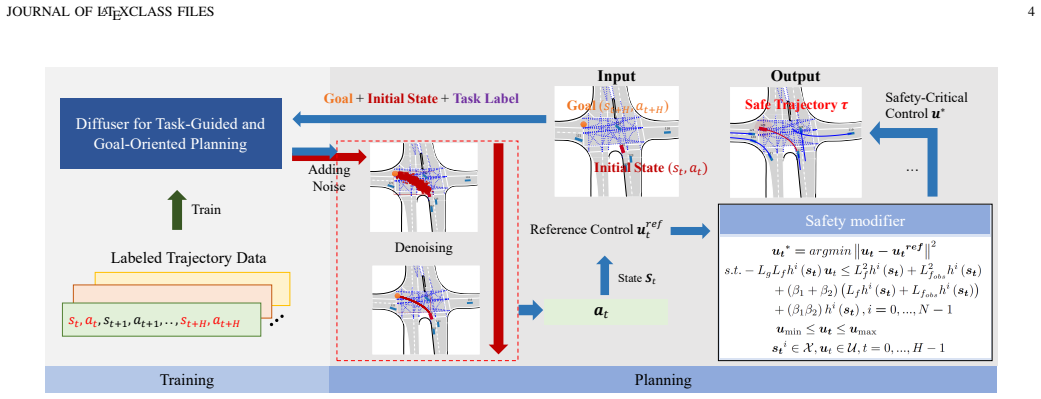
The load-bearing object is the Dynamic High-Order Control Barrier Function. The barrier function is $h(s_t, s_{\mathrm{obs}}(t)) = \|p_t - p_{\mathrm{obs}}(t)\|^2 - d_{\mathrm{safe}}(t)^2$, with a rectangle-based dynamic safe distance, and the second-order HOCBF constraint (Eq. 19) is expanded to include Lie derivatives $\mathcal{L}_{f_{\mathrm{obs}}} h$ and $\mathcal{L}^2_{f_{\mathrm{obs}}} h$ that encode the obstacle's velocity, so the safe set stays invariant when obstacles move. This constraint is enforced through a quadratic program that finds the control input closest to the diffuser's reference acceleration while satisfying the barrier condition and input limits. The other component is the goal-oriented, task-guided diffusion process: the denoiser is conditioned on the maneuver label via classifier-free guidance, and after each denoising step the final state-action pair of the sampled trajectory is overwritten with the given goal, which the paper reports as the main source of the low displacement errors.
What would settle it
Withhold the true final position from DSC-Diffuser at test time and measure ADE and FDE in the MA and GL scenes; if the errors rise toward the no-goal diffuser's values (ADE around 1), the $10^{-3}$-level precision is an artifact of the oracle goal rather than learned multi-task prediction. Separately, run the DHOCBF controller against an obstacle that brakes or accelerates after the planning step; if the distance to the obstacle ever drops below the safe threshold, the $u_{\mathrm{obs}}=0$ assumption does not deliver the claimed safety guarantee.
Extended reading notes
Core claim
The paper's central claim is that combining a goal-conditioned diffusion planner with a dynamic control barrier function yields human-like, collision-free trajectories for left, straight, and right maneuvers at signal-free intersections, in a way that transfers to an intersection the model has never seen. The key step beyond prior work is formulating the barrier condition so that the obstacle's own motion enters the derivative constraint: instead of treating the other vehicle as a fixed obstacle, DHOCBF uses the second-order condition with Lie derivatives with respect to both the ego state and the obstacle state, making the safe set $C=\{s : h(s,s_{\mathrm{obs}})\ge 0\}$ forward invariant as the obstacle moves. The reported experiments show that, compared with HOCBF, DHOCBF keeps a smaller distance to a moving obstacle while still avoiding collision, and that DSC-Diffuser achieves success rate 1 in the MA (trained) and GL (untrained) scenes with average displacement error around $10^{-3}$ meters. The authors frame the result as a unified framework that recovers multi-task policies from expert demonstrations and enforces safety as a hard constraint without sacrificing efficiency.
Load-bearing premise
The reported near-zero errors assume the planner is handed the true final position of each recorded expert trajectory as a goal, while the safety guarantee assumes surrounding vehicles keep their current motion and do not react to the ego vehicle.
Editorial extensions
If this is right
- A single diffusion policy can represent all three intersection maneuvers, so a vehicle does not need separate planners for left turns, straight-through, and right turns.
- DHOCBF works as a standalone safety filter that takes any reference control from any planner and minimally modifies it, which means the safety mechanism can be attached to planning methods other than the diffuser.
- Because goal conditioning keeps displacement errors low in an untrained intersection, deployment in a new map with known exit lanes is plausible without retraining.
- With the DHOCBF filter, the reported success rate is 1 in both the trained and the unseen scene, suggesting the integration does not trade away collision avoidance for trajectory accuracy.
Reading between the lines
- The near-zero displacement errors are largely a measure of endpoint reconstruction: because the true final position of each recorded trajectory is supplied as the goal, the metric says how well the model reproduces a known ending, not how well it predicts an unknown one; a fairer accuracy test would condition on a sampled or predicted goal, and errors would likely rise to the no-goal level.
- The safety guarantee rests on setting the obstacle's control input to zero, so DHOCBF is rigorous for obstacles that move predictably (constant velocity); for drivers who brake or swerve in response to the ego vehicle, a robust or game-theoretic extension would be needed, and the paper lists non-reactive surrounding vehicles as a limitation.
- A direct extension suggested by the method is to make the class-K gains $\beta_1,\beta_2$ adapt online to the ego speed or the obstacle's heading, which could further reduce conservatism without violating the invariance condition; the authors name dynamic parameter selection as future work.
- The goal-conditioned diffuser plus safety filter recipe should carry over to other structured maneuvers with known target lanes, such as roundabout entry or unprotected left turns at signalized intersections, where the exit position is also determined by the lane topology.
Signed reviews
Editorial analysis
A structured set of objections, weighed in public.
Referee Report
Summary. The paper proposes a safety-critical trajectory planning framework for signal-free intersections, combining a diffusion-model planner (DSC-Diffuser) with task labels and goal conditioning and a Dynamic High-Order Control Barrier Function (DHOCBF) safety filter. The planner is trained on Interaction dataset trajectories (left-turn, straight, right-turn) in the MA scene and tested in both the MA and GL scenes. The DHOCBF is intended to be a less-conservative extension of HOCBF for dynamic obstacles. The manuscript reports state-of-the-art ADE/FDE values around 1e-3 with SR=1, and includes ablation studies on guidance weight and noise.
Significance. The integration of diffusion-based trajectory generation with a hard safety filter is a timely direction, and the paper includes comparisons with several baselines and a cross-scene generalization test. However, the main technical contribution, DHOCBF, rests on an incomplete Lie-derivative derivation, and the reported near-zero displacement errors are inflated by conditioning on the ground-truth final position, which the paper itself acknowledges fixes FDE at zero. As a result, neither the safety guarantee nor the realism claims are supported as written. The paper does contain useful experimental comparisons and an ablation structure, but the core validation is not trustworthy in its current form.
major comments (3)
- [Section III.C, Eqs. (19)-(20)] The second-order HOCBF condition for h = ||s - s_obs||^2 - d_safe^2 is derived by taking only L_f^2 h and L_f_obs^2 h. The full derivative along the joint dynamics includes the mixed term 2 L_f L_f_obs h = -4 v·v_obs, so the exact L_F^2 h equals 2||v||^2 + 2||v_obs||^2 - 4 v·v_obs = 2||v - v_obs||^2. Omitting the cross term makes Eq. (19) a weaker constraint than Eq. (18) requires when the ego vehicle and the obstacle move in the same direction. Since Fig. 4 explicitly uses same-direction motion (v_obs = 1 and 3 m/s), the numerical safety shown there cannot be attributed to the DHOCBF forward-invariance guarantee. Additionally, the time derivative of the dynamic safe distance d_safe(t) is not accounted for; if d_safe(t) is state- or time-dependent, additional terms enter ẖ. The authors should either correct the derivation or explicitly state the assumptions under which the cross term and ḋ_safe vanish.
- [Section III.A and Section IV.C] The planning problem as formulated in Eq. (1) uses s_{t+H}, the final position from the expert trajectory, as a condition. Section IV.C states: "Since the positions of the last step as the goals are used in the DSC-diffuser, the FDE of the algorithm's output is fixed at zero." Consequently, the ADE values of 1.756E-03 (Table IV) and 0.1333 (Table V) are not comparable to those of baselines that lack this privileged oracle information. The claim of generating "realistic, stable, and generalizable policies" (abstract) is therefore not established by these metrics. The evaluation should either withhold ground-truth endpoints (for example, predict goals from the context) or report errors only on the portion of the trajectory not determined by the goal, and compare against baselines under identical conditioning.
- [Section V.A] The DHOCBF parameters beta1 and beta2 are described as "found by repeated experiments" and take different optimal values under different conditions, and the guidance weight w is tuned per scenario. The less-conservative comparison with HOCBF in Figs. 4, 5, and 7 is thus partly a consequence of this per-condition tuning; no procedure is given for selecting these parameters in a new scenario, and no sensitivity analysis is reported. This would be a presentation issue if Eq. (19) were correct, but combined with the derivation gap it means the reported advantage of DHOCBF is not currently supported by a valid safety filter.
minor comments (6)
- [Eq. (7)] The loss expression has an unclosed bracket in the second expectation term; the notation should be cleaned.
- [Section III.B and III.C] The symbol beta is overloaded: it denotes the conditional-information dropout probability in Eq. (7) and the HOCBF class K gains in Section III.C, which is confusing.
- [Section III.A, Eq. (3)] The symbol O_{t'} is used without definition; it presumably denotes an observation, but it should be explicitly defined.
- [Fig. 1 caption] The caption contains the phrase "Orange points is are the goals"; this is a typo.
- [Section III.C, Eq. (20)] L_f^2 h is written as 2 v_t^2, but with vector notation this should be 2||v_t||^2; the subscripts vo_xt and v_obs are also used inconsistently.
- [Abstract] The abstract contains the grammatical error "reduce the conservatism"; it should be "reduces conservatism".
Circularity Check
The headline DSC-Diffuser numbers are generated by feeding the expert trajectory's final state as a goal, hard-replacing the output endpoint with it, and then reporting the resulting zero/large-margin metrics as model performance.
-
self definitional
[Sec. III.B (Eqs. 1, 8) and Sec. IV.C (Metrics)]
"Since the positions of the last step as the goals are used in the DSC-diffuser, the FDE of the algorithm’s output is fixed at zero. Therefore, the displacement error of the penultimate step is used as the FDE for the DSC-diffuser."
Eq. 1 conditions generation on st+H, the ground-truth final state/action of the demonstration, and Eq. 8 hard-replaces the final sampled values with that goal. The FDE is therefore zero by construction, and the ADE (Table IV: 1.756E-03; Table V: 0.1333) measures inpainting between two ground-truth endpoints. Reporting this as 'precise trajectory execution' is a definitional loop: the target of the metric is one of the model's inputs.
-
self definitional
[Sec. V.B, Table IV and text]
"Introducing explicit goals further enhances performance dramatically, reducing ADE and FDE to exceptionally low values (1.756E-03 and 2.362E-03, respectively) while maintaining a success rate of 1."
The dramatic improvement is attributed to the model, but it is generated by the goal-conditioning mechanism: because the expert endpoint is supplied as input and the output endpoint is overwritten with it, the near-exact reproduction (and hence SR=1, since all processed expert trajectories are collision-free) is forced. The text presents this input-equivalent output as evidence of the model's 'performance', making the headline result reduce to its own evaluation label.
full rationale
The central evaluation of DSC-Diffuser is not an independent test of learned multi-task planning: the generative model receives the expert trajectory's final state and action as a goal, the final sampled values are replaced by that goal (Eq. 8), and the paper explicitly concedes that the FDE is fixed at zero. The near-zero ADE and perfect SR in both the trained MA and untrained GL scenes are therefore by-construction consequences of inputting the ground-truth endpoint, not evidence of realistic or generalizable prediction. The GL result is equally affected because the untrained scene's expert endpoints are supplied as goals. The DHOCBF component is independent of this loop, but its derivation is also incomplete as written: Eq. 19 omits the mixed second-order Lie derivative between ego and obstacle dynamics, so the safety guarantee is not established; this is a correctness defect rather than a circularity. The per-scenario tuning of beta1/beta2 by repeated experiments weakens the safety demonstration but is not a fitted-input-called-prediction. No load-bearing self-citation chain exists: refs [18], [19], [50] are external, and the self-citation [31] only defines SR. The score is 8 because the paper's flagship quantitative claims are forced by the goal-input definition, though the task-guided and non-goal ablations retain independent content.
Assumptions & free parameters
free parameters (3)
- beta1, beta2 (DHOCBF class K parameters) =
not specified, varies per condition
- d_safe(t) (dynamic safe distance) =
not specified, simplified in experiments
- guidance weight w =
8 (MA full model), 19 (GL no-goals), etc.
assumptions (4)
- standard math Nagumo's theorem connecting barrier function inequality to forward invariance of the safe set.
- domain assumption Obstacle accelerations are zero (u_obs = 0) and obstacle states are perfectly known at each time step.
- domain assumption Other vehicles do not respond to the ego vehicle's actions.
- ad hoc to paper The time derivative of d_safe(t) is neglected in the barrier function differentiation.
Cite this review
Pith. "Pith review of Dynamic High-Order Control Barrier Functions with Diffuser for Safety-Critical Trajectory Planning at Signal-Free Intersections." pith.science (2026). https://pith.science/paper/ESWX7WAY
@misc{pith2026241200162,
  author       = {Pith},
  title        = {Pith review of: Dynamic High-Order Control Barrier Functions with Diffuser for Safety-Critical Trajectory Planning at Signal-Free Intersections},
  year         = {2026},
  howpublished = {\url{https://pith.science/paper/ESWX7WAY}},
  note         = {Machine review of arXiv:2412.00162}
}
read the original abstract
Planning safe and efficient trajectories through signal-free intersections presents significant challenges for autonomous vehicles (AVs), particularly in dynamic, multi-task environments with unpredictable interactions and an increased possibility of conflicts. This study aims to address these challenges by developing a unified, robust, adaptive framework to ensure safety and efficiency across three distinct intersection movements: left-turn, right-turn, and straight-ahead. Existing methods often struggle to reliably ensure safety and effectively learn multi-task behaviors from demonstrations in such environments. This study proposes a safety-critical planning method that integrates Dynamic High-Order Control Barrier Functions (DHOCBF) with a diffusion-based model, called Dynamic Safety-Critical Diffuser (DSC-Diffuser). The DSC-Diffuser leverages task-guided planning to enhance efficiency, allowing the simultaneous learning of multiple driving tasks from real-world expert demonstrations. Moreover, the incorporation of goal-oriented constraints significantly reduces displacement errors, ensuring precise trajectory execution. To further ensure driving safety in dynamic environments, the proposed DHOCBF framework dynamically adjusts to account for the movements of surrounding vehicles, offering enhanced adaptability and reduce the conservatism compared to traditional control barrier functions. Validity evaluations of DHOCBF, conducted through numerical simulations, demonstrate its robustness in adapting to variations in obstacle velocities, sizes, uncertainties, and locations, effectively maintaining driving safety across a wide range of complex and uncertain scenarios. Comprehensive performance evaluations demonstrate that DSC-Diffuser generates realistic, stable, and generalizable policies, providing flexibility and reliable safety assurance in complex multi-task driving scenarios.
Figures


Figures from the paper (6 more)


Reference graph
Works this paper leans on
-
[17]
Zhuozhu Jian, Zihong Yan, Xuanang Lei, Zihong Lu, Bin Lan, Xueqian Wang, and Bin Liang. Dynamic control barrier function-based model predictive control to safety-critical obstacle-avoidance of mobile robot. In 2023 IEEE International Conference on Robotics and Automation (ICRA), pages 3679–3685, 2023
work page 2023
-
[18]
High-order control barrier functions
Wei Xiao and Calin Belta. High-order control barrier functions. IEEE Transactions on Automatic Control , 67(7):3655–3662, 2022
2022
-
[1]
Evaluation of intersection conflict warning system at unsignalized intersections: A review
Yashasvi Rachakonda and Digvijay S Pawar. Evaluation of intersection conflict warning system at unsignalized intersections: A review. Journal of traffic and transportation engineering (English edition) , 10(4):530– 547, 2023
work page 2023
-
[2]
Unsignalized Intersection Crashes
National Highway Traffic Safety Administration (NHTSA). Unsignalized Intersection Crashes. https://highways.dot.gov/safety/ intersection-safety/about, 2024
work page 2024
-
[3]
Xiangchen Cheng, Wei Tang, Ming Yang, and Li Jin. Vehicle sequencing at signal-free intersections: Analytical performance guarantees based on pdmp formulation. IEEE Transactions on Control Systems Technology , 32(6):2023–2036, 2024
work page 2023
-
[4]
Yair Wiseman. Autonomous vehicles. In Research anthology on cross- disciplinary designs and applications of automation, pages 878–889. IGI Global Scientific Publishing, 2022
work page 2022
-
[5]
Behavior planning at urban intersections through hierarchical reinforcement learning
Zhiqian Qiao, Jeff Schneider, and John M Dolan. Behavior planning at urban intersections through hierarchical reinforcement learning. In 2021 IEEE International Conference on Robotics and Automation (ICRA) , pages 2667–2673. IEEE, 2021
work page 2021
-
[6]
Xuemei Chen, Jia Wu, Jiachen Hao, and Yixuan Yang. Research on vertical strategy for left turn at signal-free t-shaped intersections based on multi-layer reinforcement learning methods. Green Energy and Intelligent Transportation, page 100261, 2025
work page 2025
Show all 67 references
-
[7]
Driving tasks transfer using deep reinforcement learning for decision-making of au- tonomous vehicles in unsignalized intersection
Hong Shu, Teng Liu, Xingyu Mu, and Dongpu Cao. Driving tasks transfer using deep reinforcement learning for decision-making of au- tonomous vehicles in unsignalized intersection. IEEE Transactions on Vehicular Technology, 71(1):41–52, 2022
2022
-
[8]
Dolan, Praveen Palanisamy, and Priyantha Mudalige
Zhiqian Qiao, Katharina Muelling, John M. Dolan, Praveen Palanisamy, and Priyantha Mudalige. Automatically generated curriculum based reinforcement learning for autonomous vehicles in urban environment. In 2018 IEEE Intelligent Vehicles Symposium (IV) , pages 1233–1238, 2018
2018
-
[9]
Shivesh Khaitan and John M. Dolan. State dropout-based curriculum reinforcement learning for self-driving at unsignalized intersections. In 2022 IEEE/RSJ International Conference on Intelligent Robots and Systems (IROS), pages 12219–12224, 2022
2022
-
[10]
Learning to drive at unsignalized intersections using attention- based deep reinforcement learning
Hyunki Seong, Chanyoung Jung, Seungwook Lee, and David Hyunchul Shim. Learning to drive at unsignalized intersections using attention- based deep reinforcement learning. In 2021 IEEE International Intelli- gent Transportation Systems Conference (ITSC) , pages 559–566, 2021
2021
-
[11]
Signal-free path-free intersection control for connected vehicles under automated driving
Elham Ahmadi, Alireza Olama, Rodrigo Castelan Carlson, and Eduardo Camponogara. Signal-free path-free intersection control for connected vehicles under automated driving. IEEE Transactions on Intelligent Vehicles, 2024
2024
-
[12]
Spatiotemporal-restricted a algorithm as a support for lane-free traffic at intersections with mixed flows
Haifei Chi, Pinlong Cai, Daocheng Fu, Junda Zhai, Yadan Zeng, and Botian Shi. Spatiotemporal-restricted a algorithm as a support for lane-free traffic at intersections with mixed flows. Green Energy and Intelligent Transportation, 3(2):100159, 2024
2024
-
[13]
Imitation is not enough: Robustifying imitation with reinforcement learning for chal- lenging driving scenarios
Yiren Lu, Justin Fu, George Tucker, Xinlei Pan, Eli Bronstein, Rebecca Roelofs, Benjamin Sapp, Brandyn White, Aleksandra Faust, Shimon Whiteson, Dragomir Anguelov, and Sergey Levine. Imitation is not enough: Robustifying imitation with reinforcement learning for chal- lenging ...
2023
-
[14]
Autonomous driving at unsignalized intersections: A review of decision-making challenges and reinforcement learning-based solutions
Mohammad Al-Sharman, Luc Edes, Bert Sun, Vishal Jayakumar, Mo- hamed A Daoud, Derek Rayside, and William Melek. Autonomous driving at unsignalized intersections: A review of decision-making challenges and reinforcement learning-based solutions. arXiv preprint arXiv:2409.13144, 2024
2024 arXiv
-
[15]
Diffusion policy: Visuomotor policy learning via action diffusion
Cheng Chi, Zhenjia Xu, Siyuan Feng, Eric Cousineau, Yilun Du, Benjamin Burchfiel, Russ Tedrake, and Shuran Song. Diffusion policy: Visuomotor policy learning via action diffusion. The International Journal of Robotics Research , page 02783649241273668, 2023
2023
-
[16]
Robust control barrier functions for constrained stabilization of nonlinear systems
Mrdjan Jankovic. Robust control barrier functions for constrained stabilization of nonlinear systems. Automatica, 96:359–367, 2018
2018
-
[19]
INTER- ACTION Dataset: An INTERnational, Adversarial and Cooperative moTION Dataset in Interactive Driving Scenarios with Semantic Maps
Wei Zhan, Liting Sun, Di Wang, Haojie Shi, Aubrey Clausse, Max- imilian Naumann, Julius K ¨ummerle, Hendrik K ¨onigshof, Christoph Stiller, Arnaud de La Fortelle, and Masayoshi Tomizuka. INTER- ACTION Dataset: An INTERnational, Adversarial and Cooperative moTION Dataset in Int...
1910 arXiv
-
[20]
Optimal control of automated vehicles crossing a lane-free signal-free intersec- tion
Mehdi Naderi, Panagiotis Typaldos, and Markos Papageorgiou. Optimal control of automated vehicles crossing a lane-free signal-free intersec- tion. In 2024 European Control Conference (ECC) , pages 1415–1422, 2024
2024
-
[21]
Collision-free cooperative motion planning and decision-making for connected and automated vehicles at unsignalized intersections
Xinle Gong, Bowen Wang, and Sheng Liang. Collision-free cooperative motion planning and decision-making for connected and automated vehicles at unsignalized intersections. IEEE Transactions on Systems, Man, and Cybernetics: Systems , 54(5):2744–2756, 2024
2024
-
[22]
Optimal coordination of automated vehicles at intersections: Theory and experi- ments
Robert Hult, Mario Zanon, Sebastien Gros, and Paolo Falcone. Optimal coordination of automated vehicles at intersections: Theory and experi- ments. IEEE Transactions on Control Systems Technology, 27(6):2510– 2525, 2018
2018
-
[23]
Distributed conflict-free cooperation for multiple connected vehicles at unsignalized intersections
Biao Xu, Shengbo Eben Li, Yougang Bian, Shen Li, Xuegang Jeff Ban, Jianqiang Wang, and Keqiang Li. Distributed conflict-free cooperation for multiple connected vehicles at unsignalized intersections. Trans- portation Research Part C: Emerging Technologies , 93:322–334, 2018
2018
-
[24]
Coordination for connected and autonomous vehicles at unsignalized intersections: An iterative learning-based collision-free motion planning method
Bowen Wang, Xinle Gong, Yafei Wang, Peiyuan Lyu, and Sheng Liang. Coordination for connected and autonomous vehicles at unsignalized intersections: An iterative learning-based collision-free motion planning method. IEEE Internet of Things Journal , 11(3):5439–5454, 2024
2024
-
[25]
Decision-making models on perceptual uncertainty with distributional reinforcement learning
Shuyuan Xu, Qiao Liu, Yuhui Hu, Mengtian Xu, and Jiachen Hao. Decision-making models on perceptual uncertainty with distributional reinforcement learning. Green Energy and Intelligent Transportation , 2(2):100062, 2023
2023
-
[26]
Towards autonomous navigation of unsignalized intersections under uncertainty of human driver intent
V olkan Sezer, Tirthankar Bandyopadhyay, Daniela Rus, Emilio Frazzoli, and David Hsu. Towards autonomous navigation of unsignalized intersections under uncertainty of human driver intent. In2015 IEEE/RSJ International Conference on Intelligent Robots and Systems (IROS) , pages...
2015
-
[27]
Pomdp and hierarchical options mdp with continuous actions for autonomous driving at intersections
Zhiqian Qiao, Katharina Muelling, John Dolan, Praveen Palanisamy, and Priyantha Mudalige. Pomdp and hierarchical options mdp with continuous actions for autonomous driving at intersections. In 2018 21st International Conference on Intelligent Transportation Systems (ITSC) , pa...
2018
-
[28]
Learn- ing when to drive in intersections by combining reinforcement learning and model predictive control
Tommy Tram, Ivo Batkovic, Mohammad Ali, and Jonas Sj ¨oberg. Learn- ing when to drive in intersections by combining reinforcement learning and model predictive control. In 2019 IEEE Intelligent Transportation Systems Conference (ITSC) , pages 3263–3268. IEEE, 2019
2019
-
[29]
Predictive trajectory planning for autonomous vehicles at intersections using reinforcement learning
Ethan Zhang, Ruixuan Zhang, and Neda Masoud. Predictive trajectory planning for autonomous vehicles at intersections using reinforcement learning. Transportation Research Part C: Emerging Technologies , 149:104063, 2023
2023
-
[30]
Self-learned au- tonomous driving at unsignalized intersections: A hierarchical reinforced learning approach for feasible decision-making
Mohammad Al-Sharman, Rowan Dempster, Mohamed A Daoud, Mah- moud Nasr, Derek Rayside, and William Melek. Self-learned au- tonomous driving at unsignalized intersections: A hierarchical reinforced learning approach for feasible decision-making. IEEE Transactions on Intelligent T...
2023
-
[31]
Data-driven traffic simulation: A comprehensive review
Di Chen, Meixin Zhu, Hao Yang, Xuesong Wang, and Yinhai Wang. Data-driven traffic simulation: A comprehensive review. IEEE Transac- tions on Intelligent Vehicles , 9(4):4730–4748, 2024
2024
-
[32]
Eraqi, Mohamed N
Hesham M. Eraqi, Mohamed N. Moustafa, and Jens Honer. Dynamic conditional imitation learning for autonomous driving. IEEE Transac- tions on Intelligent Transportation Systems , 23(12):22988–23001, 2022
2022
-
[33]
Hierarchical model-based imitation learning for planning in autonomous driving
Eli Bronstein, Mark Palatucci, Dominik Notz, Brandyn White, Alex Kuefler, Yiren Lu, Supratik Paul, Payam Nikdel, Paul Mougin, Hongge Chen, Justin Fu, Austin Abrams, Punit Shah, Evan Racah, Benjamin Frenkel, Shimon Whiteson, and Dragomir Anguelov. Hierarchical model-based imita...
2022
-
[34]
Interpretable motion planner for urban driving via hierarchical imitation learning
Bikun Wang, Zhipeng Wang, Chenhao Zhu, Zhiqiang Zhang, Zhichen Wang, Penghong Lin, Jingchu Liu, and Qian Zhang. Interpretable motion planner for urban driving via hierarchical imitation learning. In 2023 IEEE/RSJ International Conference on Intelligent Robots and Systems (IROS...
2023
-
[35]
Cleandiffuser: An easy-to-use modularized library for diffusion models in decision making
Zibin Dong, Yifu Yuan, Jianye Hao, Fei Ni, Yi Ma, Pengyi Li, and Yan Zheng. Cleandiffuser: An easy-to-use modularized library for diffusion models in decision making. arXiv preprint arXiv:2406.09509 , 2024
2024 arXiv
-
[36]
Diffusion-es: Gradient- free planning with diffusion for autonomous driving and zero-shot instruction following
Brian Yang, Huangyuan Su, Nikolaos Gkanatsios, Tsung-Wei Ke, Ayush Jain, Jeff Schneider, and Katerina Fragkiadaki. Diffusion-es: Gradient- free planning with diffusion for autonomous driving and zero-shot instruction following. arXiv preprint arXiv:2402.06559 , 2024
2024 arXiv
-
[37]
Diffusion model is an effective planner and data synthesizer for multi-task reinforcement learning
Haoran He, Chenjia Bai, Kang Xu, Zhuoran Yang, Weinan Zhang, Dong Wang, Bin Zhao, and Xuelong Li. Diffusion model is an effective planner and data synthesizer for multi-task reinforcement learning. Advances in neural information processing systems , 36:64896–64917, 2023
2023
-
[38]
Intention-aware denoising diffusion model for trajectory prediction
Chen Liu, Shibo He, Haoyu Liu, and Jiming Chen. Intention-aware denoising diffusion model for trajectory prediction. arXiv preprint arXiv:2403.09190, 2024
2024 arXiv
-
[39]
Future-focused control barrier functions for autonomous vehicle control
Mitchell Black, Mrdjan Jankovic, Abhishek Sharma, and Dimitra Panagou. Future-focused control barrier functions for autonomous vehicle control. In 2023 American Control Conference (ACC) , pages 3324–3331, 2023
2023
-
[40]
Safety-critical control with nonaffine control inputs via a relaxed control barrier function for an autonomous vehicle
Joohwan Seo, Joonho Lee, Eunkyu Baek, Roberto Horowitz, and Jongeun Choi. Safety-critical control with nonaffine control inputs via a relaxed control barrier function for an autonomous vehicle. IEEE Robotics and Automation Letters , 7(2):1944–1951, 2022
1944
-
[41]
Yiwei Lyu, Wenhao Luo, and John M. Dolan. Adaptive safe merging control for heterogeneous autonomous vehicles using parametric control barrier functions. In 2022 IEEE Intelligent Vehicles Symposium (IV) , pages 542–547, 2022
2022
-
[42]
Cgd: Constraint- guided diffusion policies for uav trajectory planning
Kota Kondo, Andrea Tagliabue, Xiaoyi Cai, Claudius Tewari, Olivia Garcia, Marcos Espitia-Alvarez, and Jonathan P How. Cgd: Constraint- guided diffusion policies for uav trajectory planning. arXiv preprint arXiv:2405.01758, 2024
2024 arXiv
-
[43]
Safedif- fuser: Safe planning with diffusion probabilistic models
Wei Xiao, Tsun-Hsuan Wang, Chuang Gan, and Daniela Rus. Safedif- fuser: Safe planning with diffusion probabilistic models. arXiv preprint arXiv:2306.00148, 2023
2023 arXiv
-
[44]
Refining diffusion plan- ner for reliable behavior synthesis by automatic detection of infeasible plans
Kyowoon Lee, Seongun Kim, and Jaesik Choi. Refining diffusion plan- ner for reliable behavior synthesis by automatic detection of infeasible plans. Advances in Neural Information Processing Systems , 36, 2024
2024
-
[45]
Safe reinforcement learning for autonomous driving by using disturbance-observer-based control barrier functions
Zhengyu Hou, Wenjun Liu, and Alois Knoll. Safe reinforcement learning for autonomous driving by using disturbance-observer-based control barrier functions. IEEE Transactions on Intelligent Vehicles, pages 1–10, 2024
2024
-
[46]
Enhancing system-level safety in mixed-autonomy platoon via safe reinforcement learning
Jingyuan Zhou, Longhao Yan, and Kaidi Yang. Enhancing system-level safety in mixed-autonomy platoon via safe reinforcement learning. IEEE Transactions on Intelligent Vehicles, 2024
2024
-
[47]
A low cost sensors approach for accurate vehicle localization and autonomous driving application
Rafael Vivacqua, Raquel Vassallo, and Felipe Martins. A low cost sensors approach for accurate vehicle localization and autonomous driving application. Sensors, 17(10):2359, 2017
2017
-
[48]
Denoising diffusion prob- abilistic models
Jonathan Ho, Ajay Jain, and Pieter Abbeel. Denoising diffusion prob- abilistic models. Advances in neural information processing systems , 33:6840–6851, 2020
2020
-
[49]
Classifier-free diffusion guidance
Jonathan Ho and Tim Salimans. Classifier-free diffusion guidance. arXiv preprint arXiv:2207.12598, 2022
2022 arXiv
-
[50]
Planning with diffusion for flexible behavior synthesis
Michael Janner, Yilun Du, Joshua B Tenenbaum, and Sergey Levine. Planning with diffusion for flexible behavior synthesis. arXiv preprint arXiv:2205.09991, 2022
2022 arXiv
-
[51]
Control barrier function based quadratic programs with application to adaptive cruise control
Aaron D Ames, Jessy W Grizzle, and Paulo Tabuada. Control barrier function based quadratic programs with application to adaptive cruise control. In 53rd IEEE conference on decision and control , pages 6271–
-
[52]
Safety-critical control and planning for obstacle avoidance between polytopes with control barrier functions
Akshay Thirugnanam, Jun Zeng, and Koushil Sreenath. Safety-critical control and planning for obstacle avoidance between polytopes with control barrier functions. In 2022 International Conference on Robotics and Automation (ICRA) , pages 286–292. IEEE, 2022. JOURNAL OF LATEXCLA...
2022
-
[53]
Control barrier functions for systems with high relative degree
Wei Xiao and Calin Belta. Control barrier functions for systems with high relative degree. In 2019 IEEE 58th conference on decision and control (CDC), pages 474–479. IEEE, 2019
2019
-
[54]
Shail: Safety-aware hierarchical adversarial imitation learning for autonomous driving in urban environments
Arec Jamgochian, Etienne Buehrle, Johannes Fischer, and Mykel J Kochenderfer. Shail: Safety-aware hierarchical adversarial imitation learning for autonomous driving in urban environments. In 2023 IEEE International Conference on Robotics and Automation (ICRA) , pages 1530–1536...
2023
-
[55]
Limitations and improvements of the intelligent driver model (idm)
Saleh Albeaik, Alexandre Bayen, Maria Teresa Chiri, Xiaoqian Gong, Amaury Hayat, Nicolas Kardous, Alexander Keimer, Sean T McQuade, Benedetto Piccoli, and Yiling You. Limitations and improvements of the intelligent driver model (idm). SIAM Journal on Applied Dynamical Systems,...
2022
-
[56]
Behavioral cloning from observation
Faraz Torabi, Garrett Warnell, and Peter Stone. Behavioral cloning from observation. arXiv preprint arXiv:1805.01954 , 2018
2018 arXiv
-
[57]
Generative adversarial imitation learning
Jonathan Ho and Stefano Ermon. Generative adversarial imitation learning. Advances in neural information processing systems , 29, 2016
2016
-
[58]
Gameformer: Game-theoretic modeling and learning of transformer-based interactive prediction and planning for autonomous driving
Zhiyu Huang, Haochen Liu, and Chen Lv. Gameformer: Game-theoretic modeling and learning of transformer-based interactive prediction and planning for autonomous driving. In Proceedings of the IEEE/CVF International Conference on Computer Vision , pages 3903–3913, 2023
2023
-
[59]
Differentiable integrated motion prediction and planning with learnable cost function for autonomous driving
Zhiyu Huang, Haochen Liu, Jingda Wu, and Chen Lv. Differentiable integrated motion prediction and planning with learnable cost function for autonomous driving. IEEE Transactions on Neural Networks and Learning Systems, 35(11):15222–15236, 2024
2024
-
[60]
Congested traffic states in empirical observations and microscopic simulations
Martin Treiber, Ansgar Hennecke, and Dirk Helbing. Congested traffic states in empirical observations and microscopic simulations. Physical review E, 62(2):1805, 2000
2000
-
[61]
Contingencies from observations: Tractable contingency planning with learned behavior models
Nicholas Rhinehart, Jeff He, Charles Packer, Matthew A Wright, Rowan McAllister, Joseph E Gonzalez, and Sergey Levine. Contingencies from observations: Tractable contingency planning with learned behavior models. In 2021 IEEE International Conference on Robotics and Automation...
2021
-
[62]
Feature-aware adaptation and density alignment for crowd counting in video surveillance
Junyu Gao, Yuan Yuan, and Qi Wang. Feature-aware adaptation and density alignment for crowd counting in video surveillance. IEEE transactions on cybernetics , 51(10):4822–4833, 2020
2020
-
[63]
An end-to- end contrastive license plate detector
Haoxuan Ding, Junyu Gao, Yuan Yuan, and Qi Wang. An end-to- end contrastive license plate detector. IEEE Transactions on Intelligent Transportation Systems, 25(1):503–516, 2023
2023
-
[64]
A consensus-based distributed trajectory control in a signal-free intersec- tion
Amir Mirheli, Mehrdad Tajalli, Leila Hajibabai, and Ali Hajbabaie. A consensus-based distributed trajectory control in a signal-free intersec- tion. Transportation research part C: emerging technologies , 100:161– 176, 2019
2019
-
[65]
Coordination for connected and autonomous vehicles at unsignalized intersections: An iterative learning-based collision-free motion planning method
Bowen Wang, Xinle Gong, Yafei Wang, Peiyuan Lyu, and Sheng Liang. Coordination for connected and autonomous vehicles at unsignalized intersections: An iterative learning-based collision-free motion planning method. IEEE Internet of Things Journal , 11(3):5439–5454, 2023
2023
-
[66]
Collision-free cooperative motion planning and decision-making for connected and automated vehicles at unsignalized intersections
Xinle Gong, Bowen Wang, and Sheng Liang. Collision-free cooperative motion planning and decision-making for connected and automated vehicles at unsignalized intersections. IEEE Transactions on Systems, Man, and Cybernetics: Systems , 54(5):2744–2756, 2024. Di Chen received the...
2024
-
[2023]
His research interests mainly include reinforcement learning and intelligent con- trol
Currently, he is a research assistant at the Hong Kong University of Science and Technology (Guangzhou), China. His research interests mainly include reinforcement learning and intelligent con- trol. Meixin Zhu is a tenure-track Assistant Professor in the Thrust of Intelligent...
2022
Reviewed August 12, 2026 · model on record in the stance chip above.
Discussion (0). Continue with ORCID to comment.