REVIEW 4 major objections 5 minor 14 references
CrafText Benchmark: Advancing Instruction Following in Complex Multimodal Open-Ended World
T0 review · 4 major / 5 minor · reviewed 2026-08-15 · deepseek-v4-flash
Pith's one-line read CrafText is a benchmark that measures whether agents can follow natural-language instructions in a dynamic, changing world, with 3,924 instructions and a dual evaluation protocol for generalization.
desk verdict CrafText ships a usable dynamic instruction-following benchmark with a genuinely new evaluation split, but unvalidated checkers and dataset inconsistencies mean the reported numbers are calibration, not proof. read the letter →
The pith
A machine-rendered reading of the paper's core claim, the machinery that carries it, and where it could break.
The reading
What carries the argument
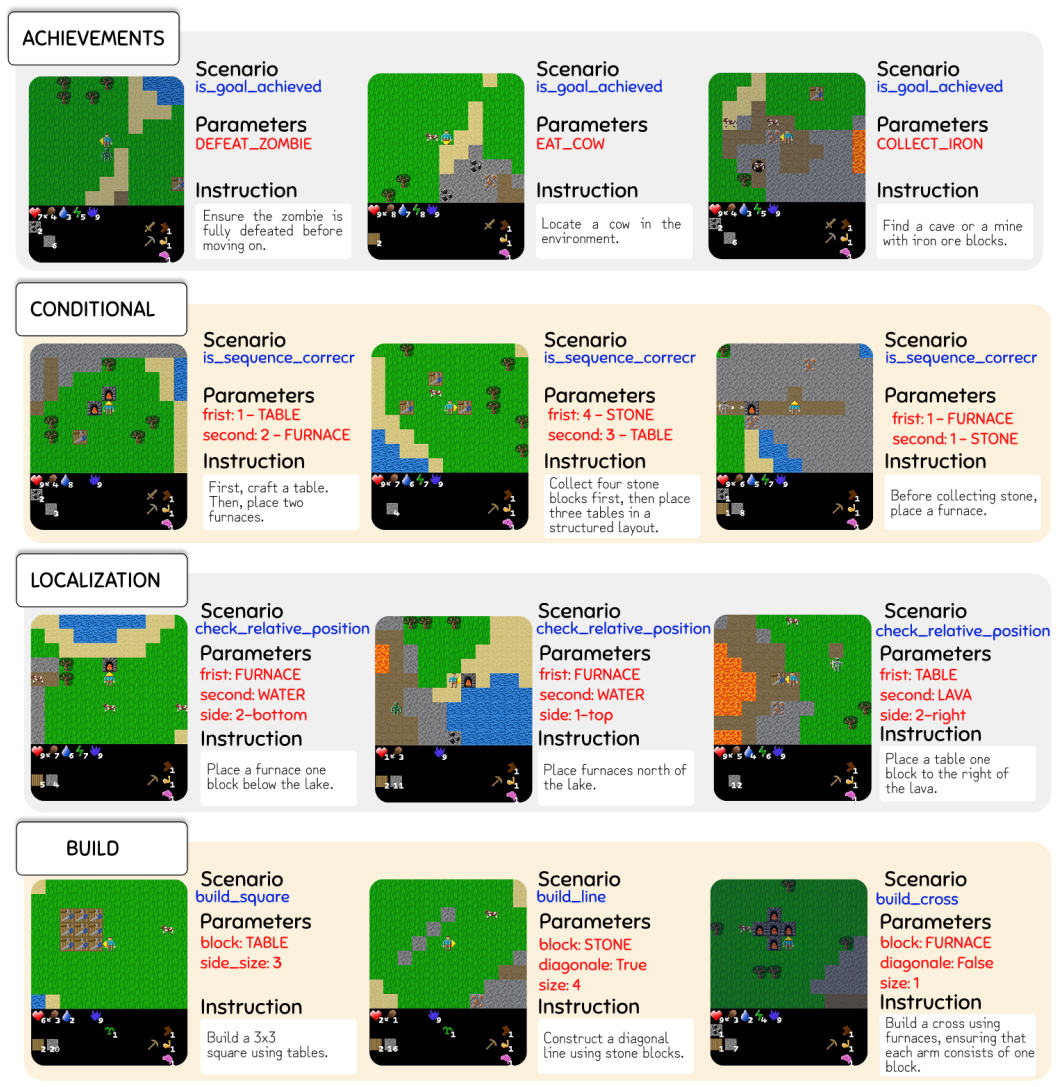
The load-bearing mechanism is the scenario checker: a hand-written function, parameterized by goal-specific arguments such as block type, shape, position, and ordering, that encodes the semantics of an instruction class and verifies completion from the world state at every timestep. Each of the twelve scenario templates (build, localization, conditional, achievement, and combinations) becomes many goals by enumerating parameters; GPT-4 only generates surface language and the call syntax for the checker, never the task logic. The checker doubles as the episode-termination condition and the reward signal, so the entire evaluation reduces to whether these functions faithfully capture what the instructions mean. The Craftax base supplies the dynamic world, with stochastic transitions, autonomous entities, and open-ended crafting, making the checker the fixed point the agent must satisfy under changing conditions.
What would settle it
Take a random sample of episodes across all four task categories, record the agent's trajectory, and have independent human annotators decide from the instruction text alone whether the agent satisfied the goal; compare their verdicts to the checker functions' verdicts. Substantial disagreement, such as checkers accepting clearly wrong constructions or rejecting clearly satisfied orders, would falsify the claim that success rate measures instruction following.
Extended reading notes
Core claim
The paper's central claim is that CrafText can evaluate instruction following under conditions that combine linguistic diversity with environmental dynamics, something existing benchmarks keep separate. The discovery, on the paper's own terms, is the measurement protocol: each of 496 goals (203 held out) is generated from twelve reusable scenario templates, phrased by GPT-4 into roughly six natural-language variants, and verified by scenario checker functions that run every timestep inside the JAX-accelerated Craftax environment. The benchmark shows that a planning-augmented PPO variant (PPO-T+) reaches a 0.45 training success rate and 0.28 on novel object combinations, while the world-model method Dynalang, strong in simpler grounded-language settings, falls to 0.15 training and 0.10 on new objects. The authors use these results to argue that preprocessing instructions into structured plans helps agents decompose novel goals, and that the benchmark exposes a gap between static-environment competence and dynamic instruction following.
Load-bearing premise
The load-bearing premise is that the hand-written scenario checker functions correctly and completely encode the meaning of every GPT-4-generated instruction; if any checker is too strict, too loose, or mismatched to what the words actually ask, the reported success rates stop measuring instruction following.
Editorial extensions
If this is right
- Researchers can now measure linguistic sensitivity separately from environmental sensitivity: the Paraphrased split isolates wording effects, while the New Objects split isolates recombination of familiar skills.
- Planning-based preprocessing (PPO-T+) outperforms direct embedding (PPO-T and FiLM) on unseen object combinations, suggesting that converting instructions into explicit subgoal plans is a promising direction for instruction following in dynamic worlds.
- A strong world-model agent such as Dynalang can score near zero in this benchmark even after substantial training, meaning static-environment competence does not automatically transfer to dynamic instruction following.
- Because the checker runs per timestep and is parameterized, new tasks can be added by writing one template and enumerating parameters, so the benchmark can grow beyond its initial 496 goals without recollecting data.
Reading between the lines
- If the checkers are sound, the benchmark's hardest findings are not the headline numbers but the failure gradient by object: tasks involving water, iron, coal, and plants approach zero success, which points to perception and inventory-state bottlenecks rather than language understanding as the next limiting factor.
- The paper's stated limitation that all instructions are generated by GPT-4 without human input means the linguistic range is bounded by that model's writing style; replacing a subset with human paraphrases would test whether the reported rankings survive more natural phrasing.
- Because the dataset exposes the function-call format for each instruction, one can turn CrafText into a closed-loop test for LLM planners by using the checker as a verifier, effectively making it an environment for evaluating agentic planning rather than only end-to-end RL.
Signed reviews
Editorial analysis
A structured set of objections, weighed in public.
Referee Report
Summary. CrafText is a benchmark paper that extends the Craftax environment with a dataset of 3,924 natural-language instructions, 12 scenario checkers, and four task categories (Localization, Conditional, Building, and Achievement). The authors propose a dual evaluation protocol: a Paraphrased test set for linguistic generalization and a New Objects test set for generalization to novel combinations of familiar objects. They implement the benchmark in JAX with XLA acceleration and report baseline results for PPO-T, PPO-T+, FiLM, and Dynalang, finding that all methods perform well below ceiling and that planning-augmented PPO-T+ generalizes best to new object combinations. The central claim is that CrafText provides a reusable, dynamic, high-vocabulary benchmark for instruction following, with paired goal checkers enabling automatic verification.
Significance. If the benchmark is valid, it fills a real gap: it combines a dynamic open-ended environment, relatively large instruction vocabulary, and an evaluation protocol that separates linguistic paraphrase generalization from compositional goal generalization. The open-source JAX implementation and the inclusion of several strong baselines are concrete assets, and the dual evaluation protocol is a useful methodological step for the instruction-following community. The reported speed numbers and baseline calibration are also useful for future work. However, the significance is currently conditional on the correctness and completeness of the hand-written scenario checkers and on the internal consistency of the dataset statistics; both need to be established before the benchmark can be relied upon. The absence of independent checker validation and the unresolved numerical inconsistencies in the dataset description are load-bearing issues that affect every success-rate number in the paper.
major comments (4)
- [Section 4.1, Section 4.2, Appendix D, Table 2] The central measurement in the paper is success rate computed by scenario checker functions, but these checkers are not validated. Section 4.1 states that all scenario verification functions were implemented by one person familiar with Craftax, yet no inter-annotator agreement, no human-labeled terminal states, no false-positive/false-negative analysis, and no independent reimplementation is reported. If a checker is too loose, an agent can receive success without satisfying the instruction; if too strict, correct behavior is scored as failure. In either case, the Table 2 SR values do not reliably measure instruction following. The concern is amplified by the instruction-generation prompt in Appendix D, which asks GPT-4 to emit a `check_lambda` alongside each instruction, blurring the claimed separation in Section 4.2 between GPT-4 as a purely linguistic generator and the human-written verification logic. The authors need to provide external validation of the checkers, for example through human-labeled episodes and a separate checker implementation, before the reported success rates can be interpreted as measuring instruction following.
- [Abstract, Section 4.1, Figure 3, Table 3] The dataset statistics are internally inconsistent, and this undermines reproducibility. The abstract reports 3,423 unique words, while Section 4.1 reports 2,923. Section 4.1 states there are 496 goals, split as 100 Easy, 277 Medium, and 219 Hard, but 100 + 277 + 219 = 596, not 496. Figure 3 states the dataset features 162 goals and 972 instructions, which is incompatible with the claimed 496 goals and 3,924 instructions. Table 3 sums to 496 implemented goals, so the discrepancy is not a simple arithmetic slip in the table but rather in the text and figure. The authors should audit the generation pipeline and reconcile all counts, because the dataset size and difficulty distribution are part of the benchmark's advertised properties and feed directly into how users interpret the experimental results.
- [Section 4.2, Section 5.2, Section 7] The Paraphrased test set does not provide an independent measure of linguistic generalization. Both training instructions and the paraphrased test instructions are generated by the same GPT-4 pipeline with the same prompt template, as described in Section 4.2 and Appendix D, and Section 7 acknowledges the absence of human-generated instructions. Consequently, a model that overfits to GPT-4's linguistic distribution will look better on both splits, and the observed drops in Section 5.2 may underestimate generalization difficulty relative to human language variation. The claim that the protocol measures 'novel instruction formulations' should be qualified to 'novel relative to a single LLM generator.' A concrete remedy would be to add a small human-paraphrased test set or a second independent generator, and to report success rates on it separately.
- [Section 5.1, Table 2] The experimental comparison would be considerably stronger with error bars or variance information. Table 2 states that results are computed across 50 seeds, but only point estimates are reported. Given that the main findings include small differences among PPO-T (0.40), PPO-T+ (0.45), and FiLM (0.43) on the training set, and smaller differences on the test sets, the absence of any measure of variance makes it impossible to judge whether the reported ordering is reliable. Adding standard deviations or confidence intervals, at least for the total rows, is necessary for the baseline calibration to be useful to subsequent users of the benchmark.
minor comments (5)
- [Introduction] There are typos and infelicities in the introductory text, such as 'amount objects and way to interact' and 'ADonemarker' in the Figure 1 caption; these should be corrected in a revision.
- [Introduction, References] The citation for CLIP is given as (Yao et al., 2022) in the introduction, but the reference list identifies Yao et al. with DetCLIP and attributes CLIP to Radford et al. (2021); the in-text citation should be corrected.
- [Section 5, Appendix I] The naming of baselines is inconsistent: the main text uses PPO-T and PPO-T+, while Figure 14 and Appendix I use PPO-B and PPO-B-GPT4Plans; the notation should be unified throughout the paper.
- [Section 4.3] The sentence 'The both possible observation types (visual and vector-based) of Craftax are augmented with instructions' contains a grammatical error; it should read 'Both possible observation types...'.
- [Appendix D] The generation prompt includes a field named `check_lambda` with a lambda expression. Even if the lambda only calls a human-written scenario function, the name and format invite confusion about whether GPT-4 is contributing verification logic; the appendix should clarify that the lambda is generated as a function call and never defines the checking logic itself.
Circularity Check
No circular derivation; the benchmark construction and baseline evaluations are self-contained.
full rationale
CrafText is a benchmark-construction paper rather than a mathematical derivation, so the main circularity patterns do not apply. The scenario checker functions are hand-written by a human familiar with Craftax and are not defined in terms of the measured success rates, so there is no self-definitional reduction. GPT-4 generates both the training instructions and the paraphrased test variants, but the paper's Section 7 explicitly acknowledges the absence of human-generated instructions as a limitation; this weakens external validity but does not make the held-out paraphrase split equivalent to the training distribution by construction. The only overlapping self-citations (e.g., the IGLU reference) appear in related-work comparisons and are not load-bearing for any claim. The reported baselines are direct measurements of success rate, not fitted parameters relabeled as predictions. Internal inconsistencies in dataset statistics (vocabulary 3,423 vs 2,923; goal counts 100/277/219 vs Table 3) are correctness and auditing concerns, not circularity. No equation or claim in the paper reduces to its own input.
Assumptions & free parameters
assumptions (4)
- domain assumption Scenario checker functions faithfully encode goal completion for all 496 goals.
- domain assumption GPT-4-generated instructions and paraphrases approximate the linguistic diversity of real human instructions.
- domain assumption Craftax is a valid open-ended dynamic environment for instruction-following research.
- domain assumption The selected baselines (PPO with DistilBERT, FiLM, and Dynalang) are sufficient to characterize benchmark difficulty.
Cite this review
Pith. "Pith review of CrafText Benchmark: Advancing Instruction Following in Complex Multimodal Open-Ended World." pith.science (2026). https://pith.science/paper/ET5XHM36
@misc{pith2026250511962,
  author       = {Pith},
  title        = {Pith review of: CrafText Benchmark: Advancing Instruction Following in Complex Multimodal Open-Ended World},
  year         = {2026},
  howpublished = {\url{https://pith.science/paper/ET5XHM36}},
  note         = {Machine review of arXiv:2505.11962}
}
read the original abstract
Following instructions in real-world conditions requires the ability to adapt to the world's volatility and entanglement: the environment is dynamic and unpredictable, instructions can be linguistically complex with diverse vocabulary, and the number of possible goals an agent may encounter is vast. Despite extensive research in this area, most studies are conducted in static environments with simple instructions and a limited vocabulary, making it difficult to assess agent performance in more diverse and challenging settings. To address this gap, we introduce CrafText, a benchmark for evaluating instruction following in a multimodal environment with diverse instructions and dynamic interactions. CrafText includes 3,924 instructions with 3,423 unique words, covering Localization, Conditional, Building, and Achievement tasks. Additionally, we propose an evaluation protocol that measures an agent's ability to generalize to novel instruction formulations and dynamically evolving task configurations, providing a rigorous test of both linguistic understanding and adaptive decision-making.
Figures


Figures from the paper (11 more)




Reference graph
Works this paper leans on
-
[1]
When specifying target objects (objects with which the player will interact), use different syn- onyms in paraphrases to assess the vocabulary range of player 2
-
[2]
Interactive grounded language understanding in a collaborative environment: Retrospective on iglu 2022 competition. InProceedings of the NeurIPS 2022 Competitions Track, volume 220 of Proceedings of Machine Learning Research, pages 204–216. PMLR. Liunian Harold Li, Pengchuan Zhang, Haotian Zhang, Jianwei Yang, Chunyuan Li, Yiwu Zhong, Lijuan Wang, Lu Yuan...
work page 2022
-
[3]
Grounded language-image pre-training. In Proceedings of the IEEE/CVF Conference on Com- puter Vision and Pattern Recognition, pages 10965– 10975. Jessy Lin, Yuqing Du, Olivia Watkins, Danijar Hafner, P. Abbeel, Dan Klein, and Anca D. Dragan. 2023. Learning to model the world with language.ArXiv, abs/2308.01399. Corey Lynch, Ayzaan Wahid, Jonathan Tompson,...
arXiv 2023
-
[4]
After collecting coal, the player should gather wood and then place a stone on the crafting table
Dino: Detr with improved denoising anchor boxes for end-to-end object detection.arXiv preprint arXiv:2203.03605. Victor Zhong, Tim Rocktäschel, and Edward Grefen- stette. 2019. Rtfm: Generalising to novel envi- ronment dynamics via reading.arXiv preprint arXiv:1910.08210. A DA TASET: Tasks Description Conditional. In theConditionalcategory, the agent is r...
arXiv 2019
-
[6]
Present the target objects in varying orders to evaluate how well player 2 understands different language structures
-
[7]
For each set of paraphrases, sort them from the simplest language to the most complex
-
[8]
Ensure the instructions are as varied as possi- ble with a broad vocabulary. Format your answer as a Python dictionary with the following structure: 1instructions = { 2instruction_id: { 3’instruction’: "Example instruction here", 4’instruction_paraphrases’: [ 5"Paraphrase 1 here", 6"Paraphrase 2 here", 7"Paraphrase 3 here", 8"Paraphrase 4 here", 9"Paraphr...
work page 2022
-
[9]
Using only object names existing in the Craftax environment, provide the plan as a numbered list
Show all 14 references
-
[10]
Each step should outline a specific action or logical task for the agent, such as resource collection, crafting, or object placement
-
[11]
Check yourself! !ATTENTION!Ensure the plan uses only ob- ject names and actions existing in Craftax
Keep steps clear, concise, and implementable in Craftax, with a maximum of 5 words per step. Check yourself! !ATTENTION!Ensure the plan uses only ob- ject names and actions existing in Craftax. Replace any incorrect terms in the instruction with their correct Craftax equivalen...
-
[12]
Environmental Features Dynamic Instruction Following Task Setup. An agent needs to interpret the same instruction in changing visual and spatial contexts.Experimental results (Table 2):Despite extensive training, agent performance remains suboptimal even on the train- ing set....
-
[13]
Linguistic Features Linguistic Variation and Paraphrasing.Each goal is expressed through multiple paraphrases that differ lexically and syntactically. The agent must understand diverse formulations, recognize equiv- alence, and map them to the same behavior.Ex- perimental resu...
-
[14]
Make a crafting table
Generalization to Novel Combinations Test New Objects Split.Includes instructions with new combinations of objects, spatial relations, and parameters. The agent must generalize beyond memorized templates and recombine known ele- ments in novel ways.Experimental results (Table ...
-
[2022]
InThirty-sixth Conference on Neural Information Processing Sys- tems Datasets and Benchmarks Track
Minedojo: Building open-ended embodied agents with internet-scale knowledge. InThirty-sixth Conference on Neural Information Processing Sys- tems Datasets and Benchmarks Track. Jonathan Gray, Kavya Srinet, Yacine Jernite, Hao- nan Yu, Zhuoyuan Chen, Demi Guo, Siddharth Goyal, ...
2019 arXiv
Reviewed August 15, 2026 · model on record in the stance chip above.
Discussion (0). Continue with ORCID to comment.