REVIEW 4 major objections 5 minor 2 cited by
Contrastive Multi-graph Learning with Neighbor Hierarchical Sifting for Semi-supervised Text Classification
T0 review · 4 major / 5 minor · reviewed 2026-08-12 · deepseek-v4-flash
Pith's one-line read Building a multi-relational document graph from titles, keywords, and events, and sifting false negatives out of contrastive learning, improves semi-supervised text classification on four datasets.
desk verdict Plausible incremental method, but the BGE-M3 confound and test-set tuning undercut the headline gains; worth a careful revision. read the letter →
The pith
A machine-rendered reading of the paper's core claim, the machinery that carries it, and where it could break.
The reading
What carries the argument
The load-bearing mechanism is the Neighbor Hierarchical Sifting (NHS) loss, a contrastive loss whose negative set is pruned twice: graph structure masks first-order neighbors of the anchor and its positives, and node attributes exclude high-order neighbors with high similarity to the anchor in the fused embedding space. The multi-relational text graph is the second essential mechanism; its title, keyword, and event edge types provide the diversity that replaces augmentation and the structure signal that NHS relies on. The paper attributes the accuracy gains to these two parts, with ablations showing that switching NHS to NT-Xent costs 3.33–5.55 accuracy points, dropping the structure signal costs 1.03–1.96, and dropping the attribute signal costs smaller amounts.
What would settle it
Run ConNHS on a dataset where class labels cut across strong surface similarity, such as 'stock' appearing in finance and real-estate news, and compare NHS against NT-Xent; if ConNHS loses its advantage or falls below NT-Xent, the homophily-based masking is removing true negatives rather than false ones.
Extended reading notes
Core claim
The central claim is that separating a multi-relational text graph into relation-specific subgraphs gives contrastive views without the semantic distortion of random edge dropping or feature masking, and that a sifted negative set makes those views useful. ConNHS builds document-to-document edges from title, keyword, and event similarities, propagates within each subgraph with a relation-aware GCN that weights edges, fuses the subgraphs with cross-graph attention, and trains contrastively with a loss that masks first-order neighbors of the anchor and its positives and also excludes high-order neighbors whose fused representations are highly similar to the anchor. Ablation results show that replacing NHS with NT-Xent lowers accuracy on every dataset, and that removing either the structure-guided or the attribute-guided sifting signal also lowers accuracy.
Load-bearing premise
The method assumes that documents joined by similar titles, keywords, or events tend to carry the same label, so removing those neighbors from the negative set helps; if similar-feature documents often belong to different classes, the graph edges and the masking would mislead learning instead of helping.
Editorial extensions
If this is right
- Graph contrastive text classification can avoid augmentation entirely, because separating a multi-relational graph into relation-specific views preserves structural information and removes the need to tune augmentation parameters.
- False negatives, not just view quality, limit contrastive learning for text, since pruning negatives by graph structure and embedding similarity sharpens cluster boundaries and lifts downstream accuracy.
- Document graphs built from titles, keywords, and events provide richer supervision than word-document graphs built from PMI and TF-IDF, because they connect documents through latent semantic content.
- The method remains effective in label-scarce regimes, with 70.21% accuracy on 20NG at a 1% label rate, well above Bi-LSTM and TextGCN.
- Each sifting signal contributes independently, and the structure-guided mask contributes more than the attribute-guided exclusion in the reported ablations.
Reading between the lines
- Part of the reported gain may come from the stronger text encoder used for initial node representations rather than from the graph construction and NHS loss; a direct test would initialize all baselines with the same encoder.
- The homophily-based masking is a liability on datasets where similar wording spans multiple classes; on such heterophilous text, NHS could mask true negatives and put ConNHS below NT-Xent.
- The graph-construction thresholds and association coefficients are tuned per dataset, so a testable extension is to learn them or make the relation weights adaptive instead of fixed.
- Because the attribute-guided sifting uses the fused representations themselves to decide exclusions, the loss can be circular in principle: if the encoder separates classes poorly in early training, similarity-based exclusion may reinforce the error.
Editorial analysis
A structured set of objections, weighed in public.
Referee Report
Summary. The paper proposes ConNHS, a semi-supervised text classification method that constructs a multi-relational document graph from titles, keywords, and events, separates it into semantic subgraphs, and learns node representations via a relation-aware graph convolutional network (RW-GCN) with cross-graph attention (CGAN). The contributions are an augmentation-free contrastive learning setup and a neighbor hierarchical sifting (NHS) loss that masks first-order neighbors and similar high-order neighbors from negative sampling. Experiments on ThuCNews, SogouNews, 20NG, and Ohsumed report accuracies of 95.86%, 97.52%, 87.43%, and 70.65%, which the authors claim outperform eight baselines.
Significance. The conceptual direction is interesting: replacing explicit graph augmentation with relation-specific subgraphs, and refining negative-sample selection using graph structure plus attribute similarity, are both reasonable ideas that could contribute to graph-based semi-supervised text classification. The paper also provides a fairly detailed description of the graph construction pipeline and a large ablation study. However, the central empirical claim is currently not supported because the comparison in Table 2 is not feature-matched and because key hyperparameters appear to be tuned on test accuracy. The manuscript also contains a core equation (Eq. 10) that, as printed, is identically zero. If these issues are fixed with a properly validated, feature-matched comparison, the method could be a useful contribution.
major comments (4)
- [§3.3, Eq. (10)] Eq. (10) as printed defines the RW-GCN aggregation operator as h(x_j^l - x_j^l; θ_h) · (x_j^l - x_j^l), which is identically zero for every neighbor. The accompanying prose states that the input should be the difference (x_j^l - x_i^l), so this is evidently a typographical error, but as written the core component of the method cannot be implemented. The equation must be corrected and the notation for the neighbor set consistently defined before the method is reproducible.
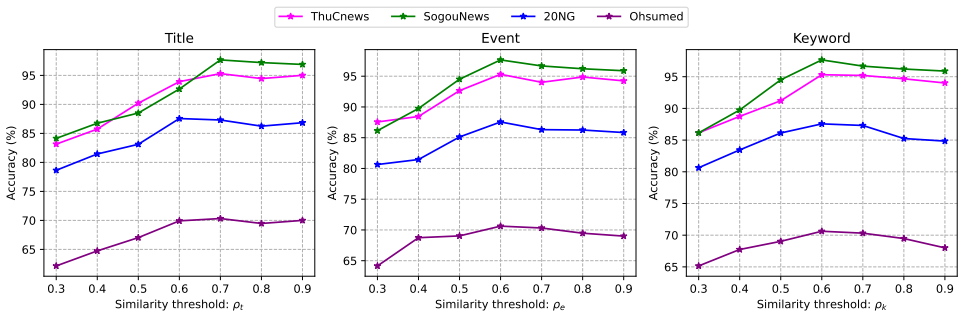
- [§4.6, Figures 4-6, Table 5] The hyperparameter analysis in Section 4.6 selects the similarity thresholds ρ_t, ρ_e, ρ_k, the association coefficients γ_e, γ_k, and the temperature τ per dataset by directly maximizing the reported accuracy on the test set (e.g., "the optimal ρ_t is 0.7", "ConNHS achieved the best performance across all four datasets with these settings"). If these choices are made on the test data and then used for the final numbers in Table 2, the reported accuracies are optimistic selection results rather than honest test-set performance. The authors must use a held-out validation split for hyperparameter selection and report only the corresponding test numbers.
- [§3.1, §4.3, Table 2] The comparison in Table 2 is confounded: ConNHS initializes node features with BGE-M3 embeddings and constructs graph edges from BGE-M3 cosine similarities over titles, keywords, and events, while the eight baselines use their standard, weaker features (bag-of-words, word vectors, or BERT-large in one case). The reported accuracy margins (1.12, 0.30, 1.51, and 2.12 points) are small enough that the stronger encoder alone could explain the observed gains. The ablation study in Table 4 does not resolve this, because all ConNHS variants share the BGE-M3 initialization and graph. To attribute the improvement to RW-GCN, CGAN, or NHS, the authors need to rerun baselines with the same BGE-M3 features and graph, or run ConNHS with the baseline feature sets.
- [§4.5, §5] The NHS loss relies on the homophily assumption stated in Section 4.5, i.e., that connected document nodes tend to share the same label. This assumption is load-bearing because first-order neighbors are masked from being negatives, and the graph edges are created from high feature similarity. The paper provides no quantitative homophily analysis (e.g., the fraction of edges connecting same-label documents) and no test on heterophilic or high-noise graphs, even though the conclusion acknowledges that the multi-relational graphs "inevitably contain some noisy edges." A homophily/edge-noise sensitivity analysis is needed to delimit when the proposed negative-sifting mechanism is beneficial.
minor comments (5)
- [§3.3] The subsection heading "Intra-graph propagation" appears twice; the second occurrence, which introduces cross-graph attention, should be "Inter-graph propagation."
- [Eq. (12)] The vector k in the attention formula α_r = softmax(k^T tanh(p(x_{i,r}; θ_p))) is not defined; please specify its dimension and whether it is a learned parameter or an input feature.
- [Eq. (11)] After concatenation, the claim that x_i^{l+1} ∈ R^{2×d} is ambiguous; the concatenation of two d-dimensional vectors should lie in R^{2d}, unless a specific reshaping is intended.
- [§4.4.1] The text refers to "TGNLCL" but the comparison method is named TGNCL; please make the notation consistent.
- [Throughout] There are numerous spacing and grammatical errors, e.g., "methodofcontrastivemulti-graphlearning" in the abstract and "the contrastive loss suffer from false negatives"; a careful proofreading pass is needed.
Circularity Check
The headline accuracies are partly selected maxima from hyperparameter grids tuned on the same test sets, so the central empirical comparison is partially fitted; the NHS method itself is not definitionally circular and no load-bearing self-citation chain is present.
-
fitted input called prediction
[Section 4.6 (Parameters sensitivity), Sections 4.6.1-4.6.3; reported in Section 4.4.1 and Table 2]
"Experimental results indicate that the optimal ρt is 0.7. While ρe is 0.6, ConNHS achieved the best performance across all four datasets with these settings. For ρk, the optimal threshold range is between 0.6 and 0.7. ... our method achieves the best results on both ThuCnews and 20NG when τ is approximately 0.5."
Section 4.6 selects the graph-construction thresholds ρ_t, ρ_e, ρ_k, the association coefficients γ_e, γ_k, and the temperature τ by inspecting Accuracy curves (Figures 4-6) computed on the same benchmark test sets whose accuracy is later reported in Table 2. No held-out validation split is described for hyperparameter selection; Section 4.3 only notes that results are averages of 10 runs. Consequently, the headline numbers 95.86, 97.52, 87.43, and 70.65 and the claimed margins over baselines are the selected maxima of the tuning grid on the test data. The 'prediction' is therefore partly a fitted value, reducing the central empirical claim to test-set model selection.
full rationale
The paper's core methodological proposal, the neighbor hierarchical sifting (NHS) loss, is not circular by construction: it is defined from the graph adjacency and a similarity score matrix, and the ablation in Table 4 isolates NHS against NT-Xent and against removing either guidance signal. The multi-relational graph is built from BGE-M3 similarities over titles, keywords, and events, but this is an input representation, not a relabeling of the classification target. No load-bearing uniqueness theorem or ansatz is imported through self-citation; the many self-citations in the related-work and method sections are not used to justify a forbidden alternative or to force the chosen loss. The main circularity burden is empirical: the reported test accuracies are partly selected maxima over hyperparameter grids evaluated on the same test sets, with no evidence of a validation split. That is a fitted-input-called-prediction pattern and warrants a score of 6. The additional concern that ConNHS uses stronger BGE-M3 node/edge features while baselines use their standard features is a real attribution risk but is a comparison confound rather than a circular derivation, so it is not counted as a separate circularity step.
Assumptions & free parameters
free parameters (6)
- Title similarity threshold rho_t =
0.7 (optimal per Figure 4 and text)
- Event similarity threshold rho_e =
0.6
- Keyword similarity threshold rho_k =
0.6 to 0.7
- Event association coefficient gamma_e =
6-7 (ThuCNews, SogouNews); 3 (20NG, Ohsumed)
- Keyword association coefficient gamma_k =
9-10 (ThuCNews, SogouNews); 6 (20NG, Ohsumed)
- Temperature tau =
0.5 (recommended search 0.4 to 0.7)
assumptions (4)
- domain assumption Graph homophily: connected document nodes tend to share the same label.
- domain assumption The BGE-M3 text encoder produces reliable semantic embeddings for titles, keywords, events, and content.
- domain assumption Core features (title, keywords, events) are extractable and meaningful for all four datasets.
- domain assumption Transductive setting: test documents may be included in the graph and used in contrastive training without labels.
Cite this review
Pith. "Pith review of Contrastive Multi-graph Learning with Neighbor Hierarchical Sifting for Semi-supervised Text Classification." pith.science (2026). https://pith.science/paper/ETDDBKC7
@misc{pith2026241116787,
  author       = {Pith},
  title        = {Pith review of: Contrastive Multi-graph Learning with Neighbor Hierarchical Sifting for Semi-supervised Text Classification},
  year         = {2026},
  howpublished = {\url{https://pith.science/paper/ETDDBKC7}},
  note         = {Machine review of arXiv:2411.16787}
}
read the original abstract
Graph contrastive learning has been successfully applied in text classification due to its remarkable ability for self-supervised node representation learning. However, explicit graph augmentations may lead to a loss of semantics in the contrastive views. Secondly, existing methods tend to overlook edge features and the varying significance of node features during multi-graph learning. Moreover, the contrastive loss suffer from false negatives. To address these limitations, we propose a novel method of contrastive multi-graph learning with neighbor hierarchical sifting for semi-supervised text classification, namely ConNHS. Specifically, we exploit core features to form a multi-relational text graph, enhancing semantic connections among texts. By separating text graphs, we provide diverse views for contrastive learning. Our approach ensures optimal preservation of the graph information, minimizing data loss and distortion. Then, we separately execute relation-aware propagation and cross-graph attention propagation, which effectively leverages the varying correlations between nodes and edge features while harmonising the information fusion across graphs. Subsequently, we present the neighbor hierarchical sifting loss (NHS) to refine the negative selection. For one thing, following the homophily assumption, NHS masks first-order neighbors of the anchor and positives from being negatives. For another, NHS excludes the high-order neighbors analogous to the anchor based on their similarities. Consequently, it effectively reduces the occurrence of false negatives, preventing the expansion of the distance between similar samples in the embedding space. Our experiments on ThuCNews, SogouNews, 20 Newsgroups, and Ohsumed datasets achieved 95.86\%, 97.52\%, 87.43\%, and 70.65\%, which demonstrates competitive results in semi-supervised text classification.
Figures


Figures from the paper (3 more)


Forward citations
Cited by 2 Pith papers
-
SDR-GNN: Spectral Domain Reconstruction Graph Neural Network for Incomplete Multimodal Learning in Conversational Emotion Recognition
SDR-GNN is a graph neural network that reconstructs missing multimodal features and labels utterance emotions, with reported gains over prior methods that are inconsistent across datasets.
-
Dynamic Graph Neural ODE Network for Multi-modal Emotion Recognition in Conversation
DGODE combines adaptive mixhop aggregation with a graph ODE for multimodal emotion recognition in conversation, reporting SOTA numbers on IEMOCAP and MELD, but the supporting derivation and experimental reporting are ...
Reference graph
Works this paper leans on
-
[1]
Mcsff: Multi-modal consistency and specificity fusion framework for entity alignment
Ai, W., Deng, W., Chen, H., Du, J., Meng, T., Shou, Y., 2024a. Mcsff: Multi-modal consistency and specificity fusion framework for entity alignment. arXiv preprint arXiv:2410.14584 . Ai, W., Li, J., Wang, Z., Du, J., Meng, T., Shou, Y., Li, K., 2024b. Graph contrastive learning via cluster-refined negative sampling for semi- supervised text classification...
-
[8]
Textgtl: Graph- based transductive learning for semi-supervised text classification via structure-sensitive interpolation., in: IJCAI, pp. 2680–2686. Li,X.,Wang,B.,Wang,Y.,Wang,M.,2023.Graph-basedtextclassification by contrastive learning with text-level graph augmentation. ACM Transactions on Knowledge Discovery from Data . Lin,Y.,Meng,Y.,Sun,X.,Han,Q.,K...
work page 2023
-
[9]
Heterogeneous graph attention networks for semi-supervised short text classification, in: Proceedings of the 2019 conference on empirical methods in natural languageprocessingandthe9thinternationaljointconferenceonnatural language processing (EMNLP-IJCNLP), pp. 4821–4830. Liu,X.,Ma,K.,Wei,Q.,Ji,K.,Yang,B.,Abraham,A.,2024.G-hfin:graph- based hierarchical f...
arXiv 2019
-
[12]
Information Processing & Management 61, 103531
Robust scientific text classification using prompt tuning based on data augmentation with l2 regularization. Information Processing & Management 61, 103531. Wei Ai et al.: Preprint submitted to Elsevier Page 15 of 16 Shou, Y., Ai, W., Du, J., Meng, T., Liu, H., 2024a. Efficient long-distance latent relation-aware graph neural network for multi-modal emoti...
arXiv 2023
-
[14]
Contrastive learning with heterogeneous graph attention networks on short text classification, in: 2022 International Joint Conference on Neural Networks (IJCNN), IEEE. pp. 1–6. Tai, K.S., Socher, R., Manning, C.D.,
work page 2022
- [15]
- [16]
- [17]
Show all 21 references
-
[18]
Prediction model of dow jones index based on lstm-adaboost, in: 2021 International Conference on Com- munications, Information System and Computer Engineering (CISCE), IEEE. pp. 808–812. You, Y., Chen, T., Sui, Y., Chen, T., Wang, Z., Shen, Y.,
2021
-
[20]
Knowledge and Information Systems , 1–26
A multi-view mask contrastive learning graph convolutional neural network for age estimation. Knowledge and Information Systems , 1–26. Zhang,Y.,Zhang,Y.,Qi,P.,Manning,C.D.,Langlotz,C.P.,2021.Biomedi- calandclinicalenglishmodelpackagesforthestanzapythonnlplibrary. Journal of t...
2021
-
[1899]
Textgcl:Graphcontrastivelearningfortransduc- tivetextclassification,in:2023InternationalJointConferenceonNeural Networks (IJCNN), IEEE
Zhao,Y.,Song,X.,2023. Textgcl:Graphcontrastivelearningfortransduc- tivetextclassification,in:2023InternationalJointConferenceonNeural Networks (IJCNN), IEEE. pp. 1–8. Zhu,Y.,Xu,Y.,Yu,F.,Liu,Q.,Wu,S.,Wang,L.,2021. Graphcontrastive learning with adaptive augmentation, in: Procee...
2023
-
[2014]
arXiv preprint arXiv:1408.5882
Convolutional neural networks for sentence classification. arXiv preprint arXiv:1408.5882 . Kipf, T.N., Welling, M.,
-
[2015]
Recurrent convolutional neural networksfortextclassification,in:ProceedingsoftheAAAIconference on artificial intelligence, pp. 1–10. Lan,G.,Hu,M.,Li,Y.,Zhang,Y.,2023. Contrastiveknowledgeintegrated graphneuralnetworksforchinesemedicaltextclassification. Engineer- ing Applicati...
2023
-
[2016]
arXiv preprint arXiv:1611.01702
Topicrnn: A recurrent neural network with long-range semantic dependency. arXiv preprint arXiv:1611.01702 . Hassani, K., Khasahmadi, A.H.,
-
[2018]
Modeling relational data with graph convolu- tional networks, in: The Semantic Web: 15th International Conference, ESWC2018,Heraklion,Crete,Greece,June3–7,2018,Proceedings15, Springer. pp. 593–607. Shen,X.,Sun,D.,Pan,S.,Zhou,X.,Yang,L.T.,2023. Neighborcontrastive learningonlea...
2018
-
[2019]
3444–3450
Text level graph neural network for text classification, in: Proceedings of the 2019 Conference on Empirical Methods in Natural Language Processing and the 9th International Joint Conference on Natural Language Processing (EMNLP-IJCNLP), pp. 3444–3450. Joulin, A., Grave, É., B...
2019
-
[2020]
arXiv preprint arXiv:2009.00901
A practical chinese dependency parser based on a large-scale dataset. arXiv preprint arXiv:2009.00901 . Zhang, Y., Shou, Y., Meng, T., Ai, W., Li, K.,
2009 arXiv
-
[2021]
Mathematical Problems in Engineering 2021, 1–9
Multihop neighbor information fusion graph convolutional network for text classification. Mathematical Problems in Engineering 2021, 1–9. Li, C., Peng, X., Peng, H., Li, J., Wang, L.,
2021
-
[2022]
7797–7805
Simple unsupervised graph representation learning, in: Proceedings of the AAAI conference on artificial intelligence, pp. 7797–7805. Piao,Y.,Lee,S.,Lee,D.,Kim,S.,2022. Sparsestructurelearningviagraph neuralnetworksforinductivedocumentclassification,in:Proceedingsof the AAAI Co...
2022
-
[2024]
arXiv preprint arXiv:2402.03216
Bge m3-embedding: Multi-lingual, multi-functionality, multi-granularity text embeddings through self-knowledge distillation. arXiv preprint arXiv:2402.03216 . Dieng, A.B., Wang, C., Gao, J., Paisley, J.,
-
[2025]
Pattern Recognition 158, 110974
Masked contrastive graph representation learning for age estimation. Pattern Recognition 158, 110974. Shou, Y., Cao, X., Meng, D., 2024b. Spegcl: Self-supervised graph spectrum contrastive learning without positive samples. arXiv preprint arXiv:2410.10365 . Shou,Y.,Lan,H.,Cao,...
Reviewed August 12, 2026 · model on record in the stance chip above.
Discussion (0). Continue with ORCID to comment.