REVIEW 3 major objections 4 minor 73 references
Confined and deconfined chaos in classical spin systems
T0 review · 3 major / 4 minor · reviewed 2026-08-06 · deepseek-v4-flash
Pith's one-line read The zero-energy shell of the classical central spin XX model is maximally superintegrable, and a weak inhomogeneous field makes chaos and thermalization share a single inverse-δ timescale.
desk verdict A solid, citable paper: the superintegrability proof is real and checkable, the deconfined-chaos timescale is well-supported numerically, and the main weakness is an empirical encounter rate that should be either derived or hedged. read the letter →
The pith
A machine-rendered reading of the paper's core claim, the machinery that carries it, and where it could break.
The reading
What carries the argument
The engine of the argument is the separation of phase space measured by $\eta = \sqrt{(S_0^\perp)^2 + (B^\perp)^2}$, the combined transverse magnitude of the central spin $S_0$ and the collective mean field $B = \sum_{j>0} g_j S_j$. The zero-energy constraint requires $S_0^\perp \cdot B^\perp = 0$, and $\eta = 0$ is the frozen dark manifold where all right-hand sides of the equations of motion vanish. Superintegrability is carried by the conserved quantities $I_0 = S_0^x/S_0^y$, $I_j = I_0 S_j^x + S_j^y$, and $Q_j = g_1 \alpha_j - g_j \alpha_1$, together with total magnetization $S^z_{\mathrm{tot}}$; the paper constructs these explicitly, proves their functional independence, and thereby obtains $2L-1$ conserved quantities confining motion to one-dimensional orbits. Under the perturbation, regions with $\eta \gg |\delta|$ remain quasi-integrable and show linear drift of the quasi-conserved quantities, while regions with $\eta \lesssim |\delta|$ form the thin chaotic manifold where trajectories rapidly separate in all coordinates; the claimed frequency of encounters with this manifold, proportional to $|\delta|$, is what converts the linear drift into the single $|\delta|^{-1}$ relaxation scale. A secondary mechanism is the Drude peak in the spectral function of the perturbation at $\delta = 0$, whose self-consistent broadening of width $\Gamma \propto |\delta|$ reproduces the observed relaxation from the standard perturbative formula.
What would settle it
Count crossings of the chaotic manifold (intervals where $\eta$ drops below $c|\delta|$ for a fixed constant $c$) in long microcanonical trajectories of the $E = S^z_{\mathrm{tot}} = 0$ central spin model at several values of $\delta$, or equivalently measure $T_{\mathrm{th}}$ over a range such as $10^{-1}$ to $10^{-5}$. The paper predicts a linear crossing rate and $T_{\mathrm{th}} \propto |\delta|^{-1}$; a sustained scaling like $\delta^{-2}$, or a crossing rate proportional to $|\delta|^p$ with $p \ne 1$, would falsify the claimed mechanism.
Extended reading notes
Core claim
On the paper's own terms, the central discovery is that the classical central spin model with XX interactions, $H_{CS} = J \sum_{j>0} g_j (S_0^x S_j^x + S_0^y S_j^y)$, is maximally superintegrable on its zero-energy shell: the paper explicitly constructs $2L-1$ independent integrals of motion---$I_0 = S_0^x/S_0^y$, the quantities $I_j = I_0 S_j^x + S_j^y$, and the angle differences $Q_j = g_1 \alpha_j - g_j \alpha_1$, together with total $S^z_{\mathrm{tot}}$---so each trajectory is a closed one-dimensional loop. A weak inhomogeneous $z$-field perturbation $V = \delta \sum_{j>0} h_j S_j^z$ does not destroy this structure uniformly. Where the instability parameter $\eta = \sqrt{(S_0^\perp)^2 + (B^\perp)^2}$ is large, the dynamics stays quasi-integrable with conserved quantities drifting linearly at rate $|\delta|$; where $\eta \lesssim |\delta|$, a thin chaotic manifold forms and the quasi-conserved quantities jump. The paper's key empirical input is that trajectories meet this manifold at an average frequency proportional to $|\delta|$, and each encounter separates nearby trajectories in all directions and relaxes the observables, so that $T_{\mathrm{lya}}$, $T_{\mathrm{melt}}$, and $T_{\mathrm{th}}$ all scale as $|\delta|^{-1}$. This is contrasted with the Ishimori chain, where $T_{\mathrm{lya}} \propto |\delta|^{-0.65}$ is asymptotically shorter than $T_{\mathrm{melt}}, T_{\mathrm{th}} \propto \delta^{-2}$.
Load-bearing premise
The whole $|\delta|^{-1}$ timescale rests on the empirical claim that trajectories enter the thin chaotic manifold at an average rate proportional to $|\delta|$; if that rate scaled differently with $\delta$, chaos and thermalization would not arrive on the same $|\delta|^{-1}$ timescale.
Editorial extensions
If this is right
- In the perturbed central spin model the three timescales $T_{\mathrm{lya}}$, $T_{\mathrm{melt}}$, and $T_{\mathrm{th}}$ all collapse onto $|\delta|^{-1}$, so no distinct chaotic-but-prethermal regime exists as $\delta \to 0$; chaos and relaxation are inseparable.
- The relaxation rate $\Gamma \propto |\delta|$ is independent of the microscopic coupling $J$ and saturates the general lower bound $T_{\mathrm{th}} \ge (1/|\delta|) \, \mathrm{Var}(Q)/\sqrt{\langle \{Q,V\}^2 \rangle \langle Q^2 \rangle}$ derived in the appendix for non-singular observables, placing the model among maximally ergodic systems.
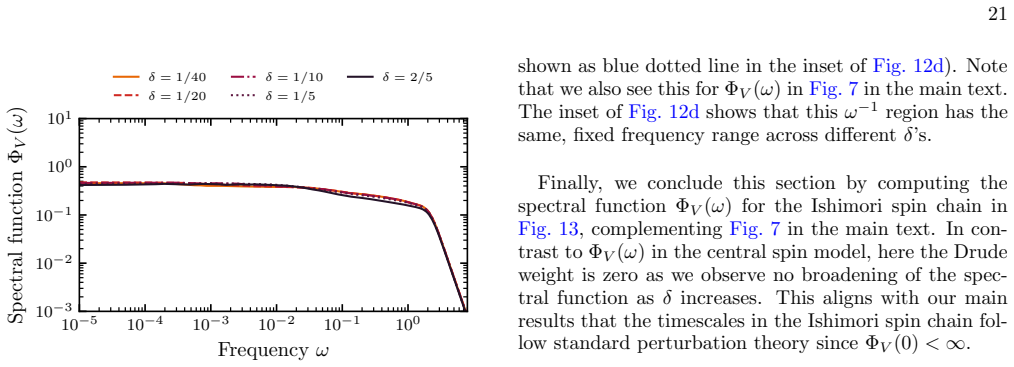
- The spectral function of the perturbation carries a nonzero Drude weight at $\delta = 0$; self-consistently broadening that peak to width $\Gamma$ reproduces the anomalous $|\delta|^{-1}$ scaling from the same perturbative formula that gives $\delta^{-2}$ in ordinary integrable systems.
- A single trajectory needs much longer than $T_{\mathrm{th}}$---on the order of $10^3 T_{\mathrm{th}}$---to sample the microcanonical distribution of $\tau_0$, so fast autocorrelator relaxation does not by itself imply fast ergodicity.
- Numerically, the zero-energy shell is the only integrable shell of the classical XX central spin model; other shells show finite Lyapunov exponents and slow, glassy relaxation, an unusual phase-space structure the authors are not aware of elsewhere.
Reading between the lines
- The linear encounter rate should be visible statically: if the microcanonical measure of the region $\eta < c|\delta|$ scales linearly with $\delta$, then a random trajectory samples it at frequency proportional to $|\delta|$; computing that measure directly on the zero-energy shell would be an independent check of the dynamical claim.
- A natural extension, which the paper does not claim, is that deconfined chaos should appear in other maximally superintegrable systems with a low-dimensional frozen manifold, such as the isotropic all-to-all Heisenberg model or the Kepler problem, when driven by a weak symmetry-breaking field.
- If the SYK analogy is more than phenomenological, the quantum central spin model should show both OTOC growth rate and equilibration rate linear in the perturbation strength in a semiclassical large-spin limit; that statement extrapolates beyond the classical analysis here.
Editorial analysis
A structured set of objections, weighed in public.
Referee Report
Summary. This manuscript introduces a distinction between two scenarios for the dynamics of weakly perturbed integrable classical many-body systems: 'confined chaos,' where Lyapunov instabilities occur on a much shorter timescale than thermalization, and 'deconfined chaos,' where the two timescales coincide. The authors study two models: the Ishimori spin chain, which exhibits confined chaos with Tmelt, Tth ∝ δ^-2 and Tlya ∝ |δ|^-β with β ≈ 0.65, and the classical central spin model with XX interactions, which they argue exhibits deconfined chaos with Tlya, Tmelt, Tth ∝ |δ|^-1. For the central spin model, they provide an appendix proof of maximal superintegrability on the zero-energy shell (2L-1 independent integrals of motion), a perturbative argument for linear drift of quasi-conserved quantities, and a phenomenological self-consistent Drude argument for the |δ|^-1 relaxation rate. They attribute the fast relaxation to intermittent encounters with a thin chaotic manifold defined by η ≲ |δ|, with an empirically inferred encounter frequency proportional to |δ|. The paper draws an analogy between this maximally fast relaxation and quantum SYK-like models.
Significance. If the central claims are fully established, the paper would make a valuable conceptual contribution to the classical and semiclassical theory of nearly integrable many-body systems. The superintegrability proof in Appendix A is explicit, checkable, and, to my knowledge, a new structural result for the classical XX central spin model. The numerical scaling collapses in Figs. 3, 4, 6, and 7 provide strong evidence for the stated timescale scalings. The distinction between confined and deconfined chaos is clearly formulated and could serve as a useful organizing principle for future work on weakly perturbed integrable systems. The SYK analogy is appropriately labeled as reminiscent and speculative, and it does not affect the core dynamical claims. However, the central mechanism for deconfined chaos rests on an empirically inferred encounter rate that is not analytically derived, and the 'fastest possible timescale' claim is not fully supported for the specific observable used in the numerics.
major comments (3)
- [Sec. III B, Eq. (23)] The claim that the chaotic manifold is traversed at an average frequency proportional to |δ| is empirical and load-bearing. This rate is what converts the linear drift of quasi-conserved quantities in Eq. (23) into the central scaling Tlya, Tmelt, Tth ∝ |δ|^-1. If the true encounter rate scaled as |δ|^α with α ≠ 1, the three observed timescales would scale as |δ|^-α, contradicting the abstract's claim. Appendix B provides supporting evidence in the form of a distribution of ΔC_τ0 whose tail mass and mean scale linearly in δ, but this is a consequence of the same rare-encounter process rather than an independent measurement of the crossing statistics of the η ≲ |δ| manifold. I recommend that the authors either provide a direct measurement of encounter-rate scaling (e.g., histograms of inter-encounter intervals versus δ, or the probability per unit time that η drops below |δ|) or derive the rate from the volume of the η ≲ |δ| region and the drift velocity in Eq. (23). Without one of these, the microscopic mechanism for deconfined chaos remains an unverified phenomenological input.
- [Sec. III C and App. C] The advertised claim that the central spin model thermalizes on the fastest possible timescale is not established for the observable actually measured. Appendix C derives a lower bound Tth ≥ O(1/|δ|) for a conserved quantity Q with a non-singular Poisson bracket with the perturbation, but the appendix's final paragraph explicitly states that this bound does not directly apply to τ0 because its equations of motion have singularities, and that the authors 'cannot rigorously confirm that the resulting bound on Tth is O(|δ|^{-1}).' Since τ0 is the observable used for the scaling collapses in Fig. 6 and for the SYK analogy in Sec. III E, the 'fastest possible' claim should either be extended to τ0 by a justified regularization of the singular bracket, or be restated as a numerically observed scaling rather than a proven bound.
- [Sec. III C, Eq. (27)] The self-consistent Drude argument in Eq. (27) assumes that the system relaxes on a single timescale Γ with Γ = Γ_τ0 = Γ_V. This assumption is close to the result being explained: establishing equality of the relaxation rates of different observables is essentially equivalent to the deconfined-chaos conclusion. The text does label the argument as 'more phenomenological,' which is appropriate, but it should be presented as a self-consistency condition consistent with the numerical observations rather than as an independent derivation. The microscopic mechanism therefore remains the empirical encounter-rate input discussed in the first major comment.
minor comments (4)
- [App. F] The first sentence of Appendix F contains a duplicated word: 'we provide provide an alternative approach.'
- [Fig. 4 caption] There is a missing space in 'system sizeL' in the caption of Fig. 4.
- [App. B(iii) and Fig. 11] The statement that the time required for a single trajectory to approximate the microcanonical ensemble 'significantly exceeds the thermalization time Tth' could be confusing, since Tth is defined as the autocorrelator decay time. The authors do clarify this, but I suggest explicitly distinguishing 'autocorrelator thermalization time' from 'ergodization time' in the main text to avoid ambiguity.
- [Sec. II] The claim that 'the exact distribution of the hj does not affect any of our results' is stated without supporting data. If this is an empirical observation, a brief test (e.g., comparing two realizations) would strengthen the assertion; otherwise, the sentence could be softened.
Circularity Check
Central 1/δ scaling in deconfined chaos rests on an empirically fitted encounter rate; Drude self-consistency assumes the single-timescale conclusion.
-
fitted input called prediction
[Section III B ('Effect of integrability breaking') and Sec. III C/III D]
"Most of the phase space lies within the quasi-integrable domain, and we empirically find that the chaotic manifold is traversed only intermittently, at an average frequency proportional to |δ|."
The paper's central scalings Tlya, Tmelt, Tth ∝ |δ|^{-1} are obtained by inverting this empirically determined encounter frequency: if each encounter resets the quasi-conserved quantities and separates nearby trajectories, then after O(1) encounters the relaxation/separation time is 1/(c|δ|). The rate c|δ| is not derived from the equations of motion (Eq. (23) only yields the linear drift, and the volume bound η ≲ |δ| does not fix the crossing rate); it is read off from the same trajectory and correlator data (Fig. 5, Fig. 6, Fig. 8, App. B) that are then said to 'reveal' the 1/δ scaling. If the rate scaled as |δ|^α, all three timescales would scale as |δ|^{-α}; the claimed fastest-timescale result is therefore a restatement of the fitted input rather than an independent prediction.
-
other
[Section III C, Eq. (27)]
"Assuming that the broadening of the Drude peaks associated with all observables is the same, i.e., assuming that the system thermalizes on a single timescale 1/Γ with Γ = Γτ0 = ΓV, we must have Γ ∝ δ2/Γ = ⇒ Γ ∝ |δ|, coinciding with the scaling of T−1 melt and T−1 th we observe."
This 'self-consistent' argument does not compute either rate from the Hamiltonian. Γτ0 is set equal to δ²ΦV(0) ∝ δ²/ΓV, and then the equality Γτ0 = ΓV is imposed as an assumption. That assumption—one common relaxation rate for the perturbation and for the conserved quantity—is exactly the deconfined-chaos conclusion (Tlya ≈ Tmelt ≈ Tth) that the section is trying to explain. The equation Γ = δ²/Γ is then a tautological consistency condition: any presumed common rate satisfies it with Γ ∝ |δ|. The paper itself calls this 'phenomenological', and it has no independent predictive content beyond the empirical encounter-rate input.
full rationale
The superintegrability proof in App. A (2L−1 explicit integrals), the linear-drift calculation from Eq. (23), the Ishimori FGR analysis, and the general lower bound in App. C are self-contained and not circular. The circularity is confined to the deconfined-chaos scaling closure: the claimed |δ|^{-1} relaxation and Lyapunov times are obtained by assuming/empirically fitting a single encounter rate proportional to |δ| and a common relaxation rate, rather than by deriving these rates from the microscopic dynamics. This makes the central scaling prediction partially reducible to its inputs, though the qualitative phase-space picture and the superintegrability result stand independently.
Assumptions & free parameters
free parameters (1)
- Lyapunov exponent scaling exponent β (Ishimori chain) =
≈ 0.65
assumptions (5)
- domain assumption Classical spin dynamics is generated by the Poisson bracket {S_i^a, S_j^b} = δ_ij ε_abc S_j^c.
- standard math Liouville-Arnold theorem and standard definitions of integrable/superintegrable systems with invariant tori.
- standard math Cauchy-Schwarz, Hölder, and triangle inequalities are valid for the relevant phase-space averages.
- ad hoc to paper The thin chaotic manifold is defined by η ≲ |δ| and is encountered at average frequency proportional to |δ|.
- ad hoc to paper The system relaxes on a single timescale Γ, i.e., Γ = Γ_τ0 = Γ_V in the Drude self-consistency argument.
Cite this review
Pith. "Pith review of Confined and deconfined chaos in classical spin systems." pith.science (2026). https://pith.science/paper/ETED6YFA
@misc{pith2026250707168,
  author       = {Pith},
  title        = {Pith review of: Confined and deconfined chaos in classical spin systems},
  year         = {2026},
  howpublished = {\url{https://pith.science/paper/ETED6YFA}},
  note         = {Machine review of arXiv:2507.07168}
}
read the original abstract
Weakly perturbed integrable many-body systems are typically chaotic, and thermal at late times. However, there are distinct relationships between the timescales for thermalization and chaos. The typical relationship is confined chaos: when trajectories are still confined to regions in phase space with constant conserved quantities (actions), the conjugate angle variables are already unstable. Chaotic instabilities thus far precede thermalization. In a different relationship, which we term deconfined chaos, chaotic instabilities and thermalization occur on the same timescale. We investigate these two qualitatively distinct scenarios through numerical and analytical studies of two perturbed integrable classical spin models: the Ishimori spin chain (confined chaos), and the central spin model with XX interactions (deconfined chaos). We analytically establish (super)-integrability in the latter model in a microcanonical shell. Deconfined chaos emerges through the separation of phase space into large quasi-integrable regions and a thin chaotic manifold. The latter leads to chaos and thermalization on the fastest possible timescale, which is proportional to the inverse perturbation strength. This behavior is reminiscent of the quantum SYK models and strange metals.
Figures


Figures from the paper (12 more)




Reference graph
Works this paper leans on
-
[26]
L. H. Tang, D. M. Long, A. Polkovnikov, A. Chandran, and P. W. Claeys, Integrability and quench dynamics in the spin-1 central spin XX model, SciPost Physics 15, 030 (2023)
work page 2023
-
[1]
L. Landau and E. Lifshitz, Mechanics, Course of Theo- retical Physics, Vol. 1 (Butterworth-Heinemann, 1976)
work page 1976
-
[2]
T. Kinoshita, T. Wenger, and D. S. Weiss, A quantum newton’s cradle, Nature 440, 900 (2006). 13
work page 2006
-
[3]
Y. Tang, W. Kao, K.-Y. Li, S. Seo, K. Mallayya, M. Rigol, S. Gopalakrishnan, and B. L. Lev, Thermal- ization near integrability in a dipolar quantum newton’s cradle, Physical Review X 8, 021030 (2018)
work page 2018
-
[4]
Malvania, Y
N. Malvania, Y. Zhang, Y. Le, J. Dubail, M. Rigol, and D. S. Weiss, Generalized hydrodynamics in strongly in- teracting 1d bose gases, Science 373, 1129 (2021)
2021
-
[5]
Ott, Chaos in Dynamical Systems , 2nd ed
E. Ott, Chaos in Dynamical Systems , 2nd ed. (Cam- bridge University Press, 2002)
2002
-
[6]
S. Strogatz, Nonlinear Dynamics and Chaos: With Appli- cations to Physics, Biology, Chemistry, and Engineering (CRC Press, 2018)
work page 2018
- [7]
Show all 73 references
-
[8]
Vidmar and M
L. Vidmar and M. Rigol, Generalized gibbs ensemble in integrable lattice models, Journal of Statistical Mechan- ics: Theory and Experiment 2016, 064007 (2016)
2016
-
[9]
Rigol, V
M. Rigol, V. Dunjko, V. Yurovsky, and M. Olshanii, Re- laxation in a completely integrable many-body quantum system: An ab initio study of the dynamics of the highly excited states of 1d lattice hard-core bosons, Phys. Rev. Lett. 98, 050405 (2007)
2007
-
[10]
Milani and A
A. Milani and A. M. Nobili, An example of stable chaos in the solar system, Nature 357, 569 (1992)
1992
-
[11]
Milani, A
A. Milani, A. M. Nobili, and Z. Kneˇ zevi´ c, Stable chaos in the asteroid belt, Icarus 125, 13 (1997)
1997
-
[12]
Laskar, Chaotic diffusion in the solar system, Icarus 196, 1 (2008)
J. Laskar, Chaotic diffusion in the solar system, Icarus 196, 1 (2008)
2008
-
[13]
O. C. Winter, D. C. Mour˜ ao, and S. M. G. Winter, Short Lyapunov time: a method for identifying confined chaos, Astronomy & Astrophysics 523, A67 (2010)
2010
-
[14]
L. S. Pereira, D. C. Mour˜ ao, and O. C. Winter, Confined chaos and the chaotic angular motion of atlas, a saturn’s inner satellite, Monthly Notices of the Royal Astronomi- cal Society 529, 1012 (2024)
2024
-
[15]
Goldfriend and J
T. Goldfriend and J. Kurchan, Quasi-integrable systems are slow to thermalize but may be good scramblers, Phys. Rev. E 102, 022201 (2020)
2020
-
[16]
Benettin, H
G. Benettin, H. Christodoulidi, and A. Ponno, The Fermi-Pasta-Ulam Problem and Its Underlying Inte- grable Dynamics, Journal of Statistical Physics 152, 195 (2013)
2013
-
[17]
Benettin, S
G. Benettin, S. Pasquali, and A. Ponno, The Fermi– Pasta–Ulam Problem and Its Underlying Integrable Dy- namics: An Approach Through Lyapunov Exponents, Journal of Statistical Physics 171, 521 (2018)
2018
-
[18]
Goldfriend and J
T. Goldfriend and J. Kurchan, Equilibration of quasi- integrable systems, Phys. Rev. E 99, 022146 (2019)
2019
-
[19]
A. S. Mishchenko and A. T. Fomenko, Generalized Li- ouville method of integration of Hamiltonian systems, Functional Analysis and Its Applications 12, 113 (1978)
1978
-
[20]
A. V. Bolsinov and B. Jovanovi´ c, Noncommutative Inte- grability, Moment Map and Geodesic Flows, Annals of Global Analysis and Geometry 23, 305 (2003)
2003
-
[21]
Miller, S
W. Miller, S. Post, and P. Winternitz, Classical and quantum superintegrability with applications, Journal of Physics A: Mathematical and Theoretical 46, 423001 (2013)
2013
-
[22]
Ishimori, An integrable classical spin chain, Journal of the Physical Society of Japan 51, 3417 (1982)
Y. Ishimori, An integrable classical spin chain, Journal of the Physical Society of Japan 51, 3417 (1982)
1982
-
[23]
Theodorakopoulos, Nontopological thermal solitons in isotropic ferromagnetic lattices, Phys
N. Theodorakopoulos, Nontopological thermal solitons in isotropic ferromagnetic lattices, Phys. Rev. B 52, 9507 (1995)
1995
-
[24]
A. J. McRoberts, T. Bilitewski, M. Haque, and R. Moess- ner, Long-lived solitons and their signatures in the classi- cal heisenberg chain, Phys. Rev. E 106, L062202 (2022)
2022
-
[25]
Villazon, A
T. Villazon, A. Chandran, and P. W. Claeys, Integrabil- ity and dark states in an anisotropic central spin model, Phys. Rev. Res. 2, 032052 (2020)
2020
-
[27]
Villazon, P
T. Villazon, P. W. Claeys, M. Pandey, A. Polkovnikov, and A. Chandran, Persistent dark states in anisotropic central spin models, Scientific Reports 10, 16080 (2020)
2020
-
[28]
Dimo and A
C. Dimo and A. Faribault, Strong-coupling emergence of dark states in xx central spin models, Phys. Rev. B 105, L121404 (2022)
2022
-
[29]
Sachdev, Quantum statistical mechanics of the sachdev-ye-kitaev model and charged black holes, International Journal of Modern Physics B 38, 10.1142/s0217979224300032 (2024)
S. Sachdev, Quantum statistical mechanics of the sachdev-ye-kitaev model and charged black holes, International Journal of Modern Physics B 38, 10.1142/s0217979224300032 (2024)
2024 doi
-
[30]
L. D. Faddeev and L. A. Takhtajan, Hamiltonian Meth- ods in the Theory of Solitons (Springer, Berlin, Heidel- berg, 1987)
1987
-
[31]
Prosen and B
T. Prosen and B. ˇZunkoviˇ c, Macroscopic diffusive trans- port in a microscopically integrable hamiltonian system, Phys. Rev. Lett. 111, 040602 (2013)
2013
-
[32]
C. Lim, K. Matirko, H. Kim, A. Polkovnikov, and M. O. Flynn, Defining classical and quantum chaos through adi- abatic transformations (2025), arXiv:2401.01927
2025
-
[33]
Langen, T
T. Langen, T. Gasenzer, and J. Schmiedmayer, Prether- malization and universal dynamics in near-integrable quantum systems, Journal of Statistical Mechanics: The- ory and Experiment 2016, 064009 (2016)
2016
-
[34]
T. Mori, T. N. Ikeda, E. Kaminishi, and M. Ueda, Thermalization and prethermalization in isolated quan- tum systems: A theoretical overview, Journal of Physics B: Atomic, Molecular and Optical Physics 51, 112001 (2018)
2018
-
[35]
Skokos, The lyapunov characteristic exponents and their computation, in Dynamics of Small Solar System Bodies and Exoplanets , edited by J
C. Skokos, The lyapunov characteristic exponents and their computation, in Dynamics of Small Solar System Bodies and Exoplanets , edited by J. J. Souchay and R. Dvorak (Springer Berlin Heidelberg, Berlin, Heidel- berg, 2010) pp. 63–135
2010
-
[36]
Benettin, L
G. Benettin, L. Galgani, A. Giorgilli, and J.-M. Strelcyn, Lyapunov characteristic exponents for smooth dynami- cal systems and for hamiltonian systems; a method for computing all of them. part 1: Theory, Meccanica 15, 9 (1980)
1980
-
[37]
Benettin, L
G. Benettin, L. Galgani, and J.-M. Strelcyn, Kolmogorov entropy and numerical experiments, Phys. Rev. A 14, 2338 (1976)
1976
-
[38]
Larkin and Y
A. Larkin and Y. N. Ovchinnikov, Quasiclassical method in the theory of superconductivity, Zh. Eksp. Teor. Fiz. 55, 2262 (1968)
1968
-
[39]
E. B. Rozenbaum, S. Ganeshan, and V. Galitski, Lya- punov exponent and out-of-time-ordered correlator’s growth rate in a chaotic system, Phys. Rev. Lett. 118, 086801 (2017)
2017
-
[40]
K.-D. N. T. Lam and J. Kurchan, Stochastic perturba- tion of integrable systems: a window to weakly chaotic systems, Journal of Statistical Physics 156, 619 (2014)
2014
-
[41]
Falcioni, U
M. Falcioni, U. M. B. Marconi, and A. Vulpiani, Ergodic properties of high-dimensional symplectic maps, Phys. 14 Rev. A 44, 2263 (1991)
1991
-
[42]
Mulansky, K
M. Mulansky, K. Ahnert, A. Pikovsky, and D. L. Shep- elyansky, Strong and weak chaos in weakly nonintegrable many-body hamiltonian systems, Journal of Statistical Physics 145, 1256 (2011)
2011
-
[43]
Malishava and S
M. Malishava and S. Flach, Lyapunov spectrum scaling for classical many-body dynamics close to integrability, Phys. Rev. Lett. 128, 134102 (2022)
2022
-
[44]
A. S. de Wijn, B. Hess, and B. V. Fine, Largest lyapunov exponents for lattices of interacting classical spins, Phys. Rev. Lett. 109, 034101 (2012)
2012
-
[45]
Ljubotina, M
M. Ljubotina, M. ˇZnidariˇ c, and T. Prosen, Spin diffusion from an inhomogeneous quench in an integrable system, Nature communications 8, 16117 (2017)
2017
-
[46]
De Nardis, S
J. De Nardis, S. Gopalakrishnan, R. Vasseur, and B. Ware, Stability of superdiffusion in nearly integrable spin chains, Phys. Rev. Lett. 127, 057201 (2021)
2021
-
[47]
Schwartz, J
I. Schwartz, J. Scheuer, B. Tratzmiller, S. M¨ uller, Q. Chen, I. Dhand, Z.-Y. Wang, C. M¨ uller, B. Naydenov, F. Jelezko, and M. B. Plenio, Robust optical polariza- tion of nuclear spin baths using Hamiltonian engineering of nitrogen-vacancy center quantum dynamics, Science A...
2018
-
[48]
London, J
P. London, J. Scheuer, J.-M. Cai, I. Schwarz, A. Ret- zker, M. B. Plenio, M. Katagiri, T. Teraji, S. Koizumi, J. Isoya, R. Fischer, L. P. McGuinness, B. Naydenov, and F. Jelezko, Detecting and polarizing nuclear spins with double resonance on a single electron spin, Phys. Rev....
2013
-
[49]
Urbaszek, X
B. Urbaszek, X. Marie, T. Amand, O. Krebs, P. Voisin, P. Maletinsky, A. H¨ ogele, and A. Imamoglu, Nuclear spin physics in quantum dots: An optical investigation, Rev. Mod. Phys. 85, 79 (2013)
2013
-
[50]
Hanson, L
R. Hanson, L. P. Kouwenhoven, J. R. Petta, S. Tarucha, and L. M. K. Vandersypen, Spins in few-electron quan- tum dots, Reviews of Modern Physics 79, 1217 (2007)
2007
-
[51]
Dukelsky, S
J. Dukelsky, S. Pittel, and G. Sierra, Colloquium: Ex- actly solvable richardson-gaudin models for many-body quantum systems, Rev. Mod. Phys. 76, 643 (2004)
2004
-
[52]
E. A. Yuzbashyan, B. L. Altshuler, V. B. Kuznetsov, and V. Z. Enolskii, Solution for the dynamics of the bcs and central spin problems, Journal of Physics A: Mathemat- ical and General 38, 7831 (2005)
2005
-
[53]
Dobrzyniecki and M
J. Dobrzyniecki and M. Tomza, Quantum simulation of the central spin model with a rydberg atom and polar molecules in optical tweezers, Phys. Rev. A 108, 052618 (2023)
2023
-
[54]
Kittel and H
C. Kittel and H. Shore, Development of a phase transition for a rigorously solvable many-body system, Phys. Rev. 138, A1165 (1965)
1965
-
[55]
Magyari, H
E. Magyari, H. Thomas, R. Weber, C. Kaufman, and G. M¨ uller, Integrable and nonintegrable classical spin clusters, Zeitschrift f¨ ur Physik B Condensed Matter65, 363 (1987)
1987
-
[56]
Liu and G
J.-M. Liu and G. M¨ uller, Infinite-temperature dynamics of the equivalent-neighbor xyz model, Phys. Rev. A 42, 5854 (1990)
1990
-
[57]
Wu, X.-W
N. Wu, X.-W. Guan, and J. Links, Separable and entan- gled states in the high-spin xx central spin model, Phys. Rev. B 101, 155145 (2020)
2020
-
[58]
De Nadai, N
E. De Nadai, N. Maestracci, and A. Faribault, Integra- bility and dark states of the xx spin-1 central spin model in a transverse field, Phys. Rev. B 110, 205427 (2024)
2024
-
[59]
J. v. Tonder and J. Links, Dark states in an integrable xy central spin model, Journal of Statistical Mechanics: Theory and Experiment 2025, 063104 (2025)
2025
-
[60]
Kubo, Statistical-mechanical theory of irreversible processes
R. Kubo, Statistical-mechanical theory of irreversible processes. i. general theory and simple applications to magnetic and conduction problems, Journal of the Phys- ical Society of Japan 12, 570 (1957)
1957
-
[61]
V. I. Arnold, Mathematical Methods of Classical Mechan- ics, 2nd ed., Graduate Texts in Mathematics (Springer New York, 1989)
1989
-
[62]
B. V. Fine, T. A. Elsayed, C. M. Kropf, and A. S. de Wijn, Absence of exponential sensitivity to small per- turbations in nonintegrable systems of spins 1/2, Phys. Rev. E 89, 012923 (2014)
2014
-
[63]
Kukuljan, S
I. Kukuljan, S. Grozdanov, and T. Prosen, Weak quan- tum chaos, Phys. Rev. B 96, 060301 (2017)
2017
-
[64]
Davidson, D
S. Davidson, D. Sels, and A. Polkovnikov, Semiclassical approach to dynamics of interacting fermions, Annals of Physics 384, 128–141 (2017)
2017
-
[65]
Schmitt, D
M. Schmitt, D. Sels, S. Kehrein, and A. Polkovnikov, Semiclassical echo dynamics in the sachdev-ye-kitaev model, Phys. Rev. B 99, 134301 (2019)
2019
-
[66]
A. S. de Wijn, B. Hess, and B. V. Fine, Lyapunov insta- bilities in lattices of interacting classical spins at infinite temperature, Journal of Physics A: Mathematical and Theoretical 46, 254012 (2013)
2013
-
[67]
J. D. Meiss and E. Ott, Markov-Tree Model of Intrin- sic Transport in Hamiltonian Systems, Physical Review Letters 55, 2741 (1985)
1985
-
[68]
Srivastava, C
N. Srivastava, C. Kaufman, G. M¨ uller, R. Weber, and H. Thomas, Integrable and Nonintegrable Classical Spin Clusters: Trajectories and Geometric Structure of Invari- ants and Geometric Structure of Invariants, Zeitschrift f¨ ur Physik B Condensed Matter70, 251 (1988)
1988
-
[69]
S. G. Johnson, Sobol.jl (2014)
2014
-
[70]
ChaosTools.jl, https://github.com/JuliaDynamics/ ChaosTools.jl (2025)
2025
-
[71]
Datseris, Dynamicalsystems.jl: A julia software li- brary for chaos and nonlinear dynamics, Journal of Open Source Software 3, 598 (2018)
G. Datseris, Dynamicalsystems.jl: A julia software li- brary for chaos and nonlinear dynamics, Journal of Open Source Software 3, 598 (2018)
2018
-
[72]
Datseris and U
G. Datseris and U. Parlitz, Nonlinear dynamics: A con- cise introduction interlaced with code (Springer Nature, Cham, Switzerland, 2022). Appendix A: Superintegrability in the XX central spin model at the zero energy We prove that motion in the central spin model with XX inter...
2022
-
[73]
Thus, we have Tth ≥ Var(Q) ⟨|{Q, H}|p⟩1/p ⟨|Q|q⟩1/q , (C12) for any such p and q. The scaling of Tth with δ is the same in this version of the bound, but the quantitative bound may be improved by taking p ̸= 2 (which reproduces the Cauchy-Schwarz inequality) for certain instan...
Reviewed August 6, 2026 · model on record in the stance chip above.
Discussion (0). Continue with ORCID to comment.