Site4Drug: Predicting Drug-Binding Target Sites with an AI Agent
Pith reviewed 2026-06-28 11:40 UTC · model grok-4.3
The pith
Site4Drug ranks protein target sites for drugs and recommends binding modalities from shared evidence on topology and modifications.
A machine-rendered reading of the paper's core claim, the machinery that carries it, and where it could break.
Core claim
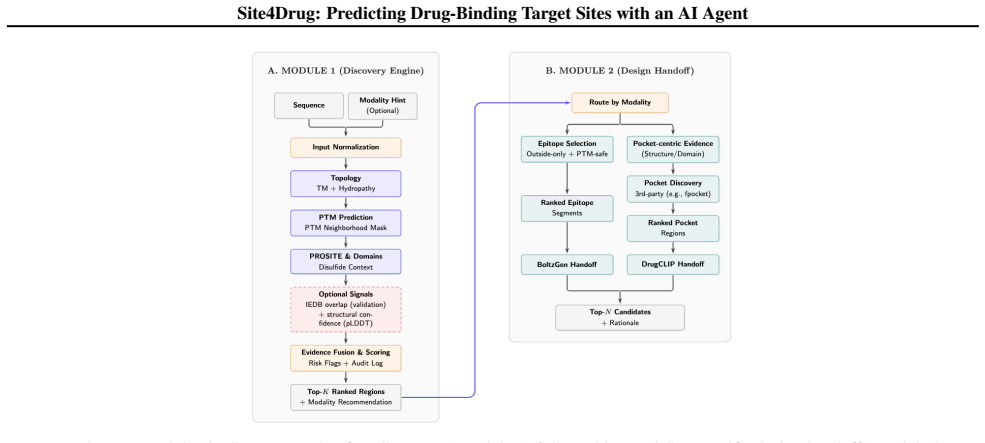
Site4Drug outputs a ranked list of targetable regions with explicit constraints, evidence summaries, risk flags, and a traceable decision log, and recommends a binding modality from the same evidence used for site discovery, including topology, hydropathy, PTM propensity, disulfides, domain context, and sequence. Importantly, this evidence is applied consistently across modalities, including small-molecule pocket discovery, to avoid selecting chemically plausible but biologically occluded sites.
What carries the argument
The modality-aware site-finding agent that integrates topology, hydropathy, PTM propensity, disulfides, domain context, and sequence to rank sites and recommend modalities from the same evidence.
If this is right
- Users receive both site rankings and modality recommendations without needing to specify the modality in advance.
- Consistent use of the same evidence across modalities reduces selection of biologically occluded sites even for small-molecule cases.
- Each recommendation includes explicit constraints, risk flags, and a decision log for review.
- The approach targets membrane proteins where topology and modifications strongly limit actionable regions.
Where Pith is reading between the lines
- The uniform feature set might allow the same agent to support non-drug interventions such as protein degradation tags or probes.
- Connecting Site4Drug outputs directly to structure-prediction pipelines could test whether predicted sites align with experimental accessibility data.
- Traceable logs could support regulatory review of target selection in therapeutic programs.
Load-bearing premise
The listed biological features can be applied uniformly and without modality-specific tuning to produce reliable site rankings and modality recommendations across small-molecule and antibody-like cases.
What would settle it
An experimental case where a top-ranked site recommended by Site4Drug proves inaccessible in cell-based assays due to unaccounted PTM or topology constraints not captured in the input features.
Figures
read the original abstract
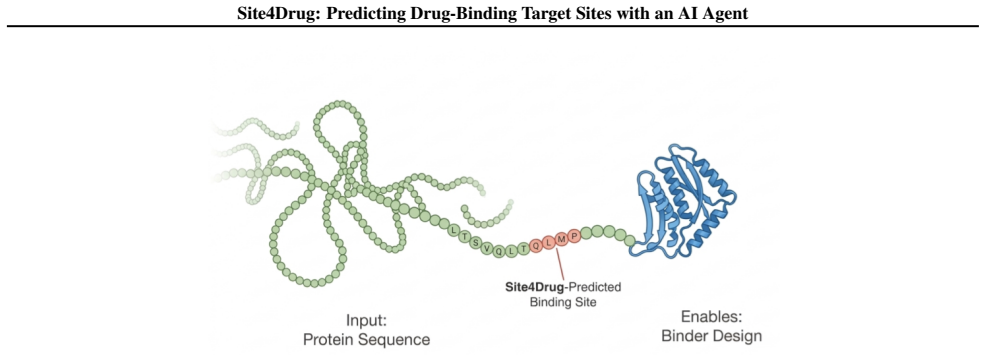
Selecting where to intervene on a protein (i.e., choosing a targetable site) is often a more ambiguous and failure-prone bottleneck than selecting what binds, especially for membrane proteins where accessibility, topology, and post-translational modifications (PTMs) constrain actionable regions. We present Site4Drug, a modality-aware site-finding agent that outputs a ranked list of targetable regions with explicit constraints, evidence summaries, risk flags, and a traceable decision log. Rather than requiring users to specify the drug modality upfront, Site4Drug can recommend a binding modality (e.g., antibody/peptide-like vs small-molecule) from the same evidence used for site discovery, including topology, hydropathy, PTM propensity, disulfides, domain context, and sequence. Importantly, this evidence is applied consistently across modalities, including small-molecule pocket discovery, to avoid selecting chemically plausible but biologically occluded sites.
Editorial analysis
A structured set of objections, weighed in public.
Referee Report
Summary. The manuscript introduces Site4Drug, a modality-aware AI agent for identifying drug-binding target sites on proteins (especially membrane proteins). It claims to output ranked lists of targetable regions that include explicit constraints, evidence summaries, risk flags, and traceable decision logs. The agent recommends a binding modality (antibody/peptide-like vs. small-molecule) from the same biological evidence—topology, hydropathy, PTM propensity, disulfides, domain context, and sequence—applied uniformly across modalities to avoid selecting occluded sites.
Significance. If the described outputs and consistency claims are validated with performance data, the work could address a recognized bottleneck in target-site selection by providing an integrated, traceable framework that avoids modality-specific upfront specification and reduces accessibility-related failures. The emphasis on consistent feature application across orthogonal constraints (buried pockets vs. exposed surfaces) would be a notable contribution if supported by benchmarks.
major comments (2)
- The central claim that the listed features (topology, hydropathy, PTM propensity, disulfides, domain context, sequence) can be scored identically for small-molecule pocket discovery and antibody-like surface targeting, with the same evidence driving modality recommendation, lacks any supporting validation, ablation, cross-modality benchmark, or error analysis on known cases. This is load-bearing for the consistency assertion in the abstract.
- No methods, implementation details, datasets, performance metrics, comparison baselines, or results are supplied, rendering it impossible to assess whether the described ranked lists, risk flags, or modality recommendations are actually produced or accurate.
Simulated Author's Rebuttal
We thank the referee for the constructive feedback on our manuscript describing Site4Drug. We address each major comment below and outline planned revisions to strengthen the work.
read point-by-point responses
-
Referee: The central claim that the listed features (topology, hydropathy, PTM propensity, disulfides, domain context, sequence) can be scored identically for small-molecule pocket discovery and antibody-like surface targeting, with the same evidence driving modality recommendation, lacks any supporting validation, ablation, cross-modality benchmark, or error analysis on known cases. This is load-bearing for the consistency assertion in the abstract.
Authors: We agree that the consistency claim requires supporting evidence to be fully substantiated. The manuscript presents the rationale for uniform feature application across modalities to maintain biological plausibility, but does not include ablations or benchmarks. In revision we will add case studies on well-characterized proteins, illustrating how the same features are scored for both pocket and surface targeting, together with any available error analysis on known targets. revision: yes
-
Referee: No methods, implementation details, datasets, performance metrics, comparison baselines, or results are supplied, rendering it impossible to assess whether the described ranked lists, risk flags, or modality recommendations are actually produced or accurate.
Authors: The current manuscript is a concise description of the agent concept and its output format. Detailed methods, including the AI agent implementation, feature computation procedures, and any internal datasets or evaluation metrics, are not provided. We will expand the revised version with a dedicated Methods section that specifies the agent architecture, decision logic, and any performance data from development testing. revision: yes
Circularity Check
No circularity in derivation chain; paper describes an AI tool without equations or self-referential reductions
full rationale
The provided abstract and description contain no equations, derivations, fitted parameters presented as predictions, or load-bearing self-citations. Site4Drug is presented as an agent that applies listed biological features (topology, hydropathy, etc.) consistently to rank sites and recommend modalities. This is a methodological claim about tool behavior rather than a first-principles derivation that reduces to its inputs by construction. No self-definitional loops, fitted-input predictions, or uniqueness theorems are visible. The central claim rests on the agent's design and evidence application, which does not exhibit the enumerated circularity patterns. The paper is self-contained as a description of an implemented system; external validation or ablation would address correctness but not circularity per the specified criteria.
Axiom & Free-Parameter Ledger
Reference graph
Works this paper leans on
-
[4]
Disulfide/context risks Target: UniProt <uniprot> Length: <len(sequence)> aa TM regions: <seq_summary.tm_regions> Cysteines: <len(seq_summary.cysteine_positions)> <ptm_text> <motif_text> Antigen sequence: <sequence> Output request: Return Top-<k> candidates. <schema_instruction> If auto mode is enabled, the prompt additionally inserts a deterministic poli...
-
[8]
recommended_modality
Disulfide/context risks Target: Sequence ID <target_id> Length: <seq_summary.sequence_length> aa TM regions: <seq_summary.tm_regions> Cysteine count: <len(seq_summary.cysteine_positions)> <ptm_text> <motif_text> Candidate table: <candidate_table> Output request: Return exactly Top-<k>. <schema_instruction> Example instantiated evidence snippets.The PTM an...
-
[9]
TM/topology constraints
-
[10]
PTM mask constraints (typed)
-
[11]
Motif-functional caveats
-
[12]
recommended_modality
Disulfide/context risks Target: Sequence ID <target_id> Length: <len(sequence)> aa Antigen sequence: <sequence> Output request: Return Top-<k> candidates. <schema_instruction> D.2. Sequence-only Ablation Results Supplementary results for the sequence-only ablation on the included pocket benchmark. Table S1.Sequence-only ablation on the included pocket ben...
discussion (0)
Sign in with ORCID, Apple, or X to comment. Anyone can read and Pith papers without signing in.