Project Ariadne: Prompt-Conditioned Route Generation for Synthesis Planning
Pith reviewed 2026-06-26 00:34 UTC · model grok-4.3
The pith
A single decoder-only model generates synthesis routes that obey depth and starting-material constraints when those are added to the prompt.
A machine-rendered reading of the paper's core claim, the machinery that carries it, and where it could break.
Core claim
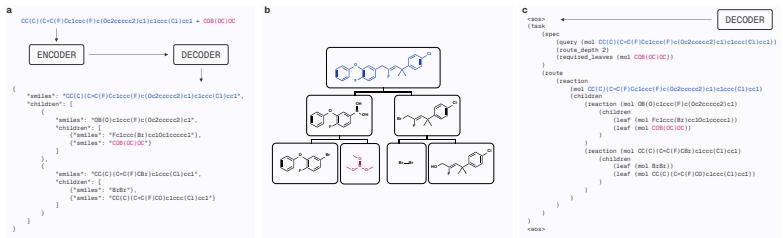
Ariadne represents the target, optional constraints such as route depth or required starting materials, and the multistep route as one prompt-completion sequence inside a decoder-only transformer. A single 24-layer checkpoint trained this way follows the supplied constraints, raising Solv-0 by 13.7 points for depth prompts and 31.2 points for required-leaf prompts on the RetroCast/PaRoutes mkt-cnv-160 family. The model also exceeds DESP on required-leaf Top-10 and Solv-0 in 24 GPU-minutes versus 6.8 GPU-hours and matches DMS Explorer XL on standard reconstruction at roughly half the inference time.
What carries the argument
The unified prompt-completion sequence that places target, constraints, and route inside one decoder-only generation task.
If this is right
- One trained checkpoint handles multiple constraint types instead of requiring separate models for each specification.
- Inference time drops below that of bidirectional search planners while meeting or exceeding their constrained-task metrics.
- Route-holdout reconstruction improves relative to prior direct-generation baselines.
- New constraint types can be added by extending the prompt format without architectural changes.
Where Pith is reading between the lines
- Prompt conditioning may allow rapid testing of new planning rules by simply altering the prompt text rather than retraining.
- The approach could be combined with larger language models to handle more complex multi-objective constraints in a single pass.
- Practical adoption would still require independent route validation tools beyond the current solvability metrics.
Load-bearing premise
The assumption that Solv-0 and Top-10 scores on the selected benchmark family measure the practical quality of routes without needing extra post-hoc checks.
What would settle it
Generate routes under explicit depth or leaf prompts and compare them to a set of experimentally verified routes that are known to satisfy the same constraints.
Figures
read the original abstract
Retrosynthetic planning seeks to connect a target molecule to commercially available starting materials through a multistep route. Classical planners construct such routes by iteratively applying single-step reaction models within a search procedure; constrained variants often require specialized algorithms or architectural changes. Direct route generation reframes retrosynthesis as sequence generation, but existing direct-generation methods still train separate models for different planning specifications. We introduce Ariadne, a decoder-only route generator that represents the target, optional constraints, and route in one prompt-completion sequence. On the RetroCast/PaRoutes mkt-cnv-160 benchmark family, one 24-layer checkpoint follows route-depth and required-starting-material prompts: adding the corresponding prompt fields raises Solv-0 by 13.7 points for depth constraints and 31.2 points for required-leaf constraints. Ariadne also improves over DESP, a bidirectional search planner, on required-leaf Top-10 and Solv-0 in 24 GPU-minutes versus 6.8 GPU-hours. On standard reconstruction, Ariadne is comparable to DMS Explorer XL at about half the reported inference time. Across additional target-only benchmarks, Ariadne's clearest gains are on route-holdout reconstruction, whereas AiZynthFinder MCTS remains stronger on several Solv-0 comparisons. These results extend sequence generation from specialist retrosynthesis models to prompt-conditioned structural route generation. We release the codebase and training scripts to support further work, but do not introduce Tier-1--3 route checkers; those remain the main bottleneck before models of this kind can become useful to experimental chemists.
Editorial analysis
A structured set of objections, weighed in public.
Referee Report
Summary. The paper introduces Ariadne, a decoder-only transformer for direct retrosynthetic route generation that encodes the target molecule plus optional constraints (route depth, required starting materials) into a single prompt-completion sequence. On the RetroCast/PaRoutes mkt-cnv-160 family, a single 24-layer checkpoint shows Solv-0 gains of +13.7 (depth) and +31.2 (required-leaf) when the corresponding prompt fields are added; it also reports faster inference than DESP on required-leaf tasks and parity with DMS Explorer XL on standard reconstruction, while releasing training code but noting the absence of Tier-1–3 route checkers.
Significance. If the central claim holds, the work demonstrates that prompt conditioning can extend sequence-generation models to constrained retrosynthesis without bespoke search algorithms or multiple specialist models, offering a simpler interface for route-depth and starting-material constraints. The public release of code and scripts is a concrete strength that enables follow-up verification.
major comments (2)
- [Abstract / Results] Abstract and results (headline claims on RetroCast/PaRoutes): the statement that the model 'follows' depth and required-starting-material prompts rests on downstream Solv-0/Top-10 improvements alone. No separate metric (e.g., fraction of routes whose depth ≤ prompted limit or that contain the required leaf, measured by an external checker) is reported, so it remains possible that gains arise from routes that violate the constraints.
- [Experiments] Experiments section: training details (data splits, hyper-parameters, checkpoint selection procedure for the 24-layer model, and any statistical significance tests on the +13.7 / +31.2 point deltas) are not supplied, preventing assessment of whether the reported gains are robust or could be artifacts of post-hoc selection.
minor comments (1)
- [Methods] Notation for prompt fields and route representation could be clarified with an explicit example sequence in the methods.
Simulated Author's Rebuttal
We thank the referee for the constructive comments, which highlight important aspects of evaluation and reproducibility. We address each major comment below and will revise the manuscript to incorporate additional details and analyses.
read point-by-point responses
-
Referee: [Abstract / Results] Abstract and results (headline claims on RetroCast/PaRoutes): the statement that the model 'follows' depth and required-starting-material prompts rests on downstream Solv-0/Top-10 improvements alone. No separate metric (e.g., fraction of routes whose depth ≤ prompted limit or that contain the required leaf, measured by an external checker) is reported, so it remains possible that gains arise from routes that violate the constraints.
Authors: We acknowledge that the evaluation relies on Solv-0 and Top-10 as aggregate success metrics under prompt conditioning, without an explicit post-hoc verification of constraint satisfaction on the generated routes. The model is trained on prompt-completion pairs where completions are consistent with the constraints present in the training data, but we agree that reporting the fraction of routes meeting the depth limit or containing the required leaf would strengthen the claim. In the revision we will add this analysis by parsing the generated route sequences (a lightweight check that does not require Tier-1–3 validation) and reporting the adherence rates for the prompted versus unprompted settings. revision: yes
-
Referee: [Experiments] Experiments section: training details (data splits, hyper-parameters, checkpoint selection procedure for the 24-layer model, and any statistical significance tests on the +13.7 / +31.2 point deltas) are not supplied, preventing assessment of whether the reported gains are robust or could be artifacts of post-hoc selection.
Authors: We agree these details should have been included. The revised Experiments section will specify the exact data splits from the RetroCast/PaRoutes mkt-cnv-160 family, the full hyper-parameter configuration for the 24-layer decoder-only model, and the checkpoint selection criterion (validation loss on a held-out set). The reported deltas come from the single selected checkpoint; we did not run multiple random seeds for statistical testing owing to training cost, and we will state this limitation explicitly while noting that the gains are reproducible from the released training scripts. revision: yes
Circularity Check
No circularity; empirical gains measured on external benchmarks
full rationale
The paper's central claims consist of empirical performance deltas (Solv-0 gains of +13.7 and +31.2) obtained by adding prompt fields to an external benchmark family (RetroCast/PaRoutes mkt-cnv-160) and comparing against independent baselines (DESP, DMS Explorer XL, AiZynthFinder). No equations, fitted parameters, or self-citations are shown that reduce these deltas to quantities defined by the authors' own inputs or prior work. The derivation chain is therefore self-contained against external data and does not exhibit any of the enumerated circularity patterns.
Axiom & Free-Parameter Ledger
free parameters (2)
- 24-layer model size
- training hyperparameters
Reference graph
Works this paper leans on
-
[1]
Grand challenges for predictive modeling in small molecule drug discovery.ChemRxiv, 2026(0304), 2026
Connor W Coley, Pankaj Daga, Marco De Vivo, Willem Jespers, Ashutosh S Jogalekar, S Roy Kimura, Lucien Koenekoop, Anne-Grete Märtson, Timothy R Newhouse, Soumya Ray, Riccardo Saba- tini, David C Thompson, and Woody Sherman. Grand challenges for predictive modeling in small molecule drug discovery.ChemRxiv, 2026(0304), 2026. doi: 10.26434/chemrxiv.15000615...
-
[2]
Peter Ertl and Ansgar Schuffenhauer. Estimation of synthetic accessibility score of drug-like molecules based on molecular complexity and fragment contributions.Journal of Cheminformatics, 1(1):8, 2009. ISSN 1758-2946. doi: 10.1186/1758-2946-1-8. URLhttps://doi.org/10.1186/1758-2946-1-8
-
[3]
Connor W. Coley, Luke Rogers, William H. Green, and Klavs F. Jensen. Scscore: Synthetic complexity learned from a reaction corpus.Journal of Chemical Information and Modeling, 58(2):252–261, 2018. doi: 10.1021/acs.jcim.7b00622. URL https://doi.org/10.1021/acs.jcim.7b00622. PMID: 29309147
-
[4]
Retrosynthetic accessibility score (RAscore) – rapid machine learned synthesizability classification from AI driven retrosynthetic planning.Chemical Science, 12:3339 – 3349, 2020
Amol Thakkar, Veronika Chadimová, Esben Jannik Bjerrum, Ola Engkvist, and Jean-Louis Reymond. Retrosynthetic accessibility score (RAscore) – rapid machine learned synthesizability classification from AI driven retrosynthetic planning.Chemical Science, 12:3339 – 3349, 2020. URL https://api. semanticscholar.org/CorpusID:233621461
2020
-
[5]
Milan V oršilák, Michał Koláˇr, Ivan ˇCmelo, and Daniel Svozil. Syba: Bayesian estimation of synthetic accessibility of organic compounds.Journal of Cheminformatics, 12(1):35, 2020. ISSN 1758-2946. doi: 10.1186/s13321-020-00439-2. URLhttps://doi.org/10.1186/s13321-020-00439-2
-
[6]
Integrating synthetic accessibility with AI-based generative drug design.Journal of Cheminformatics, 15, 2021
Maud Parrot, Hamza Tajmouati, Vinicius Barros Ribeiro da Silva, Brian Ross Atwood, Robin Fourcade, Yann Gaston-Mathé, Nicolas Do Huu, and Quentin Perron. Integrating synthetic accessibility with AI-based generative drug design.Journal of Cheminformatics, 15, 2021. URL https://api.semanticscholar. org/CorpusID:245417923
2021
-
[7]
Anton Morgunov, Yu Shee, Alexander V Soudackov, and Victor S Batista. The syntax of matter: Synthesis planning as the foundation of generative chemistry.ChemRxiv, 2026(0421), 2026. doi: 10.26434/chemrxiv. 15001278/v3. URLhttps://chemrxiv.org/doi/abs/10.26434/chemrxiv.15001278/v3. 9
-
[8]
Michał Koziarski, Andrei Rekesh, Dmytro Shevchuk, Almer van der Sloot, Piotr Gai ´nski, Yoshua Bengio, Cheng-Hao Liu, Mike Tyers, and Robert A. Batey. RGFN: Synthesizable molecular gen- eration using GFlowNets. InAdvances in Neural Information Processing Systems, volume 37, pages 46908–46955. Neural Information Processing Systems Foundation, Inc., 2024. d...
2024
-
[9]
Zygimantas Jocys, Zhanxing Zhu, Henriette M. G. Willems, and Katayoun Farrahi. Synthformer: Equiv- ariant pharmacophore-based generation of synthesizable molecules for ligand-based drug design.Ar- tificial Intelligence in the Life Sciences, 9:100148, 2026. doi: 10.1016/j.ailsci.2025.100148. URL https://doi.org/10.1016/j.ailsci.2025.100148
-
[10]
Generative flows on synthetic pathway for drug design, 2025
Seonghwan Seo, Minsu Kim, Tony Shen, Martin Ester, Jinkyoo Park, Sungsoo Ahn, and Woo Youn Kim. Generative flows on synthetic pathway for drug design, 2025. URL https://arxiv.org/abs/2410. 04542
2025
-
[11]
Shitong Luo and Connor W. Coley. Efficient and programmable exploration of synthesizable chemical space, 2025. URLhttps://arxiv.org/abs/2512.00384
arXiv 2025
-
[12]
E. J. Corey and W. Todd Wipke. Computer-assisted design of complex organic syntheses: Pathways for molecular synthesis can be devised with a computer and equipment for graphical communication. Science, 166(3902):178–192, 1969. ISSN 0036-8075, 1095-9203. doi: 10.1126/science.166.3902.178. URLhttps://www.science.org/doi/10.1126/science.166.3902.178
-
[13]
Marwin H. S. Segler, Mike Preuss, and Mark P. Waller. Planning chemical syntheses with deep neural networks and symbolic AI.Nature, 555(7698):604–610, 2018. ISSN 1476-4687. doi: 10.1038/nature25978. URLhttps://doi.org/10.1038/nature25978
-
[14]
Depth-first proof-number search with heuristic edge cost and application to chemical synthesis planning
Akihiro Kishimoto, Beat Buesser, Bei Chen, and Adi Botea. Depth-first proof-number search with heuristic edge cost and application to chemical synthesis planning. In H. Wallach, H. Larochelle, A. Beygelzimer, F. d'Alché-Buc, E. Fox, and R. Garnett, editors,Advances in Neural Information Processing Systems, volume 32. Curran Associates, Inc., 2019. URL htt...
2019
-
[15]
John S. Schreck, Connor W. Coley, and Kyle J. M. Bishop. Learning retrosynthetic planning through simulated experience.ACS Central Science, 5(6):970–981, 2019. doi: 10.1021/acscentsci.9b00055
-
[16]
Coley, Yiming Mo, Regina Barzilay, and Klavs F
Xiaoxue Wang, Yujie Qian, Hanyu Gao, Connor W. Coley, Yiming Mo, Regina Barzilay, and Klavs F. Jensen. Towards efficient discovery of green synthetic pathways with monte carlo tree search and reinforcement learning.Chem. Sci., 11:10959–10972, 2020. doi: 10.1039/D0SC04184J. URL http: //dx.doi.org/10.1039/D0SC04184J
-
[17]
Retro*: Learning retrosynthetic planning with neural guided A* search
Binghong Chen, Chengtao Li, Hanjun Dai, and Le Song. Retro*: Learning retrosynthetic planning with neural guided A* search. InProceedings of the 37th International Conference on Machine Learning, volume 119 ofProceedings of Machine Learning Research, pages 1608–1616. PMLR, 2020. URL https://proceedings.mlr.press/v119/chen20k.html
2020
-
[18]
AiZynthFinder: a fast, robust and flexible open-source software for retrosynthetic planning
Samuel Genheden, Amol Thakkar, Veronika Chadimová, Jean-Louis Reymond, Ola Engkvist, and Esben Bjerrum. AiZynthFinder: a fast, robust and flexible open-source software for retrosynthetic planning. Journal of Cheminformatics, 12(1):70, 2020. ISSN 1758-2946. doi: 10.1186/s13321-020-00472-1. URL https://doi.org/10.1186/s13321-020-00472-1
-
[19]
Grasp: Navigating retrosyn- thetic planning with goal-driven policy
Yemin Yu, Ying Wei, Kun Kuang, Zhengxing Huang, Huaxiu Yao, and Fei Wu. Grasp: Navigating retrosyn- thetic planning with goal-driven policy. In S. Koyejo, S. Mohamed, A. Agarwal, D. Belgrave, K. Cho, and A. Oh, editors,Advances in Neural Information Processing Systems, volume 35, pages 10257–10268. Cur- ran Associates, Inc., 2022. URL https://proceedings....
2022
-
[20]
Retrograph: Retrosynthetic planning with graph search
Shufang Xie, Rui Yan, Peng Han, Yingce Xia, Lijun Wu, Chenjuan Guo, Bin Yang, and Tao Qin. Retrograph: Retrosynthetic planning with graph search. InProceedings of the 28th ACM SIGKDD Conference on Knowledge Discovery and Data Mining, KDD ’22, pages 2120–2129, New York, NY , USA,
-
[21]
Association for Computing Machinery. ISBN 9781450393850. doi: 10.1145/3534678.3539446. URLhttps://doi.org/10.1145/3534678.3539446
-
[22]
Siqi Hong, Hankz Hankui Zhuo, Kebing Jin, Guang Shao, and Zhanwen Zhou. Retrosynthetic planning with experience-guided monte carlo tree search.Communications Chemistry, 6(1):120, 2023. doi: 10.1038/s42004-023-00911-8. URLhttps://doi.org/10.1038/s42004-023-00911-8. 10
-
[23]
Guoqing Liu, Di Xue, Shufang Xie, Yingce Xia, Austin Tripp, Krzysztof Maziarz, Marwin H. S. Segler, Tao Qin, Zongzhang Zhang, and Tie-Yan Liu. Retrosynthetic planning with dual value networks. In International Conference on Machine Learning, 2023. URL https://api.semanticscholar.org/ CorpusID:256416110
2023
-
[24]
Evolutionary retrosynthetic route planning [research frontier].IEEE Computational Intelligence Magazine, 19:58–72, 2023
Yan Zhang, Xiao He, Shuanhu Gao, Aimin Zhou, and Hao Hao. Evolutionary retrosynthetic route planning [research frontier].IEEE Computational Intelligence Magazine, 19:58–72, 2023. URL https: //api.semanticscholar.org/CorpusID:271115363
2023
-
[25]
Efficient retrosynthetic planning with MCTS exploration en- hanced A* search.Communications Chemistry, 7, 2024
Dengwei Zhao, Shikui Tu, and Lei Xu. Efficient retrosynthetic planning with MCTS exploration en- hanced A* search.Communications Chemistry, 7, 2024. URL https://api.semanticscholar.org/ CorpusID:268252759
2024
-
[26]
Retro- fallback: retrosynthetic planning in an uncertain world, 2024
Austin Tripp, Krzysztof Maziarz, Sarah Lewis, Marwin Segler, and José Miguel Hernández-Lobato. Retro- fallback: retrosynthetic planning in an uncertain world, 2024. URL https://arxiv.org/abs/2310. 09270
2024
-
[27]
Retrosynthesis zero: Self-improving global synthesis planning using reinforcement learning.Journal of chemical theory and computation, 2024
Jiasheng Guo, Chenning Yu, Kenan Li, Yijian Zhang, Guoqiang Wang, Shuhua Li, and Hao Dong. Retrosynthesis zero: Self-improving global synthesis planning using reinforcement learning.Journal of chemical theory and computation, 2024. URL https://api.semanticscholar.org/CorpusID: 269771006
2024
-
[28]
Davies, Kristian T Spoerer, and Jonathan D
Ton M Blackshaw, Joseph C. Davies, Kristian T Spoerer, and Jonathan D. Hirst. Enhancing Monte Carlo Tree Search for retrosynthesis.Journal of Chemical Information and Modeling, 65:6537 – 6546, 2025. URLhttps://api.semanticscholar.org/CorpusID:279328860
2025
-
[29]
Xuefeng Zhang, Haowei Lin, Muhan Zhang, Yuan Zhou, and Jianzhu Ma. A data-driven group retrosyn- thesis planning model inspired by neurosymbolic programming.Nature Communications, 16(1):192, 2025. doi: 10.1038/s41467-024-55374-9. URLhttps://doi.org/10.1038/s41467-024-55374-9
-
[30]
Joung, Kevin Yu, Zhengkai Tu, G
Jihye Roh, Joonyoung F. Joung, Kevin Yu, Zhengkai Tu, G. Logan Bartholomew, Omar A. Santiago-Reyes, Mun Hong Fong, Richmond Sarpong, Sarah E. Reisman, and Connor W. Coley. Higher-level strategies for computer-aided retrosynthesis.ACS Central Science, 12(3):345–357, 2026. doi: 10.1021/acscentsci. 5c02014. URLhttps://doi.org/10.1021/acscentsci.5c02014
-
[31]
Tagir Akhmetshin, Dmitry Zankov, Philippe Gantzer, Dmitry Babadeev, Anna Pinigina, Timur Madzhidov, and Alexandre Varnek. Synplanner: An end-to-end tool for synthesis planning.Journal of Chemical Information and Modeling, 65(1):15–21, 2025. doi: 10.1021/acs.jcim.4c02004
-
[32]
Retrosynthesis planning via worst-path policy optimisation in tree-structured mdps, 2025
Mianchu Wang and Giovanni Montana. Retrosynthesis planning via worst-path policy optimisation in tree-structured mdps, 2025. URLhttps://arxiv.org/abs/2509.10504
arXiv 2025
-
[33]
Shoichi Ishida, Kei Terayama, Ryosuke Kojima, Kiyosei Takasu, and Yasushi Okuno. AI-driven synthetic route design incorporated with retrosynthesis knowledge.Journal of Chemical Information and Modeling, 62(6):1357–1367, 2022. doi: 10.1021/acs.jcim.1c01074
-
[34]
Comparing search algorithms on the retrosynthesis problem
Milo Roucairol and Tristan Cazenave. Comparing search algorithms on the retrosynthesis problem. Molecular Informatics, 43, 2024. URL https://api.semanticscholar.org/CorpusID:253882602
2024
-
[35]
Multimodal large language models for inverse molecular design with retrosynthetic planning, 2024
Gang Liu, Michael Sun, Wojciech Matusik, Meng Jiang, and Jie Chen. Multimodal large language models for inverse molecular design with retrosynthetic planning, 2024. URL https://arxiv.org/abs/2410. 04223
2024
-
[36]
Kevin Yu, Jihye Roh, Ziang Li, Wenhao Gao, Runzhong Wang, and Connor W. Coley. Double-ended synthesis planning with goal-constrained bidirectional search. InAdvances in Neural Information Pro- cessing Systems, volume 37, pages 112919–112949. Neural Information Processing Systems Foundation, Inc., 2024. doi: 10.52202/079017-3588. URL https://proceedings.ne...
-
[37]
Chemist-aligned retrosynthesis by ensembling diverse inductive bias models, 2025
Krzysztof Maziarz, Guoqing Liu, Hubert Misztela, Austin Tripp, Junren Li, Aleksei Kornev, Piotr Gai´nski, Holger Hoefling, Mike Fortunato, Rishi Gupta, and Marwin Segler. Chemist-aligned retrosynthesis by ensembling diverse inductive bias models, 2025. URLhttps://arxiv.org/abs/2412.05269
arXiv 2025
-
[38]
Baker, Daniel Adu-Ampratwum, Reza Averly, Botao Yu, Huan Sun, and Xia Ning
Frazier N. Baker, Daniel Adu-Ampratwum, Reza Averly, Botao Yu, Huan Sun, and Xia Ning. LARC: Towards human-level constrained retrosynthesis planning through an agentic framework. InProceedings of AI for Accelerated Research Symposium, volume 3 ofEPiC Series in Technology, pages 153–176. EasyChair, 2026. doi: 10.29007/z3hb. URLhttps://easychair.org/publica...
-
[39]
Bran, Zlatko Jonˇcev, and Philippe Schwaller
Nguyen Xuan-Vu, Daniel Armstrong, Milena Wehrbach, Andres M. Bran, Zlatko Jonˇcev, and Philippe Schwaller. Synthelite: Chemist-aligned and feasibility-aware synthesis planning with LLMs, 2025. URL https://arxiv.org/abs/2512.16424
arXiv 2025
-
[40]
AOT*: Efficient synthesis planning via LLM-empowered AND-OR tree search, 2025
Xiaozhuang Song, Xuanhao Pan, Xinjian Zhao, Hangting Ye, Shufei Zhang, Jian Tang, and Tianshu Yu. AOT*: Efficient synthesis planning via LLM-empowered AND-OR tree search, 2025. URL https: //arxiv.org/abs/2509.20988
arXiv 2025
-
[41]
Diverse and feasible retrosynthesis using GFlowNets.Information Sciences, 714:122194, 2025
Piotr Gai ´nski, Michał Koziarski, Krzysztof Maziarz, Marwin Segler, Jacek Tabor, and Marek ´Smieja. Diverse and feasible retrosynthesis using GFlowNets.Information Sciences, 714:122194, 2025. doi: 10.1016/j.ins.2025.122194. URLhttps://doi.org/10.1016/j.ins.2025.122194
-
[42]
Nair, Rico Häuselmann, Riccardo Pisoni, Costas Bekas, Anna Iuliano, and Teodoro Laino
Philippe Schwaller, Riccardo Petraglia, Valerio Zullo, Vishnu H. Nair, Rico Häuselmann, Riccardo Pisoni, Costas Bekas, Anna Iuliano, and Teodoro Laino. Predicting retrosynthetic pathways using transformer- based models and a hyper-graph exploration strategy.Chemical Science, 11:3316 – 3325, 2020. URL https://api.semanticscholar.org/CorpusID:216332642
2020
-
[43]
Automatic retrosynthetic route planning using template-free models.Chemical Science, 11:3355 – 3364, 2020
Kangjie Lin, Youjun Xu, Jianfeng Pei, and Luhua Lai. Automatic retrosynthetic route planning using template-free models.Chemical Science, 11:3355 – 3364, 2020. URL https://api.semanticscholar. org/CorpusID:268816571
2020
-
[44]
Multistep retrosynthesis combining a disconnection aware triple transformer loop with a route penalty score guided tree search.Chemical Science, 14:9959 – 9969, 2023
David Kreutter and Jean-Louis Reymond. Multistep retrosynthesis combining a disconnection aware triple transformer loop with a route penalty score guided tree search.Chemical Science, 14:9959 – 9969, 2023. URLhttps://api.semanticscholar.org/CorpusID:261488982
2023
-
[45]
Yu Shee, Anton Morgunov, Haote Li, and Victor S. Batista. DirectMultiStep: Direct route generation for multistep retrosynthesis.Journal of Chemical Information and Modeling, 65(8):3903–3914, 2025. doi: 10.1021/acs.jcim.4c01982
-
[46]
Natalia Andronova, Mikhail Andronov, Jürgen Schmidhuber, Michael Wand, and Djork-Arné Clevert. Fast and scalable retrosynthetic planning with a transformer neural network and speculative beam search. Digital Discovery, 5:1783–1793, 2026. doi: 10.1039/D5DD00573F. URL http://dx.doi.org/10. 1039/D5DD00573F
-
[47]
Cavanagh, Yingze Wang, Jacob M
Kunyang Sun, Dorian Bagni, Joseph M. Cavanagh, Yingze Wang, Jacob M. Sawyer, Bo Zhou, Andrew Gritsevskiy, Oufan Zhang, and Teresa Head-Gordon. Synllama: Generating synthesizable molecules and their analogs with large language models.ACS Central Science, 11(11):2108–2120, 2025. doi: 10.1021/acscentsci.5c01285
-
[48]
TempRe: Template generation for single and direct multi-step retrosynthesis, 2025
Nguyen Xuan-Vu, Daniel P Armstrong, Zlatko Jon ˇcev, and Philippe Schwaller. TempRe: Template generation for single and direct multi-step retrosynthesis, 2025. URL https://arxiv.org/abs/2507. 21762
2025
-
[49]
LLM-augmented chemical synthesis and design decision programs, 2025
Haorui Wang, Jeff Guo, Lingkai Kong, Rampi Ramprasad, Philippe Schwaller, Yuanqi Du, and Chao Zhang. LLM-augmented chemical synthesis and design decision programs, 2025. URL https://arxiv. org/abs/2505.07027
Pith/arXiv arXiv 2025
-
[50]
Emma Granqvist, Rocío Mercado, and Samuel Genheden. Retrosynformer: planning multi-step chemical synthesis routes via a decision transformer.Digital Discovery, 5:348–362, 2026. doi: 10.1039/D5DD00153F. URLhttp://dx.doi.org/10.1039/D5DD00153F
-
[51]
Samuel Genheden and Esben Bjerrum. PaRoutes: towards a framework for benchmarking retrosynthesis route predictions.Digital Discovery, 1:527–539, 2022. doi: 10.1039/D2DD00015F. URL http: //dx.doi.org/10.1039/D2DD00015F
-
[52]
Anton Morgunov and Victor S. Batista. Procrustean bed for AI-driven retrosynthesis: A unified framework for reproducible evaluation, 2025. URLhttps://arxiv.org/abs/2512.07079
arXiv 2025
-
[53]
Choure, Mun Hong Fong, Jihye Roh, Itai Levin, Kevin Yu, Joonyoung F
Zhengkai Tu, Sourabh J. Choure, Mun Hong Fong, Jihye Roh, Itai Levin, Kevin Yu, Joonyoung F. Joung, Nathan Morgan, Shih-Cheng Li, Xiaoqi Sun, Huiqian Lin, Mark Murnin, Jordan P. Liles, Thomas J. Struble, Michael E. Fortunato, Mengjie Liu, William H. Green, Klavs F. Jensen, and Connor W. Coley. ASKCOS: Open-source, data-driven synthesis planning.Accounts o...
-
[54]
Unified language model pre-training for natural language understanding and generation
Li Dong, Nan Yang, Wenhui Wang, Furu Wei, Xiaodong Liu, Yu Wang, Jianfeng Gao, Ming Zhou, and Hsiao-Wuen Hon. Unified language model pre-training for natural language understanding and generation. InAdvances in Neural Information Processing Systems, volume 32, 2019. URL https://proceedings. neurips.cc/paper/2019/hash/c20bb2d9a50d5ac1f713f8b34d9aac5a-Abstr...
2019
-
[55]
Richard S. Sutton. The bitter lesson, 2019. URL http://www.incompleteideas.net/IncIdeas/ BitterLesson.html
2019
-
[56]
Attention is all you need
Ashish Vaswani, Noam Shazeer, Niki Parmar, Jakob Uszkoreit, Llion Jones, Aidan N Gomez, Łukasz Kaiser, and Illia Polosukhin. Attention is all you need. In I. Guyon, U. V on Luxburg, S. Bengio, H. Wallach, R. Fergus, S. Vishwanathan, and R. Garnett, editors,Advances in Neural Information Processing Systems, volume 30. Curran Associates, Inc., 2017. URL htt...
2017
-
[57]
doi: https://doi.org/10.1016/j.neucom
Jianlin Su, Murtadha Ahmed, Yu Lu, Shengfeng Pan, Wen Bo, and Yunfeng Liu. Roformer: Enhanced transformer with rotary position embedding.Neurocomputing, 568:127063, 2024. doi: 10.1016/j.neucom. 2023.127063. URLhttps://doi.org/10.1016/j.neucom.2023.127063
-
[58]
Jimmy Lei Ba, Jamie Ryan Kiros, and Geoffrey E. Hinton. Layer normalization, 2016. URL https: //arxiv.org/abs/1607.06450
Pith/arXiv arXiv 2016
-
[59]
Root mean square layer normalization
Biao Zhang and Rico Sennrich. Root mean square layer normalization. In H. Wallach, H. Larochelle, A. Beygelzimer, F. d'Alché-Buc, E. Fox, and R. Garnett, editors,Advances in Neural Information Processing Systems, volume 32. Curran Associates, Inc., 2019. URL https://proceedings.neurips.cc/paper_ files/paper/2019/file/1e8a19426224ca89e83cef47f1e7f53b-Paper.pdf
2019
-
[60]
On layer normalization in the transformer architecture
Ruibin Xiong, Yunchang Yang, Di He, Kai Zheng, Shuxin Zheng, Chen Xing, Huishuai Zhang, Yanyan Lan, Liwei Wang, and Tie-Yan Liu. On layer normalization in the transformer architecture. InPro- ceedings of the 37th International Conference on Machine Learning, ICML 2020, 13-18 July 2020, Virtual Event, Proceedings of Machine Learning Research, pages 10524–1...
2020
-
[61]
Gaussian error linear units (gelus), 2016
Dan Hendrycks and Kevin Gimpel. Gaussian error linear units (gelus), 2016. URL https://arxiv.org/ abs/1606.08415
Pith/arXiv arXiv 2016
-
[62]
Glu variants improve transformer, 2020
Noam Shazeer. Glu variants improve transformer, 2020. URL https://arxiv.org/abs/2002.05202
Pith/arXiv arXiv 2020
-
[63]
Llama: Open and efficient foundation language models, 2023
Hugo Touvron, Thibaut Lavril, Gautier Izacard, Xavier Martinet, Marie-Anne Lachaux, Timothée Lacroix, Baptiste Rozière, Naman Goyal, Eric Hambro, Faisal Azhar, Aurelien Rodriguez, Armand Joulin, Edouard Grave, and Guillaume Lample. Llama: Open and efficient foundation language models, 2023. URL https://arxiv.org/abs/2302.13971
Pith/arXiv arXiv 2023
-
[64]
Decoupled weight decay regularization
Ilya Loshchilov and Frank Hutter. Decoupled weight decay regularization. In7th International Conference on Learning Representations, ICLR 2019, New Orleans, LA, USA, May 6-9, 2019. OpenReview.net, 2019. URLhttps://openreview.net/forum?id=Bkg6RiCqY7
2019
-
[65]
Muon: An optimizer for hidden layers in neural networks, 2024
Keller Jordan, Yuchen Jin, Vlado Boza, Jiacheng You, Franz Cesista, Laker Newhouse, and Jeremy Bern- stein. Muon: An optimizer for hidden layers in neural networks, 2024. URL https://kellerjordan. github.io/posts/muon/
2024
-
[66]
Muon is scalable for LLM training, 2025
Jingyuan Liu, Jianlin Su, Xingcheng Yao, Zhejun Jiang, Guokun Lai, Yulun Du, Yidao Qin, Weixin Xu, Enzhe Lu, Junjie Yan, Yanru Chen, Huabin Zheng, Yibo Liu, Shaowei Liu, Bohong Yin, Weiran He, Han Zhu, Yuzhi Wang, Jianzhou Wang, Mengnan Dong, Zheng Zhang, Yongsheng Kang, Hao Zhang, Xinran Xu, Yutao Zhang, Yuxin Wu, Xinyu Zhou, and Zhilin Yang. Muon is sca...
Pith/arXiv arXiv 2025
-
[67]
e3nn: Euclidean neural networks,
Reiner Pope, Sholto Douglas, Aakanksha Chowdhery, Jacob Devlin, James Bradbury, Anselm Levskaya, Jonathan Heek, Kefan Xiao, Shivani Agrawal, and Jeff Dean. Efficiently scaling transformer inference. CoRR, abs/2211.05102, 2022. doi: 10.48550/ARXIV .2211.05102. URL https://doi.org/10.48550/ arXiv.2211.05102. 13 Supporting Information The Supporting Informat...
work page internal anchor Pith review doi:10.48550/arxiv 2022
-
[68]
Root T10 measures recovery of the reference root reaction, and Route|root T10 measures full-route recovery among targets whose root reaction was recovered
Top-10 CI gives the 95% bootstrap interval. Root T10 measures recovery of the reference root reaction, and Route|root T10 measures full-route recovery among targets whose root reaction was recovered. Paired CI rows compare Ariadne with AiZynthFinder MCTS: intervals containing zero indicate no significant difference, positive intervals favor Ariadne, and n...
-
[69]
Root T10 measures recovery of the reference root reaction, and Route|root T10 measures full-route recovery among targets whose root reaction was recovered
Top-10 CI gives the 95% bootstrap interval. Root T10 measures recovery of the reference root reaction, and Route|root T10 measures full-route recovery among targets whose root reaction was recovered. Paired CI rows compare Ariadne with AiZynthFinder MCTS: intervals containing zero indicate no significant difference, positive intervals favor Ariadne, and n...
-
[70]
Root T10 measures recovery of the reference root reaction, and Route|root T10 measures full-route recovery among targets whose root reaction was recovered
Top-10 CI gives the 95% bootstrap interval. Root T10 measures recovery of the reference root reaction, and Route|root T10 measures full-route recovery among targets whose root reaction was recovered. Paired CI rows compare Ariadne with AiZynthFinder MCTS: intervals containing zero indicate no significant difference, positive intervals favor Ariadne, and n...
-
[71]
Root T10 measures recovery of the reference root reaction, and Route|root T10 measures full-route recovery among targets whose root reaction was recovered
Top-10 CI gives the 95% bootstrap interval. Root T10 measures recovery of the reference root reaction, and Route|root T10 measures full-route recovery among targets whose root reaction was recovered. Paired CI rows compare Ariadne with AiZynthFinder MCTS: intervals containing zero indicate no significant difference, positive intervals favor Ariadne, and n...
discussion (0)
Sign in with ORCID, Apple, or X to comment. Anyone can read and Pith papers without signing in.