REVIEW 5 major objections 4 minor 60 references
Lower Ricci Curvature for Hypergraphs
T0 review · 5 major / 4 minor · reviewed 2026-08-07 · deepseek-v4-flash
Pith's one-line read A closed-form curvature score for hypergraph edges separates community-internal from bridge edges and does so at a fraction of optimal-transport cost.
desk verdict New closed-form hypergraph curvature measure that deserves refereeing, but the paper contains a direct, load-bearing contradiction about the sign of its main effect. read the letter →
The pith
A machine-rendered reading of the paper's core claim, the machinery that carries it, and where it could break.
The reading
What carries the argument
The load-bearing object is Eq. (1) itself, the HLRC functional. Its three additive ingredients—the inverse-degree sum $\sum_{v\in e}1/n_v$ (local density), the shared-neighborhood count $n_e$ weighted by $d_e/2-1$ (higher-order overlap), and the same term normalized by the maximum and minimum node-neighborhood sizes (boundary sensitivity)—encode the paper's notion of curvature. The $-1$ offset and the $1/2$ coefficient are design constants that make the expression collapse to 1 when every node in $e$ has the minimal possible neighborhood $d_e-1+n_e$, and force the lower bound $-1$ by positivity of the three additive terms. The proof of boundedness (Theorem 1) and the closed-form evaluations on hypercycles, hypertrees, hypergrids, and complete hypergraphs are what carry the interpretation of HLRC as a geometric invariant.
What would settle it
Take the three stochastic-block-model hypergraphs from Fig. 1 and apply hyperedge swaps that keep every node's degree and every hyperedge's size fixed while scrambling which nodes share hyperedges across communities. If the intra- versus inter-community HLRC separation persists with the same Wilcoxon significance, the signal is dominated by degree statistics rather than by the shared-neighbor geometry the formula claims to measure.
Extended reading notes
Core claim
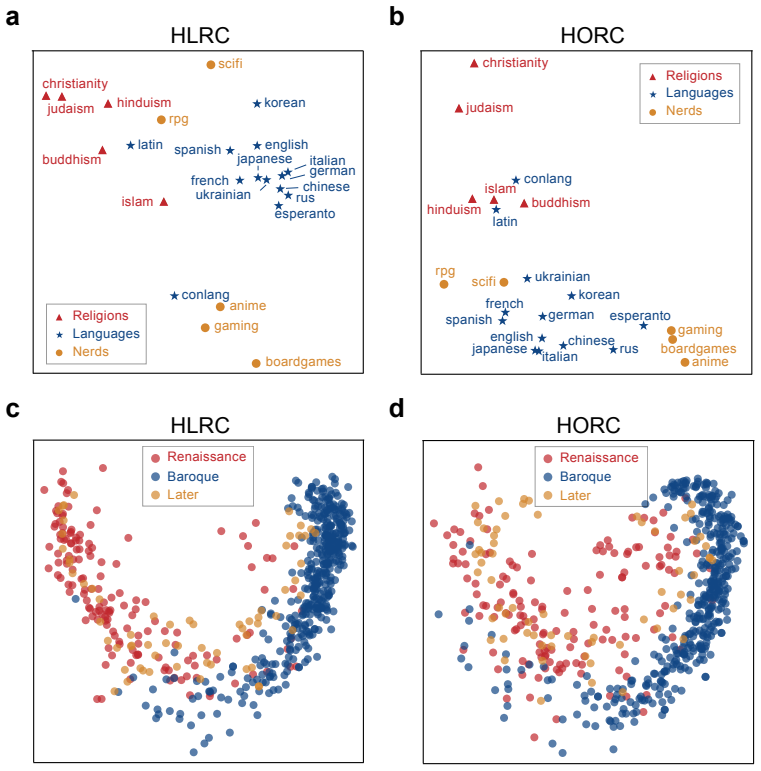
The central claim is that there exists a closed-form quantity, Eq. (1), $$ \mathrm{HLRC}(e) = \sum_{v\in e} \frac{1}{n_v} + \frac{n_e + d_e/2 - 1}{\max_{v\in e} n_v} + \frac{n_e + d_e/2 - 1}{\min_{v\in e} n_v} - 1, $$ which is a legitimate lower Ricci curvature for an unweighted, undirected hyperedge $e$: it is provably bounded in $(-1,1]$, attains 1 on complete hypergraphs, 0 on hypergrids, is non-negative on hypercycles, and becomes negative on bridging or bottleneck hyperedges. The authors show that in synthetic stochastic-block-model hypergraphs and in real-world contact and co-authorship hypergraphs, HLRC assigns significantly higher values to intra-community hyperedges than to inter-community bridges, separates venues or conferences by their theory-versus-application character, tracks temporal changes in collaboration cohesion, and produces hypergraph-cluster embeddings with higher adjusted Rand index and adjusted mutual information than HORC-based embeddings—all with runtimes on the order of HFRC, far below HORC's optimal-transport cost.
Load-bearing premise
The formula's specific normalization—the 1/2 coefficient, the -1 offset, and the max/min denominators—is chosen by hand rather than derived from a theory, and the authors themselves describe the theoretical foundation as largely heuristic; if that particular combination is arbitrary, the observed separations could be artifacts of the chosen formula rather than evidence of a genuine geometric invariant.
Editorial extensions
If this is right
- Community detection on hypergraphs can be done by thresholding a single per-hyperedge number instead of solving an optimal transport problem for every edge.
- Curvature histograms become a cheap global signature for a whole hypergraph, letting collections of hypergraphs be clustered by semantic or stylistic type.
- The fixed $(-1,1]$ scale makes curvature values comparable across datasets, addressing HFRC's lack of an intrinsic reference range.
- Bridge and bottleneck hyperedges—candidate anomalies, transmission paths, or interdisciplinary links—can be flagged as the most negative HLRC edges.
- Hypergraph neural networks can use HLRC as an edge-level filter to counter over-smoothing and over-squashing, a direction the authors propose.
Reading between the lines
- A direct test the paper does not run is to correlate HLRC with the Wasserstein-based HORC over a large random corpus of hypergraphs; the reported comparisons are task-based, so they show HLRC winning on selected separations, not that HLRC approximates HORC as a number.
- If the shared-neighbor term is the main driver, HLRC should also separate communities on the graph projection of any hypergraph; computing it on the projected graph and comparing would isolate what the hypergraph formulation adds beyond clique expansion.
- The formula suggests a null-model normalization: replacing $n_e$ by its expectation under a configuration model would yield a z-scored curvature, turning the observed bimodal separation into a statistical test for surprising bridges.
- Because HLRC is cheap to evaluate, it could serve as a prefilter that selects hyperedges for expensive HORC computation, approximating full geometric curvature with a bounded budget.
Editorial analysis
A structured set of objections, weighed in public.
Referee Report
Summary. The paper introduces Hypergraph Lower Ricci Curvature (HLRC), a closed-form scalar assigned to each hyperedge via Eq. (1), combining inverse node-degree sums, hyperedge neighborhood size, and max/min node-degree normalizations. The authors claim HLRC is provably bounded in (-1,1], computable in near-linear time, and able to separate intra-community from inter-community hyperedges, with applications to community detection, venue-level co-authorship analysis, temporal trend tracking, and clustering of hypergraph collections. The evaluation includes special uniform hypergraphs, synthetic HSBM hypergraphs, the Contact High School dataset, the MADStat and MAG-10 co-authorship hypergraphs, and the Stex and Mus collections, with comparisons against HORC and HFRC.
Significance. If the identified inconsistencies are resolved, HLRC would be a practically attractive descriptor: it is closed-form, provably bounded in (-1,1], shows a clear separation in the synthetic SBM experiments, runs orders of magnitude faster than HORC, and is accompanied by public code and data. The main value is empirical scalability rather than mathematical novelty. However, the paper's central claim to be a 'curvature' measure is weakened by the admitted heuristic nature of Eq. (1), and the current text contains a direct contradiction about the sign of the intra/inter-community effect that every downstream interpretation depends on. The empirical results are potentially useful, but the presentation must first be made internally consistent.
major comments (5)
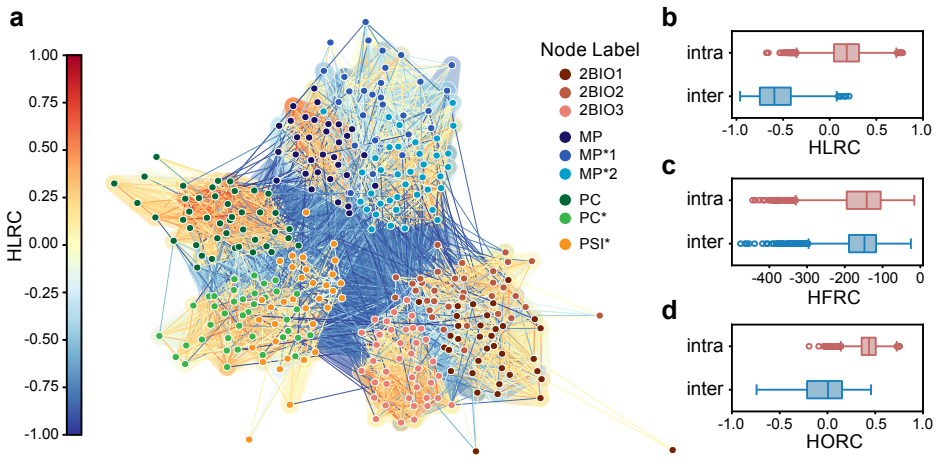
- [Section 2.2, Fig. 2 caption and text after Fig. 2b-d] The direction of the reported effect is stated twice in opposite ways. The Fig. 2 caption and the paragraph preceding it say that intra-classroom hyperedges have higher (more positive) HLRC and boundary/inter-classroom hyperedges have strongly negative HLRC, while the paragraph after Fig. 2b-d says 'both HLRC and HORC sharply distinguish these categories, assigning significantly lower curvature to intra-community hyperedges and higher curvature to inter-community hyperedges.' These statements cannot both be true. Since Sections 2.3, 2.4, and the Discussion interpret positive curvature as cohesion and negative curvature as bridging, the entire empirical story depends on which direction is correct. Please correct the statement, verify the sign in Fig. 2b, and state the effect direction consistently throughout.
- [Supplementary Note S1.1/S1.2; Section 4.4] The allowed range of HORC is given inconsistently. Supplementary Note S1.1 states that 'regardless of which reasonable choices one makes for AGG and mu, the resulting HORC value always lies in the interval [-2,-1]', while S1.2 and Section 4.4 use [-2,1] (with 60 histogram bins spanning [-2,1]). If HORC is confined to [-2,-1], the histogram binning in Section 4.4 and the comparisons in Fig. 2 and Table 3 are based on a miscalibrated feature representation; if the range is [-2,1], then S1.1's universal bound is wrong. Please reconcile the two statements and justify or re-run the clustering comparison under the correct range.
- [Section 4.2 vs Supplementary S2.3, Theorem 3] The statement of the hypercycle theorem is internally inconsistent. Section 4.2 introduces the closed-form expression under the condition 'when the hypercyle is large enough i.e. m>=2k', but Supplementary Theorem 3 specifies different regimes (m=2; m>=3; m=3; m>=4; m<2k; m>=2k), and the formula given for k>2s in the supplement is said to hold for m>=3, not only for m>=2k. For example, with k=5, s=2, m=3, the main-text condition m>=2k excludes a case that the supplement's m>=3 branch covers. Moreover, the 'intermediate regimes' are explicitly omitted from both the displayed formulas and the proof. Please state the exact conditions for each branch and either supply the omitted formulas or restrict the theorem to the cases actually proved.
- [Section 2.1 and Table 1] The paper says HLRC is defined 'for a given hyperedge of degree greater than two', but the real datasets in Table 1 contain large fractions of hyperedges of size 2 (70.3% for Contact High School, 40.8% for MADStat, 29.9% for MAG-10), and Section 4.4 states that curvature values were computed for 'all hyperedges' and 'edges of all sizes'. It is therefore unclear whether Eq. (1) was applied to de=2 hyperedges, how n_e is defined for them, and why the definition excludes them. Please clarify the domain of Eq. (1), and if pairwise hyperedges are included, state this explicitly and adjust the wording 'greater than two' (and Theorem 1's 'de>1').
- [Section 3 Discussion and Eq. (1)] The paper calls HLRC an extension of lower Ricci curvature for graphs (reference [25]) but provides no derivation connecting Eq. (1) to that graph notion; the coefficients 1/2 and the offset -1 are presented without derivation, and the Discussion concedes that the 'theoretical foundations remain largely heuristic'. Since the geometric interpretation underlies the interpretation of all experiments, either give a precise derivation or limiting argument from the graph lower Ricci curvature, or reframe HLRC as a closed-form heuristic descriptor rather than as a curvature extension. This is not a reason to reject the empirical results, but the current framing overstates the theoretical status.
minor comments (4)
- [Table 4 vs Supplementary S2.2] The notation for average hyperedge size is inconsistent: Table 4 uses \bar d_e, while Supplementary S2.2 uses \bar d_v for the same quantity, which is also confusing because d_v elsewhere denotes node degree.
- [Figure 2b-d] The real-data separation in Fig. 2b-d is not accompanied by effect sizes or test statistics, although significance is reported for the synthetic SBM results. Please add quantitative summaries (medians, p-values) for the high-school comparison.
- [Table 3 and Sections 2.4, 3] The abstract and Section 2.4 claim that HLRC outperforms both HORC and HFRC, but Table 3 and the clustering pipeline compare only HLRC with HORC; HFRC is absent from the clustering evaluation. Please either add HFRC results or adjust the claim.
- [Throughout] There are several typographical errors and grammatical slips, including '2-reguluar' in the Fig. 1 caption, 'a interpretable' in Section 2.1, 'These results demonstrates' in Section 2.2, and 'hypercyle' in Section 4.2. A careful proofreading pass is needed.
Circularity Check
No load-bearing circularity; HLRC's derivation is self-contained, with only a minor framing self-citation and separate internal inconsistencies.
full rationale
The derivation chain is self-contained. Eq. (1) is an explicit closed-form definition; the claimed bounds (−1,1] are proven in Supplementary Note S2.1 directly from this definition via n_v ≥ d_e−1+n_e, not imported from prior work. The special-hypergraph values (complete = 1, hypergrid = 0, hypertree formulas, hypercycle regimes) are obtained by substituting the defining parameters into Eq. (1), so they are arithmetic consequences of the definition rather than fitted predictions. The SBM, high-school, co-authorship, and clustering experiments use externally defined datasets and labels; the formula contains no fitted parameters, so these provide independent empirical content. The only self-citation is Ref. [25] (Park & Li; D. Li is a co-author), used to name and frame HLRC as an extension of graph lower Ricci curvature; no load-bearing theorem is imported from it. The paper itself concedes in the Discussion that HLRC's 'theoretical foundations remain largely heuristic,' which is a limitation, not a circularity. Separate non-circular correctness risks should be noted: Section 2.2 first says intra-classroom hyperedges have higher curvature (Fig. 2 caption) and then says HLRC assigns 'significantly lower curvature to intra-community hyperedges,' an unresolved contradiction; S1.1 states HORC lies in [−2,−1] while S1.2 and the main text use [−2,1]; and S1.1 says the HORC variant was chosen to 'mirror the HLRC philosophy,' which weakens it as an independent baseline. These affect interpretability but do not make the derivation circular.
Assumptions & free parameters
free parameters (2)
- Coefficient of d_e in the hyperedge adjustment terms =
1/2
- Offset term in HLRC =
-1
assumptions (3)
- ad hoc to paper HLRC is defined by Eq. (1) as a valid curvature measure.
- domain assumption Node adjacency is defined as co-membership in at least one hyperedge, and the hyperedge neighborhood N(e) is the intersection of the node neighborhoods.
- ad hoc to paper In k-uniform s-intersecting hypercycles, the omitted intermediate regimes of Theorem 3 are assumed to follow the same counting argument.
Cite this review
Pith. "Pith review of Lower Ricci Curvature for Hypergraphs." pith.science (2026). https://pith.science/paper/ETRJZRQB
@misc{pith2026250603943,
  author       = {Pith},
  title        = {Pith review of: Lower Ricci Curvature for Hypergraphs},
  year         = {2026},
  howpublished = {\url{https://pith.science/paper/ETRJZRQB}},
  note         = {Machine review of arXiv:2506.03943}
}
read the original abstract
Networks with higher-order interactions, prevalent in biological, social, and information systems, are naturally represented as hypergraphs, yet their structural complexity poses fundamental challenges for geometric characterization. While curvature-based methods offer powerful insights in graph analysis, existing extensions to hypergraphs suffer from critical trade-offs: combinatorial approaches such as Forman-Ricci curvature capture only coarse features, whereas geometric methods like Ollivier-Ricci curvature offer richer expressivity but demand costly optimal transport computations. To address these challenges, we introduce hypergraph lower Ricci curvature (HLRC), a novel curvature metric defined in closed form that achieves a principled balance between interpretability and efficiency. Evaluated across diverse synthetic and real-world hypergraph datasets, HLRC consistently reveals meaningful higher-order organization, distinguishing intra- from inter-community hyperedges, uncovering latent semantic labels, tracking temporal dynamics, and supporting robust clustering of hypergraphs based on global structure. By unifying geometric sensitivity with algorithmic simplicity, HLRC provides a versatile foundation for hypergraph analytics, with broad implications for tasks including node classification, anomaly detection, and generative modeling in complex systems.
Figures


Figures from the paper (1 more)
Reference graph
Works this paper leans on
-
[25]
Lower Ricci curvature for efficient community detection.arXiv preprint arXiv:2401.10124, 2024
Yun Jin Park and Didong Li. Lower Ricci curvature for efficient community detection.arXiv preprint arXiv:2401.10124, 2024
arXiv 2024
-
[1]
The temporal dynamics of group interactions in higher-order social networks.Nature Communications, 15(1):7391, 2024
Iacopo Iacopini, Márton Karsai, and Alain Barrat. The temporal dynamics of group interactions in higher-order social networks.Nature Communications, 15(1):7391, 2024
2024
-
[2]
Jianming Zhu, Junlei Zhu, Smita Ghosh, Weili Wu, and Jing Yuan. Social influence maximization in hypergraph in social networks.IEEE Transactions on Network Science and Engineering, 6(4):801–811, 2018. 10
work page 2018
-
[3]
Hypergraph topological quantities for tagged social networks
Vinko Zlati´c, Gourab Ghoshal, and Guido Caldarelli. Hypergraph topological quantities for tagged social networks. Physical Review E—Statistical, Nonlinear, and Soft Matter Physics, 80(3):036118, 2009
work page 2009
-
[4]
Hanrui Wu, Yuguang Yan, and Michael Kwok-Po Ng. Hypergraph collaborative network on vertices and hyperedges.IEEE Transactions on Pattern Analysis and Machine Intelligence, 45(3):3245–3258, 2022
work page 2022
-
[5]
Jürgen Lerner, Marian-Gabriel Hâncean, and Alessandro Lomi. Relational hyperevent models for the coevolution of coauthoring and citation networks.Journal of the Royal Statistical Society Series A: Statistics in Society, 188(2):583–607, 2025
work page 2025
-
[6]
Simin Xia, Dianke Li, Xinru Deng, Zhongyang Liu, Huaqing Zhu, Yuan Liu, and Dong Li. Integration of protein sequence and protein–protein interaction data by hypergraph learning to identify novel protein complexes. Briefings in Bioinformatics, 25(4):bbae274, 2024
work page 2024
-
[7]
Zitong Zhang, Lingling Zhao, Junjie Wang, and Chunyu Wang. A hierarchical graph neural network framework for predicting protein-protein interaction modulators with functional group information and hypergraph structure. IEEE Journal of Biomedical and Health Informatics, 2024
work page 2024
Show all 60 references
-
[8]
Elsevier, 1984
Claude Berge.Hypergraphs: combinatorics of finite sets, volume 45. Elsevier, 1984
1984
-
[9]
Hypergraph theory.An introduction
Alain Bretto. Hypergraph theory.An introduction. Mathematical Engineering. Cham: Springer, 1:209–216, 2013
2013
-
[10]
Tensor entropy for uniform hypergraphs.IEEE Transactions on Network Science and Engineering, 7(4):2889–2900, 2020
Can Chen and Indika Rajapakse. Tensor entropy for uniform hypergraphs.IEEE Transactions on Network Science and Engineering, 7(4):2889–2900, 2020
2020
-
[11]
Controllability of hypergraphs.IEEE Transactions on Network Science and Engineering, 8(2):1646–1657, 2021
Can Chen, Amit Surana, Anthony M Bloch, and Indika Rajapakse. Controllability of hypergraphs.IEEE Transactions on Network Science and Engineering, 8(2):1646–1657, 2021
2021
-
[12]
Diversities and the geometry of hypergraphs.Discrete Mathematics & Theoretical Computer Science, 16(PRIMA 2013), 2014
David Bryant and Paul Tupper. Diversities and the geometry of hypergraphs.Discrete Mathematics & Theoretical Computer Science, 16(PRIMA 2013), 2014
2013
-
[13]
Graph geometry interaction learning
Shichao Zhu, Shirui Pan, Chuan Zhou, Jia Wu, Yanan Cao, and Bin Wang. Graph geometry interaction learning. Advances in Neural Information Processing Systems, 33:7548–7558, 2020
2020
-
[14]
Network geometry inference using common neighbors.Physical Review E, 92(2):022807, 2015
Fragkiskos Papadopoulos, Rodrigo Aldecoa, and Dmitri Krioukov. Network geometry inference using common neighbors.Physical Review E, 92(2):022807, 2015
2015
-
[15]
Geometric deep learning on graphs and manifolds using mixture model cnns
Federico Monti, Davide Boscaini, Jonathan Masci, Emanuele Rodola, Jan Svoboda, and Michael M Bronstein. Geometric deep learning on graphs and manifolds using mixture model cnns. InProceedings of the IEEE conference on computer vision and pattern recognition, pages 5115–5124, 2017
2017
-
[16]
Curvature measures.Transactions of the American Mathematical Society, 93(3):418–491, 1959
Herbert Federer. Curvature measures.Transactions of the American Mathematical Society, 93(3):418–491, 1959
1959
-
[17]
Curvature graph network
Ze Ye, Kin Sum Liu, Tengfei Ma, Jie Gao, and Chao Chen. Curvature graph network. InInternational conference on learning representations, 2019
2019
-
[18]
Ricci curvature of Markov chains on metric spaces.Journal of Functional Analysis, 256(3):810–864, 2009
Yann Ollivier. Ricci curvature of Markov chains on metric spaces.Journal of Functional Analysis, 256(3):810–864, 2009
2009
-
[19]
A survey of Ricci curvature for metric spaces and Markov chains
Yann Ollivier. A survey of Ricci curvature for metric spaces and Markov chains. InProbabilistic approach to geometry, volume 57, pages 343–382. Mathematical Society of Japan, 2010
2010
-
[20]
Ricci curvature for metric-measure spaces via optimal transport.Annals of Mathematics, pages 903–991, 2009
John Lott and Cédric Villani. Ricci curvature for metric-measure spaces via optimal transport.Annals of Mathematics, pages 903–991, 2009
2009
-
[21]
Ricci curvature of graphs.Tohoku Mathematical Journal, Second Series, 63(4):605–627, 2011
Yong Lin, Linyuan Lu, and Shing-Tung Yau. Ricci curvature of graphs.Tohoku Mathematical Journal, Second Series, 63(4):605–627, 2011
2011
-
[22]
Mitigating over-smoothing and over-squashing using augmentations of Forman- Ricci curvature
Lukas Fesser and Melanie Weber. Mitigating over-smoothing and over-squashing using augmentations of Forman- Ricci curvature. InLearning on Graphs Conference, pages 19–1. PMLR, 2024
2024
-
[23]
Forman curvature for complex networks.Journal of Statistical Mechanics: Theory and Experiment, 2016(6):063206, 2016
RP Sreejith, Karthikeyan Mohanraj, Jürgen Jost, Emil Saucan, and Areejit Samal. Forman curvature for complex networks.Journal of Statistical Mechanics: Theory and Experiment, 2016(6):063206, 2016
2016
-
[24]
Ollivier-Ricci curvature-based method to community detection in complex networks.Scientific reports, 9(1):9800, 2019
Jayson Sia, Edmond Jonckheere, and Paul Bogdan. Ollivier-Ricci curvature-based method to community detection in complex networks.Scientific reports, 9(1):9800, 2019
2019
-
[26]
Curvature-based clustering on graphs.Journal of Machine Learning Research, 26(52):1–67, 2025
Yu Tian, Zachary Lubberts, and Melanie Weber. Curvature-based clustering on graphs.Journal of Machine Learning Research, 26(52):1–67, 2025
2025
-
[27]
Mixed-membership community detection via line graph curvature
Yu Tian, Zachary Lubberts, and Melanie Weber. Mixed-membership community detection via line graph curvature. InNeurIPS Workshop on Symmetry and Geometry in Neural Representations, pages 219–233. PMLR, 2023. 11
2023
-
[28]
Graph curvature for differentiating cancer networks.Scientific reports, 5(1):12323, 2015
Romeil Sandhu, Tryphon Georgiou, Ed Reznik, Liangjia Zhu, Ivan Kolesov, Yasin Senbabaoglu, and Allen Tannenbaum. Graph curvature for differentiating cancer networks.Scientific reports, 5(1):12323, 2015
2015
-
[29]
Characterizing cancer drug response and biological correlates: a geometric network approach.Scientific reports, 8(1):6402, 2018
Maryam Pouryahya, Jung Hun Oh, James C Mathews, Joseph O Deasy, and Allen R Tannenbaum. Characterizing cancer drug response and biological correlates: a geometric network approach.Scientific reports, 8(1):6402, 2018
2018
-
[30]
Rena Elkin, Jung Hun Oh, Ying L Liu, Pier Selenica, Britta Weigelt, Jorge S Reis-Filho, Dmitriy Zamarin, Joseph O Deasy, Larry Norton, Arnold J Levine, et al. Geometric network analysis provides prognostic information in patients with high grade serous carcinoma of the ovary t...
2021
-
[31]
Georgiou, Allen Tannenbaum, and Christophe Lenglet
Hamza Farooq, Yongxin Chen, Tryphon T. Georgiou, Allen Tannenbaum, and Christophe Lenglet. Network curvature as a hallmark of brain structural connectivity.Nature Communications, 10(1):4937, 2019
2019
-
[32]
Measuring road network topology vulnerability by Ricci curvature.Physica A: Statistical Mechanics and Its Applications, 527:121071, 2019
Lei Gao, Xingquan Liu, Yu Liu, Pu Wang, Min Deng, Qing Zhu, and Haifeng Li. Measuring road network topology vulnerability by Ricci curvature.Physica A: Statistical Mechanics and Its Applications, 527:121071, 2019
2019
-
[33]
Vulnerability analysis method based on network and copula entropy.Entropy, 26(3):192, 2024
Mengyuan Chen, Jilan Liu, Ning Zhang, and Yichao Zheng. Vulnerability analysis method based on network and copula entropy.Entropy, 26(3):192, 2024
2024
-
[34]
Analyzing neural network robustness using graph curvature
Shuhang Tan, Jayson Sia, Paul Bogdan, and Radoslav Ivanov. Analyzing neural network robustness using graph curvature. In2024 International Conference on Assured Autonomy (ICAA), pages 110–113. IEEE, 2024
2024
-
[35]
Ollivier-Ricci curvature approach to cost-effective power grid congestion management
Edmond Jonckheere and Eugenio Grippo. Ollivier-Ricci curvature approach to cost-effective power grid congestion management. In2019 Chinese control and decision conference (CCDC), pages 2118–2123. IEEE, 2019
2019
-
[36]
Understanding over-squashing and bottlenecks on graphs via curvature.arXiv preprint arXiv:2111.14522, 2021
Jake Topping, Francesco Di Giovanni, Benjamin Paul Chamberlain, Xiaowen Dong, and Michael M Bronstein. Understanding over-squashing and bottlenecks on graphs via curvature.arXiv preprint arXiv:2111.14522, 2021
2021 arXiv
-
[37]
Curvature graph neural network.Information Sciences, 592:50–66, 2022
Haifeng Li, Jun Cao, Jiawei Zhu, Yu Liu, Qing Zhu, and Guohua Wu. Curvature graph neural network.Information Sciences, 592:50–66, 2022
2022
-
[38]
A self-supervised mixed- curvature graph neural network
Li Sun, Zhongbao Zhang, Junda Ye, Hao Peng, Jiawei Zhang, Sen Su, and Philip S Yu. A self-supervised mixed- curvature graph neural network. InProceedings of the AAAI Conference on Artificial Intelligence, volume 36, pages 4146–4155, 2022
2022
-
[39]
Curvdrop: A Ricci curva- ture based approach to prevent graph neural networks from over-smoothing and over-squashing
Yang Liu, Chuan Zhou, Shirui Pan, Jia Wu, Zhao Li, Hongyang Chen, and Peng Zhang. Curvdrop: A Ricci curva- ture based approach to prevent graph neural networks from over-smoothing and over-squashing. InProceedings of the ACM Web Conference 2023, pages 221–230, 2023
2023
-
[40]
Ricci curvature of the internet topology
Chien-Chun Ni, Yu-Yao Lin, Jie Gao, Xianfeng David Gu, and Emil Saucan. Ricci curvature of the internet topology. In2015 IEEE conference on computer communications (INFOCOM), pages 2758–2766. IEEE, 2015
2015
-
[41]
Comparative analysis of two discretizations of Ricci curvature for complex networks.Scientific reports, 8(1):8650, 2018
Areejit Samal, RP Sreejith, Jiao Gu, Shiping Liu, Emil Saucan, and Jürgen Jost. Comparative analysis of two discretizations of Ricci curvature for complex networks.Scientific reports, 8(1):8650, 2018
2018
-
[42]
ORCO: Ollivier-Ricci Curvature-Omics—an unsupervised method for analyzing robustness in biological systems.Bioinformatics, 41(3):btaf093, 2025
Anish K Simhal, Corey Weistuch, Kevin Murgas, Daniel Grange, Jiening Zhu, Jung Hun Oh, Rena Elkin, and Joseph O Deasy. ORCO: Ollivier-Ricci Curvature-Omics—an unsupervised method for analyzing robustness in biological systems.Bioinformatics, 41(3):btaf093, 2025
2025
-
[43]
Inferring functional communities from partially observed biological networks exploiting geometric topology and side information.Scientific Reports, 12(1):10883, 2022
Jayson Sia, Wei Zhang, Edmond Jonckheere, David Cook, and Paul Bogdan. Inferring functional communities from partially observed biological networks exploiting geometric topology and side information.Scientific Reports, 12(1):10883, 2022
2022
-
[44]
Ollivier Ricci curvature of directed hypergraphs.Scientific Reports, 10(1):12466, 2020
Marzieh Eidi and Jürgen Jost. Ollivier Ricci curvature of directed hypergraphs.Scientific Reports, 10(1):12466, 2020
2020
-
[45]
Ollivier-Ricci curvature for hypergraphs: A unified framework
Corinna Coupette, Sebastian Dalleiger, and Bastian Rieck. Ollivier-Ricci curvature for hypergraphs: A unified framework. InEleventh International Conference on Learning Representations (ICLR 2023). OpenReview. net, 2023
2023
-
[46]
Forman–Ricci curvature for hypergraphs
Wilmer Leal, Guillermo Restrepo, Peter F Stadler, and Jürgen Jost. Forman–Ricci curvature for hypergraphs. Advances in Complex Systems, 24(01):2150003, 2021
2021
-
[47]
Consistency of spectral partitioning of uniform hypergraphs under planted partition model.Advances in Neural Information Processing Systems, 27, 2014
Debarghya Ghoshdastidar and Ambedkar Dukkipati. Consistency of spectral partitioning of uniform hypergraphs under planted partition model.Advances in Neural Information Processing Systems, 27, 2014
2014
-
[48]
Contact patterns in a high school: A comparison between data collected using wearable sensors, contact diaries and friendship surveys.PLOS ONE, 10(9):e0136497, 2015
Rossana Mastrandrea, Julie Fournet, and Alain Barrat. Contact patterns in a high school: A comparison between data collected using wearable sensors, contact diaries and friendship surveys.PLOS ONE, 10(9):e0136497, 2015
2015
-
[49]
Hypergraph clustering: from blockmodels to modularity
Philip S Chodrow, Nate Veldt, and Austin R Benson. Hypergraph clustering: from blockmodels to modularity. Science Advances, 2021. 12
2021
-
[50]
Spring embedders and force directed graph drawing algorithms.arXiv preprint arXiv:1201.3011, 2012
Stephen G Kobourov. Spring embedders and force directed graph drawing algorithms.arXiv preprint arXiv:1201.3011, 2012
2012 arXiv
-
[51]
Co-citation and co-authorship networks of statisticians.Journal of Business & Economic Statistics, 40(2):469–485, 2022
Pengsheng Ji, Jiashun Jin, Zheng Tracy Ke, and Wanshan Li. Co-citation and co-authorship networks of statisticians.Journal of Business & Economic Statistics, 40(2):469–485, 2022
2022
-
[52]
Clustering in graphs and hypergraphs with categorical edge labels
Ilya Amburg, Nate Veldt, and Austin Benson. Clustering in graphs and hypergraphs with categorical edge labels. InProceedings of the web conference 2020, pages 706–717, 2020
2020
-
[53]
An overview of microsoft academic service (MAS) and applications
Arnab Sinha, Zhihong Shen, Yang Song, Hao Ma, Darrin Eide, Bo-June (Paul) Hsu, and Kuansan Wang. An overview of microsoft academic service (MAS) and applications. InProceedings of the 24th International Conference on World Wide Web. ACM Press, 2015
2015
-
[54]
Comparing partitions.Journal of classification, 2:193–218, 1985
Lawrence Hubert and Phipps Arabie. Comparing partitions.Journal of classification, 2:193–218, 1985
1985
-
[55]
Nguyen Xuan Vinh, Julien Epps, and James Bailey. Information theoretic measures for clusterings comparison: is a correction for chance necessary? InProceedings of the 26th annual international conference on machine learning, pages 1073–1080, 2009
2009
-
[56]
Dually chordal graphs.SIAM journal on discrete mathematics, 11(3):437–455, 1998
Andreas Brandstädt, Feodor Dragan, Victor Chepoi, and Vitaly V oloshin. Dually chordal graphs.SIAM journal on discrete mathematics, 11(3):437–455, 1998
1998
-
[57]
Radial basis functions.Acta numerica, 9:1–38, 2000
Martin Dietrich Buhmann. Radial basis functions.Acta numerica, 9:1–38, 2000
2000
-
[58]
Kernel principal component analysis
Bernhard Schölkopf, Alexander Smola, and Klaus-Robert Müller. Kernel principal component analysis. In International conference on artificial neural networks, pages 583–588. Springer, 1997
1997
-
[59]
Some methods for classification and analysis of multivariate observations
James MacQueen. Some methods for classification and analysis of multivariate observations. InProceedings of the Fifth Berkeley Symposium on Mathematical Statistics and Probability, Volume 1: Statistics, volume 5, pages 281–298. University of California press, 1967
1967
-
[60]
Lower Ricci Curvature for Hypergraphs
Bogumił Kami´nski, Valérie Poulin, Paweł Prałat, Przemysław Szufel, and François Théberge. Clustering via hypergraph modularity.PloS one, 14(11):e0224307, 2019. 13 Supplement of “Lower Ricci Curvature for Hypergraphs" S1 Recap of prior hypergraph curvature definitions. In this...
2019
Reviewed August 7, 2026 · model on record in the stance chip above.
Discussion (0). Sign in to comment.