REVIEW 3 major objections 4 minor 44 references
CoDEx: Combining Domain Expertise for Spatial Generalization in Satellite Image Analysis
T0 review · 3 major / 4 minor · reviewed 2026-08-16 · deepseek-v4-flash
Pith's one-line read CoDEx claims that training one expert per training region and learning to mix their predictions with a source-only selection head yields consistent spatial generalization gains over existing domain-generalization and adaptation methods on…
desk verdict A well-built incremental extension of D3G with a learned affinity matrix and a learned expert-selection head, but the headline claim of consistent gains over D3G rests on sub-point margins without error bars. read the letter →
The pith
A machine-rendered reading of the paper's core claim, the machinery that carries it, and where it could break.
The reading
What carries the argument
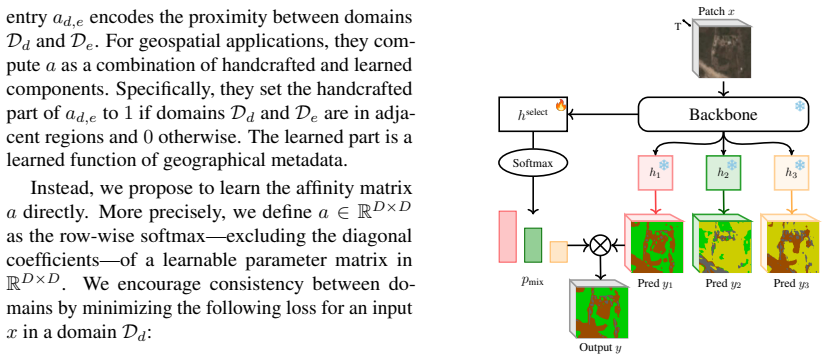
The framework rests on three pieces: per-domain experts, a learned affinity matrix, and a selection head. Each expert is a shared backbone plus a small head for its own training domain. The affinity matrix is a row-wise softmax over a learnable D-by-D parameter matrix, and it feeds a consistency loss that makes an expert from a domain similar to d also predict correctly on samples from d. The selection head h_select takes backbone features from a test sample, outputs a predicted accuracy for each expert, and turns those values into mixture weights with a softmax; a mixture loss supervises the weighted combination directly. At inference only the weighted mixture is used, so the method needs no geographic metadata, no target labels, no target images for adaptation, and adds only a few thousand parameters (roughly $D^{2}$ for the affinity plus the head).
What would settle it
Evaluate the selection head on a held-out target domain and compute, per test sample, the rank correlation between the accuracy vector it predicts and the actual per-expert accuracy; if that correlation is near zero or negative on new domains, the mixture weights are not transferring and CoDEx would reduce to a fixed expert average.
Extended reading notes
Core claim
The central claim is that spatial domain shift in satellite imagery is better handled by a multi-expert design than by any single domain-invariant model. CoDEx trains D experts, one per source domain, that share a backbone but keep their own output heads, and a fully learned affinity matrix that encourages experts of similar domains to agree. A selection head, trained only on source data, predicts each expert's accuracy on a given input and converts those estimates into mixture weights, with a second loss supervising the final mixture directly. The paper asserts that this beats all compared approaches on DynamicEarthNet, MUDS, and FMoW, and is slightly behind only the D3G method on OSCD-3ch, while also beating domain-adaptation methods that used target-domain inputs; on all four benchmarks only CoDEx and D3G exceed the single-model baseline.
Load-bearing premise
The selection head, trained only on source domains, keeps predicting which expert is best when it sees an image from a never-seen domain; the FMoW oracle gap (91.1 versus 53.9) shows it is far from perfect, so the whole gain depends on this transfer.
Editorial extensions
If this is right
- Spatial generalization in Earth observation can improve without target-domain data by replacing one generalist model with a set of specialists and a learned combiner.
- The same recipe transfers across tasks: semantic segmentation, binary change detection, and 62-class land-use classification, and across three backbone architectures.
- Because the selection head reads only the input image, the method applies directly to unseen locations with no fine-tuning and no metadata at test time.
- The computational overhead is small: roughly 14% extra training time, about 213K additional parameters for 55 domains, and about 6% extra inference time.
Reading between the lines
- Beyond the paper: the selection-head mechanism is backbone-agnostic, so the same expert-and-mixture recipe could plausibly extend to other sensor modalities, temporal sampling protocols, or foundation-model features; this specific claim is not tested in the paper.
- Beyond the paper: because the affinity matrix is fully learned, it offers a natural probe for which properties drive domain similarity; comparing learned affinities to climate or land-cover categories would be a direct test of whether geographic proximity is being replaced by functional similarity.
- Beyond the paper: the large oracle gap on FMoW (91.1 versus 53.9) suggests the selection head becomes the bottleneck as the number of experts grows, so a follow-up could test whether a learned router with larger capacity or a hierarchical grouping of experts closes part of that gap.
Signed reviews
Editorial analysis
A structured set of objections, weighed in public.
Referee Report
Summary. The paper proposes CoDEx, a domain-generalization framework for satellite imagery in which one expert is trained per training domain on a shared backbone, an affinity matrix between domains is learned rather than handcrafted, a consistency loss encourages similar experts to agree, and a second-stage selection head predicts per-expert accuracy from input features and uses a softmax mixture to aggregate expert predictions at test time without target-domain data. The method is evaluated on DynamicEarthNet, MUDS, OSCD-3ch, and FMoW across segmentation, change detection, and classification, with ablations over the affinity formulation, the two selection losses, temporal pooling, and backbone choice. The central claim is that CoDEx consistently outperforms ten prior domain-generalization and domain-adaptation methods.
Significance. If the empirical claims hold, CoDEx would be a useful contribution: it is a clearly specified, parameter-light mechanism for multi-expert spatial generalization that avoids geographic metadata at test time, and the paper covers four datasets, three tasks, and multiple backbones with public code. The ablations in Section 4.3 are informative and support the role of the consistency loss and the accuracy-prediction loss within the proposed pipeline. However, the headline result rests on sub-point margins over a self-implemented baseline, with no reported variance, and the transfer of the source-trained selection head to unseen domains is not analyzed; these issues currently limit the strength of the conclusions.
major comments (3)
- [Section 4.2, Table 2] The central quantitative claim that CoDEx 'consistently outperforms competing methods' is supported only by differences of 0.3 to 0.4 points over D3G on DynamicEarthNet, MUDS, and FMoW, and by a 0.3-point deficit on OSCD-3ch, with no standard deviations, confidence intervals, number of seeds, or significance tests reported anywhere in Sections 3.3 or 4. Without this variance information, these margins cannot be distinguished from run-to-run noise, and the abstract's and conclusion's stronger wording is not justified. Please run the main comparison over multiple seeds and report means with confidence intervals or significance tests, and do the same for the ablations in Tables 3 and 4, where the learned-affinity advantage is only 0.1-0.2 points.
- [Section 3.2 and Section 4.2, FMoW row] The selection head h_select is trained exclusively on source-domain samples (Section 3.2), and the paper's framework depends on the assumption that its accuracy estimates remain informative on unseen target domains. The FMoW result in Table 2—Oracle 91.1 versus CoDEx 53.9—shows a large gap between the best per-sample expert and the learned mixture, which sits uneasily with the Section 4.2 claim that the selection mechanism 'effectively identifies the best experts' on MUDS. Please provide a direct analysis of selection-head transfer: for example, report the correlation between predicted and true per-expert accuracy on target test samples, or the fraction of test samples where the top-weight expert is among the top few true experts, per dataset. This would clarify whether the source-only selection module is genuinely transferable.
- [Section 4.2 and Section 3.3] D3G, the strongest baseline, is a self-implementation ('results are from our own implementation, which we will release'), and the paper does not specify which components of the original D3G were used, what domain metadata was supplied, or how its hyperparameters were tuned. Since the reported CoDEx advantage over D3G is at most 0.4 points, a slightly unfavorable implementation could change the ranking. Please add implementation details for D3G, state the number of seeds used for all baselines, and, if at all possible, release the D3G implementation and checkpoints alongside the code so the comparison is reproducible.
minor comments (4)
- [Figure 1] The caption reads 'Combing Domain Experts'; this should be 'Combining Domain Experts'.
- [Section 4.2, Qualitative Results] The text says Figure 4 shows 'DynamicEarthNet (i–iv), FMoW (v–vii), and OSCD-3ch. (viii)', while the figure caption says patches (v-vii) are from MUDS; the text then discusses MUDS in the following sentences. This inconsistency should be fixed.
- [Table 1 and Table 2] The dataset name is spelled 'DynEarthNet' in Table 1 and 'DynamicEarthNet' elsewhere; please use one consistent spelling.
- [Figure 5] The vertical axes of the four panels start at 30, 55, 40, and 45 respectively, which visually exaggerates the improvements; consider starting all axes at zero or at least noting the truncated axes in the caption.
Circularity Check
No significant circularity: CoDEx's selection head and affinity matrix are fitted on source domains and evaluated on disjoint target domains; no prediction reduces to its input by construction.
full rationale
The derivation chain is self-contained in the sense that no claimed prediction is equivalent to a fitted input. Domain experts are trained with the domain loss of Eq. (1) and a consistency loss of Eq. (2) using a learned affinity matrix; the selection head is then trained on frozen experts with the accuracy-prediction loss of Eq. (3) and the mixture-supervision loss of Eq. (4), using only source-domain labels. At inference, the learned weights combine experts for unseen target samples, and the reported numbers are measured on held-out target domains rather than recovered from the training objective. The affinity matrix is learned, not derived from the target result, and the selection head is not fitted to target-domain accuracy. The paper does contain self-citations: the baseline and backbone come from the authors' prior MultiUTAE work [36], and [35] is cited in related work. These are not load-bearing in a circular sense because [36] is an external architecture used as a baseline and backbone, and the comparison is empirical rather than definitional. The small margins over the D3G baseline and the fact that D3G is self-implemented are legitimate concerns about statistical strength and comparison fairness, but they are correctness risks, not circularity. No equation in the paper is equal to another by construction, and no fitted parameter is renamed as a prediction. Thus the appropriate circularity score is 0.
Assumptions & free parameters
free parameters (3)
- learnable affinity matrix a =
not reported, D by D row-softmax, D = 55, 40, 14, 100 per dataset
- softmax temperature tau =
1
- loss weights for Ldomain, Lcon, Lacc, Lmix =
1 each
assumptions (3)
- domain assumption The selection head trained on source domains will rank expert quality on unseen target domains better than random.
- ad hoc to paper The consistency loss encourages useful specialization rather than collapse to a universal model.
- domain assumption Shared backbone features are informative enough for both the domain heads and the selection head.
Cite this review
Pith. "Pith review of CoDEx: Combining Domain Expertise for Spatial Generalization in Satellite Image Analysis." pith.science (2026). https://pith.science/paper/ETRSEENA
@misc{pith2026250419737,
  author       = {Pith},
  title        = {Pith review of: CoDEx: Combining Domain Expertise for Spatial Generalization in Satellite Image Analysis},
  year         = {2026},
  howpublished = {\url{https://pith.science/paper/ETRSEENA}},
  note         = {Machine review of arXiv:2504.19737}
}
read the original abstract
Global variations in terrain appearance raise a major challenge for satellite image analysis, leading to poor model performance when training on locations that differ from those encountered at test time. This remains true even with recent large global datasets. To address this challenge, we propose a novel domain-generalization framework for satellite images. Instead of trying to learn a single generalizable model, we train one expert model per training domain, while learning experts' similarity and encouraging similar experts to be consistent. A model selection module then identifies the most suitable experts for a given test sample and aggregates their predictions. Experiments on four datasets (DynamicEarthNet, MUDS, OSCD, and FMoW) demonstrate consistent gains over existing domain generalization and adaptation methods. Our code is publicly available at https://github.com/Abhishek19009/CoDEx.
Figures


Figures from the paper (2 more)


Reference graph
Works this paper leans on
-
[1]
Martin Arjovsky, L ´eon Bottou, Ishaan Gulrajani, and David Lopez-Paz. Invariant risk minimization. arXiv preprint arXiv:1907.02893, 2019. 1
arXiv 1907
-
[2]
Un- supervised learning of visual features by contrasting cluster assignments
Mathilde Caron, Ishan Misra, Julien Mairal, Priya Goyal, Piotr Bojanowski, and Armand Joulin. Un- supervised learning of visual features by contrasting cluster assignments. Advances in neural information processing systems, 33:9912–9924, 2020. 2
2020
-
[3]
Lfme: A simple frame- work for learning from multiple experts in domain generalization
Liang Chen, Yong Zhang, Yibing Song, Zhiqiang Shen, and Lingqiao Liu. Lfme: A simple frame- work for learning from multiple experts in domain generalization. Advances in Neural Information Processing Systems, 37:102919–102947, 2025. 2
work page 2025
-
[4]
Do- main adaptation for semantic segmentation with maximum squares loss
Minghao Chen, Hongyang Xue, and Deng Cai. Do- main adaptation for semantic segmentation with maximum squares loss. In CVPR, 2019. 2, 6
work page 2019
-
[5]
Gordon Christie, Neil Fendley, James Wilson, and Ryan Mukherjee. Functional map of the world. In CVPR, 2018. 2, 5
work page 2018
-
[6]
Sanghyuk Chun and Song Park. StyleAugment: Learning texture de-biased representations by style augmentation without pre-defined textures. arXiv preprint arXiv:2108.10549, 2021. 2, 6
work page Pith review arXiv 2021
-
[7]
Urban change detection for multispectral earth observation using convolutional neural networks
Rodrigo Caye Daudt, Bertrand Le Saux, Alexan- dre Boulch, and Yann Gousseau. Urban change detection for multispectral earth observation using convolutional neural networks. In IGARSS, 2018. 2, 5
work page 2018
-
[8]
Vivien Sainte Fare Garnot and Loic Landrieu. Panoptic segmentation of satellite image time se- ries with convolutional temporal attention networks. In ICCV, 2021. 5
work page 2021
Show all 44 references
-
[9]
Multi-modal temporal attention mod- els for crop mapping from satellite time series
Vivien Sainte Fare Garnot, Loic Landrieu, and Nes- rine Chehata. Multi-modal temporal attention mod- els for crop mapping from satellite time series. IS- PRS Journal of Photogrammetry and Remote Sens- ing, 2022. 2
2022
-
[10]
ResNet10: A lightweight resid- ual network for remote sensing image classification
Jiaming Gong, Wei Liu, Mengjie Pei, Chengchao Wu, and Liufei Guo. ResNet10: A lightweight resid- ual network for remote sensing image classification. In International Conference on Measuring Technol- ogy and Mechatronics Automation. IEEE, 2022. 8
2022
-
[11]
Deep residual learning for image recogni- tion
Kaiming He, Xiangyu Zhang, Shaoqing Ren, and Jian Sun. Deep residual learning for image recogni- tion. In CVPR, 2016. 8
2016
-
[12]
Classhyper: Classmix-based hy- brid perturbations for deep semi-supervised seman- tic segmentation of remote sensing imagery.Remote Sensing, 14(4):879, 2022
Yongjun He, Jinfei Wang, Chunhua Liao, Bo Shan, and Xin Zhou. Classhyper: Classmix-based hy- brid perturbations for deep semi-supervised seman- tic segmentation of remote sensing imagery.Remote Sensing, 14(4):879, 2022. 2
2022
-
[13]
Mixchannel: Advanced augmen- tation for multispectral satellite images
Svetlana Illarionova, Sergey Nesteruk, Dmitrii Shadrin, Vladimir Ignatiev, Maria Pukalchik, and Ivan Oseledets. Mixchannel: Advanced augmen- tation for multispectral satellite images. Remote Sensing, 13(11):2181, 2021. 2
2021
-
[14]
WILDS: A benchmark of in-the-wild distribution shifts
Pang Wei Koh, Shiori Sagawa, Henrik Mark- lund, Sang Michael Xie, Marvin Zhang, Akshay Balsubramani, Weihua Hu, Michihiro Yasunaga, Richard Lanas Phillips, Irena Gao, et al. WILDS: A benchmark of in-the-wild distribution shifts. In ICML, 2021. 1, 2, 5
2021
-
[15]
Out- of-distribution generalization via risk extrapolation (rex)
David Krueger, Ethan Caballero, Joern-Henrik Ja- cobsen, Amy Zhang, Jonathan Binas, Dinghuai Zhang, Remi Le Priol, and Aaron Courville. Out- of-distribution generalization via risk extrapolation (rex). In ICML. PMLR, 2021. 1
2021
-
[16]
Pseudo-label: The simple and efficient semi-supervised learning method for deep neural networks
Dong-Hyun Lee et al. Pseudo-label: The simple and efficient semi-supervised learning method for deep neural networks. In ICML Workshop, 2013. 2, 6
2013
-
[17]
Domain generalization using pretrained models without fine-tuning
Ziyue Li, Kan Ren, Xinyang Jiang, Bo Li, Haipeng Zhang, and Dongsheng Li. Domain generalization using pretrained models without fine-tuning. arXiv preprint arXiv:2203.04600, 2022. 1
2022 arXiv
-
[18]
Conditional adversarial domain adaptation
Mingsheng Long, Zhangjie Cao, Jianmin Wang, and Michael I Jordan. Conditional adversarial domain adaptation. NeurIPS, 2018. 2, 6
2018
-
[19]
Global road extraction using a pseudo-label guided frame- work: from benchmark dataset to cross-region semi- supervised learning
Xiaoyan Lu, Yanfei Zhong, Zhuo Zheng, Jun- Jue Wang, Dingyuan Chen, and Yu Su. Global road extraction using a pseudo-label guided frame- work: from benchmark dataset to cross-region semi- supervised learning. Geo-spatial Information Sci- ence, pages 1–19, 2024. 2
2024
-
[20]
Change-aware sampling and contrastive learning for satellite images
Utkarsh Mall, Bharath Hariharan, and Kavita Bala. Change-aware sampling and contrastive learning for satellite images. In Proceedings of the IEEE/CVF Conference on Computer Vision and Pattern Recog- nition, pages 5261–5270, 2023. 2
2023
-
[21]
Seasonal contrast: Unsupervised pre-training from uncurated remote sensing data
Oscar Manas, Alexandre Lacoste, Xavier Gir´o-i Ni- eto, David Vazquez, and Pau Rodriguez. Seasonal contrast: Unsupervised pre-training from uncurated remote sensing data. In ICCV, pages 9414–9423,
-
[22]
Geo- multitasknet: remote sensing unsupervised domain adaptation using geographical coordinates
Valerio Marsocci, Nicolas Gonthier, Anatol Gari- oud, Simone Scardapane, and Cl´ement Mallet. Geo- multitasknet: remote sensing unsupervised domain adaptation using geographical coordinates. In Pro- ceedings of the IEEE/CVF Conference on Computer Vision and Pattern Recognition...
-
[23]
Timematch: Unsupervised cross-region adaptation by temporal shift estimation
Joachim Nyborg, Charlotte Pelletier, S ´ebastien Lef`evre, and Ira Assent. Timematch: Unsupervised cross-region adaptation by temporal shift estimation. ISPRS Journal of Photogrammetry and Remote Sens- ing, 188:301–313, 2022. 2
2022
-
[24]
ClassMix: Segmentation- based data augmentation for semi-supervised learn- ing
Viktor Olsson, Wilhelm Tranheden, Juliano Pinto, and Lennart Svensson. ClassMix: Segmentation- based data augmentation for semi-supervised learn- ing. In WACV, 2021. 2, 6
2021
-
[25]
Focal loss for dense object detection
T-YLPG Ross and GKHP Doll ´ar. Focal loss for dense object detection. In CVPR, 2017. 3
2017
-
[26]
Extending the WILDS benchmark for unsu- pervised adaptation
Shiori Sagawa, Pang Wei Koh, Tony Lee, Irena Gao, Sang Michael Xie, Kendrick Shen, Ananya Kumar, Weihua Hu, Michihiro Yasunaga, Henrik Marklund, et al. Extending the WILDS benchmark for unsu- pervised adaptation. In ICLR, 2022. 1, 2
2022
-
[27]
Universal domain adaptation through self supervision
Kuniaki Saito, Donghyun Kim, Stan Sclaroff, and Kate Saenko. Universal domain adaptation through self supervision. Advances in neural information processing systems, 33:16282–16292, 2020. 2
2020
-
[28]
Parameter efficient self-supervised geospatial domain adaptation
Linus Scheibenreif, Michael Mommert, and Damian Borth. Parameter efficient self-supervised geospatial domain adaptation. In CVPR, 2024. 1
2024
-
[29]
Outrageously large neural networks: The sparsely-gated mixture-of-experts layer
Noam Shazeer, Azalia Mirhoseini, Krzysztof Maziarz, Andy Davis, Quoc Le, Geoffrey Hinton, and Jeff Dean. Outrageously large neural networks: The sparsely-gated mixture-of-experts layer. arXiv preprint arXiv:1701.06538, 2017. 2
2017 arXiv
-
[30]
Fixmatch: Simplifying semi-supervised learning with consistency and confidence
Kihyuk Sohn, David Berthelot, Nicholas Carlini, Zizhao Zhang, Han Zhang, Colin A Raffel, Ekin Do- gus Cubuk, Alexey Kurakin, and Chun-Liang Li. Fixmatch: Simplifying semi-supervised learning with consistency and confidence. NeurIPS, 33:596– 608, 2020. 2
2020
-
[31]
Deep CORAL: Cor- relation alignment for deep domain adaptation
Baochen Sun and Kate Saenko. Deep CORAL: Cor- relation alignment for deep domain adaptation. In ECCV Workshops. Springer, 2016. 2, 6
2016
-
[32]
StandardGAN: Multi- source domain adaptation for semantic segmentation of very high resolution satellite images by data stan- dardization
Onur Tasar, Yuliya Tarabalka, Alain Giros, Pierre Alliez, and S´ebastien Clerc. StandardGAN: Multi- source domain adaptation for semantic segmentation of very high resolution satellite images by data stan- dardization. In CVPR Workshops EarthVision, 2020. 1, 2
2020
-
[33]
DynamicEarthNet: Daily multi-spectral satellite dataset for semantic change segmentation
Aysim Toker, Lukas Kondmann, Mark Weber, Mar- vin Eisenberger, Andr´es Camero, Jingliang Hu, Ari- adna Pregel Hoderlein, C ¸a˘glar S ¸enaras, Timothy Davis, Daniel Cremers, et al. DynamicEarthNet: Daily multi-spectral satellite dataset for semantic change segmentation. In CVPR...
2022
-
[34]
The multi-temporal urban development SpaceNet dataset
Adam Van Etten, Daniel Hogan, Jesus Martinez Manso, Jacob Shermeyer, Nicholas Weir, and Ryan Lewis. The multi-temporal urban development SpaceNet dataset. In CVPR, 2021. 2, 5
2021
-
[35]
Pixel-wise agricultural image time series classifi- cation: Comparisons and a deformable prototype- based approach
Elliot Vincent, Jean Ponce, and Mathieu Aubry. Pixel-wise agricultural image time series classifi- cation: Comparisons and a deformable prototype- based approach. arXiv preprint arXiv:2303.12533,
-
[36]
Satellite image time series semantic change detec- tion: Novel architecture and analysis of domain shift
Elliot Vincent, Jean Ponce, and Mathieu Aubry. Satellite image time series semantic change detec- tion: Novel architecture and analysis of domain shift. arXiv preprint arXiv:2407.07616, 2024. 1, 5, 6
2024 arXiv
-
[37]
Advent: Adver- sarial entropy minimization for domain adaptation in semantic segmentation
Tuan-Hung Vu, Himalaya Jain, Maxime Bucher, Matthieu Cord, and Patrick P´erez. Advent: Adver- sarial entropy minimization for domain adaptation in semantic segmentation. In CVPR, 2019. 2, 6
2019
-
[38]
Self-training with noisy student im- proves imagenet classification
Qizhe Xie, Minh-Thang Luong, Eduard Hovy, and Quoc V Le. Self-training with noisy student im- proves imagenet classification. In Proceedings of the IEEE/CVF conference on computer vision and pattern recognition, pages 10687–10698, 2020. 2
2020
-
[39]
Neural plasticity-inspired founda- tion model for observing the earth crossing modal- ities
Zhitong Xiong, Yi Wang, Fahong Zhang, Adam J Stewart, Jo¨elle Hanna, Damian Borth, Ioannis Pa- poutsis, Bertrand Le Saux, Gustau Camps-Valls, and Xiao Xiang Zhu. Neural plasticity-inspired founda- tion model for observing the earth crossing modal- ities. arXiv e-prints, pages ...
2024
-
[40]
Improving domain generalization with domain relations
Huaxiu Yao, Xinyu Yang, Xinyi Pan, Shengchao Liu, Pang Wei Koh, and Chelsea Finn. Improving domain generalization with domain relations. In ICLR, 2024. 3, 4, 6, 8
2024
-
[41]
An empirical study on data augmen- tation for pixel-wise satellite image time series clas- sification and cross-year adaptation
Yuan Yuan, Lei Lin, Qi Xin, Zeng-Guang Zhou, and Qingshan Liu. An empirical study on data augmen- tation for pixel-wise satellite image time series clas- sification and cross-year adaptation. IEEE Journal of Selected Topics in Applied Earth Observations and Remote Sensing, 2025. 2
2025
-
[42]
Domain adaptive remote sensing image semantic segmentation with prototype guidance
Wankang Zeng, Ming Cheng, Zhimin Yuan, Wei Dai, Youming Wu, Weiquan Liu, and Cheng Wang. Domain adaptive remote sensing image semantic segmentation with prototype guidance. Neurocom- puting, 580:127484, 2024. 2
2024
-
[43]
Land cover mapping from multiple complementary ex- perts under heavy class imbalance
Valerie Zermatten, Xiaolong Lu, Javiera Castillo- Navarro, Tobias Kellenberger, and Devis Tuia. Land cover mapping from multiple complementary ex- perts under heavy class imbalance. IEEE Journal of Selected Topics in Applied Earth Observations and Remote Sensing, 2024. 2
2024
-
[44]
Contrastive learning for la- bel efficient semantic segmentation
Xiangyun Zhao, Raviteja Vemulapalli, Philip An- drew Mansfield, Boqing Gong, Bradley Green, Lior Shapira, and Ying Wu. Contrastive learning for la- bel efficient semantic segmentation. In ICCV, 2021. 2, 6
2021
Reviewed August 16, 2026 · model on record in the stance chip above.
Discussion (0). Continue with ORCID to comment.